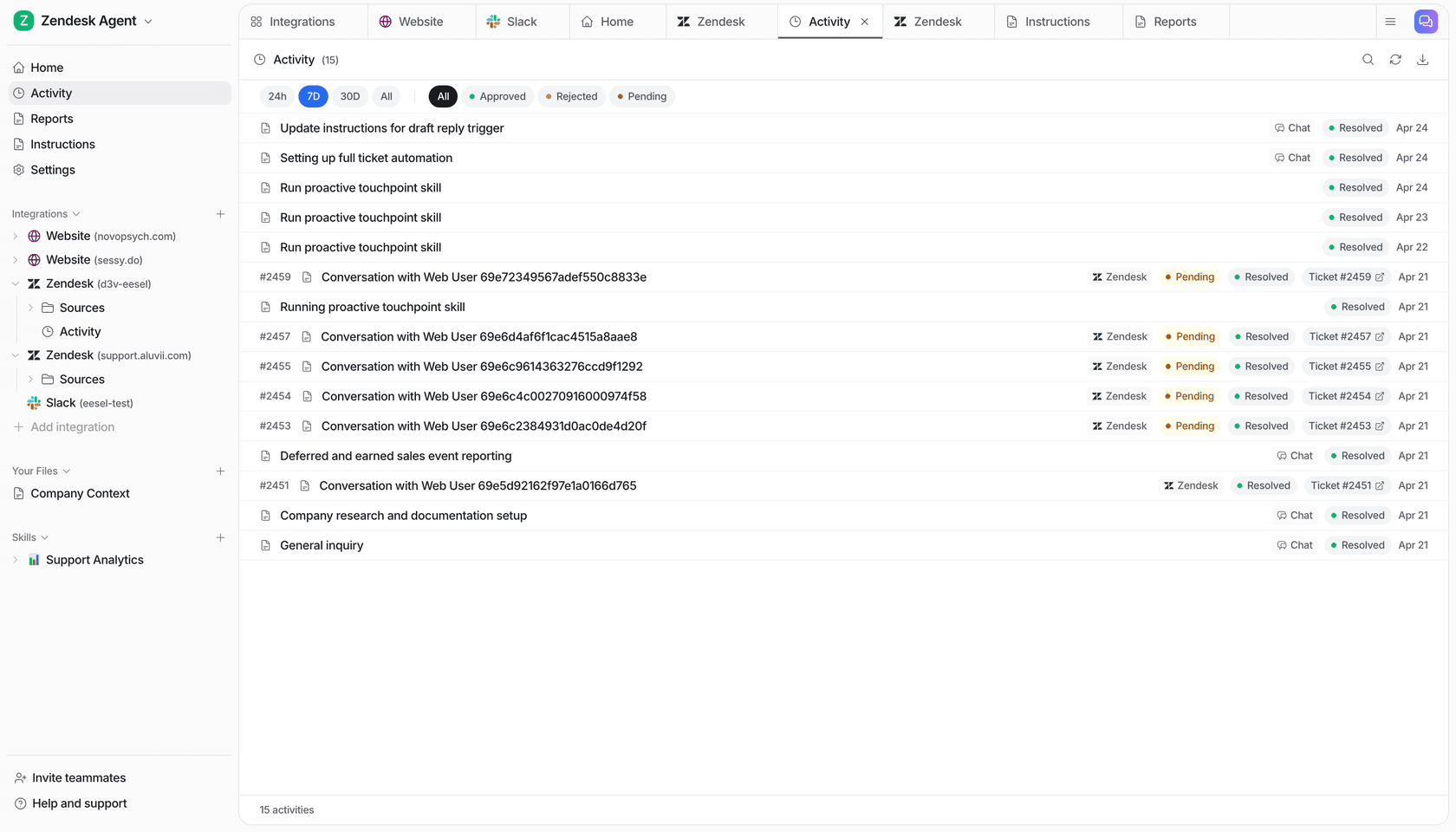


eesel and Instinct AI are the same kind of assistant with a different boss. Instinct is a personal agent you text or call to run your errands (shopping through Shop Pay, budgets on a Link balance, phone calls to your carrier, agent-to-agent customer service), and its terms license it "for your personal use only". eesel is that same "message it and it does the thing" idea, hired by a team: it works in Slack, Microsoft Teams, Google Chat, email, your helpdesk, your website chat and Shopify, for your staff and your customers.
They aren't substitutes. If the job is your own groceries, flights or cable bill, Instinct is the better pick and eesel doesn't try to do it. If the job belongs to a team (answering colleagues in Slack, replying to customers, looking up orders, sending a Monday report), you want an assistant whose permissions change with who is asking. In eesel, what it does on its own, what it asks first and what it never does differ for your team, for the specific people you name to approve, and for the customers and visitors outside your team. Add editor and viewer roles, a published price and a free trial, and that's eesel.
The twist is that they meet. When a shopper's Instinct contacts your store, eesel is the thing that answers. You can even have Claude Code or Codex set eesel up through the eesel CLI: upload your approved policies, adjust its instructions and fire test questions at it before it answers anyone, while connecting Slack or the helpdesk still needs an admin to approve.
eesel vs Instinct AI at a glance
Instinct's side comes from its site, its terms and posts by Instinct and its founder, Noah Shinn; eesel's from its docs and pricing page.
| Instinct AI | eesel | |
|---|---|---|
| Who it works for | One person, licensed "for your personal use only" (terms) | A team: one workspace with an owner, editors and viewers (roles) |
| How you reach it | Text or call it (homepage), plus iMessage group chats (group chats) | Slack, Teams, Google Chat, its own email, your helpdesk, website chat |
| Who it talks to for you | Businesses: calls, email and other companies' agents (Concierge) | Your team, the approvers you name, and your customers, each with different permissions |
| Typical jobs | Shopping, flights, doctor visits (Zocdoc launch) | Team questions with sources, ticket replies, order lookups, scheduled reports |
| Spending and action controls | You approve each Shop Pay purchase (Shop Pay post), or set a per-purchase Link limit (Link balance) | Every action set to On, Ask first or Off, per agent |
| Where approvals land | In Shop Pay, or with your personal Instinct (group chats) | The Slack thread, email, the dashboard or the terminal |
| Price | None published; the pricing page is a 404 (pricing page) | Free 7-day trial, then from $299/month for 500 credits |
| Access | Waitlist or invite (terms, section 12) | Self-serve sign-up, no card for the trial |
| Business paperwork | Terms, privacy policy and AUP; I found no DPA or trust page (privacy policy) | Security page with a GDPR DPA; SOC 2 Type II in progress |
What is Instinct AI?
Instinct is a personal assistant you message like a person, and it goes off and does the errand. Its homepage puts it plainly: "The interface is simple: there are no new interfaces. You can text or call it. It can use a phone and computer in the same way that you do." It's still gated behind a waitlist. I covered the basics in my Instinct AI guide, with a longer verdict in the Instinct AI review, so here I'll stick to what matters for this comparison.

What it does well, it does very well. The founder says "35% of our users use Instinct for personal shopping" (Shopify partnership post), and the product keeps adding rails for it. Since 28 October it can use Shop Pay anywhere, with "You approve every purchase in Shop Pay" as the control. Since 26 October you can give it a Link balance, a budget where you "set a limit for each purchase" so it can reorder your coffee beans "without needing access to your credit card or asking for approval every time" (Link balance post).
It also talks to businesses for you. Instinct Concierge makes phone calls ("have that cable bill sorted out"). Since 7 October, when your Instinct reaches a business that runs its support on Sierra or Decagon, "the agents will be able to work together to solve your problem" without a call (customer service post). Every Instinct also has its own email address for contacting restaurants and signing up for services.
Users who get in tend to love it.
"Instinct first attempted to resolve the issue via customer support chat. When that was unsuccessful, it called customer service for me and talked to a human until the issue was resolved."
That's a lovely thing to hand off. Notice whose problem it was, though: her trade-in, her account, her money. Everything Instinct is built around (your logins in its Vault, your Shop Pay card, your doctor, your flights) belongs to one person.
What is eesel?
eesel is the same "message it and it does the thing" assistant, built to be hired by a team rather than a person. I build eesel's agents, so the part I spend my days on is the question this whole post turns on: who does the assistant answer to, and what is it allowed to do without asking?
You talk to it where your team already works. In Slack, anyone on the team @mentions it or DMs it and it answers in the thread with the source linked; it can also take actions in your other apps from that thread, like looking up an order or drafting a customer reply, and "request approval before it sends anything" (Slack docs). It works the same way, natively, in Microsoft Teams and Google Chat. Like Instinct, every eesel agent has its own email address, but it only sends email to members of your workspace, so it behaves like an assistant your team emails.
The other half is customer-facing. The same teammate can sit in your helpdesk (Zendesk, Gorgias and others), on your website's chat bubble, and in Shopify, where it looks up orders, payments and shipments (e-commerce docs).
These are native, deep integrations. eesel looks up the Shopify order from inside the Gorgias ticket and tags the ticket from your fixed list; Rungne had it tag 880 tickets that way in a month.
It also shows up ready for the job. eesel learns from your docs, past tickets and Slack history, reliably follows the instructions you give it, and works proactively: it replies in its channels without being mentioned, runs scheduled checks and posts updates on its own. Correct it once in chat and the fix sticks in every app it works in (memory docs).
In practice, Cape Coffee Beans runs 160 scheduled checks a month that email the founder the tickets that slipped, and Cactus Club Cafe has one agent drafting for its IT team and another auditing the daily finance extract. eesel has spent years running AI on live support queues, and I've watched confident bots give wrong answers. That's why the permission model below exists, and why you test eesel on your own past tickets before it answers anyone.
That's the different boss in one line. Instinct's founder wrote that "Instinct should always be aligned with what's best for its user" (31 Oct post). eesel is aligned with the business it works for, and it answers to that business's team.
Who does each assistant answer to?
Instinct answers to you, and the terms say so in two places. The license is personal: "We hereby permit you to use the Services for your personal use only, provided that you comply with these Terms in connection with all such use" (Instinct terms, section 6). And it acts as you: "You hereby appoint the Services as your agent to enter into agreements, commitments or transactions on your behalf," which "shall be binding on you as if entered into directly by you."
There's a wrinkle worth being fair about. The same terms say that if you use the service "on behalf of a company or other entity," then "you" includes that entity. That covers someone who uses it for work anyway; it isn't a business plan, and instinct.com/business returns "Page not found." I went deeper on that in Instinct AI for work.
Even Instinct's group feature keeps one person as the boss. In an iMessage group, "The group gets its own Instinct that only knows what's in the chat, not anyone's accounts or data. When it needs something from you, it goes through your personal Instinct, which confirms with you first" (group chats post). That's a thoughtful design for a dinner party. It isn't a shared queue with roles.
eesel answers to a workspace, and what it may do changes with who is asking. That's a question Instinct never has to answer, because it only ever serves one person. A team's assistant hears from three kinds of people.
- Your team. People on your Team page, plus the people your connected apps show are part of your company: full members of your Slack, users in your Microsoft Teams or Google Workspace, anyone writing an internal note in your helpdesk. Some actions carry a Team only tag (writing scripts against an app's API, admin-only tools, changing the agent's own instructions or automations) and "only ever run for your team."
- The people you name. Held actions go to the members or Slack channels you pick, and only owners and editors can approve them. Per the account docs, editors "build and adjust agents, connect integrations, invite teammates and manage billing," and viewers "chat with agents and review their activity, but can't change agents or workspace settings."
- Customers and visitors. A customer on a helpdesk ticket or a visitor in your website chat gets answers, but Team only actions never run for them. Files follow the same rule: an internal file set to On can inform an answer, but the file itself, or a link to it, is never sent to someone outside your team.
How do they ask before acting?
Both ask, and that deserves credit on Instinct's side. Purchases go through Shop Pay approval, and the Zocdoc booking flow "confirms with you before booking" (Zocdoc post). The founder's view on spending is sensible: "I think budgets with guardrails are how most people will start letting agents spend for them" (Link balance thank-you). Instinct's guardrails are built around money and bookings, for one person.
A team needs the guardrail on every action, because the risky action is rarely a purchase. It's a reply to an angry customer, a ticket closed too early, a tag that sends work to the wrong queue. In eesel, every action in every connected app runs on its own (On), waits for a person (Ask first), or never runs (Off), set per agent and changeable any time (actions and approvals). You can set it in plain words too: "look things up on your own, but ask me before any refund."
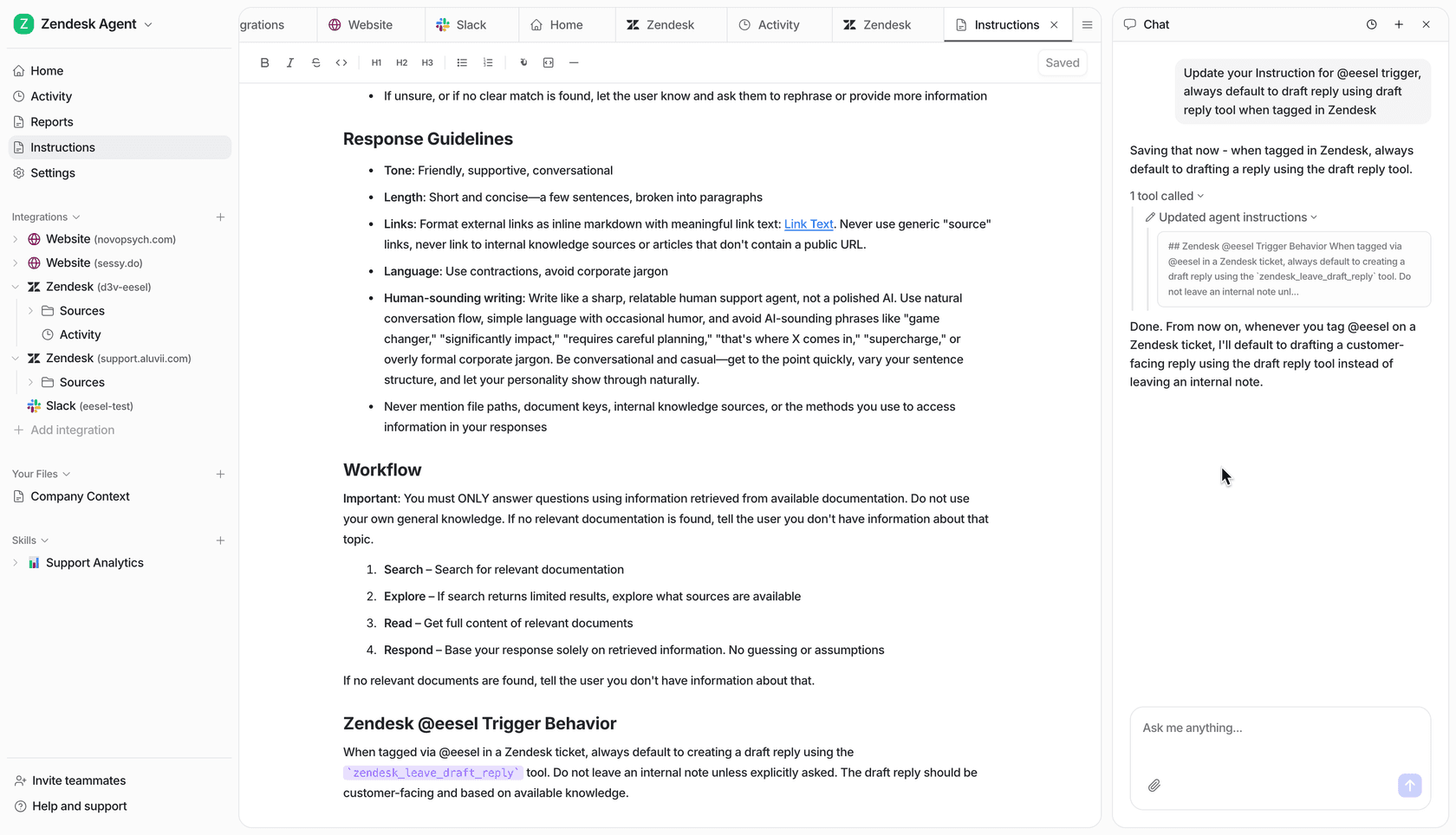
When an Ask first action comes up, the agent stops and shows the exact action with its details (the reply text, the refund amount, the tag) with Approve and Deny. If the run started in Slack, the card lands in that thread; otherwise it goes by email, waits in the dashboard, or shows up in the terminal with eesel approvals. Even an action set to On can still be held when eesel's safety check judges a call risky.
eesel has a limit here worth knowing. Live-chat replies are always On, because nobody can stop a live chat to approve each message. The docs recommend starting supervised, with replies and anything irreversible on Ask first, and keeping refunds, cancellations and anything that costs money behind approval for good. My guide to AI agent permissions walks through a sensible starting setup, and the one on refund guardrails covers the money side.
| Control | Instinct AI | eesel |
|---|---|---|
| What gets an approval | Purchases in Shop Pay, some bookings | Any action you set to Ask first, in any connected app |
| Who approves | You | Owners and editors, with requests sent to the members or channels you pick |
| Spending limit | Link balance per-purchase limit | Credit cap you set; refunds kept behind approval |
| Staff vs customer line | Not applicable (one user) | Team only actions and files |
| Change the rules | Ask your Instinct (for example, to set up Link balance) | Dashboard toggles, chat, CLI, or from Claude via MCP |
Every agent has the moment this user describes, and a team feels it louder.
"It feels amazing at first... "dude my Instinct got me a refund and all I did was text it"... But then something happens - it misses an important detail, it screws up something you have to fix, it just feels not as good anymore"
When a team's agent slips in front of a customer, the whole team owns it. That's why eesel lets you hand over routine actions one at a time as you watch them go right.
Pricing and access: a waitlist vs a free trial
Instinct has no public price. instinct.com/pricing returns "Page not found," and the only pricing language is section 4 of the terms: "You may be required to pay us fees to access or use certain features of our Services." What you spend through it is your own money at merchants. Access is still gated; the terms mention "a welcome text when your spot becomes available, waitlist updates," and one would-be user on 11 November wrote "I signed up right away. Result: I'm on the waitlist" (Byron Soulopoulos, X).
eesel's pricing is public. There's a free 7-day trial with 100 credits and no card. After that, the Teammate plan starts at $299/month for 500 credits, where a ticket or a chat is 1 credit however long it runs, extra credits are $0.80 each up to a cap you set, and agents and seats are unlimited. For a business, the published number is half the point, because you can put it in a budget. My Instinct AI pricing post covers what "free" costs on the other side.
Which one should do this job?
Pick a job and see which assistant I'd hand it to.
Instinct or eesel?
Open a job to see the pick.
Reorder my coffee beans every other week
Get my phone bill lowered or a subscription refunded
Book my own doctor's appointment or flight
Answer "where's the refund policy?" for a colleague in Slack
Reply to a customer asking where their order is
Refund a customer's damaged order
Email the founder every morning with tickets that slipped
When is Instinct the better pick?
Instinct is the better pick whenever the job is yours alone, and I'd be happy to see it win those. If you want someone to deal with your carrier, your subscriptions, your groceries and your travel, it's one of the most capable personal agents around, and eesel isn't trying to compete there.
- Your own errands. Shopping with Shop Pay, budgets on a Link balance, a train home, flowers for a friend. The last two are straight from its homepage.
- Calling and chasing companies. Concierge makes the calls you've been putting off, and Instinct can work agent-to-agent with businesses on Sierra or Decagon.
- Subscriptions and refunds. One user wrote that her Instinct "asked for a refund for a subscription I wasn't using" and got it confirmed "within the same minute" (Vitoria Lima, X).
The quiet, satisfied users say it best.
"I use Instinct and I'm very happy with it so far. It has booked some restaurants for me, replied to some personal admin-related emails, and updates my progressive workout spreadsheet when i go to the gym. No real complaints so far."

If you're weighing it against other personal agents, my Instinct vs Meta Muse comparison is the better read. I also put Instinct up against folk in folk vs Instinct, and the full list of Instinct AI alternatives covers the rest.
When is eesel the better pick?
eesel is the better pick when the job belongs to a team and the assistant needs to answer to that team. In practice that's three kinds of work.
- Your team asks it things. IT, HR and ops questions answered in Slack, Teams or Google Chat from Confluence, Notion or Drive, with the source linked (internal operations).
- Your customers ask it things. It answers tickets and chats in your helpdesk and on your website, from your docs and past tickets. Question Beauty had eesel handle 990 Gorgias tickets in a month, with 280 closed without a person.
- It runs things on a schedule. An automation is a trigger (an app event, a time like every Monday at 9am, or a webhook) plus instructions for that job (automations docs). Weekly reports, daily audits, the slipped-ticket email.
It also works with the assistant you already use. Your eesel workspace is an MCP server, so you can add it to Claude as a custom connector and say "ask eesel what it did today" (Claude docs); anything set to Ask first still asks. And if you're comparing eesel against helpdesk-native AI rather than personal agents, start with eesel vs Zendesk AI, or read eesel vs Gorgias AI if you're on Gorgias.
eesel has an honest gap too. It won't do your personal errands: it won't book your dinner, and its email address only writes to your workspace's members. That's by design, and your own errands are where Instinct earns its keep.
Where they meet: when a shopper's Instinct contacts your store
If you run a store, the Instinct you'll meet most often belongs to your customers, and it's about to show up in your support queue.
The commerce rails are already live. Shop's help center lists Instinct among the personal agents shoppers can pay with Shop Pay, and says these experiences "can help you search for products, prepare checkouts, review purchases, place orders, track deliveries, and check a store's return policy." On the merchant side, Shopify's agentic storefronts docs say "You don't need to activate Shop Pay specifically for AI agents. Orders that customers place through personal AI agents display in your Shopify admin with attribution to the agent."
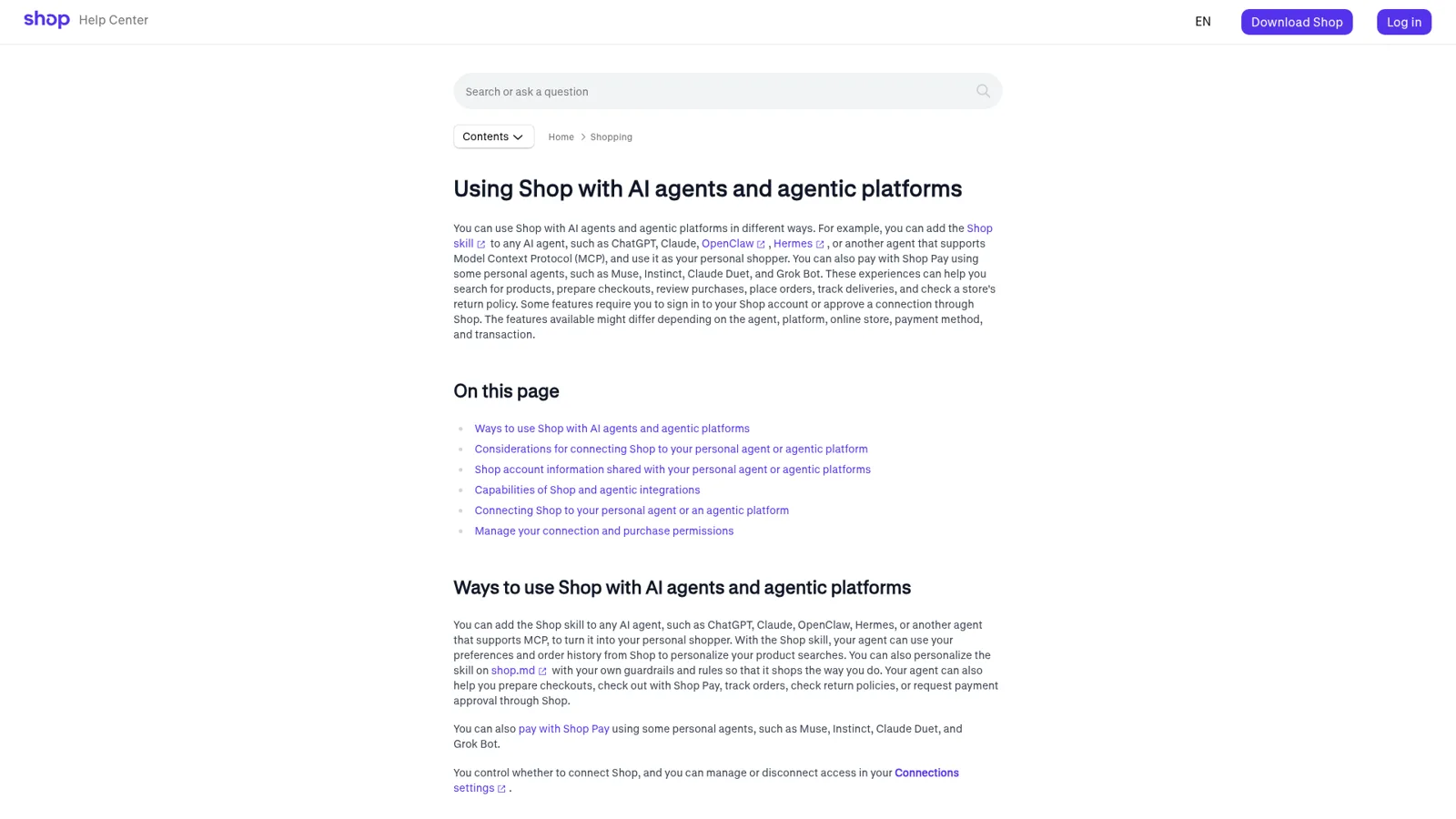
And the after-sale work stays with you. Per the Shop help page, when an agent buys for someone it "agrees to the store's shipping, refund, return, and cancellation policies on your behalf," and the store "remains responsible for fulfilling your order and handling returns, refunds, warranties, and product support." So when a delivery is late, the shopper's Instinct can chat, email or call you about it, and it doesn't get bored.
"My first SMS to my Instinct agent returned me $88 - and I can't imagine the refund was in line with that company's policy; an agent with infinite time just happened to be infinitely persistent."

That's the case for an assistant on your side of the counter. eesel answers those requests in your helpdesk and website chat the way it answers anyone: it reads the order in Shopify, checks your actual return policy, replies with the facts, and leaves the refund on Ask first so a person decides. Clear published policies help as well. Shopify's knowledge base page calls the facts you publish there "the source of truth for AI agents for all non-product information about your store." One CMO had a read on where this goes.
"Businesses with built-in friction or opaque pricing will not fare well with this new class of personal agents."
Instinct's other door into a business is agent-to-agent through Sierra and Decagon (see Decagon's personal agent gateway). For a brand on Gorgias or Zendesk, the requests arrive as ordinary tickets and chats, and that's where eesel sits. My wider take on agentic commerce for brands covers the rest, and if you'd rather hand off support entirely, eesel's managed support runs it inside your tools.
Try eesel as your team's assistant
If what you like about Instinct is that you just message it and things get done, eesel is that for your team. It works in Slack, Microsoft Teams, email, your helpdesk, your website chat and Shopify, and you decide what it does on its own, what it asks first and what it never does. Start supervised, watch its drafts, and hand over the routine actions as it earns them. The trial is free for 7 days with no card.