Instinct AI for ecommerce: what a shopper's agent means for your store

Kira

Katelin Teen
Last edited November 17, 2026

Instinct AI for ecommerce means your shoppers now have an agent that finds your products, buys from your store and chases you afterwards, and none of it is a tool your own team can run. Instinct's founder says 35% of its users use it for personal shopping, it can now pay with Shop Pay at any online store, and it talks to customer service by chat, email and phone. Shopify's Shop help center is clear that the store still owns returns, refunds, warranties and product support.
The shift for a store is on the other end of the conversation. When a shopper's agent writes, texts or calls you, the thing answering should be the same kind of agent, working for the store: inside your helpdesk, with live Shopify lookups, answering "where is my order" on its own and asking a person before any refund. That is what eesel is. What it does on its own, what it asks first and what it never does depend on who is asking: your team, the people you name to approve, or a shopper's agent on a ticket.
You can even have Claude Code or Codex set it up. With the eesel CLI, a coding agent can connect your store, upload your returns and shipping policies, and fire test questions at the agent before it goes live, while a store owner still approves the Shopify connection in the browser.
What is Instinct, from a store's point of view?
Instinct is a personal assistant you text or call. Its homepage says it "can use a phone and computer in the same way that you do", and most of the errands it lists are shopping: order ingredients, order groceries, send flowers. Access is still by invite or waitlist. At launch in August 2026 its founder Noah Shinn called it an "invite-only beta program while we're actively bringing up more compute".
I build eesel's agents, so I read Instinct as a new kind of customer arriving at the stores eesel works with. The Instinct AI overview covers using it, with a verdict in the Instinct AI review; this post is about what it does to a store.

Two founder numbers explain why a store owner should care. On 28 August he wrote that "Instinct users who make purchases spend over $1300/month on average through Instinct" (Stripe partnership post), and a month later that 35% of users shop through it (Shopify post). They're unaudited vendor numbers, but they point one way. A real share of Instinct's traffic is somebody's order.
How does an Instinct shopper reach your store?
An Instinct shopper reaches you through four doors: your catalog, your checkout, your support channels and, for some businesses, a private back door. Here is each one, with the source it rests on.
| Door | What Instinct does there | What your store sees | Source |
|---|---|---|---|
| Catalog | Searches Shopify's merchant network for "live information on prices, sizes and availability" | Your products in Shopify Catalog and your published store facts | Shopify partnership |
| Checkout | Sets up the order and pays with Shop Pay, now at any online store; the shopper "approve[s] every purchase" | An order in Shopify admin with attribution to the agent | Shop Pay anywhere |
| Support | Chats, emails, calls via Concierge, or talks agent-to-agent with businesses on Sierra and Decagon | Tickets, chats and calls about delivery, returns and refunds | Agent-to-agent support |
| Back door | Some businesses whitelist Instinct's IPs or give it private APIs | Traffic you chose to let in | Founder, 31 Oct |
The first two doors bring revenue, the third brings work, and the fourth is a choice.
Before the sale: your catalog and your policies are the storefront
Instinct's Shopify partnership lets it compare products across brands, set up the order with the store, and send "price-drop and back-in-stock notifications" and "delivery updates and return-window reminders" (founder). On 28 October that widened: "your Instinct can use Shop Pay at any online store... You approve every purchase in Shop Pay, and your card details never leave Shop Pay" (founder).
Shop's own help center fills in the mechanics for stores that don't take Shop Pay. The shopper approves "the store, purchase details, payment method, and spending limit in Shop", and the agent gets a one-time payment credential to enter at the store's checkout (Shop Help Center). On Instinct's side there's also Link balance, built with Stripe, where the shopper adds money and "set[s] a limit for each purchase", so Instinct can reorder "your favorite coffee beans every other week" without asking each time (Link balance post).
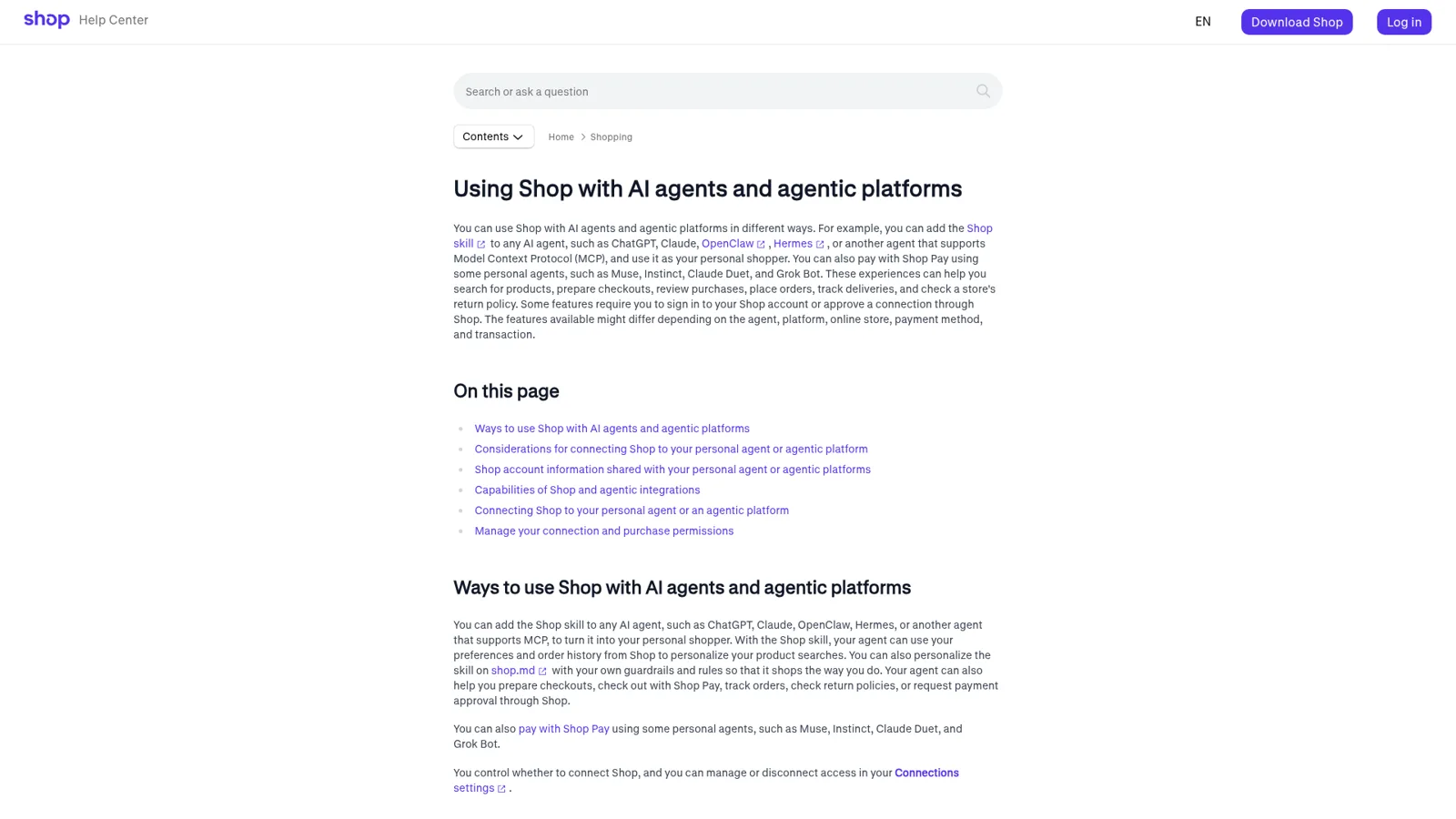
On the merchant side, Shopify's agentic storefronts page says three things a store owner should know. Agentic storefronts are "active by default for eligible stores". Every AI channel requires your Terms of service, Privacy policy and Return and refund policy to be complete. And "Orders that customers place through personal AI agents display in your Shopify admin with attribution to the agent." Your non-product facts, like the return process and shipping timelines, live in Shopify's knowledge base, which it calls "the source of truth for AI agents" and which caps out at 1,000 facts.
Here is the line I'd pin above every returns policy this year. Shop's help center tells shoppers the agent "agrees to the store's shipping, refund, return, and cancellation policies on your behalf", and suggests prompting it with "Don't buy items from stores that don't accept returns" (Shop Help Center). Your return policy used to be fine print. For an agent shopper, it can be a filter that decides whether you're in the basket at all. The agentic commerce guide and the post on the agentic commerce protocol cover the catalog side in more depth.
After the sale: the part that lands on your team
Shopify's agentic storefronts page says you keep "full ownership of the customer relationship and post-purchase experience", and Shop is blunter: "The store that you purchase from remains responsible for fulfilling your order and handling returns, refunds, warranties, and product support" (Shop Help Center). Through Shop, the agent can track the order and read your published return policy, and the shopper is pointed to the Shop app to start a return.
Instinct goes further than reading. On 7 October the founder announced native customer service: when an Instinct meets a business on Sierra or Decagon, "the agents will be able to work together to solve your problem", with examples like "Finding out when a delayed package will arrive" and "Getting clarity on a confusing return or cancellation policy" (founder). For everyone else there's Instinct Concierge, which makes phone calls, for cases like having "that cable bill sorted out" (Concierge post).
A DTC marketer describes exactly that sequence.
"Instinct first attempted to resolve the issue via customer support chat. When that was unsuccessful, it called customer service for me and talked to a human until the issue was resolved."
This is the same kind of request when the store on the other end is also running an agent.
"My instinct asked for a refund for a subscription I wasn't using. Within the same minute, I got an ai-generated response automatically, with a refund immediately confirmed to me."
And the one every store owner will recognise, because it is the oldest ticket in ecommerce.
"i recently ordered a phone cover that @instinct recommended but the phone case never arrived! who is building agentic insurance??"
The agent picked the product, but the missing parcel is the store's problem, the same order tracking question you already answer by the hundred, from an asker that never gets tired. The Instinct AI for customer support post covers how agent-sent tickets read and how to tag them. This one is about the store's whole commerce side, and who works it.
What are businesses doing about Instinct traffic?
The founder's 31 October post is Instinct's only statement aimed at businesses. Beyond announced partners, he says businesses are "Whitelisting our IPs for computer use access" and "Giving Instinct access to private APIs that aren't available anywhere on the internet", and claims higher transaction volumes, without numbers (founder). He's also clear whose side it's on: "Instinct should always be aligned with what's best for its user." That's the right stance for a personal agent, and it tells a store what to expect.
A CMO who used it on his phone bill put the merchant consequence well.
"Businesses with built-in friction or opaque pricing will not fare well with this new class of personal agents."

I'd treat whitelisting as a business decision, not a reflex. If your support side can't answer a burst of "where's my order" by the next morning, more agent orders just mean more agents chasing you.
Can your store's team use Instinct?
No, and Instinct's own documents say so. The Instinct terms grant use "for your personal use only". They do say that someone using it "on behalf of a company or other entity" binds that entity too, but there's no merchant product behind that. instinct.com/business and /merchants return "Page not found", there's no published pricing, and sign-in is one phone number per person. Shop's agent integrations are likewise "for personal, individual shopping use only, unless separately authorized by Shopify" (Shop Help Center).
That's not a knock on Instinct. It's built for one person and their accounts, and its users say it does that well. It just isn't shaped to sit in a store's Gorgias queue and answer to a support lead. The Instinct AI for work post covers the office side, and the Instinct AI pricing breakdown covers what "free and invite-only" means.
The store needs an agent of the same kind
The shopper now has one assistant that knows them, lives in the channels they already use, and acts within limits they set (a Link per-purchase cap, a Shop budget, an approval on every purchase). The store needs the mirror image, one teammate that knows the store, lives in the tools the store already uses, and acts within limits the store sets.
| The shopper's agent (Instinct) | The store's teammate (eesel) | |
|---|---|---|
| Works for | One shopper | Your whole team |
| Lives in | Text, calls and its own email | Your helpdesk, chat bubble, email, Slack, phone line |
| Knows | The shopper's sizes, brands and order history | Your catalog, policies, macros and past tickets |
| Money guardrail | Shopper approves in Shop Pay, or a per-purchase limit | Refunds and cancellations on Ask first until you trust it |
| Who can steer it | The account holder | Editors steer and approve; Viewers watch |
| Licensed for | Personal use | Business use, from $299/month |
eesel is that right-hand column, and the difference that matters most against a personal agent is who is asking. What eesel does on its own, what it asks first and what it never does change with who is talking to it: someone on your team in Slack or an internal note, the specific people you name to approve things, or a shopper (or a shopper's agent) on a ticket or in the website chat.
Each action is set per action to On (it does it by itself, and eesel's safety check can still hold a risky call), Ask first (a person approves after seeing the exact refund amount or reply text) or Off. You can just say it in chat: "look things up on your own, but ask me before any refund." Actions tagged Team only, like writing scripts against an app's API or changing the agent's own instructions, run only when your team asks, never for a customer. And only the owner and Editors can approve a held action, with requests going to the members or Slack channels you pick.
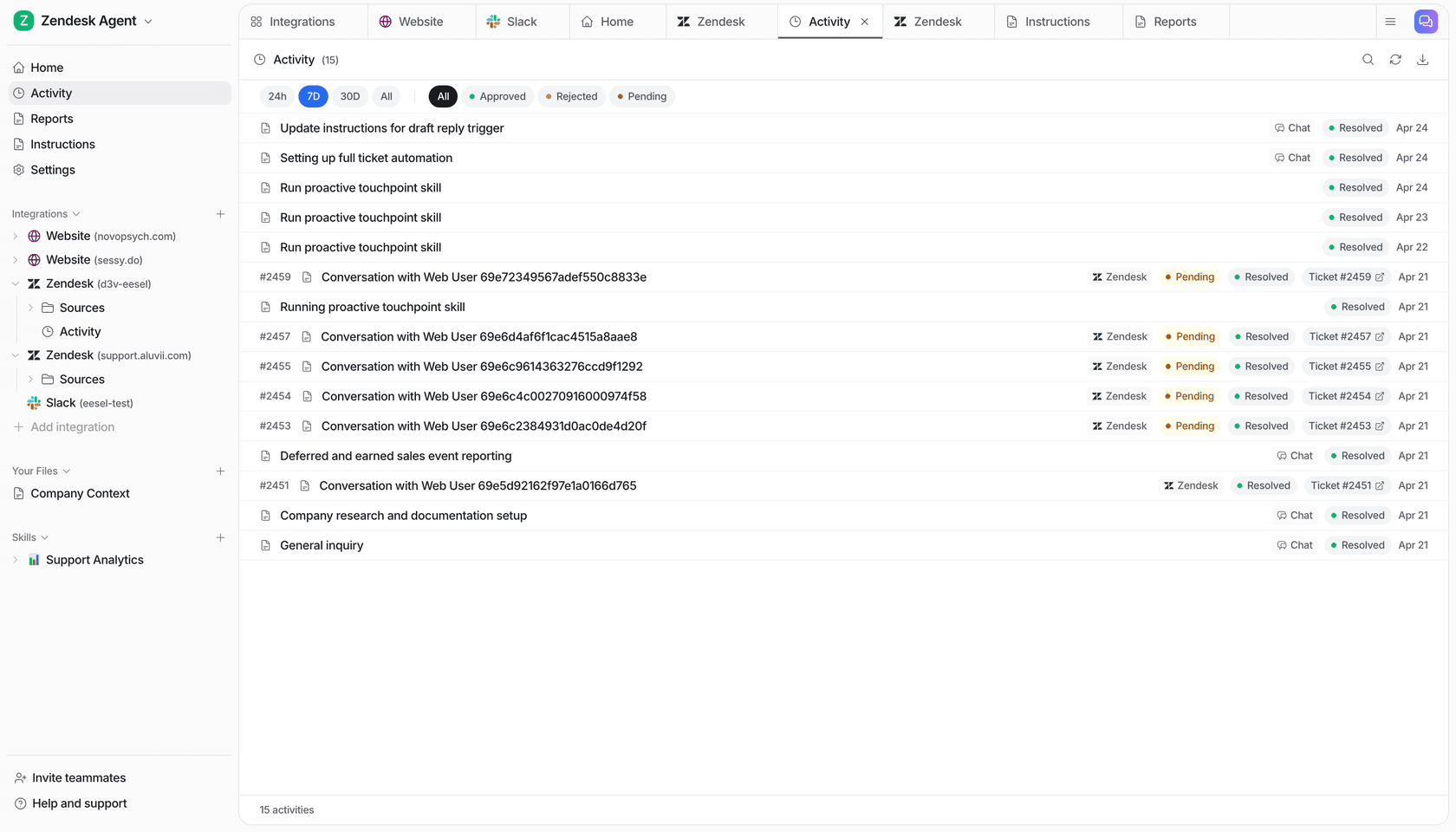
Underneath, eesel works natively and deeply in the store's tools. In Gorgias it "drafts or sends replies, leaves internal notes, tags, assigns and closes tickets, and checks your customer's Shopify orders" (Gorgias docs), and it does the same in Zendesk, email and the chat bubble, with live Shopify order, product and stock lookups.
It arrives with the skills and context for the job. It learns from your policies, macros and past tickets, follows your instructions reliably, is proactive about handing a person what needs one, and when you correct it in chat, the fix sticks in every app it works in.
A shopper's agent will try every door, politely and forever. The store's teammate should answer the routine ones instantly and hold the money doors shut until a person says yes. The guide to support agent permissions goes further, and so does the one on approval workflows.
A shopper's agent just wrote in: what should happen?
Pick the message to see what I'd want the store's teammate to do, and the setting I'd start a new store on.
The message from the shopper's agent:
A few under-the-hood details change how you set this up.
- The conversation wakes the agent, not Shopify. eesel's Shopify integration has no triggers. A Gorgias ticket, an email, a chat message or a Slack mention starts the run, and the Shopify actions get used inside it.
- Lookups are live, knowledge is a copy. Order, tracking and stock lookups read Shopify at the moment of the question. Products, pages and policies sync on a schedule, so re-read them after a policy change.
- Approvals don't appear in the ticket. A held refund waits in the dashboard, the Slack thread the run started from, or email. Pick the agent's communication channel before putting refunds on Ask first.
- Phone is look-up only by design. The phone calls docs are explicit: "On a call your agent only looks things up. Anything that changes data stays with your team."
Not on Shopify alone? The e-commerce integrations page covers Magento, BigCommerce, WooCommerce, Stripe, Recharge and AfterShip. For returns, see AI returns management; refunds have their own guide to ecommerce refund automation.
What does a store-side teammate actually handle?
eesel has spent years putting AI on live support queues, and the lesson I took into how eesel's agents get built is that a confident wrong answer about someone's order is worse than a slow right one. So eesel gets tested against a store's past tickets before it answers anyone. These are four ecommerce stores running it, numbers from 8 August to 8 September 2026.
| Store | Setup | In one month |
|---|---|---|
| Question Beauty (cosmetics) | Gorgias + Shopify | 990 tickets, 960 replies sent directly, 290 Shopify orders looked up, 280 closed with no person |
| Clutchloop (phone accessories) | Gorgias + Shopify | 230 tickets, 180 replies sent directly, 76 live product lookups, 27 chats in the customer's language |
| Stil Classics (planners) | Gorgias + Shopify | 320 tickets prepared, 430 drafts as internal notes, 230 orders looked up before drafting |
| Rungne (climbing apparel) | Gorgias | 2,100 tickets, 880 tagged from a fixed list, 580 internal-note drafts, 440 replies sent |
Look at the spread. Question Beauty lets eesel send 960 replies by itself, because the Shopify lookup answers its routine questions. Stil Classics keeps a person on every send, so eesel looks up 230 orders and leaves 430 drafts. Clutchloop sits in between, with about seven in ten conversations needing no person. Same teammate, different permission settings, and that's the dial a store needs when the next wave of tickets is written by agents. I'd also tag those tickets from a fixed list, the way Rungne does, to see what share of the queue they become (AI ticket tagging shows how).
How to get your store ready for Instinct shoppers
- Finish your Shopify policies. Every AI channel needs Terms of service, Privacy policy and Return and refund policy completed. Agents read them literally.
- Publish your knowledge base facts. Facts Shopify generates from your storefront stay unpublished until you publish them. Start with returns and shipping.
- Make the return policy a selling point. Shoppers can tell their agent to skip stores that don't accept returns.
- Put "where is my order" on autopilot. It's the most predictable agent request, so let the teammate answer it from live data.
- Keep money behind a person. Refunds and cancellations on Ask first, with approvals going to a Slack channel someone watches. See the refund guardrails guide.
- Decide on the phone line. Concierge calls businesses, and an AI phone agent that looks up the order and transfers the rest beats voicemail.
- Whitelist last. Open private doors once the support side can keep up.
If you'd rather hand support off entirely, eesel also runs managed support for ecommerce brands inside their own tools, for a flat monthly fee. For Meta's version of the same shift, see Meta Muse for Shopify, or compare the two shopper agents in Instinct vs Meta Muse.
Try eesel as your store's teammate
Your shoppers are getting an agent that never gets tired of asking. Give your store one that never gets tired of answering, and that only touches money when you say so. eesel connects natively to Shopify and Gorgias or Zendesk, gets tested on your past tickets before it replies to a customer, and lets you set every action to On, Ask first or Off. It starts with a free 7-day trial with 100 credits and no card, then the Teammate plan from $299/month for 500 credits, where a ticket or a chat is one credit (pricing).
Try eesel and point it at last month's "where is my order" tickets first.