ChatGPT for ecommerce: what it does for shoppers, your team, and your inbox

Kurnia Kharisma

Katelin Teen
Last edited November 17, 2026
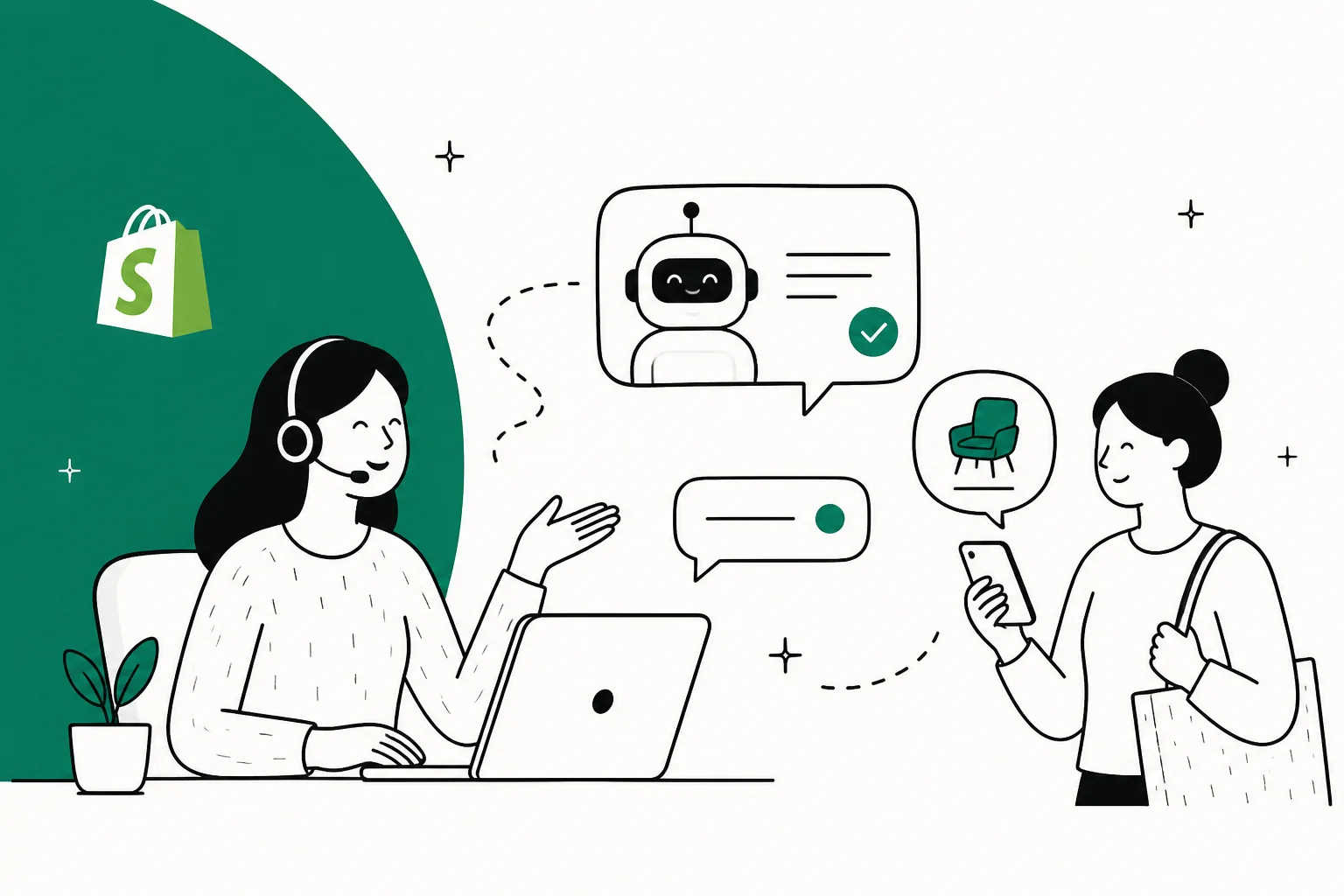
"ChatGPT for ecommerce" means two things in 2026: shoppers using ChatGPT to find and compare your products, and your own team using ChatGPT to write copy and draft replies. On the shopper side, OpenAI pulled back its own checkout in March 2026, so purchases now finish on your site or app, with no fees, and Shopify and Etsy catalogs are already wired in. Shopping is live for US users only. On 10 November 2026 OpenAI added Business Agents, which answer shoppers inside ChatGPT while orders, fulfillment and support stay with you.
Every one of those roads ends in the same place: your inbox, your helpdesk and your Shopify admin. ChatGPT can send you the customer, but it doesn't sit in Gorgias at 9pm looking up order #4412. That's the job I'd hire an AI teammate for, and it's what eesel does, with permissions that change depending on who is asking. It answers a shopper on a ticket and looks up their order on its own, a refund waits for the people you name, and staff-only tools run only for your team. With the eesel CLI, Codex or Claude Code can connect your store, load your returns policy and run test questions before it goes live; the store owner still approves full Shopify access in a browser.
I write for eesel's blog with an SEO hat on, and this keyword is a good example of a search that hides two different buying questions. "How do I get my products into ChatGPT?" is one. "How do I get ChatGPT to help run my store?" is the other. This post answers both, from OpenAI's and Shopify's own pages, and then shows where they meet. Underneath it is eesel's own experience: eesel has put AI on live support queues for years, and the team has watched confident bots give wrong answers, which is why eesel gets tested against a store's past tickets before it answers a shopper.
What does "ChatGPT for ecommerce" mean in 2026?
It means ChatGPT shows up at two ends of your business: in front of the shopper, and behind the counter with your team. Those are different products with different rules, and mixing them up is how stores end up expecting the wrong thing from each.
| Side | What it is | Who uses it | Where the work ends up |
|---|---|---|---|
| Shopping in ChatGPT | Product results, comparisons, try-on, links to your store | Shoppers in the US | Your site, then your inbox |
| Agentic Storefronts | Shopify syndicates your catalog; checkout in an in-app browser | Shoppers via Shopify | Your Shopify admin |
| Business Agent (beta) | Your own agent inside ChatGPT, answering product and policy questions | Shoppers in ChatGPT | Your store, then your inbox |
| ChatGPT Business seats | ChatGPT, Work and Codex for each staff member | Your team | A tab next to your helpdesk |
The first three are about being found, which my Shopify ChatGPT integration guide covers from the Shopify side. The last one is about getting work done. None of them is a teammate that works in Gorgias, Zendesk or your Shopify admin, which matters more than it sounds, and I'll come back to it.
How do shoppers use ChatGPT to find products?
They ask it what to buy, and ChatGPT answers with product results: images, prices, reviews and ways to purchase. OpenAI's shopping help page describes comparing products, a virtual "Try on" button for clothing and accessories, and saving finds to a library. My ChatGPT shopping research guide covers the research feature itself, so here's just what a merchant needs to know.
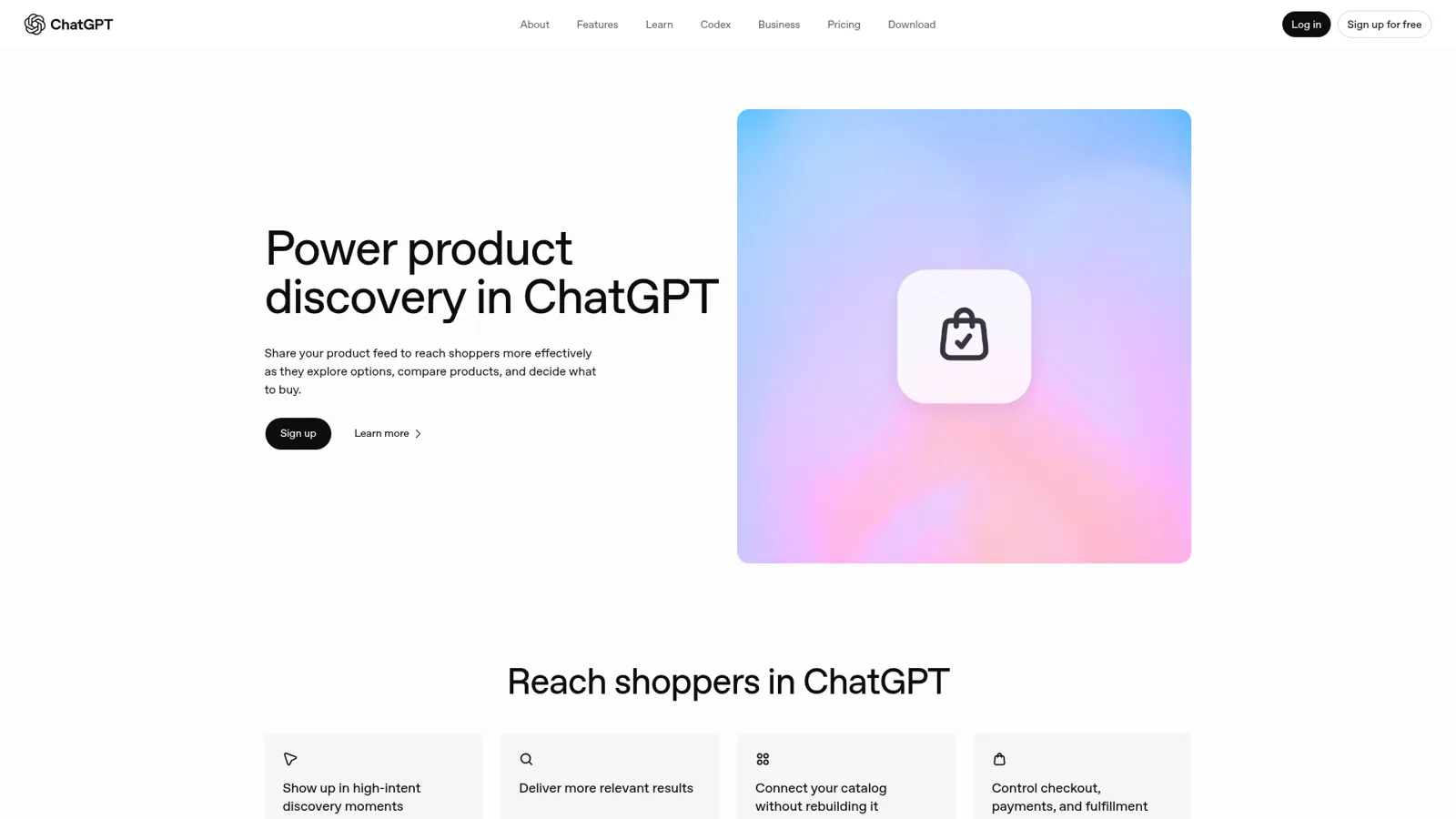
The merchants page is plain about the deal. Shoppers "discover and evaluate products in ChatGPT, but purchases are completed on merchant-owned websites or apps." "There are no fees on purchases that start in ChatGPT." And if you sell through Shopify or Etsy, "your catalog is already integrated, and no additional setup or application is required." For readers outside America, the line that matters most is this one, "Shopping is currently live for ChatGPT users in the U.S."
Two details on the help page matter for support, and I'd flag them to whoever runs your inbox. ChatGPT "may generate simplified product titles and descriptions", and labels like "Budget-friendly" are "not guarantees or verified statements." And when you update pricing or shipping terms, OpenAI says "there may be some delay before it is reflected." So a shopper can arrive with a price or a description ChatGPT showed them that isn't quite what your store says. OpenAI's own advice to shoppers is to confirm the final price, availability and return policy with the merchant. That confirmation is a ticket, or a chat, on your side.
What happened to ChatGPT Instant Checkout?
OpenAI launched it, then stepped back from it. On 29 September 2025 OpenAI announced Instant Checkout: US users could buy from Etsy sellers in chat, "with over a million Shopify merchants... coming soon," built with Stripe on the Agentic Commerce Protocol. Even then, OpenAI said the merchant "handles fulfillment and customer support exactly as they do today."
Six months later, on 24 March 2026, OpenAI changed course in its own words: "the initial version of Instant Checkout did not offer the level of flexibility that we aspire to provide, so we're allowing merchants to use their own checkout experiences while we focus our efforts on product discovery." If you read my Instant Checkout or buy on ChatGPT posts, that's the turn they track.
The same week, Shopify launched Agentic Storefronts, which put merchants' catalogs in ChatGPT, Microsoft Copilot, AI Mode in Google Search and the Gemini app from the Shopify admin. Shoppers "complete purchases via an in-app browser," with "no transaction fees beyond standard processing rates," and "orders flow into the admin with ChatGPT referral attribution." Merchants remain the merchant of record.
One Hacker News commenter put the retreat down to something simpler than flexibility, in a thread titled "Walmart: ChatGPT checkout converted 3x worse than website":
"I've been running e-commerce systems for 30 years (tech, marketing, etc). This was going to fail from the start for one reason: intent. Most people using AI chat are exploring ideas and solutions. They're doodling, not shopping."

Whatever the reason, the practical result for a store is the same. ChatGPT is now a discovery channel (my agentic commerce guide covers the wider shift), and the order, the payment and every "where is it?" email after it live in your systems. My ChatGPT merchant fees post has the fee history if you're reconciling old numbers.
What is a Business Agent in ChatGPT?
It's your store's own AI agent, published inside ChatGPT, that shoppers can chat with. OpenAI introduced Businesses in ChatGPT in beta on 10 November 2026: you claim your business in Business Hub, keep your details and product feed current, see aggregate insights (mentions, website clicks, discovery topics), and, if eligible, publish a Business Agent. Those agents "are now available to eligible ecommerce and online service businesses in the United States."

OpenAI's Businesses in ChatGPT page says the agent "answers questions with your product and policy information, using guidelines you control." For Shopify stores it's three steps: connect the store, review the info shared through Shopify's catalog, then preview and publish. My claim your business walkthrough covers each screen, and the Business Hub post covers the insights side.
OpenAI's free ChatGPT app on the Shopify App Store does the connecting. Its listing showed 1.3 stars from 110 reviews when I checked, with recent reviews about business-name verification and an OpenAI reply on 16 November saying it had updated onboarding. Early beta, in other words, and my Business Agents explainer tracks what's changing.
Three lines from OpenAI's own pages set the boundaries:
- You don't get the chats. "We don't share users' conversations or Business Agent chats with businesses." Insights are aggregated.
- It doesn't make big calls alone. The Business Agents policy says an agent must not "automate high-stakes decisions without human review" and must be clear "that it is AI representing the business."
- The relationship stays yours. Even with ChatGPT Wallet (13 November 2026, Pro users in the US first, covered in my ChatGPT Wallet post), OpenAI says businesses "keep their customer relationships and control over pricing, fulfillment, returns, and customer service."
I think Business Agents are a smart move for discovery. A shopper comparing two serums gets a conversation with the brand instead of a generic answer, and the brand sets the guidelines. But read that third line again. The refund, the damaged parcel and the address change after checkout are all still yours, and they arrive in your helpdesk, not in ChatGPT.
How do ecommerce teams use ChatGPT at work?
Mostly as a very good assistant in a separate tab: product descriptions, campaign copy, a first draft of a tricky customer reply, a summary of a supplier PDF. OpenAI sells this as ChatGPT Business: $25 per user per month, or $20 billed annually, with a two-seat minimum, and Standard seats include ChatGPT, ChatGPT Work and Codex. Premium seats are $125 ($100 annually) for higher limits. My ChatGPT pricing post has every plan, and the ChatGPT Work post covers what the Work part adds.
For a store team it's good at the writing and thinking parts. A support engineer on G2 described the pattern I see most:
"I use it to understand technical concepts, troubleshoot issues, prepare for customer discussions, draft professional communications, and simplify complex documentation."

The same reviewer adds that answers can "sound confident but aren't always accurate." For ecommerce, that bites hardest on product content, where nobody reviews the output before it goes live. One Hacker News commenter described exactly that:
"My line manager using a lazy single line description of a product is generating whole product listings and HTML for our web shop, never checking it. SEO is poor, views and conversion are collapsing."
Two limits are worth knowing before you plan around a seat. The first is copy-paste. ChatGPT drafts the reply, then a person moves it into Gorgias, checks the order in Shopify, and sends. The second is the terms. OpenAI's Business limits page summarises the Services Agreement as prohibiting "reselling access or using ChatGPT to power third-party services." A seat is a staff tool, not a customer-facing bot. Customer-facing builds go through the API, billed separately. If you'd rather write the content side with a tool built for it, my best AI for ecommerce content roundup compares the options.
Where does a ChatGPT customer question end up?
In your store's own tools, every time. That's the part of "ChatGPT for ecommerce" that most guides skip. Try it with the questions your team gets every week.
Four of those five land with you. OpenAI designed it that way, and says so on its own commerce pages. It just means the store needs something ChatGPT-like on its own side of the counter.
What does a ChatGPT-like teammate look like inside your store?
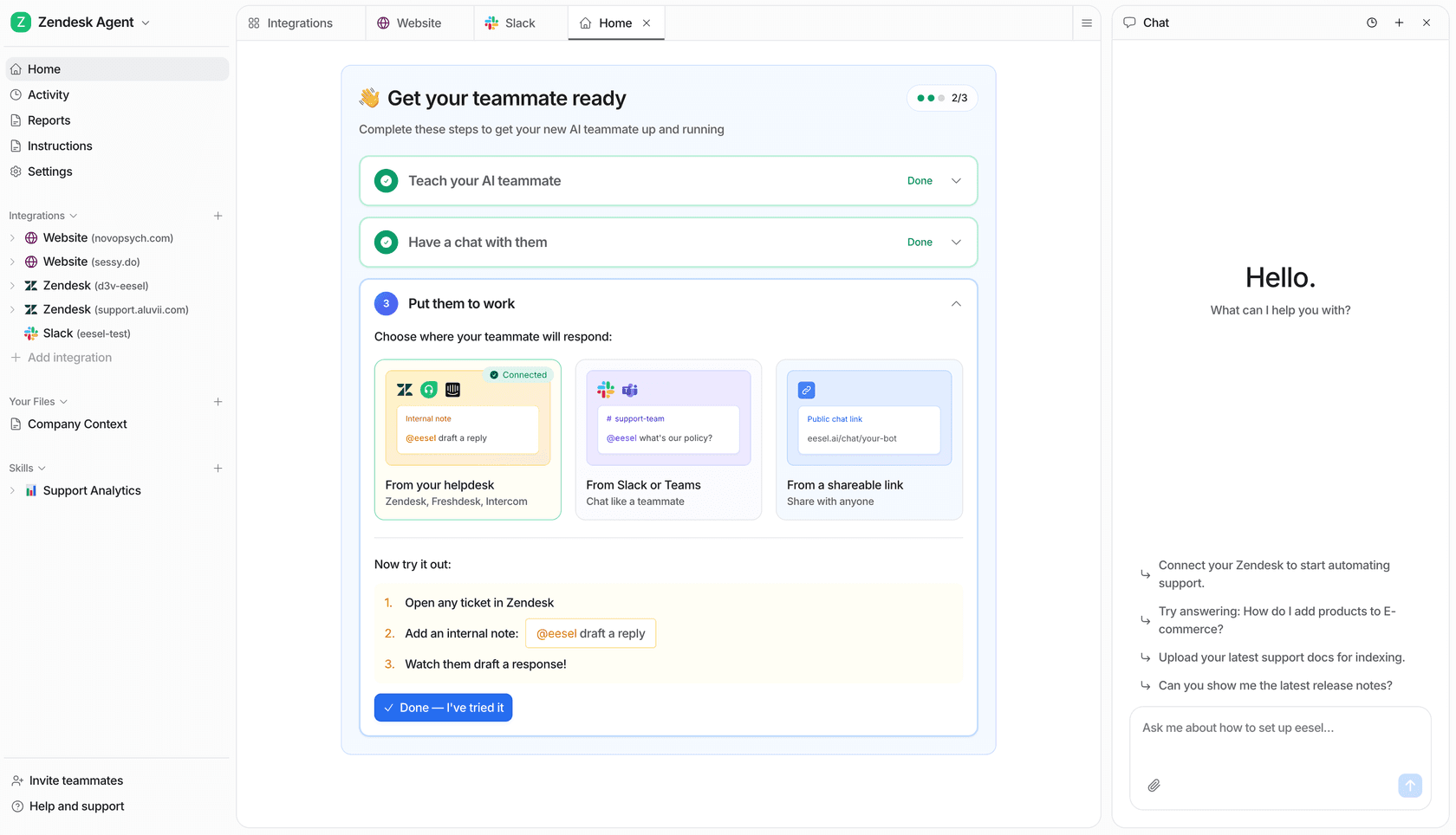
It works the way ChatGPT does (you ask, it thinks, it does), but it lives in Shopify, your helpdesk and Slack, and the whole team shares it. That's what eesel is built to be. You hire it, connect your apps, and it arrives with the skills and context for store work: it learns from your products, policies, past tickets and Slack history, follows your instructions reliably, and picks up work on its own instead of waiting to be asked. Correct it once in chat and the fix sticks, because it goes into its instructions and memory.
The part I'd look at first is who is asking, because a store hears from two very different groups all day. ChatGPT has real controls of its own: workspace admins decide which apps are enabled, and OpenAI's workspace agents ask before write actions by default. But ChatGPT acts for the person using it and behaves the same whoever that request came from, and a seat isn't built to face your customers in your own channels. A store teammate has to tell the difference between your ops lead in Slack and a stranger in the chat bubble.
eesel draws that line in three places, all from its actions and approvals doc:
- Your team. People on your Team page, full members of your Slack, and anyone writing an internal note in your helpdesk. Some actions, like writing scripts against an app's API or changing the agent's own instructions, carry a Team only tag and run only when one of them asks (scripts and admin-only tools never run on a customer's ticket, even from an internal note).
- The people you name. Held actions go to the members or Slack channels you pick, and only people with edit access can approve them. Viewers can chat with the agent and see activity, but can't change it, per eesel's roles.
- Customers and visitors. A shopper on a Gorgias ticket or in your website chat gets answers, but never a Team only action, and never a Team only file or a link to an internal one.
On top of that, every action runs on its own (On), waits for a person (Ask first), or never runs (Off), set per agent and per action. You can change it any time, or just say it in chat: "look things up on your own, but ask me before any refund." Here's how I'd set up a Shopify store on day one, using the actions eesel's Shopify integration lists:
| Job | Setting I'd start with | Why |
|---|---|---|
| Answer product, sizing and policy questions | On | Grounded in your catalog and policies, for anyone who asks |
| Look up an order, its tracking and stock | On | Reads Shopify live at the moment it's asked |
| Change a shipping address (unfulfilled only) | Ask first, then On | Cheap to check, annoying to get wrong |
| Start a return | Ask first, then On | Turn it on once the drafts are consistently right |
| Refund or cancel an order | Ask first | The docs recommend keeping anything that costs money behind approval (refund guardrails) |
| Write scripts against an app's API | Team only (tag eesel adds) | Runs when your team asks, never for a shopper |
| Reply in live chat | Always On | Nobody can pause a live chat to approve a reply |
An Ask first approval shows the exact action, the reply text and the refund amount, with Approve and Deny. It lands on the dashboard, as a card in the Slack thread the run started from, by email, or in a terminal with eesel approvals. So the refund a customer asked for on a ticket waits for the person you named, while your ops lead can ask in Slack for a script that pulls last week's refunds, something no shopper could ever trigger.
Then it works where your tickets are. eesel connects natively and deeply with your helpdesk, Shopify and the rest of its 3,000+ integrations. In Gorgias and Zendesk it looks up the Shopify order inside the ticket, tags from your own list and leaves a draft as an internal note if you'd rather check it first. That's the bulk of order tracking and returns work, done where your team already looks.
It also sits on your storefront as a chat bubble with product cards a shopper can add to cart, answers on WhatsApp, and has its own email address. Not on Shopify? The e-commerce integrations page lists Magento, BigCommerce, WooCommerce, Stripe, Recharge and AfterShip with the same kind of live lookups.
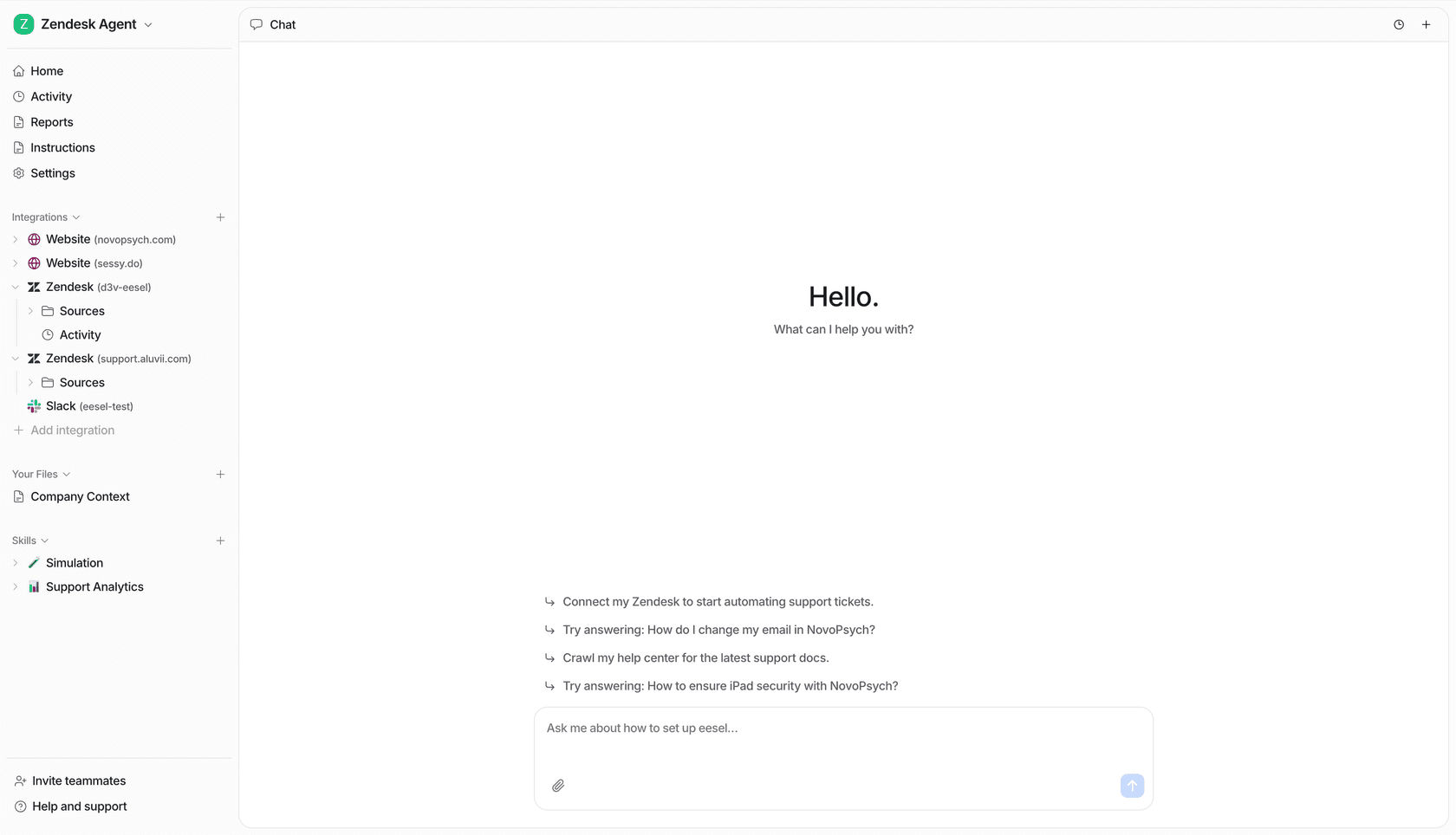
And it isn't only tickets. Your team can @mention it in Slack and ask "which products under $40 are in stock?", and it answers in the thread with products, prices and stock. It can run on a schedule, too, like a weekday-morning check of tickets that slipped. If you like ChatGPT as your own assistant, keep it: eesel's apps for ChatGPT are being listed in ChatGPT's app directory, per helpdesk (Gorgias, Zendesk, Freshdesk and others), so you can ask eesel what's waiting on you from a ChatGPT chat.
What does that look like for real stores?
Here's what five ecommerce brands did with eesel between 8 August and 8 September 2026, from their published customer stories:
| Store | Setup | What eesel did in a month |
|---|---|---|
| Question Beauty | Gorgias + Shopify | 990 tickets; 960 replies sent directly; 290 Shopify orders looked up; 280 closed without a person |
| Rungne | Gorgias | 2,100 tickets; 880 tagged from a fixed list; 580 drafts as internal notes; 440 replies in Norwegian or English |
| Stil Classics | Gorgias + Shopify | 320 tickets prepared; 430 internal-note drafts; 230 orders looked up before drafting |
| Clutchloop | Gorgias + Shopify | 230 tickets; 180 replies sent directly (about seven in ten); 76 live product lookups; 27 chats in the customer's language |
| Cape Coffee Beans | Zendesk + Shopify + Drive | 160 scheduled checks emailing the founder tickets that slipped; 23 tickets where staff called eesel in with an @eesel note |
What I like about this spread is that it isn't one mode. Question Beauty lets eesel send most replies itself; Stil Classics has it leave drafts as internal notes; Rungne uses it as a tagging and drafting machine; Cape Coffee Beans uses it as an ops check that emails the founder. Same teammate, different permissions, which is the point.
ChatGPT vs a store teammate: which does which job?
Use both. They answer different questions, and the table below is how I'd split the work.
| ChatGPT (shopping + Business Agent) | ChatGPT Business seat | eesel as your store teammate | |
|---|---|---|---|
| Where it works | Inside ChatGPT | A ChatGPT tab or desktop app | Shopify, Gorgias, Zendesk, email, chat, WhatsApp, Slack |
| Who it serves | Shoppers before they buy | One staff member at a time | Shoppers and your whole team |
| Orders and refunds | Stay with the merchant, per OpenAI | Acts in connected apps for the signed-in user; not built to face your customers | Looks up live; refunds on Ask first |
| Who controls it | Guidelines you set in Business Hub | Admin app controls; workspace agents ask before writes by default | Per-action On / Ask first / Off, changing with who is asking |
| You see the chats | No, insights are aggregated | Your own chats | Every run, on the Activity page |
| Price | No fees on purchases that start in ChatGPT | $25/user/month ($20 annually), 2-seat minimum | From $299/month for 500 credits, unlimited seats |
If you're only after discovery, claim your business and keep your Shopify catalog clean; that's free. If you want help writing, a ChatGPT seat is a fine buy. If you want the tickets that come after both of those handled in your tools, that's a teammate's job. My best AI for ecommerce support list compares the options if you want to shop around, and ChatGPT for Shopify support covers the build-it-yourself route on the API.
What if you'd rather not run support at all?
Then hand it off. For ecommerce brands that want support done for them, eesel's Managed support runs the whole support team inside your own tools for $5,000/month flat, as a founding-partner offer. It's the same teammate with eesel's people steering it. If you're weighing that against an agency, my support outsourcing guide lays out the trade-offs.
Try eesel as your store's ChatGPT
ChatGPT now sends you shoppers and helps your team write. eesel is the ChatGPT-like teammate on your side of the counter: it works natively inside Shopify and your helpdesk, looks up orders on its own, and does more for your team than for a shopper, with refunds waiting for the people you name. It's a free 7-day trial with 100 credits and no card, then the Teammate plan from $299/month, and you can watch it work on your AI ecommerce agent page first.