

How I picked these
I've spent the last two years doing SEO and running eesel's content pipeline, so my bar isn't "which homepage looks slickest." It's which tool I'd actually trust to ship copy I'd attach a brand name to, at the volume a real store needs.
I weighted four things:
- Does it understand a catalog? Writing one product description is easy. Writing 4,000 on-brand, without duplicate content, is the actual job.
- Real pricing, not "starts at." I dug out the full tiers, including the ones hidden behind "contact sales," because the cheap headline plan is usually not the one that does the work.
- Output quality on real product data. The tools that win feed on your specs, reviews, and brand voice instead of hallucinating features.
- What real users say. Every verdict below leans on G2, Reddit, or Trustpilot, not the vendor's own testimonial wall.
Here's how they stack up before we get into each one.
| Tool | Best for | Entry price | Billable unit | Bulk catalog | Native store connect | Free option |
|---|---|---|---|---|---|---|
| Describely | Bulk product copy | $0.75 / product | Per product | Yes | Shopify, Woo, Wix | Trial credits |
| Hypotenuse AI | Catalog enrichment | Custom quote | Words / seats | Yes | Shopify, Amazon, Etsy | Free trial |
| Jasper | Marketing teams | $69 / mo / seat | Per seat | Business tier only | No native | 7-day trial |
| Copy.ai | Enterprise GTM | $29 / mo | Workflow credits | $1,000/mo+ tier | Via integrations | Chat tier |
| Anyword | Ad & performance copy | $49 / mo | Per seat | CSV bulk | No native | 7-day trial |
| Shopify Magic | Shopify merchants | $0 (with plan) | Token limits | Per product | Native (Shopify) | Free with plan |
| Writesonic | AI-search visibility | $79 / mo | Articles / answers | Limited | No native | 7-day trial |
| Claude / ChatGPT | Hands-on control | ~$20 / mo | Per seat | Manual | No | Free tier |
The single most useful way to read this market is on two axes: how ecommerce-native a tool is, and whether it works one item at a time or across your whole catalog. Plot the tools and the clusters jump out.
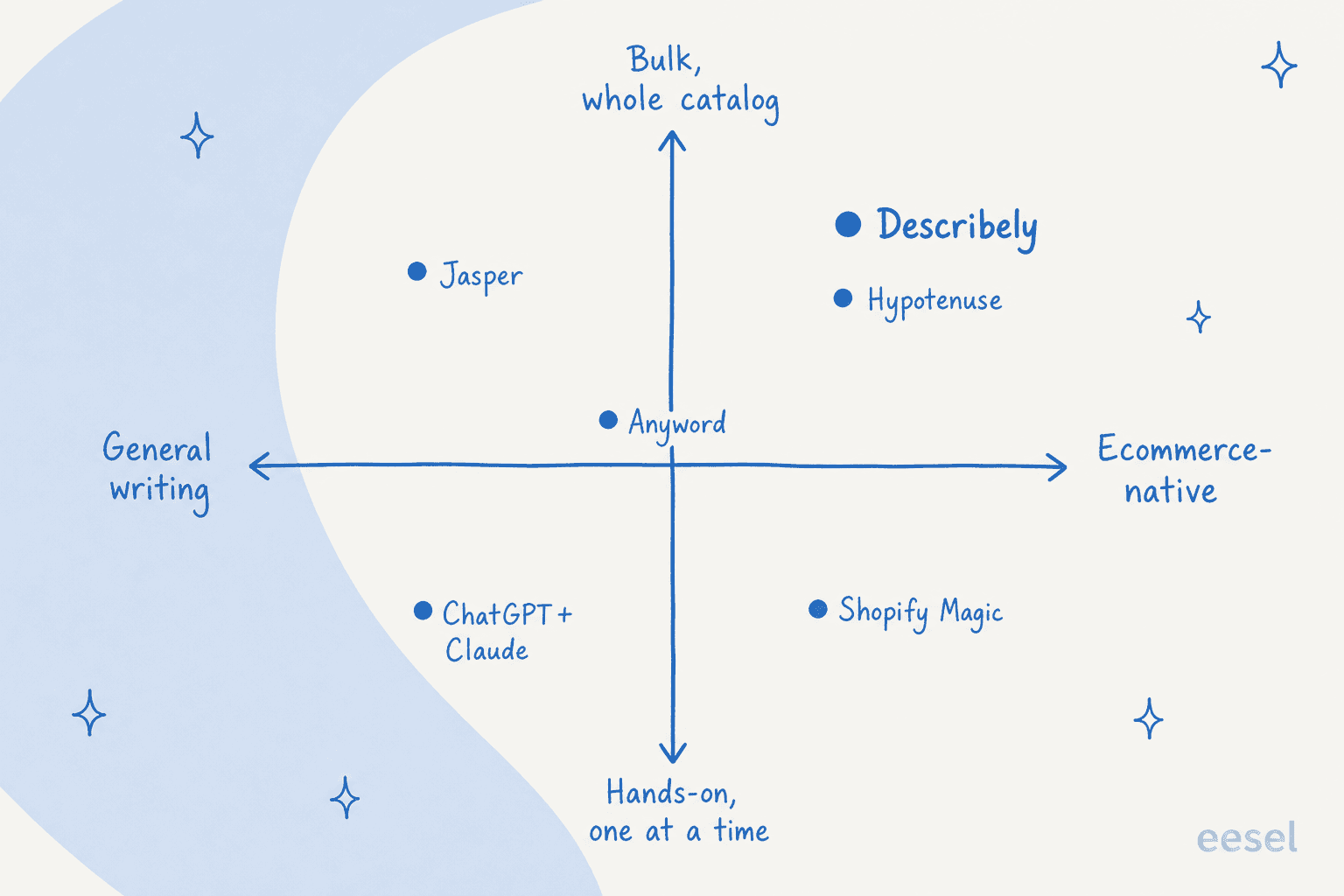
The top-right (Describely, Hypotenuse) is where the purpose-built catalog tools live. The left side is general writing power you point at any task. There's no "winner" square, just the square that matches your bottleneck.
Which one fits your store?
Before the deep dives, here's a quick way to narrow it down. Pick the thing that's actually slowing you down and the recommendation updates.
The 8 best AI tools for ecommerce content
1. Describely, best for bulk product descriptions
Describely is the most ecommerce-native tool on this list, and it doesn't pretend to be anything else. It exists to turn a catalog of bare SKUs into polished, SEO-ready product descriptions, titles, bullets, and meta tags, "10, 100, or 10,000 descriptions at once," per its own product page. It connects natively to Shopify, WooCommerce, Wix, and Squarespace, or you import a CSV, generate, review, and push back.
The feature that earns it the top slot is product data enrichment: even a bare title and SKU can be filled out into a full description because Describely fills the attribute gaps first. Its Content Rules lock tone, length, and brand voice across the whole catalog, which is why agencies juggling multiple client brands like it.
Pricing. Refreshingly, it's usage-based with no seat fees.
| Plan | Price | Scope |
|---|---|---|
| Pay as you go | $0.75 / product | Up to 500 products; unlimited generations; SEO tools |
| High volume | Custom | 500+ products; custom seats; scales with catalog |
Source: Describely pricing. Data enrichment is billed separately at $0.55/credit and image processing at $0.05/credit.
Pros: purpose-built bulk workflow; pay only for what you generate; brand-consistent output via Content Rules; native store connectors plus SEO and AI-search readiness.
Cons: cost scales with catalog size (heavy users on G2 flag that "the cost can increase if you have hundreds or thousands of products"); narrow scope, it's a catalog tool, not a general writer; PIM integration is still limited.
"Describely's bulk content generator has transformed our product creation workflow... we can produce SEO-optimised content that's consistent, engaging, and ready to publish, making scaling our listings quicker and simpler than ever."
Group Content & Merchandising Manager, G2 review (Describely holds 4.8/5 there)

Our take: if your bottleneck is "we have a giant catalog and half the products have one-line descriptions," Describely is the sharpest fit on this list. Skip it if you mostly need ads, email, or blog posts, because it doesn't really do those.
2. Hypotenuse AI, best for catalog enrichment at scale
Hypotenuse AI sits right next to Describely in the "ecommerce-native, bulk" corner, but it leans harder into the messy data problem that big catalogs actually have. Its pipeline is import (CSV, XLSX, or a PIM) → generate or rewrite in bulk → review → export back, and it claims "thousands of descriptions within minutes." It connects directly to Shopify, Etsy, Amazon, Walmart, and Target, and can produce per-channel description variants, which matters when your Amazon listing and your Shopify PDP need different copy.
Where it pulls ahead is product data enrichment: it fills missing attributes from the web, images, and spec sheets, standardizes units, and auto-classifies products into your taxonomy. That's genuinely hard to do by hand across a large catalog, and it's the kind of thing a general model can't touch.
Pricing. This is the catch: the entire ecommerce track is contact-sales.
| Plan | Price | For |
|---|---|---|
| Basic | Custom | Catalogs under 100 products; 1 seat; 40+ languages |
| Ecommerce Pro | Custom | + knowledge reference, bespoke brand voice, SEO tooling |
| Ecommerce Enterprise | Custom | + attribute enrichment, taxonomy, bulk image editor, SOC 2, dedicated CSM |
Source: Hypotenuse pricing. There's a free trial with no card, but no public per-month figure on the live ecommerce cards.
Pros: purpose-built bulk pipeline; broad marketplace integrations with per-channel variants; strong data enrichment; 40+ languages with a no-duplicate-content guarantee.
Cons: opaque contact-sales pricing makes it hard to budget; output occasionally repeats sentences and needs a light edit pass; per-tier limits are partly hidden behind the site's JS tabs.
"It ocassionally repeats similar sentences within the same blog... this repitition sometimes disrupt the flow."
Rohma R., Content Writer, G2 review (Hypotenuse holds 4.7/5 across 73 reviews)
Our take: the strongest choice when your real problem is dirty product data across a large, multi-marketplace catalog, not just thin copy. The opaque pricing is the friction, so budget for a sales call before you commit.
3. Jasper, best for marketing teams and brand voice
Jasper isn't an ecommerce tool, it's a marketing platform that happens to do ecommerce well when you're a team. Its retail and consumer goods page frames product copy as a conversion-and-returns lever, and the real draw is Brand IQ, which centralizes brand voice and product knowledge so output is on-brand by default, with multi-brand-voice support for portfolios. A single brief can fan out into a full campaign: email, ad variations, social, and landing copy, with a translation agent for multi-market stores.
The catch is that the at-scale machinery (Jasper Grid, unlimited brand voices, bulk pipelines) lives on the custom-priced Business tier.
| Plan | Monthly | Limits |
|---|---|---|
| Pro | $69 / mo / seat | 1 seat; capped at 2 brand voices, 5 knowledge assets, 3 audiences |
| Business | Custom | Unlimited brand voices/knowledge, Jasper Grid, API, admin controls |
Source: Jasper pricing. 7-day trial, no permanent free tier.
Pros: explicitly built for product descriptions and PDPs at SKU scale; pipelines codify a content workflow once and run it repeatedly; Brand IQ keeps a portfolio on-brand; one brief to a full campaign suite plus localization.
Cons: no native Shopify or catalog connector, "product data" is described generically; Pro caps you at 2 brand voices and costs $69/seat; a recurring G2 complaint is that output can be "generic/repetitive, requiring additional editing."
"The output quality was very very bad. We ended up using chatGPT... because it could follow our brand voice perfectly."
Verified user, G2 review (Jasper still holds 4.7/5 across 1,270+ reviews, so this is the minority view, but a loud one)
Our take: pick Jasper if you're a marketing team running governed, multi-brand product and campaign content and can justify Business pricing. Skip it if you're a solo store wanting a cheap, Shopify-connected description generator, the seat price and brand-voice caps don't fit.
4. Copy.ai, best for enterprise GTM at catalog scale
Copy.ai used to be the go-to product-description generator. In 2026 it has fully repositioned as a go-to-market AI platform, and that changes who it's for. The ecommerce capability is real, its Workflows and Tables can generate product copy across enormous catalogs (a case study claims content across 100,000+ product pages with 80% lower ops cost), but it's now buried under the generic "content creation" use case rather than sold as a product-description tool.
The pricing tells the whole story. There's a cheap chat plan and then a cliff.
| Plan | Annual price | Seats | Workflow credits / mo |
|---|---|---|---|
| Chat | $29 / mo | 5 | None (chat only) |
| Growth | $1,000 / mo | 75 | 20,000 |
| Scale | $3,000 / mo | 200 | 75,000 |
| Enterprise | Custom | Custom | Unlimited + API + bulk runs |
Source: Copy.ai pricing. The meter is workflow credits, not words, and bulk runs plus API are enterprise-gated.
Pros: catalog-scale product copy via Workflows; Brand Voice and Infobase keep a big catalog consistent; LLM-agnostic with 2,000+ integrations and built-in localization; strong enterprise proof points.
Cons: no dedicated product-description product anymore; the real bulk capability starts at $1,000/mo, the $29 Chat tier is just a prompt box; the enterprise framing makes it overkill for an SMB merchant.
Our take: Copy.ai can absolutely produce product copy at catalog scale, but it's an enterprise GTM platform first now. Great if your company is already buying into Workflows at $1k+/mo; hard to justify for a single store on the $29 tier when Describely does the same job cheaper.
5. Anyword, best for ad and performance copy
If your ecommerce content problem is really an ad spend problem, Anyword is the one to look at. Its differentiator is predictive performance scoring: it estimates which copy variant will perform before you publish, so you're not A/B testing live with real budget. The performance-marketers page claims a 15-30% ROAS lift and surfaces the "top 5 before you go live." It also builds copy around customer personas and pain points, which is useful for segment-specific product descriptions, and supports CSV bulk generation with brand voice across 30+ languages.
| Plan | Monthly | Seats | Predictions / mo |
|---|---|---|---|
| Starter | $49 | 1 | 50 |
| Data-Driven | $99 | 3 | 100 |
| Business | Custom | 3 | 250 |
| Enterprise | Custom | Custom | 500+ |
Source: Anyword pricing. All plans include unlimited words; 7-day trial, no free-forever tier.
Pros: predictive scoring is a genuine differentiator for paid acquisition; persona-targeted copy; brand voice plus CSV bulk for catalog work; unlimited words.
Cons: no dedicated product-description tool (the /tools/product-description-generator URL 404s); the signature scoring is gated, real-time scoring needs the $99 Data-Driven tier and learning from your own campaign data needs custom-priced Business; pricey for a small shop versus a general writer.
"Anyword stands out for its predictive performance scores... The platform's AI-driven suggestions are very accurate, saving me a lot of time in drafting ad copies."
G2 review, accessed 2026-06-25
Our take: worth it for ecommerce teams running real paid acquisition, where the predictive scoring pays for itself. Overkill for a store that just needs bulk product descriptions, since the best of Anyword sits behind the $99+ tiers.
6. Shopify Magic and Sidekick, best for Shopify merchants who want free
The tool a huge number of stores should try first costs nothing extra. Shopify Magic (now consolidated under the Sidekick brand) is built into the Shopify admin and writes product descriptions, email campaigns, social posts, and blog copy against your store's own data, no setup beyond clicking the assistant icon. SEO-oriented product descriptions are the flagship use, and Sidekick goes further than writing, handling collections, analytics queries, and store tasks.
Pricing. It's free with any Shopify plan, so the cost is really just your Shopify subscription: Basic $29/mo, Grow $79/mo, Advanced $299/mo per the pricing page. Shopify's own FAQ notes "features and usage limits vary by plan."
Pros: free with the plan you already pay for; zero setup; generates product, email, social, and blog copy natively in your store's data context; Sidekick adds operational help beyond writing.
Cons: locked inside Shopify, useless for content anywhere else; built for short commerce copy with limited brand-voice depth versus a dedicated writer; reliability is uneven outside core tasks, and early merchants hit a clunky product-description flow.
"it helps you like an assistant. Not like an assistant just, like a cofounder. It helps with taking strategic decisions and also recommends the perfect numbers"
r/ShopifyWebsites, Dec 2025

Our take: a no-brainer free first-draft engine if you're already on Shopify. Treat it as the fast starting point for product, email, and social copy, then reach for a dedicated tool when you need long-form depth or tight brand control.
7. Writesonic, best for getting cited in AI search
Heads up: Writesonic in 2026 is barely a copywriting tool anymore. It has pivoted to being an "AI Search Growth Engine," and its old product-description and ad-copy template library is gone (the /templates/product-descriptions URL is a confirmed 404). Its ecommerce angle now is getting your products cited inside ChatGPT Shopping and Google AI Overviews, a real and growing concern, just a different one from writing descriptions.
What it still does for content: an AI Article Writer with up to 10 brand voices and "upload your own data," plus optimization of existing product and category pages for AI citation (schema, FAQ blocks, comparison tables). It tracks visibility across up to 10 AI engines and is SOC 2 Type II, GDPR, and HIPAA compliant.
| Plan | Price | AI articles / mo | Brand voices |
|---|---|---|---|
| Starter | $79 / mo | 15 | 1 |
| Basic | $199 / mo | 25 | 5 |
| Growth | $399 / mo | 50 | 10 |
| Enterprise | Custom | Custom | Custom |
Source: Writesonic pricing. Billed annually; 7-day trial, no card.
Pros: strong generative engine optimization tooling; on-brand long-form via brand voices and your own data; product-level AI-shopping tracking; enterprise compliance.
Cons: no dedicated product-description, ad, or email generators anymore, the wrong tool if you want bulk copy; entry price jumped to $79/mo and you pay for visibility tooling even if you only want writing; article quotas are low.
"Writesonic is super easy to use and great for quickly creating stuff like blogs, ads, landing pages, and social posts. It has tons of templates..."
G2 review (4.7/5 across 2,114 reviews; a Reddit counterpoint cancelled because "the AI results were not as good as their competitors")
Our take: pick Writesonic to get your products found by AI search, not to crank out descriptions. If discovery in ChatGPT Shopping is on your radar, it's a serious option; if you just need copy, this isn't your tool anymore.
8. ChatGPT and Claude, best for hands-on control and lowest cost
Don't sleep on the general models. For many small and mid-size stores, the best-written product copy comes from Claude or ChatGPT, driven by hand. They have no catalog connector and no bulk pipeline, so you're prompting and pasting rather than syncing 10,000 SKUs, but the trade is raw writing quality and total control at around $20/month (Claude Pro and ChatGPT Plus both land near there; both have usable free tiers for light work).
The reason they belong here: real sellers keep reaching for them. In an r/FulfillmentByAmazon thread on product copy, a seller noted Claude was "noticeably better for product copy... more natural tone, less generic filler," and one of Jasper's own G2 reviewers (quoted above) switched to ChatGPT for brand-voice fidelity.
Pros: the best raw writing quality of anything here; cheapest paid option at ~$20/mo with free tiers; total control over tone and structure; great for the high-value hero products where copy really matters.
Cons: no catalog import, enrichment, or bulk publishing, so it doesn't scale to thousands of SKUs without you building a workflow; no built-in SEO scoring or brand-voice memory across sessions (you re-feed context each time); easy to get generic output if you prompt lazily.
Our take: the value pick for stores with a manageable catalog or a handful of high-stakes product pages. If you're hand-writing your 30 best sellers, a general model plus a good prompt beats most dedicated tools. It's not the answer for 10,000 SKUs, that's where Describely and Hypotenuse come back in.
How the bulk tools actually work
The catalog-focused tools (Describely, Hypotenuse, and Copy.ai's Workflows) all follow the same shape under the hood, and understanding it tells you whether one fits your store. It's a five-step pipeline, and the steps that aren't "generate" are the ones that decide quality.
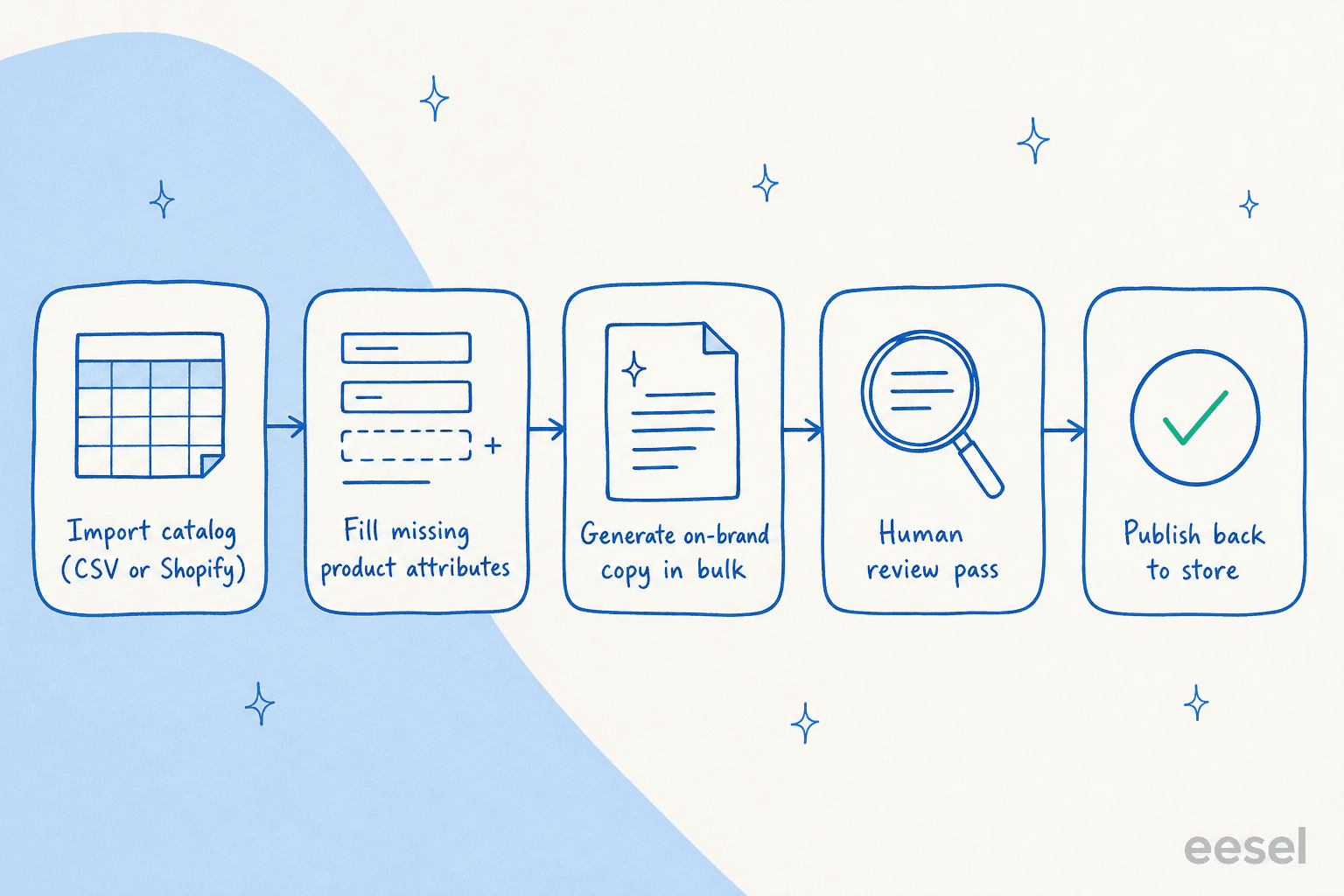
The make-or-break step is the second one, enrichment. A model can only write a good description if it knows the product's material, dimensions, and use case, and most catalogs have those fields half-empty. Tools that enrich first (filling gaps from spec sheets, images, and the web) produce copy that's specific; tools that skip it produce the generic "elevate your everyday" filler that both shoppers and Google ignore. The fourth step, the human review pass, is non-negotiable too: AI hallucination of a feature your product doesn't have is a returns-and-trust problem, not a typo.
What it actually costs
Sticker prices across this category are all over the place, because the billing units don't match: per seat, per workflow credit, per product, or free-with-plan. Here's the entry monthly price lined up, with the two usage-based tools noted separately.
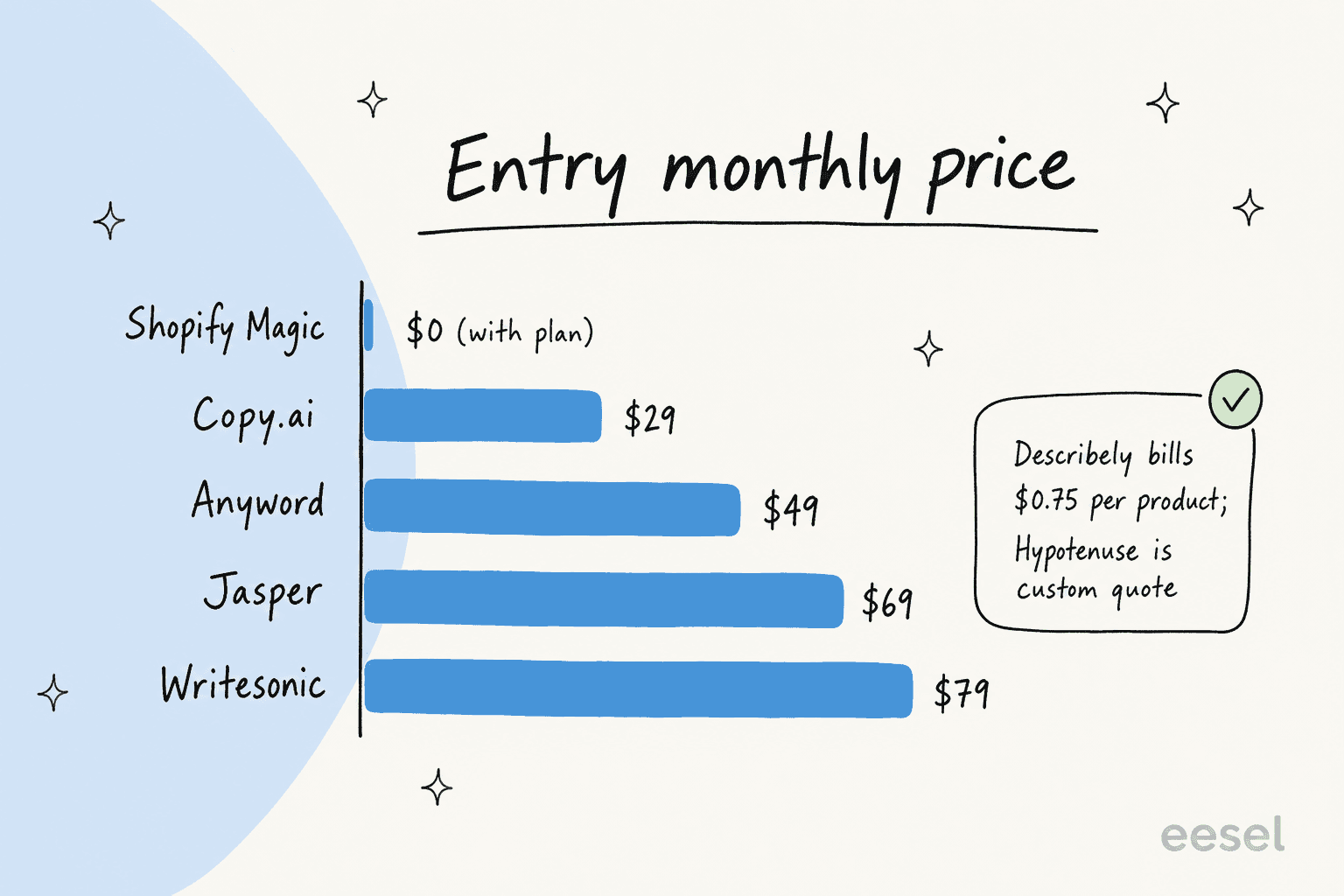
The headline numbers hide the real cost, though. Copy.ai's useful tier is $1,000/mo, not $29. Jasper's at-scale features need the custom Business plan, not the $69 Pro. The honest cheap options are Shopify Magic (free), Describely (you pay per product, so 200 products is $150 one-time-ish, not a subscription), and a general model at $20/mo. For a worked example: a store with 1,000 thin product pages would pay about $750 in Describely credits to fix the lot once, versus a year of Jasper Pro at $828 that still caps your brand voices. That's the kind of math that should drive the pick.
Try eesel for the content that answers your customers
Every tool above writes marketing content, the copy that brings shoppers to your store and nudges them to buy. But a big share of what an ecommerce team actually writes is the other kind: the help articles, FAQs, shipping-and-returns pages, and the replies that resolve "where's my order?" for the hundredth time. That's the gap eesel AI fills.
eesel's AI writer learns from your existing knowledge base, past tickets, and docs, then drafts content grounded in what your store actually knows rather than what a general model guesses. And it runs alongside an AI helpdesk agent that resolves real support questions on the same knowledge, so your ecommerce support answers and your published help content stay consistent. (Full disclosure: eesel's writer drafted the first pass of this very post, which is the most honest test I can give it.)
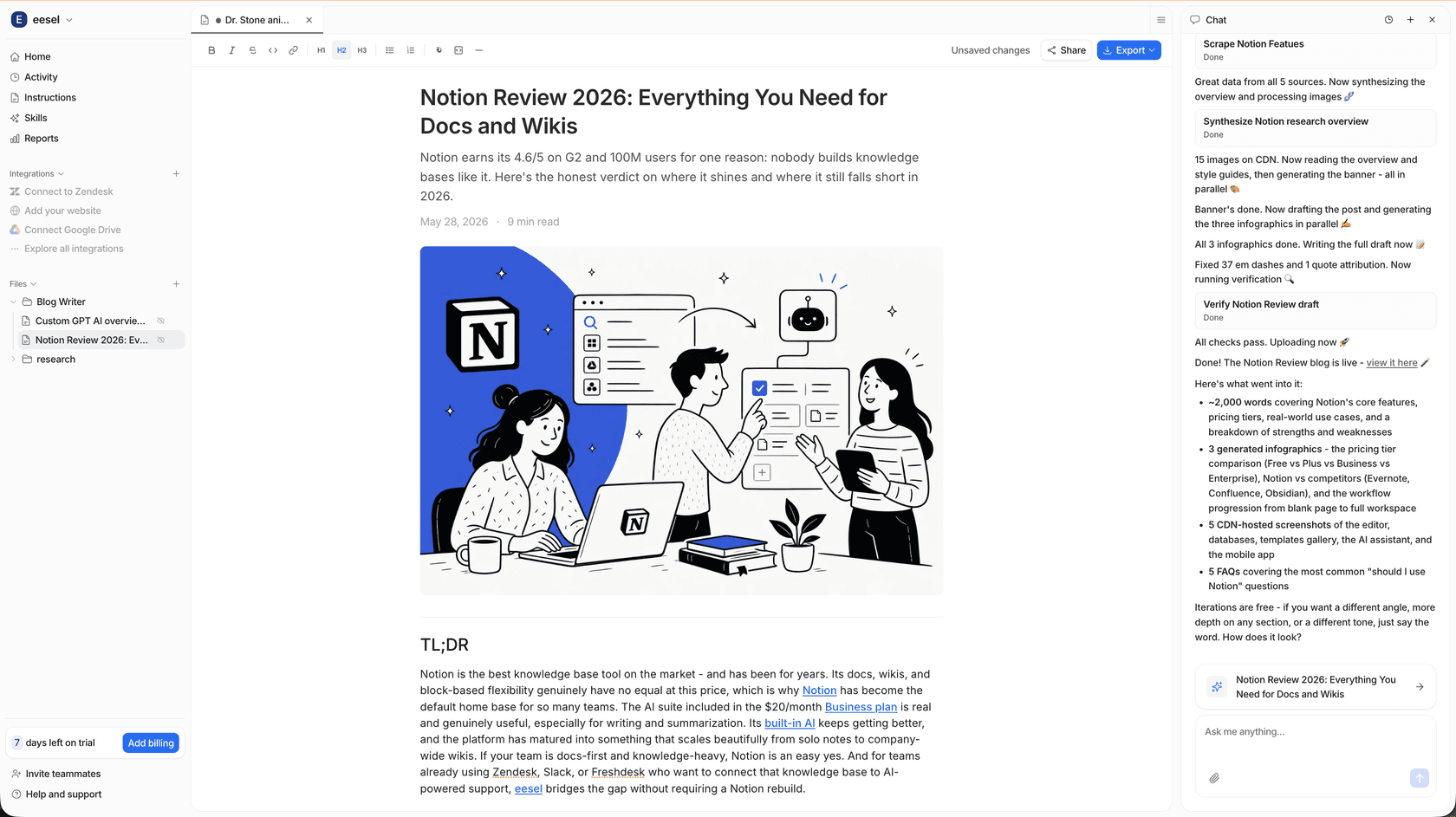
Pricing is usage-based, a full blog draft is billed as a single $4 "heavy" task with no per-seat fees, and you get 2 free blog generations plus $50 in free usage to try it. If your content problem is "we know our products better than anyone but can't keep the help content current," that's exactly what it's for. You can try eesel free, no credit card needed.
Frequently asked questions
What is the best AI tool for ecommerce content in 2026?
Is there a free AI tool for writing product descriptions?
How much does an AI ecommerce content tool cost?
Can AI write product descriptions that actually convert?
Which AI tool is best for a small Shopify store on a budget?
What about the content that answers my customers, not just sells to them?


Article by
Kurnia Kharisma
Kurnia is a software engineer and writer at eesel AI with two years of SEO experience, writing about AI tools, helpdesk software, and customer support. He pairs a developer's understanding of how these products are built with search-driven research into what actually ranks and resonates with the people searching for them.