
How I picked these
I've spent the last two years doing SEO, and I run the content engine that ships eesel's blog, which means I publish with AI tools every single day rather than demoing them for an afternoon. That's the lens here: not "which has the prettiest homepage," but which one I'd actually trust to produce a post I'd put my name on.
For each tool I looked at four things: the quality of a first draft with minimal prompting, how much SEO help is built in, the real price once you hit normal usage, and what verified users say on G2, Trustpilot, and Reddit. Pricing comes straight from each vendor's own page, and review scores link to the source so you can check them yourself. Where a tool is genuinely weak, I say so, even the ones I like.
One thing I won't pretend: I haven't lived inside all eight for a year. I've drafted real posts in the ones I use weekly and read the docs, UI, and user threads for the rest. That's the honest boundary of any comparison like this, including the ones that claim otherwise.
The 8 best AI tools for blogging in 2026 at a glance
Here's the whole field in one table. "Billable unit" matters more than the headline price, since a $9 plan billed in words runs out faster than a $49 plan billed in articles.
| Tool | Best for | Entry price | Billable unit | Built-in SEO | AI visibility (GEO) | Free trial | User rating |
|---|---|---|---|---|---|---|---|
| Jasper | Marketing teams, all-in-one | $69/mo (Pro) | Per seat | Yes (SEO agent) | Yes | 7-day | 4.7/5 G2 (1,270) |
| Koala AI | Cheap, fast SEO articles | $9/mo | Words | Yes (SERP) | Partial | 5,000 words | 3.5/5 Trustpilot (21) |
| Surfer SEO | On-page optimization | $49/mo | Articles/docs | Yes (Content Score) | Yes (AI Tracker) | Money-back | 4.7/5 G2 (543) |
| Frase | Briefs + SEO research | $49/mo | Articles | Yes | Yes (all plans) | Limited | 4.8/5 G2 (301) |
| Scalenut | End-to-end SEO on a budget | $59/mo | Articles | Yes (NLP score) | Yes | 7-day | 4.7/5 G2 (315) |
| Writesonic | Tracking AI search | $79/mo | Articles + prompts | Yes (agents) | Yes (10 engines) | 7-day | 4.8/5 G2 (2,031) |
| Writer | Enterprise brand control | Contact sales | Per seat + credits | Partial | Via agents | 14-day | Gartner reviews |
| Claude | Raw writing quality | $17/mo (Pro) | Usage limits | No | No | Free tier | High (writing) |
If you want a fuller field, our best AI blog writing tools list goes wider, and AI writing tools comparison digs into the general-purpose models.
Which one actually fits you?
The table tells you what each tool is. This picks one for your situation, tap whichever line sounds most like you:
What actually changed in 2026: tools optimize for AI, not just Google
Here's the shift almost nobody mentioned a year ago and everyone's selling now. The job of a blogging tool used to be simple: match keywords, optimize on-page, climb the blue links. In 2026, the job is to get your content cited inside AI answers, the responses people read in ChatGPT, Perplexity, and Google's AI Overviews instead of clicking through.
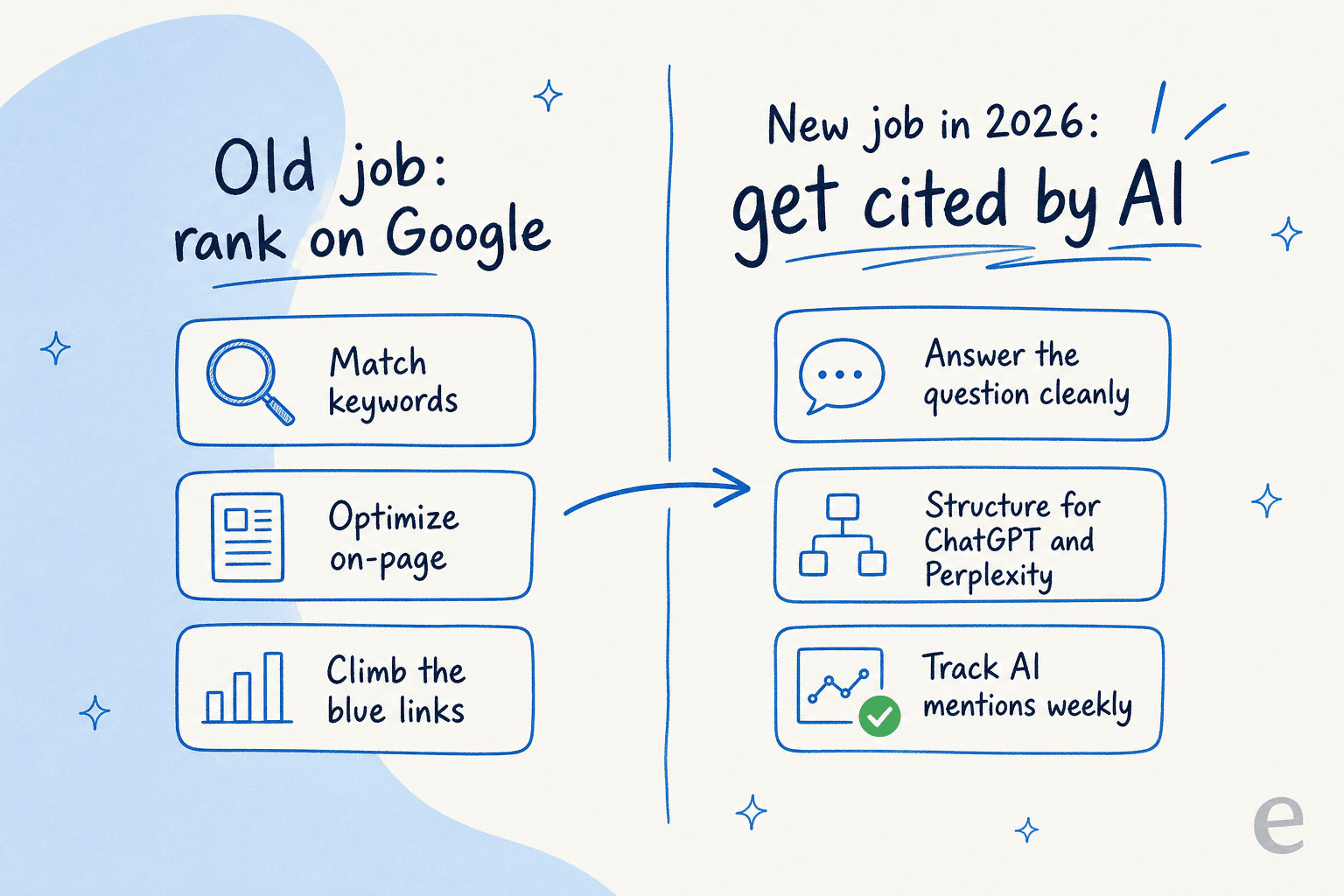
You can see it in how the tools repositioned. Surfer rebranded from an "SEO content tool" to an "AI Visibility Platform". Writesonic now calls itself an "AI Search Growth Engine" and tracks mentions across 10 AI surfaces. Frase put GEO optimization on every plan. This new discipline even has a name now, generative engine optimization, and it's the single biggest reason the category looks different than it did in 2025.
The practical takeaway for you: if a tool you're evaluating still talks only about keyword density and word count, it's selling you a 2024 product. Surfer's own study claims content optimized for it is 25% more likely to get cited by AI (their number, not independently tested), but the direction is real across the whole field.
1. Jasper, best all-in-one for marketing teams
Best for: marketing teams that want brand voice, SEO, and team governance in one platform.
Jasper is not a writing chatbot, it's a platform built around marketing teams. The 2026 product is organized into purpose-built agents (SEO, campaigns, research), content pipelines for scaled production, and Jasper IQ, a context layer that stores your brand voice, style guide, and knowledge so every output stays on-brand. That last piece is the real reason teams pick it: when six writers share one brand voice profile, the blog stops sounding like six different people.
It's also the most credentialed option here. Jasper claims 100,000+ businesses and names customers like Wayfair, L'Oréal, and Cox Automotive, with 4.7/5 across 1,270 reviews on G2. Anthropologie says it automated 60% of its SEO with the tool.
Pros
- Genuinely strong brand-voice and team governance, the best here for multi-writer teams.
- A real SEO agent plus a Chrome extension that works inside Docs, WordPress, and Gmail.
- LLM-agnostic, so it routes to whichever model fits the task.
Cons
- The dominant G2 complaint is "generic / repetitive" output, and one paying reviewer switched to ChatGPT because it followed their brand voice better.
- Pricing is steep for solos: $59 to $69 per seat draws the most "expensive" tags from small teams.
- No free forever tier, and Pro is single-seat only.
Pricing: Pro is $69/month ($59 annual), single seat. Style Guide, API, and SSO are all Business-only, and Business is custom-quoted with a 12-month commitment. A 7-day free trial runs without a sales call.
Verdict: if you're a marketing team and brand consistency across writers is the thing keeping you up at night, Jasper earns its price. Solo bloggers will find it expensive for what they use, and should look at Jasper alternatives or weigh it against ChatGPT first.
2. Koala AI, best value for fast SEO articles
Best for: affiliate bloggers and solo publishers who need volume cheaply.
If Jasper is the enterprise option, Koala AI is the indie-hacker favorite. Its hero pitch is "AI Articles That Actually Rank," and the flagship KoalaWriter does one thing brilliantly: type a keyword, pick an article type, and get a 3,000-plus-word, publish-ready post out the other side. The feature users rave about isn't the writing, it's the one-click WordPress publishing and automatic internal linking, which is what flips people off plain ChatGPT.
The catch is in the billing. Koala charges by words, and word counts are metered at the GPT-5 Mini rate. Run the recommended Claude 4.5 Sonnet model and you burn words twice as fast, so a $49 plan's "100,000 words" is really about 50,000 high-quality words. Worth knowing before you budget.
Pros
- Unbeatable entry price at $9/month, with a free 5,000-word trial.
- One-click publishing to WordPress, Shopify, Webflow, and Ghost.
- Strong long-form output and Amazon affiliate article support.
Cons
- Public Trustpilot sits at 3.5/5 across 21 reviews, well below the 5-star wall on its own site.
- Word billing doubles on the good models, so the cheap plans are cheaper on paper than in practice.
- Pure SEO focus means weaker editorial range than a general model.
Pricing: Essentials $9/month (15,000 words), Professional $49/month (100,000 words, plus Deep Research and internal linking). Free trial is 5,000 words, no card.
Verdict: for anyone publishing at volume on a budget, especially affiliate and niche-site builders, Koala is the best dollar-for-draft value in this list. Just budget by effective words, not the headline number.
3. Surfer SEO, best for on-page optimization
Best for: teams that draft elsewhere and want the on-page SEO standard.
Surfer's signature is the Content Score, a single 0 to 100 number derived from reverse-engineering the live SERP, and it's become the de facto optimization metric writers reference. Long-time G2 reviewers call it "the best tool for content optimisation." In 2026 it rebranded into an "AI Visibility Platform" with an AI Tracker that monitors mentions across ChatGPT, Gemini, Perplexity, and Claude.
The honest knock, straight from users: Surfer can push over-optimization. Follow its recommendations literally and you get "SEO soup," too many H2s and a bloated word count, as a r/WebsiteSEO thread puts it. Its built-in Surfer AI writer produces a publish-ready article in under 20 minutes, but reviewers find it best for a skeleton, weak for technical or how-to niches.
Pros
- The Content Score and SERP Analyzer are best-in-class for on-page guidance.
- Genuinely useful for non-SEO writers who need a checklist.
- Strong content audit and re-optimization loop for existing posts.
Cons
- Easy to over-optimize if you treat the score as gospel.
- Pricier than Frase for similar core optimization.
- Surfer AI's auto-writing is the weakest part of the package.
Pricing: Discovery $49/month, Standard $99, Pro $182, Peace of Mind $299, billed yearly. The AI Tracker and higher prompt limits live on the upper tiers.
Verdict: if you already draft well (in Claude, ChatGPT, or your own head) and want the optimization layer the rest of the industry uses, Surfer is the pick. If price stings, Frase vs Surfer SEO is the comparison to read, and Claude vs Surfer SEO covers the draft-then-optimize combo.
4. Frase, best for content briefs and SEO research
Best for: SEO-led writers who live and die by the brief.
Frase is most often described in head-to-head threads as "a cheaper Surfer," and that undersells it. Its real strength is the content brief: it scrapes the top 10 SERP results for a keyword in about 30 seconds, finds the gaps competitors miss, and rolls them into an outline you can hand to a writer. If your workflow starts with a brief, Frase is built for exactly that moment.
It's also leaned hardest into GEO of anyone at this price. Every plan, even the $49 Starter, includes GEO content optimization and AI visibility tracking, with plans differing on volume rather than capability. Kevin Indig, Shopify's former SEO director, says his "organic traffic is up 3x" since adopting it (a vendor-published testimonial, worth a grain of salt).
Pros
- Outstanding brief and outline generation, the standout strength across reviews.
- 4.8/5 from 301 G2 reviews, among the highest here.
- GEO and AI tracking on every plan, not gated to enterprise.
Cons
- Optimization depth is a notch below Surfer for hardcore on-page work.
- Article limits on the Starter plan (10/month) are tight for high-volume teams.
- The "$38/month" figure on its tools page doesn't match the $49 pricing page, so confirm before budgeting.
Pricing: Starter $49/month (10 articles), Professional $129 (40 articles, 3 seats), Scale $299 (100 articles). Annual billing knocks off 20%.
Verdict: for solo SEOs and small agencies who plan content around briefs, Frase delivers most of Surfer's value for less, with better research. If your bottleneck is writing rather than planning, pair it with a stronger drafter.
5. Scalenut, best end-to-end SEO workflow on a budget
Best for: solo marketers who want keyword research, writing, and optimization in one cheap tool.
Scalenut tries to be the whole pipeline: keyword planning, clustering, one-click writing, optimization, and AI visibility tracking. Its writing core is Cruise Mode, which turns a keyword into a 1,500-plus-word draft in under five minutes using SERP and AI-prompt data. Reviewers consistently say its biggest win is replacing two or three separate tools, the keyword research to draft flow happens in one place.
It rates well (4.7/5 from 315 G2 reviews), and the recurring complaint is the familiar one: output can be repetitive and needs human editing. There's also a sharp 0/5 review describing refund and cancellation pushback, worth knowing before you commit annually.
Pros
- Genuinely all-in-one for the price, keyword research through optimization.
- Keyword planner and clustering are repeat standouts in reviews.
- Frequent promos (a 60%-off deal was live at research time) make it cheap to start.
Cons
- AI output leans generic without editing, the dominant complaint.
- Billing and refund friction shows up in detailed negative reviews.
- No SOC 2 / ISO certifications surfaced, a concern for larger orgs.
Pricing: Starter $59/month list (often discounted to ~$24 on promo), Plus $89, Professional $199. A done-for-you VIP service is custom-quoted. 7-day free trial.
Verdict: if you're a solo marketer or small team who wants one affordable tool to cover the whole SEO content workflow, Scalenut is a strong value play. Just edit everything it produces, and read the cancellation terms before going annual.
6. Writesonic, best for tracking AI search visibility
Best for: teams whose priority is showing up inside AI answers.
Writesonic made the boldest pivot in the category. It's no longer pitched as an AI writer at all, it's an "AI Search Growth Engine" built to track your brand across 10 AI surfaces (ChatGPT, Perplexity, Gemini, Grok, and more), prioritize fixes in an Action Center, and run agents that rewrite pages for AI citation. The old article writer still exists as a metered quota inside the platform, but it's no longer the front door.
The numbers behind it are real: a 2 billion-conversation dataset updated weekly, 10,000+ marketing teams, and 4.8/5 across 2,031 G2 reviews. The headline customer story is Maestra closing six-figure deals from AI leads in 60 days. The catch: the multi-engine tracking that makes Writesonic special (Perplexity, Claude, Grok) is Enterprise-only, and the entry plan tracks ChatGPT alone.
Pros
- The deepest AI search visibility tracking here, across 10 engines.
- SOC 2 Type II, GDPR, and HIPAA compliant, hosted on Azure.
- Action Center turns visibility data into a weekly to-do list.
Cons
- Real multi-engine power is gated to Enterprise; lower plans track only ChatGPT.
- Expensive entry at $79/month, climbing fast to $399 for the popular Growth tier.
- Writing is now a secondary feature, so it's not a drafting-first tool.
Pricing: Starter $79/month (ChatGPT only), Basic $199, Growth $399, Enterprise custom (all 10 engines, full agents, SSO).
Verdict: if your boss is asking "are we showing up in ChatGPT?", Writesonic is the most complete answer, but you'll likely need Enterprise to get the full picture. As a pure writer, it's overkill; compare it against Copy.ai vs Writesonic or Ahrefs vs Writesonic if drafting is your main need.
7. Writer, best for enterprise brand control
Best for: large, regulated companies that need governance, security, and brand consistency at scale.
Writer is the odd one out, and deliberately so. It's a full-stack enterprise AI platform, not a blogging tool you sign up for on a Tuesday. Founded in 2020 and running its own Palmyra model family, it sells to Vanguard, Salesforce, KPMG, and Uber. Every CTA on the site is "Request a demo." For blogging specifically, the draw is its brand-voice enforcement, the single most-praised feature across Gartner and TrustRadius reviews, plus departmental voice profiles that keep a 500-person company sounding like one brand.
It's overkill for most bloggers, and I'd say so to anyone's face. But if you're in finance, healthcare, or any regulated space where a hallucination in published content is a compliance problem, Writer's governance stack (SOC 2 Type II, HIPAA, PCI, audit logs, SSO) is in a different league than the consumer tools.
Pros
- Best-in-class brand-voice and governance for large teams.
- Its own Palmyra LLMs, built for regulated enterprises.
- Deep compliance: SOC 2 Type II, GDPR, HIPAA, PCI.
Cons
- No public pricing; expect five- to six-figure annual contracts.
- The repeated complaint is slow performance on large documents.
- Enterprise-only gating frustrates anyone below a sales contract.
Pricing: a self-serve Starter plan exists (14-day trial, no public per-seat price) and Enterprise is full contact-sales. Treat it as a budgeted procurement decision, not an impulse buy.
Verdict: if you're an enterprise where brand and compliance outrank cost, Writer is the serious choice and the rest of this list isn't really competing. Everyone else should skip it.
8. Claude, best raw writing quality
Best for: writers who care most about how the prose actually reads.
No SEO dashboard, no AI tracker, no WordPress button, and it's still the tool I reach for when the writing has to be good. Claude is Anthropic's general-purpose large language model, and across Reddit it's the consensus pick for writing quality, "more natural and less AI-smelly" than its rivals. The current lineup runs on Fable 5 and Opus 4.8 with a 1M-token context window, which means you can feed it your whole back catalog and ask for a post that matches your voice.
The trade-off is that everything SEO is on you. Claude won't give you a content score or a SERP analysis, so you'll pair it with Surfer or Frase for the optimization layer. For pure first-draft quality at a low price, though, nothing here beats it.
Pros
- The most natural writing of any tool in this list, by a wide margin.
- Huge 1M-token context for long-form work and voice matching.
- A genuinely usable free tier; Pro is only $17/month annual.
Cons
- Zero built-in SEO or GEO; you supply the optimization step.
- Usage limits and occasional latency on the cheaper tiers.
- No one-click publishing or content-management integrations.
Pricing: Free $0, Pro $17/month (annual) or $20 monthly, Max from $100/month. API is usage-based if you want to build it into a pipeline.
Verdict: if your editing time is the bottleneck and you don't mind a separate SEO step, Claude is the best-writing, best-value option here. The natural pairing is Claude vs ChatGPT for blogging for the general-model decision, then an optimizer on top.
How much will this actually cost you?
Entry prices span almost an order of magnitude, from Koala's $9 to Writesonic's $79, with general models like Claude sitting cheaply in the middle. Here's the spread on the cheapest paid plan for each:
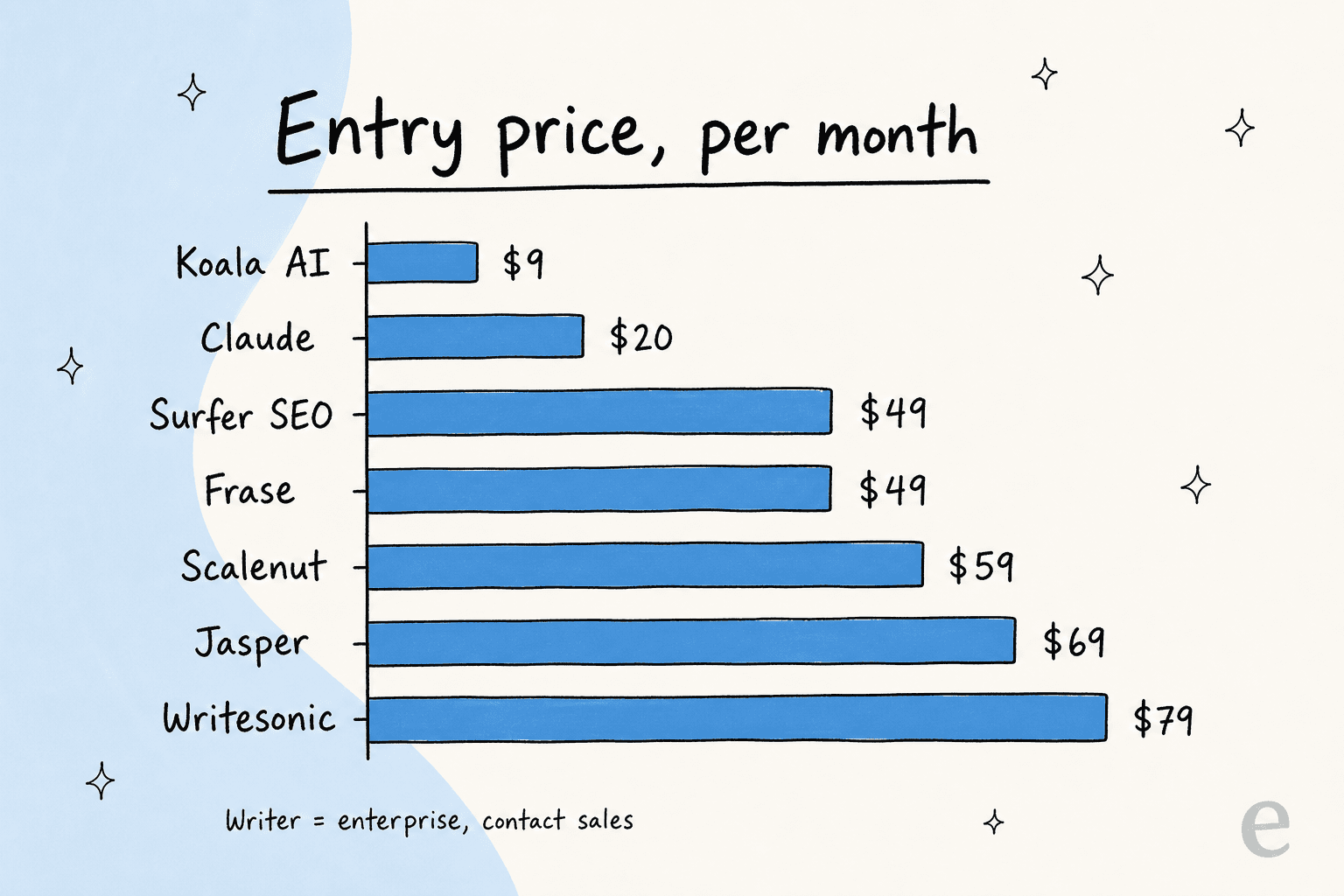
But the sticker price hides the real math. A worked example: say you publish 20 posts a month. On Koala's $49 Professional plan that's ~100,000 words, plenty, if you stick to the cheaper model; switch to Claude 4.5 Sonnet inside Koala and you're effectively at ~50,000 words, so 20 long posts will push you to the next tier. On Frase's $49 Starter you get 10 articles, so 20 posts means the $129 Professional plan. The lesson: always price your actual monthly volume against the billable unit, not the headline number. Our AI blog writer pricing guide runs more of these scenarios, and AI blog writer cost covers the hidden extras.
And remember the editing tax that no pricing page lists: every tool here produces a draft that a human has to fact-check and shape before it's safe to publish. Budget for that time, because the content decay and generic-phrasing problems that get AI posts ignored all trace back to skipping it.
Try eesel for content that answers your customers
Every tool above is built to write marketing blogs, the posts that bring strangers to your site. But a huge share of the content your team actually writes is the other kind: help articles, knowledge base pages, and the answers that resolve support tickets. That's the gap eesel AI fills.
eesel's AI writer learns from your existing knowledge base, past tickets, and docs, then drafts long-form content that's grounded in what your company actually knows, not just what a general model guesses. It runs alongside an AI helpdesk agent that resolves real support questions, so the same knowledge powers both your content and your customer answers. (Full disclosure: eesel's writer drafted the first pass of this post, which is the most honest test I can give it.)

Pricing is usage-based: a full blog draft is billed as a single $4 "heavy" task, with no per-seat fees, and you get 2 free blog generations plus $50 in free usage to try it. If your content problem is "we know our product better than anyone but can't write it down fast enough," that's exactly what it's for. You can try eesel free, no credit card needed.
Frequently asked questions
What is the best AI tool for blogging in 2026?
Is there a free AI tool for blogging?
How much does an AI blog writer cost?
Can AI writing tools actually rank on Google?
What is generative engine optimization (GEO) and why do these tools mention it?
Which AI tool is best for blogging if I'm a solo writer on a budget?
Do I still need an SEO tool if I write with Claude or ChatGPT?


Article by
Kurnia Kharisma
Kurnia is a software engineer and writer at eesel AI with two years of SEO experience, writing about AI tools, helpdesk software, and customer support. He pairs a developer's understanding of how these products are built with search-driven research into what actually ranks and resonates with the people searching for them.