Creating content that actually ranks on Google feels like a two-part job. First, you have to write something genuinely good, an engaging draft that people actually want to read. Then, you have to optimize that draft with data to make sure search engines will show it to people. This often means content teams are juggling a bunch of different tools, which can make the whole process a bit of a mess.
This guide looks at two popular tools that handle different parts of this process. On one side, you have Claude, a smart AI assistant from Anthropic that's great at generating text that sounds human. On the other, you have Surfer SEO, a platform built specifically for on-page optimization that tells you exactly what you need to do to rank.
The challenge? Using them together usually means writing in Claude, pasting it into Surfer, and then manually hunting for images and videos. It can be slow, clunky, and the subscription costs add up. This is why a new wave of tools is popping up. For instance, the eesel AI blog writer is designed to handle the entire workflow, taking you from a single keyword to a fully optimized, publish-ready post in one go.
Understanding Claude's role
Claude, from the folks at Anthropic, is more than just a chatbot. It’s an AI assistant designed for complex conversations, detailed summaries, and creative writing. Think of it as a writing partner who can help you brainstorm, draft, and polish your ideas. It's a fantastic tool for getting words on the page, but it's a writer, not an SEO specialist.
Here’s what makes it a solid choice for drafting:
It’s known for producing text that is coherent and genuinely human-sounding. This makes it a go-to for drafting everything from blog posts and emails to detailed reports. One of its best features is its ability to process and remember a lot of information. With a standard 200K token context window, it can handle about 500 pages of text. This is great for analyzing long documents or keeping track of complex ideas without getting lost.
It also has a neat "Artifacts" window that sits alongside your chat. You can draft documents or write code there, making it feel more like an interactive workspace than a simple Q&A bot.
But for all its writing skill, Claude has some major limitations for SEO. It has no built-in SEO features. It won't give you keyword suggestions, analyze the competition, score your content, or suggest internal links. To optimize a draft from Claude, you'll have to move it into a dedicated SEO tool.
Pricing:
- Free: A basic version for individuals to try out, with usage limits.
- Pro: Starts at $17 per month (when billed annually) for more usage, access to different Claude models, and integrations with tools like Google Workspace.
- Max: Starts at $100 per month for 5-20 times more usage than the Pro plan and priority access to new features.
Understanding Surfer SEO's role
If Claude is the writer, Surfer SEO is the data scientist. It's a specialized on-page SEO platform designed to give your content the best possible chance of ranking. Instead of focusing on the initial creative part, Surfer analyzes what's already working on Google and gives you a clear, data-backed blueprint for what to do.
Here's a look at its main features:
The Content Editor is Surfer's core tool. As you write or paste in text, it gives you a real-time "Content Score." It analyzes top-ranking pages for your target keyword and suggests important terms to include, the right word count, heading structure, and more. Before you even write, Surfer can also break down the top-ranking pages to create a brief that tells you what a competitive article needs to cover.
Surfer has some AI features like Auto-Optimize to help you refine your draft and an automatic internal linking tool. It even has an AI Humanizer to make AI-generated text sound a bit more natural. Its AI Tracker is a newer feature that monitors how visible your brand is in AI-powered search answers, like those from ChatGPT and Google AI Overviews.
The main drawback? While Surfer does have an AI writer, the output is often structured to hit SEO targets, which can sometimes make the text feel a bit robotic. It usually needs a good bit of human editing to add the nuance and flow you'd get from a writing-focused model like Claude.
Pricing:
- Essential: Starts at $79 per month (when billed annually) and gives you 30 Content Editor articles per month plus other basic features.
- Scale: Starts at $175 per month (when billed annually) for higher limits, 5 AI Tracker prompts, and more collaborative features for teams.
Claude vs. Surfer SEO: A head-to-head comparison
So, how do these two really stack up? The easiest way to see where each tool shines is to put them side-by-side. Claude is your creative partner for getting that first draft written, while Surfer is your data-driven coach for getting that draft into SEO shape. This comparison shows the core differences in the Claude vs. Surfer SEO debate.
| Feature | Claude | Surfer SEO |
|---|---|---|
| Primary Goal | Generate high-quality, human-like text for a first draft. | Optimize content based on SERP data to improve rankings. |
| Ideal Use Case | Brainstorming complex topics, writing long-form content, rewriting text. | Optimizing a finished draft, creating structured SEO content, auditing pages. |
| Workflow | Conversational and iterative. Refine output through prompts. | Data-driven and checklist-oriented. Focus on hitting SEO targets. |
| Key Strength | Creative writing, tone, and producing natural-sounding prose. | Data analysis, competitor benchmarking, and structured optimization. |
| Main Limitation | No built-in SEO guidance or competitor analysis tools. | AI-generated text can be generic and requires human editing. |
The challenge of a fragmented workflow
This is where the process can become complicated. While both Claude and Surfer SEO are effective tools, using them together can highlight challenges in a modern content process. The workflow is often disjointed, forcing you to pay for multiple subscriptions and constantly switch between tabs.
SurferSEO + ChatGPT (custom GPTs) — Surf’s audit data is super detailed, and pairing it with GPT-4 or Claude helps you turn that into actual optimization recs (not just scores).

A typical workflow looks something like this:
- Research: You start in a tool like Ahrefs or SEMrush to find your keyword and see what the competition is doing.
- Write: You take your research over to Claude and work with it to generate a solid first draft.
- Optimize: You then copy the entire draft from Claude and paste it into Surfer SEO's Content Editor.
- Refine: Now you spend your time tweaking the text to chase a high Content Score, adding in suggested keywords, and reworking your headings.
- Publish: Finally, you move the finished text into your CMS (like WordPress), where you have to find and add images, videos, and other media.
An alternative: Unified content generation with the eesel AI blog writer
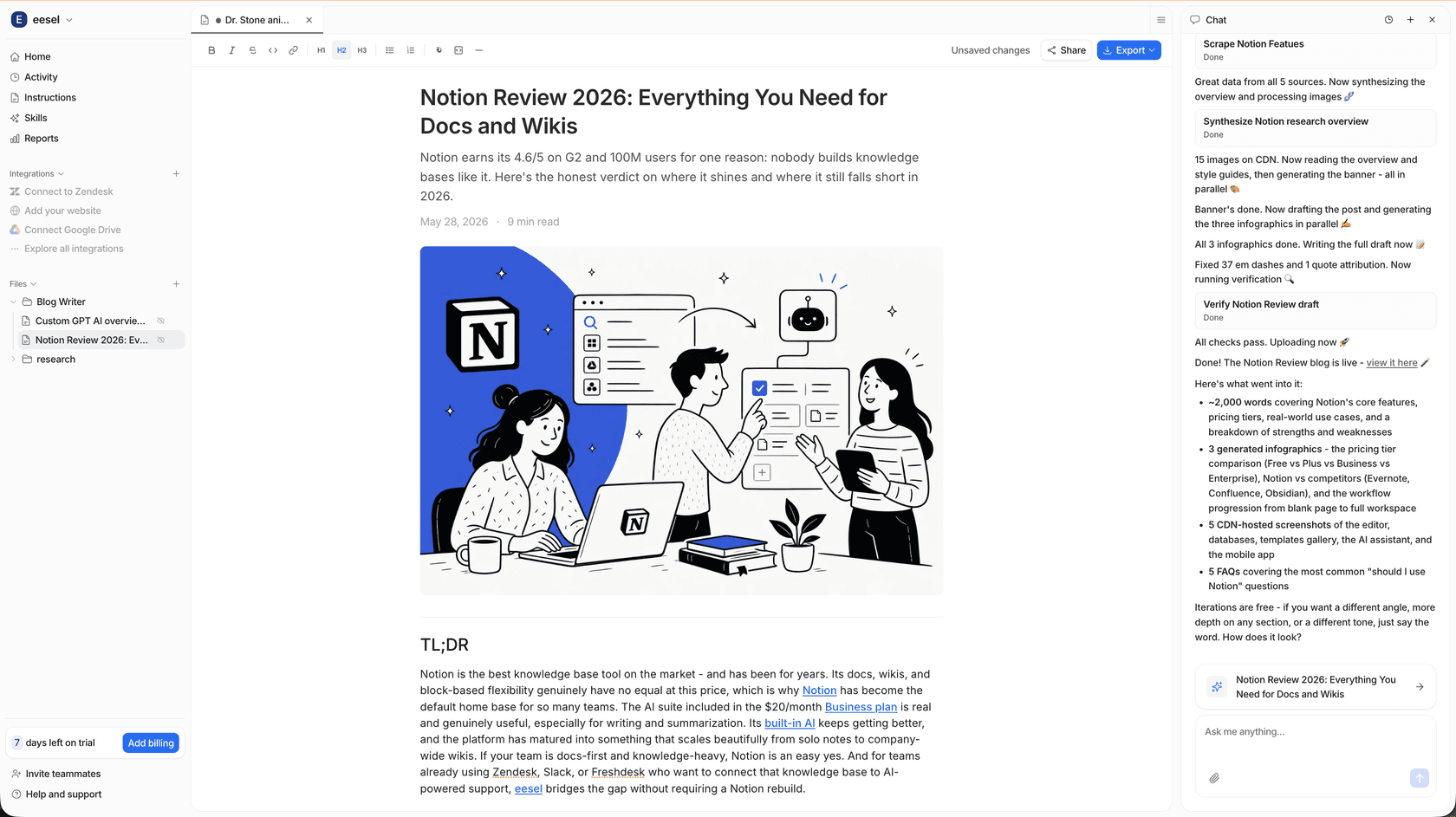
You just give it a keyword, and eesel AI handles the rest. It automates the research, writing, optimization, and even finds assets for you, turning that clunky, multi-step process into a single click.
Here’s what makes it different:
- Complete Content, Not Just a Draft: It doesn't just give you a rough draft. You get a fully structured article with an introduction, body, conclusion, and optimized headings, ready for both traditional search and new AI answer engines.
- Automatic Assets Included: The blog post comes with relevant, AI-generated images, infographics, and tables. This alone can save you hours of work.
- Built-in Social Proof: To add a layer of authenticity, it automatically finds and embeds relevant quotes from real people on forums like Reddit, which helps your content connect with readers.
- Proven Results: We used this exact tool at eesel AI to grow our own site from 700 to 750,000 daily impressions in just three months.
The best part? It's completely free to try, so you can see the quality of the content for yourself without any risk.
Claude vs. Surfer SEO: Which tool is right for you?
Choosing between Claude and Surfer SEO really comes down to which part of your content workflow is causing the most friction. The truth is, neither one offers a complete solution on its own.
Here’s a simple way to decide:
| Choose if you... | The Right Tool Is... |
|---|---|
| Need a creative partner to write high-quality first drafts. | Claude |
| Need a data-driven coach to optimize existing content for SEO. | Surfer SEO |
| Need an all-in-one engine to go from keyword to published blog. | eesel AI blog writer |
For teams that are tired of the disjointed workflow and want to scale high-quality content production, a unified tool is the clearest path forward. For a deeper dive into how AI writers are impacting traditional SEO tools, the video below offers some interesting insights on the evolving landscape.
Ready to try a seamless workflow that combines intelligent writing with data-driven SEO and automatic asset creation? Generate your first blog post for free with the eesel AI blog writer.