

Most AI writing tools solve for the blank page but fail the publishing pipeline. They draft generic text but leave you to handle the SEO, visuals, and CMS manual labor. We tested 15+ generators through real startup workflows; only seven held up to venture-backed speed. The one criterion that separated winners from losers, and our top picks, below.
Building a startup in 2026 isn't about working harder; it's about building a stack that works for you. When you're lean, every hour spent wrestling with a content editor is an hour taken away from product or sales. That's why the conversation around AI has shifted. We're no longer looking for "assistants" that need constant prompting. We're looking for teammates that can own a workflow from start to finish.
What are AI writing tools for startups?
At their most basic level, AI writing tools are software platforms that use Large Language Models (LLMs) like GPT-4 or Claude 4.5 to automate the creation of marketing copy, blog posts, and internal documentation. But for a startup, a basic text generator is rarely enough.
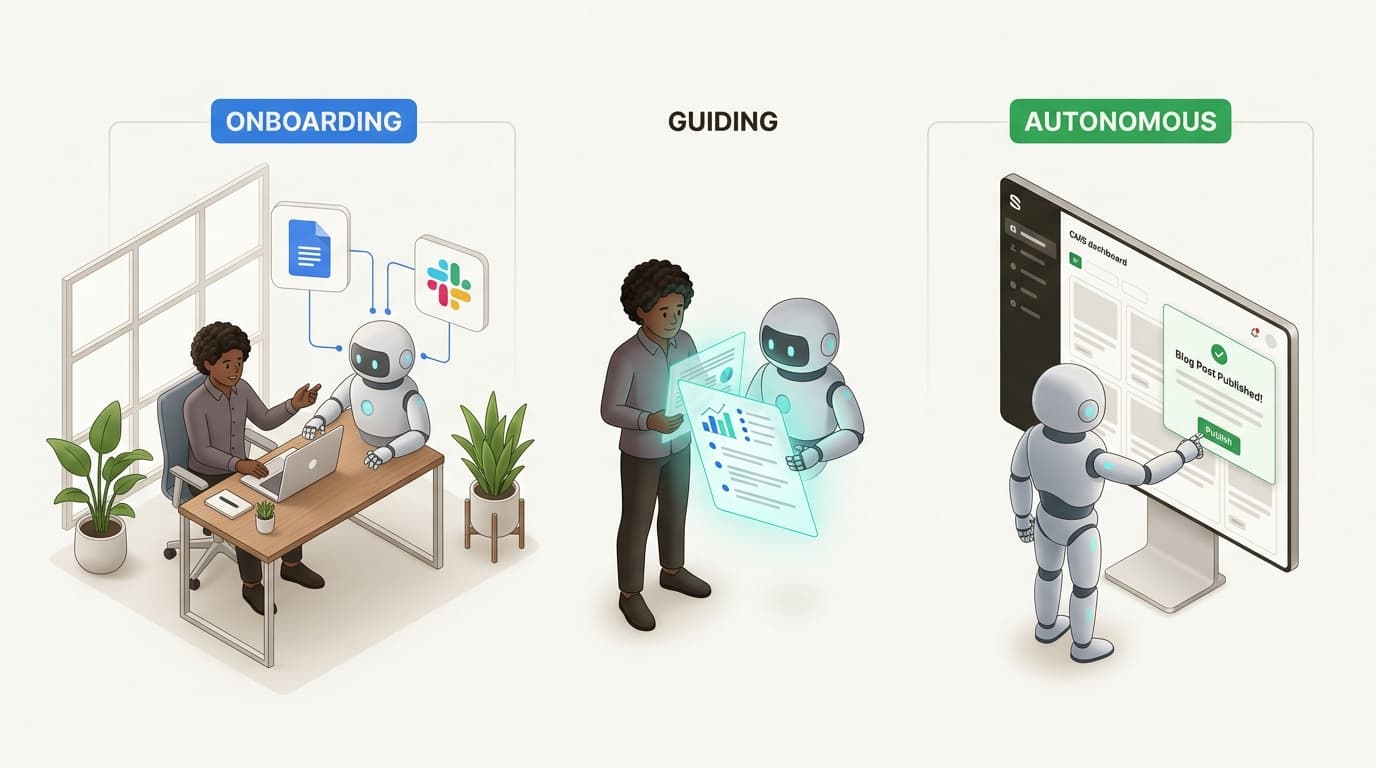
We use a "teammate" mental model when evaluating these tools. In a traditional setup, you configure a tool: you set the rules, you provide the inputs, and you manage the output. When you hire an AI teammate, the relationship changes. You onboard it by connecting it to your existing knowledge, you give it guidance on your brand voice, and you let it level up to work autonomously.
For lean teams, this generative output is a massive multiplier. Instead of hiring a full content agency, a single founder or marketing lead can oversee a pipeline that produces high-quality, researched content daily. It's about moving from "doing the work" to "reviewing the work," which is the only way to maintain venture-backed speed without a venture-backed headcount.
Choosing the right AI writing teammate for your startup
Not every tool fits every team. A bootstrapped SaaS founder has different needs than a series A marketing director. Before you "hire" your next AI writer, you need to look at five specific criteria:
- Speed to publish: Drafting is only about 20% of the battle. If a tool gives you a draft but leaves you to find images, format the SEO metadata, and manually upload it to WordPress, it isn't saving you as much time as you think.
- Cost-efficiency: Startup budgets are tight. You need to evaluate ROI across freemium tiers, per-task credits, and per-seat pricing. A "cheap" tool that requires three hours of human editing per post is actually more expensive than a premium tool that delivers publish-ready work.
- Scalability: Can the tool grow with you? You might start with two posts a week, but your stack should be able to handle 12 posts a day if you hit a growth spurt.
- Brand voice memory: Does the tool actually sound like you? Look for platforms that auto-learn your positioning from your existing docs rather than making you fill out a 20-page style guide.
- SEO and GEO capabilities: In 2026, ranking in Google isn't enough. Your content needs to be optimized for Generative Engine Optimization (GEO) so it shows up in AI search overviews as well.
7 best AI writing tools for startups in 2026
We've categorized the best AI content writing tools based on their "job description." Here is the shortlist of the teammates actually worth their spot in your stack.
1. eesel AI
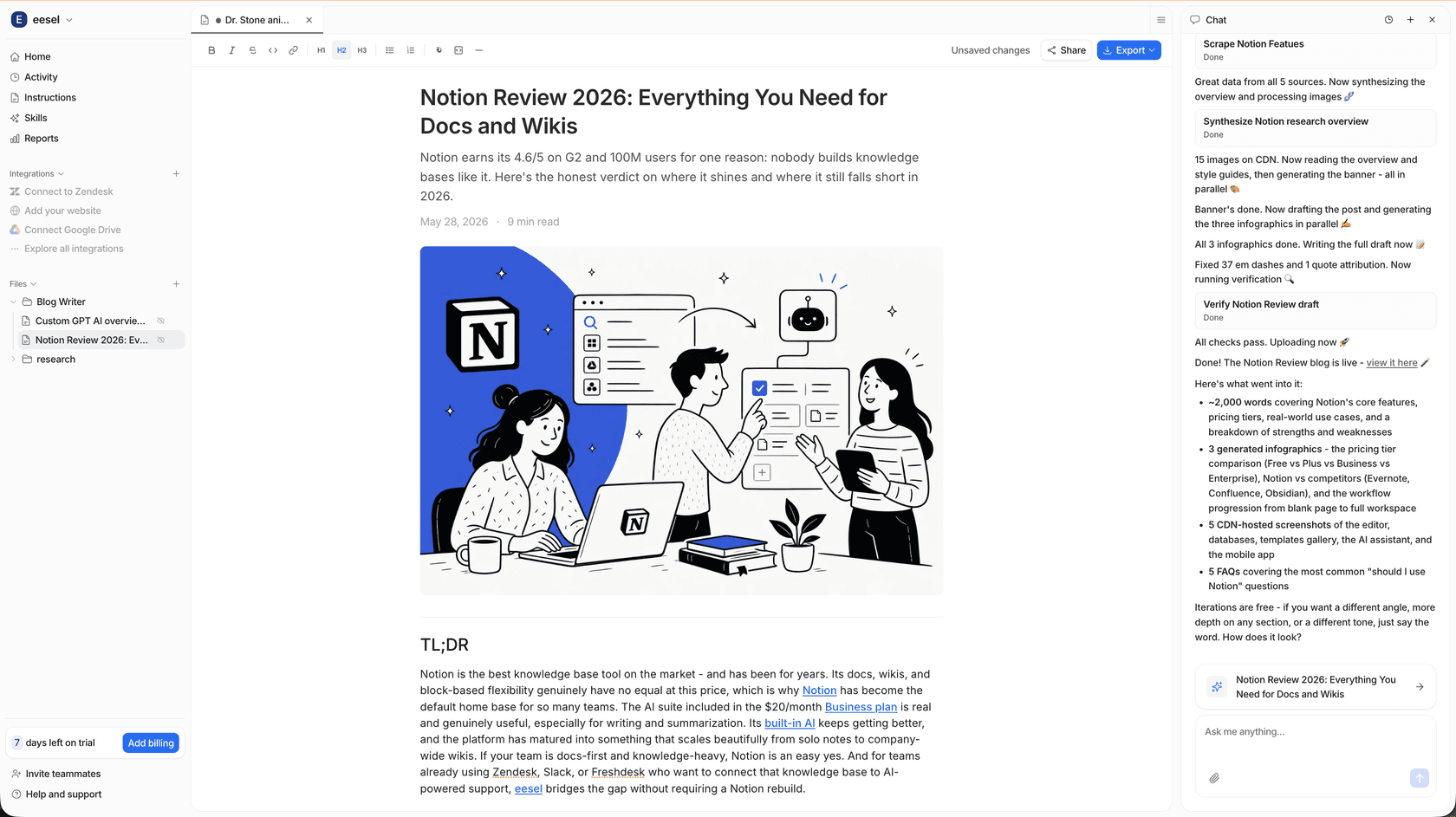
We built eesel AI to be the teammate that doesn't just write, but actually owns the publishing loop. It is specifically designed for startups that want to scale their organic traffic without building a massive content team.
Our AI Content Writer works by absorbing your existing company knowledge from day one. You don't "configure" it. You connect it to your help center, your past blogs, and your internal docs. It achieves a 94% brand voice match immediately, meaning your revision cycles drop from hours to minutes. It also handles the "boring" parts of blogging: it researches primary sources, generates SEO-aware metadata, and even includes automated visuals like diagrams and header images.
| Plan | Price | Key Inclusions |
|---|---|---|
| Free Plan | $0 | 100 free credits, no card |
| Teammate | From $299/mo | 500 credits, 1 credit per ticket or chat |
| Blog post | $4 each | Full blog post drafts with research |
| Add-ons | From $199/mo | SSO and MFA, priority support from $299/mo |
Pros:
- No manual training required; it learns from your existing tools.
- Blog posts are $4 each, so you only pay for what you publish.
- Handles the full loop from keyword research to CMS publishing.
Cons:
- Focused heavily on long-form blog and support content.
- Not a general-purpose "chat with a bot" interface.
Mastering AI and automation in your team is much easier when you have a tool that manages its own content creation pipeline.
2. Jasper
Jasper is the enterprise-grade veteran of the space. It is a comprehensive marketing platform that provides an extensive library of over 50 templates for everything from Facebook ads to long-form articles. For marketing teams that need deep collaboration features and a structured way to manage multiple brand voices, Jasper is a solid choice.
Jasper's brand voice features allow you to upload style guides or analyze existing content to ensure consistency. However, it is important to note that Jasper is a per-seat platform. For a growing startup, the monthly cost can add up quickly as you add more team members.
| Plan | Price | Seats | Key Features |
|---|---|---|---|
| Pro | $69/seat/mo | 1 | 2 Brand Voices, 5 Knowledge assets |
| Business | Custom | Unlimited | API access, SSO, dedicated support |
Pros:
- Massive template library for almost any marketing use case.
- Strong collaboration tools for larger marketing departments.
Cons:
- High per-seat pricing can be a drain on early-stage budgets.
- Does not offer direct publishing to most CMS platforms without third-party integrations.
3. Copy.ai
Copy.ai has evolved from a simple copywriting tool into a powerful workflow automation platform for Go-To-Market (GTM) teams. If your startup needs to automate sales outreach, generate social media captions at scale, or build custom marketing workflows, this is the tool for you.
Their GTM workflow builder allows you to connect different parts of your marketing funnel. While its long-form blog writing has improved, its real strength lies in high-volume, short-form copy and the ability to access multiple AI models (OpenAI, Anthropic, and Gemini) from one pricing plan.
| Plan | Price | Seats | Key Limits |
|---|---|---|---|
| Chat | $29/mo | 5 | Unlimited words in chat |
| Growth | $1,000/mo (annual) | 75 | 20k Workflow credits/mo |
| Expansion | $2,000/mo (annual) | 150 | 45k Workflow credits/mo |
Pros:
- Best-in-class for short-form copy and social media content.
- Access to multiple leading AI models in one interface.
Cons:
- Workflow-based pricing can be confusing for simple needs.
- Long-form content often requires more manual editing compared to specialized writers.
4. Notion AI
If your startup already lives in Notion, Notion AI is the most frictionless hire you can make. It lives directly inside your workspace, meaning there is no new tab to open and no copy-pasting required. It functions as a centralized "brain" for your company, allowing you to ask questions across your entire wiki or summarize meeting notes instantly.
The add-on pricing makes it very affordable for small teams. While it is excellent for internal documentation and drafting initial ideas, it lacks the specialized SEO and publishing features found in dedicated marketing tools.
| Plan | Base Price | AI Add-on | Key Features |
|---|---|---|---|
| Plus | $10/seat/mo | +$10/seat/mo | Q&A across docs, inline drafting |
| Business | $20/seat/mo | +$10/seat/mo | Advanced search, meeting summaries |
Pros:
- Zero friction for teams already using Notion for project management.
- Excellent for internal knowledge sharing and document cleanup.
Cons:
- Generic writing style for external-facing marketing content.
- Lacks native SEO optimization tools and GEO capabilities.
5. Claude
Claude, developed by Anthropic, is the choice for startups that need high-reasoning capabilities and a more "human" conversational tone. With a massive context window, it can digest entire industry reports or large datasets to help you find unique angles for your content.
While it isn't a dedicated marketing tool, Claude is widely considered to produce the most structured and nuanced writing of the general-purpose LLMs. It is a powerful partner for a founder who wants to brainstorm complex strategies or analyze market trends.
| Plan | Price | Limits |
|---|---|---|
| Free | $0 | Standard usage limits |
| Pro | $20/mo | 5x more usage than Free |
| Team | $25/user/mo | Higher usage and admin tools |
Pros:
- Best-in-class reasoning and ability to maintain complex structures.
- Sounds more natural and less "robotic" than many competitors.
Cons:
- Requires extensive manual prompting to get marketing-ready results.
- No native integrations with CMS or SEO tools.
6. ChatGPT
ChatGPT is the Swiss Army knife of the AI world. It's the most consistent all-rounder for ad-hoc tasks, brainstorming, and quick drafts. For bootstrapped startups, the free tier (powered by GPT-4o) is an unbeatable entry point into AI content creation.
However, for a professional content pipeline, ChatGPT has significant limitations. It lacks native brand voice memory and doesn't offer any features for automated publishing or SEO auditing. It's a great "thinking partner," but a poor "workflow owner."
| Plan | Price | Key Features |
|---|---|---|
| Free | $0 | Access to GPT-4o, limited data analysis |
| Plus | $20/mo | Early access to new features, higher limits |
| Team | $25/user/mo | Shared workspace, admin controls |
Pros:
- Extremely versatile; good for everything from coding help to email drafts.
- Most reliable performance across a wide range of general tasks.
Cons:
- No built-in way to save brand style guides or product context.
- Requires significant manual effort to move content from chat to CMS.
7. Koala
Koala is a specialist tool laser-focused on one thing: ranking in search engines. For startups that rely on niche site marketing or heavy SEO traffic, KoalaWriter is a powerful asset. It integrates real-time search data to ensure your articles are factually up-to-date and include the entities Google's algorithm is looking for.
Their credit-based pricing is straightforward, and the tool includes unique features like an Amazon Affiliate mode for product roundups.
| Plan | Price | Word Limit |
|---|---|---|
| Essentials | $9/mo | 15,000 words |
| Professional | $49/mo | 100,000 words |
| Boost | $99/mo | 250,000 words |
Pros:
- Built-in SERP analysis for better search rankings.
- Fetches real-time factual data to avoid AI hallucinations.
Cons:
- Limited to long-form blog content; not suitable for social or operations.
- The interface is functional but lacks the collaboration features of Jasper.
Comparing the top AI writing stacks for 2026
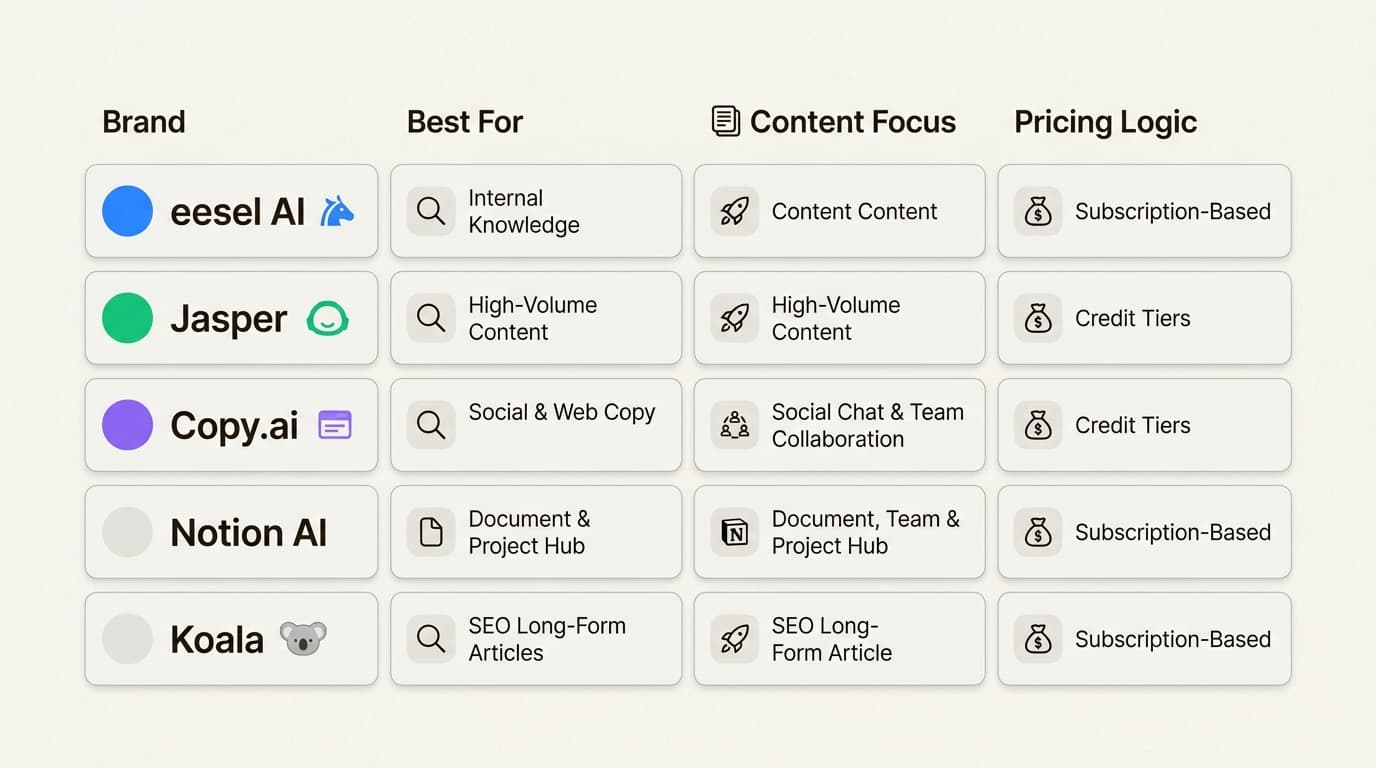
Choosing a tool depends on where your startup is in its journey. If you're looking for a "Hire and Forget" solution that handles the entire pipeline, eesel AI is the clear winner. If you're a marketing agency managing 20 different clients, Jasper's template library might be a better fit.
| Tool | Best For | Content Focus | Pricing Logic |
|---|---|---|---|
| eesel AI | Hands-off blog scaling | SEO Blogs | $4 per blog post |
| Jasper | Large marketing teams | Multi-channel | Per-seat |
| Copy.ai | GTM workflow automation | Sales/Social | Workflow credits |
| Notion AI | Internal documentation | Wikis/Docs | Per-seat add-on |
| Koala | Niche SEO sites | Long-form SEO | Credit-based |
The key differentiator is the "Strategy Engine" versus the "Drafting Assistant." Tools like ChatGPT and Notion AI are assistants; they wait for you to tell them what to do. Platforms like eesel AI function as a strategy engine, analyzing the market and executing the work with minimal oversight.
Tips for onboarding your AI writing teammate
"Hiring" an AI isn't a one-and-done setup. To get the best ROI, you need to manage them like a human teammate.
- Start supervised: Even the best tools need a probationary period. We recommend using an AI blog generator to draft content for review before you turn on full autonomous publishing. Watch how it handles your specific product nuances and give it feedback.
- Feed the knowledge base: Your AI is only as smart as the data it has access to. Connect your help centers, link your past successful blogs, and upload your product roadmap. This is how you move from generic output to a 94% brand voice match.
- Avoid technical debt: In the early days, it's tempting to use five different free tools for five different tasks. But this leads to a fragmented stack. Prioritize tools with native APIs and CMS integrations so your content flows seamlessly from research to live site.
How to get started with an AI writing teammate today
The bottom line? AI tools in 2026 are hires, not configurations. If you are still spending your weekends editing AI drafts, you haven't found the right teammate yet. Startups that win are the ones that automate the "manual labor" of content creation so they can focus on the big-picture strategy.
If you're ready to scale your organic growth without adding to your headcount, it's time to "hire" an AI marketing tool that actually knows how to work.