If you've spent any time inside SE Ranking, you've probably bumped into its Content Marketing toolkit, the bundle that pairs a real-time Content Editor with an AI Writer, a Content Idea Finder, and an AI Score. It's a reasonable add-on for teams already paying for SE Ranking's wider SEO suite. The trouble starts when content becomes the main job. The Content Editor's credit limits, a SERP database that's smaller than Semrush's or Ahrefs', and AI drafts that often need heavy editing all push serious content teams to look at dedicated alternatives.
This list covers six tools that real content teams actually compare against the SE Ranking content tool when they outgrow it. Some are cheaper, some are more expensive, and a couple cover ground SE Ranking simply doesn't, like AI search visibility tracking and topical authority planning. Each item has the pricing, what it's actually good at, where it falls short, and what users on G2, Capterra, and Reddit say after using it for real.
A small note before you dive in. We build eesel, an AI agent platform for support and internal teams. We pay attention to content tools because the same content you optimize for Google ends up feeding the AI agents your customers ask questions to. So this list is opinionated, but it's about helping you pick the right tool for your team, not selling you ours.
What we're looking for in a SE Ranking content tool alternative
A useful replacement does at least four things well. First, real-time SERP-based content scoring, the thing SE Ranking's Content Editor exists to do. Second, an AI writer that produces drafts you'd actually publish after a sensible edit pass, not generic filler. Third, some signal of how content is performing in AI search engines like ChatGPT, Perplexity, and Google's AI Overviews, since that's increasingly where readers find answers. Fourth, pricing that scales with your publishing volume rather than locking advanced features behind enterprise tiers.
We also weighted three softer factors. Editor experience matters because content teams live inside this tool every day. Integrations matter because briefs that can't move into WordPress or Google Docs create friction. And learning curve matters because tools with steep onboarding tend to gather dust on most teams.
Comparison at a glance
A quick read before the deep dives. Prices are starting tiers on annual billing where available; everything below the table sits in the per-tool sections.
| Tool | Starting price | AI writer | AI search visibility | Free trial |
|---|---|---|---|---|
| Surfer SEO | $49/mo (annual) | Surfer AI add-on at ~$19/article | AI Tracker, ChatGPT + Gemini + Perplexity | 7-day money-back |
| Frase | $39.20/mo (annual) | AI Agent included on every plan | GEO score + 8-platform AI tracking | 7-day free trial |
| Clearscope | $129/mo | AI drafting workflow included | Prompt Tracking on ChatGPT + Gemini | Demo only |
| NeuronWriter | $19/mo (annual) | Content Designer on Gold and up | Limited (semantic-only) | 7-day Gold trial |
| MarketMuse | Free, paid from ~$99/mo | Brief-driven, no native generator | Limited | Free plan |
| Writesonic | $79/mo (annual) | Full Article Writer | 10+ AI platforms tracked | Free tier |
Now let's walk through each tool, in roughly the order content teams should consider them.
1. Surfer SEO
Surfer SEO is the most direct replacement for the SE Ranking Content Editor. Where SE Ranking bundles content into a wider SEO suite, Surfer treats the editor as the main event. You drop in a target keyword, Surfer pulls the top SERP results, and a real-time Content Score grades your draft against NLP-derived terms, structure, and length recommendations. The platform was bootstrapped out of Poland and acquired by Groupe Positive in early 2025, and it's used by 16,000+ paying businesses across 140 countries.
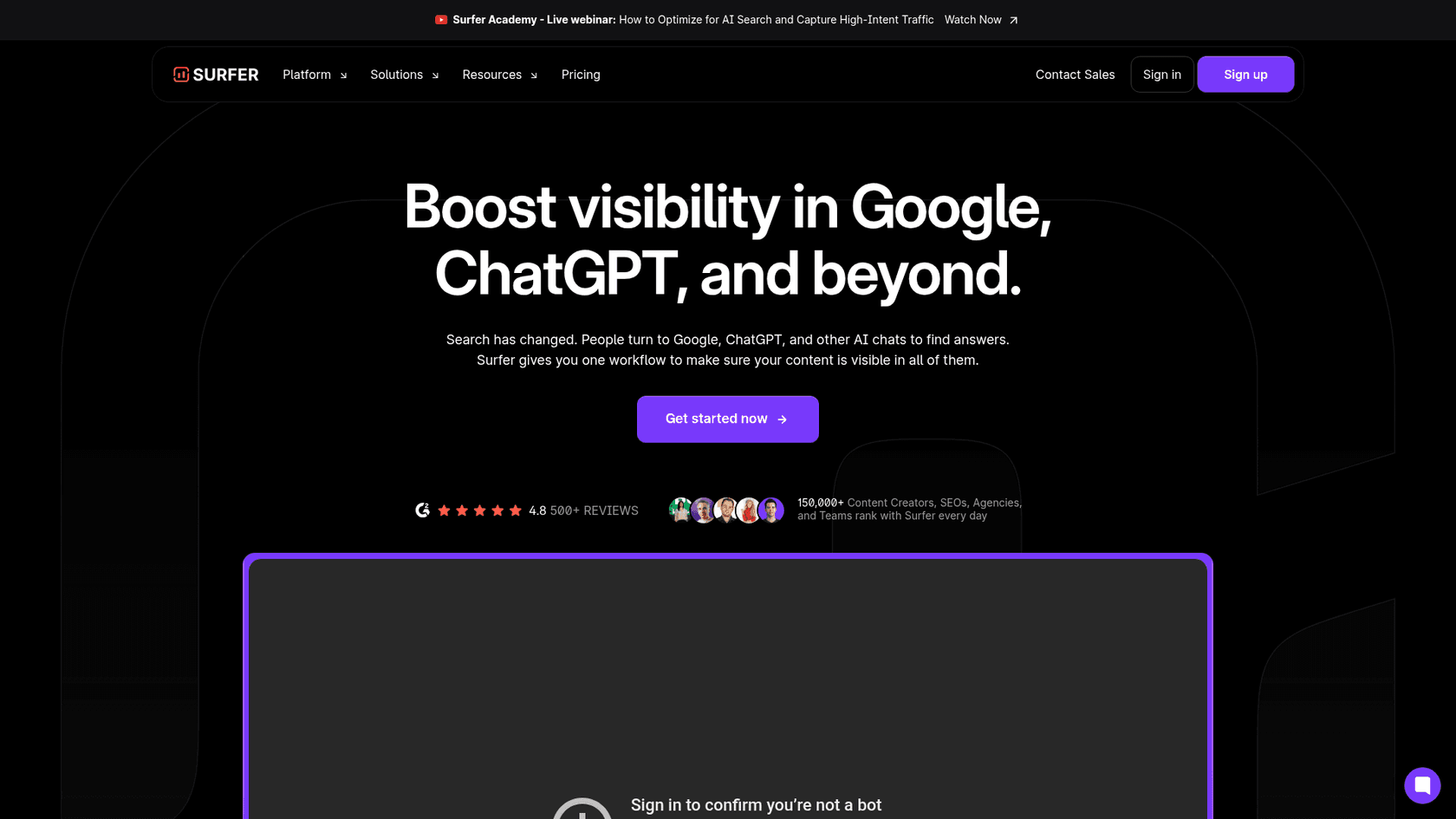
The Content Editor is the headline feature, but the more interesting layer is Surfer AI, which uses a mixture of models including GPT-4o to draft long-form articles directly inside the editor with the SERP recommendations baked in. Recent additions include the AI Tracker, which monitors brand mentions inside ChatGPT, Gemini, and Perplexity, and Auto-Optimize, which inserts internal links and refreshes existing content automatically.
Pricing
| Plan | Monthly billing | Annual (per month) | Documents | AI Tracker prompts |
|---|---|---|---|---|
| Discovery | $59/mo | $49/mo | 120 | 0 |
| Standard | $119/mo | $99/mo | 360 | 25 weekly |
| Pro | $219/mo | $182/mo | 360 | 50 daily |
| Peace of Mind | $359/mo | $299/mo | Unlimited | 100 daily |
| Enterprise | Custom | $999+/mo | Custom | Custom |
Surfer AI is billed separately at roughly $19 per article, on top of the base subscription. Annual plans are charged upfront for the year, per the Surfer pricing page.
What's strong
The Content Score is the single best-known number in the SEO content world, which means writers and freelancers know how to hit it. That makes Surfer especially useful for agencies handing briefs to outside writers, since the score gives a clear, data-backed target. SERP analysis is rich, NLP-driven, and updated frequently, and the editor is genuinely pleasant to write in.
What's weak
Two things come up repeatedly in user reviews. The first is cost relative to alternatives, especially once you add Surfer AI credits on top. The second is over-reliance on the score, which can produce content that hits a 90+ but reads like checklist writing.
"At nearly five times the cost of comparable tools, Surfer AI simply doesn't deliver enough unique value to justify the premium. I consistently found myself double-checking the statistics and references provided by the AI, only to discover they were either inaccurate or completely fabricated. What should be a time-saving tool instead creates more work." Amin N., CMO, Capterra, April 2025
That review captures a real risk. The Content Score is a useful constraint, but treating it as a quality bar rather than a floor is where teams get into trouble.
Best for
Agencies and content teams who write a lot, want strict editorial standards across freelancers, and can absorb the price. If your monthly volume sits in the 30-100 articles range, Surfer's editor is hard to beat. For solo creators on tight budgets, look further down this list.
2. Frase
Frase is the closest tool to "what SE Ranking's content add-on wishes it was." It bundles SERP-driven briefs, a long-form editor with a real-time Content Score, an AI Agent that handles drafting end-to-end, dedicated GEO scoring for AI search engines, topic clustering, and content monitoring, all under one subscription. It's the most feature-dense tool in this list, which is both its strongest argument and its main usability complaint.
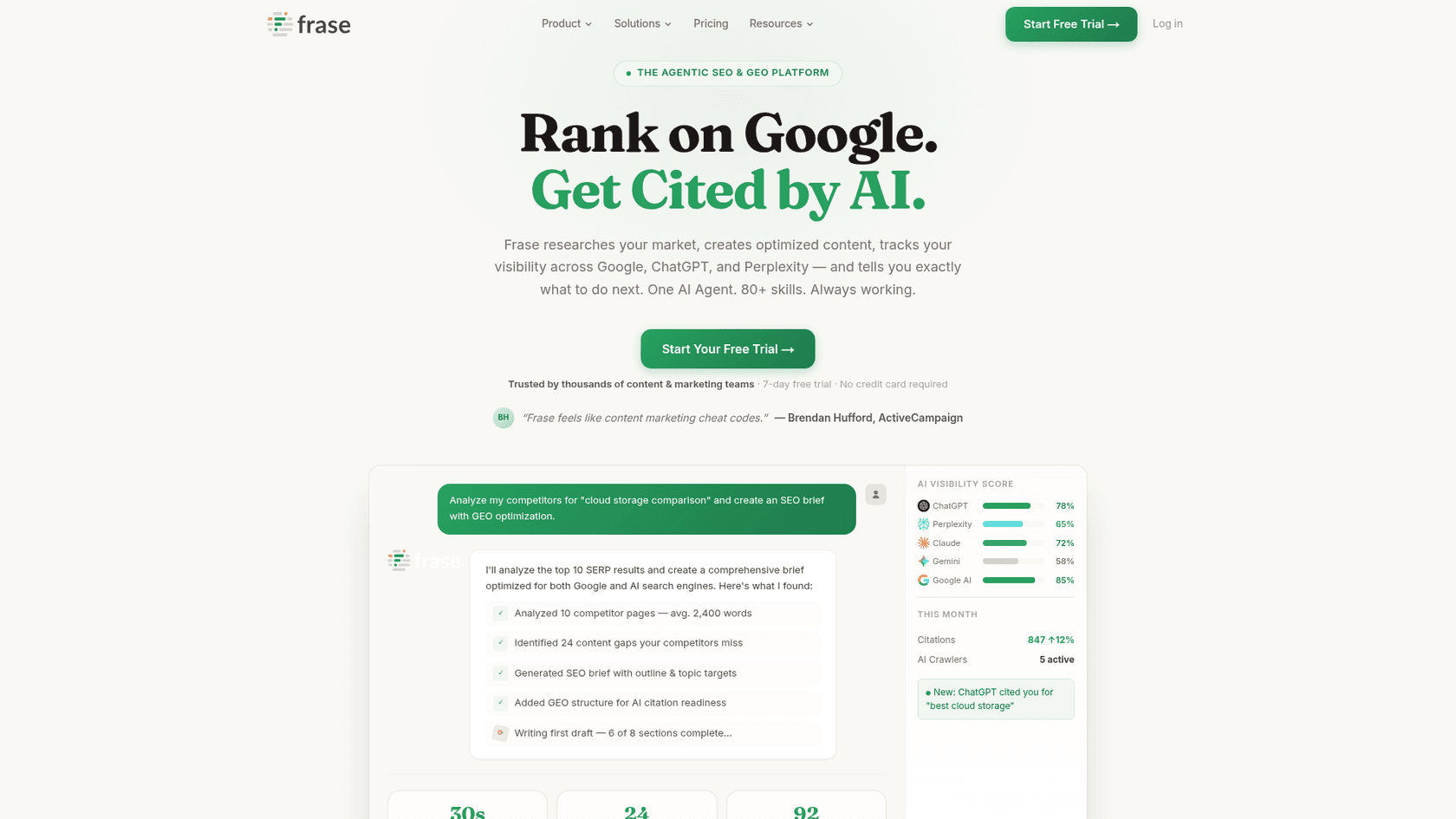
Where Frase pulls clearly ahead of SE Ranking is the GEO scoring layer. While SE Ranking has added some AI Visibility tracking, Frase has a separate score in the editor that grades content for citation likelihood inside ChatGPT, Perplexity, Claude, and Gemini, on top of the traditional SEO score. The AI Agent advertises 80+ specialized skills covering everything from research to content atomization, including a read-write MCP server so you can drive Frase from inside Claude or another AI assistant.
Pricing
| Plan | Monthly | Annual (per month) | Articles/mo | Team seats | Domains |
|---|---|---|---|---|---|
| Starter | $49 | $39.20 | 10 | 1 | 1 (50 pages) |
| Professional | $129 | $103.20 | 40 | 3 (+$29 each) | 5 (250 pages) |
| Scale | $299 | $239.20 | 100 | 5 (+$29 each) | 10 (1,000 pages) |
| Enterprise | Custom | Custom | Custom | Custom | Custom |
The full breakdown is on the Frase pricing page. Every plan, including Starter, includes the AI Agent. There's a 7-day free trial on every tier with no credit card up front.
What's strong
The Frase AI Agent does more out of the box than any other tool here. From a single input, it can produce a competitive brief, draft a full article against it, and atomize the result into LinkedIn posts and a newsletter. The GEO score is genuinely differentiated, and on paper Frase is the only tool in this list with a dedicated MCP server for AI-assisted workflows. G2 ratings sit at 4.8/5 across ~300 reviews.
What's weak
The interface is dense. Several reviewers describe a learning curve while they figure out which of the 80+ skills they actually need, and Frase rebranded under parent company Copyrytr in 2024, which created some friction for legacy lifetime-deal users.
"The brief builder and topic research features are incredibly helpful and easy to use. The SERP analysis saves a ton of time, and the AI writer feels like a real productivity boost without sounding robotic. It eliminates the guesswork in SEO and gives our team actionable insights to improve rankings." Parsa M., Digital Marketing and Workflow Automation Manager, G2
Quotes like that are common from technical marketers who've integrated Frase into a wider AI stack. If you're not the kind of team that would touch an MCP server or write your own brief templates, the breadth can feel like overkill.
Best for
Teams who want a single tool that handles briefing, writing, optimizing, AI search tracking, and atomization, and don't mind a steeper first week. Frase is a reasonable bet if you're moving away from SE Ranking specifically because you want a content-first tool that takes GEO seriously.
3. Clearscope
Clearscope sits at the premium end of the content optimization market. Where Surfer is the editor for high-volume agencies and Frase is the agent-driven all-rounder, Clearscope's pitch is that it's the cleanest, most accurate content grader. It's the tool the Webflow and IBM teams use to manage editorial calendars and protect rankings on existing pages.
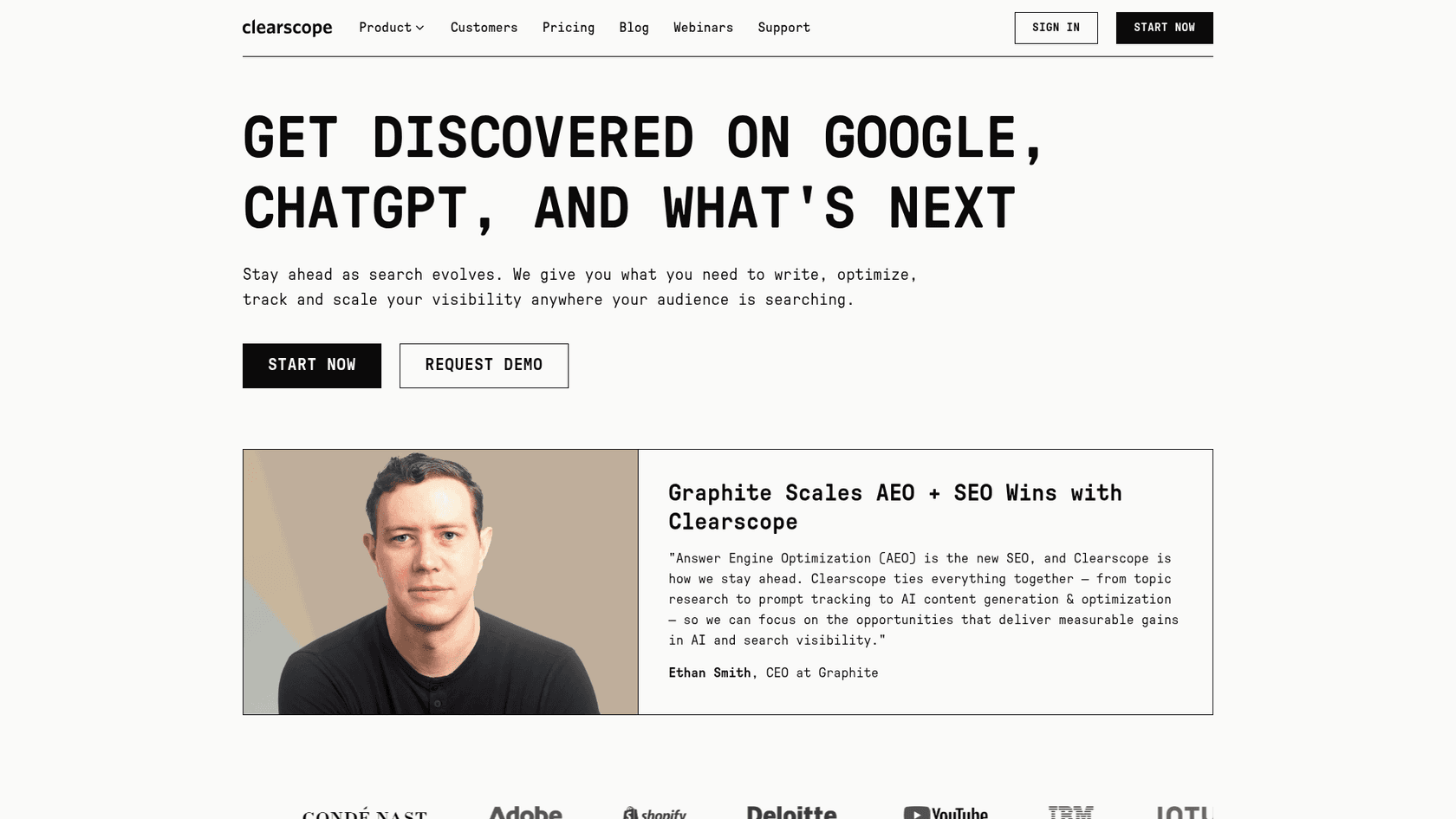
The product has four real layers. Topic Explorations for finding clusters and adjacent topics. The flagship grader and editor for term suggestions and scoring. An AI drafting workflow for first drafts. And Protect, which monitors published pages and flags rankings drift before it becomes a traffic problem. On top of that, Prompt Tracking tracks brand visibility inside ChatGPT and Gemini, with "query fan-out" awareness so you can see the searches AI platforms run when generating answers.
Pricing
| Plan | Price | Tracked topics | Pages | Topic Explorations | Drafts |
|---|---|---|---|---|---|
| Essentials | $129/mo | 20 | 50 | 20/mo | 20/mo |
| Business | $399/mo | 50 | 300 | 50/mo | 20/mo |
| Enterprise | Custom | Custom | Custom | Custom | Custom |
All plans include unlimited users, unlimited projects, prompt tracking, brand visibility tracking, intent recommendations, and free onboarding, per the Clearscope pricing page. Add-on credits are available at $25/mo per 100 extra pages on Essentials, and $20 per additional batch of 10 drafts on Business.
What's strong
Clearscope's term suggestions are widely considered the most accurate in this list, and the editor is the cleanest. The Graphite case study describes Clearscope as the connecting tissue between traditional SEO and answer-engine optimization, which lines up with how customers in the testimonials describe their workflow.
"Clearscope ties everything together, from topic research to prompt tracking to AI content generation and optimization, so we can focus on the opportunities that deliver measurable gains in AI and search visibility." Ethan Smith, CEO at Graphite
A second customer, Ryan Law, reports a 1.5 to 3 hour saving per article, in a context where the average article takes around 15 hours of cumulative team time.
What's weak
The price. At $129/mo for Essentials, Clearscope is roughly twice what teams pay for the SE Ranking Content Marketing add-on, with no free tier and no public trial (you have to request a demo to see the product). Limits on tracked topics are tight on Essentials, and most teams hit the Business plan within a year.
Best for
Established content teams at SaaS companies and publishers who already publish 5-15 well-researched articles a month, want premium term accuracy, and need clean Google Docs collaboration. If you're moving away from SE Ranking because the content side feels thin, Clearscope is a clear upgrade. If you're price-sensitive, skip ahead.
4. NeuronWriter
NeuronWriter is the value pick on this list, and the closest in spirit to SE Ranking's "bundled, affordable" content add-on, but built specifically for content optimization. It came up through AppSumo as a lifetime-deal favorite and now operates on a subscription model. The pitch is straightforward: semantic SEO recommendations, a content editor with a real-time score, SERP analysis, internal linking suggestions, and an AI writer that includes one-click article generation on the Gold plan and up.
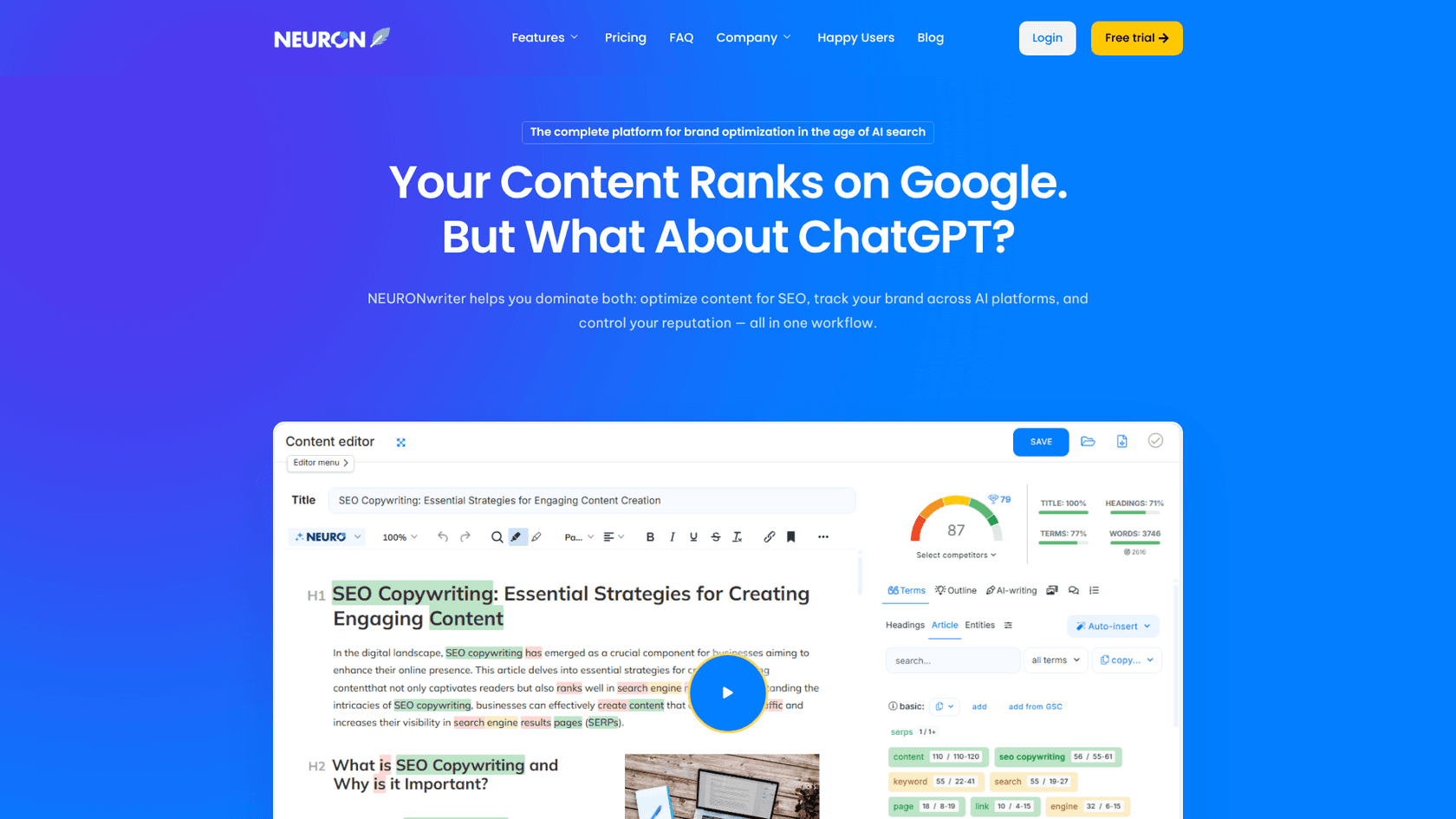
What sets NeuronWriter apart in the budget tier is the bring-your-own-key model for OpenAI on Gold and above. If you have your own OpenAI account, you can route AI writing through your own credits rather than paying for AI usage as part of the platform fee, which keeps cost predictable as volume grows.
Pricing
| Plan | Monthly | Annual (per month) | Projects | Analyses/mo | AI credits | OpenAI BYOK |
|---|---|---|---|---|---|---|
| Bronze | $23 | $19 | 2 | 25 | 15,000 | No |
| Silver | $45 | $37 | 5 | 50 | 30,000 | No |
| Gold | $69 | $57 | 10 | 75 | 45,000 | Yes |
| Platinum | $93 | $77 | 25 | 100 | 60,000 | Yes |
| Diamond | $117 | $97 | 50 | 150 | 75,000 | Yes |
There's a 7-day free trial under Gold-plan terms, and a 30-day refund window on first plan purchase, per their refund policy. Gold and above also include the Content Designer for one-click articles, integrations with WordPress and Shopify, and the Neuron API.
What's strong
For most content teams publishing 10-25 articles a month, NeuronWriter is half the price of SE Ranking's Content Marketing add-on plus base plan, and roughly a third the price of Surfer Standard. The editor is competent, the SERP analysis is solid for the cost, and the BYOK option is rare in this category. The 7-day free trial runs under Gold plan terms, so you can also try the Content Designer one-click article feature before committing, which most premium tools in this category gate behind a sales call.
What's weak
The interface feels less polished than Frase, Surfer, or Clearscope, and the AI writer's outputs are usable but rarely the best on this list. AI search visibility tracking is limited compared to dedicated tools like Frase or Writesonic.
Best for
Solo creators, small agencies, and bootstrapped SaaS teams who currently use SE Ranking's content add-on and find themselves wishing for more articles per month at less cost. NeuronWriter is the most direct trade-off in pricing for editor depth.
5. MarketMuse
MarketMuse is the topical authority specialist. Where most tools in this list start with "give me a keyword and I'll help you write a post about it," MarketMuse starts a layer up: "what should we be writing about, and how much, given what's already on our site?" That makes it less of a direct SE Ranking content editor swap and more of a strategic upgrade.
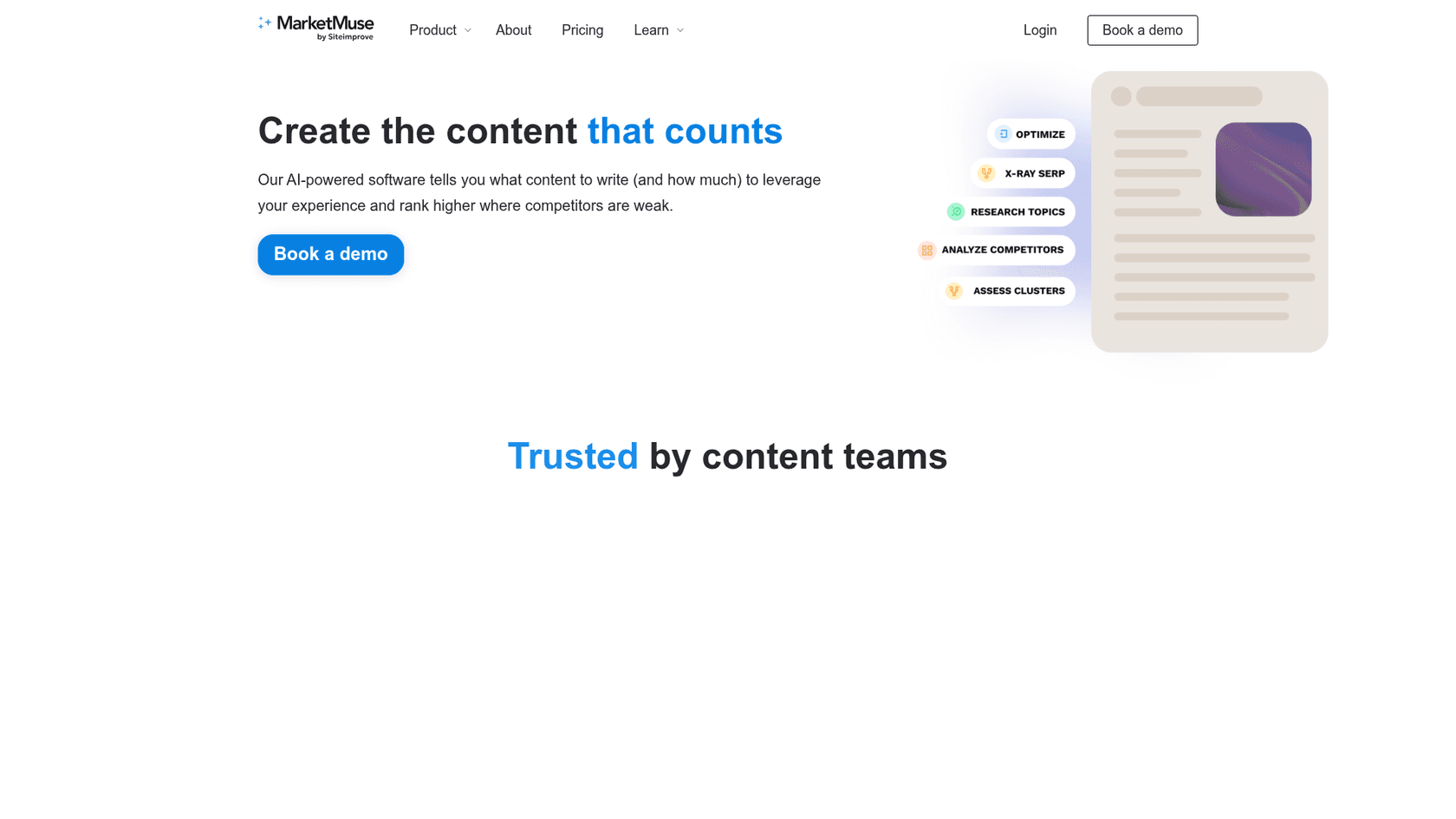
The platform's core idea is the Content Inventory, a continuously updated map of every page and topic on your site, paired with Personalized Difficulty scores that factor in the topical authority you already have. You feed MarketMuse a domain and a few seed topics, and it produces a content plan with brief outlines, cluster maps, and quick-win recommendations. The on-page editor uses Optimize briefs for writing assistance, not a one-click AI writer.
Pricing
| Plan | Tracked topics | Briefs/mo | Strategy docs/mo | Users |
|---|---|---|---|---|
| Free | None | None | None | 1 |
| Optimize (~$99/mo) | 100 | 5 | 1 | 1 |
| Research (~$249/mo) | 1,000 | 10 | 3 | 3 |
| Strategy (~$499/mo) | 10,000 | 20 | 5 | 5 |
Public pricing is light. The pricing page lists feature limits but routes paid plans through "Book a demo," with annual rates around $99, $249, and $499/month reported by G2 and review sites. The Free plan is genuinely usable for 10 monthly queries and a single user.
What's strong
Topic modeling and cluster planning are MarketMuse's clearest differentiators. If you publish at scale, the Content Inventory and difficulty scoring catch quick-win refresh opportunities that keyword-only tools miss. Andy Crestodina of Orbit Media described it as "precisely how you can outmaneuver your largest competitors," and a Sumo Logic content manager reported "4x to 10x more traffic with pieces we optimize with MarketMuse."
"We see 4x to 10x more traffic with pieces we optimize with MarketMuse." Zoe Hawkins, Principal Content Manager at Sumo Logic, MarketMuse customer testimonial
What's weak
Two things stand out across reviews. First, the interface has a steep learning curve. Reviewers commonly mention multiple weeks before they feel productive. Second, MarketMuse doesn't ship a one-click AI writer or GEO tracking on the same level as Frase or Writesonic. You're buying topical strategy and brief quality, not end-to-end content creation.
Best for
Content-led businesses, large publishers, and agencies whose primary job is to plan and protect topical authority across hundreds or thousands of pages. If your move away from SE Ranking is driven by wanting to be more strategic rather than to publish faster, MarketMuse is worth a serious look.
6. Writesonic
Writesonic is the AI-first option in this list. Where Surfer, Frase, and Clearscope started as content optimizers and added AI later, Writesonic started as an AI writer and added SEO and GEO tracking on top. The result is a tool that leans into automation. You give it a topic, and it produces a draft, an outline, optimization signals, and a visibility plan all in one workflow. Writesonic is trusted by 20,000+ teams, with 4.7/5 across 2,107 G2 reviews.
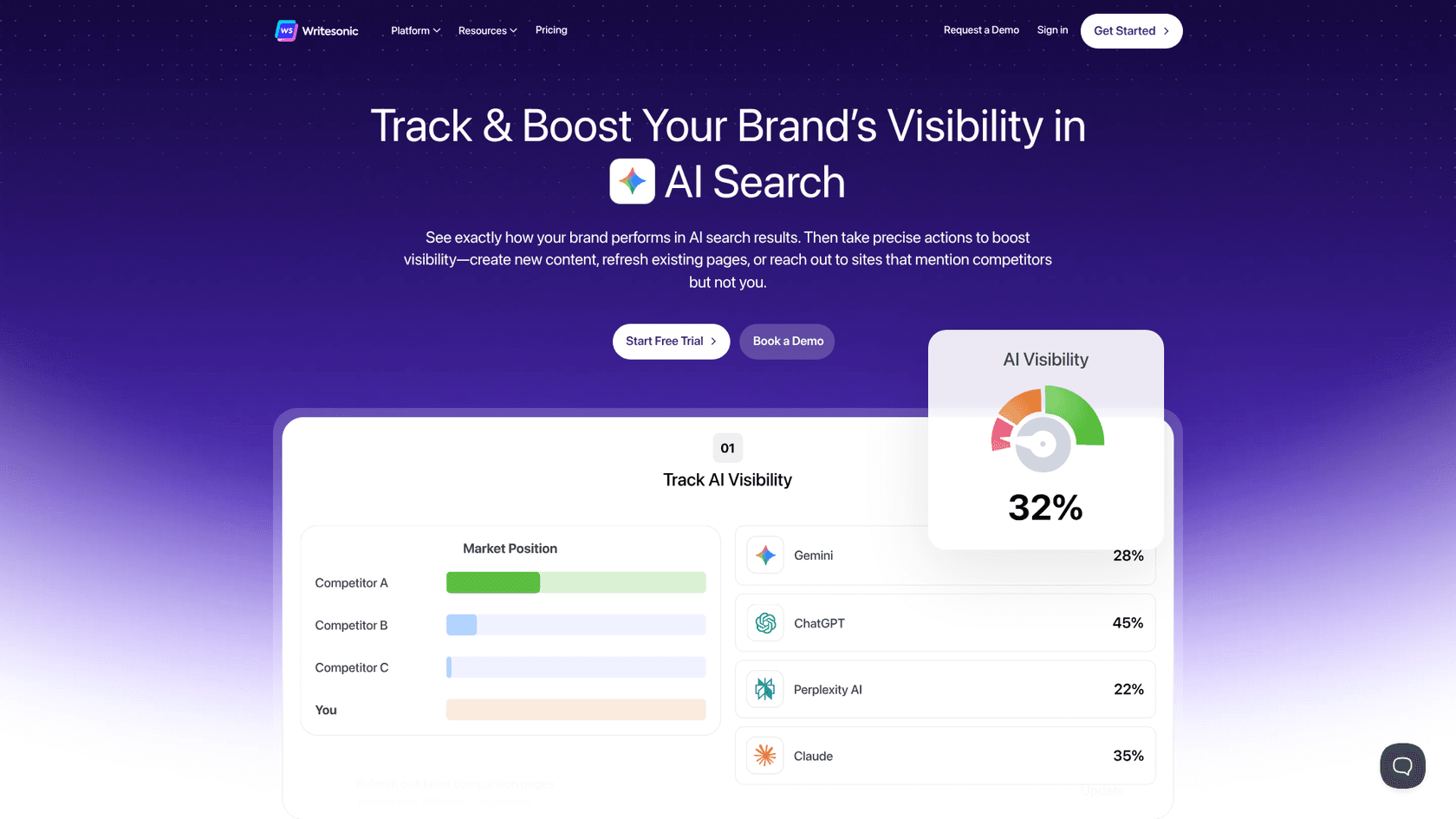
The most interesting recent move is depth in AI Search Visibility, tracking your brand across 10+ AI platforms including ChatGPT, Google AI Overviews, Gemini, and Perplexity. There are also two adjacent products under the same login: Botsonic for custom AI chatbots, and Chatsonic as a multi-model marketing assistant with access to GPT-4o, Claude 3.7 Sonnet, and Gemini.
Pricing
| Plan | Monthly | Annual (per month) | AI queries tracked | AI articles/mo | SEO audits | Pages analyzed |
|---|---|---|---|---|---|---|
| Starter | $99 | $79 | 50 | 15 | 10 | 100 |
| Basic | $249 | $199 | 100 | 25 | 20 | 1,200 |
| Growth | $499 | $399 | 200 | 50 | 50 | 2,500 |
| Enterprise | Custom | Custom | Custom | Custom | Custom | Custom |
Annual billing saves 20%, per the Writesonic pricing page. Starter only tracks ChatGPT visibility; Basic and Growth add Google AI Overviews and Gemini, with Perplexity, Claude, and others on higher tiers.
What's strong
Volume and breadth. If you want one tool that can draft articles, audit your site, monitor AI search visibility, and run a customer chatbot, Writesonic gets closer than anything else here. Reviews consistently praise speed and the breadth of templates.
"Writesonic lets you think about content strategy in the AI era on purpose, instead of just throwing stuff at the wall. We picked the prompts we care about being visible for, looked at how our competitors show up for those same prompts, now we generate content against them quickly, and track whether anything's actually shifting." Marya A., Head of Content, G2, 2025
What's weak
Writesonic's outputs are consistent but rarely the highest-quality drafts in this list. Reviewers note content quality issues more often than with Frase or Clearscope, and pricing for AI search tracking ramps quickly past Starter. If you'd rather have a slow, careful editor than a fast AI generator, this is not your tool.
Best for
Marketers and small SaaS teams who want one platform that handles AI writing, SEO scoring, and GEO tracking, and don't mind a heavier edit pass on drafts. Writesonic is also the best fit if you want chatbots and content under the same vendor.
How to choose the right tool for your team
A few patterns we keep seeing in teams switching away from the SE Ranking content tool. Use these as starting points, not rules.
If your monthly volume is under 10 articles and your budget is the main constraint, NeuronWriter is the cleanest swap. You give up some editor polish for roughly half the cost.
If you write 10-30 articles a month and want a single tool that handles briefing, drafting, optimization, and AI search tracking, Frase is the most complete option. Watch for the learning curve in week one.
If you need extreme term accuracy, work with editors and writers in Google Docs daily, and have budget to match, Clearscope is hard to beat. The price is a real consideration, but the editor experience is the cleanest.
If you publish at scale and your bottleneck is what to write next, not how to optimize a draft you already have, MarketMuse is the right strategic upgrade, even if it sits awkwardly next to a tool like Frase or Surfer.
If you want maximum AI automation and visibility breadth and you're comfortable editing drafts heavily, Writesonic covers more ground than any single tool above.
And if your team mostly cares about writing for outside contractors and freelancers with a clear, gamified target, Surfer SEO remains the safest pick, expensive credit limits and all.
A separate point worth making. Once content is live, it has to do real work. People search your site, ask questions in the chat bubble, file support tickets that mostly want what's already in the docs. That's where AI agents like eesel come in. eesel connects to your help center, blog, and internal docs and lets your customers ask questions against the content you've already produced, which closes the loop between content optimization and the people who actually need the answers. Whichever tool from this list you pick, the content you publish will be more valuable if it's also discoverable inside the AI agent your visitors talk to.
Wrapping up
The honest answer is that most teams don't really need an SE Ranking content tool replacement, they need a content tool that takes content seriously. SE Ranking's add-on works as part of a wider rank-tracking subscription. Once content becomes the main job, you'll be better served by something built for it. Surfer, Frase, Clearscope, NeuronWriter, MarketMuse, and Writesonic each represent a different trade-off, and the right pick depends on your volume, budget, and whether AI search visibility matters to your audience.
If you've made the swap recently, we'd love to know how it went. And if you're thinking about how the content you publish flows into the AI agents your customers and teams interact with, come and see what we're building at eesel.
Frequently Asked Questions
Is the SE Ranking content tool worth keeping if I already pay for the platform?
What's the cheapest SE Ranking content tool alternative?
Which alternative handles AI search visibility best?
Can I use these tools alongside an AI assistant on my own site?
What happens to my drafts if I switch tools?


Article by
Alicia Kirana Utomo
Kira is a writer at eesel AI with a Computer Science background and over a year of hands-on experience evaluating AI-powered customer service tools. She focuses on breaking down how helpdesk platforms and AI agents actually work so that support teams can make better buying decisions.