


Why people are leaving Writesonic in 2026
Writesonic's homepage doesn't even use the words "AI writer" anymore. The new framing is "track, prioritize, act, prove" across 10 AI search platforms - citation share, AI traffic, pipeline. That's a real product, and one with 4.8 stars across 2,031 G2 reviews supporting it. But it's not the product most "Writesonic alternatives" searchers came for.
What changed in practice:
- The entry tier got narrower. Starter at $79/mo tracks ChatGPT only - no Perplexity, no Claude, no Gemini, no Google AI Overviews. Anyone who needs the other engines has to jump to Basic ($199) or Growth ($399).
- Article generation is a quota now, not the product. Starter gives you 15 articles/month, Basic 25, Growth 50, with +20 articles for $100/mo as an add-on on Growth. That's effectively $5 per extra article on top of the platform fee.
- The Action Center - the headline new feature - is largely Enterprise-only. Growth gets a "trial" of 5 off-page + 5 on-page actions per month; everything else is gated to custom pricing.
- Older review threads still rank. The long-running r/SEO debate from years back summed up the AI-writer category as "you can turn full time blog writer into owner spending 3 hours a week … and yes, you're always gonna be heavily editing." That caveat hasn't gone away - it just isn't what Writesonic markets anymore.
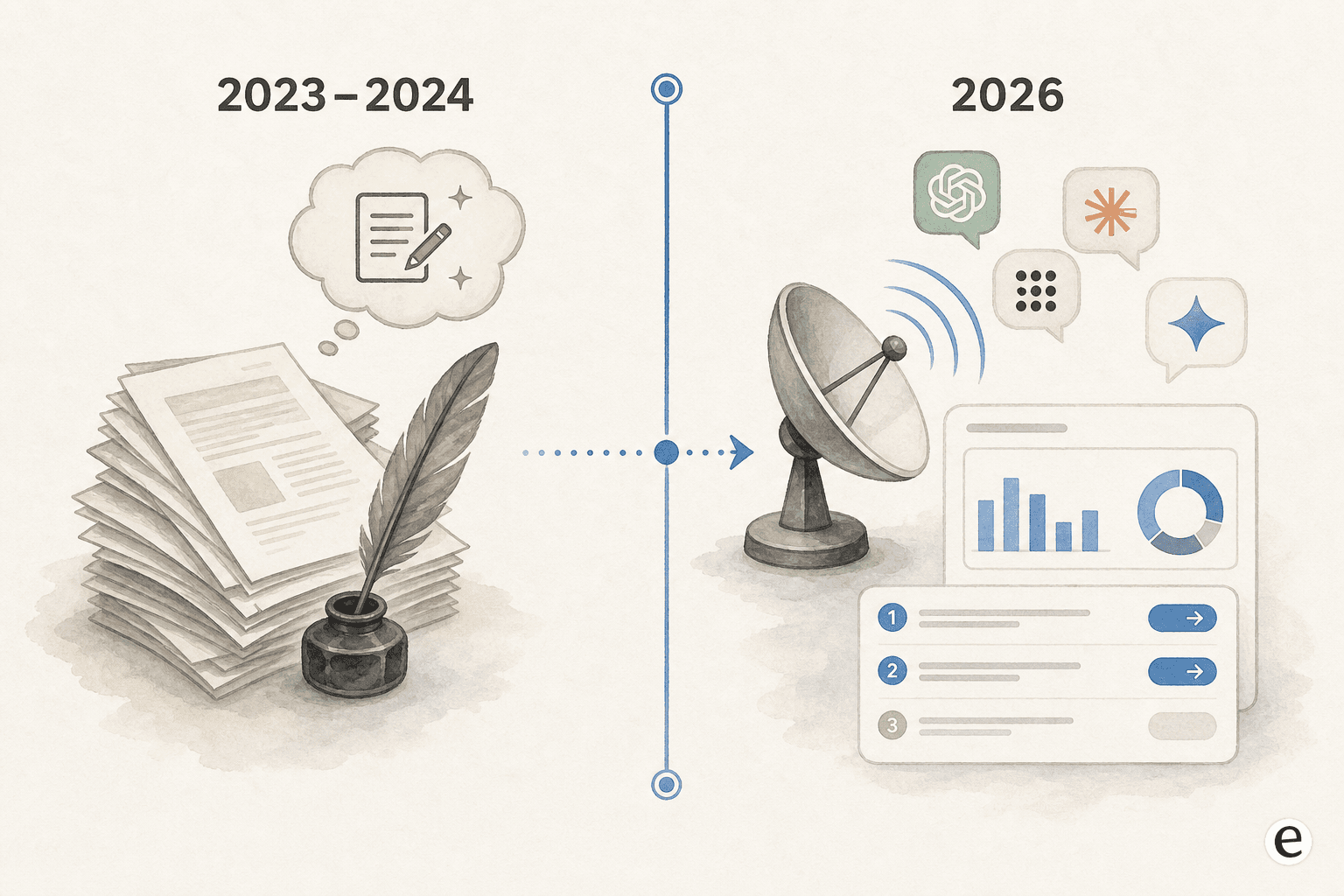
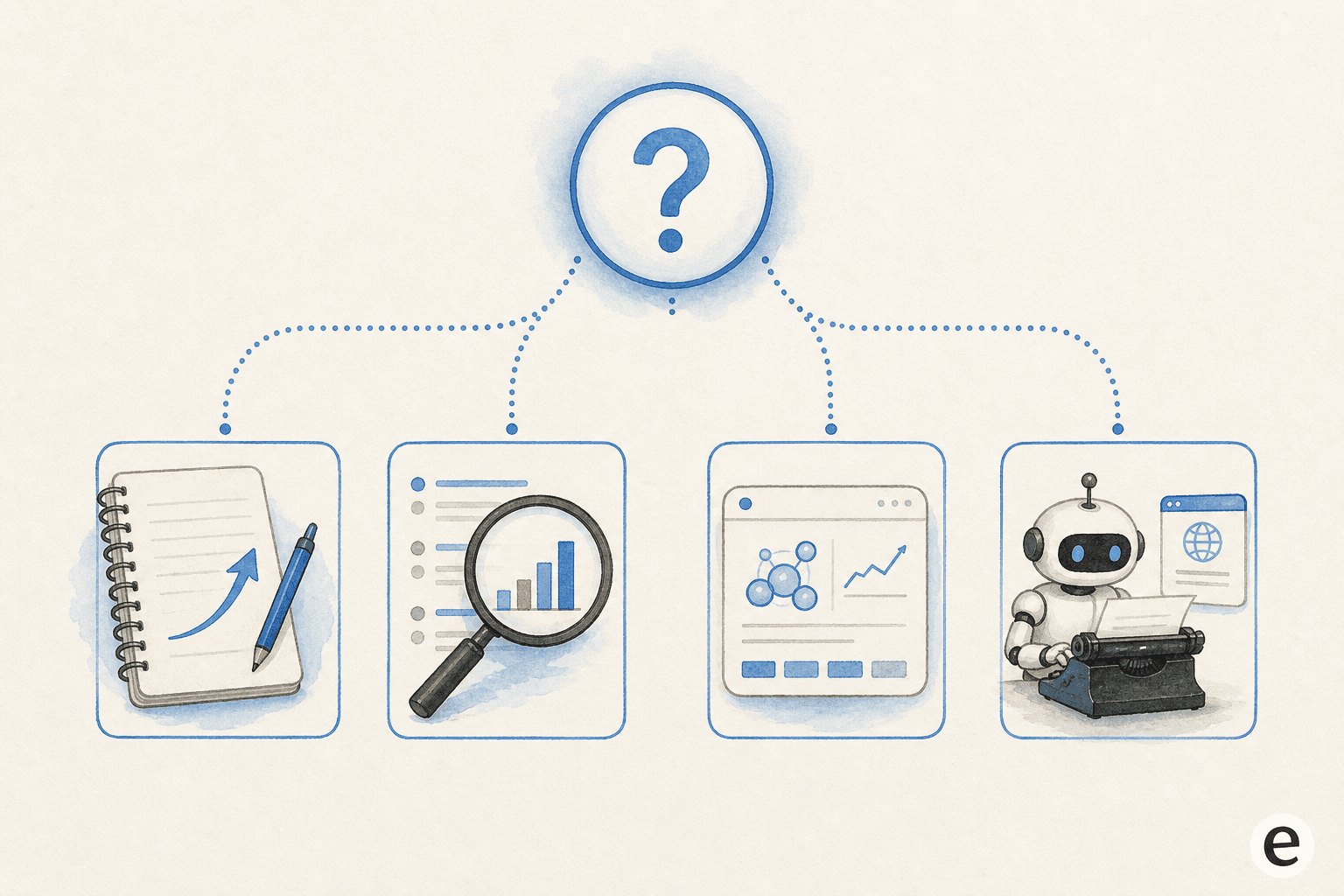
That mismatch is why this list reads the way it does. The question isn't "which tool is most like Writesonic" - it's "which tool actually does the job you came to Writesonic to get done." Four shapes of alternative cover it: autonomous publishing, brand-voice long-form, SEO optimization depth, and budget drafting.
How we picked the 9
We pulled the homepage, pricing, and feature pages from each tool in the last week, screenshotted the live UI, and cross-checked claims against G2 review counts, Trustpilot aggregates, and recent Reddit threads. Where vendors and reviewers disagreed (Koala's testimonial wall is uniformly five-star; its public Trustpilot sits at 3.5/5 across 21 reviews), we flag the gap.
Selection criteria, in order of weight:
- Real overlap with Writesonic's job-to-be-done - drafting blogs, SEO-optimizing them, scaling content, or replacing them with autonomous output.
- Live, current product - every tool below has a homepage, public pricing or sales-touch tier, and recent (last 6 months) sign of life.
- Verifiable user voice - at least one G2 / Trustpilot / Reddit thread we could pull a real quote from. No "according to industry reports" placeholders.
- A meaningfully different angle - we cut a half-dozen candidates that were near-clones of Jasper or Rytr. Each item here is on the list because it does something the others don't.
Quick comparison
| Tool | Starting price | Best for | Brand voice | SEO depth | Free trial |
|---|---|---|---|---|---|
| eesel AI Blog Writer | $4/post | Autonomous drafting + publishing | Yes (Brand DNA + style files) | Built-in SEO formatting | 100 free credits, no card |
| Jasper | $59/seat/mo (annual) | Brand-marketing teams | Yes - 2 voices (Pro) / unlimited (Business) | Via SEO agent + Surfer integration | 7-day Pro trial |
| Copy.ai | $24/mo (Chat) → $1,000/mo (Growth) | GTM workflows / RevOps | Yes - Brand Voice + Infobase | Light (workflow-driven) | None public (was 2K free words) |
| Writer.com | Contact sales | Regulated enterprise + AI agents | Yes - voice profiles | Light | 14-day Starter trial |
| Surfer SEO | $49/mo (Discovery) | SEO writers chasing SERP | Limited (workspaces) | Deepest of the list | 7-day money back |
| Frase | $49/mo (Starter) | Cheaper Surfer + GEO | Yes - brand voice profiles | Strong (SERP-driven briefs) | None public |
| Koala AI | $9/mo (Essentials) | Solo bloggers + affiliate SEO | Brand DNA from v2 | Real-time SERP analysis | 5K words free |
| Rytr | Free (10K chars/mo) | Solo creators on a budget | 1 custom tone (Unlimited) | None | Free forever tier |
| Anyword | $39/mo (Starter, annual) | Performance-driven marketers | Brand Voice hub | Light (SEO score on Blog Wizard) | 7-day trial |
Now the items.
1. eesel AI Blog Writer - best for "just write the blog for me, end to end"
We'll lead with our own. Not because we want to ambush the listicle, but because eesel's AI Blog Writer sits in a different operational mode than everything else on this page - and that mode is what most people actually want when they leave Writesonic.
The rest of this list is "writing tools" - a workspace, a brand-voice hub, a SERP brief, a one-click button. You still drive. eesel's blog writer is an autonomous agent: you give it a topic, and it researches, drafts, picks the images, formats the SEO frontmatter, and ships a publish-ready post in one task. Not a button you click 12 times; a brief you write once.
That makes it the closest 1:1 swap for the original Writesonic pitch, before Writesonic became a GEO dashboard.
Features
- Brief → finished post in a single agent run. You write what you want, including which competitors to mention and which internal links matter, and the agent does the research pass, the outline, the draft, the screenshots, the FAQs.
- Brand DNA from your own writing. Point it at past posts, brand guidelines, or your style guide; it absorbs tone, vocabulary, and the things you'd never say.
- Multi-task agent platform. The same workspace can run a helpdesk agent in Zendesk, a Slack agent for internal Q&A, or an e-commerce agent on Shopify. The blog writer is one role.
- No seat fees, no platform fee. Pricing for the blog writer is $4 per finished blog post. Support agents run on a fixed monthly plan from $299/month for 500 credits (1 credit per ticket or chat), with 100 free credits to start. Paying a year upfront gets you two months free.
Pros
- Genuinely end-to-end - no copy-and-paste between a brief tool, a writing tool, and an SEO checker.
- Per-post billing makes ROI math trivial. A $4 post that drives one organic conversion has already paid back.
- The same platform handles other AI jobs (support, internal Q&A) - useful if you're consolidating an AI stack instead of stacking up another single-purpose tool.
Cons
- Newer to the AI-writer category than Jasper or Copy.ai - the brand recognition is in customer support, not content marketing.
- You hand more control to the agent. If your editorial process is "I write the outline, AI fills the paragraphs," tools like Frase or Surfer fit that loop more naturally.
- The full agent platform's most-developed surface today is customer support - the blog writer ships finished output, but power-user content workflows like programmatic SEO are lighter than purpose-built Koala or Frase setups.
Pricing
| Item | Price |
|---|---|
| Free plan | 100 credits, no card required |
| Blog post | $4 per finished post |
| Support agent (Teammate plan) | From $299/mo for 500 credits (1 credit per ticket or chat) |
| Dashboard Q&A | Mostly free |
| Pay a year upfront | Two months free |
| Add-ons | SSO and MFA from $199/mo, priority support from $299/mo |
Per-post pricing means you can run a 50-post quarter for $200 - comparable to a single Writesonic Starter month, with no platform fee and no per-seat charges.
Our take: Pick this if you're tired of "AI writing tools" that still leave you doing 90% of the work, and you'd rather brief an agent than babysit one. Skip if you want a workspace you can tinker inside paragraph by paragraph - Jasper, Frase, or Surfer are closer to that loop.
2. Jasper - best for brand-marketing teams at scale
Jasper is the safest direct swap if you want what Writesonic used to be: a real marketing-content platform with brand-voice controls, a long-form editor, and enough enterprise plumbing that procurement won't push back. Where Writesonic pivoted, Jasper doubled down.
The pitch is built around three layers: purpose-built marketing agents (SEO, campaigns, research, optimization), content pipelines for repeatable execution at scale, and Jasper IQ - the context layer storing brand voice, style guides, audiences, and knowledge so every output stays on-brand across the team.
Real numbers to anchor on: 4.7/5 across 1,270 G2 reviews, 100,000+ businesses, customers including Wayfair, L'Oréal, Mars, Accenture, Anthropologie, and Adidas. The most quotable claim on the homepage is Adidas writing 7,500 product descriptions in 24 hours with Jasper, and Anthropologie reporting 60% of SEO now automated.
Features
- Brand Voice. Store and apply tone, style, and vocabulary across every output. 2 voices on Pro, unlimited on Business.
- Canvas. The long-form editor - closest to the Writesonic article-writer experience.
- Agents library. Named marketing agents for SEO, GEO, campaigns, email, social, and research. The Optimization agent handles the post-publish lift.
- Knowledge Base. Multi-modal (text, image, audio, video) brand knowledge ingestion. 5 assets on Pro, unlimited on Business.
- Image Pipelines for on-brand product imagery, which Jasper claims runs up to 10x faster and 50% cheaper than traditional production.
- Jasper MCP. Pipes brand context into Claude, ChatGPT, Cursor - useful if your team writes in multiple LLM apps.
Pros
- Brand-voice control is the strongest in this category, full stop. If consistency matters to legal, comms, or marketing leadership, Jasper IQ is the lever.
- Enterprise stack is real: SOC 2, 99% uptime, 30+ languages, SSO/SCIM on Business.
- Multimodal - text plus image plus context layer in one tool.
Cons
- The price is concentrated at the SMB end. G2's reviewer mix is 93% small business, and "Cost" plus "Expensive" appear 7 times combined in top cons. $59/seat (annual) feels steep next to Copy.ai or Rytr.
- "Generic / repetitive output" is the dominant complaint that recurs across SMB Reddit threads and G2 reviews - "quick drafts are okay, but structure and tone for blogs often felt off."
- The pause-plan billing flow drew a specific 1.5/5 G2 review from Kyle B. in February 2026 - pausing immediately cut off remaining prepaid access.
Pricing
| Plan | Annual | Monthly | Seats included | Notable gates |
|---|---|---|---|---|
| Pro | $59/seat/mo | $69/seat/mo | 1 | Brand Voice (2), Knowledge Base (5 assets) - no Style Guide, no API, no SSO |
| Business | Custom | Custom | Multiple | Unlimited voices/knowledge/audiences, Style Guide, Visual Guidelines, API, SSO/SCIM, AI Studio, dedicated CSM, 12-month commit |
Our take: Pick Jasper if you're running a content team that ships volume and brand control isn't negotiable. Skip if you're a solo writer trying to leave Writesonic for something cheaper - the $59/seat floor will sting, and Rytr or Koala will give you 80% of the drafting at a fraction of the price.
3. Copy.ai - best for GTM workflows, not just content
Copy.ai has done the same pivot as Writesonic, but in a different direction. It now calls itself "The First AI-Native GTM Platform" - sales, marketing, and operations workflows codified once and run at scale. The AI copywriting assistant that the brand was built on is still in there, but it's no longer the front door.
The numbers: 17 million users (up from ~10M a year ago), LLM-agnostic routing across OpenAI, Anthropic, Gemini, and Perplexity, 2,000+ integrations anchored on Salesforce, HubSpot, Gong, Outreach, Salesloft, and Zapier. The GTM thesis post is genuinely worth reading if you're tired of point-solution AI tools.
Features
- Workflows. Codified GTM processes - inbound lead enrichment, ABM personalization, deal coaching - built once, run at scale.
- Tables. A unified data layer that consolidates CRM data, website content, docs, and call transcripts as an embedding-searchable foundation for automation.
- Brand Voice. Trained or manually defined brand personalities, applied across Workflows and outputs.
- Agents + Actions. Modular building blocks that compose into Workflows.
- Chat. The one-off prompting interface - what's left of the original copywriting assistant.
Pros
- The Workflows model is genuinely different - if your problem isn't "write one blog" but "run a content engine plus an outbound engine plus a deal-coaching engine off one platform," nothing else on this list overlaps.
- Brand Voice plus Infobase plus Workflows means on-brand output without the per-prompt repetition.
- The Chat tier at $24/mo is the cheapest serious entry point on the list, if you're happy to skip Workflows.
Cons
- The pricing chasm is real. Chat is $24/mo for 5 seats. The next tier - Growth - is $1,000/mo. That gap is where most non-GTM buyers stall out.
- Public review aggregators frame the negative pole bluntly: The Marketing Agency's third-party review summarised it as "hate the reliability issues. Small business owners think it's expensive."
- The legacy "free 2,000 words/month" mention on
/reviewsis stale copy - the public pricing page doesn't list a free tier anymore. Don't promise a buyer free unless they've verified inside the app.
Pricing
| Tier | Annual | Monthly | Seats | Workflow Credits/mo |
|---|---|---|---|---|
| Chat | $24/mo ($288/yr) | $29/mo | 5 | None - Chat only |
| Growth | $1,000/mo ($12,000/yr) | - | 75 | 20,000 |
| Expansion | $2,000/mo ($24,000/yr) | - | 150 | 45,000 |
| Scale | $3,000/mo ($36,000/yr) | - | 200 | 75,000 |
| Enterprise | Custom | - | Custom | Custom |
Our take: Pick Copy.ai if you're solving a multi-channel GTM problem and AI writing is one of several jobs the platform needs to do. Skip if you're just looking for an AI blog writer - the Workflows infrastructure is overkill, and Chat alone is a stripped-down experience compared to Jasper or Koala.
4. Surfer SEO - best for SEO writers who live in the SERP
If you came to Writesonic for the SEO-writer half of the product, Surfer SEO is the most credible direct replacement. The 2026 rebrand pitches it as an "AI Visibility Platform" / "AI Search Operating System", but the bones are still the same Content Score, SERP Analyzer, and Content Editor that built the brand.
It claims 150,000+ marketers, agencies, and SEO professionals use it daily and that content optimized with it is 25% more likely to be cited by AI engines. Named results: ClickUp +85% blog traffic in 12 months, Hostinger Tutorials scaling to 1M+ clicks/week.
The signature workflow is what you'd expect: pick a keyword, Surfer reverse-engineers the top 10 ranking pages, tells you exactly which terms to include, which H2s/H3s to structure around, and gives you a real-time 0–100 Content Score as you write.
Features
- Content Editor. Real-time optimization workspace with live guideline scoring.
- Surfer AI. One-click long-form generator running on GPT-4o 128k, analyzing ~300K words per article, writing in 11 languages, ready in under 20 minutes.
- SERP Analyzer. 500+ ranking factors, competitor comparison, content gap reports.
- AI Tracker / Visibility. ChatGPT, Google AI Overviews, Gemini, Perplexity mentions tracked at the keyword level.
- Auto Internal Linking. One-click contextual interlinking across your site.
- Content Audit + Re-optimization Loop. Detects rank drops, suggests fixes, claims content updates are 2x more likely to hit Top 10 in 30 days.
Pros
- Deepest SEO research surface of anything on this list. The Content Score is industry-recognized - long-time G2 reviewers since 2021 call it "the best tool for content optimisation".
- Workflow is genuinely closed-loop: diagnose → fix → monitor → re-optimize.
- AI visibility tracking is built in, not a $399 Writesonic upsell.
Cons
- The classic complaint: over-optimization. Following Surfer's recommendations literally produces what Redditors call "SEO soup" - too many H2s, too much word count, term-stuffed paragraphs that read robotic.
- Surfer AI's auto-writing is fine for an outline or a skeleton, weaker for technical, how-to, or review niches.
- Pricing draws comparison to cheaper Frase / NeuronWriter. Surfer users often pair it with Ahrefs or Semrush for the keyword-data layer, which adds up.
Pricing
| Plan | Price (annual) | Docs/mo | AI prompts | Seats |
|---|---|---|---|---|
| Discovery | $49/mo | 120 | None | 1 |
| Standard | $99/mo | 360 | 25 weekly | 3 |
| Pro (recommended) | $182/mo | 360 | 50 daily | 5 |
| Peace of Mind | $299/mo | Unlimited* | 100 daily | 10 |
| Enterprise | Custom | Custom | Custom | Custom |
Our take: Pick Surfer if your job is "write content that ranks." It's the deepest SEO surface in the list and gives you AI-visibility tracking without an Enterprise contract. Skip if you'd rather write naturally and have AI do less of the optimization - the temptation to chase the Content Score is real, and the resulting prose isn't always shareable.
5. Frase - best as a "cheaper Surfer with GEO baked in"
Frase is the tool that gets named in the same breath as Surfer on Reddit, almost always as the cheaper option. The 2026 positioning is "agentic SEO + GEO platform" - same SERP-driven brief generation, same content optimization scoring, plus AI visibility tracking included on every plan rather than gated to an enterprise tier.
The headline claims: 30 seconds to analyze the top 10 SERP results and generate a brief, 4.8 stars across 500+ G2 reviews, and 98% Would Recommend. Kevin Indig, Director of SEO at Shopify, credits Frase with 3x organic traffic. Red 11 Media reports going from 1 post/week to 3–4 posts/week per client using it.
The mental model: it's not a freeform AI writer, it's a SERP-mirroring brief generator with an AI writer attached. You feed it a keyword, it surfaces what's ranking, builds an outline from the gaps, and writes against that scaffolding.
Features
- AI Agent. Research, write, optimize, monitor, fix - the single-agent loop that replaces a stack of tools.
- SEO Research. 30-second top-10 SERP analysis, gap detection, outline auto-generation.
- SEO Content Optimization. Real-time score 40→90 as you write.
- GEO Content Optimization. Structures and cites content for ChatGPT, Perplexity, Claude, Gemini citation.
- AI Search Tracking. Share of voice, appearance rate, authority rate, momentum across AI engines.
- 37+ AI writing tools organized into 6 categories: long-form, copywriting, social, email, SEO, creative.
- Programmatic SEO + Content Atomization. Teams have built 10,000+ pages in a single workflow, and one post can atomize into LinkedIn carousels, Twitter threads, newsletters.
Pros
- Plans differ in volume, not capability - Frase's pricing FAQ makes the point explicitly. Starter gets the AI Agent, GEO tracking, brand voice, and SEO research; it just gets less of each per month.
- Cheaper than Surfer at the same depth (Starter is $49/mo vs Surfer Discovery's $49/mo with zero AI prompts).
- GEO is first-class, included on every plan - no Enterprise upsell.
Cons
- The "cheaper Surfer" framing comes with the same tradeoff: a SERP-mirroring brief that's only as good as what's already ranking. If the top 10 is full of AI-generated thin content, your draft will follow the same template.
- Active 2025/2026 Reddit threads question whether SERP-optimization tools earn their keep in an LLM era - Frase's GEO pivot is the direct answer, but the underlying skepticism is fair.
- One pricing discrepancy worth noting: the AI Writing Tools page advertises "$38/month" while the pricing page starts at $49/mo. Annual math gets close, but isn't fully reconcilable. Verify before quoting a single number.
Pricing
| Plan | Price (monthly) | Articles/mo | Site audits/mo | AI platforms tracked | Seats |
|---|---|---|---|---|---|
| Starter | $49/mo | 10 | 50 | 2 | 1 |
| Professional | $129/mo | 40 | 250 | 3 | 3 (+$29/seat) |
| Scale | $299/mo | 100 | 1,000 | 5 | 5 (+$29/seat) |
| Enterprise | Custom | Custom | Custom | 8 | Custom |
Annual billing knocks 20% off.
Our take: Pick Frase if you want what Surfer does but at half the price, or if AI citation tracking matters to you and you don't want to pay Writesonic Enterprise to unlock it. Skip if your existing SEO process already runs on Surfer or Ahrefs - switching costs aren't worth saving $50/month.
6. Koala AI - best for solo bloggers and affiliate SEO
Koala AI is the indie answer to Writesonic. The homepage tagline - "AI Articles That Actually Rank" - is the entire pitch. Five products under one $9/mo entry tier: KoalaWriter, KoalaChat, KoalaImages, KoalaLinks, and KoalaMagnets. The April 2026 Brand DNA + KoalaWriter v2 release was Koala's own "biggest update in history".
The community signal is consistent: the killer feature is one-click WordPress publishing, and the wedge against ChatGPT is 3,500+ words per article of long-form output, not 800-word snippets.
Features
- KoalaWriter. Pick a keyword, pick an article type (Blog Post / Listicle / Local Places / Amazon Roundup / YouTube-to-Blog / Rewrite), pick a model (Claude 4.5 Sonnet recommended, GPT-5.2, or GPT-5 Mini), and Koala produces a publish-ready long-form article.
- Deep Research mode. "Uses 100x more context to research your topic, pulling from authoritative sources to create factual, well-cited content."
- Real-time SERP analysis. Surfaces entities and semantic keywords from top-ranking pages.
- Automatic Internal Linking. Indexes your whole site and adds contextual links automatically. Koala claims 10+ million internal links created to date.
- One-click integrations. WordPress, Shopify, Webflow, Ghost; Zapier and Make webhooks; Google Sheets; REST API.
- Amazon affiliate articles. Pulls live Amazon reviews, pricing, and product data - niche but exactly what affiliate SEOs need.
Pros
- The entry-level price is genuinely low: $9/mo for 15,000 words. Even the Professional tier at $49 unlocks Deep Research, auto internal linking, and KoalaLinks.
- Community feedback is unusually warm about one specific feature - the WordPress push. Multiple Reddit users in 2025 / 2026 cite it as the time-saver that flipped them off plain ChatGPT.
- Long-form output (3,500+ words) is the wedge - Writesonic, Jasper, and Copy.ai all default shorter unless you push.
Cons
- The Trustpilot reality check. Koala's on-site testimonial wall is uniformly five-star; the public Trustpilot aggregate sits at 3.5/5 across 21 reviews. That gap is the most quotable contradiction in the data.
- Word counts are billed at the cheapest model rate. The $49 Professional plan's 100,000 words/month is at GPT-5 Mini speed. Switching to the recommended Claude 4.5 Sonnet doubles the cost - so effective high-quality output on Professional is ~50,000 words/month, not 100,000.
- No team workspaces on the lower tiers. Pricing is built for solo operators and affiliate sites.
Pricing
| Plan | Monthly | KoalaWriter words | KoalaChat msgs | Key unlocks |
|---|---|---|---|---|
| Essentials | $9 | 15,000 | 250 | Base features, API, WordPress integration |
| Professional | $49 | 100,000 | 1,000 | + Deep Research, auto internal linking, AI editing, KoalaLinks, KoalaMagnets |
| Boost | $99 | 250,000 | 2,500 | 2x faster bulk |
| Growth | $179 | 500,000 | 5,000 | - |
| Elite | $350 | 1,000,000 | 10,000 | - |
| Scale I → III | $750 → $2,000 | 2.5M → 10M | 15K → 25K | 3x faster bulk on Scale I+ |
Free trial: 5,000 words and 25 chat messages, no credit card. 15-day refund window if you've used less than 15,000 words and 100 messages.
Our take: Pick Koala if you're running a content site solo (affiliate, niche blog, SaaS marketing of one) and the WordPress publish-button is doing most of the work. Skip if you need brand-voice governance across a team or if Trustpilot's mixed signal makes you nervous - Frase or Surfer give you depth without the testimonial-wall asymmetry.
7. Rytr - best free / budget pick for solo creators
Rytr is the cheapest serious option on this list. Free tier is real: 10,000 characters/month, no credit card. The paid Unlimited tier is $7.50/mo on annual billing. That's the entire pitch.
The claims to anchor: 8 million+ users, 4.9/5 satisfaction across 1,000+ reviews on Trustpilot and G2, 4.7/5 stars from 819 verified G2 reviews, 40+ content templates across long-form, marketing, creative, and editing surfaces.
This isn't an SEO platform or an enterprise tool. It's an AI writing assistant that does one thing - generate content from a prompt - and does it cheap enough that you can let it sit in your stack alongside something heavier without thinking twice about the subscription.
Features
- 40+ content templates across blog, email, social, ad copy, essay, and editing categories.
- 20+ preset tones on every tier (Casual, Professional, Excited, Convincing, etc.).
- Custom tone matching. Feed Rytr a writing sample; it mirrors that voice. 1 custom tone on Unlimited, up to 5 on Premium.
- AI Autocomplete, Continue Writing, Text Inflator, Grammar Checker, Paragraph Generator, Magic Command. Inline editing surfaces.
- Built-in plagiarism checker (50/month on Unlimited, 100/month on Premium).
- Chrome Extension - Rytr is available wherever you write on the web.
Pros
- The free tier alone beats Writesonic's 7-day trial. 10,000 characters/month is enough to write a handful of short posts indefinitely.
- $7.50/mo Unlimited annual is the lowest serious price point on this list - about 10% of Writesonic Starter and 13% of Jasper Pro.
- Tone matching at the Unlimited tier is unusually generous for the price.
Cons
- Output reads as generic without human editing. Reviewers who use Rytr to augment (autocomplete, expand) report better results than those generating end-to-end.
- Character / credit caps are the #1 complaint - even 5-star G2 reviewers list "usage cap could be more generous" as their downside.
- No team plan. All three tiers are individual-seat. Premium is for "freelancers managing multiple brands," not teams.
- Surface depth is shallow. No SEO scoring, no SERP research, no publishing integrations beyond the Chrome extension. Marketing site itself has visible neglect -
/featuresreturns a 404 as of this writing.
Pricing
| Tier | Price (yearly) | Headline limit | Tone match | Plagiarism | Languages |
|---|---|---|---|---|---|
| Free | $0/mo | 10K characters/mo | None | None | 1 |
| Unlimited | $7.50/mo | Unlimited characters | 1 custom tone | 50/mo | 1 |
| Premium | $24.16/mo | Unlimited + 3x input | Up to 5 custom tones | 100/mo | 35+ |
Monthly billing toggles roughly 30% higher; G2 lists the monthly-billing ceiling at $29/mo.
Our take: Pick Rytr if your budget is "as close to zero as possible" or you want an always-on Chrome extension to autocomplete prose wherever you write. Skip if you need brand-voice governance, SEO depth, or any kind of team workspace - Jasper, Frase, or Surfer all fit those needs in ways Rytr doesn't try to.
8. Anyword - best for performance-marketing copy with predictive scoring
Anyword has the most distinctive wedge on this list: a numeric prediction of how your copy will perform, before you publish it. The flagship claim, taken verbatim from the homepage:
"Anyword's AI delivers industry-leading performance prediction - accurately determining which of two content variations will perform better based on audience, business goal, and channel - with 82% accuracy. In comparison, generic AI models like GPT-4o achieve only 52%."
A second framing on the same page hedges to 70% with Anyword vs 52% without, so the honest range is 70–82%. Either way, the gap to a generic LLM is real and is the reason most reviewers buy in. The trust posture is also strong: SOC 2, ISO 27001, GDPR, HIPAA, 99.9–99.99% uptime, private LLM option on Enterprise.
Features
- Predictive Performance Scoring - flagship. 1-click on Starter, real-time on Data-Driven and above.
- Data-Driven Editor - short-form copy with inline scoring on every line.
- Content Intelligence - benchmarks your live content against Anyword's A/B-test corpus (Business+).
- Brand Voice hub - tone, audience profiles, messaging bank, brand rules.
- Blog Wizard - long-form AI blog writer with SEO score, plagiarism checker, brand voice alignment, and a research panel.
- Custom-Built AI Models - fine-tuned on the customer's own performance history. Business+ only.
- Performance API + Performance-RAG - lets developers bolt the prediction layer onto ChatGPT, Notion, Gemini, or custom agents. Enterprise only.
- Chrome extension - overlays predictions on ChatGPT, Notion, and Gemini outputs.
Pros
- The performance-scoring loop is unique on this list. If your KPI is conversion lift (paid media, email subject lines, landing page heroes), nothing else here measures it the same way.
- Real customer numbers: ~30% lift in conversion rates across the customer base, per the homepage hero. One verified reviewer said "Yesterday, I executed an entire landing page strategy in 1 day. It would have taken several weeks… before Anyword."
- Enterprise compliance posture is strongest in the list alongside Writer.
Cons
- Cost is the dominant pushback for solo / freelance users. Starter at $49/mo (monthly) feels high vs Copy.ai or Writesonic for general-purpose AI writing.
- API access and SSO are Enterprise-only - a common mid-market friction point. You'll hit it before you finish growing.
- Niche / sensitive-topic handling is a stated weakness for content outside mainstream marketing.
- Reddit signal is thin - only two genuinely on-topic threads (r/studytips and r/advertising) surface in a
site:reddit.com anywordsearch.
Pricing
| Plan | Monthly | Yearly (per mo) | Seats | Predictions/mo | Data rows |
|---|---|---|---|---|---|
| Starter | $49 | $39 | 1 | 50 (or 100 yearly) | 50 |
| Data-Driven | $99 | $79 | 3 | 100 (or 175 yearly) | 50 |
| Business | Custom | Custom | 3+ | 250 | 5,000 |
| Enterprise | Custom | Custom | Custom | 500+ | 10,000+ |
7-day free trial on Starter and Data-Driven, no free forever plan. Extra Data-Driven seats are $59/mo (or $49/mo yearly), capped at 10 seats.
Our take: Pick Anyword if you're a performance marketer and the prediction layer is the thing - ads, emails, landing-page heroes, places where a 30% conversion lift pays the platform fee back the first week. Skip if your job is mostly long-form blog content; the prediction loop matters less there, and Jasper or Frase give you stronger drafting.
9. Writer - best for regulated enterprises building AI agents
Writer is the most ambitious tool on this list and also the most enterprise-locked. Every primary CTA on every product page is "Request a demo," not self-serve signup. The 2026 positioning: "WRITER is where the world's leading enterprises orchestrate AI-powered work. Our vision is to expand human capacity through superintelligence."
This is not an AI writing assistant in the consumer sense. It's a full-stack platform for building, governing, and operating AI agents that autonomously execute multi-step work across enterprise data and tools - with Writer's own in-house Palmyra LLMs under the hood.
Marquee customer logos on the homepage: Vodafone, Vanguard, Salesforce, KPMG, Qualcomm, American Eagle, Uber, Dropbox, e.l.f. Cosmetics, SCAN Health Plan, Accenture, HubSpot, Hilton, Ally. No SMB logos. 201–500 employees, founded in 2020.
Features
- WRITER Agent. "Not a tool you prompt. An agent you delegate to." Autonomous multi-step execution across data and tools.
- AI Studio. The developer + IT layer for building, governing, and deploying agents.
- Playbooks. Repeatable multi-step workflows - e.g. a churned-customer win-back that runs a Snowflake query → segments customers → personalizes outreach → sends via Gmail → notifies a Slack channel.
- Skills. Reusable domain expertise blocks. Examples on the page: Weekly Campaign Performance, SEC Filing Parser, Finserv Compliance Checker, Voice of Customer Summarizer.
- Knowledge Graph. Writer's proprietary RAG layer over customer data - 1 GB on Starter, 50 GB on Enterprise (with unlimited graphs).
- Voice profiles. Brand-voice + persona enforcement. Departmental voice profiles are Enterprise-only.
- Governance stack. Audit logs, RBAC, SAML SSO, SCIM, third-party guardrails, team-level policies - all Enterprise-only.
- Trust & Security. SOC 2 Type II, GDPR, HIPAA, PCI built-in.
Pros
- Brand-voice enforcement is the most-praised feature across G2, Gartner, and TrustRadius - it's the wedge against ChatGPT, Grammarly, and Microsoft Copilot in reviewer language.
- Palmyra LLMs purpose-built for regulated enterprises (financial services, healthcare, government).
- The agent-builder pattern is genuinely ahead of the field - closer to eesel's autonomous-agent platform than to Writesonic's old AI writer.
Cons
- No published pricing. Starter trial is free for 14 days; everything beyond that is contact-sales. Based on its competitive set (Glean, Cohere for Business, Microsoft 365 Copilot Enterprise tiers), expect five- to six-figure ACV.
- Performance on large documents is the most-repeated complaint. Multi-minute query times against Knowledge Graphs come up across multiple reviews.
- Enterprise-only feature gating frustrates SMB users who can't access departmental voices, Agent Builder, advanced connectors, or BAA without a sales contract.
- Polarized accuracy. Some named reviewers report near-zero hallucinations over a year; the 1-star Gartner review reads "Cannot be trained like it says it can be."
Pricing
| Plan | Price | Users | Knowledge Graph | Agent Builder |
|---|---|---|---|---|
| Starter | Self-serve (free trial → per-seat, no public $) | Up to 5 | 1 GB | No |
| Enterprise | Contact sales | Unlimited | 50 GB (single graph) | Yes |
Our take: Pick Writer if you're at a regulated enterprise (financial services, healthcare, public sector) and the conversation is about governance, agents, and AI compliance - not "we need to write more blog posts." Skip for any non-enterprise team - the contact-sales motion alone will eat more time than the blogs would.
How to actually pick
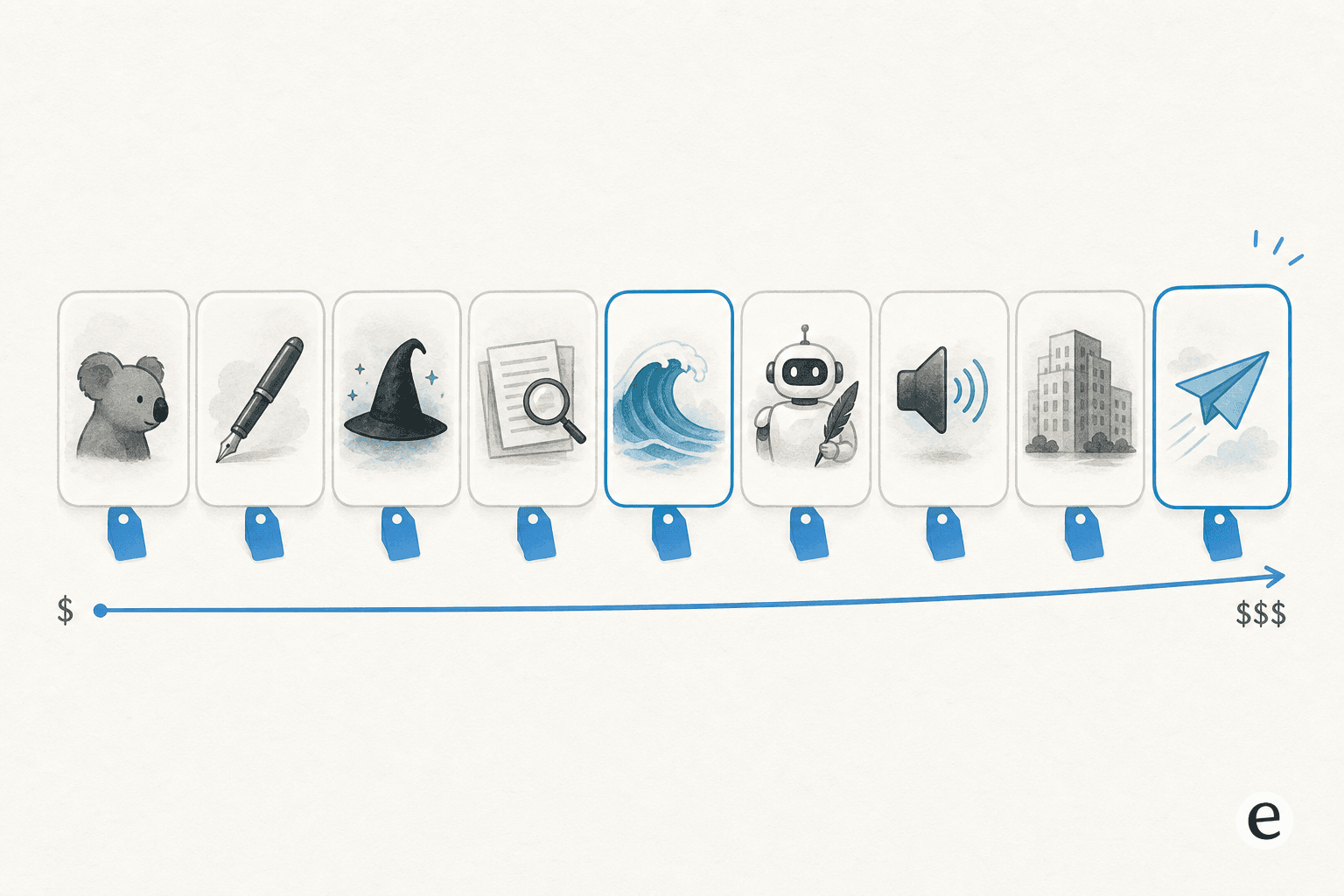
The honest decision tree, based on what you came to Writesonic to get done:
- If you wanted "blog content, written for me, finished and ready to publish": eesel's AI Blog Writer at $4/post is the closest 1:1 swap for the original Writesonic pitch, before the GEO pivot. The agent does research, drafting, images, and SEO formatting in one task.
- If you wanted "brand-controlled long-form for a marketing team": Jasper at $59/seat/mo. Brand Voice plus Jasper IQ keeps tone consistent across the team, and the enterprise stack won't trip procurement.
- If you wanted "an AI writer that ranks": Surfer SEO ($49–$182/mo) for depth, Frase ($49–$129/mo) for the same workflow at lower cost, or Koala AI ($9–$49/mo) for solo affiliate-style SEO.
- If you wanted "as cheap as possible": Rytr ($0 free / $7.50 Unlimited annual). The free tier alone beats most paid trials in the category.
- If you wanted "copy that performs in paid channels": Anyword at $39/mo annual - predictive scoring is the only thing on this list that closes that loop.
- If you wanted "AI agents for a regulated enterprise": Writer - accept the contact-sales motion as table stakes.
- If you wanted "a multi-channel GTM platform that also writes": Copy.ai Chat at $24/mo if Chat is enough; otherwise the $1,000/mo Growth tier.
What you should probably not do: subscribe to Writesonic's $79/mo Starter and assume it's still the AI writer it was two years ago. The product is fine - it's just a different product now, and the people searching "Writesonic alternatives" are mostly searching because they figured that out.
Try eesel's AI Blog Writer
If you read this far and "an autonomous agent that finishes the post" is the actual ask, eesel's AI Blog Writer is built for exactly that. You give it a brief - keyword, angle, competitors to mention, internal links you want included - and it researches, drafts, picks images, formats the frontmatter, writes the FAQs, and lands a publish-ready post in one run.
Billing is per finished post: $4 per blog, with 100 free credits to try. No seats. No platform fee. No quota math. The same workspace can run a Zendesk agent, an Intercom agent, or a Slack workplace-Q&A agent on the side - useful if you'd rather consolidate AI tools than stack a fourth single-purpose subscription.
Start with the free credits and try it on real posts before you decide.
Frequently asked questions
What are the best Writesonic alternatives in 2026?
Why are people looking for Writesonic alternatives now?
What is the cheapest Writesonic alternative?
Is there a Writesonic alternative that writes and publishes blogs autonomously?
Does Writesonic have a free plan I can use instead of buying an alternative?


Article by
Riellvriany Indriawan
Riell is a designer and writer at eesel AI with about two years of experience researching CX platforms, AI chatbots, and helpdesk software. She combines her design background with a sharp eye for how these tools actually look and feel in practice — making her comparisons unusually visual and user-focused.