

Not too long ago, picking an AI writing tool felt like choosing between different brands of bottled water. They all pretty much did the same thing: you gave them a prompt, and they gave you some text. But things have changed, and fast. Today’s AI writers aren't just simple text generators; they’ve grown into specialized platforms built for very specific jobs.
Two of the biggest names out there, Writesonic and Copy AI, are perfect examples of this evolution. They have both moved from their generalist beginnings to serve completely different business needs.
So, the real question is, which one is right for you? Is it Writesonic, built to help you dominate both old-school and AI-powered search results? Or is it Copy AI, designed to put your entire go-to-market strategy on autopilot? Let's dig in and figure it out.
What AI writing tools have become in the Writesonic vs Copy AI era
A common concern with AI content is that it can sound generic. The first wave of tools were basically just GPT with a nice interface, making the AI-generated text easily identifiable. There's a good reason people worry that using AI will make their content feel hollow.
Above all though I always clean up the cringe at the end, rewrite some, and take out all the damn emojis.

But the best tools have moved past that. They are no longer just text generators; they’re platforms that understand and automate complex business processes. They do this by connecting to unique data sources, building out specific workflows, and focusing on niche problems. Instead of just writing an article, they’re helping you rank it with real SEO data. Instead of just writing an email, they’re automating your entire sales outreach sequence. They've become specialists, and that's what makes them so useful today.
How we're comparing Writesonic vs Copy AI
To give you a clear picture, we're going to put these two platforms head-to-head based on their new strategic directions. Forget what they were two years ago; this is about what they are today and who they're built for.
Here’s what we’ll be looking at:
-
Primary use case and target audience: Who is this tool actually for?
-
Content generation capabilities: How good is it at long-form content versus GTM copy?
-
SEO and AI search optimization features: Can it actually help you rank?
-
Workflow automation and integrations: How well does it connect with your other tools?
-
Ease of use and user interface: Is it intuitive, or are you going to need a manual?
-
Pricing and overall value: Are you
Just a recommendation , I don’t think I’d immediately redirect to PayPal when starting a free trial. This turned me off from even testing, because I couldn’t try it without entering payment first.
An overview of the contenders in Writesonic vs Copy AI
Before we jump into a side-by-side comparison, let's get to know the two platforms and their new identities. They’ve both carved out some seriously impressive, and very different, spaces for themselves.
What is Writesonic? A look at one side of Writesonic vs Copy AI
Writesonic has rebranded itself as an "AI visibility platform." That’s a way of saying it's designed to get your brand seen everywhere people are searching, whether that’s on Google (classic SEO) or in AI answer engines like ChatGPT, Perplexity, and Google's AI Overviews. They call this second part "Generative Engine Optimization," or GEO, and it’s their big bet on where search is headed.
Key Features: Writesonic’s main draw is its GEO tools, which actually track your brand’s visibility in AI search results. It also has a powerful AI Article Writer that creates fact-checked articles with citations, a built-in SEO checker, and direct access to live data from Ahrefs and Google Keyword Planner.
Pricing:
-
Lite: $39/month (billed annually) for 1 user and 15 articles.
-
Professional: $199/month (billed annually) for 2 users, 100 articles, and access to those key GEO features.
-
Advanced: $399/month (billed annually) for 5 users, 200 articles, and more advanced analytics like sentiment analysis in AI search.
Pros: It’s one of the few platforms tackling SEO and GEO together. This gives content marketers a way to stay ahead as search continues to change. Having premium SEO data baked right in is a huge plus, saving you from juggling multiple subscriptions.
Cons: The GEO features are the main selling point, and they’re locked behind the pricier Professional plan. This makes it a big investment for a solo blogger or a small team just testing the waters.
What is Copy AI? A look at the other side of Writesonic vs Copy AI
Copy AI has gone in a completely different direction, positioning itself as the "first AI-Native GTM Platform." Its focus is entirely on go-to-market teams (sales, marketing, ops) and automating the workflows that drive revenue. It's less about creating a single piece of content and more about building and running entire campaigns.
Key Features: The heart of Copy AI is its AI-powered Workflows, which let you map out complex processes like enriching new leads or personalizing outreach emails. It has a Prospecting Cockpit for sales teams, an Inbound Lead Processing tool for instant follow-ups, and Brand Voice features to keep all your generated copy on-brand.
Pricing:
-
Chat: Starts at $24/month per seat (billed annually) which gives you access to chat features and multiple large language models.
-
Agents: Starts at $249/month, which unlocks workflow automation credits.
-
Enterprise: Custom pricing if you need API access and more advanced integrations.
Pros: It is highly effective for automating repetitive GTM tasks. If you want to enrich leads, score them, and send out hyper-personalized emails without lifting a finger, Copy AI is built for you. It can save sales teams a ton of time and speed up the sales cycle.
Cons: This is not the tool for writing long-form SEO blog posts from scratch. Its content generation is geared towards sales and marketing snippets that fit inside its automated workflows. You won't find any of the deep SEO or GEO analytics that Writesonic offers.
Writesonic vs Copy AI: A feature breakdown
Now that we know who they are, let's see how they stack up in a direct comparison across a few key areas.
Blog and long-form content generation
This one's a knockout for Writesonic. Its AI Article Writer is specifically built to create factually accurate, long-form articles (up to 5,000 words) that are ready to rank. It handles things like automated internal linking, pulling in real-time data, and even analyzing competitor content to make sure your post has the best shot at hitting page one.
Copy AI can do some neat things like repurpose a video transcript into an article, but it’s not designed to generate a brand new, SEO-optimized blog post from a keyword. Its content abilities are all about supporting the sales cycle, not building out a content hub.
Go-to-market and sales content automation
Here, the tables are turned completely. Copy AI is the undisputed champ. The entire platform is a GTM engine, with features like AI-powered Account Intelligence, automated lead follow-ups, and the ability to generate personalized sales copy at scale. Its workflow builder is particularly well-suited for these specific, process-driven tasks.
Writesonic has templates for social media ads and marketing emails, but it doesn't have the deep, workflow-based automation that Copy AI brings to the table for sales and marketing teams.
SEO vs GEO capabilities
This is Writesonic's home turf. It’s the only platform of the two that explicitly offers Generative Engine Optimization (GEO). It actively tracks your brand's mentions across AI chat platforms like ChatGPT, Perplexity, and Google AI Overviews. It combines this forward-thinking feature with a solid set of traditional SEO tools, giving you a complete strategy for search visibility.
Copy AI does not focus on this area. Its goal is to create effective GTM copy that converts, not to rank that copy in organic or AI search engines.
Ease of use and user interface
The two interfaces really reflect their target users. Copy AI is built for GTM teams who need to set up and run workflows. The UI is clean and process-oriented, making it fairly easy to build complex automations without needing to be a developer.
Writesonic's dashboard is data-rich, packed with charts and analytics for SEO pros and content strategists. It's incredibly powerful, but all that information can create a bit of a learning curve for someone who isn't living and breathing SEO data every day.
At a glance: A Writesonic vs Copy AI comparison table
Here's a quick summary to see the key differences side-by-side.
| Feature | Writesonic | Copy AI |
|---|---|---|
| Best For | SEO & Content teams focused on search visibility | Go-to-Market (sales & marketing) teams |
| Primary Goal | Rank content in Google and AI search (SEO + GEO) | Automate GTM tasks and scale sales content |
| Starting Price | $39/month (billed annually) | $24/month per seat (billed annually) |
| Free Plan | Free trial with 10k words | Free plan with 2,000 words |
| Key Feature | Generative Engine Optimization (GEO) | AI-powered Workflows |
| Integrations | SEO data (Ahrefs), CMS (WordPress), Zapier | CRM, Zapier (2,000+ apps), API access |
| AI Image Generation | Yes | No |
| User Interface | Data-rich, for SEO professionals | Process-oriented, for GTM teams |
Limitations of specialized AI writers
Both Writesonic and Copy AI are highly capable in their respective areas, but they primarily focus on text generation. This means users often receive a text draft that requires further manual work, such as sourcing and adding images, videos, or social proof to create a complete article. For users looking to automate the entire blog creation process, other solutions are available.
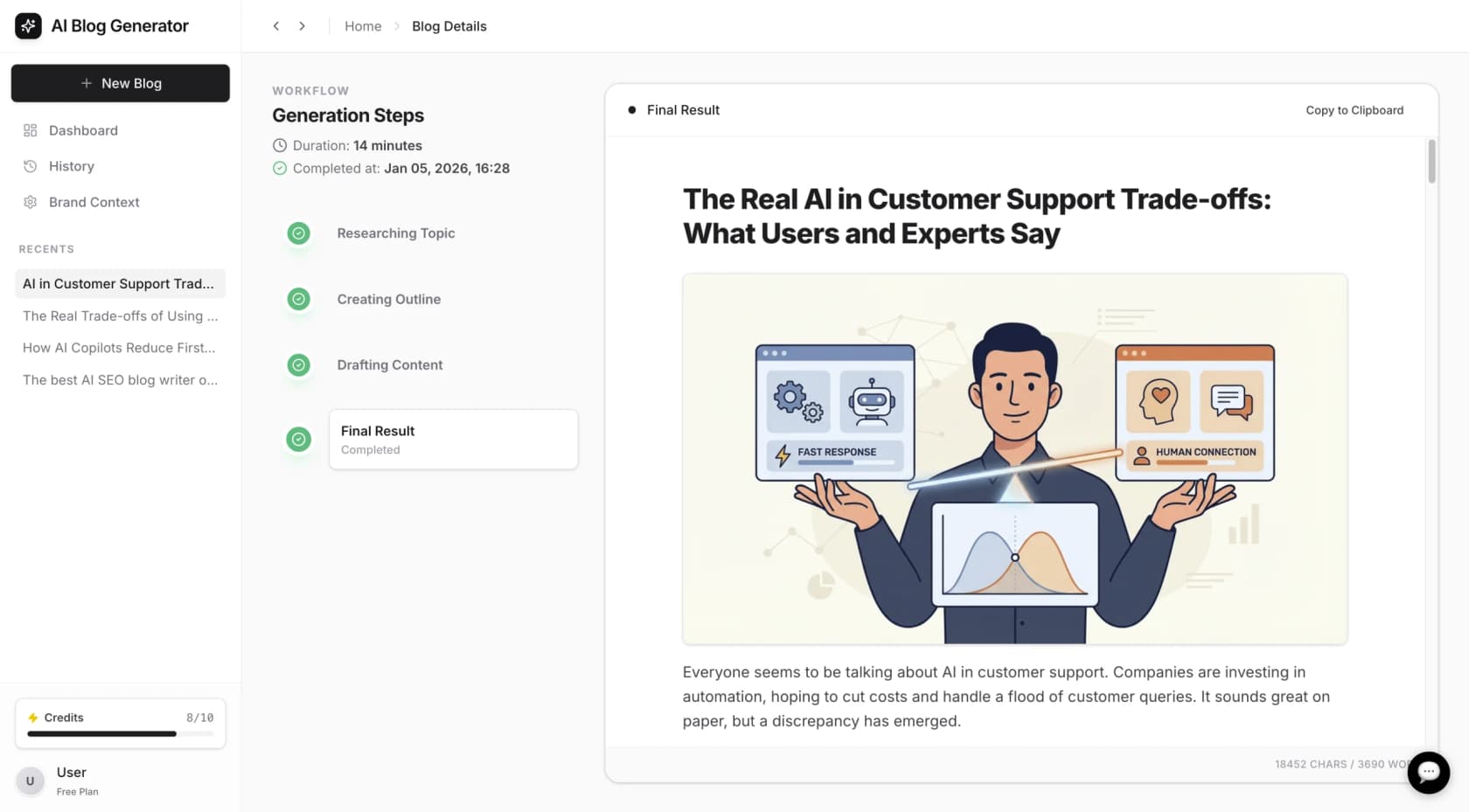
For example, the eesel AI blog writer is designed to address this by moving beyond text generation to produce more complete articles. It incorporates several features to assist with this:
-
Automatic Assets: It can automatically generate and insert relevant images, infographics, and data tables directly into the article.
-
Social Proof: It finds and embeds quotes from Reddit discussions and relevant YouTube videos to add authority and context.
-
AEO & SEO Optimization: It is built to create content optimized for both traditional search engines and AI Answer Engines (AEO), like Google's AI Overviews.
eesel AI uses this tool for its own content, which has helped grow its organic traffic from 700 to 750,000 impressions per day. It is available to try for free.
For those who prefer a visual breakdown, many find video reviews helpful for making a final decision. Watching a side-by-side comparison can highlight the user experience and workflow differences in a way that text alone cannot.
Writesonic vs Copy AI: Which AI writer should you choose?
So, after all that, which tool is the right one for your team? It really boils down to your main goal.
Choose Writesonic if: You’re an SEO professional or content marketer. Your job is to maximize organic visibility across Google and the new wave of AI search platforms, and you love a data-driven content strategy.
Choose Copy AI if: You’re on a sales or GTM team. You need to automate your processes, from prospecting and lead nurturing to creating hyper-personalized outreach campaigns at a massive scale.
Consider eesel AI if: Your main goal is to scale your blog production by creating media-rich, formatted, and SEO-optimized articles that are closer to a publish-ready state.
Final thoughts on the Writesonic vs Copy AI debate
It’s clear that both Writesonic and Copy AI are incredibly powerful platforms. But they’ve evolved to serve very different, highly specialized roles. One is a master of search visibility, while the other is a master of GTM automation.
The "best" tool isn't about which one has more features; it’s about which one aligns with your team's most important goal. It’s time to think beyond simple text generation and choose a platform that solves your real business challenge.
Frequently asked questions
What is the main difference in the Writesonic vs Copy AI comparison?
The biggest difference is their target audience. Writesonic is built for SEO and content teams aiming to rank on Google and in AI search results (GEO). Copy AI is designed for sales and marketing teams to automate their go-to-market (GTM) workflows, like lead enrichment and personalized outreach.
For creating SEO blog posts, which is better in a Writesonic vs Copy AI matchup?
Writesonic is the clear winner for creating SEO blog posts. Its AI Article Writer is specifically designed for long-form, fact-checked content with built-in SEO tools. Copy AI's strengths lie in sales copy and workflow automation, not long-form blog content.
How does pricing compare for Writesonic vs Copy AI?
Their pricing models are quite different. Writesonic's plans are based on the number of articles and users, starting around $39/month. Copy AI's pricing is more seat-based for its chat features and has a higher entry point for its workflow automation, starting around $249/month for the "Agents" plan.
Is there a free plan available when considering Writesonic vs Copy AI?
Yes, both offer a way to get started for free. Writesonic has a free trial with a 10,000-word credit, while Copy AI offers a permanent free plan with a 2,000-word limit. This lets you test out their core features before committing.
In the debate of Writesonic vs Copy AI, which tool is better for a sales team?
Copy AI is hands-down the better choice for a sales team. Its entire platform is built around automating GTM tasks, from prospecting and lead intelligence to crafting personalized outreach emails at scale. Writesonic is not focused on sales automation.
Why might a user choose an alternative over both in the Writesonic vs Copy AI discussion?
A user might look for an alternative if their goal is to produce a fully finished, publish-ready blog post. Both Writesonic and Copy AI generate text drafts, but tools like the eesel AI blog writer go a step further by automatically adding images, social proof, and YouTube videos, bridging the gap between a draft and a complete article.