Writesonic vs Anyword: Which AI writer is best for traffic and conversions?

Stevia Putri
Last edited January 6, 2026
Picking the right AI writer can be challenging. You've got two major players, Writesonic and Anyword, and they represent a fundamental marketing question: are you chasing organic traffic or guaranteed conversions?
Writesonic focuses on modern SEO and the concept of Generative Engine Optimization (GEO), which is centered on brand visibility in AI search results. Anyword has a different focus. It's a data-driven tool designed to generate marketing copy with a trustworthy performance score.
In this post, we will examine their features, pricing, and where each one is most effective. We will also introduce a third option, the eesel AI blog writer, a tool designed to create complete, publish-ready blog posts for organic growth.
What are AI writing assistants?
AI writing assistants were once simple tools for creating ad copy or a blog post. They have since evolved significantly. These days, they're much more than just text generators.
Imo, for this kind of thing, it can be useful *as a tool*. But would I use it to generate, say, a piece of thought leadership content, or sales copy? No. It's going to be a while before AI tools are truly on par with an actual human copywriter -- if that's even truly feasible.

We're talking about platforms packed with features for SEO, performance prediction, brand voice matching, and even tracking how you appear in AI search results like ChatGPT and Google AI Overviews. This field is called Generative Engine Optimization (GEO), and it’s an evolution of traditional SEO. While most run on tech like GPT-4 to generate human-like text, the specific features of each platform determine if it's better suited for improving Google rankings or for crafting an effective ad.
How we evaluated AI writers for this comparison
To ensure a fair and useful comparison, we evaluated each tool based on the following criteria:
-
Core purpose: Is the tool designed for SEO and traffic, for conversions and ad performance, or for generating complete, ready-to-publish articles?
-
Unique features: What are its standout features, such as predictive scoring, AI search tracking, or automatic media generation?
-
Content quality: Does the output sound natural, or does it require heavy editing?
-
User-friendliness: Can a marketer start using it effectively without extensive training?
-
Price vs. value: What is the price, and what features are included? Is there a free plan or trial available?
Writesonic vs Anyword: A quick comparison
Here’s a side-by-side comparison of how Writesonic and Anyword compare. We’ve also included the eesel AI blog writer to show how a specialized tool for blog content fits into the landscape.
| Feature | Writesonic | Anyword | eesel AI blog writer |
|---|---|---|---|
| Primary Goal | SEO & Generative Engine Optimization (GEO) | Data-Driven Conversions | Publish-Ready Blogs That Rank |
| Best For | SEO Managers & Content Teams | Performance Marketers & Ad Agencies | Growth & Content Teams |
| Key Feature | AI Search Visibility Tracking | Predictive Performance Scoring | Automatic Asset & Media Generation |
| Long-Form Content | Yes, with fact-checked articles up to 5000 words | Yes, with its Blog Wizard feature | Yes, from a single keyword to a complete post |
| Free Plan | Yes, with limited words | Yes, with limited words | Yes, completely free to try |
| Starting Price | $49/month (Lite Plan) | $49/month (Starter Plan) | $99 for 50 blog posts |
A closer look at leading AI writing tools
We're focusing on the Writesonic vs. Anyword comparison, but it's helpful to see where they stand in the broader market. Here is a list of notable tools in this category.
Hard pass. The programs don’t understand what they’re saying and sometimes write factually inaccurate information. Editors will tell you that if a piece is bad enough, it’s more work to edit than to write something better from scratch.
1. eesel AI blog writer
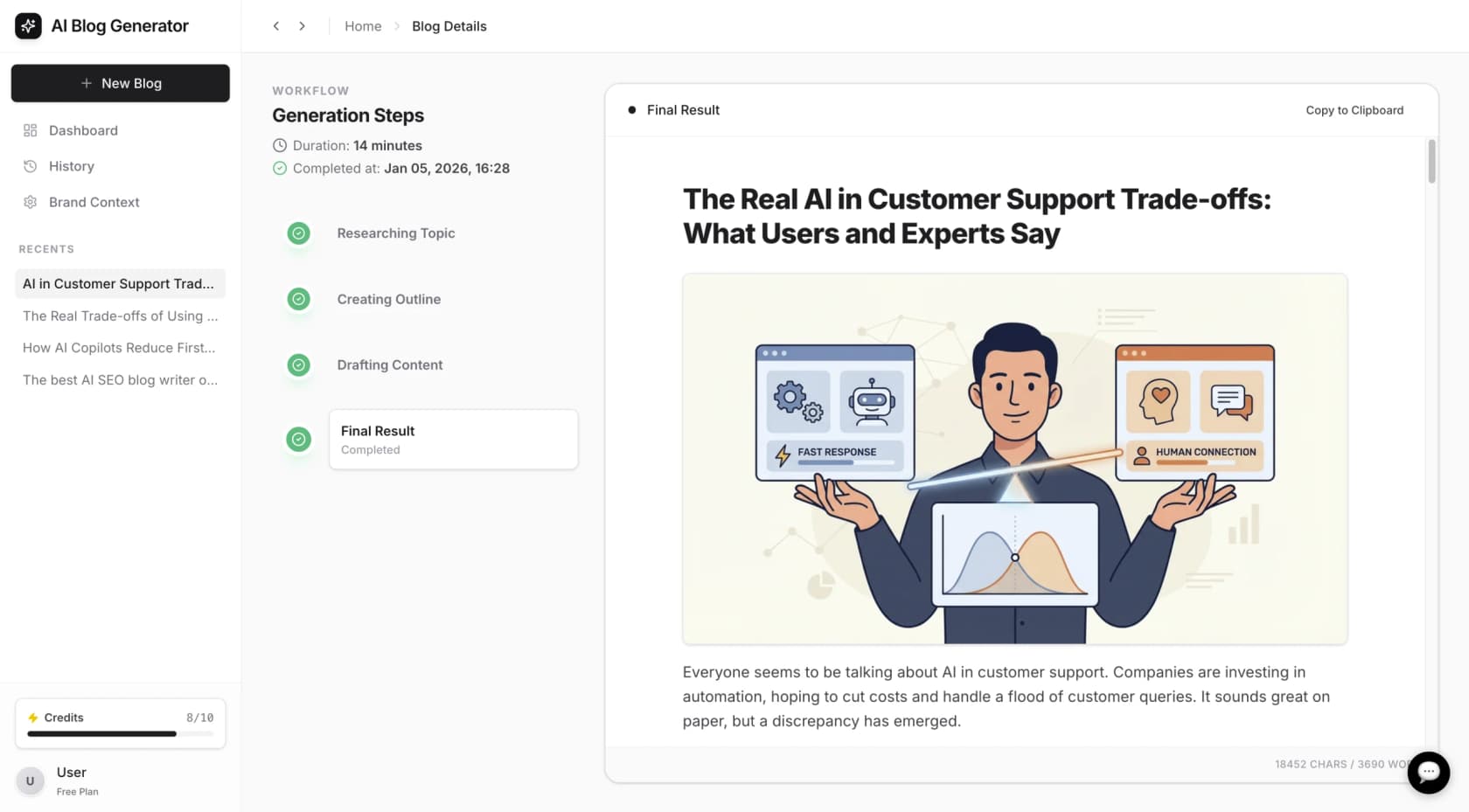
The eesel AI blog writer is a specialized tool designed to generate a complete article from a single keyword. It aims to streamline the content creation process for teams by handling research, structure, and media sourcing.
Its features focus on automating manual tasks. It handles research, automatically creates images and tables, and finds relevant YouTube videos and Reddit quotes to make the content more engaging. This approach helps create content suitable for both traditional SEO and Answer Engine Optimization (AEO).
Pros and Cons: The main advantage is its all-in-one workflow for creating blog posts. Its specialization in long-form blog content means it is not designed for creating short-form copy for social media or ads.
Pricing: You can try the eesel AI blog writer for free. Paid plans are credit-based, starting at $99 for 50 complete blog posts.
2. Writesonic
Writesonic has evolved from a general AI writer into an AI visibility platform. It is designed to address both traditional SEO and the new area of Generative Engine Optimization (GEO). This tool is for content teams and SEO managers who need to write content and track its performance in AI search engines like ChatGPT, Perplexity, and Google AI Overviews.
Their AI Article Writer 6.0 can produce fact-checked articles, with citations and internal links included. A key feature is its AI Search Visibility Tracking. This lets you monitor your brand's share of voice, sentiment, and mentions in AI-generated search results. It is a comprehensive tool for users focused on modern SEO.
Pros and Cons: The primary benefit is its combination of SEO and GEO features, which places analytics and content creation in one platform. The one-click WordPress export is a convenient feature. A potential drawback is that the platform has many features, and access to advanced GEO tools requires higher-tier plans.
Pricing: Writesonic offers a free plan with a word cap. Paid plans begin at $49/month for the Lite plan, which provides 15 articles a month. The GEO features are part of the Professional plan, which starts at $249/month.
3. Anyword
Anyword is an AI writing tool designed for performance marketers, ad agencies, and others focused on conversion rates. Its core feature is the Predictive Performance Score. It grades copy on its likely conversion effectiveness for a specific audience before you spend on ads.
The platform specializes in generating copy for ads, social media, emails, and landing pages. All plans come with unlimited word generation, allowing for extensive testing of different ideas. You can also provide past marketing campaigns to build a custom AI model that learns your brand's effective messaging.
Pros and Cons: Anyword’s data-driven method can help reduce ad spend by predicting performance. Predicting how copy will perform with different demographics is a significant benefit. The platform's focus is primarily on conversion copy, with its long-form content features being less central to its offering.
Pricing: Anyword has a 7-day free trial. Paid plans start at $49/month for the Starter plan, which gives you 50 performance predictions per month.
4. Jasper
Jasper is one of the early platforms in the AI content space and is trusted by marketing teams for its brand voice controls and automation features. It has shifted its focus to AI Content Automation, using "Content Pipelines" to link strategy, data, and creation into one workflow.
It's a versatile tool that can handle most content types. Its context hub, Jasper IQ, lets you upload brand guidelines, tone of voice, and key messaging to ensure content consistency across your team.
Pros and Cons: Jasper is recognized for its output quality and user interface. Its extensive integrations and team collaboration features are notable benefits. It is one of the higher-priced options, and its advanced features may have a steeper learning curve compared to more specialized tools.
Pricing: Jasper's pricing starts at $69/month per seat for the Pro plan ($59/month if you pay annually). A 7-day free trial is available.
5. Scalenut
Scalenut is an AI-powered platform that specializes in the content planning and research phase. It combines an AI writer with powerful SEO tools, and its key features include its Keyword Planner and topic clustering tool.
This tool helps marketers build a data-backed content strategy. It groups related keywords into clusters, which helps in establishing topical authority. From there, its "Cruise Mode" can generate a long-form blog post from one of those clusters. For SEO professionals planning and executing a content strategy, Scalenut offers an integrated solution.
Pros and Cons: Scalenut’s primary strength is its combined approach to SEO strategy and content creation. The topic clustering tool is particularly useful for building pillar pages and planning a content calendar. Some users may find the interface complex, and the generated content typically requires human editing.
Pricing: Scalenut plans start at $19/month (paid annually) for the Essential plan.
For a more detailed visual comparison, here is a video review that breaks down the features and user experience of both Writesonic and Anyword.
Which AI writer should you choose?
The right choice depends on your specific goals.
-
For performance marketers: Anyword is a suitable option. Its predictive scoring is designed for those focused on conversions and ROAS, helping to optimize copy for performance.
-
For SEO and GEO management: Writesonic is a strong candidate. It provides tools to track visibility and produce optimized content for both traditional and AI search.
-
For streamlined blog production: The eesel AI blog writer is designed for teams looking to create complete blog posts efficiently. It focuses on delivering a more complete first draft, including research and media, to reduce manual work.
Final thoughts
The "best" AI writer depends on the task. Writesonic offers robust features for SEO and GEO. Anyword's predictive analytics are designed for conversion optimization. For teams whose primary goal is to scale blog content production for organic growth, a specialized tool may be more efficient.
The eesel AI blog writer is built to handle the entire content creation process, not just the writing. It aims to reduce the time spent on editing, research, and formatting by generating a more complete initial draft. It's free to try, so you can evaluate the quality for yourself without any commitment.
Try the eesel AI blog writer for free and generate your first complete, SEO-optimized article today.

Frequently asked questions
The biggest difference is their core focus. Writesonic is built for SEO and visibility in AI search (GEO), making it great for content teams trying to rank. Anyword is all about [data-driven conversions](https://www.anyword.com/data-driven-editor), using predictive scores to help performance marketers create copy that sells.
Both have features for long-form content, but Writesonic's AI Article Writer 6.0 is more geared towards creating fact-checked, SEO-optimized articles. Anyword's [Blog Wizard](https://www.anyword.com/blog-wizard) is capable, but the platform's main strength lies in shorter, conversion-focused copy like ads and landing pages.
Both platforms offer starter plans at a similar price point, around $49/month. However, the value you get depends on your needs. Writesonic's plan is based on the number of articles, while Anyword's includes a set number of performance predictions. You'll want to check their latest pricing, as the more advanced features are on higher-tier plans for both.
For ad copy, [Anyword is often preferred](https://medium.com/@zoran_trimmel/anyword-vs-writesonic-i-ditched-my-old-ai-stack-for-one-of-these-2025-review-6b0f3af751d5). Its Predictive Performance Score is designed specifically to help you write ads that are more likely to convert, taking much of the guesswork out of campaign optimization.
Yes, you can test both platforms before committing. Writesonic offers a free plan with a limited word count, while Anyword provides a 7-day free trial to explore its features. This is a great way to see which one [fits your workflow](https://www.anyword.com/quick-start-guide).
Yes. While Writesonic and Anyword are powerful, other [tools like the eesel AI blog writer](https://www.eesel.ai/blog/copy-ai-alternatives) are designed to automate the entire process from keyword to a finished, media-rich article. For teams focused on scaling blog production with minimal manual intervention, such end-to-end solutions can be a suitable option.
Share this article

Article by
Stevia Putri
Stevia Putri is a marketing generalist at eesel AI, where she helps turn powerful AI tools into stories that resonate. She’s driven by curiosity, clarity, and the human side of technology.
