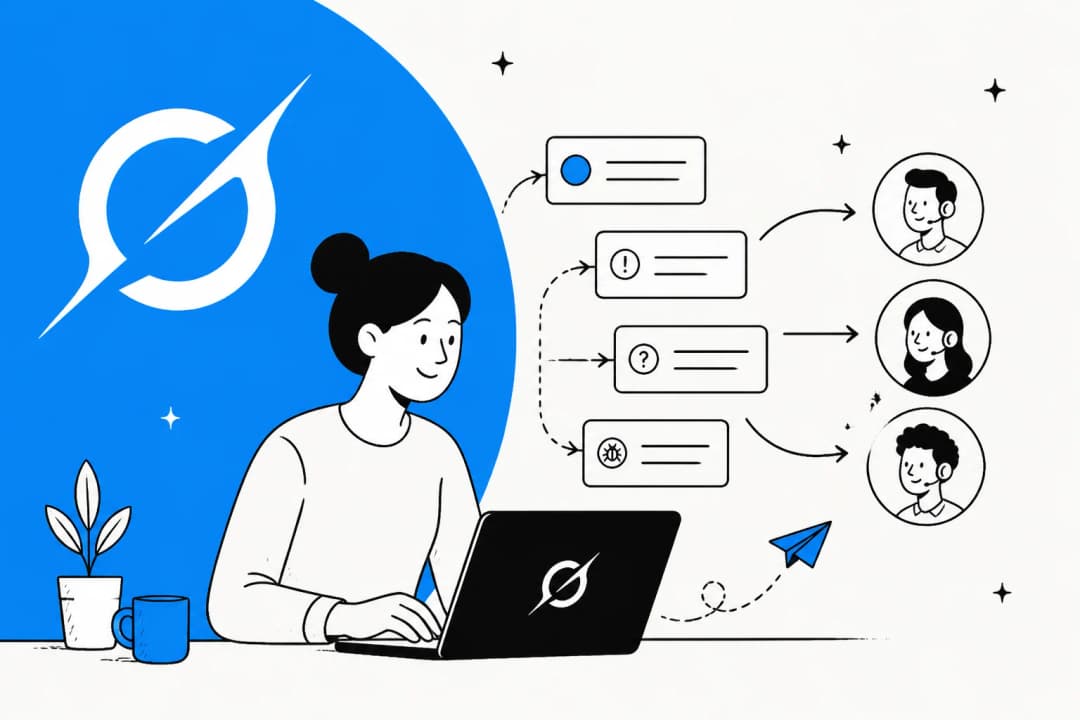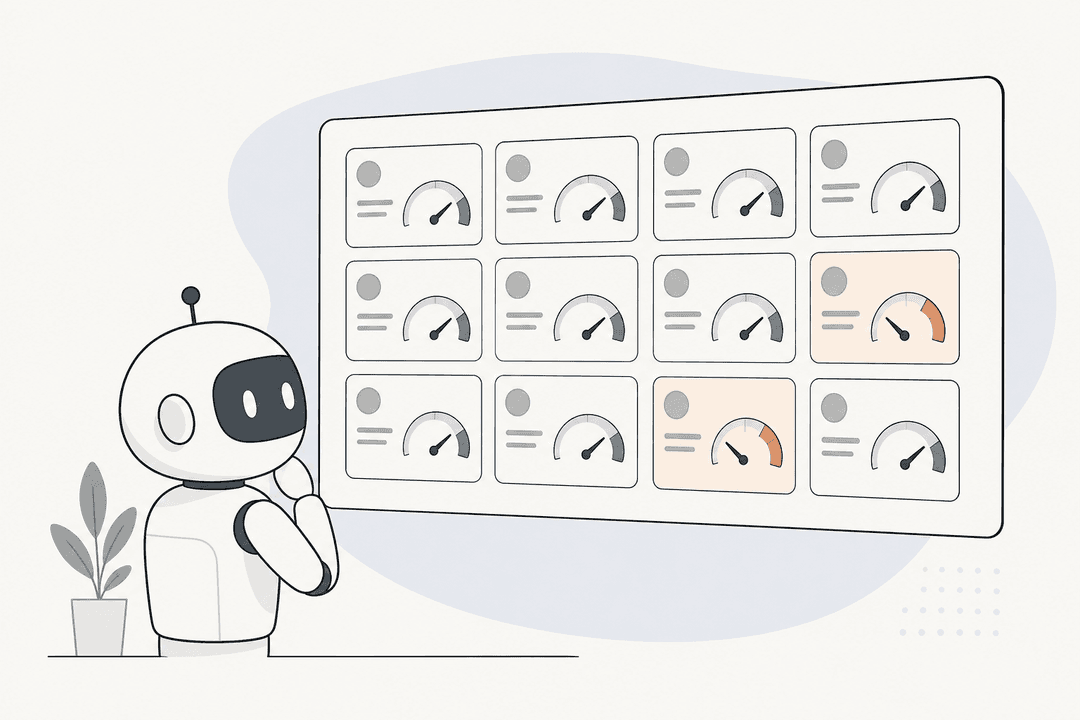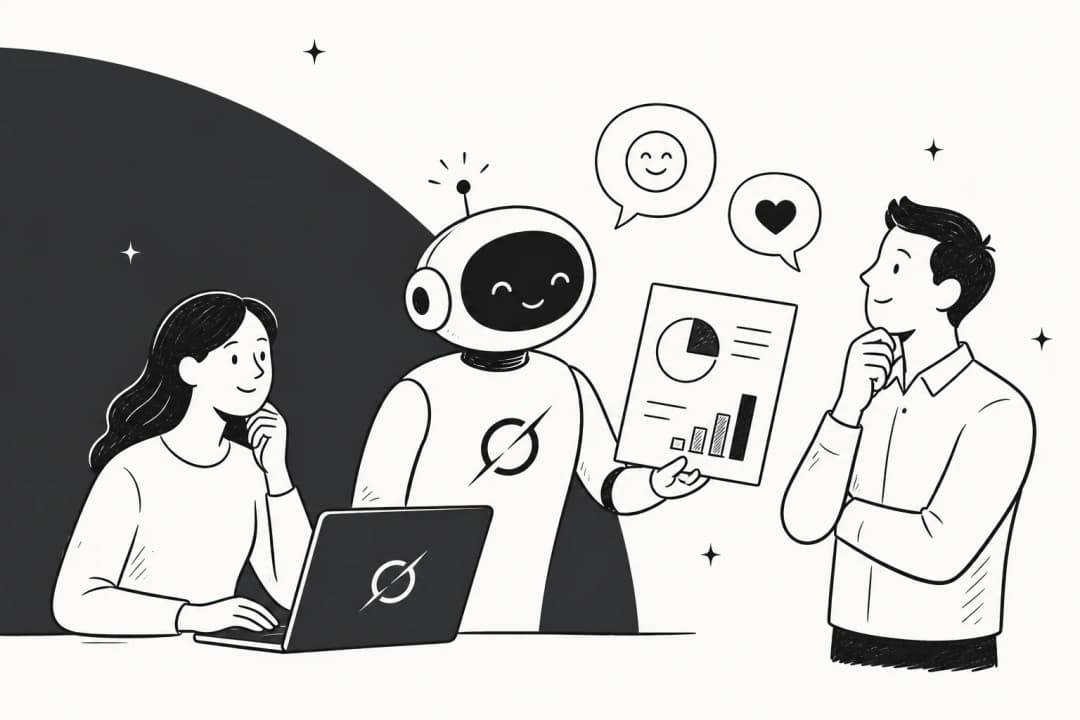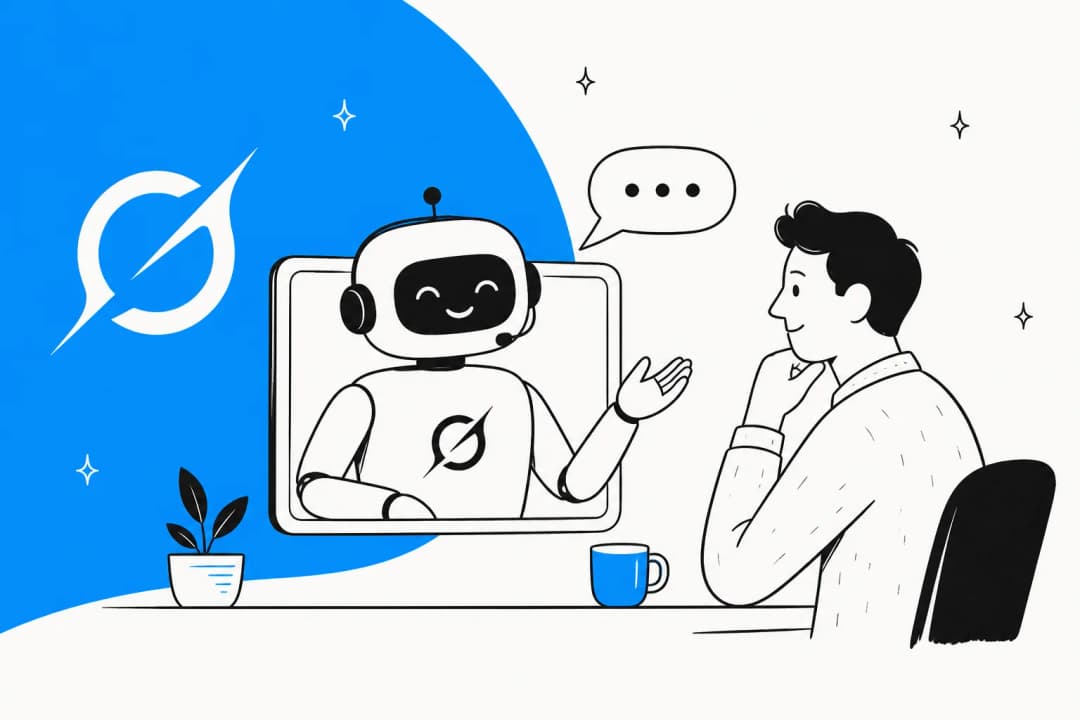
What Grok Bot actually is
Grok Bot is xAI's AI teammate app, announced on 11 August 2026 and labelled "Early beta" on its own page. Each bot is a persistent, named worker that gets its own cloud computer, signs into the apps you already use, and drives them through their normal interface. It's a general-purpose labour agent, not a support product, and it sits in the same category as other autonomous AI agents that operate a real logged-in browser.
The design goal is coverage. Grok Bot is built to work across apps "including platforms with no clean API or MCP", and the way it pulls that off is by acting like a human: it takes over a screen, clicks around, and reads what's on it. That single mechanism is what buys the broad reach, and it's also the source of every caveat in this post.
The sign-in flow is the heart of the product. The bot never holds your password. It hands you the screen, you type the password, passkey, 2FA code or CAPTCHA yourself, then you hand control back. From there, per xAI's docs, "the browser session persists on your shared Grok Bot computer, so other Bots can use the same signed-in session when appropriate." A pre-release tester on Hacker News described it plainly:
"It'll ask you to take over its computer to log in […] After you do you just tell the bot you're done logging in and it'll keep driving. And yea, it's a separate VM for each bot."

Here's the detail that matters for this post. Eight named bot roles shipped at launch: Sales Outbound, Talent Scout, Paid Media, Expense Manager, Product Performance, Bug Reproduction, Account Health, and Chief of Staff. None of them is a support role, and none of them is quality assurance. Yet the first example prompt on Grok Bot's own page is "Sign in to Zendesk so I can work the support queue." The product points itself at support work and then ships zero roles for the part where you check that the work was any good.
Can Grok Bot read a closed ticket and score it?
Yes, and the setup is quick. You install the desktop app (macOS or Windows; the mobile app is iOS 18+), spin up a bot, and ask it to sign into your helpdesk. It hits the takeover flow, you log into Zendesk or Freshdesk yourself, and the bot starts reading. Give it your scorecard as a prompt, "rate these tickets on tone, accuracy and resolution out of 10", and it will open conversations and hand back ratings.
There's also a "Teach a task" feature (xAI calls the saved versions Routines): you do a job once while the bot watches, and it saves the steps to repeat later. In theory you could teach it a QA pass. The limits are real though, and worth knowing before you build a workflow on it: teaching is browser-only, capped at 10 minutes, the output is explicitly "a draft", and you get 50 routines per bot with only 20 run records kept per routine.
So the "can it" box is checked. The reason this post keeps going is that "can it put a number on a ticket" and "can I run a QA program on it" are different questions, and the second one is where the design starts to strain.
What support quality assurance actually needs
Here's what a demo won't show you. QA isn't reading a conversation and picking a number, it's applying the same standard to every ticket and being able to defend that number when an agent disagrees with it. Three things turn a rating into quality assurance you can coach on, and a bot that drives a browser session as a logged-in human has nowhere to put any of them.
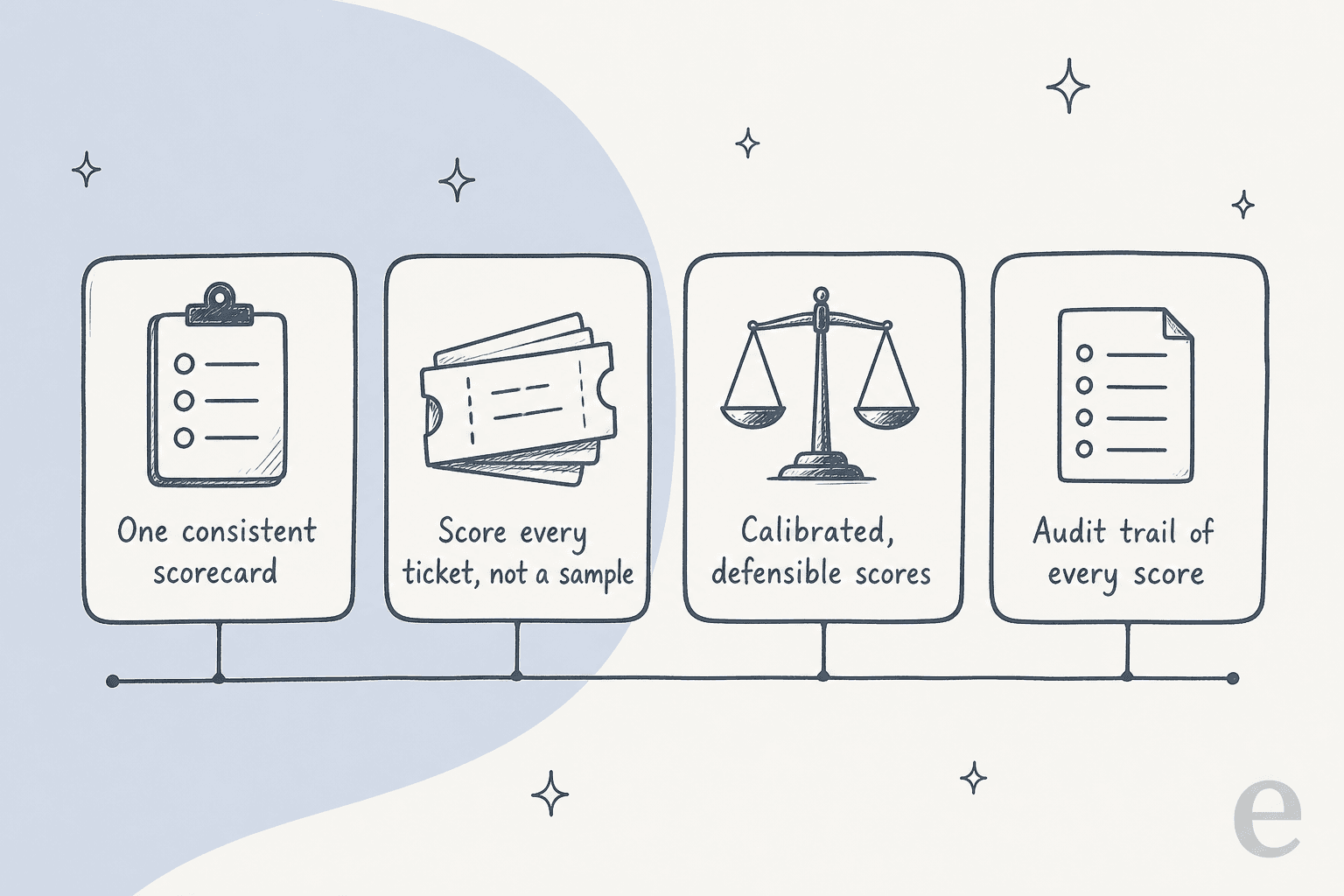
One consistent scorecard. QA means the same conversation gets the same score every time, whoever, or whatever, is reviewing it. That's inter-rater reliability, and it's the whole game. Ask Grok Bot to score the same ticket twice and you can get two different numbers, because each run is a fresh reading, not a rubric applied. Support teams get that repeatability from tools that run the same classification and tagging rules on every pass. A score that drifts between runs isn't a quality signal, it's noise with a decimal point.
Coverage you can prove. The old QA problem is that a human can only review 1-2% of tickets, so most of your queue is never checked. The whole promise of AI QA is that it reviews everything. Grok Bot can't make that promise: it drives a browser session, so there's no report of which tickets it opened and which it skipped. A buyer I spoke to put the coverage problem better than I can:
"The AI will never be able to answer 100% of the questions, but if it tries and just answers 'sorry I don't know this,' I cannot go and check all my 7,000 tickets to see if the AI actually made a good answer, then the point is a little bit gone. I need an AI who is only handling the tickets that it's confident to handle."
a CX lead at a 7,000-ticket/month DTC brand
Nobody can eyeball 7,000 tickets. That's exactly why coverage has to be measured and reported, not assumed.
An audit trail. When an agent disputes a score, someone has to reconstruct why the ticket got the number it did, which line of the transcript, which rubric criterion. Grok Bot's scoring is prose from a session it doesn't keep, and the gap is documented in xAI's own docs: "An audit view of Bot actions is coming." Future tense. Today there's no record of what the bot read or how it weighed it, so a contested score becomes your word against a black box.
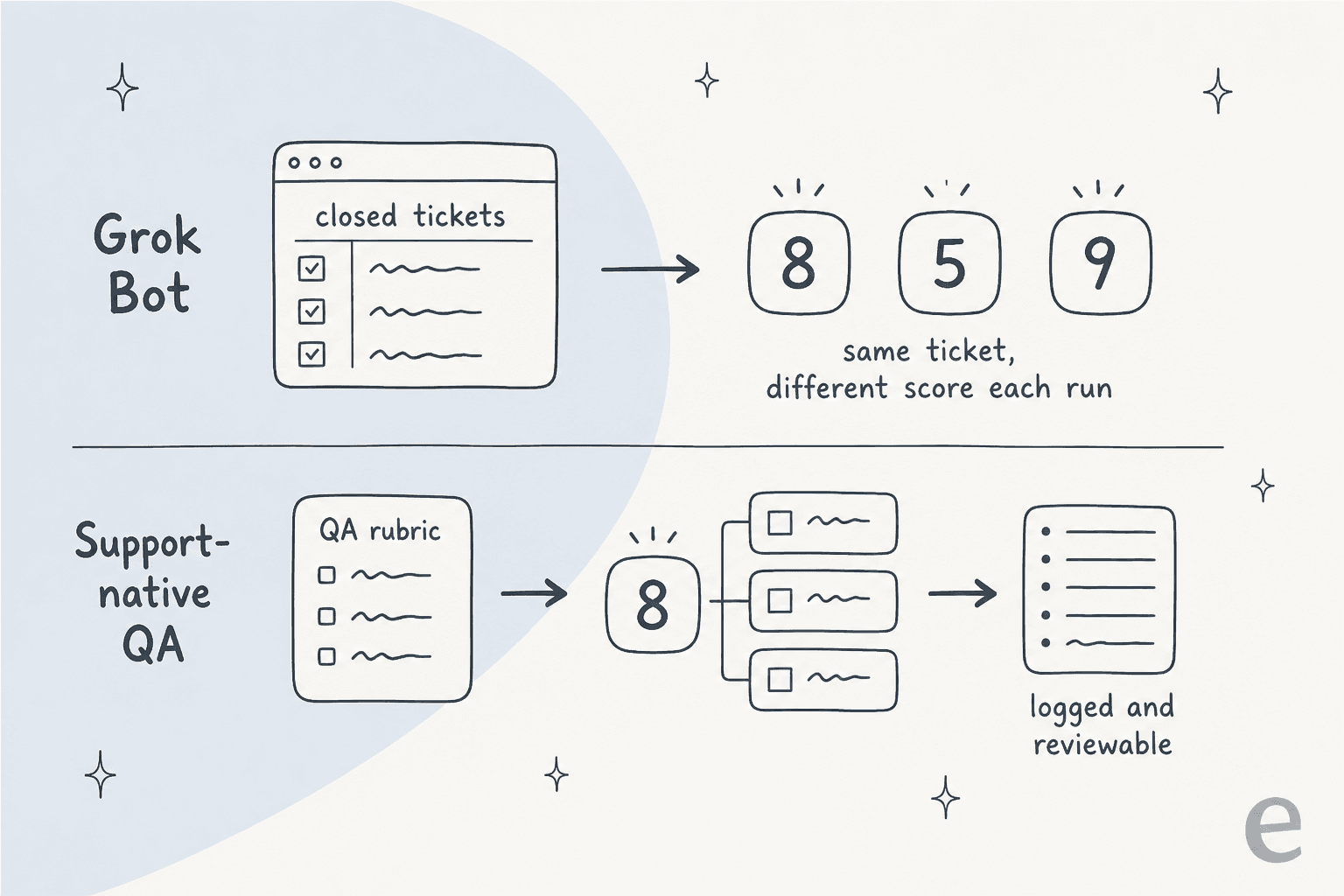
None of this makes Grok Bot bad. It makes it the wrong shape for this specific job. Where its UI-driving design wins is workflow automation against tools that have no API at all, the honest descendant of call center RPA. Grading the quality of work your team gets measured on just isn't that.
The security question to ask first
Before cost, before accuracy, there's a question a lot of coverage skips: what does giving a shared AI worker a signed-in session to your entire ticket history actually expose?
Start with the design. Per xAI's docs, "All of your Bots share one cloud computer… Files, browser sessions, and command line credentials on that computer are available across your Bot roster," followed by the instruction, stated twice in the FAQ, to "not use separate Bots as a security boundary." So the helpdesk session your QA bot creates is reachable by your sales bot, your paid-media bot, and anything else on the account.
There's a popular misreading worth clearing up, because it's not the real problem: critics say you upload every login to Elon's servers. You don't, you type the password yourself in the handoff. The accurate objection is subtler. Because the bot acts inside your signed-in session, the logs attribute its actions to you. One Hacker News commenter named the design in four words:
"By hijacking a real person's credentials, that person becomes the accountability sink. Very neat. Very deliberate."
Now layer the data on top. QA runs over closed tickets, which is the densest PII you own: names, emails, order histories, sometimes payment details, all in one place, all being read at once. A persisted, signed-in session to that archive is a standing data surface. And Grok Bot claims zero compliance certifications: no SOC 2, ISO 27001, GDPR, HIPAA, PCI or FedRAMP, no stated retention period, no data residency, with retention deferred to Cursor's terms. For anyone who's been through a security review, that's a hard stop. As one commenter tied it together on launch day:
"Pricing: 120/200 USD per month, per employee. This is an interesting idea although I'm not sure how many companies are comfortable with giving SpaceXAI access to all your files and data. Outside of America this is, most likely, not going to fly."
If you're evaluating any AI on your history, the data privacy and control questions and whether it meets SOC 2 and GDPR are the ones to settle first, not last.
What Grok Bot costs
Grok Bot ships on two self-serve plans, both named after Cursor rather than xAI, plus a bundle. Here's the full picture:
| Plan | Price | Notes |
|---|---|---|
| Cursor Ultra | $200 / month | Solo plan |
| Cursor Premium Teams | $120 / seat / month | Central billing, shared skills marketplace, usage analytics, SAML/OIDC SSO |
| SuperGrok Heavy | Included, no extra charge | Bundled with the Heavy subscription |
| Free tier | None | No published trial length |
A couple of things jump out. The team plan is cheaper per seat than the solo plan, which is unusual. And the only stated quota is "Extended limits on AI tokens" with no figure; the docs add the allowance is weekly and overage bills off model and token cost. That matters for QA, because reading full conversation transcripts to score them is a token-heavy job, and doing it across your whole closed queue multiplies it. The pre-release tester again, who likes the product:
"Biggest downsides are token expenditure. I've used more tokens this month than not this month. That's not a typo - I've used less tokens in the last 5 years prior to this month than I have this month. Always on perpetual agents use a LOT of tokens."
The deeper point is what you're paying for. Grok Bot charges per seat, which is the price of access to a worker, not the price of the reviews it produces. If you're weighing the cost of an AI agent against what QA actually saves you, that unit difference is worth putting real numbers to before you commit.
Should you use Grok Bot for support QA?
Rather than a verdict from me, here's the decision the way I'd actually walk it. Pick the row that sounds like you.
What to use instead: quality that's built in, not bolted on
If the reason you looked at Grok Bot was "I want to know my support quality is good", the tool that helps most isn't a general worker you ask to grade transcripts after the fact. It's one that does the front-line work to a consistent standard and logs every step, so quality is measurable and auditable by construction. That's the gap eesel fills.
eesel is an AI teammate platform, and the teammate that fits here is its AI helpdesk agent. Because it plugs into your helpdesk as an app rather than driving a signed-in browser, it handles each ticket the same way and keeps a record of what it did. That flips the QA problem: instead of grading inconsistent work after it ships, you get consistent work you can review.
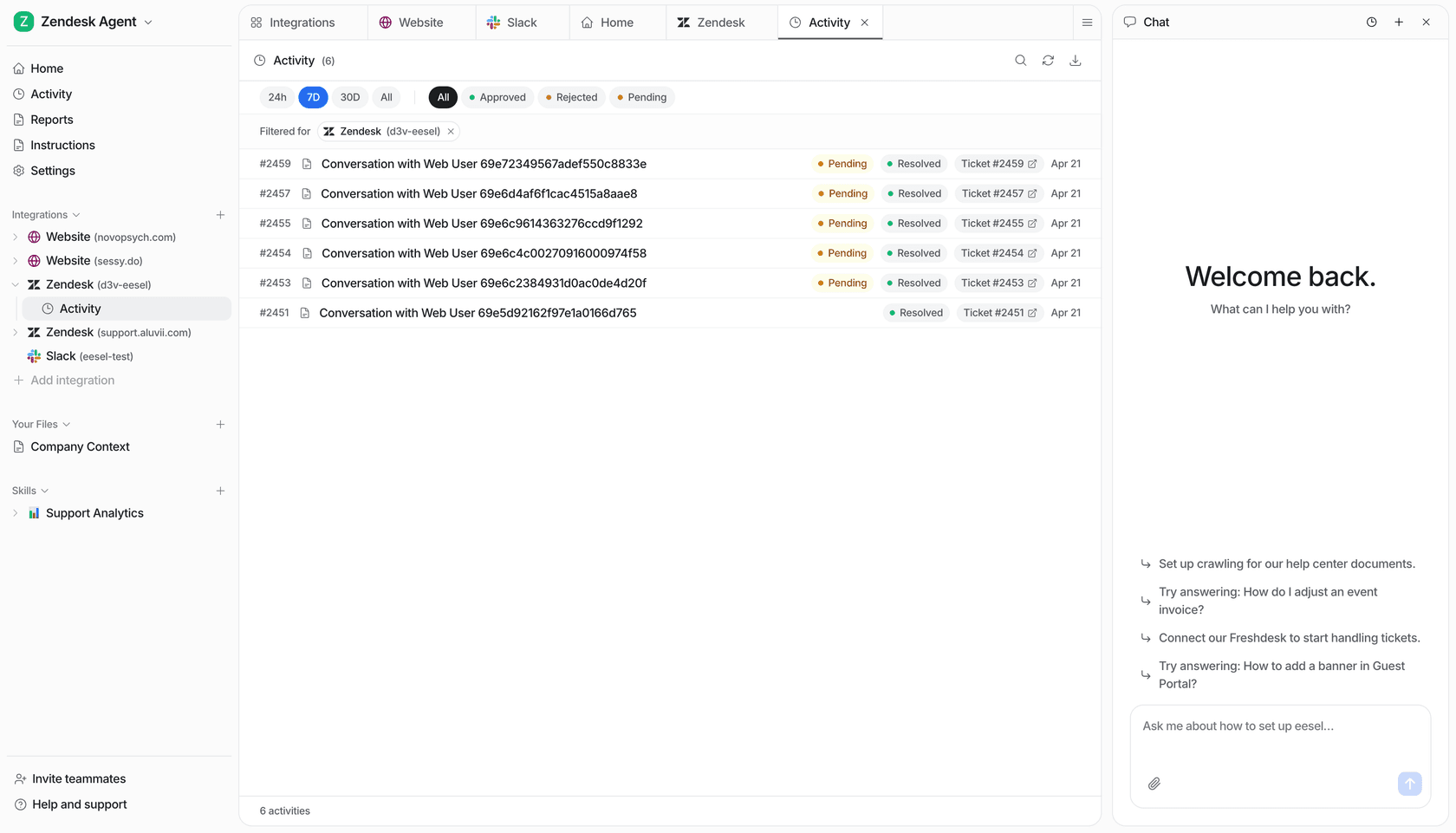
- A consistent standard on every ticket. eesel applies the same rules and knowledge base to every conversation, so the quality bar doesn't drift between Monday and Friday, or between one reviewer and the next. That's the repeatability a QA scorecard is trying to enforce, moved upstream into the work itself.
- A confidence threshold you set. You decide how sure the agent has to be before it replies. Above the bar it answers; below it, it hands off to a human with a clean handoff. That's the exact control the CX lead above was asking for, and it's why we lean on a dry run against your real past tickets first. We've watched confident-sounding bots quietly get things wrong, so eesel shows you how it would have handled your history, and how it would score against it, before it touches a live ticket.
- Everything is logged and measurable. Every reply, tag and action is recorded and reviewable, which is what lets you audit a bad interaction and actually improve the rule behind it. It's also how you measure and lift your resolution rate, your CSAT, and your support ROI instead of guessing.
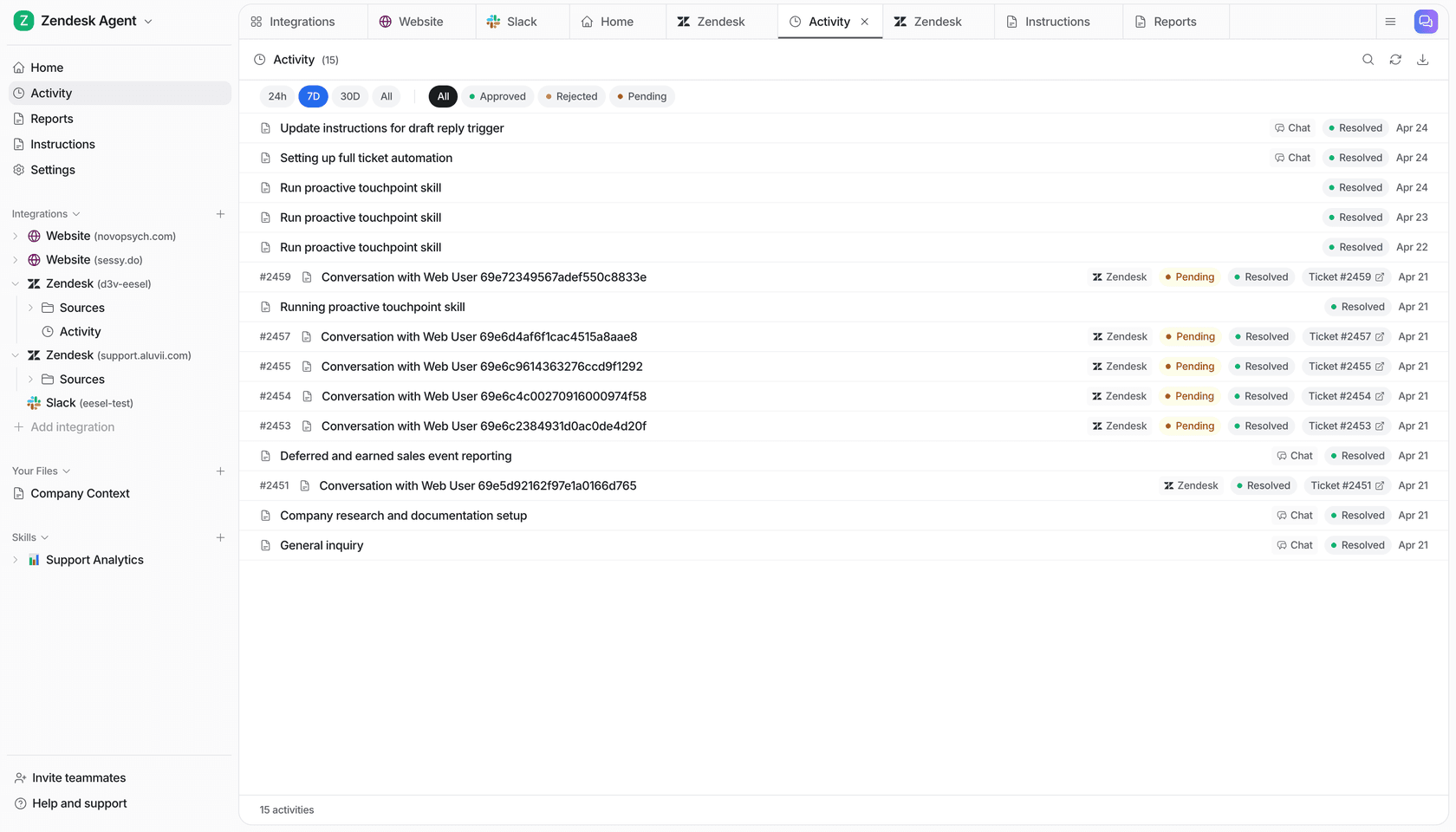
And for the crowd that came here because Grok Bot has no API, CLI or MCP: eesel goes the other way. It exposes a customer support agent API and a CLI, so scripts and coding agents like Claude Code or Cursor can pull the same quality and ticket data the dashboard shows, into a terminal or a pipeline, not just a browser window. If you'd rather compare the whole field first, my roundups of AI customer service software, agentic customer service software, and AI helpdesk software are a good place to start.
Try eesel for support quality you can trust
If the real goal was confidence that your support is good across Zendesk, Freshdesk or Gorgias, eesel works like a new hire that plugs into the helpdesk you already run, handles every ticket to the same standard, and only acts above the confidence you set. You can simulate it on your last few thousand tickets before it touches a live one, so you see exactly how it would perform first. It's usage-based at a flat rate per ticket handled, not per seat, and it's free to try.
The short version: Grok Bot is a clever general-purpose worker, and QA is the job where "reads it once and decides" is exactly the habit you're trying to remove. For quality your team gets measured on, use something built to do the work consistently and prove it.
Frequently Asked Questions
Can Grok Bot do support quality assurance?
Is Grok Bot good for scoring support tickets?
How much does Grok Bot cost for QA?
Does Grok Bot score every ticket or just a sample?
Is Grok Bot safe to point at my support history?
What's the best Grok Bot alternative for support QA?
Does Grok Bot have an API for QA data?


Article by
Riellvriany Indriawan
Riell is a designer and writer at eesel AI with about two years of experience researching CX platforms, AI chatbots, and helpdesk software. She combines her design background with a sharp eye for how these tools actually look and feel in practice — making her comparisons unusually visual and user-focused.