


What an "AI roundup post generator" actually is
A roundup post is the "X best tools for Y in 2026" listicle you land on when you're shopping for software, plus its cousins: the expert roundup, the resource list, the affiliate product roundup. It's one of the highest-intent formats in content marketing, because the reader is already in buying mode. An AI roundup post generator is any tool that turns "best CRMs for startups" into a finished-looking draft of that listicle.
Working in SEO, I look at the start of the funnel for a living: what people actually search, which formats win the click, and what the click is worth. And the thing that strikes you fast about roundups is how little the writing is the bottleneck. A model can draft ten tool summaries and a comparison table in a minute. The hard parts, choosing the right items and having a real opinion about them, are the parts no generator touches.
So it helps to split the phrase into the two jobs hiding inside it.
The generation job is assembling the post: finding candidate tools, pulling each one's pricing and features, writing the per-item sections, and formatting the table. This is what people picture when they hear "AI roundup post generator," and it's the part AI is good at. Dedicated AI blogging tools like Koala and Byword live almost entirely here.
The judgement job is everything around the assembly: which tools deserve a slot, what criteria you ranked them on, which one you'd actually recommend and why. This is the part that decides whether the post ranks, and it's the part a generator can scaffold but can't do for you.
Most people over-index on the first job. They generate a wall of polished items, publish the prettiest one, and wonder why it never cracks page two. The writing was rarely the problem.
How an AI roundup post generator works
Under the hood, every one of these tools runs on the same kind of large language model that powers any AI content generation tool. You give it inputs (a topic, a list of tools or a "find them for me" instruction, a tone), it predicts the most likely next words, and it returns a draft. The dedicated roundup tools wrap extra steps around that core: a SERP scrape to see who's ranking, a pull of live product data, automatic internal linking, and a comparison-table builder.
Here's the split that matters, and it's worth being honest about where the generator's job stops.
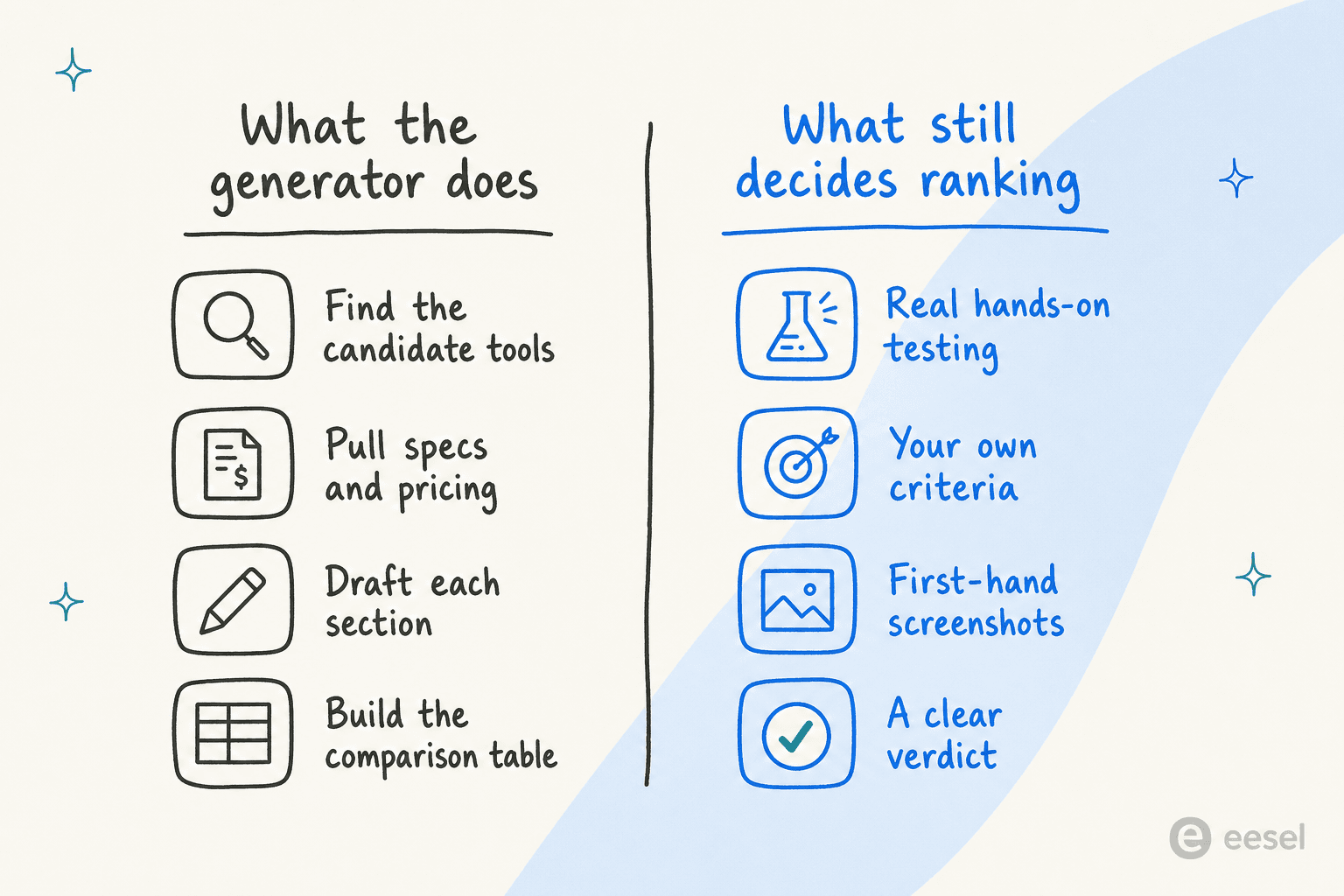
The generator owns the cheap, mechanical half. The expensive half, the testing and the criteria and the verdict, is the half that separates a roundup that ranks from one that sinks. Hold that picture, because it's the difference between a listicle that compounds traffic and one that Google quietly ignores.
The tools that actually generate roundup posts
There's no single best pick, only the right category for your job. After going through each tool's own pricing and feature docs and the output people share, they sort into three buckets: dedicated listicle writers, SERP-research platforms, and general-purpose marketing writers.
| Tool | Best for | Standout for roundups | Pricing (entry) | The catch |
|---|---|---|---|---|
| Koala | Amazon affiliate roundups | Live Amazon data in product roundups | $9/mo Essentials | Drafts "may still require a lot of editing" |
| Byword | Bulk SEO listicles | Programmatic generation at volume | $99/mo (25 articles) | Per-article credit math adds up |
| Jasper | Marketing teams | Brand-voice consistency across items | $69/seat/mo | Per-seat, not roundup-specific |
| Writesonic | AI-search visibility | Listicles plus AI-answer tracking | $79/mo annual | Low article counts per tier |
| Surfer | SERP-driven outlines | NLP-graded brief from top pages | $49/mo Discovery | Optimization layer, not a one-click writer |
| Frase | Research briefs | Aggregates competitors into one brief | $39/mo Starter | Article caps per tier |
A quick read on each. Koala is the most on-topic tool in the set: its Amazon Affiliate Articles mode generates "product roundups and reviews with live Amazon data including real reviews, pricing, and product specs," and it starts at just $9/month. It holds a strong 4.7/5 on G2 across 9,664 reviews, with the most common caveat being that "the output may still require a lot of editing." You can see the affiliate-roundup flow in its own product UI:
Byword is the volume play, "the AI article writer built for SEO at scale," with sample outputs that include a "12 Best Espresso Machines 2026" listicle. Its plans run $99/mo for 25 articles up to $999/mo for 300, and by its own FAQ each article costs $2.50 to $3.50. Jasper is the broad marketing platform rather than a roundup specialist; its Pro plan is $69/month per seat, and it leans on brand-voice consistency, though it's not tuned for affiliate-roundup workflows the way Koala is. (Jasper's own blog is refreshingly straight about the bar: Google aims to reward high-quality content, even when AI made it, as long as it follows E-E-A-T.)
On the research side, Surfer and Frase don't one-click a roundup; they hand you a SERP-built brief and score your draft against the top-ranking pages. Surfer's Content Editor builds guidelines from "over 500 web and AI signals," and Frase aggregates the competing pages into a comparison-ready brief before you draft. Both are optimization layers, so you still write the listicle, but for a research-grade roundup that's often a feature, not a bug. Writesonic has repositioned around AI-search visibility, bundling article generation with tracking across ChatGPT, Gemini, and Google AI Overviews, though its included article counts are low per tier.
One thing the table can't show: how fast this category churns. Content at Scale was a go-to roundup writer a year ago; today contentatscale.ai redirects to brandwell.ai, which has dropped article writing entirely to become a lead-gen platform. So don't marry a tool, marry the workflow.
Here's how the entry prices actually stack up, which is worth a glance before you commit.
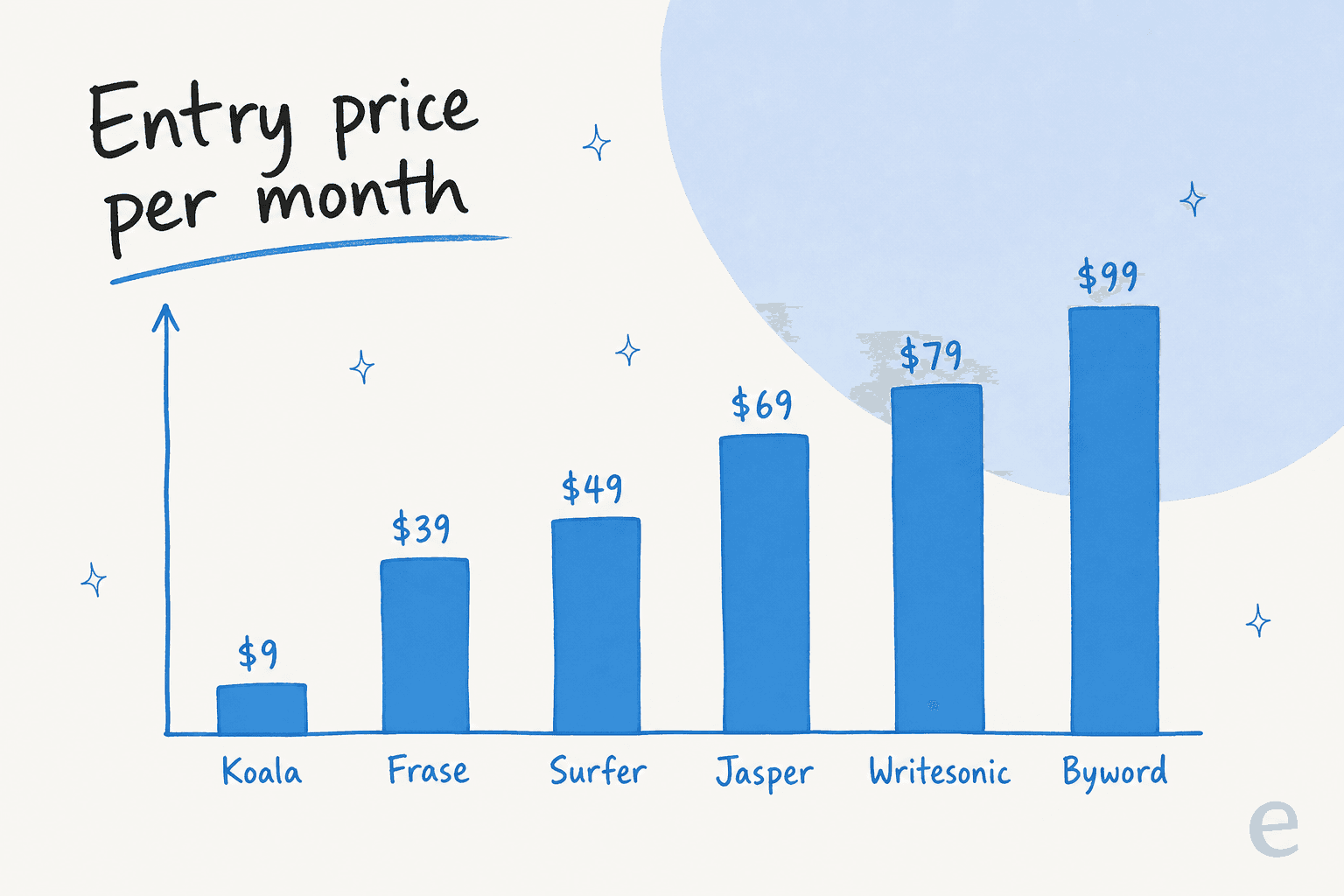
The spread is wider than people expect, and notice that the cheapest tool isn't the volume tool. Koala at $9 is built for one-off affiliate roundups; Byword at $99 is built to publish hundreds. If you're comparing the full field of AI blog writers, our roundup of the best AI writing tools goes deeper on the general-purpose options.
Why AI roundups read generic (and what Google does about it)
The single most common complaint about AI roundups is that they read like AI: ten tools, three bland sentences each, a table, and zero point of view. Copy you could paste under any logo. That's almost never the model's fault, it's an input problem. Fed nothing but "write the best CRMs for startups," a language model reaches for the statistical average of every roundup it has ever seen, which is the same ten items, in the same order, that everyone else published.
And in 2026, that's exactly what gets buried. The pattern shows up clearly in the SEO community. On an r/bigseo thread about Google's listicle crackdown, one practitioner put the fix bluntly:
"seeing this too on thin 'top x' pages without original proof. fastest recovery i've seen is rebuilding around first-hand evidence (screenshots, test data, real comparisons) and tightening intent so each list page has one clear job. if it reads like a generic roundup, google seems way less forgiving now."
Another commenter on the same crackdown thread named the trap that AI generators walk straight into:
"the '10 best X' format still works if theres real substance behind it also make sure your list isnt just regurgitating the same items as every other listicle for that topic. if you have the same exact 10 companies as 50 other sites google sees no reason to rank you."
That's the whole game. The format isn't penalized; the sameness is. And the irony is that an AI roundup post generator, left to its defaults, produces maximum sameness, because it's literally predicting the most common answer. The affiliate marketers feel it too. In an r/Affiliatemarketing thread, one tester summed up the tooling: "most either spit out generic listicles or just regurgitate product info with zero soul."
For the record, Google's position isn't anti-AI. Per Google Search Central, the line is: "If you use automation, including AI-generation, to produce content for the primary purpose of manipulating search rankings, that's a violation of our spam policies." The bar is the same for a human-written and an AI-written roundup, E-E-A-T either way. No special penalty for using AI, and no special credit either.
How to generate a roundup post that actually ranks
So the move isn't to skip the generator, it's to feed it the things it can't invent and edit what it gives back. Here's the workflow I'd run, and it maps cleanly onto any AI blog writing workflow you already have.
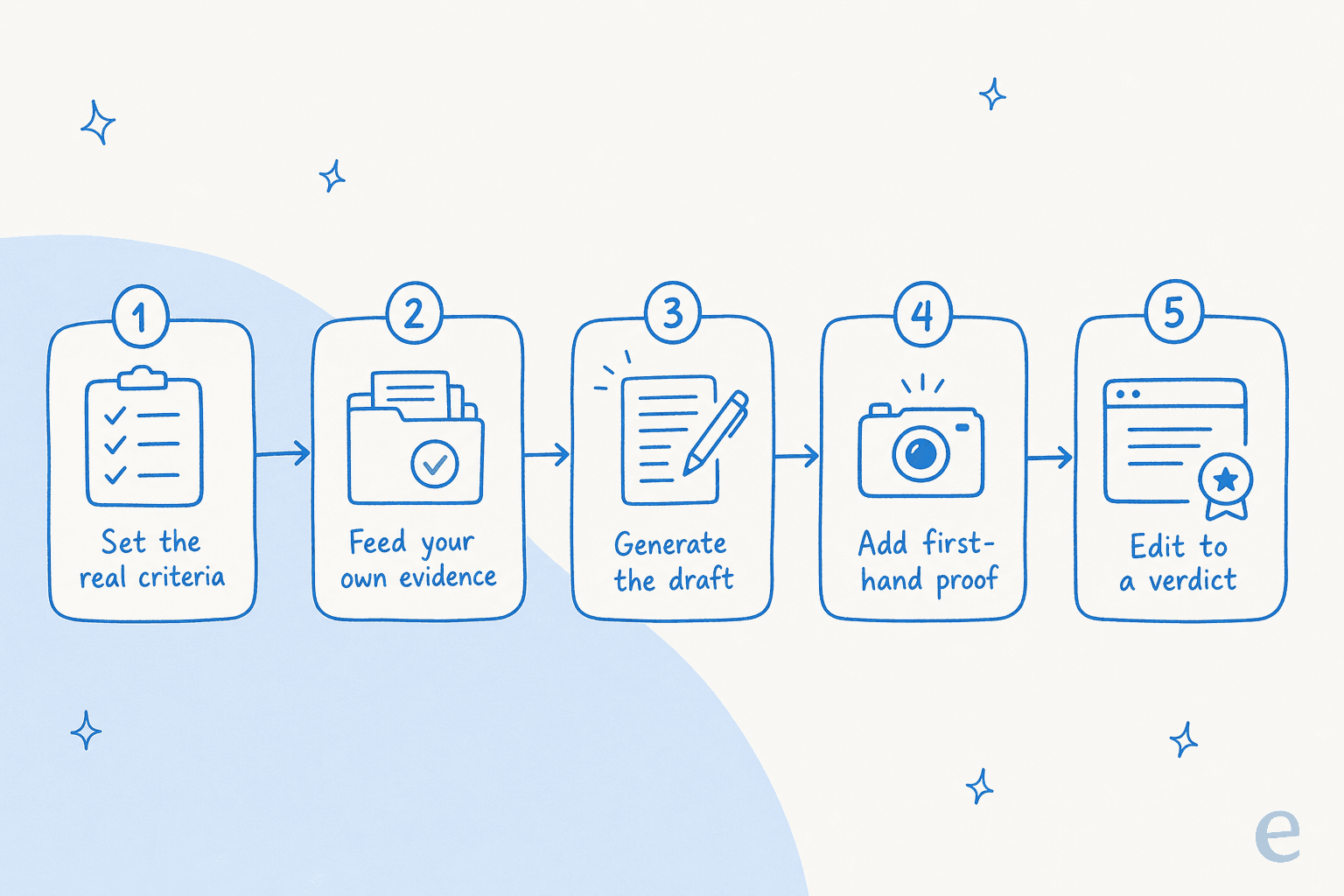
- Set the real criteria first. Before you generate a word, decide what you're actually ranking on, the dimensions a buyer cares about that most listicles skip: security certifications, integration count, the billable unit in the pricing, a real free tier. Criteria are the cheapest way to be different from the other fifty posts.
- Feed it your own evidence, not a blank box. Give the generator your shortlist, your notes from actually using the tools, the pricing you verified yourself. This is the same discipline behind maintaining brand voice with AI: the more real context in, the less generic out.
- Generate the draft. Now let the tool do what it's good at, assembling the sections and the comparison table. Treat the output as a first draft, not a final.
- Add first-hand proof. Drop in real screenshots of each tool's UI, a screenshot a reader can't get from the vendor's homepage, plus a real number you measured. This is the single biggest ranking signal the generator can't produce, and the one the Reddit crowd kept naming.
- Edit to a verdict. End each item with who it's for and who should skip it. A roundup with a spine reads as someone who actually chose; a roundup that likes everything reads as AI. That edit is also where you strip the AI tells that creep into every draft.
Done this way, the generator saves you the hours of assembly and you spend your time on the parts that rank. Skip steps one, four, and five, and you've just published the same post as everyone else, faster.
Where AI gets roundup posts wrong
To be fair to the tools, they're good at what they do, and the limitations are predictable rather than dealbreaking. Worth knowing before you lean on one:
- It invents specifics. Ask for a roundup and a model will happily make up a price, a feature, or a "SOC 2 certified" badge that isn't real. This is the same failure mode as AI hallucinations everywhere else: the output sounds confident whether or not it's true, so every spec in your table needs a human check against the vendor's own page.
- It defaults to the consensus list. Left alone, it picks the same items as the top-ranking posts, which is precisely what stops AI listicles from ranking. You have to override the default with your own shortlist.
- It has no first-hand experience. A generator can summarize a feature page, but it can't tell you the onboarding was painful or the mobile app is an afterthought. That texture is what E-E-A-T rewards, and it only comes from you.
- Stale data ages fast. Pricing and plans change monthly (see Content at Scale). A roundup is only as trustworthy as its last fact-check, so build a refresh habit rather than publish-and-forget.
None of that means skip the generator. It means treat its output as a fast first draft from a capable but unreliable junior, which is exactly how I'd treat any AI content generation tool on the stack.
Try eesel for context-first content
Here's where I'll be straight with you: eesel is, at its core, an AI built for customer support, not an affiliate-roundup machine. But the reason our support AI works where generic bots fall flat is the exact same reason generic roundup AI falls flat, context. A bot trained on the open web gives average answers; a bot trained on your help center, past tickets, and docs gives answers that sound like you. Same principle, different output.
That's the idea behind eesel's AI Writer: point it at your own knowledge and brief instead of a blank box, and you get drafts that start from your criteria, not the internet's average. We run our entire blog on a research-grade AI writing workflow, this post included, which is the most honest demo I can offer: a roundup written by AI, grounded in real research, edited to a verdict.
The AI Writer is free to try, and it's built on the same context-first approach this whole post argues for. If you take one thing from here, let it be this: the generator is never the differentiator, the context and the criteria you bring to it are. Pick whichever tool fits your budget, then spend your real effort on the 40% that ranks.
Frequently Asked Questions
What is an AI roundup post generator?
Can AI write a listicle that ranks on Google in 2026?
What is the best AI roundup post generator?
How much does an AI roundup post generator cost?
Do AI-generated roundup posts get penalized by Google?


Article by
Kurnia Kharisma Agung Samiadjie
Kurnia is a software engineer and writer at eesel AI with two years of SEO experience, writing about AI tools, helpdesk software, and customer support. He pairs a developer's understanding of how these products are built with search-driven research into what actually ranks and resonates with the people searching for them.