The world of search is changing, and it's happening fast. For years, we were all about climbing to that number one spot on Google. Now, AI Overviews and chatbots like ChatGPT are the new front page, giving people a single, consolidated answer. This shift means traditional clicks aren't the only goal, and tracking your brand's visibility just got a lot more complicated.
Your standard SEO metrics don't really tell the whole story anymore. To stay ahead, you need to know if AI engines are mentioning your brand and citing your content as a source. That's why I reviewed the top AI SEO tools to see which ones are most effective. Ultimately, getting cited by AI engines comes down to creating high-quality, Answer Engine Optimized (AEO) content. This foundational strategy highlights the importance of tools designed for this purpose, including content generators like the eesel AI blog writer.
What are AI SEO tools for visibility optimization?
Think of these tools as the next step up from rank trackers. You might see them called Generative Engine Optimization (GEO) or Answer Engine Optimization (AEO) platforms, but they’re all built to measure your brand’s performance inside AI-generated search results. Instead of just tracking a list of links, they analyze the content of the AI's answer itself.
GEO tools add a new layer beyond classic SEO by focusing on AI-driven search visibility and brand presence in AI summaries. They can help, but many are still early-stage, so expect some trial and error. Their long-term value depends on how fast you adapt to Google’s AI updates and if you actually use the insights to tweak your content and outreach. Most are good for spotting gaps and brand mentions you’d otherwise miss, but don’t rely on them alone, traditional SEO and solid content still matter most.

Based on what platforms like Peec AI and Semrush are doing, these tools usually measure a few key things:
-
Mentions: How often an AI names or recommends your brand in a response.
-
Citations: When an AI uses your content as a source for its answer, often with a link back to your site.
-
Sentiment: The tone of the AI's response when it talks about you, is it positive, negative, or neutral?
-
Share of Voice: A clear picture of how often you show up in AI answers for key topics compared to your competitors.
This is a completely different way of thinking about SEO. It’s no longer about just getting a high position on a results page. It's about becoming the trusted source that directly shapes the single, authoritative answer the AI gives the user.
How I selected the top AI SEO tools for visibility optimization
To make this list actually useful, I set some ground rules. I wasn't just looking for a long list of features; I wanted practical tools that solve real problems for marketing and SEO teams. Here's the criteria I used:
-
Core Functionality: Does the tool do what it says it will? Can it reliably track mentions and citations across major AI engines like ChatGPT, Perplexity, and Google AI Overviews?
-
Actionable Insights: Raw data is useless. I looked for tools that give clear recommendations to help you improve your visibility, not just a dashboard full of numbers.
-
User Experience: Is the platform easy to use? Can a busy team member get in and find what they need without a week of training?
-
Value for Money: Does the price make sense for the features and the results you can expect?
You'll also see this list includes both dedicated visibility trackers and a powerful content creation tool. That’s on purpose. You can't track visibility you don't have, and creating content that AI engines want to cite is the most important first step.
A quick comparison of the best AI SEO tools for visibility optimization
For a quick overview, here’s how the top tools stack up against each other.
| Tool | Best For | Key Feature | Pricing Starts At |
|---|---|---|---|
| eesel AI blog writer | Creating AEO-optimized content that gets cited | Generates complete, publish-ready blogs with assets | Free to try ($4 per blog post) |
| Profound | Historical reference (domain is for sale) | N/A | N/A |
| Peec AI | Competitor benchmarking in AI search | Pitch Workspaces for sharing client reports | €89/month (approx. $95/month) |
| Surfer SEO | Integrating visibility tracking with content optimization | Real-time Content Score and AI Tracker add-on | $79/month + $95/month for AI Tracker |
| Semrush | Integrating GEO into an all-in-one SEO suite | AI Visibility Index and prompt database | $165.17/month (as part of Semrush One) |
| Otterly AI | Startups and small teams on a budget | Accessible entry-level pricing | $29/month for 15 prompts |
A closer look at the 6 best AI SEO tools for visibility optimization in 2026
Now, let's get into the details. Here’s a breakdown of the strengths, weaknesses, and ideal use cases for each tool based on my testing.
1. eesel AI blog writer
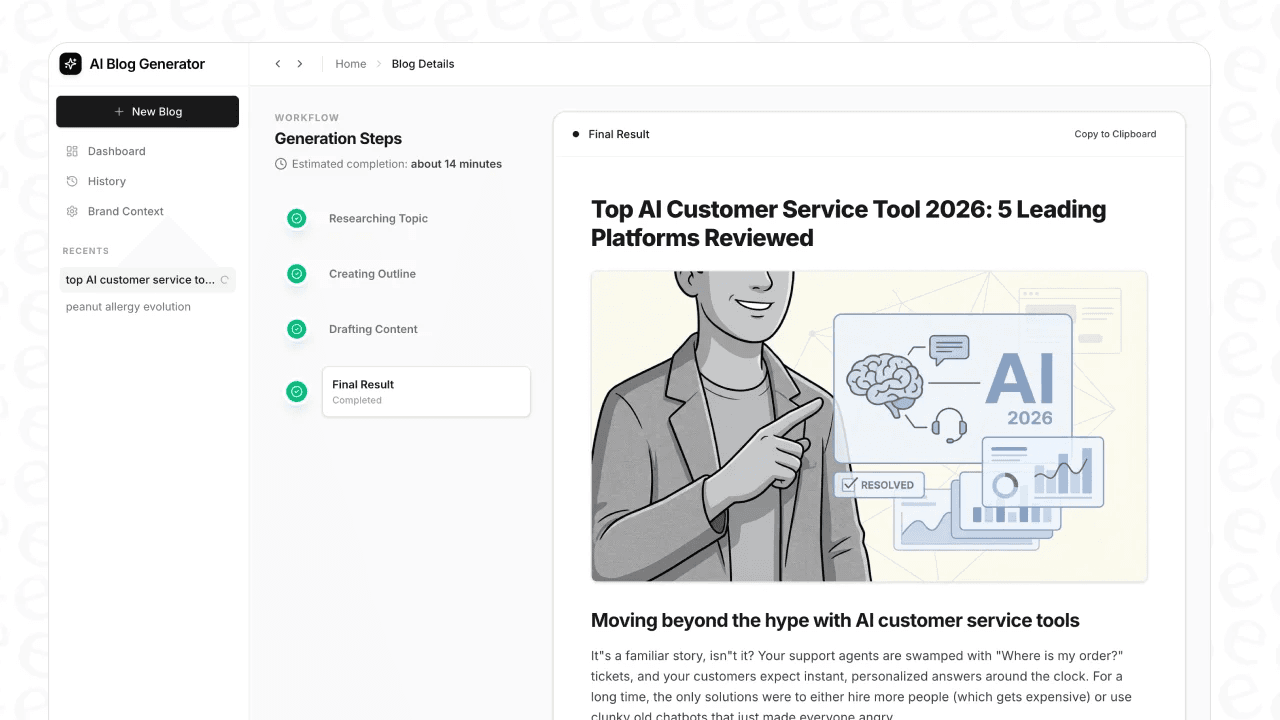
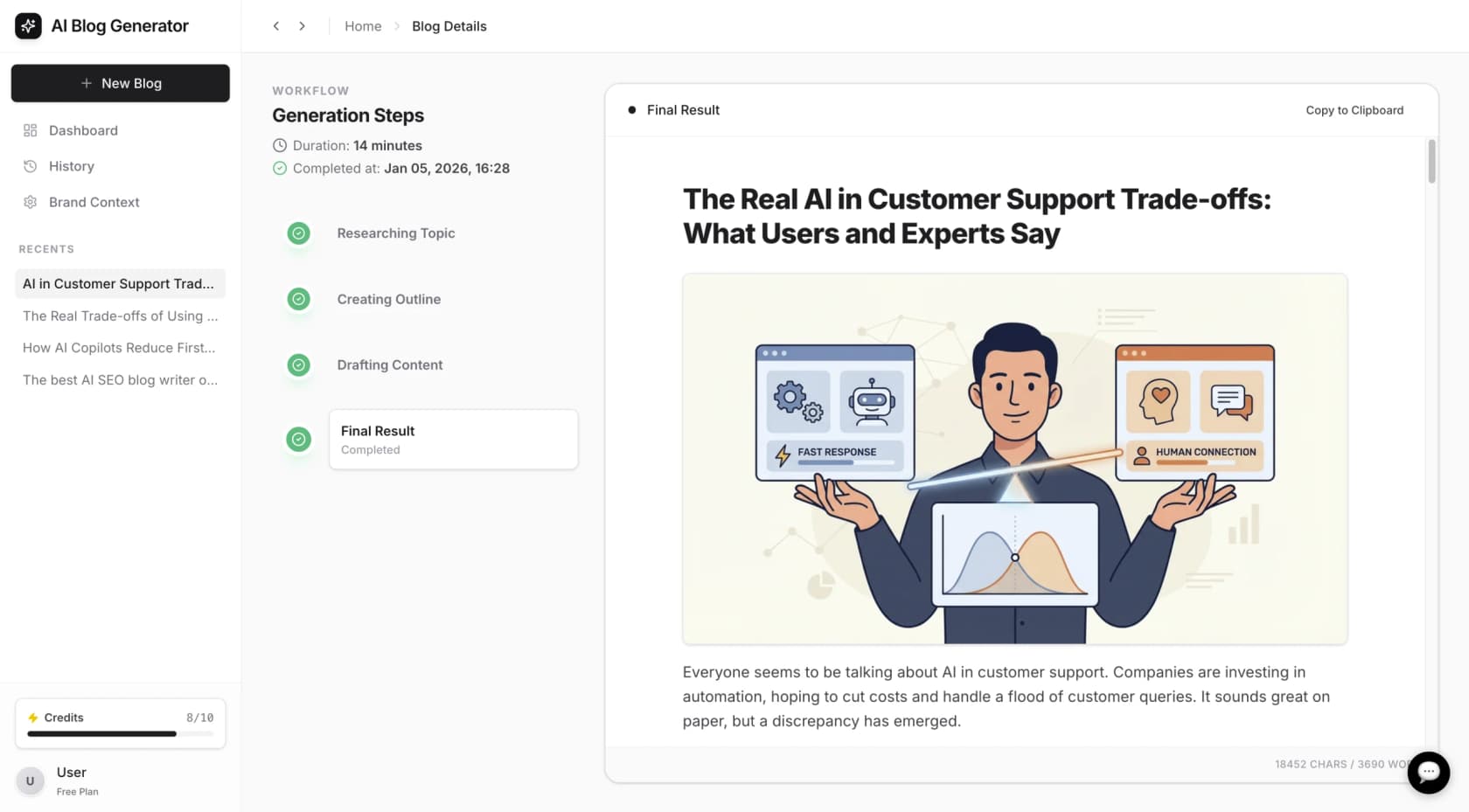
While many visibility tools focus on tracking and analytics, the eesel AI blog writer concentrates on the content creation aspect of AEO. It's designed to help you proactively build a library of citable content.
Pros: Its main feature is the ability to turn a single keyword into a complete, publish-ready, and AEO-optimized blog post. It doesn't just output text; it builds a structured article with assets like infographics and tables, which makes your content more citable. It also pulls in real Reddit quotes and YouTube videos, adding the human experience signals that AI systems are increasingly trained to value. This approach is about producing genuinely helpful content at scale.
Cons: This is a content creation platform, not a monitoring tool. While it’s effective at creating the assets you need to earn AI visibility, you'll still want a separate platform to track your mentions and measure your content's impact over time.
Pricing:
-
You can try it for free to generate your first article.
-
The eesel AI blog writer costs $4 per blog post.
Verdict: For teams looking to scale their AEO content strategy, this tool addresses the production bottleneck, allowing for the consistent creation of articles and guides that are structured for generative engines.
2. Profound
Profound was once a player in the AI visibility space, but today it serves as a lesson in the importance of due diligence when choosing a new tool.
Pros: Based on old information from a Reddit thread, it appeared to have a solid feature set. It offered tiered pricing and apparently tracked brand mentions across multiple AI engines, which are the core functions you'd expect.
Cons: The main issue is that the profound.ai domain is for sale. A tool cannot be used if its website is on the market. This is a clear sign that the business is likely shut down, making any past features or pricing irrelevant.
Pricing:
- Previously listed plans ranged from $99 to $399 per month.
Verdict: Profound is a non-starter. Its story is a critical reminder for anyone investing in the fast-moving AI tool space. Always check for recent company activity and updates before you commit to a subscription.
3. Peec AI
Peec AI is a polished, data-driven platform built for agencies and in-house marketing teams focused on the competitive landscape. It shows you not just how you're doing, but how you measure up against everyone else.
Pros: The user interface and onboarding are excellent. One of its best features is "Pitch Workspaces," which lets agencies easily create and share reports with clients, a huge time-saver. It’s effective for analyzing competitors and identifying the exact sources that are recommending them. This gives you a clear roadmap for your own content strategy. Peec also uses advanced UI scraping to collect authentic user data, which can be more reliable than API responses.
Cons: The platform works best for brands that already have some search volume. If you're a brand new site, you might find the data a bit thin. Also, the baseline plans cover the three main answer engines, but tracking others costs extra.
Pricing:
-
Starter: €89/month for 25 prompts.
-
Pro: €199/month for 100 prompts.
-
Enterprise: Starts at €499/month.
Verdict: Peec AI is a solid choice for product-led companies and agencies. If your goal is to benchmark performance against competitors and understand their success in AI conversations, this is a suitable tool for the job.
4. Surfer SEO
Surfer SEO is a well-known name in content optimization, and it has adapted to the AI era. It gives you a workflow to create content structured for AI engines and then track its performance.
Pros: Surfer offers an end-to-end workflow, from topic research with its Topical Map feature to auditing existing content. The real-time Content Editor is its core feature, giving you actionable, SERP-based suggestions as you write. The recent addition of its AI Tracker add-on is a key addition, bringing direct visibility monitoring for ChatGPT, Perplexity, and AI Overviews right into the platform where you create your content.
Cons: While it’s a powerful combination, it isn’t a specialized GEO platform. The AI visibility tracking is a separate, paid add-on, which increases the total monthly cost. You have to buy a base plan first, making the entry price for the full suite higher than some dedicated tracking tools.
Pricing:
-
The base platform starts at $79/month (when billed annually).
-
The AI Tracker add-on costs an additional $95/month for 25 prompts.
Verdict: Surfer is an effective tool for content teams that need to optimize for both traditional search and AI citations. It bridges the gap between content creation and visibility monitoring, keeping everything in one place.
5. Semrush
For teams already using the Semrush ecosystem, its expansion into AI visibility is a natural and convenient move. It brings GEO capabilities into a familiar, all-in-one platform.
Pros: The biggest advantage here is integration. With the AI Visibility Toolkit, you can manage your traditional SEO campaigns and your GEO efforts from a single dashboard. It offers an AI-readiness site audit to find opportunities and gives you access to a massive database of prompts to track. The new Semrush One plan bundles all their tools, including the AI toolkit, for a more unified approach.
Cons: The AI features are part of a larger, more expensive package; it's not a standalone tool. At the time of testing, it tracked fewer answer engines than some specialized competitors, and certain promised features like AI crawler visibility analysis weren't available yet.
Pricing:
- The Semrush One "Starter" plan, which includes the AI Visibility Toolkit, starts at $165.17/month (when billed annually).
Verdict: If your team is already heavily invested in Semrush, its integrated AI toolkit is a logical way to start tracking AI visibility. It saves you from adding another platform to your marketing stack.
6. Otterly AI
Otterly AI stands out for its accessibility. It's a budget-friendly GEO platform that serves as an entry point for startups, small businesses, or anyone wanting to test AI visibility tracking without a large investment.
Pros: The pricing is the most accessible on this list. It allows small teams to start tracking prompts and gathering data without needing a large budget approval. This focus on affordability makes it a practical choice for proving the value of GEO internally before you scale up your investment.
Cons: As expected from a tool built for smaller budgets, the feature set might not be as deep as enterprise platforms like Peec or Semrush. According to a recent Reddit market survey, it's also a newer player, which means it has fewer third-party reviews and case studies available.
Pricing:
-
Starts at $29/month for 15 tracked prompts.
-
The Standard plan is $189/month for 100 prompts.
Verdict: Otterly AI is a good starting point for anyone new to AI visibility tracking who needs to be mindful of their budget. It offers a low-risk, low-cost way to start gathering the essential data you need to compete.
Practical tips for improving visibility with AI SEO tools
After testing these tools, a few clear patterns emerged for what kind of content gets cited by AI. Here are some practical tips you can use right away:
frequent AI posts may work in the short term, but for stable visibility, combining automation with human input wins every time.
-
Answer questions directly: Structure your articles with clear, question-based headings (like "What is..." or "How does..."). Then, provide a concise, direct answer right below the heading. This makes it incredibly easy for an AI to parse and use your content.
-
Focus on E-E-A-T: Double down on demonstrating Experience, Expertise, Authoritativeness, and Trust. Include author bios, use first-hand language ("I tested," "We found"), and create original data, charts, or visuals. AI systems are being trained to prioritize sources that feel authentic and credible.
-
Build "citation-worthy" pages: Go beyond standard blog posts. Create ultimate guides, detailed comparison tables, and pages dedicated to statistics. These formats organize complex information in a structured way that is perfect for an AI to reference.
-
Use structured data: This is a technical but important step. Implement schema markup (like Article, Organization, and Author schema) on your pages. This gives AI systems clear, machine-readable signals about your content's context and credibility.
To see these strategies in action, it's helpful to hear from experts who are navigating this new landscape. The video below from Ahrefs offers a deep dive into the new SEO playbook for AI search, covering top GEO ranking factors and practical advice.
The role of content in AI visibility
The takeaway is clear: AI search is here to stay, and success is no longer just about the #1 ranking. It's about becoming a source of truth for AI engines.
While monitoring tools are essential for measuring your progress, you can't improve what you don't have. Visibility begins with creating content that is specifically designed to be found, understood, and cited by AI.
This is where content creation tools like the eesel AI blog writer play a key role. They are designed to solve the content production challenge, helping you generate AEO-optimized, media-rich articles that AI systems can easily reference.
Ready to create content that wins in AI search? Try the eesel AI blog writer for free and generate your first publish-ready article in minutes.
Frequently asked questions
What are the main benefits of using AI SEO tools for visibility optimization?
The main benefit is that they show you what traditional SEO tools can't: whether your brand is being mentioned and cited in AI-generated answers. This helps you measure your share of voice in places like Google AI Overviews and ChatGPT, which is the new front page of search.
How do AI SEO tools for visibility optimization differ from traditional rank trackers?
Traditional rank trackers tell you your position in a list of blue links (e.g., #3 on Google). AI SEO tools for visibility optimization analyze the actual content of an AI's answer to see if your brand is mentioned, cited as a source, or recommended, giving you a much deeper understanding of your influence.
Can startups on a budget find effective AI SEO tools for visibility optimization?
Absolutely. Tools like Otterly AI are designed specifically for smaller teams and startups, offering affordable entry-level plans. This allows you to start gathering data and proving the value of tracking AI visibility without a large upfront investment.
What's the most important feature to look for in AI SEO tools for visibility optimization?
The core feature is the ability to track brand mentions and source citations across major AI engines like ChatGPT, Perplexity, and Google AI Overviews. Beyond that, look for competitor benchmarking and actionable insights that tell you *how* to improve, not just where you stand.
How do content creation tools like eesel AI complement AI SEO tools for visibility optimization?
They work hand-in-hand. Monitoring tools tell you where you need to improve your visibility, but a content tool like the eesel AI blog writer gives you the AEO-optimized articles and guides needed to actually *earn* those citations. You can't track visibility you don't have, so creating the right content is the first step.