
Staring at a blank page, trying to dream up blog topics people actually want to read, can feel like a total guessing game. You pour hours into brainstorming and writing, hit "publish," and... nothing. The traffic needle doesn't budge, leaving you wondering where you went wrong.
The thing is, the problem usually isn't your writing. It's the research—or lack of it. Finding good topics is the most important part of content marketing, but let's face it, it takes forever. And today, the old trick of just stuffing a keyword into a post a dozen times simply doesn't work anymore. Modern SEO is all about figuring out what your audience wants to achieve and creating content that actually helps them do it.
This guide will walk you through a framework for finding and validating blog topics that connect with your audience and rank on search engines. We'll cover everything from getting inside your audience’s head to using data to back up your ideas.
We'll also show you how AI can be a huge help in this process. By using AI-powered platforms like the eesel AI blog writer, you can automate the deep research and turn a simple idea into a full-blown article. It's the same workflow we used here at eesel to grow from 700 to over 750,000 daily impressions in just three months.
Why blog topic research is more than just keyword research
For years, SEO felt like trying to crack a code. The main goal was to find the right keywords and figure out how many times to use them. But search engines like Google have gotten way smarter. With changes like the Helpful Content Update, the focus has shifted from algorithms to people. Google wants to reward content that gives people a good experience, not just content that's built to rank.
This is where the difference between keyword research and topic research really matters.
- Keyword research is about finding specific search terms people use, like "best CRM for small business." It’s a tactic focused on a single phrase.
- Topic research is about understanding the whole story behind that search. What questions does this person have? What problem are they trying to solve? Are they just starting to look, or are they ready to make a purchase?
Instead of just targeting one keyword, topic research encourages you to think in "topic clusters." This involves creating a main "pillar" post on a broad subject (like "small business CRM") and then supporting it with smaller, more specific posts that answer related questions ("how to migrate CRM data," "CRM pricing comparison," and so on). This approach is illustrated in the graphic below.
When you cover a topic this completely, you naturally start ranking for related keywords without even trying. The goal changes from winning a single keyword to becoming the go-to authority on an entire subject.
Understanding your audience: The foundation of topic research
Before you even glance at search volume or keyword difficulty, you need to get to know the people you're writing for. What are their biggest headaches? What keeps them up at night? The best blog ideas come from real human problems, not just data points. Here’s how to find them.
Competitor analysis for topic ideas
One of the fastest ways to find proven topic ideas is to see what's already working for your competitors. By checking out their best-performing content, you can spot gaps in their strategy and find opportunities they've overlooked.
Tools like Ahrefs and Semrush are great for this. For instance, you can use Ahrefs' Content Gap tool to pop in a few of your competitors' domains and see which keywords they rank for that you don't. This is a goldmine for uncovering untapped opportunities that you know have an existing audience.
In the same way, Semrush's Top Pages report shows you which of your competitor's pages are getting the most traffic. You can see how people find those pages (search, social, etc.) and work backward to figure out their successful content strategies.
- Limitation: This method is reactive. You are seeing what has already worked for someone else, which can put you in a position of playing catch-up rather than spotting emerging trends.
Digging into forums and online communities
If you want to hear the raw, unfiltered voice of your customer, go where they are. Forums and online communities like Reddit and Quora are amazing sources for topic ideas because they're full of real people asking real questions.
You won't find polished marketing language here. This is where you'll discover the exact words your audience uses to describe their problems. Try searching for phrases related to your industry, followed by things like:
- "how do I..."
- "problem with..."
- "any advice on..."
- "what's the best way to..."
Once you decide on a topic, take a look at the 'People also ask' section in the Google results. Write those down and Include those popular questions in your blog post.

The questions you find can literally become the headlines for your next blog posts. The detailed answers and discussions can form your subheadings and main points. It's like having a direct line into your audience’s brain.
- Limitation: This approach can be very manual. It is easy to spend hours scrolling through threads without a clear topic emerging. Discipline is required to extract actionable insights efficiently.
Listening to your audience
Sometimes the best topic ideas are right in front of you. Your own customers and internal teams are a fantastic resource because they're on the front lines every day.
- Talk to your customers: Send a simple survey to your email list asking what they're struggling with. Jump on a few 15-minute calls with new customers and ask what "aha!" moment made them choose you.
- Check in with your support team: Your customer support agents know every common question, frustration, and feature request. Turn those frequently asked questions into detailed, helpful blog posts.
- Chat with your sales team: What are the biggest objections they hear on demos? What selling points get prospects excited? These are perfect for bottom-of-the-funnel content.
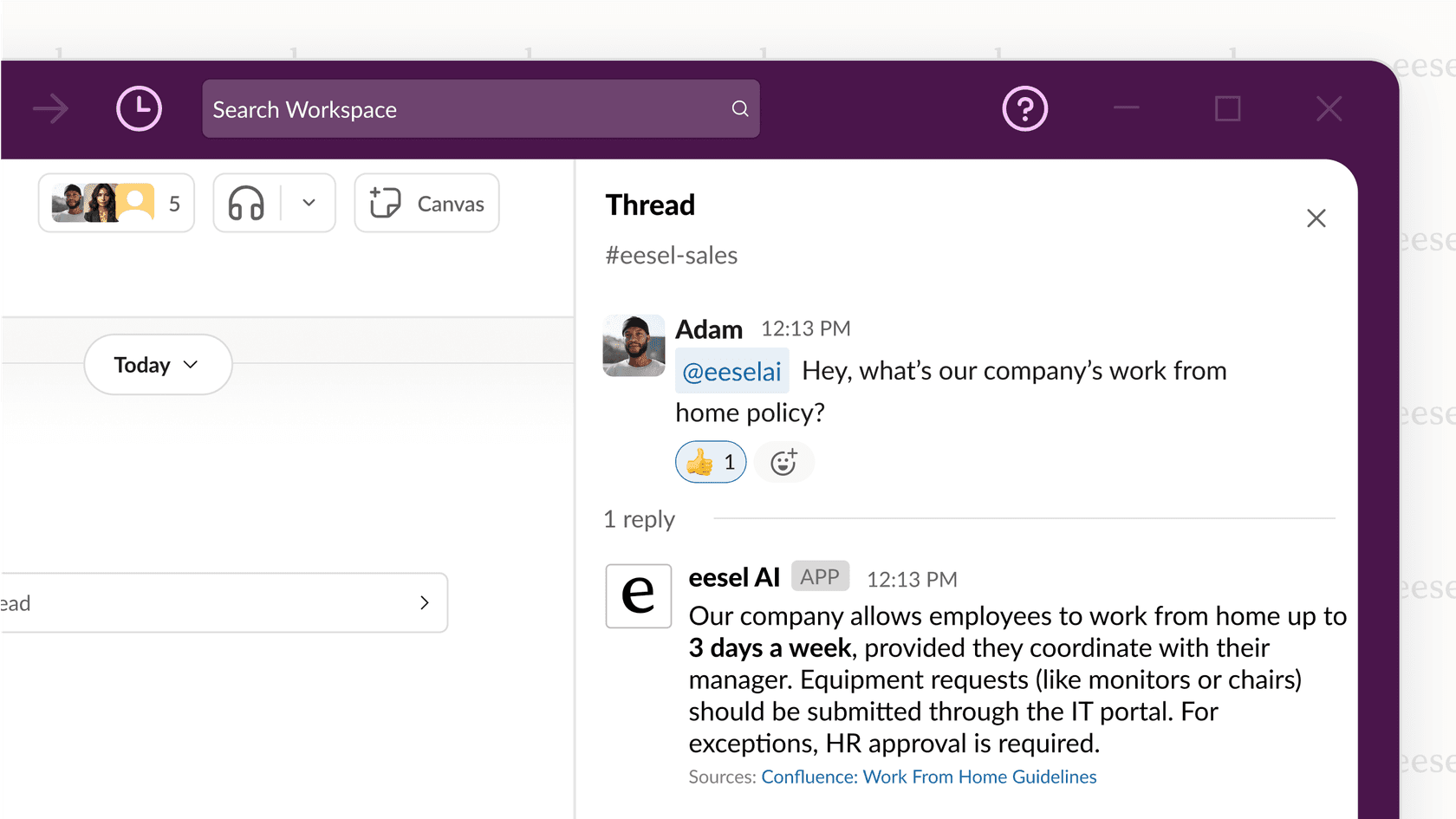
Bringing all this internal knowledge together is a big deal. It's the idea behind tools like eesel AI's internal chat, which connects to all your company documents to give teams quick, reliable answers. When your whole company shares what they know, your content strategy gets a whole lot smarter.
Data-driven tools for topic research
Once you have a list of potential ideas from talking to people, it's time to look at the data. Quantitative tools help check if these topics have real search demand and can show you new angles you might have missed.
Using free tools to uncover questions
You don't need a pricey subscription to get started with data-driven research. A couple of free tools can provide a ton of information.
AnswerThePublic is a brilliant tool for understanding what people want. You start with a broad keyword (like "content marketing"), and it visualizes related questions people are asking online. It groups them into categories like Questions (what, why, how), Comparisons (vs, or), and Prepositions (for, with). It's a fantastic way to find questions people are asking, giving you a ready-made structure for your blog post.
Google Trends is your tool for seeing the big picture. It shows you how popular a topic is over time, which is useful for spotting seasonal trends or checking if interest in a topic is growing or shrinking. It doesn't give you exact search volume numbers but scores topics on a 1-100 scale. Look for "Rising" queries and especially "Breakout" topics, which are terms that have grown by more than 5000% in a short time.
The challenge of manual synthesis
While these tools are useful, they all work separately. You might have a list of keywords from Ahrefs, a mind map of questions from AnswerThePublic, and a trend line from Google. So, what's next?
The real challenge, and the biggest bottleneck for most content teams, is putting all this separate information together. You're still left with the slow, manual task of combining everything into a logical article outline that actually helps the reader. This is where great ideas often die because of the effort it takes to structure them.
| Tool | Primary Use Case | Best For | Cost |
|---|---|---|---|
| AnswerThePublic | Finding user questions and search intent | Structuring content around specific, long-tail queries | Freemium |
| Google Trends | Identifying seasonality and emerging interest | Creating timely content and validating topic longevity | Free |
How to research blog topics at scale with eesel AI
The foundational methods are great for understanding your audience, but they don't scale. If you want to publish high-quality content, you can't spend days researching every single post. This is where a modern workflow comes in, shifting from manual work to an automated, AI-driven process.
The eesel AI blog writer streamlines this entire research phase into one simple step. Instead of you having to piece everything together, it does the heavy lifting. This is the exact tool that let us scale our own content production and grow to over 750,000 daily impressions.
Here’s how it fixes the headaches of manual research:
- Context-aware research: A key feature of eesel AI is its ability to understand the intent behind your topic. If you prompt it with "best project management software," it knows you're writing a comparison post. It will automatically find relevant data like pricing, key features, and user reviews, making sure the content is deeply researched and helpful.
- Automatic social proof and media: Remember all that time you spent digging through Reddit? eesel AI does that for you. It finds relevant Reddit discussions and YouTube videos and embeds them right into the draft. This adds instant credibility and depth to your content, saving you hours of work.
- Complete asset generation: Great content is more than just words. Visuals are key for keeping people engaged. eesel AI automatically generates the assets you need, including AI-generated images, helpful infographics, and data tables to summarize complex information.
It takes all the separate pieces of research—competitor data, user questions, social proof, and visuals—and pulls them together into a publish-ready draft in minutes.
Putting it all together: Creating a winning outline
Whether you do it manually or with an AI assistant, the goal of your research should always be a clear, actionable outline. An outline is the blueprint for your article. It makes sure your final piece is logical, focused, and covers all the important points without getting sidetracked.
A strong blog post outline usually includes:
- A compelling introduction: Hook the reader and tell them what they'll learn.
- Logical body sections: Each section should have a clear heading and focus on a single key point supported by your research.
- A concluding summary: Wrap up the main takeaways and give a clear call to action.
Pro tip
Don't skip the outline! A well-researched outline is the best way to beat writer's block. When you know exactly what you need to write in each section, the words come much more easily.
Visual learners might find it helpful to see these research strategies in action. The video below from Ahrefs offers a great walkthrough on how to find compelling content ideas, reinforcing many of the data-driven techniques we've discussed.
Moving forward with your research
Blog topic research has changed. It's no longer about finding a keyword and hitting a word count. It's about understanding audience intent and building authority by answering their questions better than anyone else.
The best way to do this is to combine human-centric research with data-driven validation. Listen to your customers, analyze your competitors, and use tools to confirm that your ideas have real demand.
But while these manual methods are insightful, they just don't scale. To consistently create high-quality content that drives traffic, AI-powered platforms are becoming essential. They automate the most time-consuming parts of the research process, so you can focus on strategy and creativity.
Ready to see the future of content research for yourself? Generate your first article for free with the eesel AI blog writer and get a publish-ready, deeply researched post in just a few minutes.




