


Salesforce vs HubSpot for customer support comes down to one question first: pick the support tool that sits on the CRM your company already runs, because the whole point of either is a ticket that knows the customer's deals, plan and history. When that doesn't settle it, price does. HubSpot Service Hub Professional is $90 a seat a month, and its Customer Agent costs $0.50 for each conversation it resolves. Salesforce Service Cloud Core is $195 a user a month, and Agentforce lists $2 per conversation. For a 10-agent team whose AI handles 1,000 chats a month and resolves 600 of them, that is about $1,170 a month on HubSpot against about $3,950 on Salesforce, before HubSpot's one-time $1,500 onboarding.
I build eesel's helpdesk integrations, including the ones for Salesforce and HubSpot, so I spend a lot of time inside both. If you already run one of them and want an AI teammate in it, eesel joins your existing cases or tickets and learns from past replies, and an AI coding agent can set it up for you with the eesel CLI (loading approved articles and asking test questions before it goes live), while connecting the helpdesk still needs an admin's approval.
Salesforce Service Cloud vs HubSpot Service Hub at a glance
Here is how the two line up for a support team, using each vendor's list prices as of November 2026.
| Salesforce Service Cloud | HubSpot Service Hub | |
|---|---|---|
| Entry plan for a support team | Core, $195 per user a month, billed annually | Professional, $90 per seat a month ($100 crossed out as the list price) |
| Cheaper bundles | Starter Suite $25, Pro Suite $100 (CRM suites with service basics) | Free (2 users), Starter $7 per seat (a new-customer discount on $20) |
| Top plan | Max, $550 per user a month | Enterprise, $150 per seat a month |
| One-time fees | None listed | Onboarding: $1,500 (Professional), $3,500 (Enterprise) |
| AI agent for customers | Agentforce: $2 per conversation, or Flex Credits | Customer Agent: 50 credits ($0.50) per resolution |
| AI usage included | 2.75M Flex Credits a year on Max | 3,000 credits a month (Pro), 5,000 (Enterprise) |
| Built for | Case-heavy service orgs that already run Salesforce | Teams running marketing and sales in HubSpot |
The headline difference is not features. Both have ticketing, a knowledge base, routing, SLAs and an AI agent. It is how much configuration you get, and how much configuration you have to do.
What is Salesforce Service Cloud?
Service Cloud is Salesforce's support product: cases, a service console, omni-channel routing, entitlements and knowledge, all on the same objects as Sales Cloud. Its pricing page now leads with three service editions. Core ($195) is "the CRM for service with every essential service tool to manage cases", with case management, a self-service help center and Slack Business+. Advanced ($395) adds an "AI agent for customer service", a full sandbox and the Premier Success Plan. Max ($550) bundles Agentforce for Service, contact center tools, IT service and 2.75M Flex Credits per org per year.
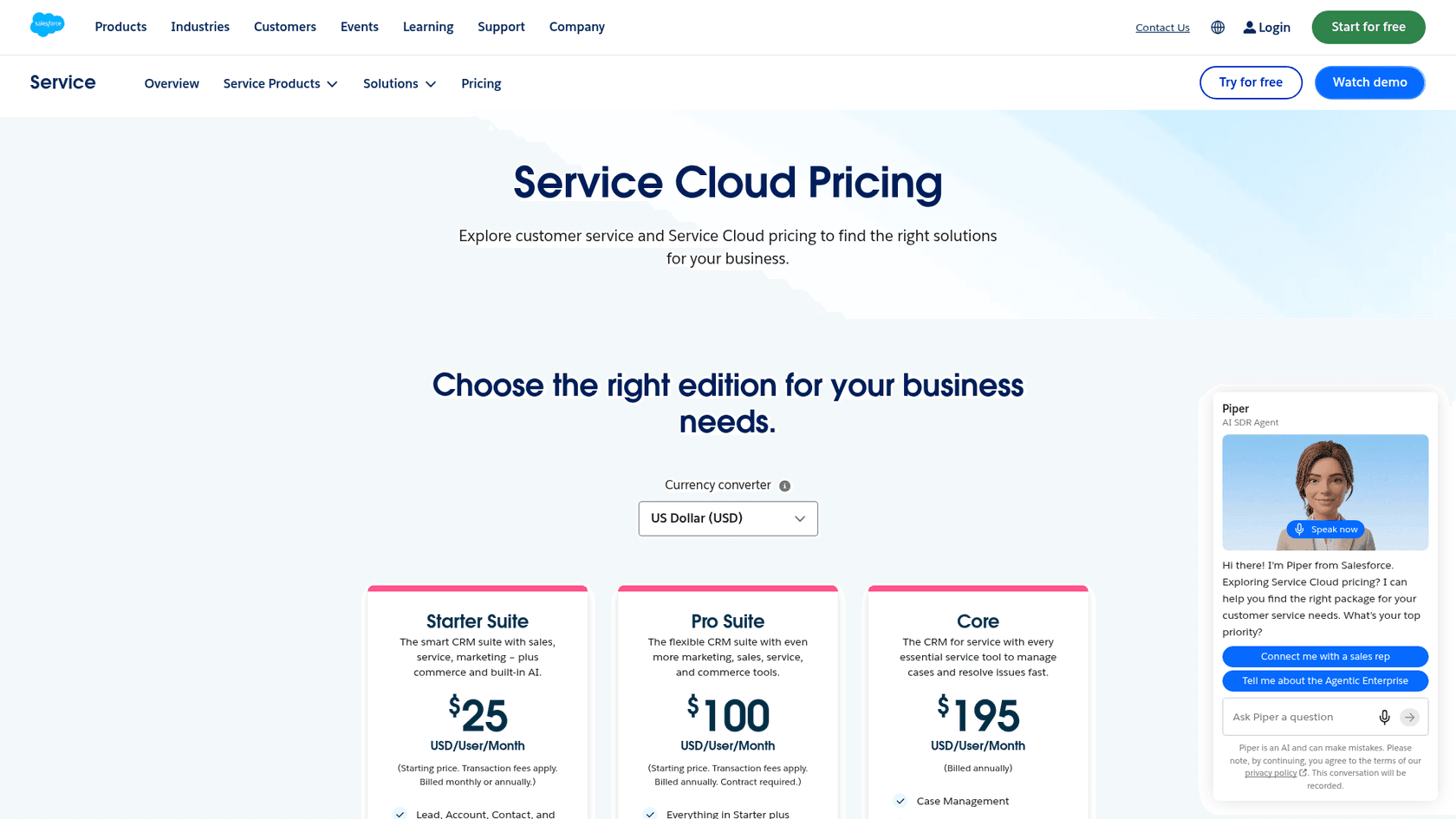
The add-ons are where Service Cloud bills grow. Enhanced Messaging costs an extra $75 per user a month on Core and Advanced, and most of the AI features in the comparison table (service replies, case routing, article recommendations, knowledge creation) are listed as "available for purchase" on Core and Advanced rather than included. For the pieces themselves, there are separate guides to Omni-Channel routing and entitlements and milestones.
Reviewers who like it describe the single view of the customer. The cost of that depth comes up just as often:
"Additionally, the licensing costs and add-on pricing models (especially for advanced AI capabilities and certain third-party integrations) can scale up very quickly."

What is HubSpot Service Hub?
Service Hub is HubSpot's help desk, built on the same contact, company and deal records as its marketing and sales hubs. Its pricing page puts the support features on Professional: the Help Desk Workspace, Customer Agent, a knowledge base of up to 2,000 articles, 500 macros, customer portal and feedback surveys, with 3,000 HubSpot Credits a month. Enterprise ($150) adds skill-based routing, conditional SLAs, capacity limits and a sandbox, with 5,000 credits.
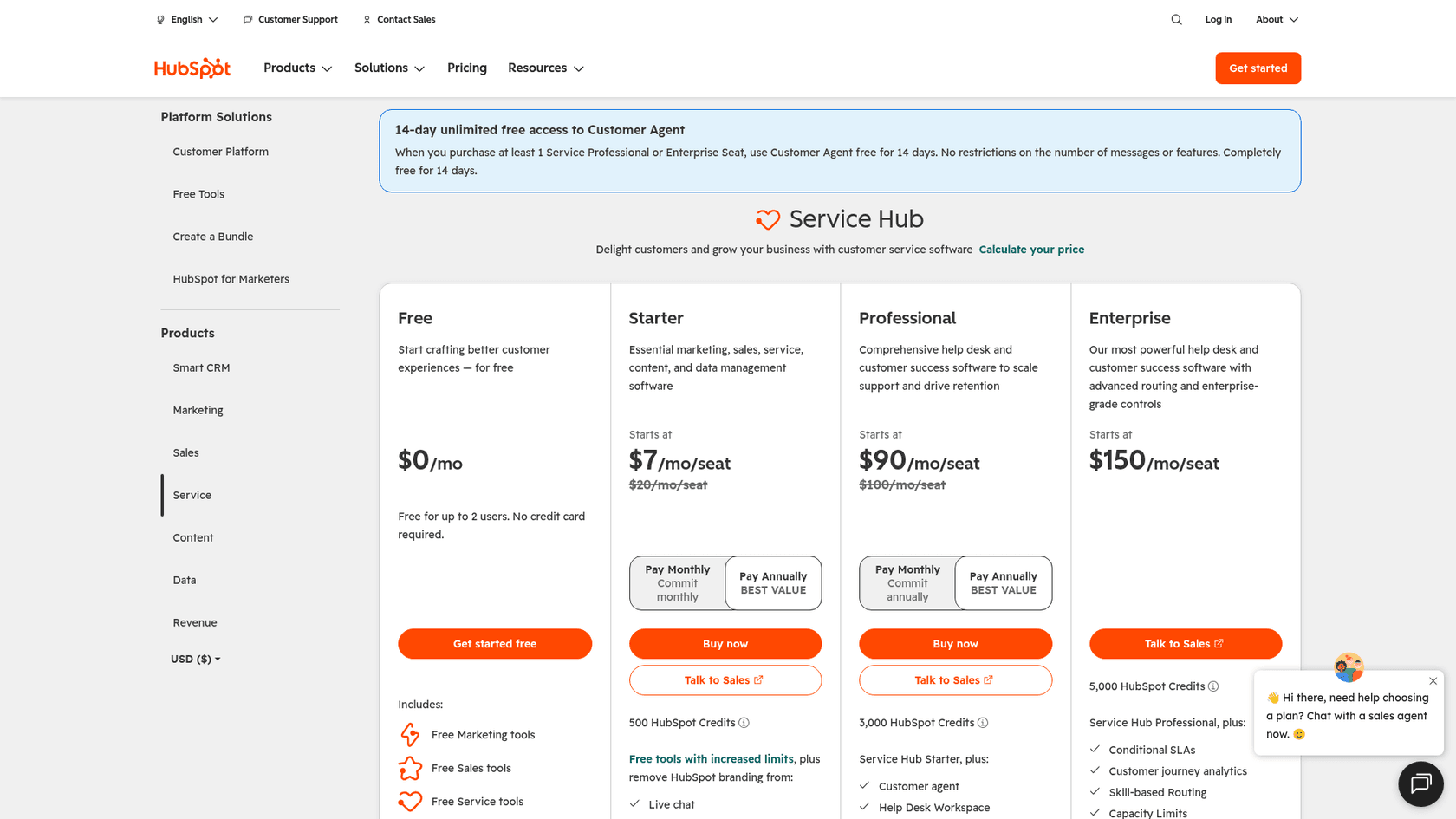
The $7 Starter price is a discount for new customers ($20 a seat otherwise), and it gets you ticketing and live chat without HubSpot branding, but not Customer Agent or the knowledge base. Both paid tiers above it carry a required one-time onboarding fee that the seat price leaves out. For a closer look at the help desk itself, see the guides to HubSpot's help desk SLAs and skill matching.
Where HubSpot reviewers push back, it is usually on flexibility rather than cost:
"As my business grew, I needed much more flexibility. I operate multiple brands under one business, and customizing HubSpot to fit my workflows and organize each brand separately became difficult without increasing my subscription costs."
How much does each cost for a 10-agent support team?
On seats alone, Service Cloud costs about twice as much as Service Hub. Ten agents on HubSpot Professional is 10 x $90 = $900 a month, plus $1,500 once for onboarding. Ten agents on Service Cloud Core is 10 x $195 = $1,950 a month. Move both up a tier and it is $1,500 (HubSpot Enterprise, plus $3,500 once) against $3,950 (Service Cloud Advanced).
| 10 agents, per month | Seats | One-time |
|---|---|---|
| HubSpot Service Hub Professional | $900 | $1,500 |
| HubSpot Service Hub Enterprise | $1,500 | $3,500 |
| Salesforce Service Cloud Core | $1,950 | None listed |
| Salesforce Service Cloud Advanced | $3,950 | None listed |
Two things that table hides. Salesforce's cheaper Starter Suite ($25) and Pro Suite ($100) exist, but they are CRM suites for small businesses (sales, service and marketing basics in one), not the service editions the AI and contact center add-ons are sold on. And neither list price includes the person who configures the thing. On Salesforce that is usually a dedicated admin; the setup cost of Agentforce is its own topic.
How do their AI agents charge?
The AI agents flip the usual story about which vendor is cheaper per unit, because HubSpot charges for a resolution and Salesforce lists a price per conversation. HubSpot's credits page prices Customer Agent at 50 credits per resolved messaging conversation, at $0.01 a credit. Salesforce's Agentforce pricing lists $2 per conversation, or Flex Credits at $500 per 100,000, and its rate card charges 20 credits for a standard action ($0.10) and 400 for a Help Agent resolution ($2).
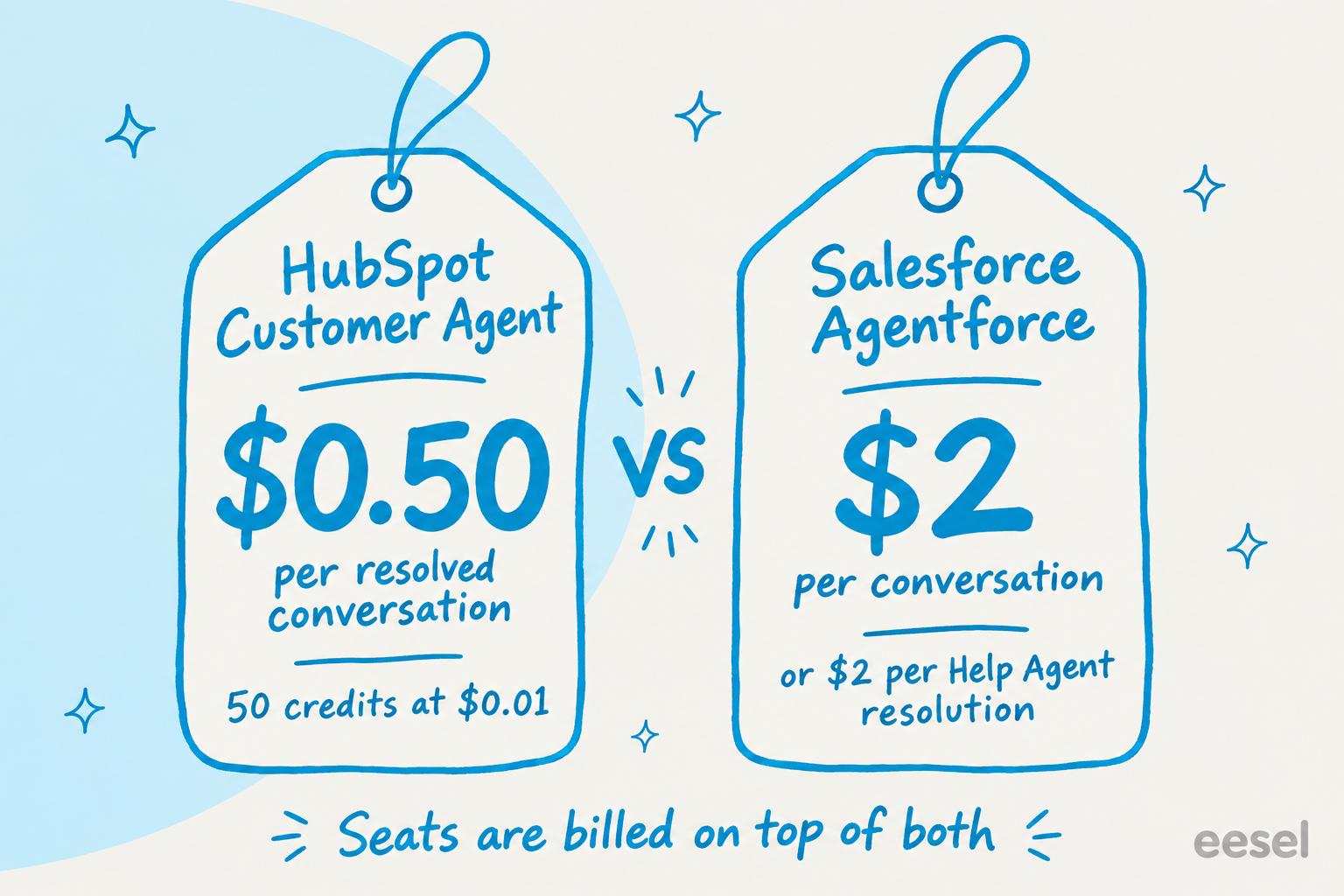
The included allowances are small next to a real queue. HubSpot Professional's 3,000 monthly credits cover 60 resolutions. Its credits help article says unused credits expire each month, and if you haven't bought a pack, credit-based features pause until the next reset. That last part matters for support: an AI agent that goes quiet on the 20th of the month is a staffing problem. Buy one $10 pack and overages switch on instead.
On Salesforce, Max is the edition with a real allowance (2.75M Flex Credits a year). Core and Advanced list no included allowance, so budget Agentforce usage on top, and note the list rate is per conversation, not per resolution. If you're weighing the two agents directly, there are deeper write-ups on Agentforce for customer service and Breeze Customer Agent.
There is one more cost that doesn't show up on either page: the data the agent answers from. A Service Cloud reviewer put it plainly:
"It can take months to clean the data before using AI, and to ensure accurate data, the knowledge base, old cases, and CRM data need to be prepared along with properly configuring the Data Cloud."
Which is easier to run day to day?
HubSpot is easier to run, and Salesforce lets you build more. That is the trade most reviewers describe, and it matches what I see when I connect each one. A HubSpot help desk is close to working the day you buy it: tickets, inbox, knowledge base and reporting share one data model, and a support lead can change most of it without help. Service Cloud gives you case record types, assignment rules, escalation rules, entitlements and flows, and every one of those is something a person has to design and keep working. One Service Cloud reviewer said their migration project lasted almost 12 months.
The flip side shows up as you grow. HubSpot's ticket routing and workflow branching are simpler, and a Service Hub reviewer found the ticketing "a bit basic when you're dealing with high volumes". Teams that need workforce and quality management or a full contact center end up on Service Cloud because HubSpot doesn't sell those.
Work out your own monthly bill
The numbers above assume one team. Put in your own agent count, how many conversations the AI would handle, and how many of those it would resolve without a person, and compare the two at list price.
Move the sliders to your team's numbers; prices are each vendor's current pricing-page rates (Service Cloud billed annually), with Agentforce at its $2 per-conversation rate.
Which should you pick?
Start from where your customer record lives, because moving it is the expensive part. If sales already works in Salesforce, Service Cloud puts every case on the same account and opportunity, and the seat premium buys you that. If marketing and sales run on HubSpot, Service Hub does the same for tickets at under half the seat price, with an AI agent that charges $0.50 per resolution against Agentforce's $2 per conversation.
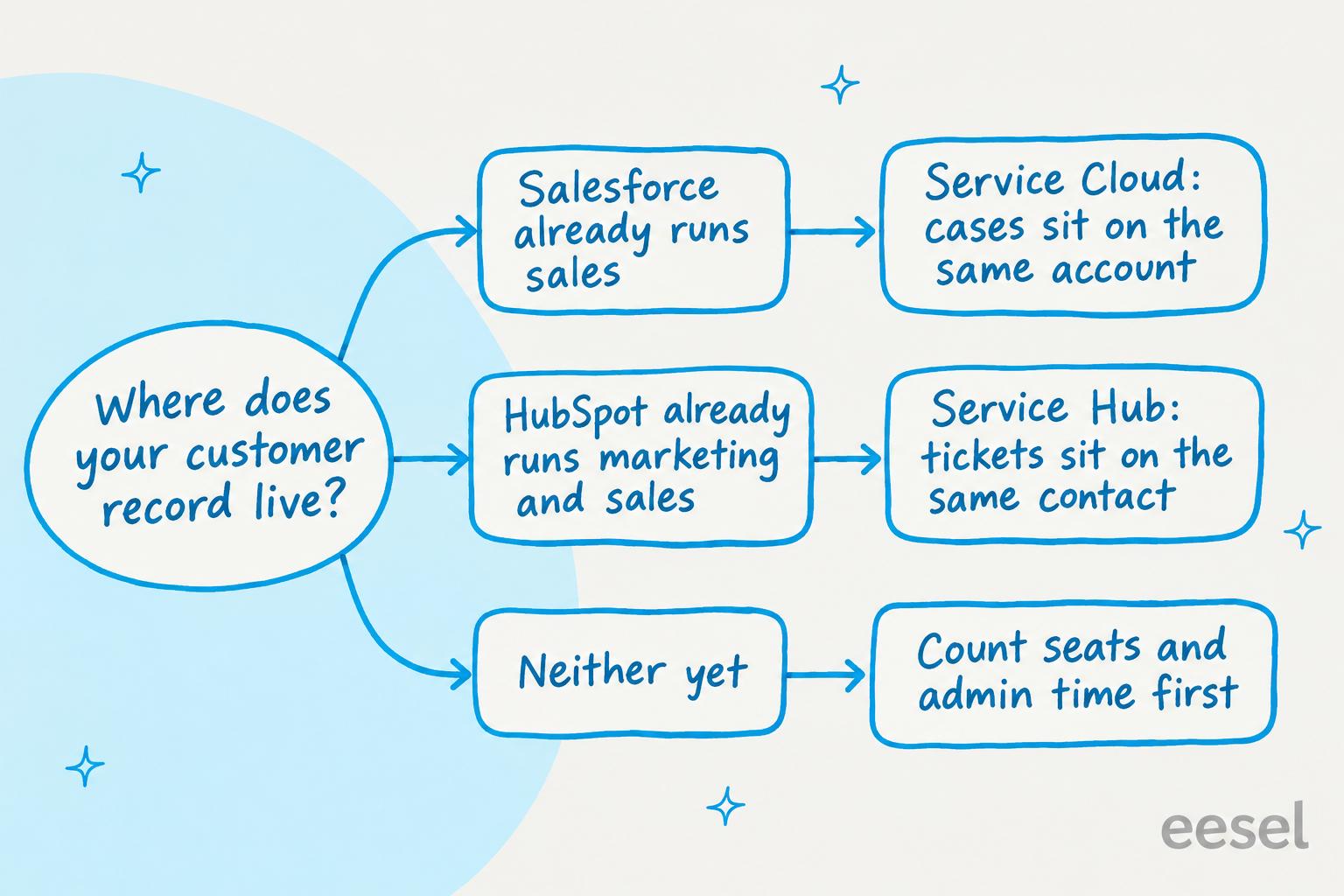
If you run neither yet, here is my take. A team under about 30 agents without a Salesforce admin should start on HubSpot Service Hub Professional: a support lead can run most of it without an admin, and the costs are easy to predict once you buy a credit pack so the AI agent never pauses. Pick Service Cloud when you need what HubSpot doesn't sell (workforce and quality management, a contact center, complex entitlements) or when your company is going to standardise on Salesforce anyway. And if you're comparing either against a dedicated help desk, I'd read Service Cloud vs Zendesk and HubSpot vs Zendesk before signing.
Try eesel inside whichever one you pick
Whichever help desk wins, the AI agent is a separate decision, and it doesn't have to come from the same vendor. eesel is an AI teammate that works inside Salesforce Service Cloud cases or HubSpot tickets: it learns from your past replies and knowledge base, drafts or sends answers, updates fields and routes what it shouldn't handle. What it may do is set per kind of person, so it can act on its own for your team, ask first for a verified customer, and stay away from billing for an anonymous visitor (actions and approvals).
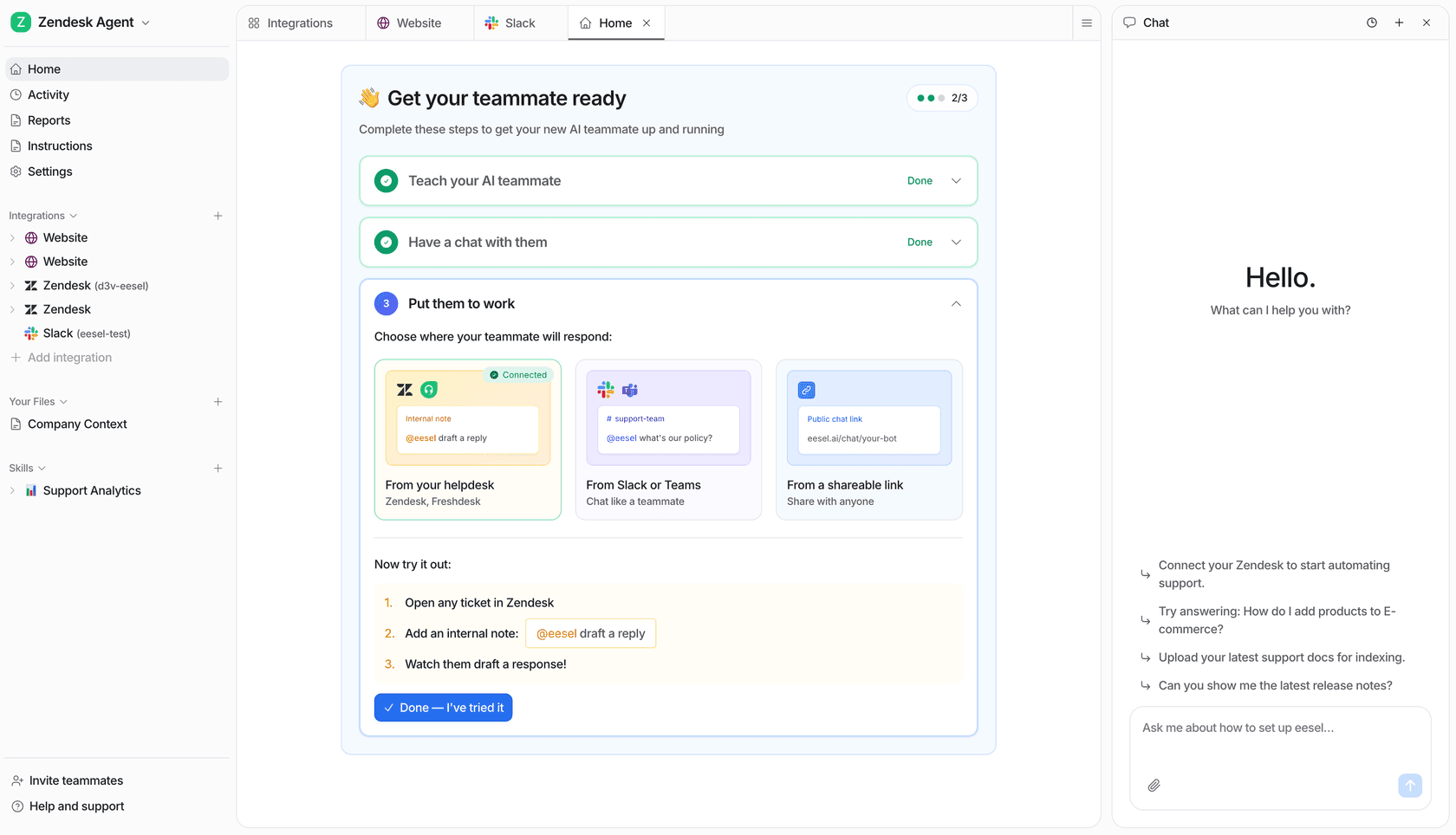
MentorShow, a French online learning platform, runs eesel entirely inside HubSpot: in one month it read about 1,200 HubSpot conversations and tickets and wrote 432 reply drafts for the team, in whichever language the member wrote in. Because eesel is priced per ticket rather than per seat, adding agents to your help desk doesn't change its bill, and if you ever move from HubSpot to Salesforce (or back), the same teammate comes with you.
eesel has a 7-day free trial with 100 credits, then plans start at $299 a month for 500 credits, where a ticket or chat is 1 credit however many replies it takes (pricing). Try eesel on last month's tickets before it answers a live one.