


Heymarket costs $20, $41 or $62 per user a month on annual billing ($24, $49 or $75 monthly), with a two-user minimum, and messaging is billed on top. Message credits start at $0.03 each, 10DLC registration is $10 a month per campaign, and Salesforce is a $7.50 per user add-on on Pro.
The number most pricing summaries skip: an AI agent text costs 3 credits, so $0.09 a segment at the base tier, and the AI agents only exist on Plus and up. For a five-person team, moving from Standard to Plus for the AI is $105 a month in seats alone. In my worked example, a 5-person support team on Plus with the AI agent pays about $470 a month, against about $230 for the same team texting by hand on Standard.
If those texts turn into Zendesk or Gorgias tickets, eesel is the AI teammate that works the ticket queue, priced per ticket with unlimited seats. Adverscale runs it on about 2,400 Zendesk tickets a month and sends about 1,600 replies itself.
How much does Heymarket cost in 2026?
I build AI agents for eesel's helpdesk teammate, and the thing I check first on any AI pricing page is the meter: what exactly gets counted, and who pays for it. Heymarket has two meters. You pay per seat for the people in the shared inbox, and per credit for every message that moves through it.
Here are the four plans as listed on the Heymarket pricing page on October 27, 2026. Every paid plan needs at least two users.
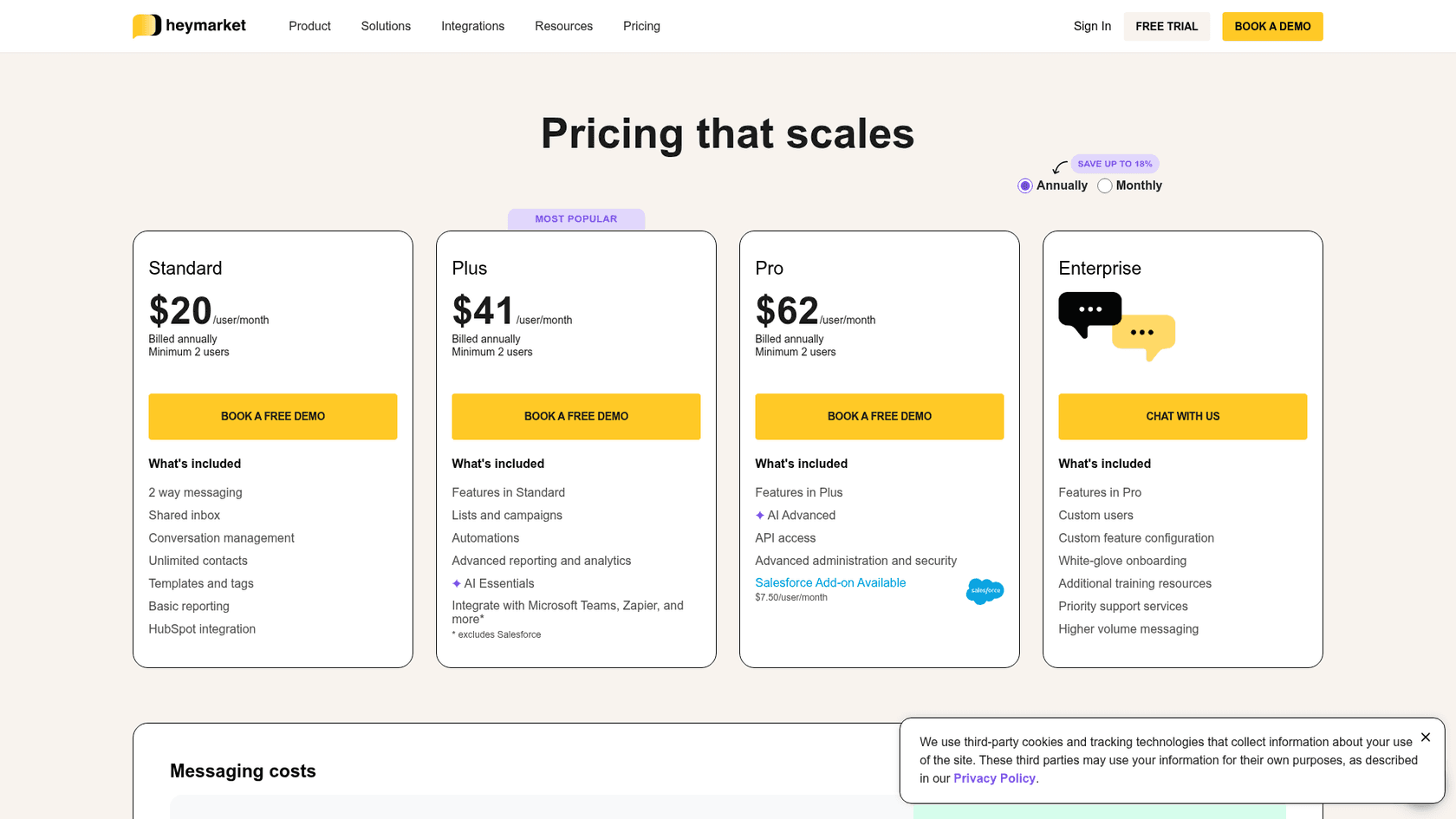
| Plan | Annual billing | Monthly billing | Yearly price in Heymarket's pricing feed | What the plan adds |
|---|---|---|---|---|
| Standard | $20/user/month | $24/user/month | $237/user/year | Two-way texting, shared inbox, templates and tags, unlimited contacts, basic reporting, HubSpot |
| Plus | $41/user/month | $49/user/month | $486/user/year | Lists and campaigns, automations, AI agents and AI helpers, email, web chat, Zendesk, Help Scout, Shopify, Slack, Teams, Zapier, MCP server |
| Pro | $62/user/month | $75/user/month | $736/user/year | Suggested replies, API, HIPAA, custom roles, configurable data retention, 7-day support, Salesforce add-on |
| Enterprise | Custom | Custom | Not listed | WhatsApp, custom feature setup, white-glove onboarding, priority support, higher volumes |
The third column comes from the plan feed the pricing page loads its numbers from. It shows the page rounds up slightly: Plus is really $486 a year per user, which is $40.50 a month, not $41. My worked examples below use the rounded page prices, so a real annual invoice lands a few dollars under them.
Two lines on the page matter more than they look. The FAQ says each user gets an inbox and a phone number if needed, so five seats come with up to five inboxes and numbers at no extra charge. And Plus carries an asterisk on "Integrate with Microsoft Teams, Zapier, and more" that reads "excludes Salesforce", which is why Salesforce teams start on Pro.
For a support team, the real entry price is Plus at $41 a seat, not Standard at $20. Standard has no Zendesk, no Help Scout, no automations and no AI agents. If texting will sit beside a helpdesk, budget for that bill as well; I've broken down Zendesk pricing and Help Scout pricing separately.
What do Heymarket message credits cost?
Seats get you into the inbox. Credits pay for the texts. Every message, in or out, draws from a monthly credit bundle you commit to at the start of your subscription, and the pricing page's slider defaults to 1,000 credits at $0.03, or $30 a month.
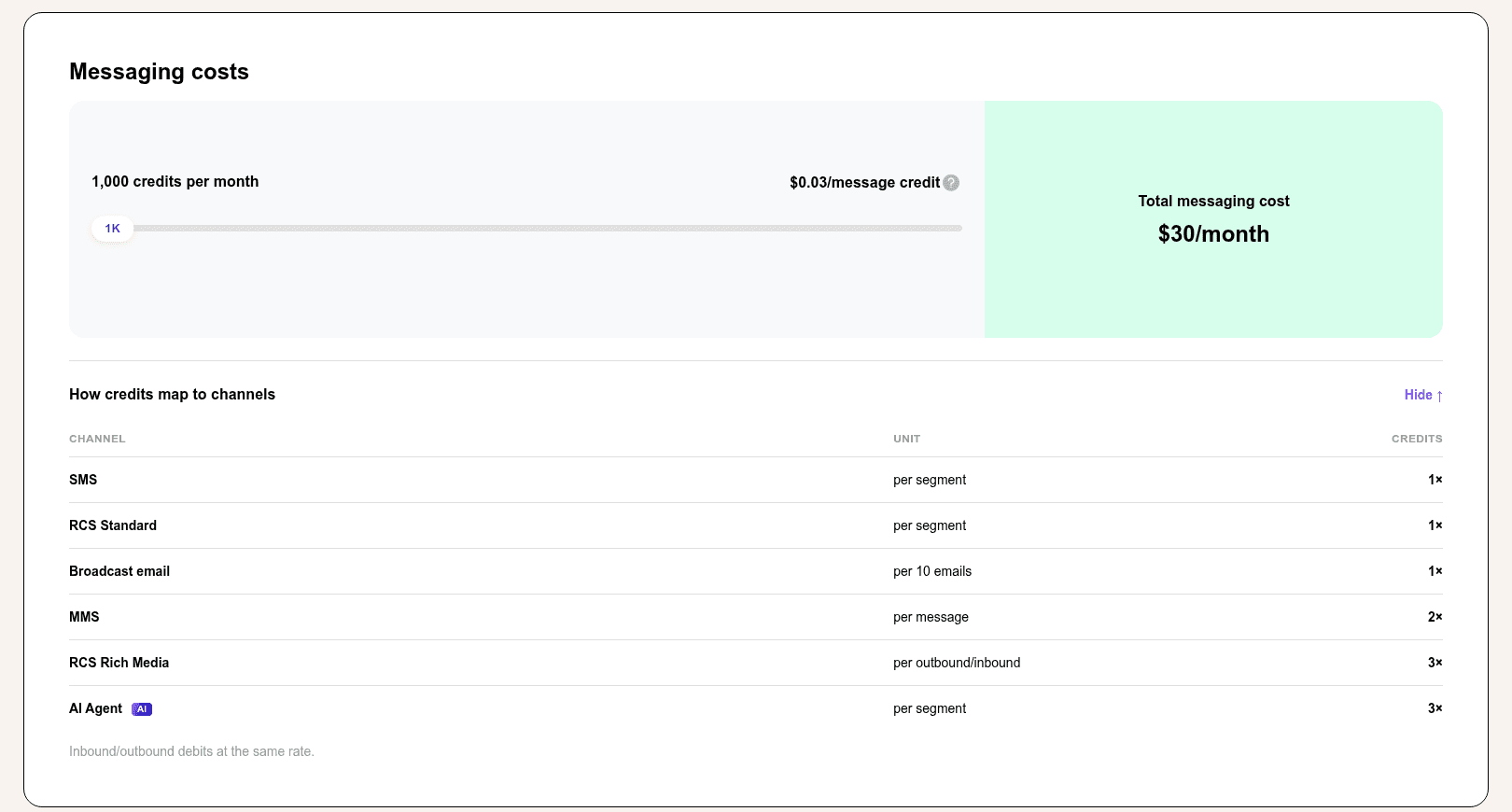
The per-credit price drops as your committed volume goes up. These tiers are from Heymarket's volume-based credits article:
| Credits committed per month | Price per credit | Monthly cost at the bottom of the tier |
|---|---|---|
| 500 to 9,999 | $0.03 | $15 for 500 |
| 10,000 to 24,999 | $0.025 | $250 for 10,000 |
| 25,000 to 49,999 | $0.02 | $500 for 25,000 |
| 50,000 and above | $0.015 | $750 for 50,000 |
The two cheaper tiers are annual-only in practice: on monthly billing the pricing page's slider stops at $0.025. The article also says your tier is set by the volume you commit to, not by what you end up sending, and that credits don't roll over to the next term.
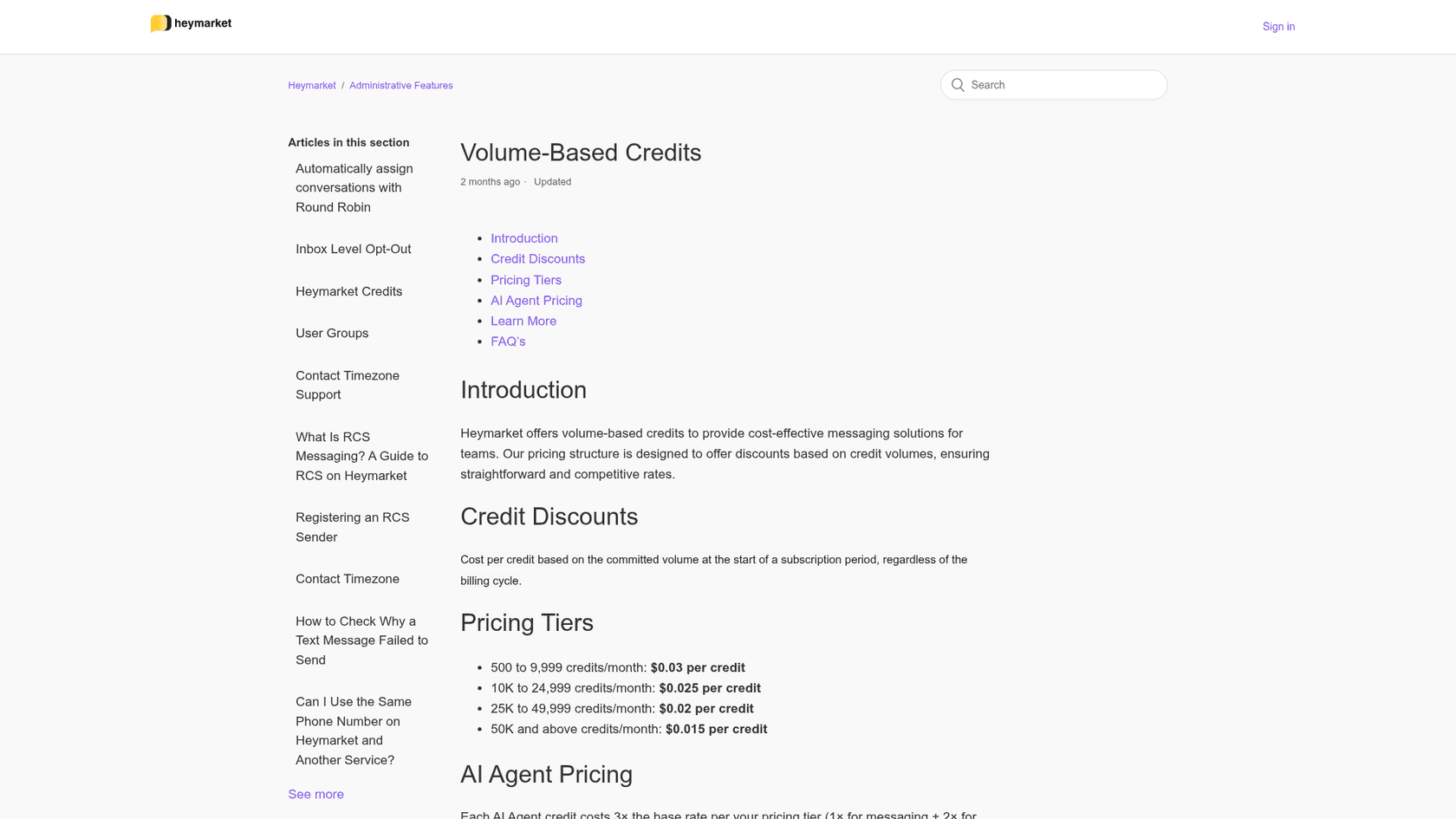
Then each channel burns credits at its own rate, per the pricing page FAQ:
| Message type | Credits | Cost at the $0.03 tier |
|---|---|---|
| SMS or RCS text, per 160-character segment | 1 | $0.03 |
| Broadcast email, per 10 emails | 1 | $0.003 per email |
| MMS, per message | 2 | $0.06 |
| RCS Rich Media, per message | 3 | $0.09 |
| WhatsApp, per message (Enterprise only) | 1 | $0.03 |
| AI agent, per segment | 3 | $0.09 |
Two details change your math. "Inbound/outbound debits at the same rate", so a customer's reply costs the same as yours, and a conversation where each side sends two texts is four credits, not two. And a 161-character text is two segments, so long replies quietly double. If you're new to how segments work, my guide on adding AI to SMS support walks through it.
What does the Heymarket AI agent really cost?
The credit table says an AI agent segment is 3 credits. The help article spells out why: 1x for the message plus 2x for the AI agent, so at the $0.03 tier "each AI Agent credit costs $0.09". On the cheapest annual tier it drops to $0.045.
Per message, that's cheap. A typical short exchange where a customer sends three texts and Heymarket's Q&A agent sends three single-segment answers costs 3 + 9 = 12 credits, or $0.36. That's well under what a person costs to type the same answers; my breakdown of AI vs human agent cost has the comparison.
But the per-message rate isn't the real price of the AI. The real price is the plan you have to be on. The Q&A, Scheduling and contact enrichment agents are all marked "not available on Standard" in the comparison table, so turning them on means moving every seat to Plus:
- 3 users: $63 a month more in seats
- 5 users: $105 a month more
- 10 users: $210 a month more
For a five-person team, the Plus upgrade costs more than 1,100 AI agent segments would. That's the number I'd put in front of whoever signs off the budget, because the 3x credit rate looks like the cost and it's the smaller half of it. You do get more than the AI for the upgrade (Zendesk, automations, campaigns), so if you need those anyway, the AI's marginal cost really is just the credits.
The other thing to plan for is how far you let the agent run. Heymarket lets each inbox run its agents in autonomous or supervised mode. In autonomous mode every answer is three credits a segment whether it solved the problem or not, so it pays to track your resolution rate and keep a human in the loop on anything sensitive.
What does a real team pay for Heymarket?
Sticker prices are per seat and per credit, which tells you nothing until you plug in a team. Here are three teams, all on annual billing, each with one 10DLC campaign (two for the largest).
Team A: a 2-person office on Standard. Two users text customers by hand, about 1,000 segments a month in and out.
- Seats: 2 x $20 = $40
- Credits: 1,000 x $0.03 = $30
- 10DLC: $10
- Total: $80 a month, $960 a year. On monthly billing it's $88.
Team B: a 5-person support team on Plus with the AI agent. People send and receive 4,000 segments, and the Q&A agent sends another 1,500.
- Seats: 5 x $41 = $205
- Credits: 4,000 + (1,500 x 3) = 8,500 credits x $0.03 = $255
- 10DLC: $10
- Total: $470 a month, $5,640 a year. On monthly billing it's $510.
Team C: a 12-person multi-location team on Pro with Salesforce. 20,000 human segments plus 6,000 AI agent segments, two 10DLC campaigns.
- Seats: 12 x $62 = $744
- Salesforce add-on: 12 x $7.50 = $90
- Credits: 20,000 + (6,000 x 3) = 38,000 credits x $0.02 = $760
- 10DLC: 2 x $10 = $20
- Total: $1,614 a month, $19,368 a year. On monthly billing it's $1,978, because seats rise to $75, Salesforce to $9 and credits stop at $0.025.
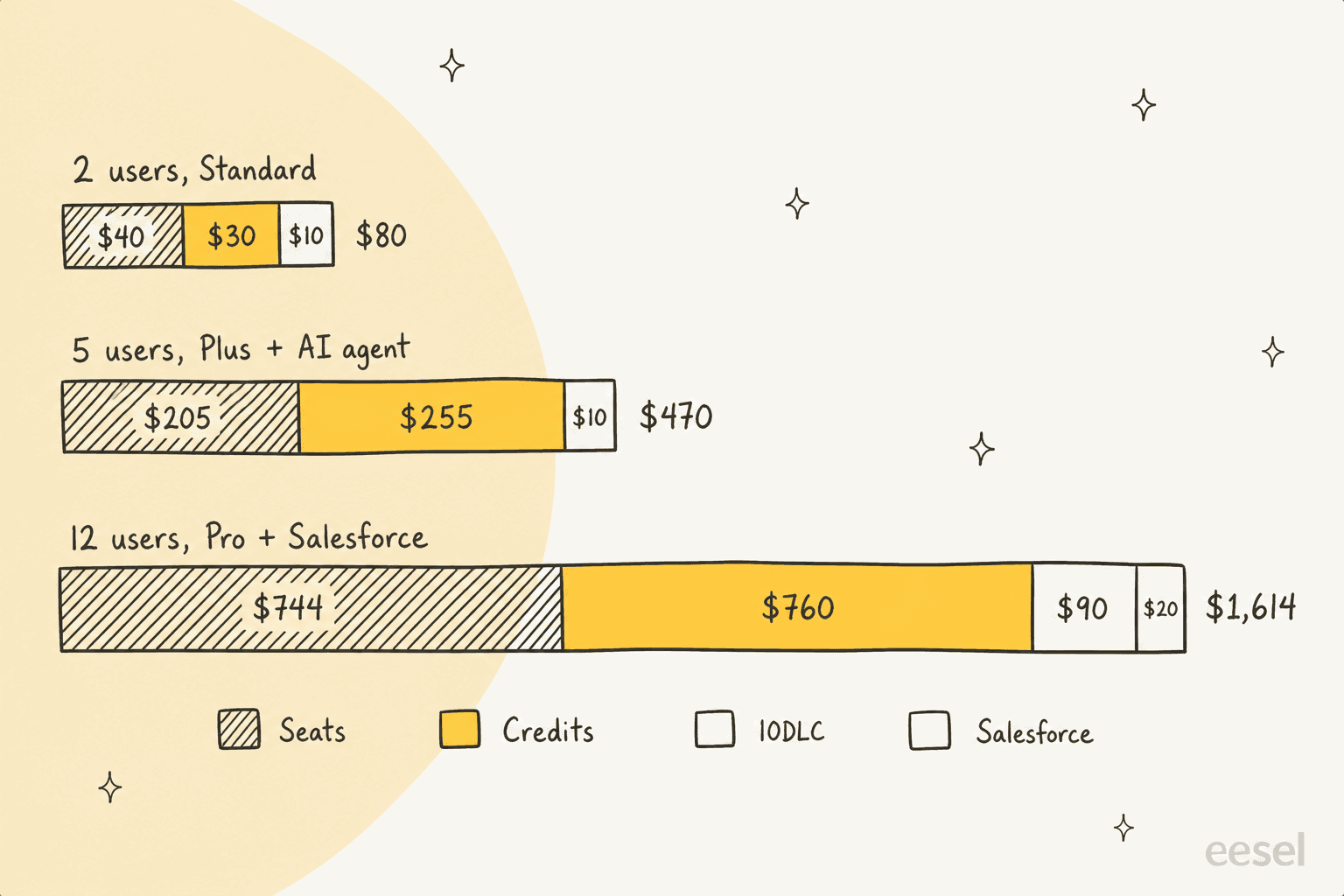
Look at Team B again. Texting by hand on Standard, the same five people would pay $100 in seats, $120 in credits and $10 for 10DLC: $230 a month, so the AI setup roughly doubles the bill. $105 of the $240 jump is the Plus seats and $135 is the AI agent's credits. Whether that's worth it depends on how many of those 1,500 AI segments answered something a person would otherwise have typed. Divide the total by your conversations and you get a cost per ticket you can compare against anything else.
To run your own team, tick what you need and the calculator picks the cheapest plan that has it:
Tick what your team needs, set users and monthly conversations, and the calculator picks the cheapest Heymarket plan and prices seats, credits, Salesforce and 10DLC.
Which hidden costs push a Heymarket bill up?
None of these are hidden in the sense of being secret. They're all on Heymarket's own pages. They're hidden in the sense that the $20 headline doesn't include them.
The two-user minimum. A solo founder or a one-person front desk still pays for two seats, so Standard is really $40 a month, Plus $82 and Pro $124 on annual billing.
10DLC registration. US carriers require business texting from local numbers to be registered, and Heymarket's FAQ charges "$10 per month per campaign" to cover it. One G2 reviewer said that's half the reason they signed up:
"We mainly switched to HeyMarket because we needed to deal with 10DLC. Most companies charged for it and had no idea if it even applied to us, so we went with HeyMarket."

Overage bundles that stick. If you send more than you committed to, Heymarket adds a credit bundle automatically at your current rate, and the bigger bundle stays on your subscription at renewal until you contact them to reduce it. Admins get emails as usage gets close, so this one is avoidable if someone reads them.
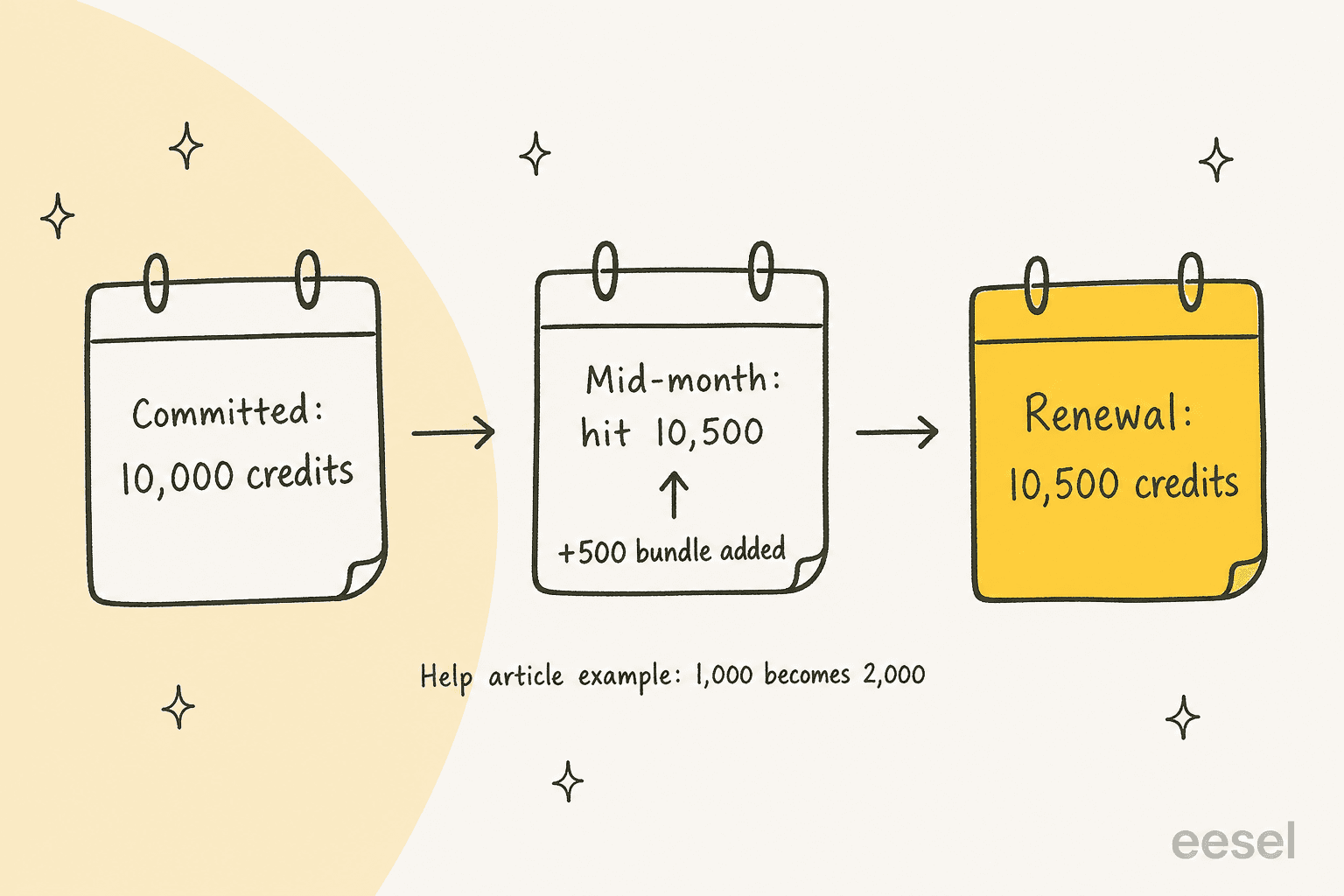
Heymarket's own pages disagree on how big that top-up is. The pricing page FAQ example adds exactly the 500 credits you went over, so a 10,000-credit plan renews at 10,500. The help article example adds a full 1,000-segment bundle to a 1,000-segment plan, so it renews at 2,000. The pricing FAQ's own step-by-step list adds a third reading, saying you "will be moved to the next tier". I can't tell you which one your contract follows, so ask sales to put it in writing.
Credits that expire. The help article says credits "do not roll over to the next term". A quiet month doesn't bank anything for a busy one, which pushes you to commit to your peak month, not your average.
Discounts skip messaging. Heymarket offers nonprofit and volume discounts, but the help article says discounts apply to user licenses and add-ons, "not to messaging costs or compliance fees". On a credit-heavy team like Team C above, that's nearly half the bill.
Add-ons on Pro. Salesforce is $7.50 per user a month annually ($9 monthly) and is charged per user, so a 12-seat team pays $90 a month for it. SAML single sign-on and directory sync are listed as Pro add-ons with no price on the page.
RCS and WhatsApp. RCS Rich Media is annual-only, and the FAQ says verified sender registration "carries additional one-time and recurring fees not required for SMS", with 6 to 10 weeks of carrier vetting. WhatsApp is marked available on Enterprise only, so teams that need it are on custom pricing; for WhatsApp-heavy support, compare Wati pricing or respond.io pricing.
Should you pick annual or monthly billing?
Annual billing wins for anyone who'll still be texting customers in a year. The pricing feed shows exactly how much: Standard is $237 a year against $288 on monthly billing, Plus $486 against $588, and Pro $736 against $900. That's a saving of 17.3% to 18.2%, which matches both the "Save up to 18%" toggle and the FAQ's "two months of Heymarket free".
Annual billing also changes the credit math. Monthly plans top out at $0.025 per credit, so a team sending 38,000 credits a month pays $950 for messaging on monthly billing and $760 on annual. RCS Rich Media is annual-only, too.
Monthly makes sense in one case: you're piloting texting with two people and don't know your volume yet. The pricing page doesn't publish a trial length, so book the demo and ask how long you can test before you commit to the annual plan. For cancellations, the FAQ points to section 9.6 of Heymarket's terms of service.
Is Heymarket worth the price?
For what it does well, yes. Heymarket holds 4.6 out of 5 on G2 and 4.5 on Capterra, and reviewers who use it as a support desk tend to rate the value well:
"I find Heymarket cost-effective and easy to use. I like that it allows for multiple agents to coordinate texting efforts across shifts."
The price complaints come from smaller teams comparing it with cheaper texting tools:
"Compared to other messaging platforms, Heymarket is on the pricier side, especially for small businesses."
"pricing may be slightly expensive for smaller companies but it is worth the investment"

My read: Standard at $20 a seat is fair for a team that needs a shared texting inbox and HubSpot. The price jumps when you need the helpdesk link or the AI, because both live on Plus and every seat pays for them, including the people who never touch the AI. If cost is the main reason you're looking, my roundup of Heymarket alternatives prices seven options for the same team, and Front pricing is worth a look if you want email and SMS in one shared inbox.
How does eesel fit next to Heymarket?
eesel doesn't send texts, so it isn't a Heymarket replacement. It sits one step later. If Heymarket turns each incoming text into a Zendesk ticket (or your email and chat already land in Zendesk, Freshdesk or Gorgias), eesel is the AI helpdesk teammate that works those tickets: it reads the ticket, tags it, drafts or sends the reply from your past answers and canned responses, and hands the rest to a person with a note.
The pricing model is the part that's different. Heymarket charges per seat plus per message. eesel's pricing is a fixed monthly credit plan with unlimited seats, where a ticket or a chat is 1 credit however long it runs. The Teammate plan starts at $299 a month for 500 credits and goes to $1,749 for 5,000, and there's a free plan with 100 credits to try it on real tickets.
To be fair to Heymarket: on a short SMS thread, its AI agent is the cheaper meter. That three-and-three exchange above costs $0.36 in Heymarket credits, while an eesel ticket works out to about $0.60 on the 500-credit plan and $0.35 on the 5,000-credit plan. Where eesel comes out ahead is a long thread (still one credit), a team with lots of seats (no per-seat price), and a queue that's mostly email and chat with texts mixed in. More on the tradeoffs in my guide to AI customer service cost.
Two eesel customers show what that looks like on a real queue:
- Adverscale, a US passport application service, runs one agent on its Zendesk. Between August 8 and September 8, 2026 it worked about 2,400 tickets, sent about 1,600 replies on billing, fees and application status, and left about 2,700 internal notes, with refunds always handed to a person. On today's pricing page, a queue that size sits in the 2,500-credit plan at $999 a month.
- ClutchLoop, a US phone accessory brand, runs eesel on Gorgias and its website chat. In the same month it handled about 230 tickets and 27 chats, replied directly to about seven in ten conversations, and checked live prices and stock in Shopify 76 times.
If your helpdesk is Freshdesk or HubSpot, it works the same way, and my write-up on AI for Zendesk covers the Zendesk setup step by step.
The setting I'd think hardest about is the line between what the AI answers alone and what it hands over. Adverscale keeps refunds with a person; ClutchLoop lets returns and product questions go out directly. My guide to AI agent handoffs covers how to draw that line.
Try eesel on the tickets your texts create
If Heymarket is already turning texts into Zendesk tickets, you don't need to pay per seat for the AI that answers them. eesel joins your Zendesk as a helpdesk teammate, learns from your past tickets and macros, and drafts or sends replies the way Adverscale has it do on about 2,400 tickets a month. Every seat on your team can use it, and the 100 free credits are enough to watch it work on real tickets before you pick a plan. Try eesel.
Frequently Asked Questions
How much does Heymarket cost per month?
Heymarket costs $20, $41 or $62 per user a month on annual billing, or $24, $49 and $75 on monthly billing, with a two-user minimum on every plan. Messaging is extra: credits start at $0.03 each, and 10DLC registration is $10 a month per campaign. A two-person team on Standard texting 1,000 segments a month pays about $80. My Heymarket review covers what each plan is like to use.
How much do Heymarket AI agents cost?
Every AI agent message costs 3 credits per segment, so $0.09 at the $0.03 tier and $0.045 at the $0.015 tier. The AI agents also need the Plus plan or higher, which is $21 more per user a month than Standard. For a five-person team, that upgrade is $105 a month before the agent sends a single text. Compare it with the per-ticket model on eesel pricing.
What is a Heymarket message credit?
A credit is Heymarket's billing unit for messaging. One SMS or RCS text segment of up to 160 characters is 1 credit, 10 broadcast emails are 1 credit, an MMS is 2, an RCS rich media message is 3 and an AI agent segment is 3. Inbound and outbound texts are both debited. More on texting costs in my guide to AI for SMS support.
Is Heymarket pricing cheaper on annual billing?
Yes. Annual seats are $20, $41 and $62 against $24, $49 and $75 monthly, which Heymarket describes as two months free and the toggle labels as saving up to 18%. Annual billing also unlocks the $0.02 and $0.015 credit tiers and RCS, which monthly plans don't get. Run your own numbers through the calculator in this Heymarket pricing guide.
What happens if I go over my Heymarket message credits?
Heymarket adds a credit bundle automatically at your current rate, and that bigger bundle stays on your subscription at renewal until you ask to reduce it. Heymarket's own pages disagree on the bundle size: the pricing page example adds exactly 500 credits, while the help article example adds a full 1,000. Credits don't roll over either, so watch your ticket volume before you commit.
How much is the Heymarket Salesforce integration?
The Salesforce add-on is $7.50 per user a month on annual billing and $9 on monthly billing, and it is only available on Pro and Enterprise. So a Salesforce team's real floor is $69.50 per user a month annually. My breakdown of Service Cloud pricing shows what the Salesforce side adds.
Is Heymarket worth the price for a small support team?
For a small team that mostly needs a shared texting inbox and HubSpot, Standard at $20 a seat is fair value. Once you need Zendesk or the AI agents you are on Plus at $41 a seat, and per-seat pricing grows with every person you add. If the texts end up as helpdesk tickets anyway, an AI on the tickets, like eesel for Zendesk, is priced per ticket with unlimited seats.