

What Grok Bot actually is
I've spent the last couple of years getting AI content to actually rank, and the fastest way to waste a week is to point a general-purpose tool at a specialist job. So before we talk about briefs, it's worth being precise about what Grok Bot is, because it isn't an SEO tool.
Grok Bot is xAI's AI teammate app, announced on 11 August 2026 and labelled "Early beta" on its own page. Each Bot is a persistent, named worker that gets its own cloud computer, signs into the apps you already use, and operates them through their normal interfaces. It runs on the same Grok model family as xAI's other products, and it sits inside the same wider agent push.
The strategic claim is coverage. Because a Bot drives a UI like a logged-in human, xAI says it works across apps and websites "including platforms with no clean API or MCP". That design is the whole story, both the reason it can reach your keyword tool and CMS and the reason every caveat later in this post exists. It puts Grok Bot in the same bucket as Manus AI and Claude Cowork: a general agent that acts on a computer, not a product tuned for one job.
The eight named Bot roles that ship tell you where xAI's head is at: Sales Outbound, Talent Scout, Paid Media, Expense Manager, Product Performance, Bug Reproduction, Account Health, and Chief of Staff. Not one is a writer, editor, or SEO role. If you want Grok Bot to build your content briefs, you're building that workflow from scratch.
What an SEO content brief actually is
A content brief is the document that decides whether a post ranks before a single word gets written. It's the plan a writer or an AI SEO content writer works from, and a good one carries six things.
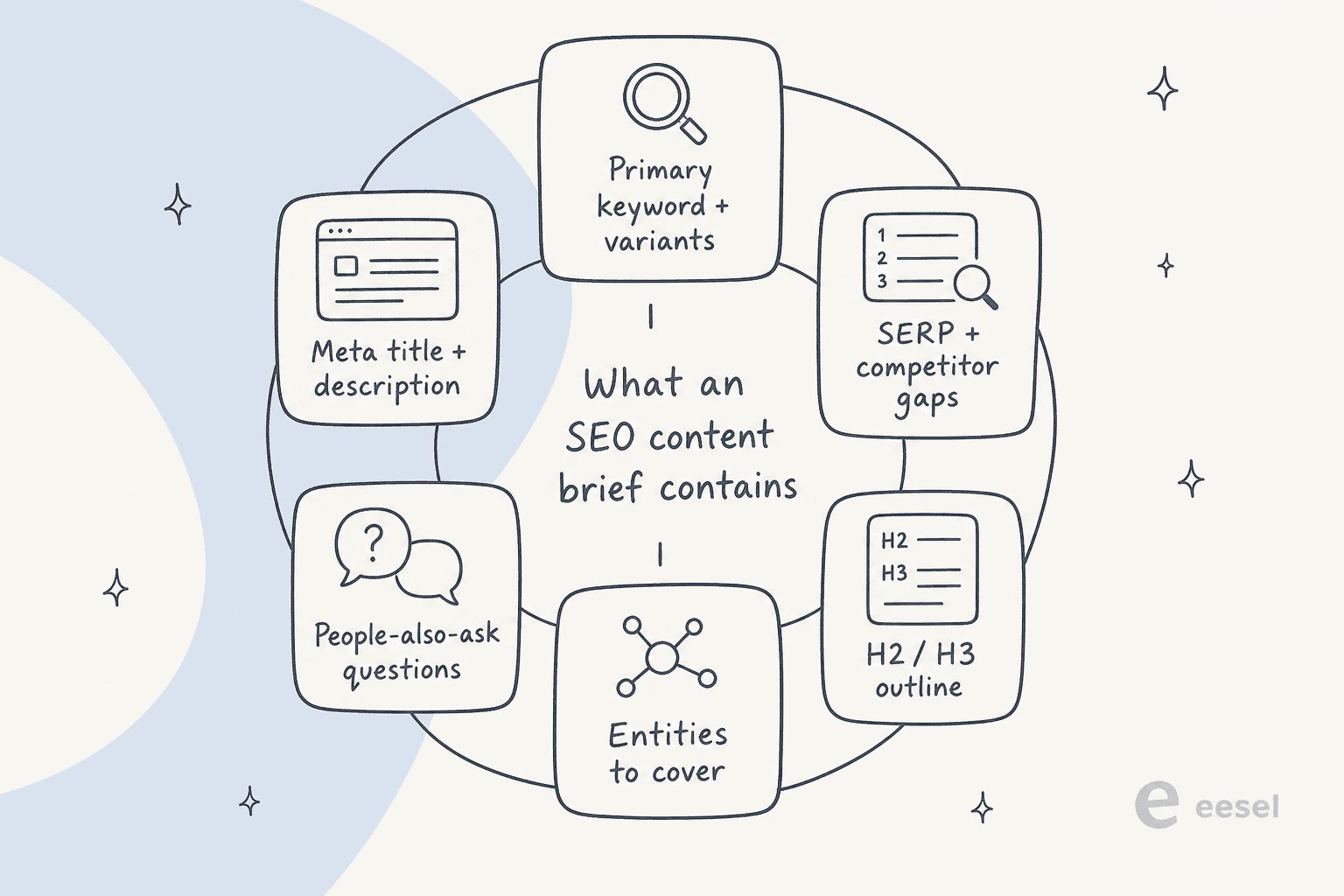
- The primary keyword and its variants, pulled from real search-volume data with AI SEO tools, not a guess.
- The SERP and competitor gap: what the top pages already cover and where they're thin.
- The outline, an H2/H3 structure that matches search intent, like a good topic cluster generator produces.
- The entities to cover, the named concepts Google expects on a page about this topic.
- The people-also-ask questions that become the FAQ and the featured-snippet targets.
- The metadata, a title and meta description written to the length the SERP actually shows.
The reason this matters for a Grok Bot evaluation is simple. Every one of those six parts is a skill, not a click. Keyword research needs a data source. SERP gap analysis needs you to read and score the competing pages. Entity coverage needs a model that knows the topic. A generalist agent can operate the tools that produce these, but it doesn't produce them on its own. That distinction is the entire question here, and it's the same one behind AI content briefs well.
Can Grok Bot build a content brief? How you'd actually set it up
Yes, with a lot of teaching. Here's the honest version of what the setup looks like, because "Grok Bot can do SEO" hides a week of configuration.
First, you'd sign a Bot into every tool the brief touches: your keyword research tool, Google Search itself, a competitor-analysis tool, and the doc or CMS where the brief lives. Grok Bot does this through a screen handoff, where you type the password, passkey, or 2FA yourself. That part is useful if one of those tools has no API.
Then you'd teach it the brief. Grok Bot has a "Teach-a-task" mode, but it's capped at 10 minutes per recording, so a full brief workflow becomes several stitched-together routines plus a long written instruction set. You're writing, in plain English, the process a good AI blog outline generator already runs by default: pull these keywords, read the top five results, list the headings they share, find the gaps, draft an outline, write the metadata. It's the same manual work covered in content briefs for AI writers, except you're teaching a generalist to do it.
Finally you'd run it and check everything, because the model is doing knowledge work it was never specialised for. It can copy a search-volume number into a doc, but it has no way to tell you that number is stale, or that the keyword you asked for has shifted intent since you last looked. This is the gap between affordable SEO tools that own their data and a generalist reading someone else's screen. The output looks like a brief. Whether it's a good brief is on you to verify, every time.
None of this is impossible. It's just a build, and the thing you're building is a worse version of tools that already exist, like the ones in this roundup of AI content tools for SEO.
Where it breaks for content briefs
Four design choices turn from "fine" to "a problem" the moment you use Grok Bot for real content work.
No dry-run mode
This is the big one. xAI's own docs say, in plain text, that "a test run performs real work. It can navigate websites, change files, and call connected tools." There is no preview mode where a Bot shows you the brief or the draft it would create without touching anything. Its own docs also note that "an approval controls the proposed action. It does not reverse work already completed."
For a brief, that's survivable. For the step after the brief, where the same Bot is signed into your CMS and asked to publish, it's the difference between a draft in a folder and a half-finished post live on your site. Any content workflow needs a genuine preview before go-live, which is exactly what controlled workflow automation is for.
Every Bot shares one signed-in computer
All of your Bots share a single cloud computer per account, and sessions persist on it. xAI says twice in its docs: "Do not use separate Bots as a security boundary." Once your content Bot signs into your CMS, that session is reusable by any other Bot on the account. For a solo blogger that's a shrug. For a content team sharing an account with sales and finance Bots, it's a real question to answer before you connect anything sensitive.
It doesn't do the SEO parts natively
This is the one that undoes the whole "use Grok Bot for briefs" idea. Grok Bot has no keyword database, no SERP scoring, no entity model tuned for search, and no meta-tag optimization logic. It can read a tool that has those things, but you're still paying for that tool and the Bot. A dedicated AI SEO content generator folds the data source into the workflow, so the brief and the numbers behind it come from one place. It's why AI-based SEO tools built for the job beat a generalist that only borrows their output.
Pricing starts at $200/month with no free tier
Grok Bot has no free plan and no published trial. The self-serve options are Cursor Ultra at $200/month and Cursor Premium Teams at $120/seat/month, and it's bundled into SuperGrok Heavy. The team plan is cheaper per seat than the solo one, which is unusual, but the model is the same either way: you pay for a seat, not for briefs produced. If you write four briefs a month, you're paying $200 for four briefs plus your keyword tool on top. That's a very different shape from a usage-based AI blog writer pricing model that bills per piece of work.
Grok Bot vs a purpose-built content teammate
Here's the comparison that actually decides this. A general-purpose agent and a purpose-built content teammate are answering two different questions. Grok Bot answers "can an AI operate my tools?" A content teammate answers "can an AI do the content job?"
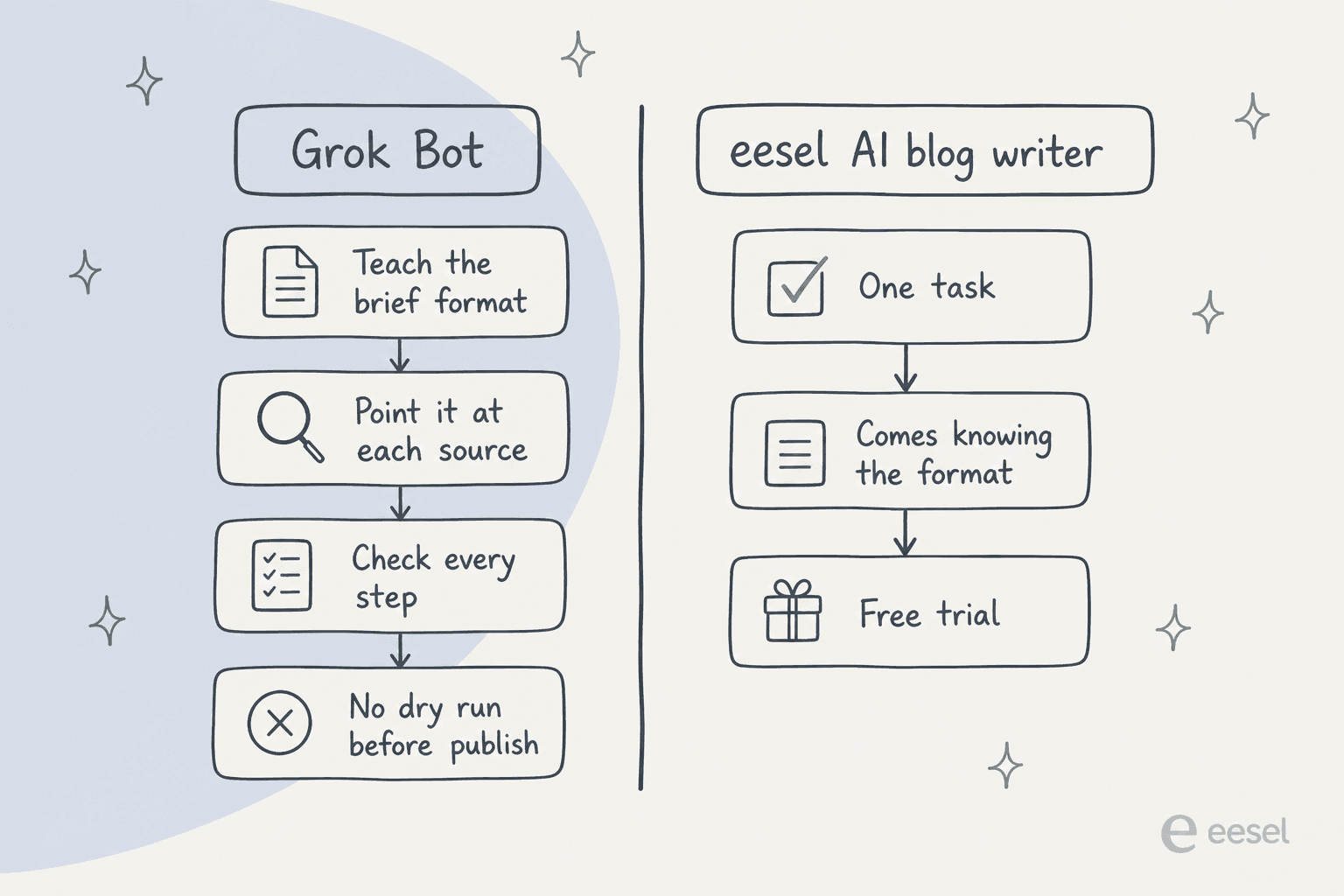
This is the eesel positioning, and it's worth being precise about it. eesel is an AI teammate platform, and you hire ready-to-work teammates for specific jobs. The current roster is an AI helpdesk teammate and an AI blog writer. The blog writer isn't a generalist you point at a doc, it's a teammate that already knows the brief-to-draft workflow: it finds topics, researches primary sources, maps keywords, matches your brand voice, and generates the visuals. Grok Bot is agent infrastructure, a worker you have to train. The blog writer is the trained employee.
For SEO specifically, that difference shows up in the parts Grok Bot leaves to you. eesel ships a free SEO keyword generator and a meta description generator, so two of the six brief components are covered before you've paid anything. The full workflow, including internal linking automation, runs as one task rather than a stitched routine you maintain.
That last piece matters more than it sounds. If you care about site graph, it's worth knowing internal links per page actually helps, and how to automate internal linking so you're not hand-placing every one, both of which a purpose-built AI content writer handles for you.
If your CMS truly has no API and no integration anywhere, a UI-driving agent like Grok Bot is a real option, and I would rather be honest about that than pretend it has no use. But for the actual content-brief job, a tool built for AI and SEO beats a generalist you spend a week configuring, and it's how I'd think about AI blog writer alternatives in general.
Want to skip the brief entirely?
Here's the thing I keep coming back to after two years of this: the brief is a middle step, and the middle step is where AI content teams lose the most time. You write a brief so a writer can turn it into a post. What if the same teammate did both?
That's what eesel's AI blog writer does. Instead of teaching a generalist agent to assemble a brief and then handing it to someone else, you give the teammate a topic and it does the keyword research, the outline, the primary-source research, the draft, the metadata, and the images, in your brand voice, as a single job. It's the difference between hiring a temp and teaching them your process, versus hiring someone who already knows it.
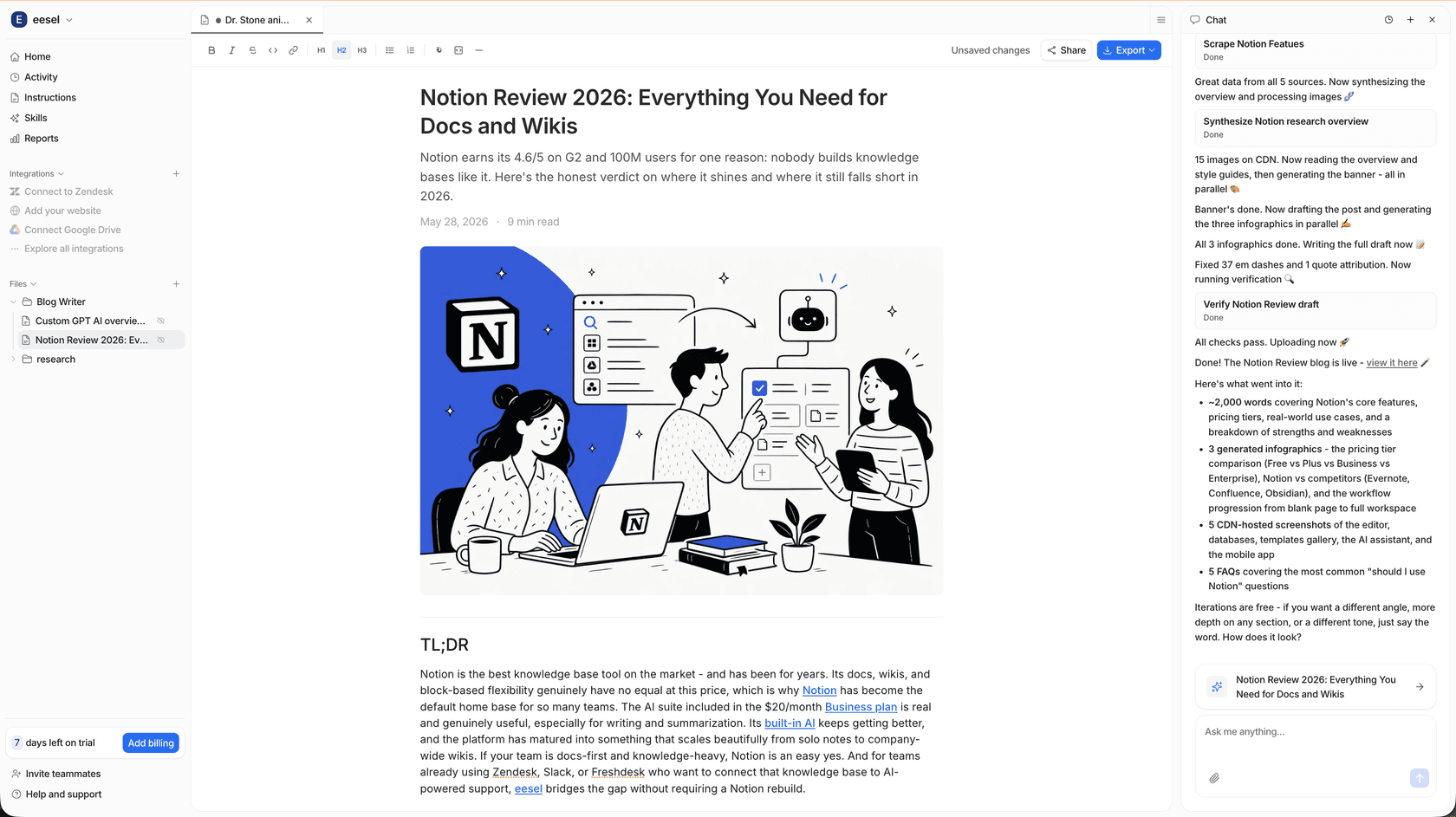
It's free to try, there's no seat minimum, and you're billed per post rather than per month of access. There's a built-in AI humanizer for drafts that read too robotic, and it covers AI SEO content strategy end to end. If you're comparing it against a generalist agent for content, that's the real question: do you want to build the writer, or hire one? Try eesel.
Frequently Asked Questions
Can Grok Bot create SEO content briefs?
How much does Grok Bot cost for SEO work?
Is Grok Bot good for keyword research?
What are the risks of using Grok Bot for SEO briefs?
What's a better alternative to Grok Bot for content briefs?
Can Grok Bot write the blog post from the brief too?


Article by
Kurnia Kharisma Agung Samiadjie
Kurnia is a software engineer and writer at eesel AI with two years of SEO experience, writing about AI tools, helpdesk software, and customer support. He pairs a developer's understanding of how these products are built with search-driven research into what actually ranks and resonates with the people searching for them.