
AI has significantly changed search engine optimization. These days, AI driven SEO tools can do much more than just analyze data. They automate tasks ranging from keyword research and content writing to monitoring visibility in AI search and generating performance reports.
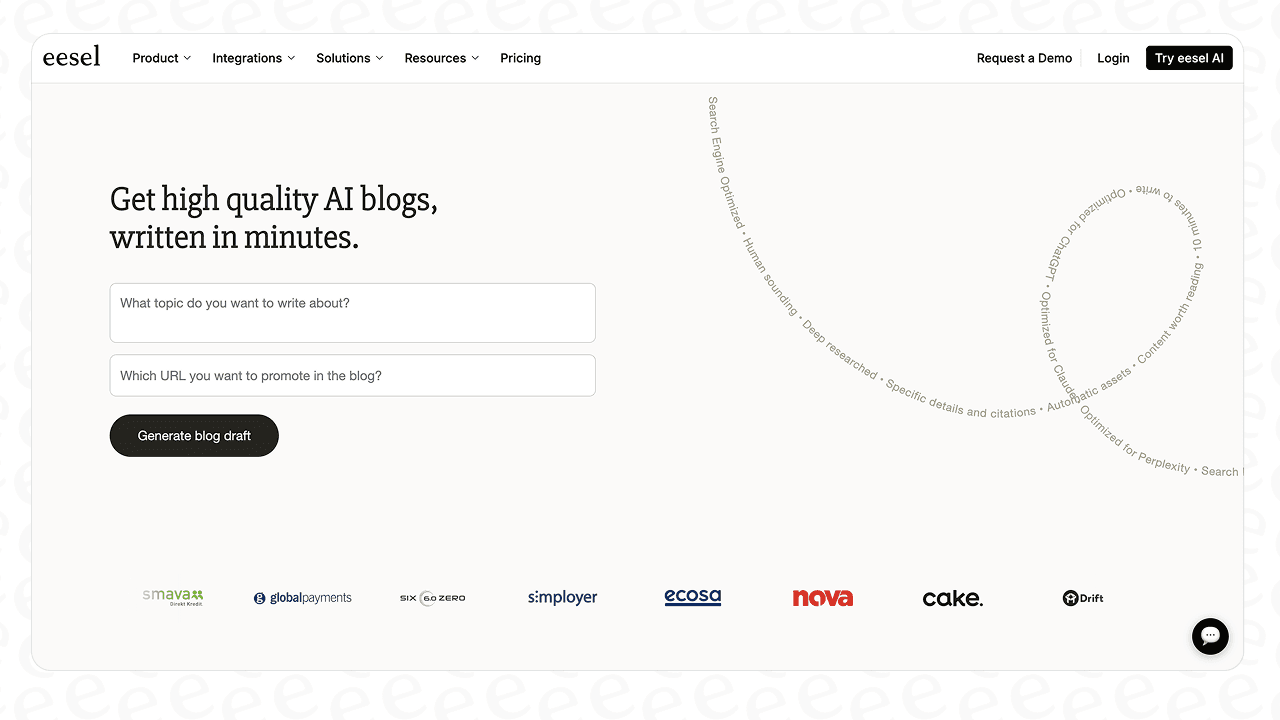
The market is filled with many options, each with different strengths. To help you navigate the choices, I've spent time testing the top six tools available. This is a hands-on review to help you select the right one for your business. We'll examine tools for different aspects of SEO, including some content generators like the eesel AI blog writer. For example, the eesel AI blog writer was used to increase daily impressions from 700 to 750,000 in just three months.
What are AI driven SEO tools?
What exactly are these tools? In simple terms, they're software that uses artificial intelligence, machine learning, and natural language processing to simplify and automate SEO tasks. The main idea is to move beyond traditional data analysis to receive predictive advice that helps improve visibility in standard search results and in the new AI-powered answer engines.
What makes them different from traditional SEO software? A few things:
-
Automated Content Generation: They can write entire articles and blog posts from just a keyword.
-
Predictive Analytics: They can forecast which keywords may become popular, helping you stay ahead of trends.
-
Generative Engine Optimization (GEO): This involves optimizing content to be featured in AI search results.
-
Technical SEO Automation: They can automatically find and suggest fixes for technical website issues, ensuring AI crawlers can effectively index your site.
-
Intelligent Reporting: They provide summaries of performance data and suggest next steps.
How we evaluated the AI driven SEO tools
To ensure this review is useful, I followed a clear process for testing each tool. Here’s what I looked at:
-
Core Functionality: Does the tool's main AI feature work effectively? Is it accurate?
-
Impact on SEO Performance: Can it help improve metrics like organic traffic, rankings, and visibility in AI search?
-
Integration and Workflow: How easily does it fit into a standard marketing or content process without adding complexity?
-
Value Proposition: Considering the price and features, does it offer good value?
AI driven SEO tools: A direct comparison
This table provides a quick overview to help you compare the options before we dive into the details.
| Tool | Best For | Key AI Feature | Pricing Model |
|---|---|---|---|
| eesel AI blog writer | Automated, publish-ready content generation | Complete blog post creation with assets and AEO | Credit-based (free to try, then $99 for 50 blogs) |
| Semrush | Comprehensive SEO and AI market analysis | AI Visibility Toolkit for tracking in LLMs | Subscription (from $199/month) |
| SurferSEO | On-page content optimization and editing | Real-time Content Editor with SERP analysis | Subscription (from $99/month) |
| Rankscale.ai | Specialized Generative Engine Optimization (GEO) tracking | AI search engine visibility monitoring | Credit-based (from $20/month) |
| Whatagraph | Automated SEO performance reporting | IQ Summary for AI-powered report insights | Subscription (from $229/month) |
| Clearscope | Optimizing human-written content | Data-backed content grading and AI Drafts | Subscription (from $129/month) |
The 6 best AI driven SEO tools in 2026
Here’s my detailed breakdown of each platform, based on my hands-on testing.
1. eesel AI blog writer: For automated content creation
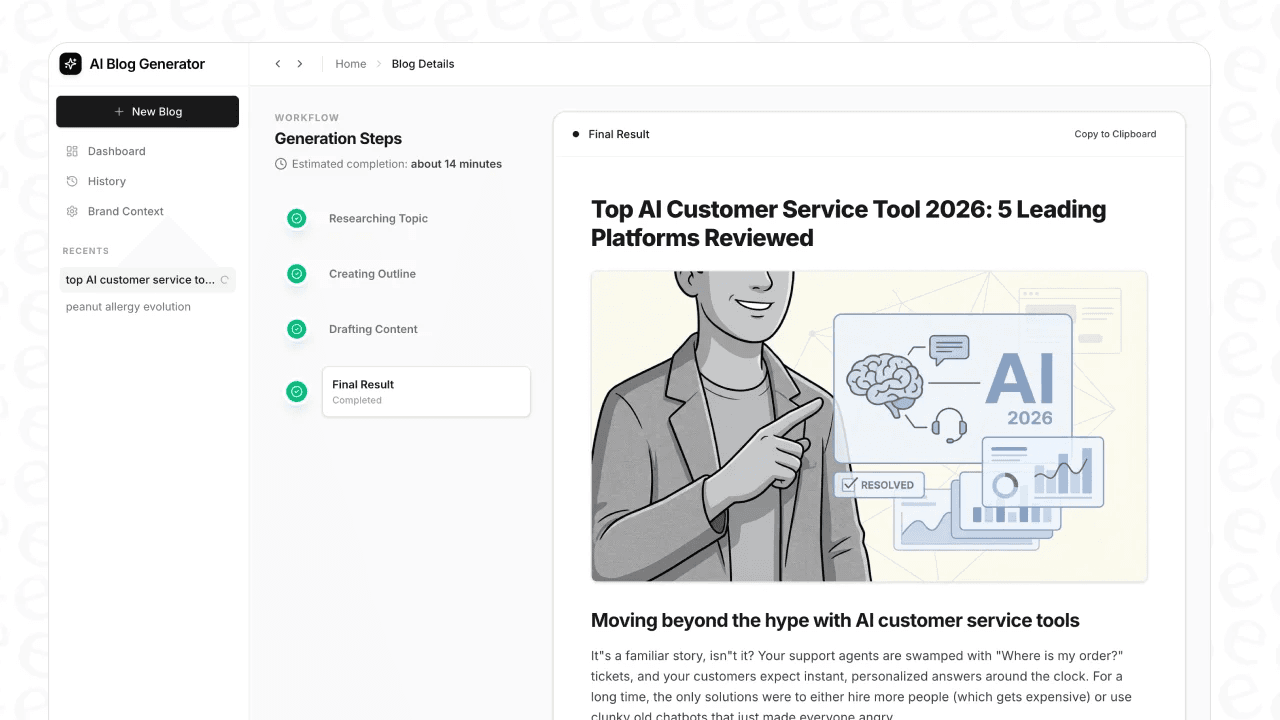
Overview The eesel AI blog writer is designed to take a single keyword and transform it into a complete, SEO-friendly, and media-rich blog post. Its focus is on creating content that’s ready to publish, meeting the needs of search engines, human readers, and AI Answer Engines (AEO). It can also connect to a brand's documents to produce content in a specific voice.
The platform's main advantage is its efficiency. It handles research, article structure, and the creation of assets like images and tables. This reduces the time from concept to publication. A consideration is that, like any AI tool, the final draft can benefit from a human review to add brand-specific touches.
Pricing eesel AI blog writer uses a flexible, credit-based system. It’s free to try, and paid plans start at $99 for 50 blog posts.
2. Semrush: For comprehensive SEO analysis
Overview Semrush is a comprehensive all-in-one SEO platform that has integrated powerful AI features into its toolkit. Their Semrush One offering combines traditional tools for keyword research and site audits with an AI Visibility Toolkit. This allows you to monitor your brand's visibility in AI search results on platforms like ChatGPT, Google AI Overviews, and Perplexity.
Semrush's main strength is the large amount of data it provides, offering a full picture of the competitive landscape. Its AI features give you information on technical issues and keyword opportunities. However, the platform can be complex for newcomers, and its pricing is suited for agencies and larger companies that will use its full range of features.
Pricing Semrush One plans start at $199 per month ($165.17 per month if billed annually) and include both the classic SEO tools and the AI Visibility Toolkit.
3. SurferSEO: For on-page content optimization
Overview SurferSEO is a tool that focuses on on-page optimization. It uses AI to analyze top-ranking search results and provide data-driven recommendations. Its primary feature is the Content Editor, which offers real-time feedback on keyword usage, structure, and readability as you write. It is designed to help you optimize content based on what is already performing well in search results.
Surfer provides clear, actionable steps to improve a post's ranking potential. It also integrates with Google Docs and WordPress, which can streamline the workflow for content teams. A consideration is that closely following its suggestions may result in content that sounds unnatural or over-optimized. It also lacks the deep keyword research or technical SEO features of an all-in-one platform.
Pricing Plans start at $99 per month ($79 per month if billed annually), which includes credits for the Content Editor and 5 AI-written articles.
4. Rankscale.ai: For specialized GEO tracking
Overview Rankscale.ai specializes in Generative Engine Optimization (GEO). It allows you to track your brand's visibility within AI search engines like ChatGPT, Perplexity, and Google AI Overviews. It provides detailed data on your performance for specific keywords and in different regions, addressing a need not covered by many traditional tools.
The tool's primary advantage is its specificity and accuracy for tracking AI search performance. It helps you identify which of your content is being used by AI and the tone of those mentions. Because it is so specialized, it does not offer content creation or other SEO functions, so it should be used alongside other SEO tools rather than as a standalone solution.
Pricing Rankscale.ai uses a credit-based system. The Essentials plan starts at $20 for 120 credits per month.
5. Whatagraph: For automated reporting
Overview Whatagraph is a marketing data platform that uses AI to automate the creation of SEO reports. It connects to sources like Google Search Console and Ahrefs to consolidate your metrics into a single dashboard. Its AI feature, Whatagraph IQ, can create report summaries, build reports from text, and answer questions about your data within the platform.
Whatagraph's key benefit is the time it saves on reporting and its ability to simplify data interpretation. The AI-generated summaries provide quick takeaways without needing to manually analyze spreadsheets. It is important to note that it is purely for reporting and data visualization; it does not include tools for executing SEO tasks.
Pricing The Start plan costs $229 per month (billed annually) and includes access to Whatagraph IQ.
6. Clearscope: For optimizing human-written content
Overview Clearscope is designed to help writers create more comprehensive content. It analyzes top-ranking pages for a keyword and provides a report of related terms and topics to include. As you write, it provides a content grade that updates in real-time. The platform has also added AI features for creating AI-powered drafts and tracking your brand in AI chatbots.
Clearscope helps make human-written content more relevant and in-depth. Its Google Docs add-on makes it simple to integrate into a writing process. While its pricing has become more accessible, it remains a focused tool, suitable for teams prioritizing content quality.
Pricing The Essentials plan starts at $129 per month and includes 20 content reports and 20 AI drafts.
How to integrate AI driven SEO tools into your workflow
Subscribing to these tools is just the first step. It's important to integrate them into your existing processes.
The trick isn’t stacking a dozen tools it’s building a lean workflow where data / content / distribution / visibility all connect. Otherwise, you’re just paying for dashboards you don’t use.

-
Create a hybrid workflow: AI is a tool to assist, not a complete replacement. Use it for initial tasks like research, drafting, and data analysis, but have a human make the final strategic decisions and perform the last editorial review. This ensures your content maintains the correct voice and reflects real expertise.
-
Pick one main tool for each job: To avoid confusing or conflicting data, choose a primary tool for each major task (e.g., one for content generation, one for rank tracking). Using multiple tools for the same task can lead to confusion.
-
Get good at writing prompts: For any tool that generates content, create a set of standard, detailed prompts. Include brand context, target audience, and desired tone. This will produce better, more consistent results that require less editing.
-
Keep measuring and tweaking: Use reporting tools to monitor the performance of your AI-assisted content. See which articles are ranking and being featured in AI answers, then use that information to refine your content strategy and your AI prompts.
To see these tools in action and get another perspective on how they stack up against each other, check out this detailed video review that breaks down the pros and cons of the top AI SEO tools on the market.
Final thoughts on AI driven SEO tools
Using AI driven SEO tools is increasingly important for staying competitive in search. The right tool depends on specific needs, whether that's in-depth market analysis, specialized GEO tracking, or a faster way to produce content. Each tool reviewed here specializes in a particular aspect of the SEO process.
For teams whose main goal is to produce high-quality, publish-ready content efficiently, a content generation tool is a strong option. The ability to go from a keyword to a complete article with relevant assets can be a significant advantage where both speed and quality are important.
Many tools offer free trials to test their capabilities. For example, you can generate a blog post for free with the eesel AI blog writer to see how content automation can fit into your strategy.
Frequently asked questions
What are the main benefits of using AI driven SEO tools for a small business?
For a small business, the biggest benefits are speed and efficiency. AI driven SEO tools can automate time-consuming tasks like keyword research and content drafting, allowing them to manage SEO tasks efficiently without a large budget. They also provide data-backed insights to help you make smarter decisions.
Can AI driven SEO tools completely replace a human SEO expert?
They are best viewed as a powerful assistant, not a total replacement. They handle tasks like data analysis and first drafts, but a human is still needed to set the strategy, review the output for brand voice and accuracy, and make the final creative decisions.
How do I choose the right AI driven SEO tools for my company?
Start by identifying your biggest pain point. If you need assistance with content creation, a tool like eesel AI could be suitable. Need better reporting? Look at Whatagraph. Is on-page optimization your bottleneck? Try SurferSEO. Don't buy an all-in-one suite if you only need one specific function.
Are free AI driven SEO tools good enough to get started with?
Many platforms, like the eesel AI blog writer, offer free trials or credit-based plans that are perfect for getting started. While a fully free tool might have limitations, these trials allow you to test the core functionality and see if it fits your workflow before committing to a paid plan.
How do AI driven SEO tools help with Generative Engine Optimization (GEO)?
They help in two main ways. First, tools like Rankscale.ai can track if your content is being cited in AI search results. Second, content generators can structure articles in a way that is easy for AI engines to understand and use, increasing your chances of being featured in places like Google's AI Overviews.