

GLM-5.4 has no per-token API price yet, so today it costs $18, $80 or $168 a month on Z.ai's GLM Coding Plan. If you use every credit, that works out to $0.16 to $0.66 per million output tokens, roughly a seventh to a twenty-eighth of GLM-5.3's API rate of $4.40.
The catch is the thinking. GLM-5.4 bills a third fewer credits per token than GLM-5.3, but early users report it writing about 1.5x more tokens on Max effort, which eats most of that saving. Pick Pro or Max, keep effort on medium or high, and work off-peak.
If the job is answering customers rather than writing code, eesel is a ready AI helpdesk teammate, and the eesel CLI lets the same coding agent you run GLM-5.4 in upload approved help docs and test its answers before go-live.
How much does GLM-5.4 cost right now?
GLM-5.4 costs whatever your GLM Coding Plan costs, because the plan is the only paid way in. Z.ai's GLM-5.4 model docs still say "the Model API will be made available upon completion of the security assessment," and on November 25 the API pricing page still tops out at GLM-5.3. You can also try it in ZCode and Z.ai Chat, but anything heavier runs on plan credits.
I build the integrations that sit between models and helpdesks, so a new model to me is mostly a new rate card and a new set of limits. Z.ai's is more readable than most. Here's the full individual and team lineup from the subscribe page:
| Plan | Monthly | Quarterly (per month) | Yearly (per month) | Weekly credits | 5-hour credits |
|---|---|---|---|---|---|
| Lite | $18 | $14.40 | $12.60 | 10,000 | 2,000 |
| Pro | $80 | $64 | $56 | 60,000 | 12,000 |
| Max | $168 | $134.40 | $117.60 | 140,000 | 28,000 |
| Team Standard seat | $88 per seat | n/a | $79.20 per seat | 66,000 | not listed |
| Team Premium seat | $188 per seat | n/a | $169.20 per seat | 155,000 | not listed |
Quarterly billing takes 20% off and yearly takes 30% off the individual plans; team seats save 10% on annual billing. The 5-hour limits come from the Coding Plan docs, and the quarterly column is my arithmetic on Z.ai's stated discount.
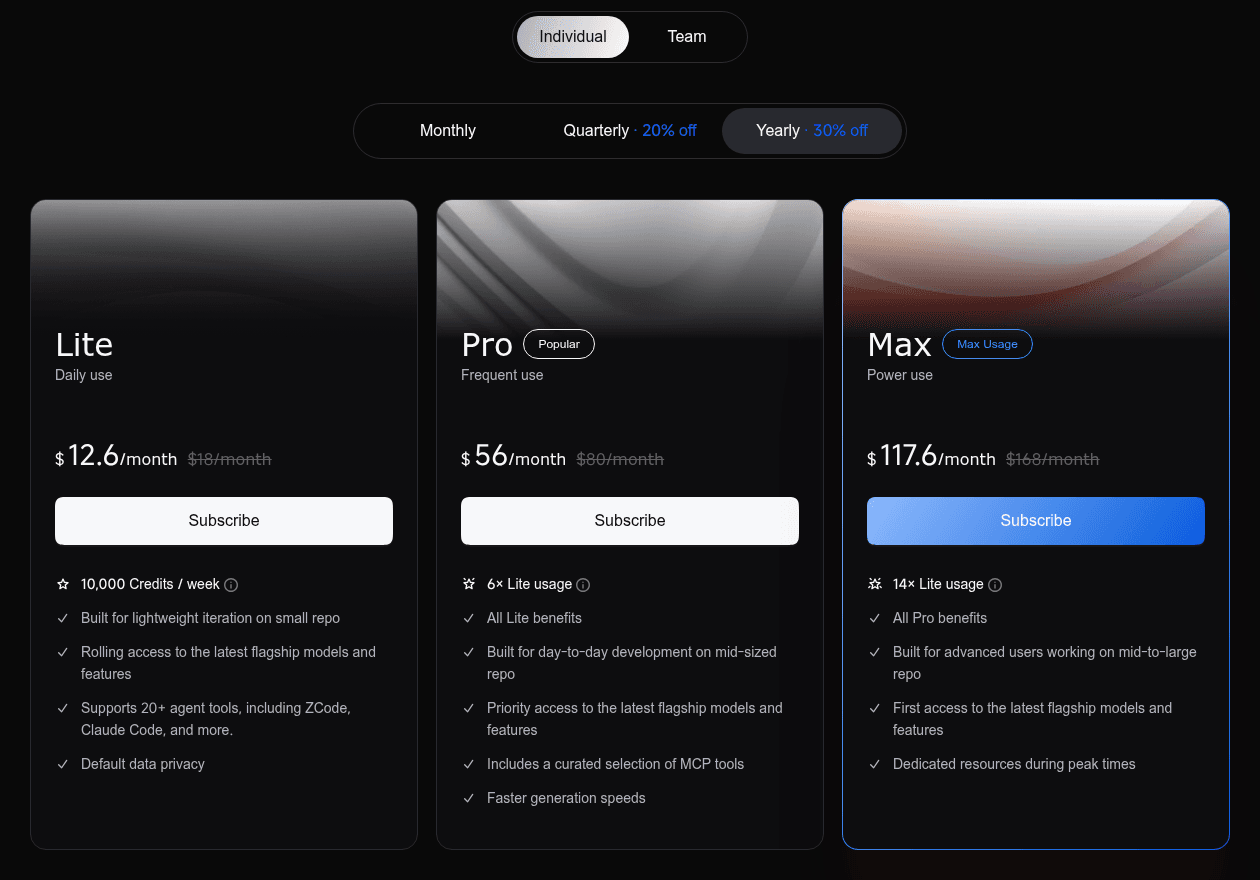
Every tier gets GLM-5.4, GLM-5.3 and GLM-5.3-Flash, plus the vision, web search, web reader and Zread MCP tools. What changes between tiers is the credit pool, how many projects Z.ai recommends running at once (one on Lite, one or two on Pro, two or more on Max, per the usage policy) and who gets served first at busy times.
If you want the architecture story behind the model, the GLM-5.4 overview covers it, and the GLM-5.4 review has the verdict on quality.
How do GLM Coding Plan credits work?
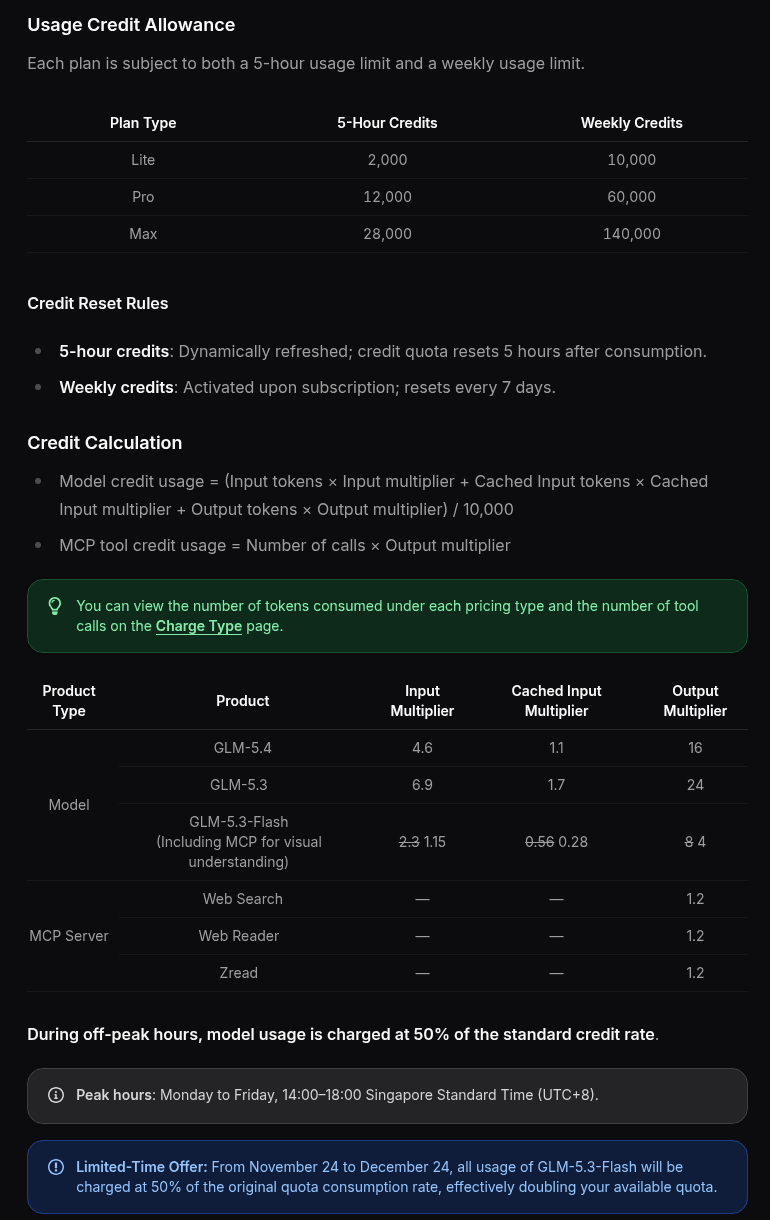
Credits are Z.ai's meter. Every call spends credits according to a published formula, and you get a fixed pool every 5 hours and every week. The Coding Plan docs spell it out:
Model credit usage = (Input tokens × Input multiplier + Cached Input tokens × Cached Input multiplier + Output tokens × Output multiplier) / 10,000
So the multipliers are credits per 10,000 tokens:
| Model | Input | Cached input | Output |
|---|---|---|---|
| GLM-5.4 | 4.6 | 1.1 | 16 |
| GLM-5.3 | 6.9 | 1.7 | 24 |
| GLM-5.3-Flash | 1.15 (promo, normally 2.3) | 0.28 (normally 0.56) | 4 (normally 8) |
| Web Search, Web Reader, Zread MCP | n/a | n/a | 1.2 per call |
Two rules change the real cost more than the table does:
- Off-peak is half price. "During off-peak hours, model usage is charged at 50% of the standard credit rate." Peak is only Monday to Friday, 14:00 to 18:00 Singapore time, which is 20 of the week's 168 hours. That's 06:00 to 10:00 UTC, so it lands on a European morning and a US late evening.
- There are two limits, not one. The 5-hour pool refreshes 5 hours after you spend it; the weekly pool resets every 7 days from when you subscribed. On every individual tier, one full 5-hour window is exactly a fifth of the week.
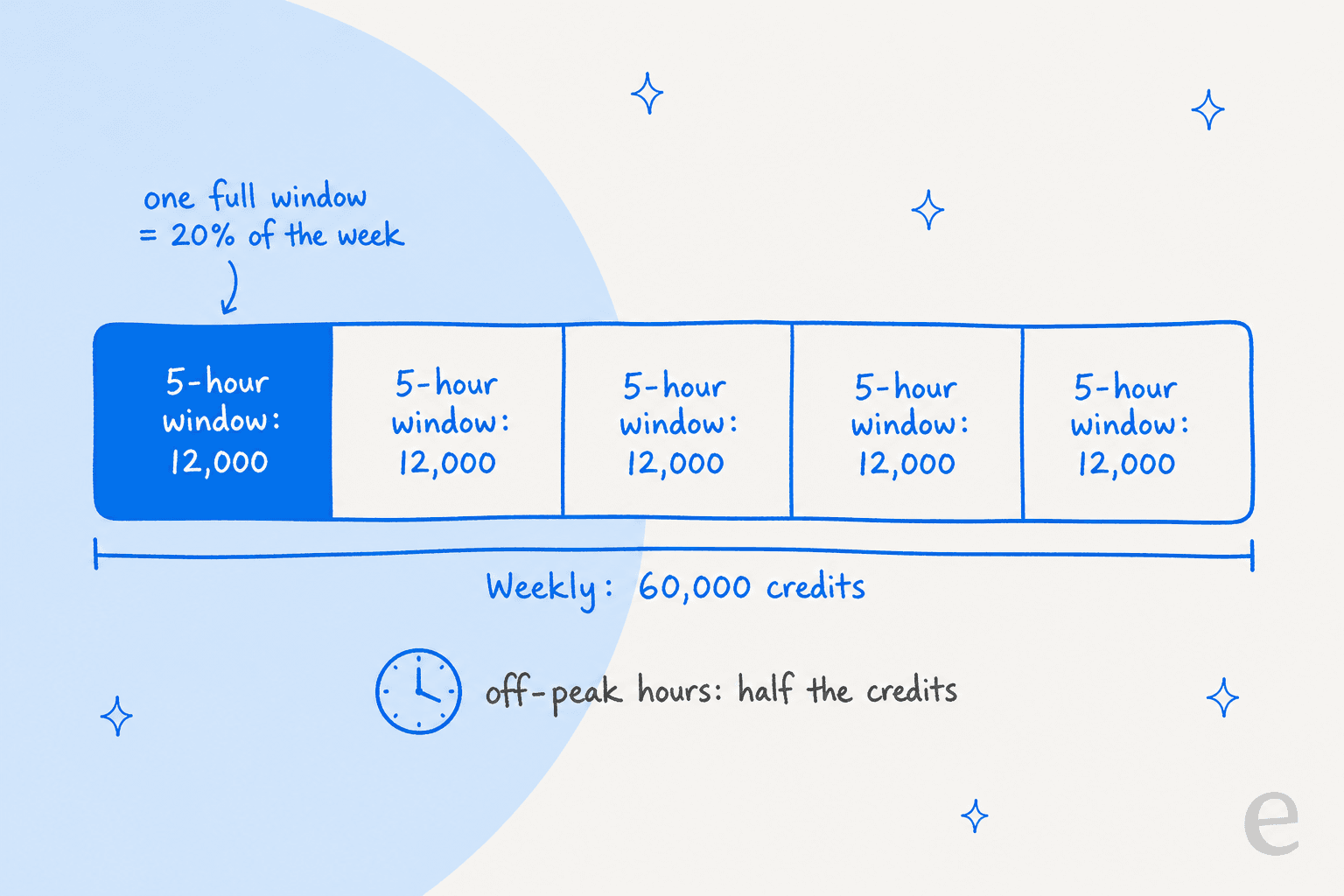
That second rule is why "credits per week" overstates what you can do in a day. Burn five heavy windows on Monday and Tuesday and you're done until your weekly reset. Early users noticed fast:
"Works well, but indeed token consumption seems to be 1.5x of GLM 5.3 on Max level thinking. And they are offering 50% more on 5.4, sooooooo. On the pro plan, a full 5-hr window equals to 20% of weekly quota."

When credits run out, the Coding Plan FAQ says you wait for the next window. Nothing gets charged to your account balance, which is the friendly part: a subscription can't surprise you with an overage bill.
What does GLM-5.4 cost per million tokens?
At full use, between $0.16 and $0.66 per million output tokens, depending on plan, billing period and time of day. I got there by dividing each plan's price by its monthly credit pool (weekly credits × 52 ÷ 12), then multiplying by GLM-5.4's multipliers:
| Plan and billing | Input (peak / off-peak) | Cached input (peak / off-peak) | Output (peak / off-peak) |
|---|---|---|---|
| Lite, monthly ($18) | $0.19 / $0.10 | $0.046 / $0.023 | $0.66 / $0.33 |
| Lite, yearly ($12.60) | $0.13 / $0.07 | $0.032 / $0.016 | $0.47 / $0.23 |
| Pro, monthly ($80) | $0.14 / $0.07 | $0.034 / $0.017 | $0.49 / $0.25 |
| Pro, yearly ($56) | $0.10 / $0.05 | $0.024 / $0.012 | $0.34 / $0.17 |
| Max, monthly ($168) | $0.13 / $0.06 | $0.030 / $0.015 | $0.44 / $0.22 |
| Max, yearly ($117.60) | $0.09 / $0.04 | $0.021 / $0.011 | $0.31 / $0.16 |
Prices per 1M tokens, assuming every credit gets used. The Team Standard seat lands on the same per-credit rate as monthly Pro, and Premium sits between monthly Pro and monthly Max.
For context, here's what the same million output tokens cost on the APIs you can actually call today, all from vendor pricing pages:
| Model (API) | Input | Cached input | Output | Source |
|---|---|---|---|---|
| GLM-5.3 | $1.40 | $0.26 | $4.40 | Z.ai pricing |
| Kimi K3.1 Pro | $2.00 | $0.20 | $10.00 | Kimi API pricing |
| DeepSeek V4.1 Flash (off-peak / peak) | $0.15 / $0.30 | $0.003 / $0.006 | $0.60 / $1.20 | DeepSeek pricing |
| Claude Sonnet 5.5 | $2.00 | $0.10 | $10.00 | Claude pricing |
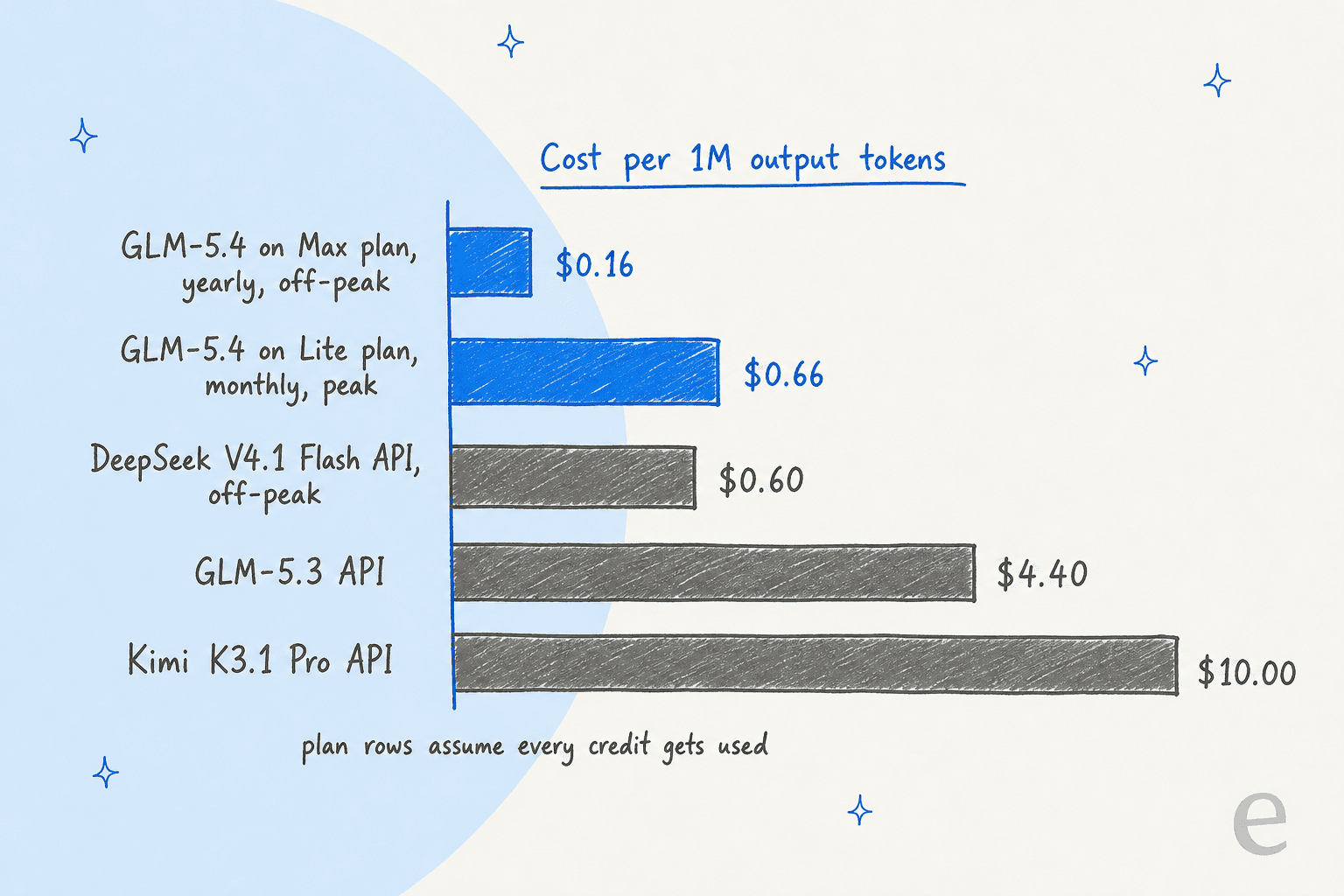
That's the headline, and it needs a big asterisk: a plan's per-token price only holds if you use the plan. Unused credits don't roll over. On the typical agent call in the next section, the Lite plan beats GLM-5.3's API once you use about a sixth of its monthly credits. Against DeepSeek's off-peak API, a fully used Lite plan is still a little more expensive per token, and Pro and Max only match it if you keep them busy.
What does a real coding session cost?
Per-token numbers are abstract, so here's one agent call I'd call typical for a coding agent working in a mid-sized repo: 80,000 tokens of context with a 95% cache hit (76,000 cached, 4,000 fresh) and 2,000 tokens of output. That costs 13.4 credits on GLM-5.4 versus 20.5 on GLM-5.3.
| Plan | Calls per 5-hour window (peak) | Calls per month (peak) | Calls per month (all off-peak) | Cost per call (peak / off-peak) |
|---|---|---|---|---|
| Lite | about 149 | about 3,230 | about 6,470 | $0.0056 / $0.0028 |
| Pro | about 895 | about 19,400 | about 38,800 | $0.0041 / $0.0021 |
| Max | about 2,090 | about 45,300 | about 90,500 | $0.0037 / $0.0019 |
The same call on pay-as-you-go APIs costs about $0.034 on GLM-5.3, $0.043 on Kimi K3.1 Pro, $0.036 on Claude Sonnet 5.5 (before cache-write charges) and $0.002 on DeepSeek V4.1 Flash off-peak. So a fully used Lite month buys roughly $110 of GLM-5.3 API work for $18. The one API that keeps up is DeepSeek: a fully used, all-off-peak Pro plan costs about the same per call ($0.0021 vs $0.0020) as DeepSeek V4.1 Flash pricing at its off-peak rate.
Heavy users do get through these pools. One Max subscriber posted this on the second day:
"600M Token used, 78% used of the Weekly Limit on Max Plan V2 and today was my reset...... Unusable. Literally."
Do the maths on that and it's about 182 credits per million tokens, which only happens when nearly everything is a cache hit. Six hundred million tokens is a lot of agent work. If that's your week, you're past what any single plan was sized for.
Does a third fewer credits make GLM-5.4 cheaper?
Only if it doesn't think much longer than GLM-5.3, and early reports say it does. Z.ai cut the credit rate by a third and its launch post sold that as more quota:
"For users with weekly quotas, GLM-5.4 now comes with 50% more quota compared to GLM-5.3."
That's true per token. But the credit formula only knows three kinds of token (input, cached input, output), so the model's thinking text is generated output and bills at the 16-credit rate. In my sample call, GLM-5.4 stays cheaper until it writes about 3.2x as much output as GLM-5.3 would for the same task. Past that, the old model costs fewer credits.
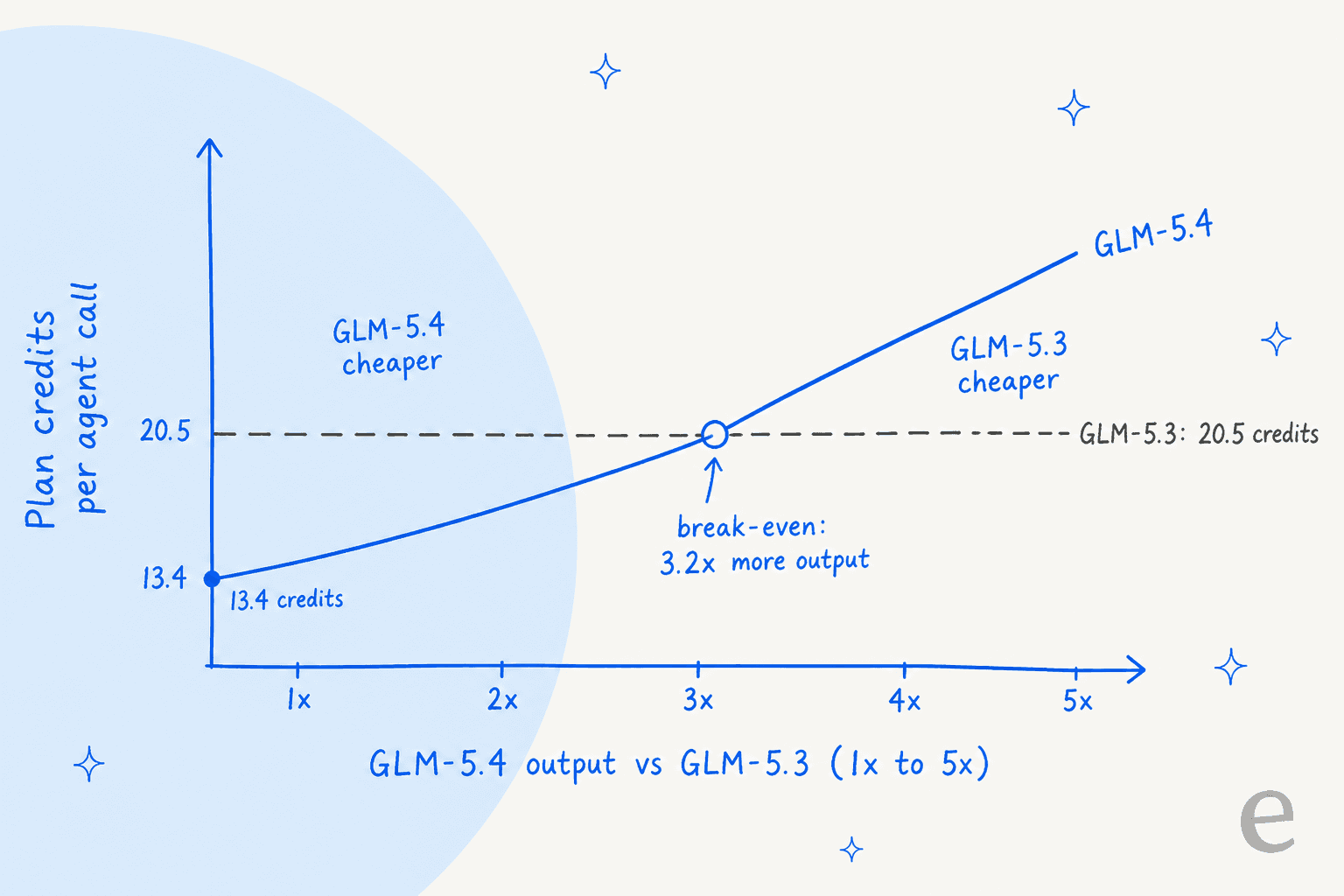
The reports from the first two days sit uncomfortably close to that line. The u/nockyama comment above measured 1.5x token use on Max effort. Another developer in the r/ZaiGLM thread on response times said "something GLM-5.3 would have taken 10 minutes takes 40 minutes on GLM-5.4", and one user said a single prompt used a whole 5-hour window. Time isn't tokens, so I wouldn't push those numbers too far, but the direction is clear.
Paweł Huryn, who ran GLM-5.4 against 105 planted bugs on a Pro plan, hit both limits in one test:
"5.5 hours of enforced pauses (either API meltdown or a 5-hour window exhausted)"
Z.ai's own guidance points at the fix: its launch-day advice was to use GLM-5.3-Flash for quick work and save GLM-5.4 for hard problems. In practice that means three settings:
- Default to medium or high effort. Max is for the bug you've been stuck on for a day, not for renaming a variable.
- Route simple work to GLM-5.3-Flash. At its promo rate of 4 credits per 10,000 output tokens (until December 24), it's a quarter of GLM-5.4's output rate.
- Schedule long runs off-peak. Overnight agent runs bill at half the credits, and the 5-hour window stretches twice as far.
Work out your own GLM-5.4 rate
The tables above assume perfect use. This calculator lets you put in how much of your plan you really use, your token mix and your peak share, then compares the result with the APIs you could call instead.
Two things stand out when you play with it. Utilization matters more than plan choice: Pro at 30% use costs more per token than Lite at 100%. And DeepSeek's API stays cheaper than every plan setting until you push utilization high and move most work off-peak.
How does GLM-5.4 compare with Claude, Kimi and DeepSeek plans?
On published numbers, Z.ai is the most transparent of the subscription options, which makes a fair comparison oddly one-sided. Here's what each vendor lists:
| Option | Entry price | Top price | What the limit is | Published token or credit math? |
|---|---|---|---|---|
| GLM Coding Plan (GLM-5.4) | $18/month | $168/month | Credits per 5 hours and per week | Yes: multipliers and token estimates |
| Claude Pro / Max / Ultra | $20/month ($17 yearly) | $200/month | Usage per 5 hours and per week; Ultra has no 5-hour limit | No token figures |
| Kimi membership Plus to Ultra | $19/month ($15 yearly) | $199/month | "Agent credits" (Pro 2x, Max 5x, Ultra 10x of Plus) | No token figures |
| DeepSeek API | Pay as you go | Pay as you go | None beyond concurrency | Per-token prices |
Claude Code comes with every paid Claude plan from Pro up, and Anthropic says how fast you reach a limit "depends on the model you use, how long your chats are, and how large your files are". Max also adds $100 a month in API credits and Ultra $200. Kimi Code is included from Plus. Neither publishes a credit-to-token conversion, so you can't do the per-million maths above for them. You can only compare the sticker and your own experience.
The Claude Pro pricing and Kimi K3 pricing breakdowns go deeper on those two, and Cursor pricing covers the editor side.
A practical difference: the GLM Coding Plan works inside 20+ third-party tools, including Claude Code itself, Codex, Cursor and OpenCode. So you can keep the agent you already know and point it at GLM through Z.ai's endpoint, which the Coding Plan FAQ lists as https://api.z.ai/api/anthropic for Claude Code. Quality is a separate question: Z.ai's win rates put GLM-5.4 ahead of Kimi K3.1 Pro and roughly level with DeepSeek's Flash model on its own tasks, and the review covers why that's thin evidence.
What are the hidden costs of the GLM Coding Plan?
The sticker is simple. The fine print has six things I'd read before paying, all from Z.ai's own pages:
- No refunds. "Once a subscription service is purchased, it is considered confirmed, and refunds are not supported," per the usage policy. That makes the yearly discount a real commitment.
- Two different cancellation deadlines. The usage policy says cancel "at least 3 days" before renewal; the FAQ says at least 24 hours. Go with 3 days.
- Supported tools only. The plan "may only be used within officially supported tools and products," and the FAQ adds that API calls outside the plan aren't available to plan users. You can't put a Coding Plan key behind your own product. If you need GLM in an app, the GLM-5.3-Flash pricing and GLM-5.3 for business guides cover the API route.
- One person per subscription. Account sharing is prohibited, and accounts with more than three violations may be banned. Teams need team seats.
- Upgrades don't all start now. A same-tier upgrade (monthly Lite to yearly Lite) waits for the current plan to expire. A cross-tier upgrade starts immediately and converts the remaining value to account balance.
- Capacity isn't guaranteed. Concurrency limits shift with load ("Max > Pro > Lite"), and launch week brought plenty of 429 and "model at capacity" errors. Among individual plans, only Max promises dedicated resources at peak.
One small upside: Z.ai's invite program pays up to 20% back in platform credits, which can offset a renewal.
Which GLM Coding Plan should you buy for GLM-5.4?
Here's where I'd land for the four buyers I hear from most:
- You want to try GLM-5.4 on side projects. Lite monthly at $18. It's enough for a few focused sessions a week, and the no-refund rule makes monthly the safe first step.
- You code with an agent most working days. Pro. At about 895 typical calls per 5-hour window, it survives a real session, and it's the cheapest tier where a single long GLM-5.4 run won't end your afternoon. Go yearly only after a month of watching your usage.
- You run parallel agents or long overnight jobs. Max, scheduled off-peak. It has the lowest per-credit price and the only peak-time resource guarantee.
- You're building a product, not coding in an IDE. No plan fits; wait for the API. Until then, GLM-5.3, DeepSeek V4.1 Flash or Kimi K3.1 Pro all have per-token prices you can build on, and the Gemini 4 Neon pricing and GPT-6.2 Astra pricing posts cover the US options.
Where a model's price stops mattering
On sales calls, the most common alternative technical buyers raise isn't another vendor. It's building their own support agent on a model API. Cheap tokens make that look easy, and GLM-5.4 at $0.16 per million output tokens makes it look even easier. In my experience the tokens are rarely the expensive part. The work is in retrieval from your own docs (what RAG means in practice), the helpdesk connection, the rules for when to hand off, and testing against real tickets before a customer sees an answer. That's the case for buying over building, and it doesn't change when a cheaper foundation model ships.
GLM-5.4 is infrastructure: a model you point at code. eesel is the employee. Its AI helpdesk teammate joins your existing queue already knowing your help center and past tickets, and you can simulate it on your ticket history before it replies to anyone.
Qontro, an ERP software company in Auckland, runs it as a co-pilot on Freshdesk: every new ticket gets an internal note with a customer-ready draft, grounded in about 9,800 past tickets and help articles, and the team drafted 190 tickets that way in a month. OroSoft, which makes bullion ERP software, has support agents mention eesel on a Freshdesk ticket to get a draft built from 6,100 resolved tickets, with the source ticket or article named every time.
If you're already running GLM-5.4 inside Claude Code or Codex, the eesel CLI fits the same terminal. Your coding agent can upload approved knowledge such as exported help articles, macros and refund policies, then run test questions and check the answers before anything goes live. Connecting the helpdesk itself still needs a person with admin access to approve it. The guide to AI agent CLIs covers the pattern.
Try eesel
If you priced out GLM-5.4 because you want to automate support replies, skip the model shopping. eesel gives you ready-to-work AI teammates for specific jobs: a helpdesk teammate that plugs into Freshdesk, Zendesk or Gorgias in minutes and learns from your past tickets, and an AI blog writer for publish-ready posts.
There's a free plan, paid plans start at $299 a month for 500 credits on the pricing page, and you can test it on your own ticket history first. Try eesel.
Frequently Asked Questions
How much does GLM-5.4 cost?
GLM-5.4 costs $18, $80 or $168 a month through the GLM Coding Plan (Lite, Pro or Max), with 20% off quarterly and 30% off yearly. There's no per-token API price yet. If you use every credit, GLM-5.4 pricing works out to $0.16 to $0.66 per million output tokens. For the model itself, see the GLM-5.4 overview.
Does GLM-5.4 have API pricing?
Not yet. Z.ai says the API opens after a security assessment, and its pricing page still tops out at GLM-5.3 ($1.40 input, $4.40 output per million tokens). If you need an API today, GLM-5.3-Flash pricing and DeepSeek V4.1 Flash pricing are the closest options.
How many GLM-5.4 tokens does the Lite plan include?
Lite gives 10,000 credits a week. Z.ai estimates that covers 72 to 146 million GLM-5.4 tokens a week at a 95% cache hit rate, depending on how much runs off-peak, where credits cost half. A 5-hour cap of 2,000 credits also applies. The GLM-5.4 review covers how fast real sessions use it.
Is GLM-5.4 cheaper than GLM-5.3?
Per token, yes: GLM-5.4 costs 4.6, 1.1 and 16 plan credits per 10,000 input, cached and output tokens, against 6.9, 1.7 and 24 for GLM-5.3. Per task, it depends on effort. GLM-5.4 thinks longer, and on a typical agent call it stays cheaper only while it writes less than about 3.2x the output GLM-5.3 would. The GLM-5.3-Flash guide covers the cheapest option for quick work.
What happens when my GLM Coding Plan credits run out?
You wait. Once a 5-hour or weekly pool is spent, calls stop until it refreshes, and Z.ai doesn't charge your account balance. Off-peak work uses half the credits, so long runs stretch further overnight. If you need an agent that answers customers rather than code, an AI helpdesk agent like eesel bills on its own plan.
Can I get a refund on the GLM Coding Plan?
No. Z.ai's usage policy says subscriptions are non-refundable once purchased, even if unused. Cancel at least 3 days before renewal to stop the next charge. Start monthly before committing to a yearly GLM-5.4 plan. For how Anthropic handles the same question, see the Claude Code pricing breakdown.
Is GLM-5.4 cheaper than Claude Code?
On sticker price, the entry tiers are close: GLM Coding Plan Lite is $18 a month and Claude Pro is $20, which includes Claude Code. Anthropic doesn't publish token allowances, so a per-token comparison isn't possible. You can also run GLM-5.4 inside Claude Code by pointing it at Z.ai's endpoint.