Foundation model
A foundation model is a large AI model trained on broad data that can be adapted to many different downstream tasks rather than built for just one.
What a foundation model means
A foundation model is a large AI model trained on a broad, general dataset that can be adapted to many different downstream tasks rather than being built for a single one. The term, coined by researchers at Stanford in 2021, captures the shift away from training a separate narrow model for each problem and toward one large, general model that serves as a base others build on.
The defining traits are scale and generality. A foundation model is pretrained on huge amounts of data, usually with self-supervised learning that needs no manual labels, which gives it broad capabilities it was never explicitly told to acquire. That same base model can then be pointed at translation, summarization, classification, code generation, or question answering. Large language models are the most familiar kind, but foundation models also cover images, audio, and combinations of those in multimodal systems. They are almost always built on the transformer architecture.
In customer support, foundation models are the general intelligence that an AI tool adapts, rather than a model trained only on support data, which is why grounding and adaptation matter as much as the base model itself.
Why foundation models matter
- One base, many uses. A single pretrained model can be adapted to dozens of tasks, so teams build applications instead of training models from scratch.
- Emergent capability. Because they learn from such broad data, foundation models pick up abilities like reasoning and translation that were never an explicit training goal.
- Lower barrier to entry. Most teams consume a foundation model through an API, so the expensive pretraining is done once by the provider and reused everywhere.
- Adaptable several ways. The same base can be steered with prompting, few-shot learning, retrieval grounding, or fine-tuning, depending on how much control a task needs.
- A shared dependency. Many products run on the same handful of foundation models, so the base model is general while the value sits in how each product adapts and grounds it.
Picture the "one base, many uses" idea as a hub with spokes, where a single pretrained model feeds a whole spread of jobs.
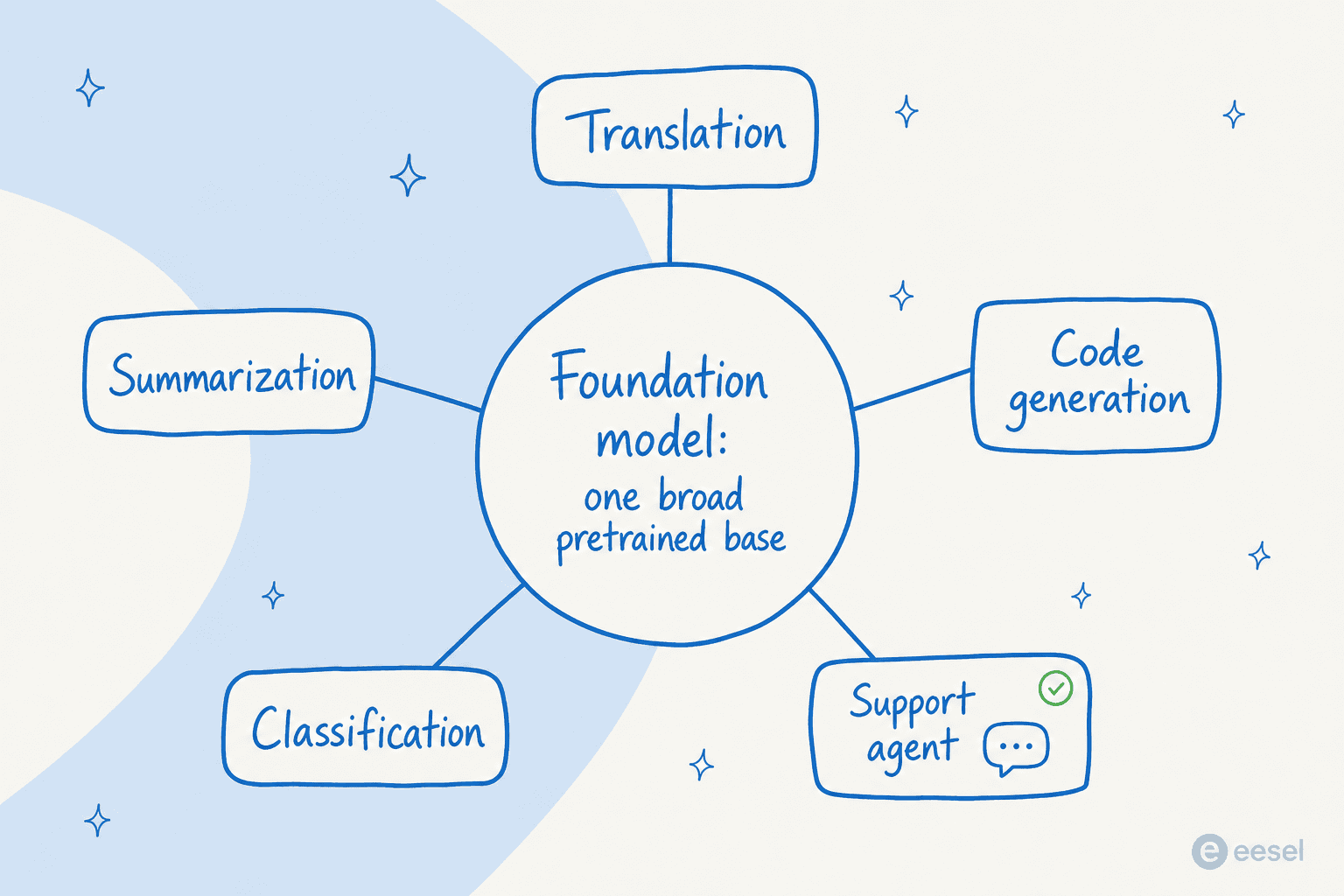
The same broad base can be pointed at translation, summarization, code, or classification, and a support agent is just one more spoke. What turns that general spoke into something useful on a live queue is the grounding and guardrails wrapped around it.
How a foundation model works
- Pretrain on broad data. The model learns general patterns from a very large, diverse dataset, typically without human labels.
- Acquire general capability. Through that scale, it develops broad skills in language, reasoning, and pattern recognition that span many domains.
- Adapt to a task. Developers tailor the base model to a specific use with prompting, examples, retrieval, or fine-tuning.
- Deploy in an application. The adapted model is wrapped in product logic, integrations, and guardrails to do real work.
A support agent like eesel AI sits at that last step: it builds on foundation models for their language ability, then grounds them in your help center and past tickets so the general intelligence answers from your facts, and adds the actions and escalation rules that make it usable on a live queue.
Foundation models in practice
The practical lesson is that the base model is rarely the differentiator, because most products draw from the same small set of providers. What separates a useful support AI from a generic chatbot is everything wrapped around the model: the quality of the knowledge it can reach, how tightly answers are grounded, the actions it can take, and the guardrails that make it escalate instead of guess. A stronger foundation model raises the ceiling, but adaptation and grounding are what determine whether it actually resolves a customer's problem.
A foundation model, applied to support
eesel AI builds on foundation models and grounds them in your knowledge so they answer support questions from your facts.