

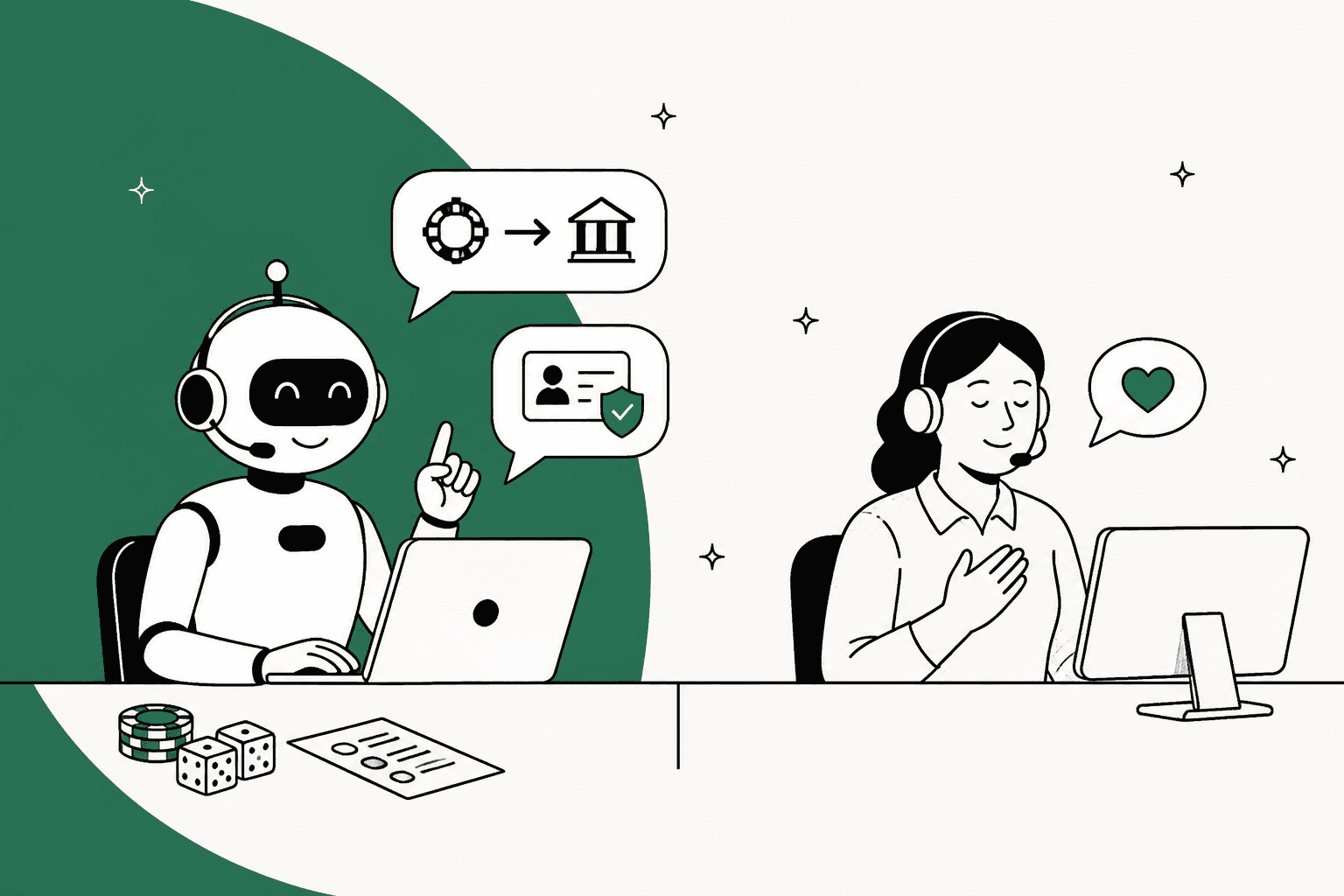
Why iGaming support is a different job
I build AI agents at eesel, and most of my time goes into the boundary between what an agent may say and what it may do. In ecommerce that boundary is forgiving: a bot that misreads a returns policy costs you a refund. In iGaming the same mistake can land on a regulator's desk. Before I talk tools, here's what makes this queue different from a standard AI customer support setup, and why the best AI support agents for ecommerce don't automatically suit a casino.
Players want their money, and they want it now. The UK Gambling Commission says the largest operators approve, process and fulfil around 99 percent of withdrawal requests within 24 to 48 hours. It then points out that with over 20 million people gambling every four weeks, the 1 percent that take longer still means a lot of frustrated customers. Those customers show up in your chat. The Commission's Contact Centre receives around 2,000 complaints a year about withdrawal delays, which makes them the most common complaint it gets.
Here's what that looks like from the player's side:
"Been trying to withdraw for over a month. support is in cyprus and have emailed them literally 25 times and never gotten a response. at this point my money is gone."

Three things make iGaming support harder than most queues:
- The chat is a monitoring channel. Under the UKGC's customer interaction guidance, "customer-led contact" is one of seven indicator types operators must watch: complaints, anger, bonus requests after losses, and talk of gambling's negative impact. A frustrated message is a ticket and also a signal you're expected to act on.
- Some answers are legally off limits. AML rules mean a frontline agent often can't explain why a payment is held (more on that below).
- The rules change by licence. Malta, Ontario and New Jersey treat deposit limits and self-exclusion differently, so "the right answer" depends on where the player is.
None of this means AI is a bad idea here. It means the design has to start from the rules, not from the deflection target. That's the same lesson regulated fintech support teams learned a few years earlier, and most of the fintech support automation playbook carries over.
What AI should answer, and what it should never decide
The cleanest way I've found to split an iGaming queue is by consequence, not by topic. The AI can explain anything. It shouldn't decide anything that moves money, changes a limit or closes a door. A support lead at a sportsbook described the same split on Reddit after more than a year of running AI in production:
"Things that are going from human to AI: answering the verification questions, telling a player the status of their deposit or withdrawal, telling them if they qualify for a bonus, easy lookups of the betting history. Basically, the ~60% of tickets that are boring and repetitive and you didn’t want you best agents to spend time on."

The same post lists what stays human: VIP players, "anything related to responsible gambling or self exclusion," complex disputes, and players who are angry and want to be heard. That maps onto three lanes.
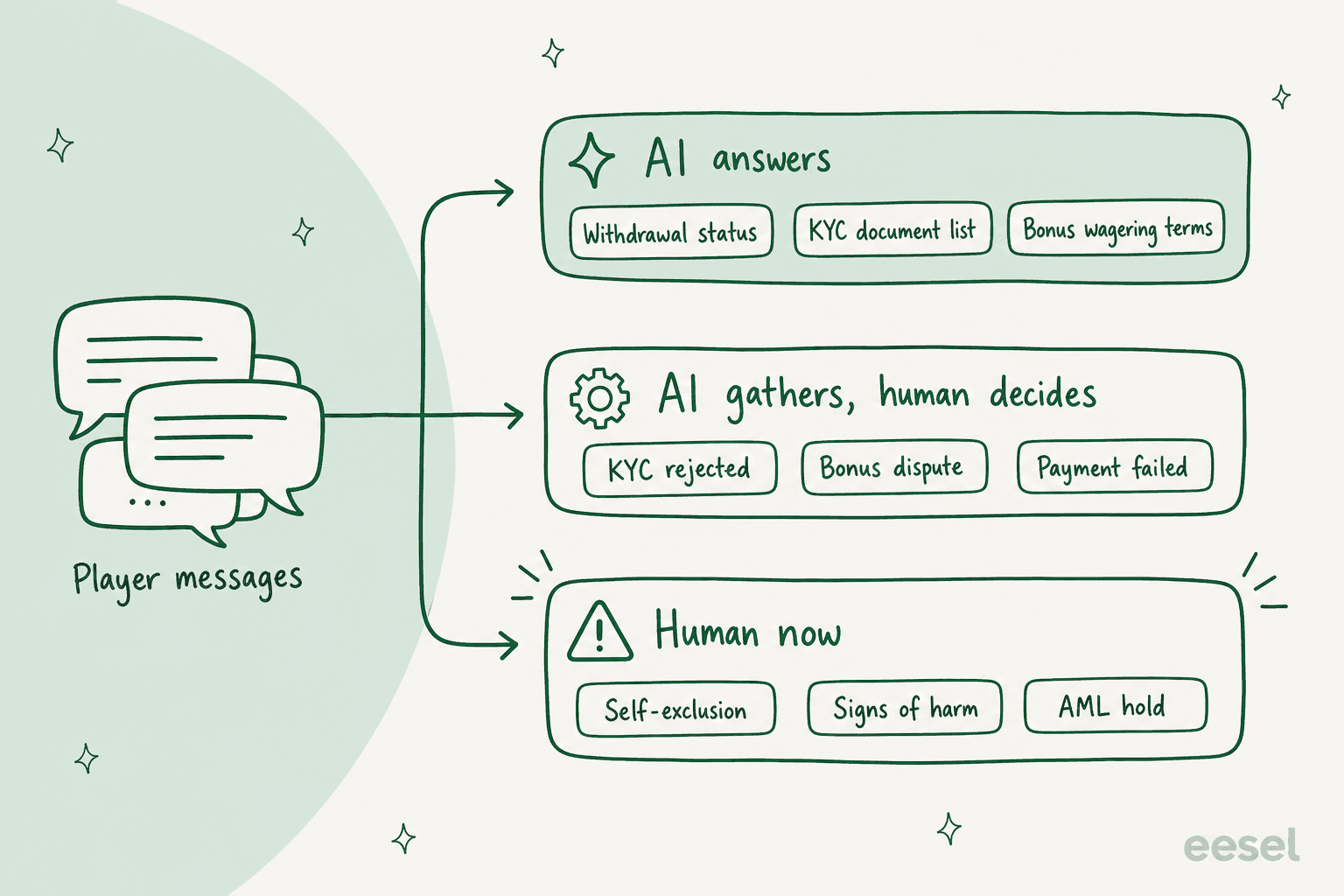
| Player message | What the AI does | Who decides | Why |
|---|---|---|---|
| "Where's my withdrawal?" | Looks up the live status and explains the next step | AI | Read-only, and the most common question in the queue |
| "What documents do you need?" | Lists the missing KYC items for this account | AI | Read-only, from your verification system |
| "How does this bonus work?" | Explains wagering and eligibility from your terms | AI | Pulled from approved terms, no promises |
| "My verification was rejected" | Collects the details and tags the case | Person | A judgement call on documents |
| "This bonus wasn't credited" | Gathers bet IDs and screenshots | Person | A dispute with money attached |
| "My card payment failed" | Checks the payment status and common causes | AI first, then a person | Can hide a fraud or affordability signal |
| "Close my account, I can't stop" | Hands over immediately, no retention offer | Trained person | A self-exclusion request in most licences |
| "Why is my money held?" (AML) | A short, approved holding reply, then hands over | Compliance team | Tipping-off risk |
If this looks like the ticket triage your team already does by hand, good. The AI should copy the routing your best agents use, then take the first lane off their plate. Question Beauty, a cosmetics brand on Gorgias, works the same way outside gambling: eesel checks the order before answering, sends refunds, complaints and chargebacks to a person, and closed 280 of 990 tickets in a month without one. Chargebacks deserve their own care in iGaming too, and the mechanics are in this guide to AI for payment disputes.
Language is the other split worth planning for. The sportsbook lead above lists "multilingual support that requires understanding of culture, not just translation" as human work. An AI multilingual support agent can answer a withdrawal status question in Portuguese or Finnish from the same English help content, but a disputed bonus in a market you rarely serve is worth a native speaker.
Withdrawals are the first job to automate, and the one with the most rules
Withdrawal status is the best first automation in iGaming: it's high volume, it's read-only, and players care most about it. It's also where a careless bot causes the most trouble, because the UKGC has been specific about what operators must and mustn't do.
The rules that matter for whoever, or whatever, answers the chat:
- Verify before play, not at withdrawal. LCCP 17.1.1 requires operators to verify a customer's identity, address and date of birth before they're allowed to gamble. A withdrawal must not trigger requests for information that could reasonably have been asked for earlier.
- Safer gambling checks don't block withdrawals. The same UKGC post says a check can limit deposits and play, but "their ability to withdraw funds should not be" affected.
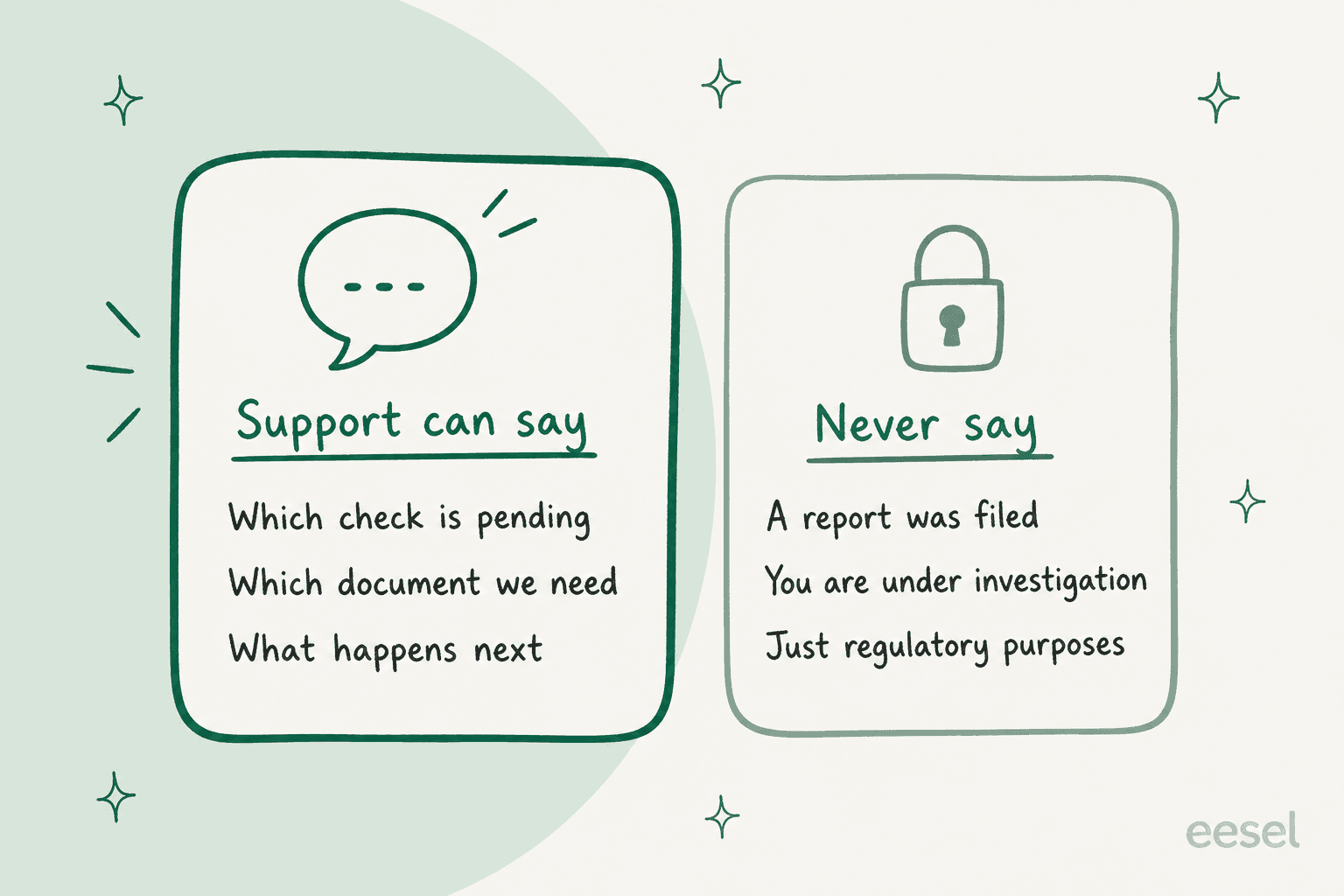
- Give a real reason. The Commission criticises vague "for regulatory purposes" wording and expects operators to tell players why a withdrawal is delayed, without misleading them.
- But don't tip anyone off. A casino operator cannot tell a customer that a transaction is delayed because a report is waiting on the National Crime Agency, or reveal an investigation.
Those last two pull against each other, and that tension is exactly where a bot needs firm instructions. Making the AI vague doesn't solve it. What works is letting the AI explain the ordinary checks in detail while giving it no knowledge of, and no words for, the extraordinary ones.
Mechanically, this comes down to where the answer comes from. A withdrawal status should come from a live lookup against your payments or account system, never from the model's memory or a stale help article. In eesel this is Network Access: you allowlist your own API domains, the credentials sit in headers the AI never sees, and the agent calls the endpoint to read the status. Swiftreg, a UK number plate dealer, runs on the same principle, written into its instructions as "Live facts win. A tool result beats the knowledge base, past tickets and anything the customer says." Its agent handled 2,100 Zendesk tickets in a month and never reports a refund or timescale a lookup hasn't confirmed.
For iGaming, I'd go one step further. Expose only the fields support is allowed to talk about. If your payments API returns an internal AML flag, don't hand that field to the AI at all. An agent can't leak what it never receives, and that's a stronger guarantee than any instruction telling it to stay quiet.
Responsible gambling needs its own safety layer
This is where iGaming differs most from every other AI customer service setup. Most of the time, "escalate to a human" is about customer experience. Here, it's a duty.
The UKGC's guidance is direct about chat. Its vulnerability examples include "A customer mentions their ill-health during a conversation with customer service". Its enforcement examples describe a customer who said they were struggling and recently bereaved, and an operator that kept offering bonuses. Once indicators appear, Requirement 9 expects action that scales with the risk, up to "strong or stronger action as the immediate next step" and a "hot transfer to support" when a customer is looking for help.
Malta draws a line that every support bot needs to know. If a player asks to close their account and mentions a gambling problem, the MGA says the operator must set a self-exclusion, and must never set a shorter exclusion than the player asked for. A former casino support agent gave a player the same advice on Reddit:
"Instead, ex plicitly tell them you have a gambling addiction and want to self exclude permanently. Not just you want to 'close the account'. An account closure and a self exclusion are entirely different."
That player shouldn't have needed the right words. A good setup catches "close my account" plus any sign of struggle and treats it as a self-exclusion request. What the AI must never do is the thing the player in that thread complained about: answer an exit request with a free bet.
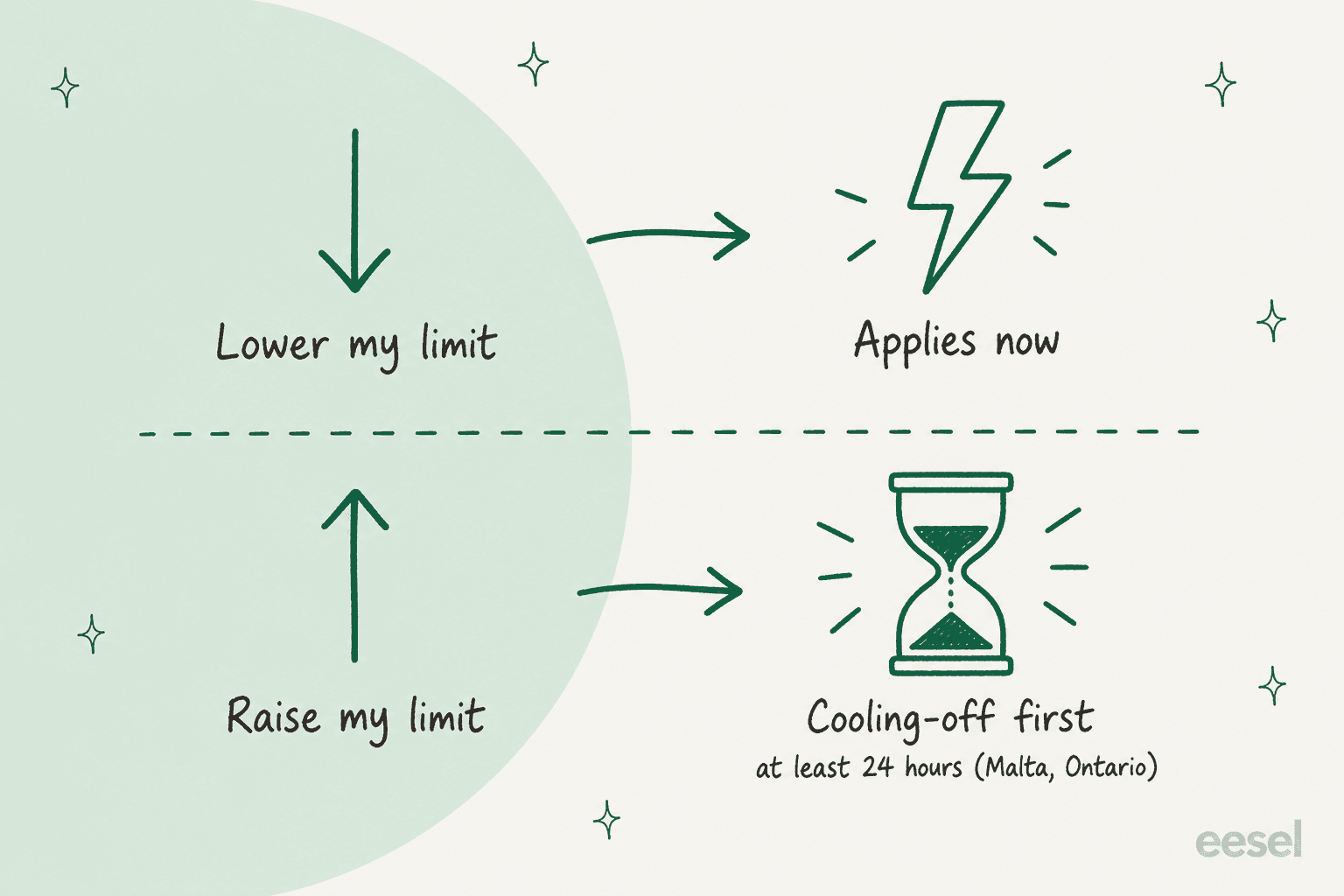
Deposit limits are the other trap, because the direction matters. In Malta, a player's request for a stricter limit must take effect immediately, while a looser limit only applies after at least 24 hours. Ontario's AGCO standards also require a cooling-off period of at least 24 hours before a limit is relaxed or removed. A bot that says "done, your limit is now higher" breaks the rule in a single sentence.
In practice, I write these as plain-language rules the agent reads on every ticket:
- Harm language goes to a person immediately. Mentions of debt, borrowing to gamble, bereavement, job loss, self-harm or "I can't stop" end the automated reply. The AI sends one short message and hands over with the transcript.
- No offers in an exit conversation. No bonus, free bet or cashback in any thread that mentions closing, limiting or excluding.
- Limits are explained, never changed upward. The AI can explain how limits work and link to the tool. Increases go through the product flow with its cooling-off period, not through chat.
- Every handoff carries context. The player shouldn't have to repeat themselves to the person who takes over. That's the core of good AI handoff practice anywhere, and here it's also an evidence trail.
The UKGC expects operators to keep a record of each interaction: the customer, the behaviour that prompted it, the action taken and the outcome. An AI that logs why it escalated and what it saw gives your compliance team that record for free.
The rules change with your licence
The UKGC hasn't published a rule that bans or approves AI support. Its own page on its approach to artificial intelligence covers how it uses AI internally, and says it will look at industry use "where appropriate". I didn't find an official AI-specific rule from the MGA, the AGCO or New Jersey either. What every regulator does have is rules for the conversations your AI will be part of. The details differ enough that I built this quick reference.
Pick your licence
What your support AI has to get right
The same player message can need a different answer depending on who licensed you. Tap a regulator to see the rules that land on the support queue.
Great Britain, UK Gambling Commission
Malta, Malta Gaming Authority
Ontario, AGCO Registrar's Standards
New Jersey, Division of Gaming Enforcement
Summarised from each regulator's own pages, linked in the section below. Rules change, so check the current text with your compliance team before you write bot instructions.
Two of these stand out for anyone designing a bot. Ontario's standards require live support 24/7, which is where AI earns its keep on the overnight shift (more on AI after-hours support here). The AGCO's guidance on players at risk also lists "expressions of financial or emotional distress" in customer service contact as a risk signal.
New Jersey's rules, in the version I read, say staff who contact players by "phone, e-mail, electronic chat" must be trained to handle a player who discloses a gambling problem. If the chat is automated, the escalation path to that trained person has to be instant.
My advice: hand this widget to your compliance lead before anyone writes bot instructions, and let them correct it for your exact licences. Rules move, and your licence conditions beat any summary, including mine.
How to set it up around the helpdesk you already have
Most iGaming support teams already run a helpdesk, and the AI should sit inside it rather than replace it. A new platform means new audit trails, new data residency questions and a new security review. Adding AI to the queue you have keeps your existing records, routing and reporting in one place.
Here's how the main options compare on the things a licensed operator asks about:
| Option | How AI is billed | Handoff to humans | Live account lookups | Data residency |
|---|---|---|---|---|
| Zendesk AI agents | Per automated resolution: $1.50 committed or $2.00 pay-as-you-go | Escalation blocks in the dialogue builder | Action credits, extra at $200 per 100K actions | US, EEA, UK, Japan and Australia via the Data Center Location add-on |
| Freshdesk Freddy AI | Per session: 500 included, then $49 per 100 | Handover settings with sensitive-topic phrases | API Action block in workflows | Not stated on the pages I checked |
| Text by LiveChat | Per AI resolution: 10 on the entry plan, 200 on the $79 plan, extra 50 for $49.50 | Chat transfer | Custom skills | Not stated on the pricing page |
| Zoho Desk Zia | Per seat, $7 to $40 per user per month billed annually (pricing), Zia from Professional | Not captured | AI Agents with your own model key or Zoho's | Not captured |
| eesel | Per ticket or chat: $299 a month for 500, up to $1,749 for 5,000 | Plain-language escalation rules plus per-action approvals | Network Access to your own REST APIs | EU residency available, confirm the plan with the team |
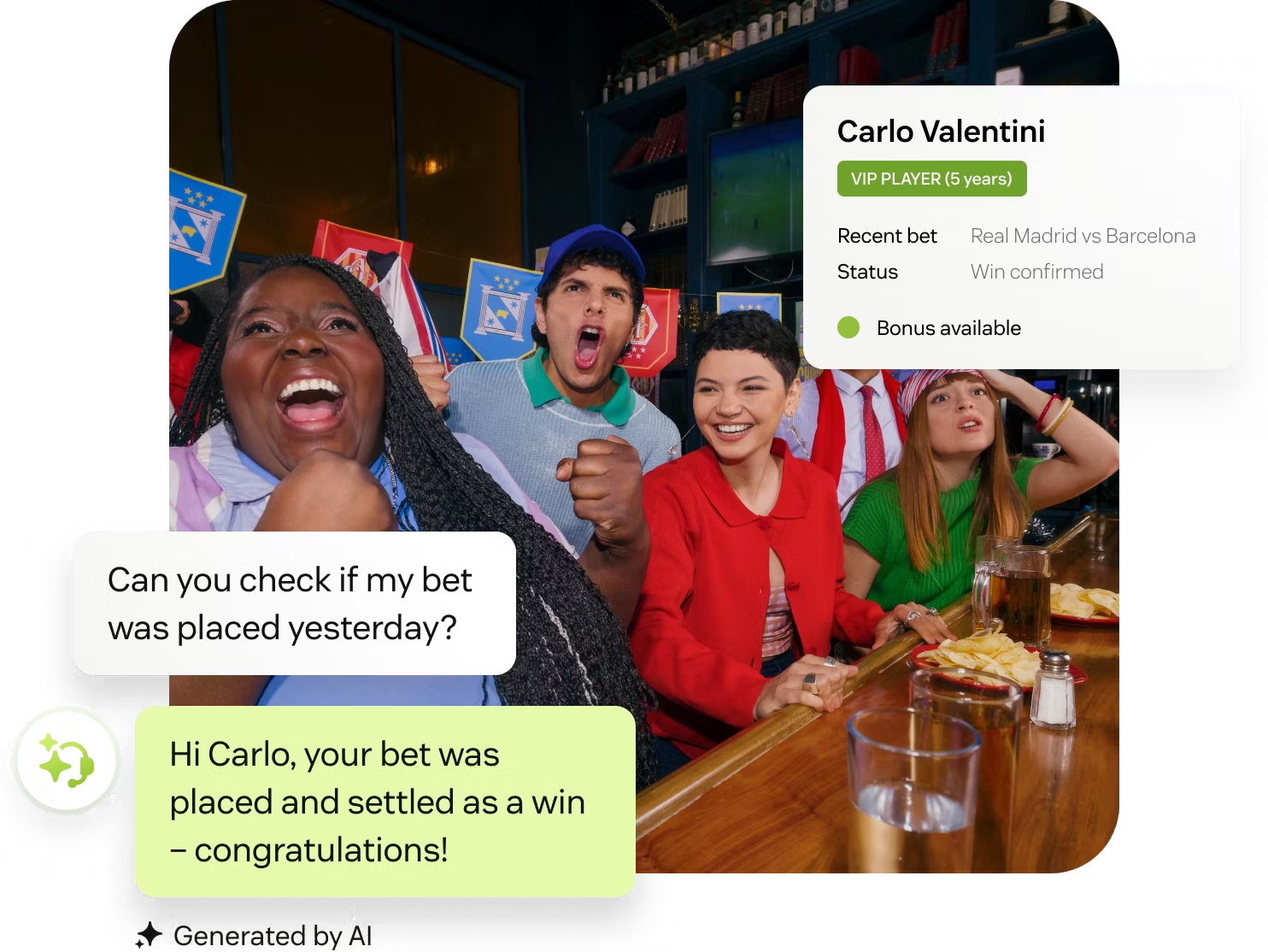
Zendesk is the one helpdesk vendor I found with a dedicated iGaming and betting page that talks about responsible gambling, KYC and fraud checks by name. It cites Jackpots, with 45% of chats handled by the AI agent, and Superbet, with over 35% of requests automated. If you're already on Zendesk, its native agent is a reasonable baseline to test against, and its AI pricing is worth modelling at your volume before you commit.
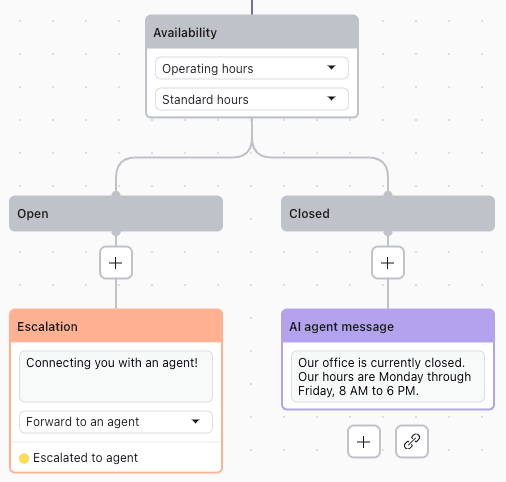
Whichever tool you pick, check how it handles handoff outside your team's hours. Zendesk's docs show escalation flows that branch on operating hours, so an escalation at 3am lands in a queue with a clear message rather than a promise nobody can keep. For the rule side, see Zendesk AI agent escalation rules. Zendesk's own escalation docs advise designing the strategy before launch, because escalating too many messaging conversations overloads a small team.
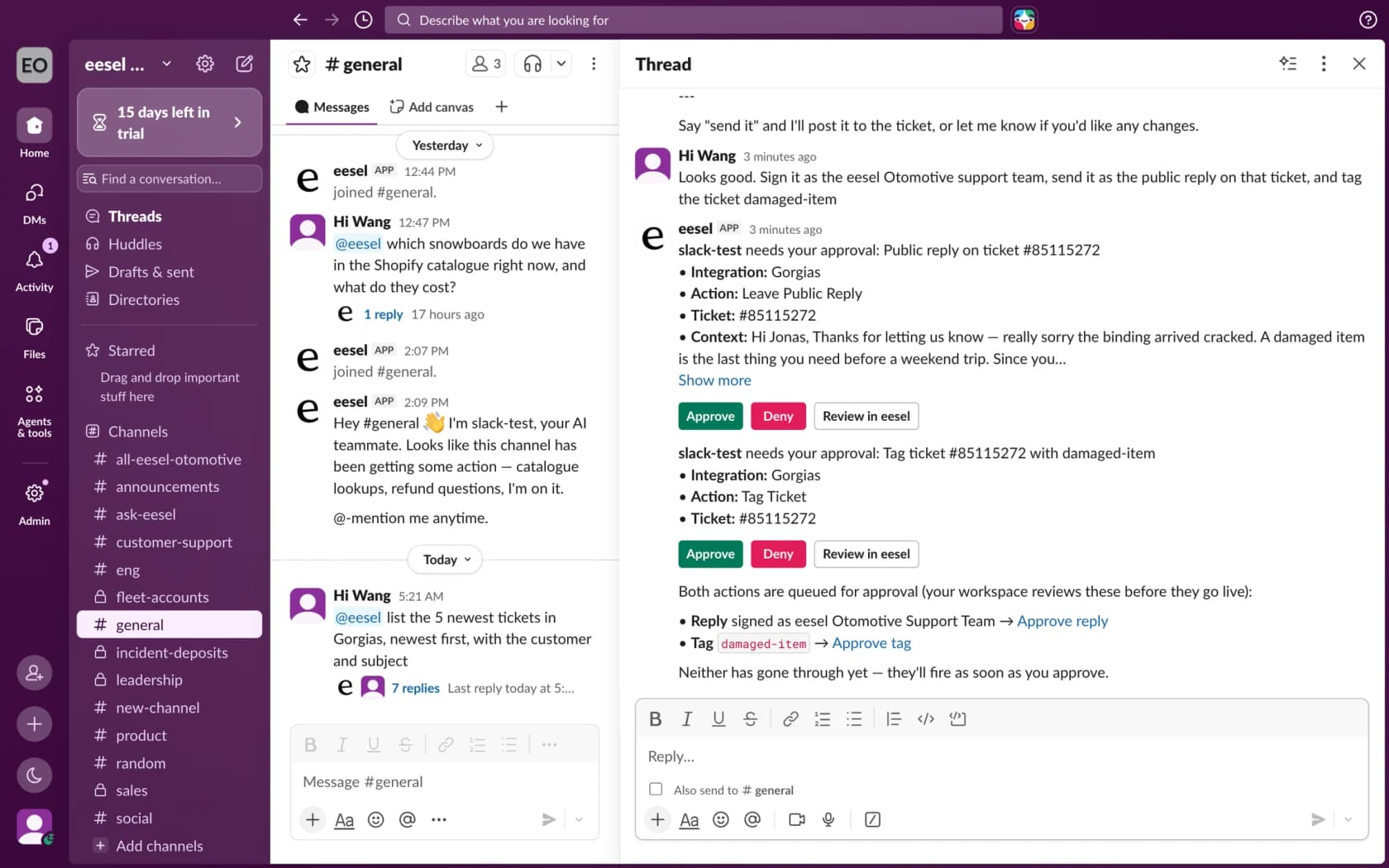
Where eesel differs is control over actions. Each action can run on Auto, Needs approval or Disabled, set per agent, and the approvals docs suggest keeping refunds, cancellations and anything that costs money behind an approval. For an operator, I'd extend that list to bonus credits, limit changes and account reopenings. Approvals can arrive in Slack, so a team lead can approve or deny from their phone.
If your compliance or engineering team prefers scripts to dashboards, the eesel CLI runs the same agent from a terminal. You start it with npx @eesel/cli, every command prints JSON, and commands like eesel approvals and eesel activity let you pull pending decisions and the action log into your own tooling. Coding agents such as Claude Code or Cursor can drive it too. For a regulated team, that's a practical way to export a week of AI decisions into a compliance review without anyone clicking through screens.
On security, I'd rather be exact than impressive. eesel's Trust Center says its SOC 2 Type II audit is in progress, with the observation period starting 1 October 2026. It also says eesel doesn't train models on your data, outbound requests are limited to domains you allow, and optional PII redaction strips emails, phone numbers and card numbers from synced tickets. If your security review needs a finished SOC 2 report today, raise that early. My colleagues wrote up the wider checklist on SOC 2 and GDPR for support chatbots.
Roll it out in phases, starting with past tickets
The worst way to launch AI in a casino's support queue is to switch it on for every player on a Friday before a big match. The best way starts with tickets you've already answered.
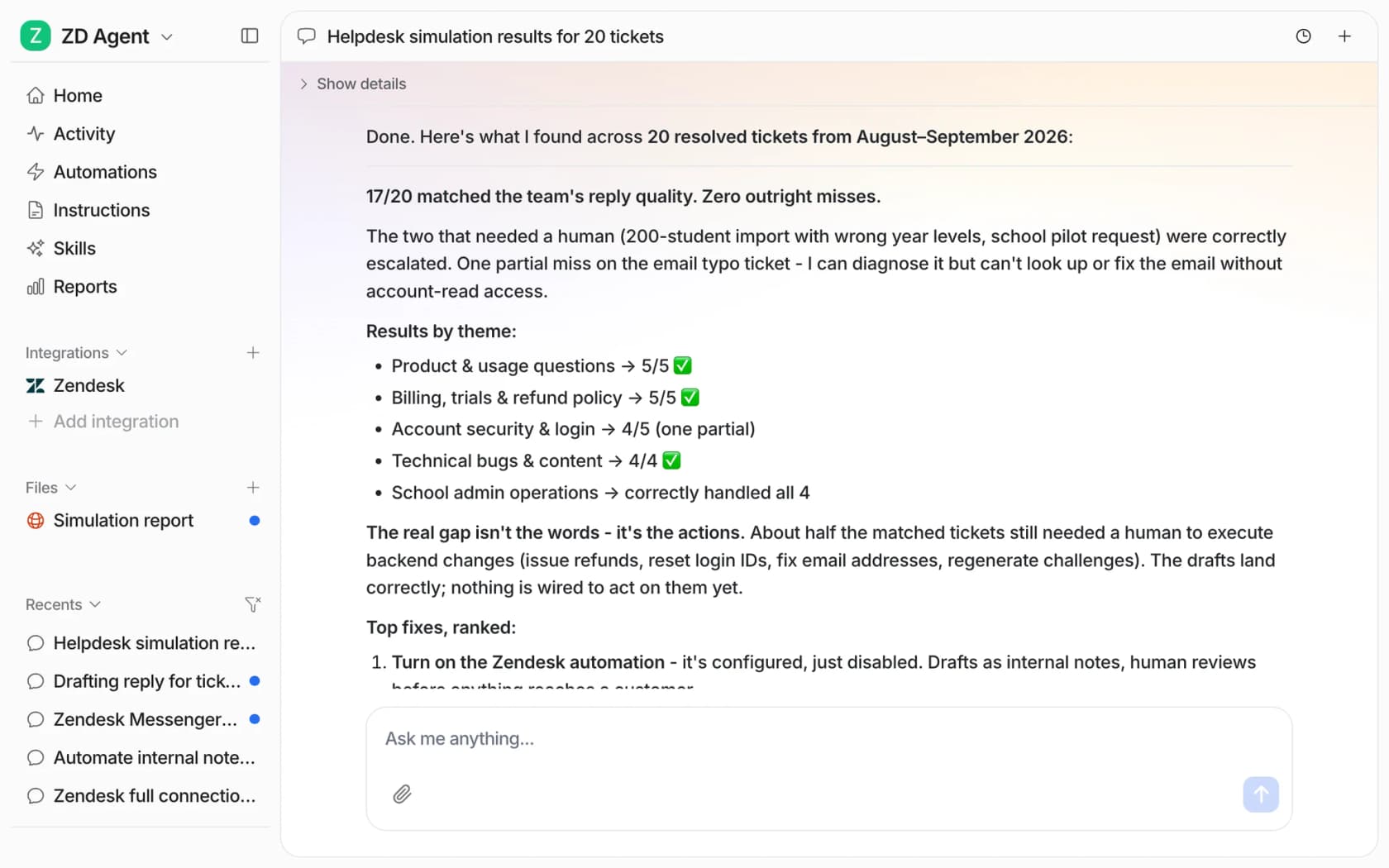
- Simulate on your history. First, make sure your knowledge base holds the current bonus terms and verification steps. Then run the agent against a few hundred resolved tickets and compare its answers with what your team sent. In eesel, simulation replays past tickets and scores each answer. This is where you catch the bot that confidently promises a payout date.
- Draft only. Let the AI write internal notes or draft replies that agents approve. This is how smava works in regulated finance: across 27,000 tickets in a month, eesel categorised 14,600 and prepared 15,300 drafts, while only the narrow "no advisor assigned" slice gets automatic replies.
- Automate lane one. Turn on automatic replies for withdrawal status, KYC document lists and bonus terms only. Everything else stays in draft mode.
- Widen slowly, by evidence. Add a topic to automation only when its drafts have been sent unchanged for a few weeks.
The instinct behind this phased approach comes up again and again on eesel's sales calls. A CX lead at a direct-to-consumer brand handling around 7,000 tickets a month put it well:
"I need an AI who is only handling the tickets that it's confident to handle and all the other ones, leave them alone."
That's the right brief for an iGaming AI too. A bot that answers 40% of tickets perfectly and leaves the rest untouched is worth far more than one that tries everything and gets the sensitive 5% wrong. If you want a fuller test plan, I'd start with this guide to testing an AI agent before launch and the AI support pilot guide.
Measure more than deflection
Deflection rate is the number vendors love, and in iGaming it can mislead you badly. A bot that keeps players in a loop counts as deflection right up until they file a complaint with the regulator.
"How do you actually get to speak to a human on the web chat? I just keep going in circles with the bot!"
Even vendors are moving away from raw deflection. Zendesk now separates assisted escalation, contained resolution and verified resolution in its resolution tiers, and only the verified tier counts against its resolution allowance. Its flow also asks the player whether the answer solved the problem before counting a resolution.
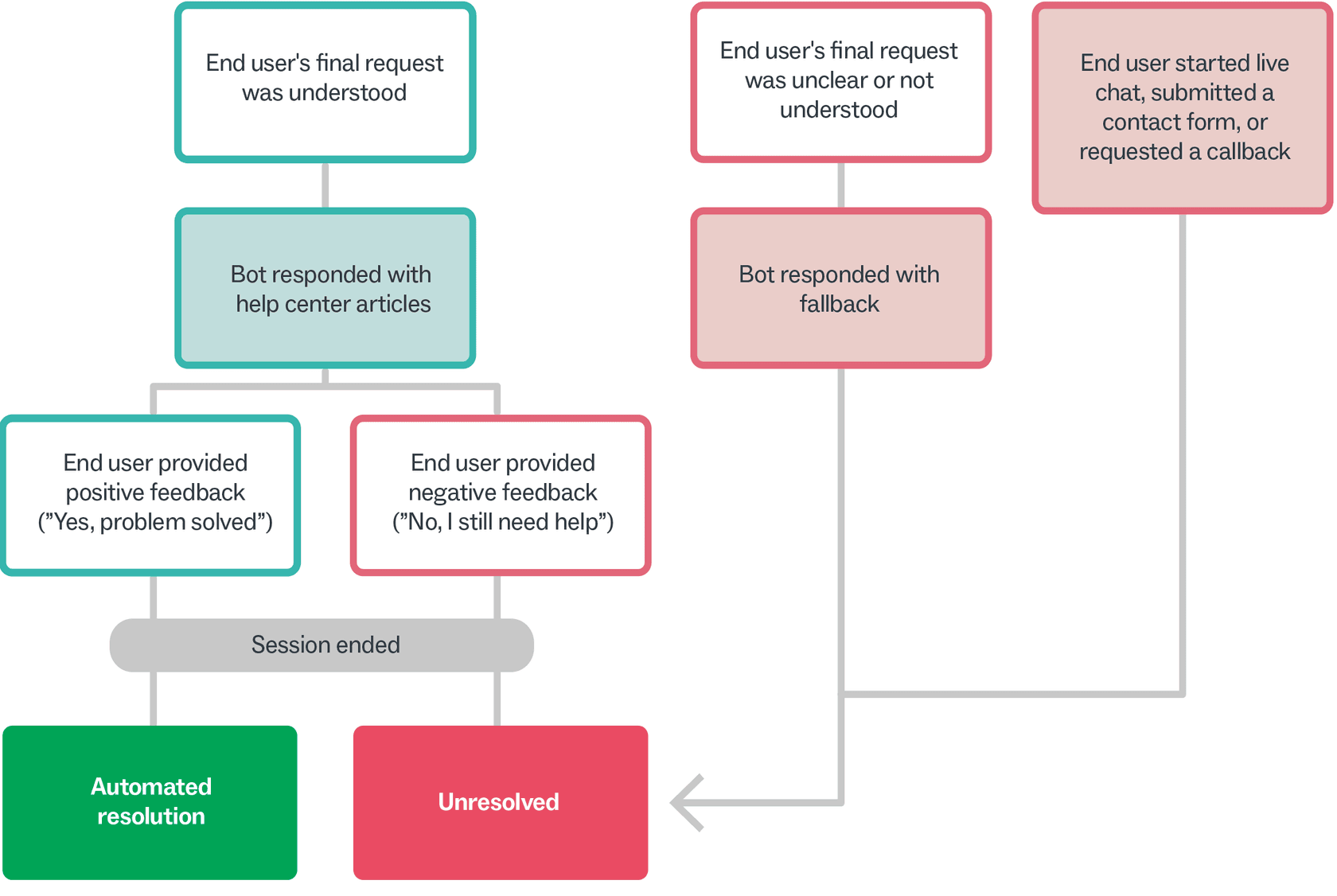
The metrics I'd put on an iGaming AI dashboard:
- Withdrawal complaints per 1,000 withdrawals. If AI is working, this falls. If it rises, the bot is deflecting without informing.
- Time from harm signal to human. Measure in minutes, not hours, and review every case over your target.
- Handoffs with full context. Track the share of escalations where the agent didn't have to ask the player to repeat themselves.
- Unchanged-draft rate by topic. This tells you which topic is ready to move from draft to automatic.
- Requests to speak to a person. A rising count means the bot is in the way.
There's also a commercial point. Not every player wants a bot, and some operators compete on that. One Malta-based support worker wrote:
"One of the most common praises we receive on sites like Trustpilot is that we have no AI chat assistants at all, but real CS staff answering all chats and calls."
I take that seriously. My answer is to make the person easy to reach and use AI to make your people faster, rather than to drop AI altogether. A good AI escalation setup lets a player reach a human in one message, the opposite of the chatbot escalation dead ends players complain about, with a reply that's honest about wait times instead of pretending someone is joining right now. For more on that metric, see measuring containment and escalation quality.
Try eesel for iGaming support
If you're on Zendesk or Freshdesk and the withdrawal-status queue is eating your team's night shift, eesel is built for this kind of split. It joins your existing Zendesk or Freshdesk queue as an AI helpdesk teammate. It reads live account status from your API, answers only from content you've approved, and hands self-exclusion, harm and AML cases to your trained staff with the full conversation attached. Every action that touches money or limits can wait for a person's approval.
To be clear about the limits: eesel doesn't ship gambling-specific features like a self-exclusion register or KYC checks. Your rules and your systems stay the source of truth, and eesel follows them. That's the same way SE Ranking runs 24/7 live chat across three products, with 2,100 chats a month answered first by eesel and every request for a person passed to the team with the customer's details.
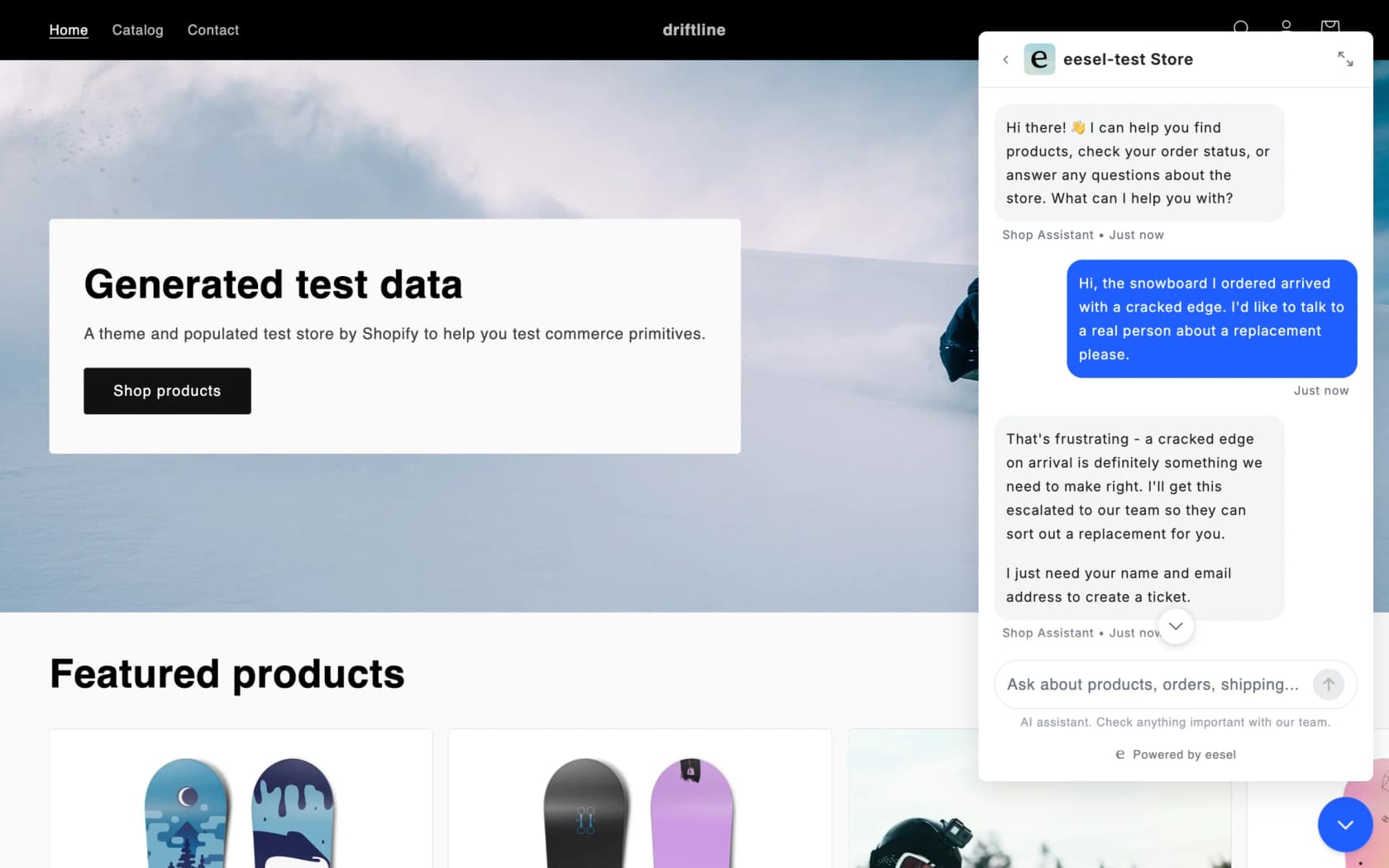
Start by running a simulation on a month of your own tickets. You'll see which lane-one questions it handles and which ones it rightly leaves alone, before a single player talks to it. Try eesel free, or browse more customer stories first.