

Yes, but far less than most teams expect. I ran the same support ticket through OpenAI's current models in 14 languages: Spanish used 1.17x the tokens of English, German 1.27x, Japanese 1.45x and Thai 1.73x. At today's model prices that adds a fraction of a cent per ticket. The real swing is billing and accuracy. If your vendor charges per ticket or per resolution, the token difference never reaches your invoice, while a weaker resolution rate in one language costs far more in human time. eesel charges one credit per ticket in any language, so the thing to test is answer quality, not tokens.
Does AI support cost more in non-English languages?
I build the AI agents at eesel, and a big share of the tickets they handle are not in English. smava, a German loan comparison site, runs about 27,000 Zendesk tickets a month through eesel, almost all in German, and every one gets a language tag written into a Zendesk field before an advisor sees it. Koffer.ch gets drafts in German, French, English and Italian, in Swiss spelling. So the question "does this cost more in Japanese?" is one I get from buyers all the time.
The honest answer has two layers. There is a small, real token cost that comes from how language models split text into pieces. And there is a much larger operating cost that comes from how well the AI answers in that language and how your vendor bills you. Most articles on this topic stop at the first layer. This one prices both.
If you're setting up multilingual customer support with eesel, the eesel CLI lets an AI coding agent upload approved knowledge for each market, like exported German and Japanese help articles, then ask test questions in each language and check the answers before anything goes live. Connecting the helpdesk itself still needs someone with admin access to approve it.
How many more tokens does each language use?
Language models don't read words. They read tokens, chunks of text that a tokenizer cuts out of your message. English got most of the attention when these tokenizers were built, so it packs the most meaning into each token. Other languages need more tokens to say the same thing, and model APIs bill by the token.
To get real numbers instead of rules of thumb, I wrote one realistic support exchange: a customer asking where their running shoes are and whether they can get a refund, and an agent reply with tracking details and the refund policy. I translated it into 13 languages and counted the tokens two ways: with OpenAI's open-source o200k_base tokenizer, and with OpenAI's own input token counting endpoint for gpt-6.1-terra, gpt-6-luna and gpt-5.4-mini. All three current models returned identical counts (the tokenizer plus six tokens of message wrapping), so one column covers today's OpenAI lineup.
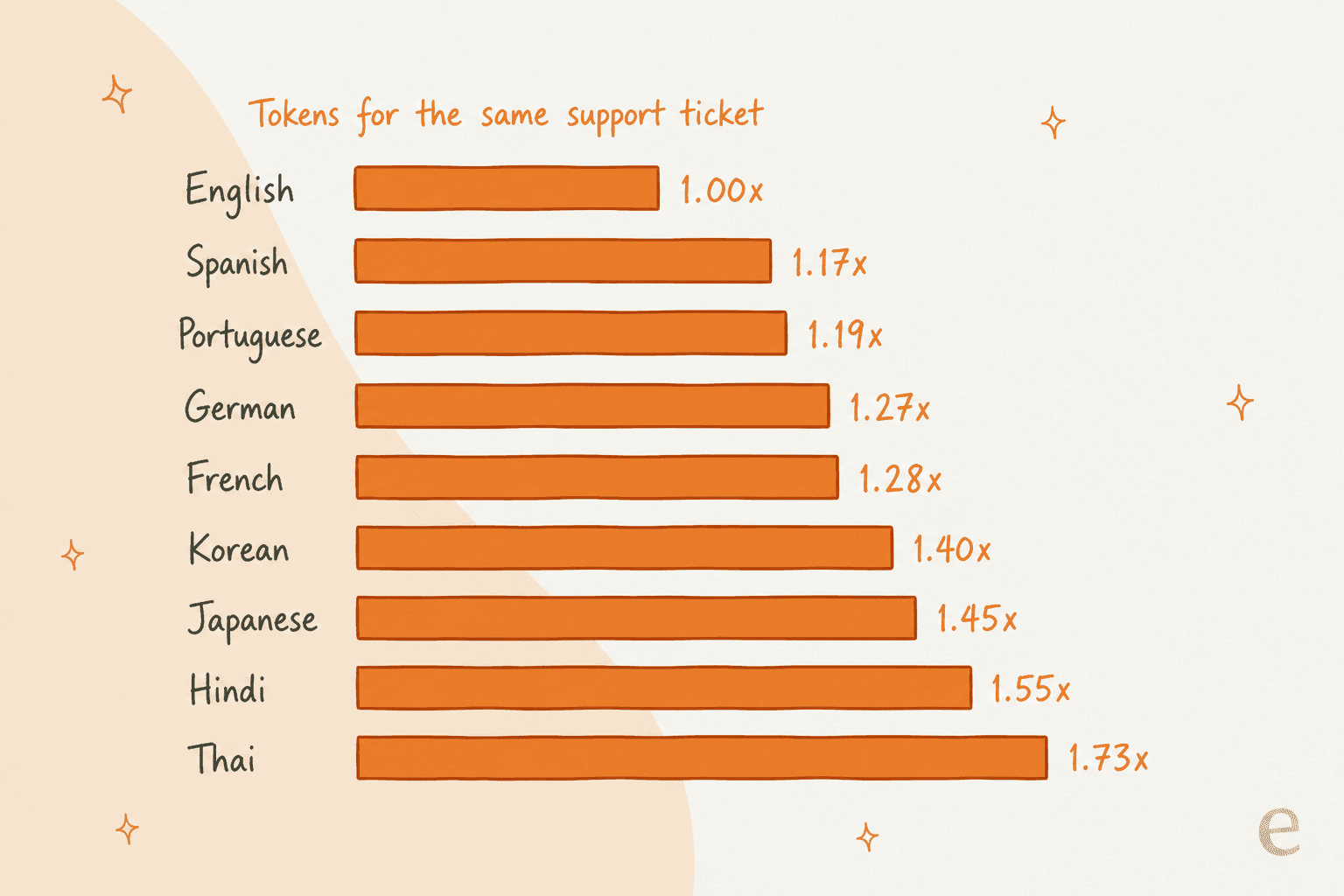
| Language | Tokens on current OpenAI models | vs English | Tokens on GPT-4 era tokenizer (cl100k) | vs English |
|---|---|---|---|---|
| English | 166 | 1.00x | 163 | 1.00x |
| Chinese (Simplified) | 182 | 1.10x | 256 | 1.57x |
| Spanish | 194 | 1.17x | 219 | 1.34x |
| Portuguese (Brazil) | 198 | 1.19x | 230 | 1.41x |
| Arabic | 206 | 1.24x | 467 | 2.87x |
| German | 210 | 1.27x | 257 | 1.58x |
| Indonesian | 211 | 1.27x | 257 | 1.58x |
| French | 213 | 1.28x | 249 | 1.53x |
| Italian | 226 | 1.36x | 253 | 1.55x |
| Vietnamese | 228 | 1.37x | 372 | 2.28x |
| Korean | 233 | 1.40x | 354 | 2.17x |
| Japanese | 241 | 1.45x | 345 | 2.12x |
| Hindi | 258 | 1.55x | 775 | 4.75x |
| Thai | 288 | 1.73x | 670 | 4.11x |
Three things stand out:
- The penalty is real but moderate on current models. Most European languages land between 1.17x and 1.36x. Japanese and Korean sit around 1.4x. Only Thai and Hindi go past 1.5x.
- Old tokenizers were brutal. On the
cl100k_basetokenizer that GPT-4 and GPT-3.5 used, Hindi took 4.75x and Arabic 2.87x. If a vendor's bot still runs on an older model, the gap you pay is several times wider than the first column. - Your numbers will differ. This is one ticket. A German ticket full of compound product names, or a Japanese one heavy on formal phrasing, can move a few points either way. Anthropic and Google use their own tokenizers, so measure on the model you actually run. Anthropic's token counting endpoint is free to call, and Google's token guide puts a Gemini token at about four characters of English.
What does that mean per ticket?
A token multiplier only matters once it's attached to a price, and a support ticket isn't just the customer's message. It also carries your system instructions and the help articles the AI pulled in to answer. That context is often in English, and it doesn't grow when the customer writes in Japanese.
Here is a worked example on GPT-6.1 Terra, which OpenAI lists at $1.00 per million input tokens and $5.00 per million output tokens. My assumptions: 3,000 tokens of English instructions and help articles, 1,000 tokens of conversation, and a 400 token reply, with no reasoning tokens.
| Setup | Input tokens | Output tokens | Cost per ticket | vs English |
|---|---|---|---|---|
| English ticket | 4,000 | 400 | $0.0060 | 1.00x |
| Japanese ticket, English help center | 4,450 | 580 | $0.0074 | 1.23x |
| Japanese ticket, Japanese help center | 5,800 | 580 | $0.0087 | 1.45x |
| Japanese ticket, translated to English and back | 6,250 | 1,980 | $0.0162 | 2.69x |
Two findings surprised me when I first ran this:
- English knowledge dilutes the penalty. When the help center stays in English, only the conversation and the reply get more expensive, so a 1.45x language becomes a 1.23x ticket. Current models can answer in Japanese from English source articles, and it's the same idea behind how eesel answers Innr's Dutch, German and French customers from one help center of about
1,500articles and past tickets. - The translate-first pipeline is the expensive one. Translating the customer's message into English, answering in English, then translating the reply back adds two model calls, and translation is mostly output, the priciest kind of token. In this example it cost 2.2x a native Japanese reply. Teams often add a translation layer to save money and end up paying more.
At 5,000 Japanese tickets a month, the native setup with an English help center adds $6.75 a month over English. That is the whole "language tax" on tokens. Even on a premium model like GPT-6 Astra at $10 in and $50 out per million, it stays well under a hundred dollars a month. If you build on Anthropic instead, the same shape holds on Claude Haiku 5.5 and Claude Sonnet 5.5.
Who pays the language tax, you or your vendor?
Whether that extra token cost ever reaches you depends on the unit your AI is billed in. I see three billing models in support AI right now, and only one of them passes the token difference through.
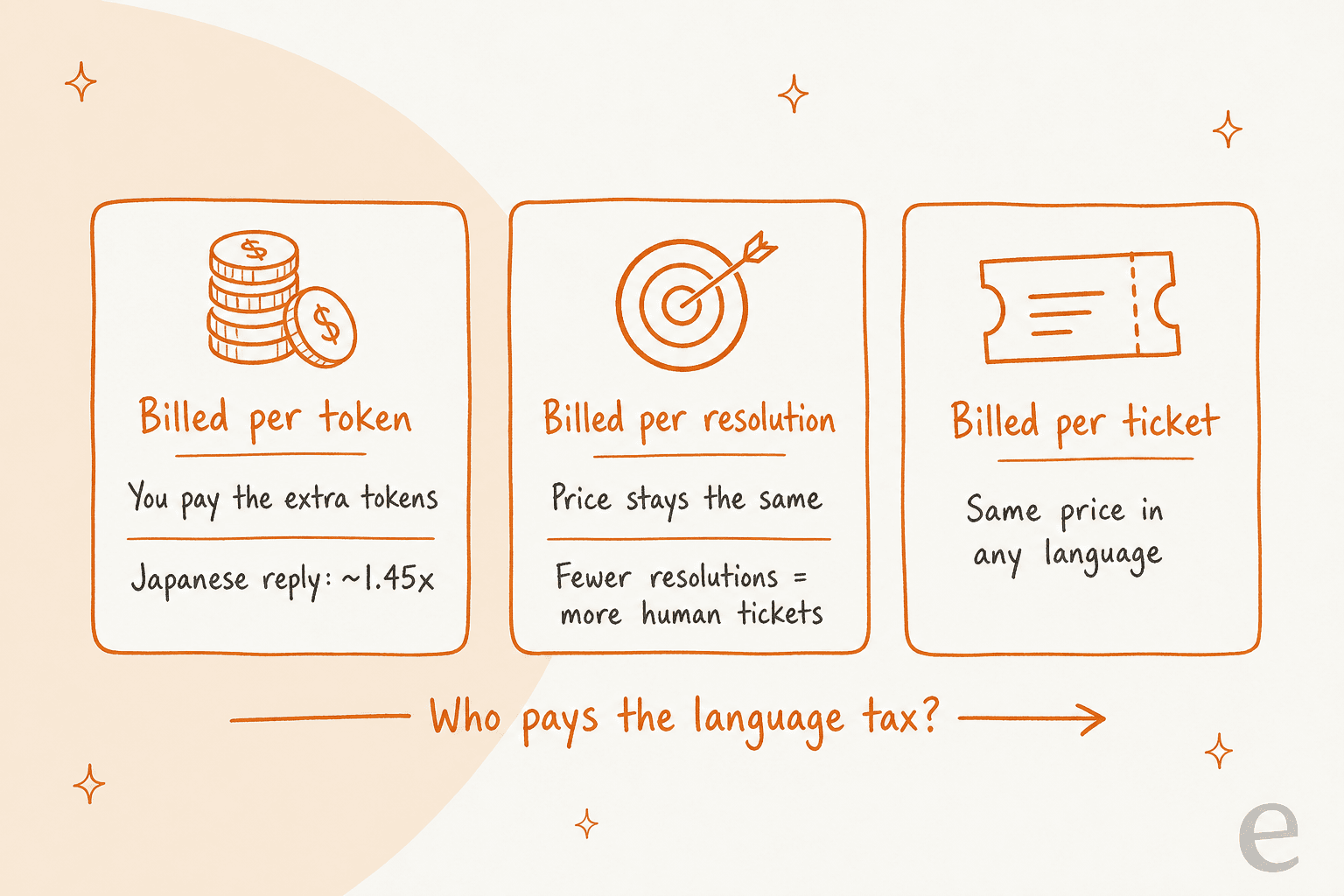
| Billing model | Who uses it | Unit price | Does language change the price? |
|---|---|---|---|
| Per token | Building on the OpenAI API, Anthropic or Google directly | Varies by model | Yes, by the token multiplier above |
| Per automated resolution | Zendesk AI agents | $1.50 committed, $2.00 pay-as-you-go | No |
| Per AI session | Freshdesk Freddy AI Agent | First 500 sessions included, then $49 per 100 | No |
| Per automated interaction | Gorgias AI Agent | $0.85 to $1.00 depending on plan | No |
| Per ticket handled | eesel | 1 credit, from $299 for 500 credits | No |
None of the vendor pricing pages I checked lists a language surcharge. Zendesk's pricing page advertises support for 80+ languages on its AI agents at the same per-resolution price, and Freshworks' pricing page and Gorgias' pricing page charge their session and interaction units the same way regardless of language.
That doesn't make language free on those plans. It moves the cost somewhere else:
- Per resolution means you only pay when the AI resolves the ticket. If it resolves fewer Japanese tickets, your AI bill for Japanese drops, and your human bill rises by more. Read deflection vs resolution rate before you compare quotes on this unit.
- Per session or interaction charges for the attempt, so a weaker language costs the same AI money and still sends more tickets to people.
- Per ticket is the flattest. eesel's pricing page says a ticket is one credit "however many replies go back and forth", so a long German thread and a short English one cost the same.
Where does the real cost of a non-English ticket come from?
Once you see that tokens are cents, the money question moves to the places that cost dollars per ticket.
A lower resolution rate in some languages. This is the big one. If the AI resolves 60% of English tickets but 50% of Japanese ones, that 10-point gap on 5,000 tickets is 500 extra tickets for your team every month. At an illustrative $5 of agent time per ticket (plug in your own figure from cost per ticket benchmarks), that's $2,500 a month, against $6.75 of extra tokens. The calculator below lets you run your own numbers.
Knowledge in the customer's language. Translating a help center is a one-off cost plus upkeep every time an article changes. You often don't need to: an AI that reads English articles and answers in German avoids the translation bill, and only the articles customers read directly need a localized version. My comparison of multilingual knowledge base software covers the tools for the ones that do.
Terminology with no clean translation. On a sales call this year, a B2B vehicle-telematics team expanding into new EU markets worried that technical terms like "wiring harness" have no direct equivalent in some languages. That is a quality risk, not a token cost, and it's the reason to keep a short glossary of product terms per language in the AI's instructions.
Review by native speakers. Someone has to check that the German reply sounds like your brand and not like a textbook. Koffer.ch's customers expect Swiss spelling in German, which a generic model will get wrong unless it's told. Budget review time per language for the first few weeks, then sample; my guide to multilingual support QA has a review routine, and customer support language quality covers what to score.
Local wages change the comparison. A flat per-resolution price looks cheap against a US salary and expensive against a lower one. One Zendesk customer put it bluntly in a comment on Zendesk's own help article:
"A $1.5 per conversation is viable only for the US/Europe. In our case, we will have to disable the chatbot and look for an alternative solution."
So if your non-English queue is staffed in a lower-cost market, compare the AI's unit price with that team's real cost per resolution, not with your headquarters' numbers.
How do I estimate AI support cost per language?
You can get a reliable per-language estimate in an afternoon. Here's the process I'd follow:
- Pull a sample of real tickets per language. Take 100 to 200 recent tickets for each language, covering the same mix of topics. Comparing English password resets with Japanese technical faults will distort the result.
- Count the tokens on the model you'll use. OpenAI, Anthropic and Google all offer token counting endpoints, and Anthropic's is free. Count the customer messages, your instructions, and the help articles the AI is likely to retrieve, then compare each language with English.
- Check how your vendor bills. If it's per ticket, per resolution or per session, skip the token math entirely; your unit price is the same in every language. If you're building on a raw API, multiply the token counts by the model's price.
- Test the resolution rate per language. This is the number that moves your budget. Run the AI against past tickets in each language and score the answers against what your team actually sent. My guide on testing an AI agent before launch walks through it, and reviewing AI support conversations covers the ongoing checks.
- Price the gap in human time. Multiply the tickets the AI won't resolve in each language by your team's cost per ticket. Add native-speaker review hours for the first month. That total, not the tokenizer, is your real AI support cost for non-English languages.
If a language comes out weak in step 4, the fix is usually better knowledge, not a different model: a missing policy page, a product glossary, or a few example replies in that language. Once it's live, keep an eye on AI escalation rates per language, since a jump there is the first sign the AI is struggling in one market.
If you'd rather hand the whole queue off, compare those numbers with the cost of an outsourced team in my breakdown of customer service outsourcing cost, and check whether AI can handle multilingual customer support for your mix first.
eesel for support in every language
eesel joins your helpdesk as an AI teammate for support and answers in whatever language the customer wrote in, from the knowledge you already have, even if it's all in English. It works inside Zendesk, Freshdesk and the other major helpdesks, and it bills one credit per ticket in any language, so a German thread and an English one cost the same. smava uses it to tag and draft German tickets across two brands, and Innr gets drafts in four languages from a single help center.
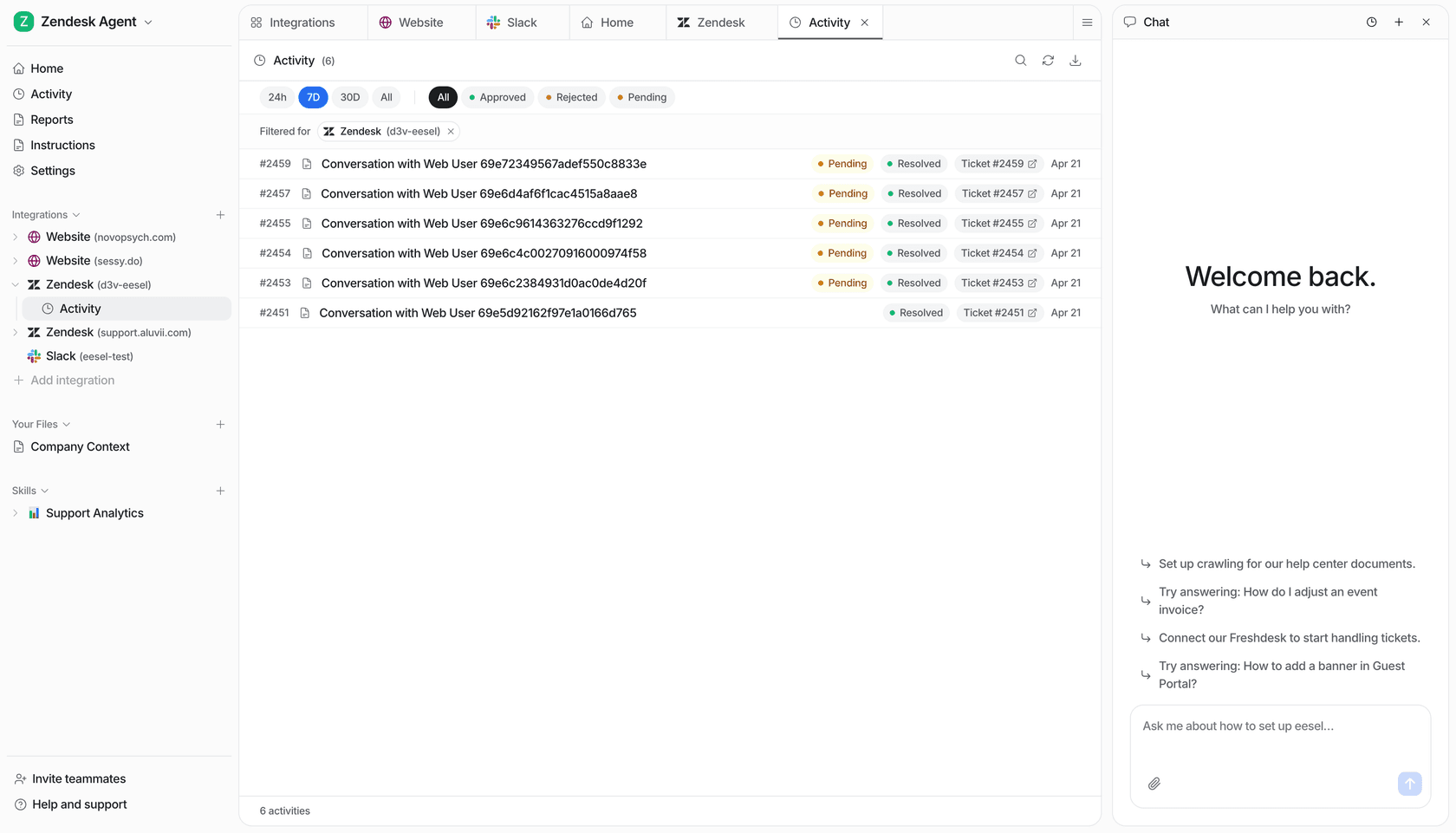
You can connect your helpdesk, run it on your past German or Japanese tickets, and read the drafts before a customer sees one. Try eesel free for seven days, no card needed.