


Invicta AI pricing at a glance
The first thing to know is where the prices live. Invicta AI has no pricing page at all: invictai.io/pricing, invictai.io/pricing-2, and info.invictai.io/pricing all return a hard 404. The complete rate card is published inline on the homepage, between a customer testimonial and the FAQs.
Here is the full table. Every price is the monthly figure as displayed by default; a Monthly/Annual toggle advertises annual billing as "2 free months", which is roughly a 16.7% discount.
| Free | Plus | Pro | Business | Enterprise | |
|---|---|---|---|---|---|
| Price | $0/mo | $30/mo | $100/mo | $300/mo | Quote only |
| Credits | 25 per day | 6,000/mo | 20,000/mo | 60,000/mo | Not published |
| Agents | Unlimited | Unlimited | Unlimited | Unlimited | Not published |
| Knowledge base | 50 entries | Unlimited | Unlimited | Unlimited | Not published |
| Seats | Single user | Single user | Single user | 10 seats | Not published |
| LLM access | All leading LLMs | Inherited | Inherited | Inherited | Not published |
| Chat widget | No | No | Yes | Yes | Not published |
| Embeddings | No | No | Yes | Yes | Not published |
| Advanced analytics | No | No | Yes | Yes | Not published |
| Workspaces / admin | No | No | No | Yes | Not published |
| White-glove onboarding | No | No | No | Yes | Not published |
Source: the Invicta AI homepage pricing section. Enterprise has no card and no price, just a "Need more capabilities?" line and a single Calendly booking link.
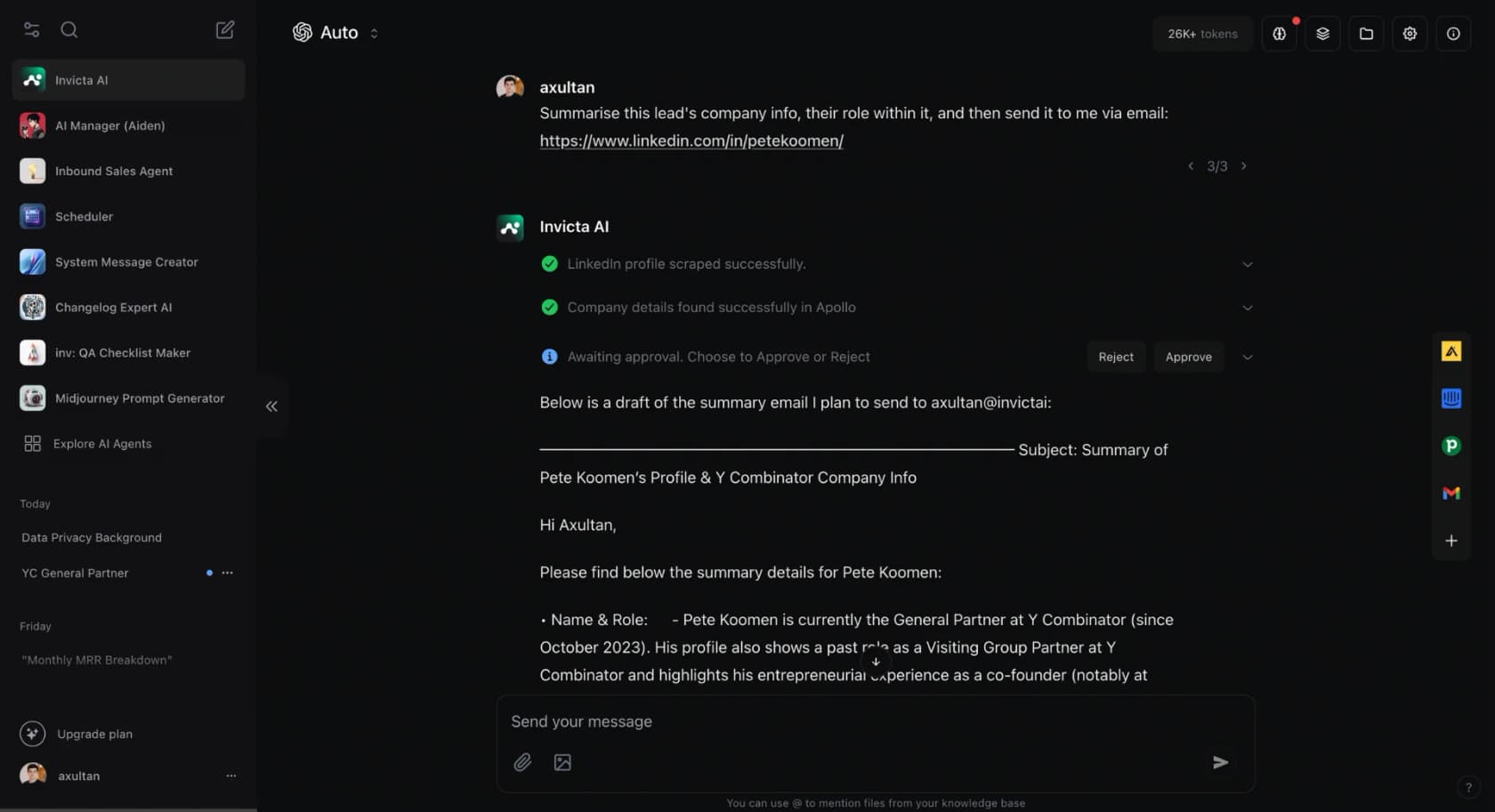
Notice the token counter up in that corner. That is your bill ticking up, and honestly it is the whole story of this pricing model. To understand what any of these plans actually cost you, first you have to understand what one credit is.
What you are actually buying: credits
On the cards, credits look like a simple allowance: pay $30, get 6,000. The complication is that Invicta never tells you what one credit actually buys, not anywhere on the pricing surface. That detail lives only inside the credits documentation, and it changes how you should read every number above.
Invicta defines a credit as "a metric used to quantify the consumption of computing resources when tasks are performed by our AI agents." Every agent request consumes credits, and three factors drive how many:
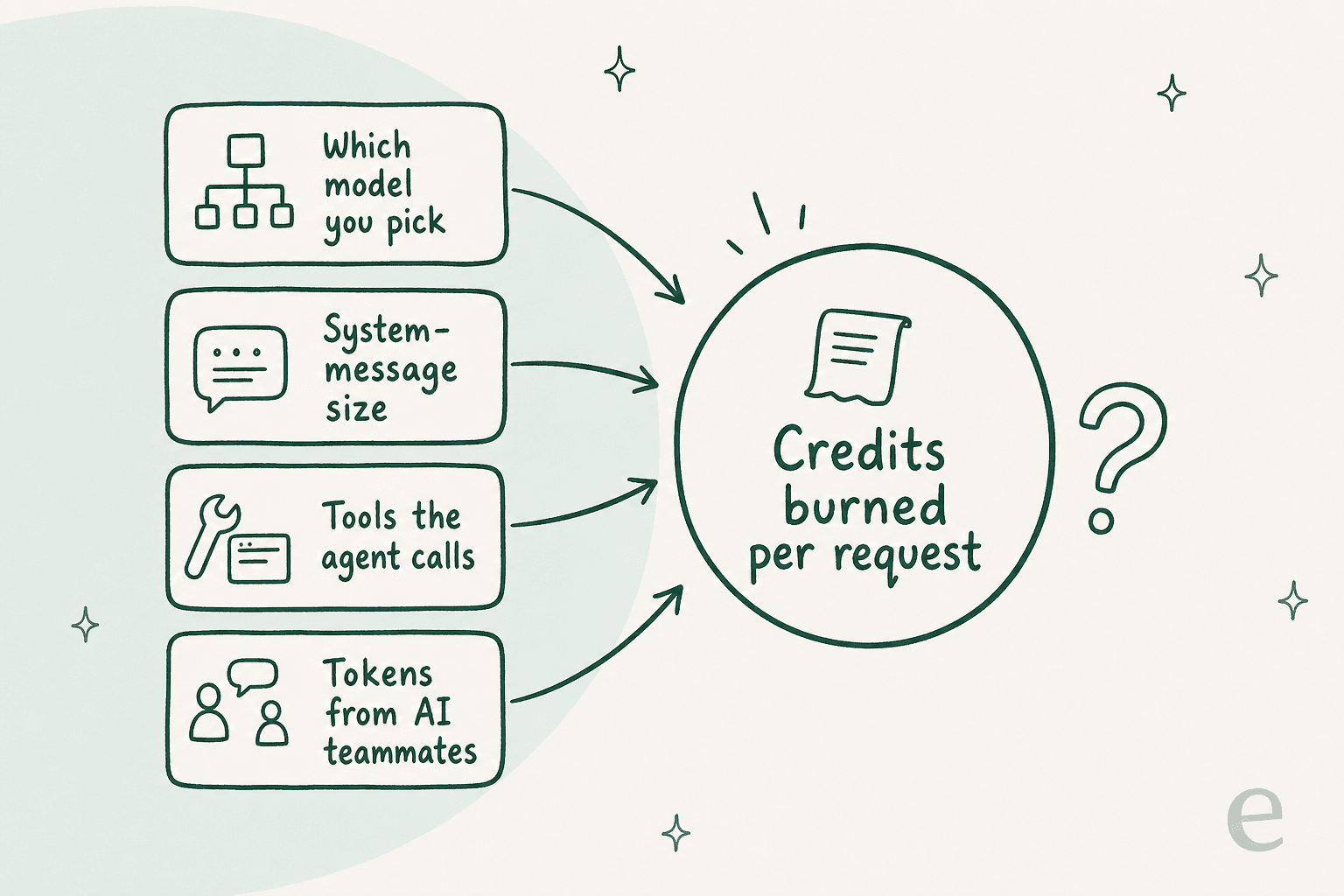
- Token processing. The input, output, and reasoning tokens the model handles. The docs are explicit that "larger models like GPT-4o and Claude-3.5 use more credits than simpler models like Llama 3 or Mistral Large."
- Agent complexity. "The size of the system message and other complexity factors of the agent." A longer, more detailed instruction set costs more per run.
- Tool usage. "Some specific tools consume a fixed number of Credits per request." The only published tool rate is DALL-E 3 at 13 credits per request; every other per-tool cost is hidden behind a tooltip inside the product marked "coming soon."
The practical consequence is the thing to sit with here: the price is public, but the unit is not computable from outside the product. A buyer cannot turn "$30 for 6,000 credits" into a cost per conversation or per ticket, or per workflow run either, without first knowing which model each agent uses, how long its system message runs, and which tools it ends up calling. This is the exact problem eesel's team heard so often in customer research that we designed around it: as one finding from that research put it, the word "credit" forced math ("wait, what is a credit?"), so an eesel credit is defined as one ticket or chat, however long, and nothing else.
It gets sharper for Invicta's headline use case. The whole pitch is teams of agents that delegate to each other, and per the docs the token count "includes your request, the agent's output, and any tokens processed by AI teammates invoked." So an agent that hands work off to two teammates gets billed for all three agents' tokens. The credit cost of a "team" scales with the number of agents in the chain, not only your own request.
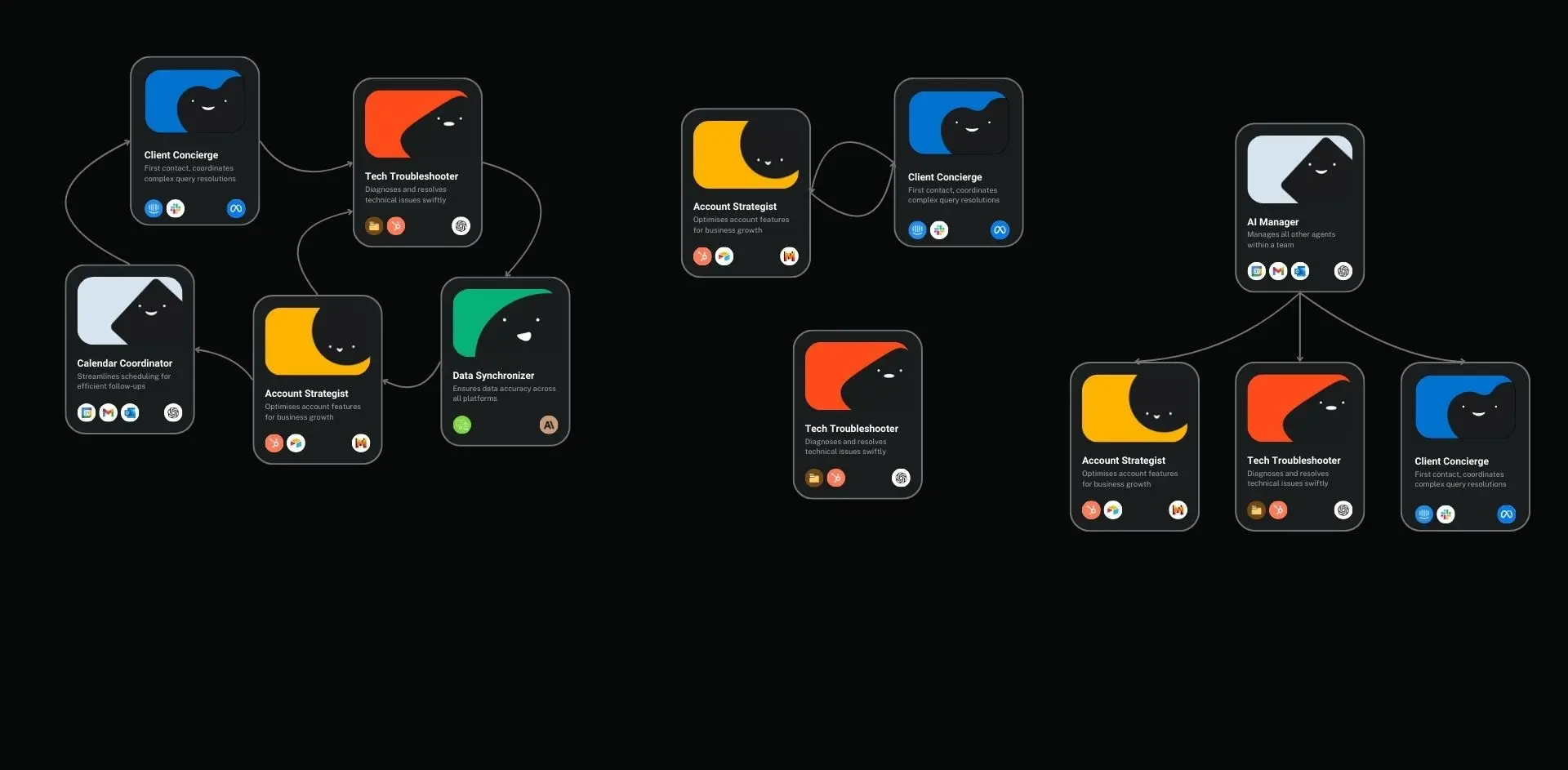
That is a clever architecture for building AI agents, and it is the thing most of Invicta's positive reviews praise. It is also why the billing gets hard to predict: the more you lean into the feature that makes the product interesting, the less the sticker price actually tells you.
The rate that never changes: 200 credits per dollar
Here is a detail that gets missed because there is no pricing page laying it out side by side. Work out the credit rate on each paid tier and it is identical:
- Plus: $30 for 6,000 credits = 200 credits per dollar
- Pro: $100 for 20,000 credits = 200 credits per dollar
- Business: $300 for 60,000 credits = 200 credits per dollar
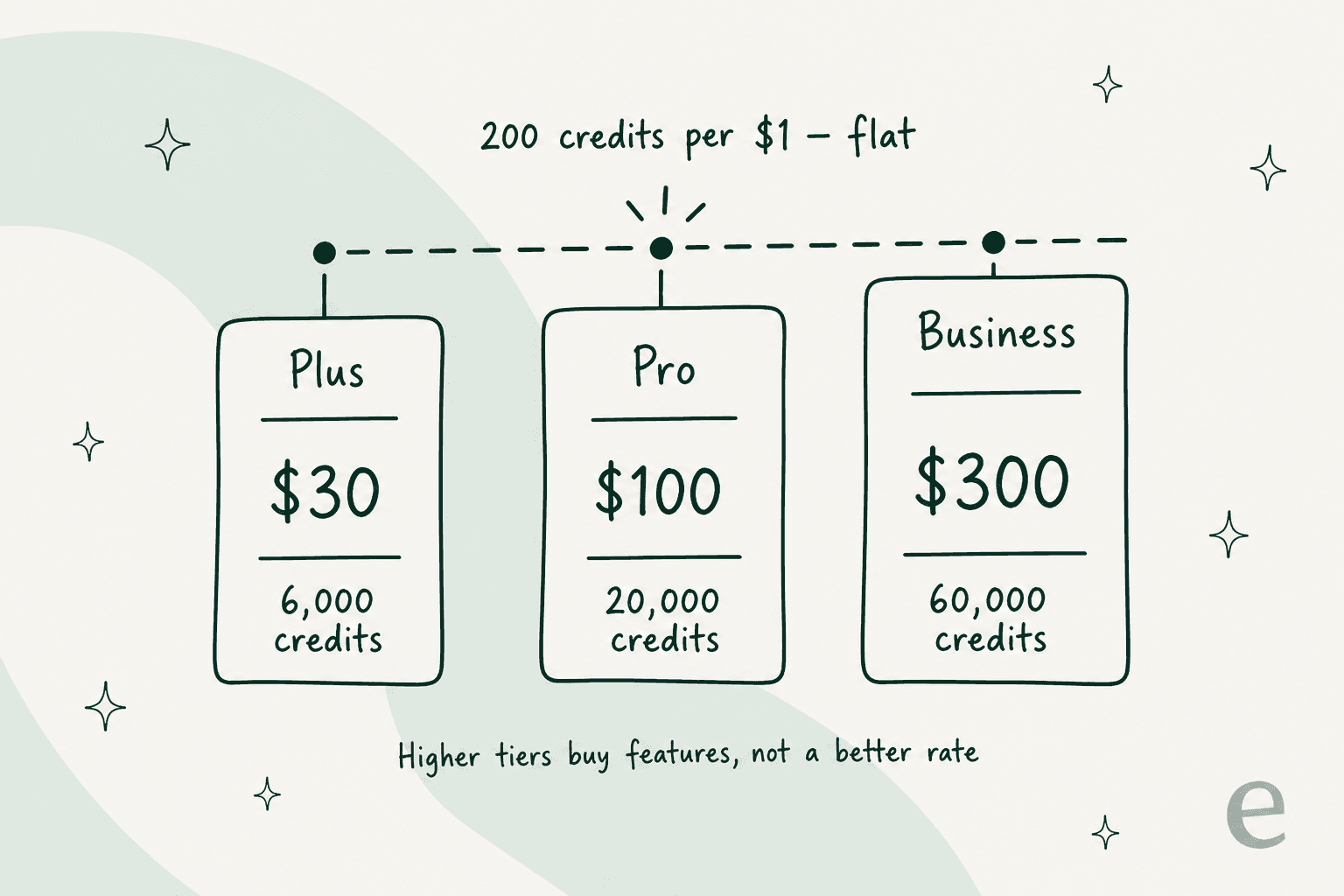
There is no volume discount. Buying 10x the credits costs you 10x the money. What the higher tiers actually unlock is capability: the chat widget, embeddings and advanced analytics all arrive at Pro ($100), while seats, workspaces and admin management only show up at Business ($300). If you are pricing Invicta, the real question isn't "which tier gives me the best rate" (they all give the same one), it is "which feature forces me up a tier."
Two of those force-ups are worth flagging for a small team:
- The chat widget is a $100/month feature. Invicta promotes embedding agents on your site as a headline capability, but the widget and embeddings are gated to Pro. If putting an agent on your website is the reason you are here, your floor is $100, not $30.
- Seats only appear at $300. No seat count is stated on Free, Plus, or Pro, and 10 seats show up only on Business. A team that needs shared access but nowhere near 60,000 credits has no middle option.
The free tier, top-ups, and rollover
The free tier is unusually generous on structure and tight on volume. It gives you unlimited agents, access to all leading LLMs and all agentic tools, so the model roster and the 70+ tool catalogue for workflow automation aren't paywalled at all. What is capped is the work itself: 25 credits per day, plus 50 knowledge base entries. No credit card required and no trial expiry, which makes it a real place to kick the tyres.
One catch on the free credits: they are a daily bucket, and daily free credits do not roll over. An unused day is just gone.
When you run out, you top up. A few things a buyer should know, because they aren't on the pricing cards:
- Top-up bundles come in units of 1,000 credits, but the price of a bundle isn't published anywhere on the site or in the docs. You only learn the number inside the product.
- Only purchased credits roll over. Bundles of 1,000 roll over and don't expire; monthly and daily credits do not. So your subscription allowance is use-it-or-lose-it, and only the paid top-ups bank.
- No overage rate is published. The docs describe running out and buying more, but whether hitting your cap stops the agents or bills through automatically isn't documented on any public page.
- Business and Enterprise pool credits. The whole organisation draws from one monthly pool, and where a user has both, org credits are spent before personal ones.
None of this is unusual for a credit-based tool. It is just a lot of pricing behaviour that you have to reconstruct from three separate documentation pages, which is the recurring theme with Invicta AI pricing: the answer does exist, only never where you would think to look for it.
The part the rate card doesn't mention: is Invicta still running?
I'll be straight about this, because it is the single most important thing for anyone about to enter a card. Before you weigh $30 against $100, check first whether the product is even live, because Invicta's own systems suggest a complicated answer.
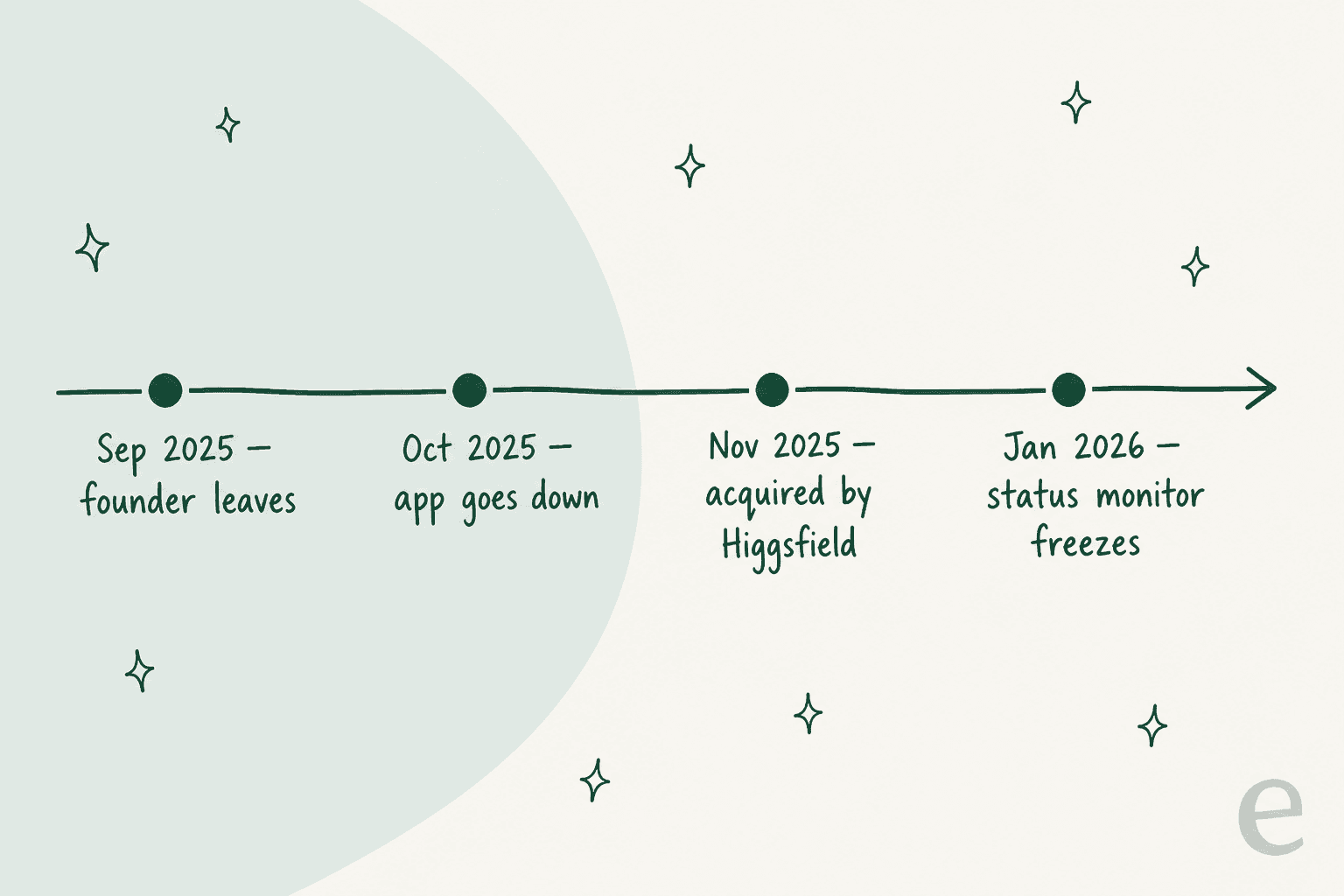
The strongest evidence here is primary and self-published. Invicta ran a public status page out of its own GitHub org, and its incident log records that both the marketing site and the product app went down on 22 October 2025, and neither incident was ever marked recovered. Every other incident in that repo was a short blip closed within about 20 minutes; these two stayed open. The monitor itself then stopped updating in January 2026, with its final frozen README self-reporting one-year uptime of about 76% for both the site and the app, while the docs site sat at 99.9%. In other words, the monitoring was working fine; it was the app that stopped answering.
Around the same window, the founder moved on. Axultan Alimkulov's own LinkedIn post announced that "Invicta AI has been acquired by Higgsfield AI" and that he was joining Higgsfield as Head of Product, and his profile lists his Invicta tenure as ending in September 2025.
When I checked directly on 27 August 2026, the marketing site returned a normal 200, but the product subdomain app.invictai.io failed HTTPS verification entirely. That does not prove the product is permanently gone, and I won't overstate it, but it does mean the sensible move is to confirm you can actually sign up and reach a working app before you go and plan a budget around any of the numbers above. A rate card is only useful when there is a product behind it.
What users say about the price
There isn't a large community to consult here, which is itself worth to know. Invicta has no Capterra or Trustpilot listing, no Hacker News footprint, and zero Product Hunt reviews two years after launch. The one real review corpus is on G2, where it sits at 4.5/5 from 11 reviews. Read that number with the caveats attached: the profile is unclaimed, 10 of the 11 reviews are marked incentivized through a G2 invite, and none is newer than August 2025, so the whole corpus predates both the outage and the acquisition.
With that framing, the pricing signal in the reviews is consistent. On value for smaller teams:
"Pricing may be high for small teams or startup depending on the plan. Cost could add up quickly if you need access to advanced feature or multiple agents."

And on the shape of the packaging itself:
"Limited pricing options making it difficult for some businesses."
Both line up with the rate card. "Cost could add up quickly with multiple agents" is exactly the multi-agent billing behaviour from the docs, and "limited pricing options" is a fair read of a model where every tier carries the same rate and the only real lever you have is which feature bumps you up.
eesel: pricing you can forecast before you buy
I've spent the last three-plus years on eesel's side of this, putting AI agents onto live support queues across thousands of real tickets, and the lesson that shaped our pricing is the one Invicta's model keeps running into: buyers can't commit to a number they cannot compute. So eesel prices in the unit you already think in.

The frame is different too. Invicta sells you a toolkit to assemble your own agent workforce; eesel instead sells ready-to-work AI teammates for defined jobs, each one arriving with the skills, integrations and company context for its role. The current roster is an AI helpdesk teammate that joins your existing support queue, plus an AI blog writer. Here is how the pricing compares on the axis this whole post has been about:
| Invicta AI | eesel | |
|---|---|---|
| Billable unit | Credit (compute) | Credit (1 ticket or chat handled) |
| Can you compute it upfront? | No, it depends on model + tools | Yes, 1 credit per support ticket, from $299/mo for 500 credits |
| Per-seat fees | Seats start at $300/mo | None |
| Platform minimum | None on paid tiers | One fixed monthly price, everything included |
| Free to try | 25 credits/day, no card | 100 free credits, no card |
eesel's pricing is one fixed monthly price sized to your volume, with no platform fee and no per-seat fees. A support ticket or a chat session counts as one credit no matter how many messages it takes, and tickets your human agents handle do not count. So 500 tickets a month is $299, and 1,000 is $499. You can do that math before you sign anything at all.
The other piece we learned the hard way, watching confident bots give wrong answers on real queues, is that you shouldn't switch pricing models on faith. eesel lets you simulate an agent against your own historical tickets before it ever touches a live customer, so you get to see the resolution rate and the projected cost first. If you are comparing agent platforms and want a number you can actually forecast, that is the pitch. It is free to start, and the 100 free credits let you see real work before you pay.