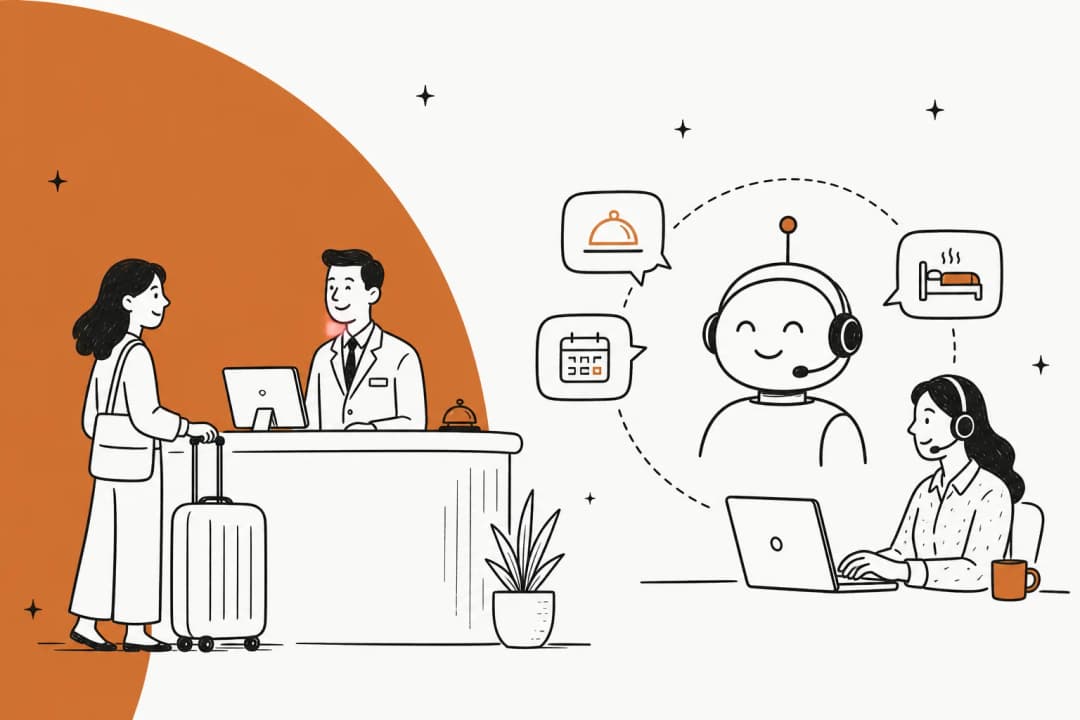

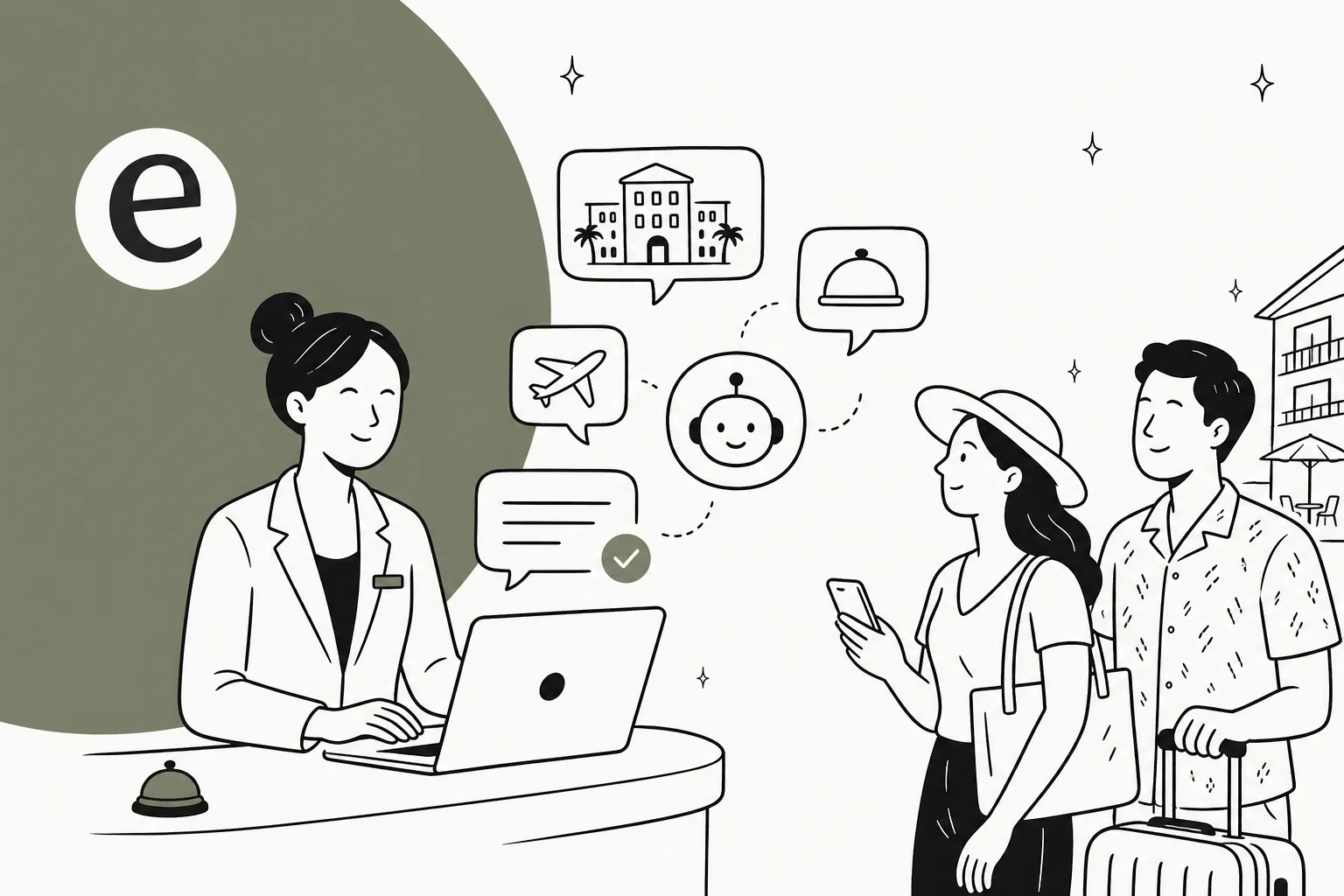
Why hospitality is turning to AI right now
A few years ago, a hotel "chatbot" was a scripted popup that frustrated everyone. That's not what's happening now. Modern guest-facing AI runs on large language models that pull answers from your own property knowledge and connect to your systems, which is a different category of tool. And the timing isn't a coincidence.
The pressure is mostly about labor. According to BCG and NYU SPS research, 65% of North American hotels reported staffing shortages in 2025 while labor costs rose 11.2% year over year, and labor is roughly half of operating margin. When you can't hire your way out of the queue, automating the repetitive part of it stops being optional.
The demand side has shifted too. The same BCG research found that 37% of travelers already plan and book through AI assistants, so guests arrive in a conversational frame of mind and expect your website to keep the conversation going. And Medallia's research found 61% of consumers will pay more for a personalized experience, which is exactly what a well-fed AI can offer at the moment a guest is asking.
The money has followed. The market for AI in hospitality and tourism was worth USD 15.7 billion in 2024 and is projected to hit USD 198.9 billion by 2034, a 28.9% compound annual growth rate. In a 2026 hotel AI research report from Canary Technologies, 82% of hotels expected their AI usage to increase in the next year, and 71% said AI was already having a significant or transformative impact. Guest communications is the single most-cited place hoteliers expect that impact to land.
None of this means you should rush. It means the question has changed from "should we?" to "how, without annoying our guests?"
What AI customer service actually handles in hospitality
The useful way to think about this is the guest journey, not a feature list. AI shows up at every stage, and the job is the same each time: handle the routine query instantly so a human only touches what needs them.
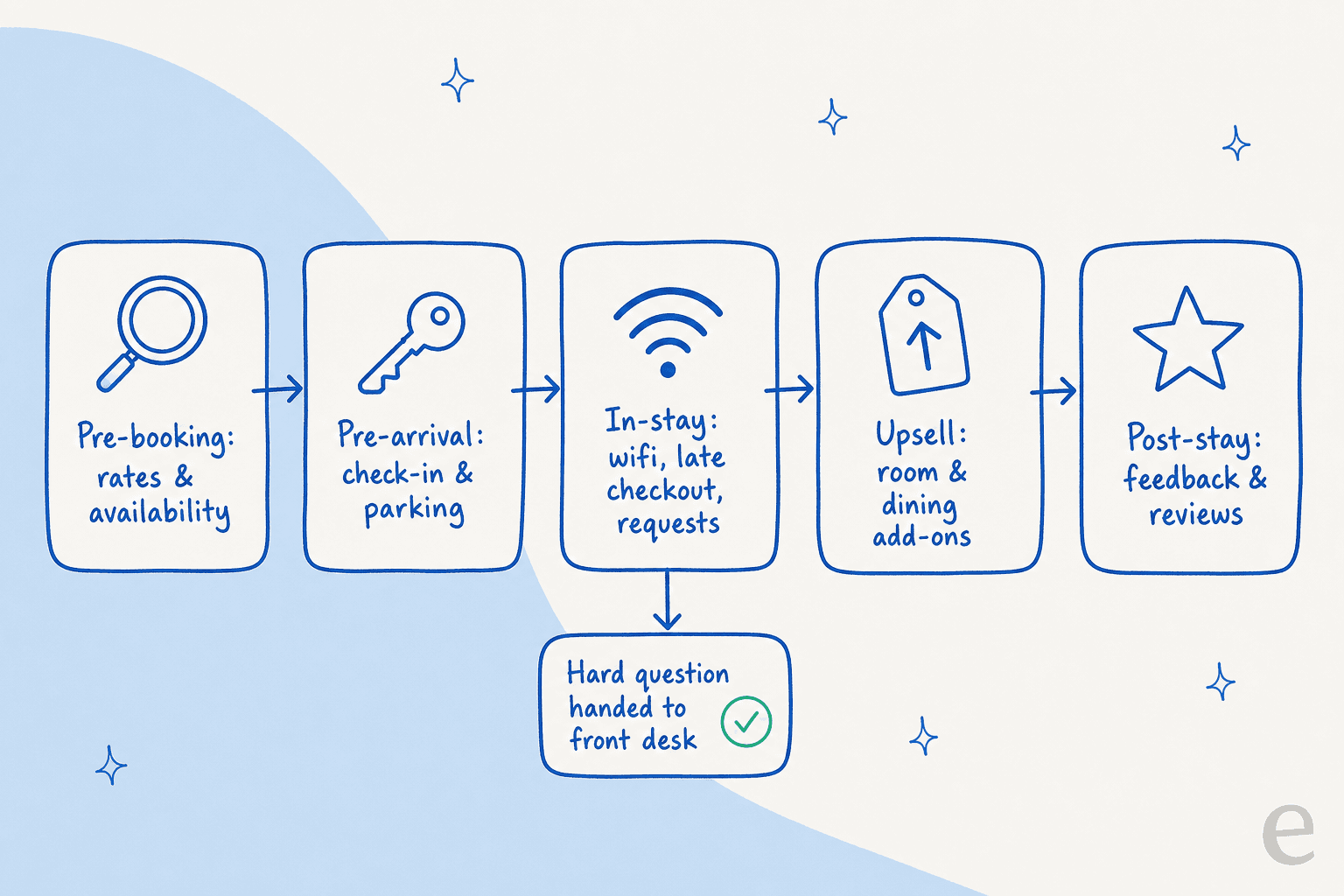
Here's where it does real work:
- 24/7 guest messaging. The flagship use case: instant answers across WhatsApp, SMS, web chat, and email without a person awake at 3am. Canary frames its AI guest messaging as automating more than 80% of guest communication, handing off to staff only when it can't answer.
- Pre-booking and reservations. A 24/7 sales layer that answers availability, rate, and policy questions and completes bookings. The win, as Canary puts it in its conversational AI guide, is answering nuanced questions ("Is the pool heated in October?") accurately by reading your systems, instead of letting a generic model guess.
- Pre-arrival and check-in. Automated pre-arrival messages, online check-in forms, and the predictable wave of "what time is check-in / where do I park" questions, often connected straight to the PMS.
- FAQ deflection. The bread and butter: wifi, parking, pool hours, late checkout, pet policy. This is where the 25 to 35% reduction in repetitive front-desk inquiries comes from, and it's the easiest, safest place to start. It's the hospitality version of the tier-1 support deflection every support team is chasing.
- Multilingual support. International guests, one front desk. The AI answers in the guest's language automatically, which removes a pain that's been near the top of every hotel's list since the first chatbot.
- Upsells. Room upgrades, late checkout, parking, dining, all surfaced at the right moment. The LINE SF drove 65% of its early-check-in revenue through AI upsells.
- In-stay requests routed to a team. The best systems don't just reply, they turn "can I get extra towels" into a tracked task for housekeeping, the way an AI customer service workflow routes and tags a ticket inside your ticketing system.
- Post-stay follow-up. Personalized check-out messages, feedback collection while the memory is fresh, and drafted review responses.
For restaurants and F&B the shape is similar: reservations, mobile ordering, and answering the phone line that nobody has time to pick up. And for vacation-rental operators, the entire point is not being on call. One host running a fleet of properties summed up the appeal of a good setup: "thanks god for [an AI tool that] handles 99% of things, when needed it notifies me and I take over." (r/ShortTermRentals)
If you want the broader category view beyond hospitality, our roundup of the best customer service AI platforms and our guide to AI customer service chatbots cover the tools that do this work across industries.
What good actually looks like
The honest version of the pitch isn't "AI replaces your team." It's that AI clears the repetitive queue so your team's time goes where it counts. A boutique-hotel owner argued the point well in a thread about whether tech erodes the human touch:
"By handling repetitive, low-impact queries like 'What time does the pool open?' or 'Do you have late check-out available?', tech frees up hotel staff to focus on delivering personalized and meaningful experiences… it's about meeting guests where they are."
u/jaemoraga, r/hotels

When it's set up that way, the numbers are concrete. Beyond hospitality-native results like the Holiday Inn Express that automated 82% of inquiries and added $1,700 a month in incremental revenue, the horizontal AI helpdesk tools tell the same story. On eesel AI, Gridwise resolved 73% of its tier-1 requests in the first month, and Global Payments reported up to 80% time savings finding answers across documentation. Those are the kinds of figures that move a front-office budget, and they tend to track a small set of AI customer service metrics: resolution rate, response time, and how many conversations a human ever has to touch.
The part operators undersell is response time. The LINE SF cut its median response time from 10 minutes to under one minute. For a guest deciding between texting you and calling the OTA, that minute is the whole game, and it's the same lever support teams pull when they chase first contact resolution.
A practical note on getting there: the reason a tool feels natural rather than robotic is almost always that it learned from your own past conversations and help docs, not a generic script. If you already run a helpdesk like Front, Gorgias, or Zendesk, an AI layer can sit on top of it and work the queue you already have.
Where AI guest service goes wrong
This is the section that keeps you out of a viral complaint thread. AI in hospitality fails in a few predictable ways, and knowing them is most of the defense.
Broken escalation is the real villain
The thing guests hate most isn't a wrong answer, it's being trapped. The clearest cautionary tale of 2025 was a Hilton guest stuck with a phone AI bot:
"After sitting through a few minutes of it asking if I needed towels or parking repeatedly, we would say 'front desk' it would sometimes disconnect the call saying 'I can't hear you'… about 40% of the time. There was no way to call the front desk, concierge, housekeeping, or room service directly."
u/idwmaruna, r/Hilton
A commenter in that same thread nailed the design lesson: the hotel had "set up the AI as a wall instead of a filter." The whole point is to solve the easy stuff fast so a human can deal with the actual problem. Any system that hangs up on you for saying "front desk" isn't a limitation of the technology, it's a bad configuration.
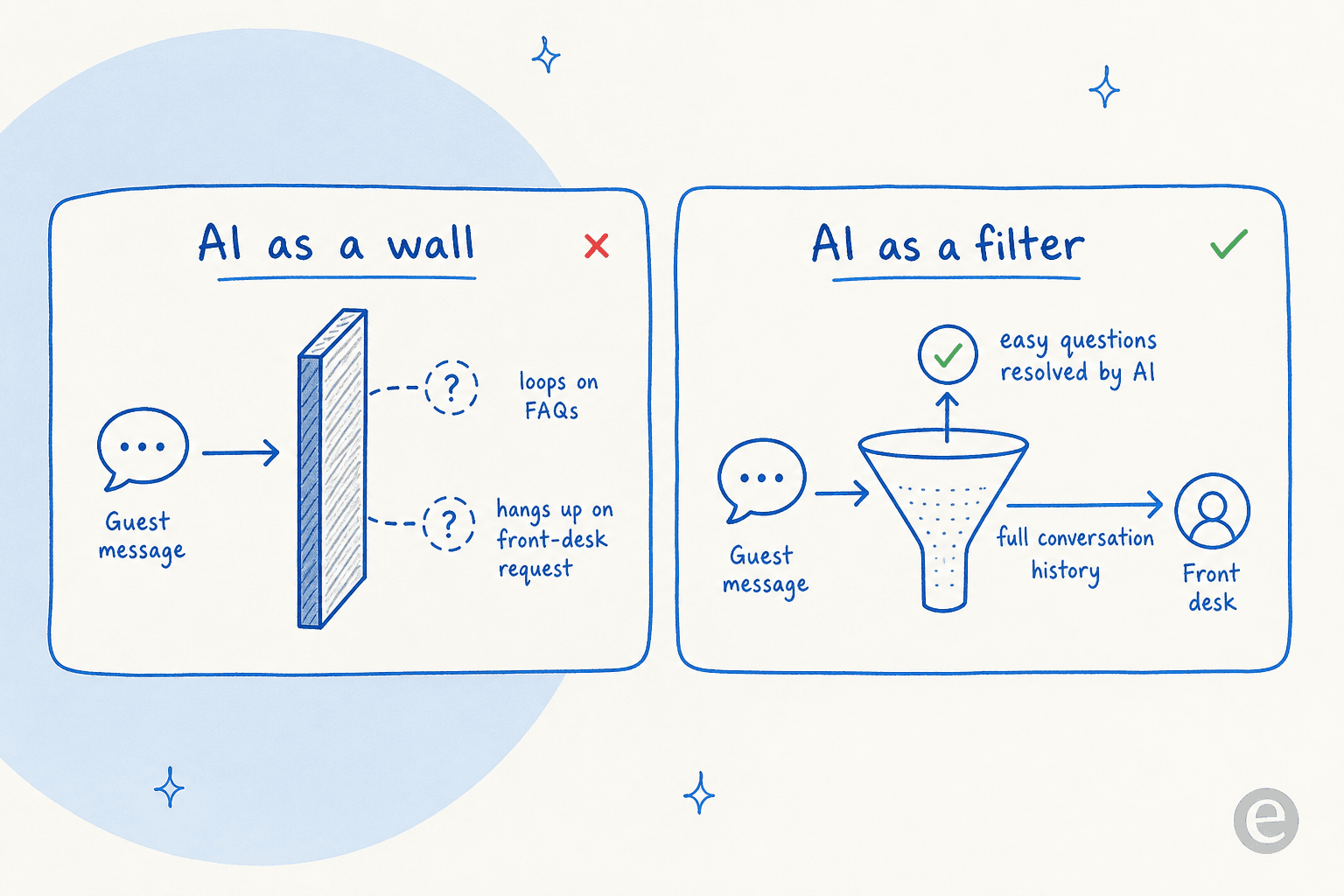
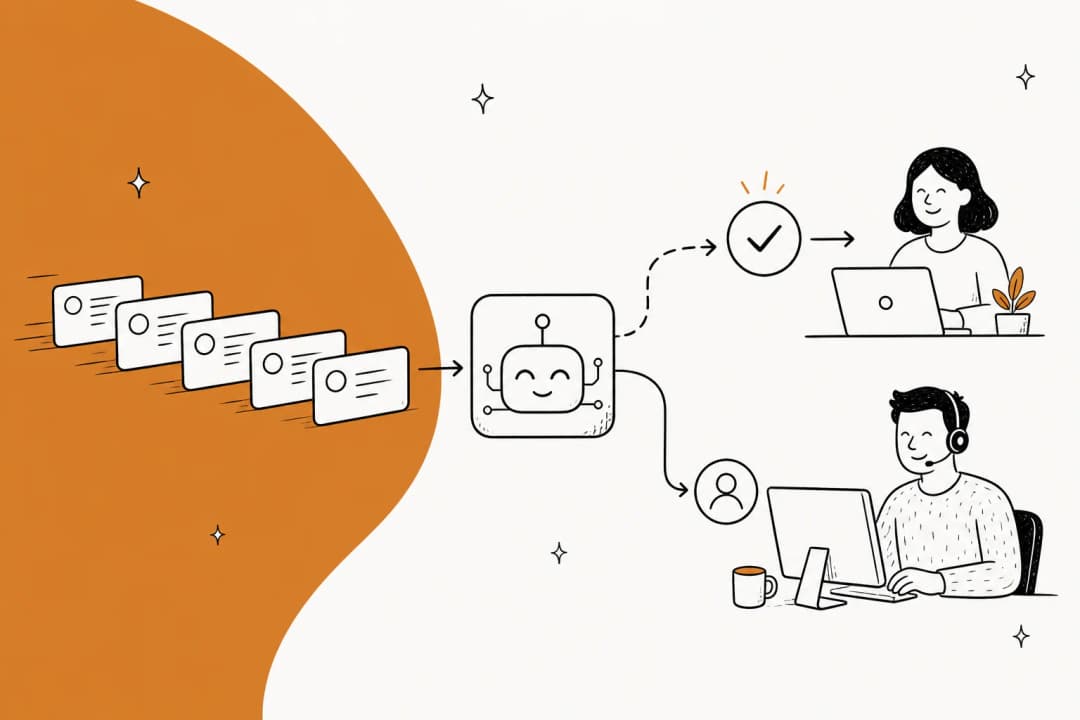
The fix is to design for the filter, not the wall. The AI should auto-reply only when it's confident, escalate everything else, and hand the human a full transcript so the guest never starts over. This is the same principle a DTC CX lead we work with described for their own queue: they wanted "an AI who is only handling the tickets that it's confident to handle and all the other ones, leave them alone." That's confidence-based routing, and it's the single most important thing to get right.
Hallucination on policy and booking details
The highest-stakes risk is the AI inventing a fee waiver, a shuttle policy, or stale breakfast hours. A buyer's guide from Hotel Tech Insight puts its single most important demo test bluntly: ask the AI something it shouldn't be able to answer, and "if it invents a rooftop bar, a shuttle policy, or a fee waiver that does not exist, the model is not ready for guest-facing deployment." The defense is grounding the AI in editable, hotel-controlled knowledge and letting it refuse or escalate rather than guess. Preventing confidently-wrong answers is a whole discipline in itself, and it matters even more in refund and booking-change situations where the wrong answer costs money.
The luxury and brand-voice problem
Not every guest wants to text a bot. In the luxury segment especially, some actively resent it: one guest said they'd "just rather pass by or telephone the front desk… than send some impersonal text." That's a real signal, not a complaint to dismiss. The answer isn't to skip AI, it's to scope it: let AI handle the logistics so your staff have more time for the in-person moments that justify the room rate.
Integration friction is where projects die
Hospitality runs on legacy systems, and "PMS integration" on a vendor's website rarely means your PMS. The EHL hospitality school warns that hotels relying on outdated systems often end up "with 50 different 'tools' but little (if any) positive impact." (EHL Insights) The 15-year operator's version is more vivid: a PMS migration that "nearly killed us. 3 months of chaos for features we don't even use." Demand that the demo run on your exact stack, or get a written connector plan before you sign.
How to choose an AI tool for hospitality support
There are two broad families to choose from, and the right one depends on how your support is already set up.
| Hospitality-native platforms | Horizontal AI helpdesk / agent | |
|---|---|---|
| Examples | Canary, HiJiffy, Asksuite, Duve | eesel AI, Zendesk AI |
| Best for | Properties wanting PMS-native messaging, check-in, and upsell in one suite | Groups and brands that already run a helpdesk and want AI on top of it |
| Strengths | Deep PMS hooks, hospitality-specific flows (digital keys, F&B ordering) | Learns from your own tickets, works across every channel and team, fast to pilot |
| Watch-outs | Can be bundled and priced per room; flows are hotel-shaped only | You bring the channel/PMS connections; not hospitality-branded out of the box |
Whichever family you lean toward, the buying process matters more than the brochure. Operators in this space are vendor-fatigued for good reason, so pressure-test the demo before you commit:
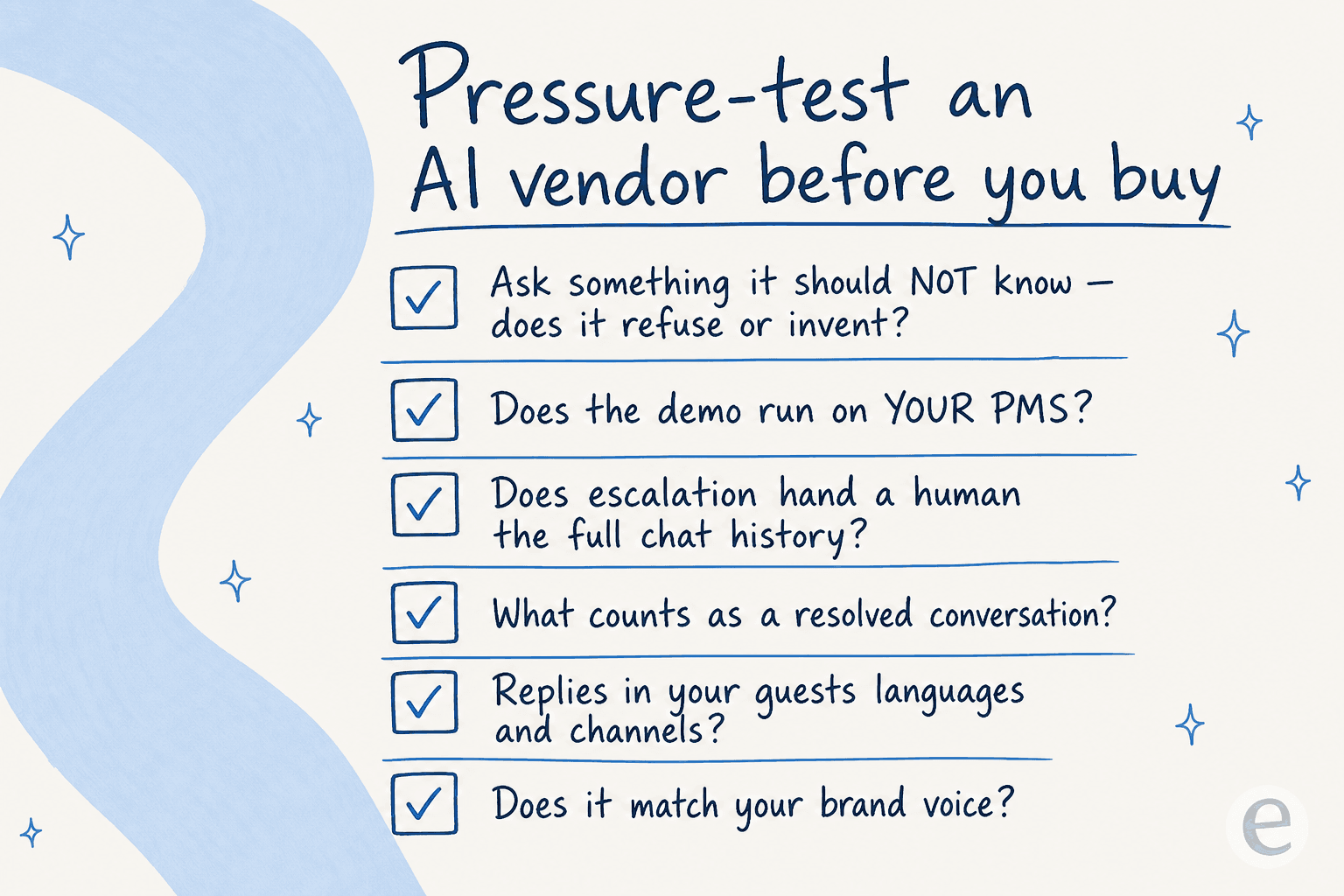
One question on that list deserves a flag: when a vendor quotes an automation rate, ask for the denominator. As Hotel Tech Insight warns, "a percentage without the denominator is not useful. Ask what counted as a resolved conversation, whether repeat messages were counted twice, which channels were included, and how many answers were corrected by staff later." A confident "we automate 90%" with no definition behind it is marketing, not a metric.
The smartest way to de-risk all of this is to test against your own history before you go live. The best tools let you run the AI over your past guest conversations and show you exactly what it would have answered, so you find the gaps in a sandbox instead of in front of a guest. That's the difference between a polished demo and a tool you can actually trust on your busiest weekend. If you're weighing options across the wider market, our list of companies using AI for customer service and the best AI chatbot for customer service are good places to calibrate.
Try eesel for hospitality support
If you already run a helpdesk, eesel AI is the layer that puts an AI agent on top of it. It learns from your past tickets, help docs, and connected tools on day one, drafts and resolves the repetitive guest questions, and escalates the rest with full context, which is the filter-not-a-wall design this whole post is about.
The piece worth a look for a cautious hospitality team is simulation mode: you can run eesel over thousands of your past guest conversations to see its coverage and accuracy before a single real guest talks to it. It connects to helpdesks like Zendesk, Freshdesk, Front, and Gorgias, answers in 80+ languages, and bills per resolved conversation rather than per seat, so a busy season doesn't punish you. You can start with a free trial and no credit card.

Frequently Asked Questions
What is AI customer service for hospitality?
It's the use of conversational AI to handle guest communication and back-office support across the whole guest journey: pre-booking questions, pre-arrival and check-in, in-stay requests like wifi or late checkout, upsells, and post-stay feedback. Modern systems run on large language models that retrieve answers from your own property knowledge and connect to your PMS or helpdesk, so they complete tasks rather than just answer FAQs. See our guide to AI in customer service for the fundamentals.
How much does AI customer service for a hotel cost?
It depends on the pricing model, and the model matters more than the sticker. Many hospitality tools bundle AI into a per-room or per-property fee, while horizontal AI helpdesk tools like eesel AI charge per resolved conversation (eesel starts at $0.40 per ticket with no per-seat fee). Watch for per-resolution pricing that punishes you for being busy in peak season.
Can AI handle guest messages without sounding robotic?
Yes, if you train it on your own past conversations and set its tone. The tools that read as natural are the ones grounded in your real ticket history and help docs, not a generic script. You can shape voice and escalation rules so the AI handles repetitive questions and a human takes the moments that need warmth. Our piece on AI for agent productivity covers how this works in practice.
What happens when the AI can't answer a guest?
A good system escalates to a human and hands over the full conversation history, so the guest never repeats themselves. The failure mode to avoid is an AI set up as a wall that loops on FAQs and blocks people from reaching the front desk. Look for confidence-based routing that only auto-replies when the AI is sure.
Is AI customer service worth it for a small or independent hotel?
Often yes, and small operators tend to see value fastest because the pain is sharpest: a single host fielding 3am messages gets nights back. Start by automating the repetitive 80% (wifi, parking, check-in times) and keep humans on the rest. Our AI for small business guide has a wider view of where to begin.


Article by
Alicia Kirana Utomo
Kira is a writer at eesel AI with a Computer Science background and over a year of hands-on experience evaluating AI-powered customer service tools. She focuses on breaking down how helpdesk platforms and AI agents actually work so that support teams can make better buying decisions.