

What an AI chatbot for hospitality actually is
Let's clear up the biggest confusion first, because "chatbot" covers two very different things.
The old kind is a rules-based bot: a decision tree with buttons, the thing that popped up on a hotel site in 2019 and shut down the moment you asked something off-script. It felt like a database, and it usually frustrated guests.
The new kind is a conversational AI agent. It reads a guest's free-form question, understands intent, and pulls the answer from a knowledge base and your booking system rather than a fixed menu. Ask it "is the pool heated in October?" and, if it's connected properly, it gives your actual answer instead of a generic one an external model would hallucinate.
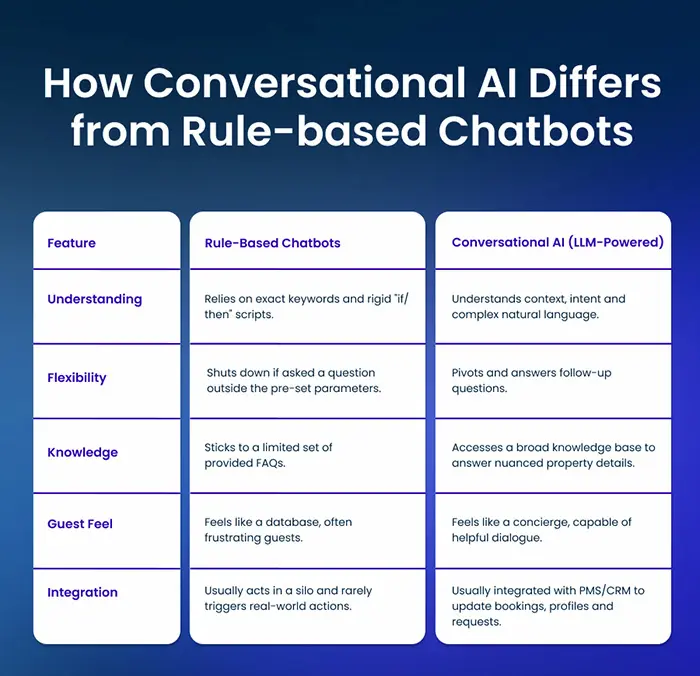
The practical difference for you: the rules-based bot deflects a handful of exact-match FAQs and irritates everyone else, while a well-built AI agent handles the long tail of how guests actually phrase things, and can take an action at the end instead of just answering. That second part, doing something rather than reciting something, is the line that matters.
Where an AI chatbot helps across the guest journey
The clearest way to think about this isn't a feature list, it's the guest's timeline. An AI chatbot can carry weight at every stage.
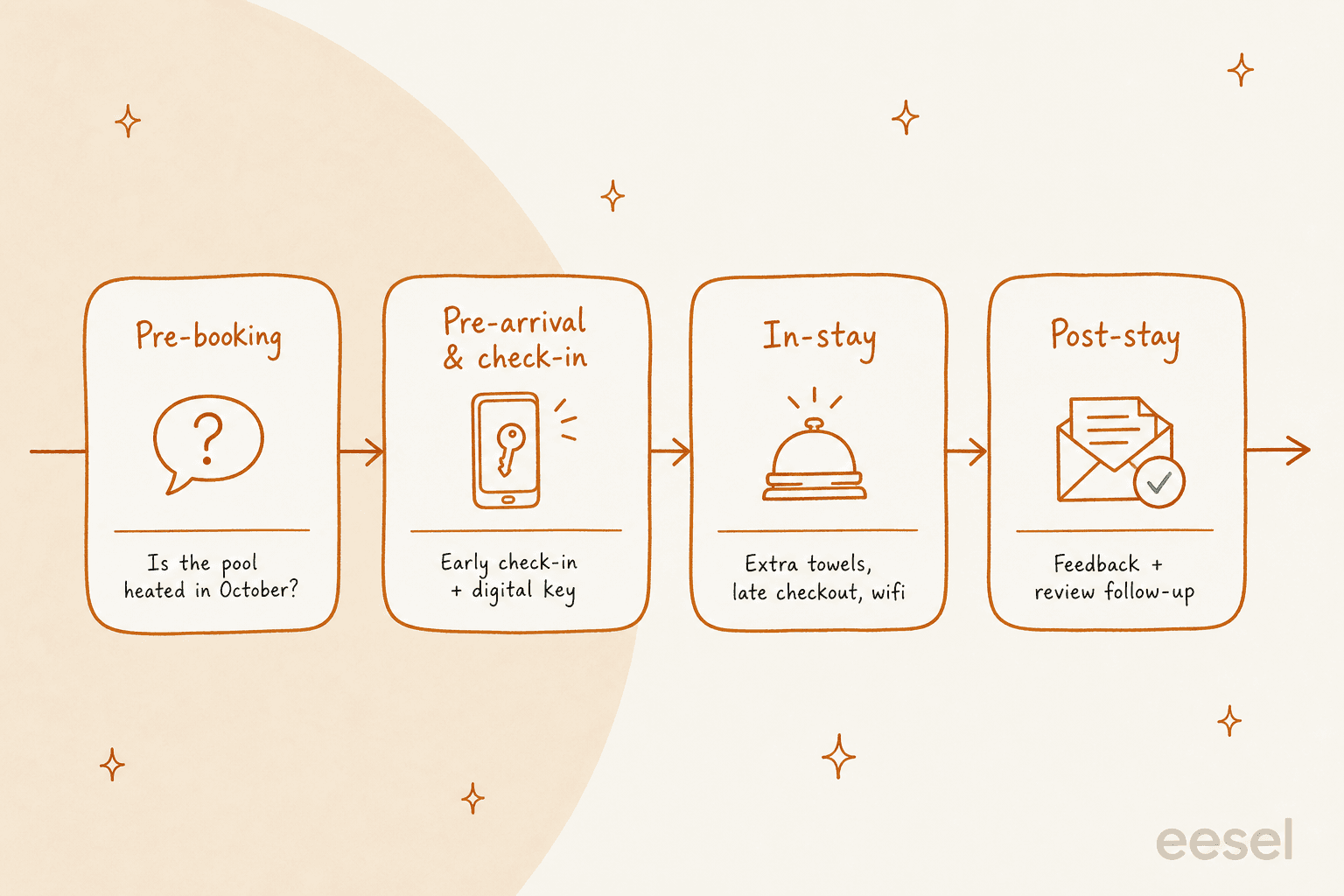
- Pre-booking. It answers availability, rate, and policy questions on your site 24/7 and can complete a reservation. This matters more every quarter: 37% of travelers now plan and book through AI assistants, so guests arrive already mid-conversation and expect your site to continue it.
- Pre-arrival and check-in. It fields the "what time is check-in / can I get early check-in / where do I park" wave, handles pre-check-in forms, and can offer early check-in at the right fee.
- In-stay. The bread and butter: wifi, parking, pool hours, late checkout, extra towels. The best systems turn a texted request into a tracked job for housekeeping rather than a message that gets lost.
- Post-stay. Personalized follow-ups at scale, feedback collection while the memory's fresh, and a nudge for reviews.
Here's a real example of the check-in flow, where the bot doesn't just answer but actually books the early check-in and its fee:
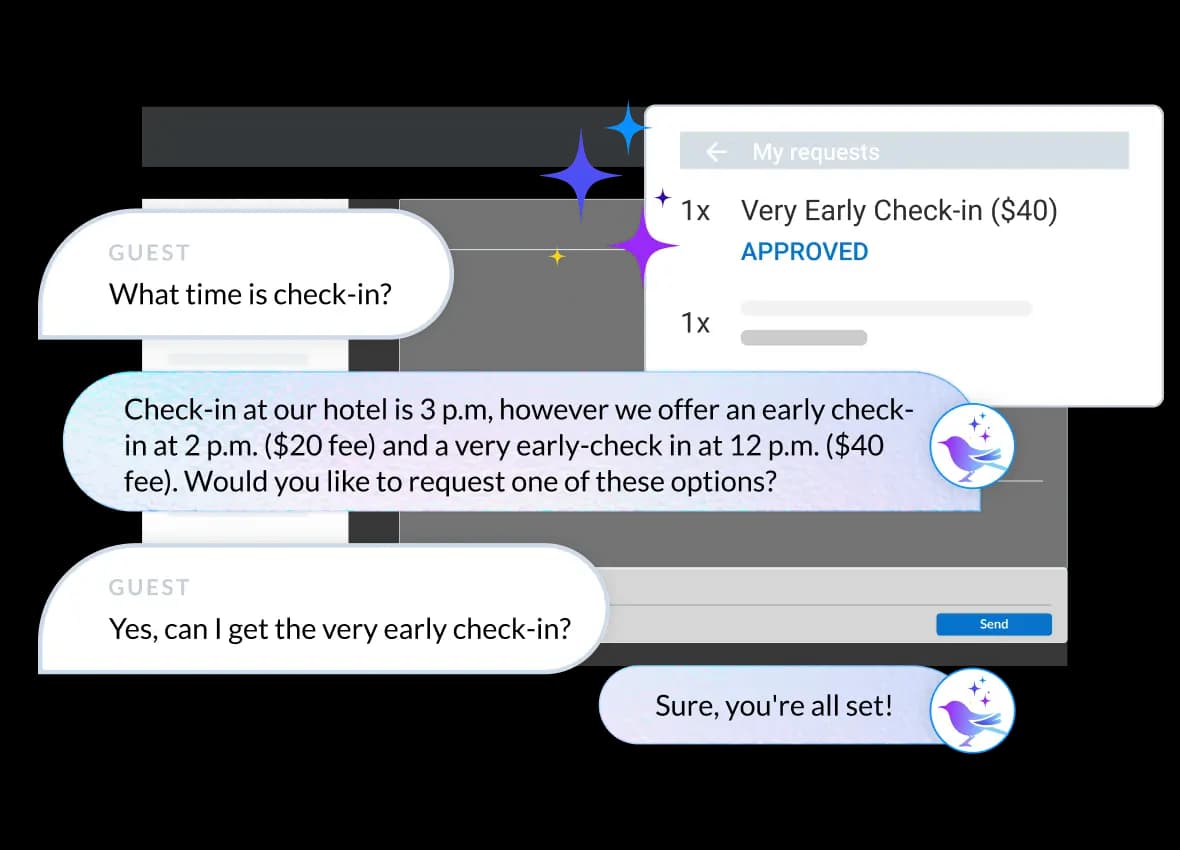
Two more use cases worth calling out because they move money, not just minutes. Multilingual support lets one front desk answer guests in whatever language they message in, and revenue automation surfaces upgrades and add-ons at the right moment. The LINE SF, for instance, drove 65% of its early-check-in revenue through AI upsells while cutting median response time from 10 minutes to under one.

How an AI hotel chatbot actually works under the hood
Skip the "magic AI" framing, because the mechanism is what tells you whether a tool will actually work for you. A solid hospitality chatbot does four things in sequence.
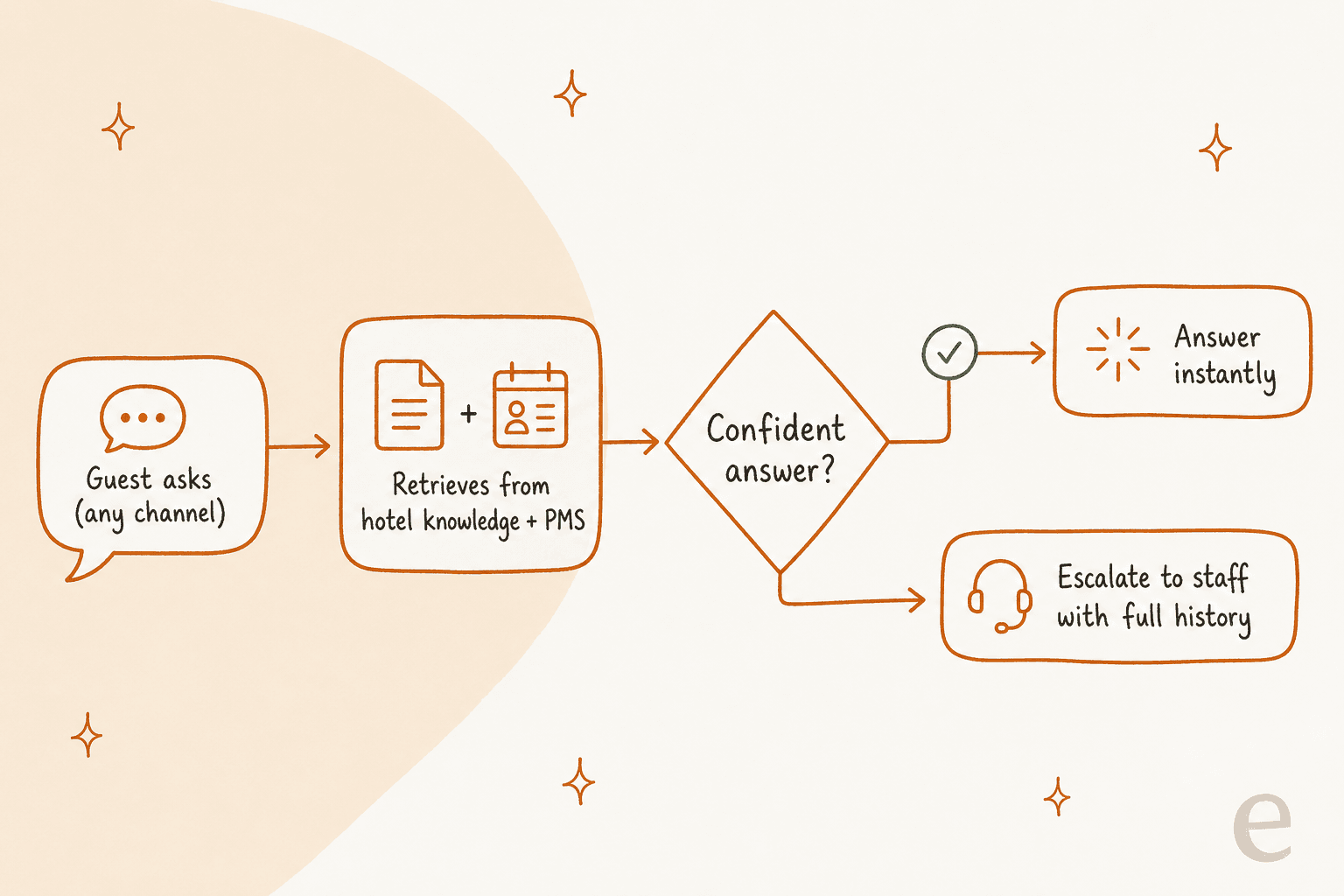
- It takes the question from wherever the guest is - WhatsApp, SMS, web chat, in-app, email. Guests don't want to switch channels to reach you.
- It retrieves the answer from your own sources: your editable property knowledge (policies, hours, amenities) and, crucially, your PMS or booking engine for live availability, rates, and reservation details. This retrieval step is what keeps it accurate. HiJiffy's approach, for example, is retrieval over editable knowledge docs, so answers stay grounded in what you actually told it.
- It checks whether it's confident. A good agent knows when it doesn't know.
- It answers or escalates. Confident answers go out instantly. Everything else routes to a human, ideally with the full conversation attached so staff don't make the guest repeat themselves.
That fourth step is where cheap tools cut corners, and it's the single thing I'd stress-test hardest. Which brings us to what guests actually say.
What guests and operators actually say
The sentiment online is not "AI good" or "AI bad." It's more specific and more useful than that.
The strongest pull toward adoption comes from small operators drowning in after-hours messages. A short-term rental host put the entry-point pain perfectly:
"I'm starting to get late night questions from guests, and it's freaking me out because I feel like I have to sleep with my phone in my hand. My cohost tries to help but we're both feeling overwhelmed. How do you manage this without being awake 24/7?"

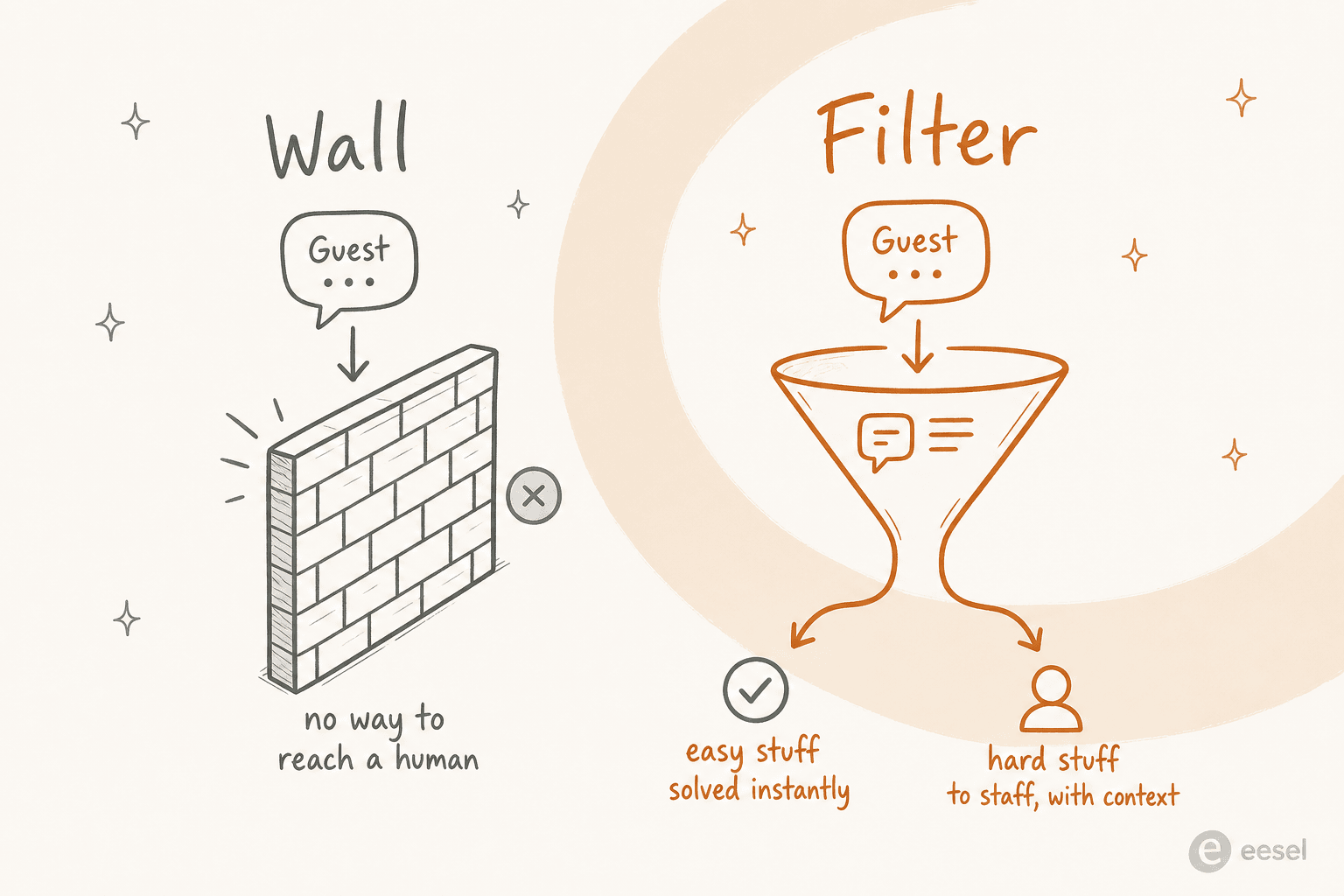
The single loudest complaint, though, isn't wrong answers. It's broken escalation, an AI that walls guests off from a human. A Hilton guest described a phone bot that would loop through "towels or parking" and then, when they said "front desk," hang up on them about 40% of the time, with no way to reach a person. A commenter (who mentioned working at eesel) reframed it well:
"They've just set up the AI as a wall instead of a filter... The whole point is supposed to be solving the easy stuff fast so a human can deal with the actual problems. Any system that hangs up on you for saying 'front desk' is just badly designed, not a limitation of the tech itself."
That wall-versus-filter distinction is the whole game:
And the luxury segment is genuinely split. Some guests resent messaging that replaces face-to-face service. But a self-described owner of four boutique hotels made the counter-case that I think holds up:
"By handling repetitive, low-impact queries like 'What time does the pool open?' or 'Do you have late check-out available?', tech frees up hotel staff to focus on delivering personalized and meaningful experiences... it's about meeting guests where they are."
The hard parts nobody puts on the sales deck
I've spent enough time putting AI on live support queues to know the demo is the easy part. Here's what actually decides whether this works.
Hallucination on policy and booking details. The highest-stakes risk is a bot inventing a fee waiver, a shuttle policy, or a rooftop bar that doesn't exist. The fix is grounding it in editable, hotel-controlled knowledge plus a hard rule to escalate instead of guess. Hotel Tech Insight's best demo test is to ask the bot something it shouldn't be able to answer: if it invents a policy, it's not ready. Our own take on hallucination prevention is the same: ground it, gate it, test it.
PMS integration friction. This is hospitality's biggest practical blocker. EHL notes many hotels run outdated legacy systems and end up with "50 different tools but little impact". "PMS integration" on a vendor's site rarely means your PMS, so demand the demo run on your exact system or get a written connector plan.
The deflection number with no denominator. Vendors love a headline automation rate. Ask what counted as resolved, whether repeat messages were double-counted, which channels were included, and how many answers staff had to correct later. As Hotel Tech Insight puts it, "a percentage without the denominator is not useful."
Brand voice and staff pressure. In the luxury tier, tone matters as much as accuracy. And the sub-3-minute response SLA messaging creates can pile stress on staff, which is an argument for letting AI absorb the routine load, not for pushing humans to respond like machines.
What to look for when you pick one
Boil the noise down to a short buyer's checklist:
| What to check | Why it matters | Green flag |
|---|---|---|
| Grounding | Stops invented policies and fees | Answers come from your editable knowledge, not the open web |
| Escalation | The #1 guest complaint | Clean handoff to a human with full conversation history |
| PMS / booking connection | Turns answers into actions | Runs on your PMS in the demo, not a generic one |
| Channels | Guests message where they already are | WhatsApp, SMS, web, in-app, email in one place |
| Testing before launch | Catches bad answers before guests do | Simulate on your real past messages first |
| Billing unit | Where the cost surprises hide | Clear per-resolution or per-ticket pricing, no per-seat trap |
If you're weighing the broader build, our guides on reducing ticket volume with AI, no-code AI support agents, and implementing AI in customer support go a level deeper. For the vertical-specific angle, AI customer service for hospitality covers the market and vendor landscape.
Try eesel for guest support
If you already run guest support through a helpdesk, you probably don't need a whole new hospitality platform, you need an AI agent that sits on top of the stack you have. That's the gap eesel fills.

eesel plugs into email, WhatsApp, Zendesk, Freshdesk and 100+ other tools, learns from your existing help docs and past tickets, and drafts or fully handles guest messages while escalating the genuinely hard ones with full context, the filter, not the wall. The part I'd point any hospitality team to first: you can simulate it on your real past guest messages before it ever touches a live conversation, so you see the resolution rate and catch bad answers before a guest does. It bills per ticket rather than per seat, so a seasonal spike doesn't mean buying a rack of licenses. Try eesel free, or book a demo to see it on your own data.