
Where I am coming from
I have spent the last couple of years living in the gap between what a tool's marketing page promises and what a buyer actually types into a search bar. Most people searching "Tasklet vs Manus" are not shopping for a demo, they are trying to answer one question: which of these will do the work without a nasty surprise on the invoice. So I read both products through that lens, and I read them next to the AI agents for customer service I help build, because that is the job where "usually right" stops being good enough.
That experience is why one thing jumps out at me about both Tasklet and Manus: you cannot see how they will behave before you turn them loose. At eesel we have spent years putting agents on live queues, and the scar tissue from that is a hard rule now: every rollout gets simulated against historical tickets before it touches anything real. One customer put the whole thing better than I can. "The AI will never be able to answer 100% of the questions," a DTC supplements CX lead told us. "I need an AI who is only handling the tickets that it's confident to handle and all the other ones, leave them alone." That confidence gate is exactly what a general-purpose agent does not give you. Tasklet meters every run as credits whether the output is right or wrong; Manus can run for hours and bill you regardless. Both are impressive engineering. Neither was built to be careful with your data before it acts. Let me walk through what each one actually is.
What Tasklet is
Tasklet calls itself "IFTTT for the agentic age," and the pitch is "agents that own the work." Instead of building a rigid Zapier-style flowchart, you write plain-text instructions and an LLM decides what to do at each step. Each agent runs in an isolated cloud sandbox (roughly 2 vCPU and 15GB RAM) with its own command-line environment and a real web browser for tasks that need one.
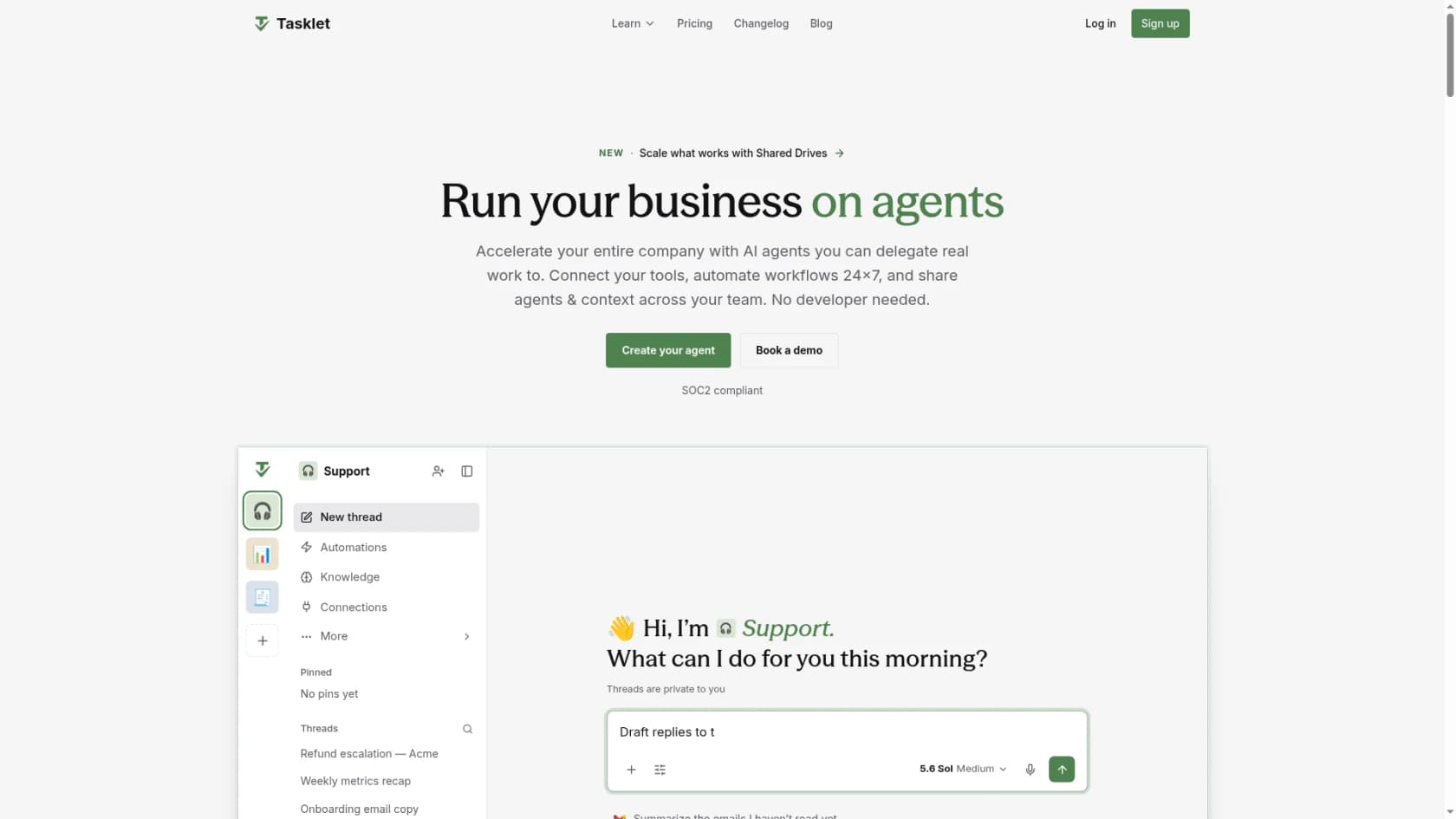
The strength here is coverage across your stack. Tasklet is multi-model (it defaults to a "5.6 Sol" option and can run Claude and Gemini) with intelligence levels from Basic up to Genius, and it connects to 30-plus integrations, Gmail, Slack, HubSpot, Salesforce, Notion, Zendesk, Stripe, QuickBooks, plus custom HTTP and MCP. It is SOC 2 compliant, every agent asks for approval on sensitive data access, and its homepage now leads with a support-agent demo that drafts replies (nothing is sent) on a schedule. Built by the Firebase creators and backed by Y Combinator, the pedigree is real, and the "no flowchart" setup is a real step up from wiring a hundred-node automation by hand. It sits closer to agentic customer service software than to a classic rule-based chatbot.
What Manus is
Manus is an autonomous, general-purpose agent with a different philosophy: "Less structure, more intelligence." You type a goal into a single prompt box ("build me a website," "research this market," "make a slide deck"), and it plans and executes the whole multi-step task on its own inside a cloud computer, then delivers the finished artefact. It does not just draft, it builds and ships the thing.
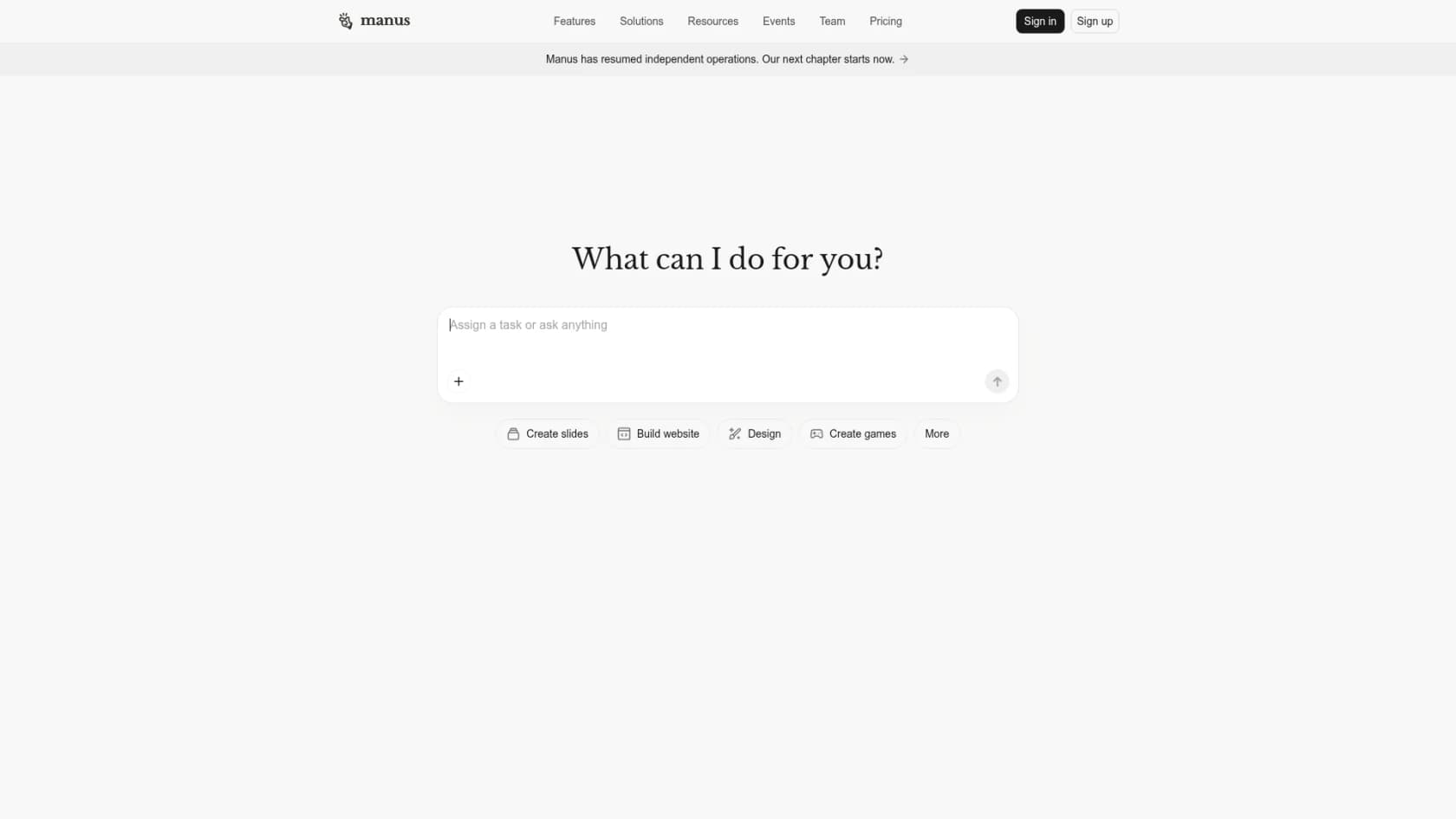
Manus's ownership is the plot twist most coverage still gets wrong. Meta acquired Manus in December 2025, but Manus formally resumed independent operations on September 1, 2026, under its founding team. The separation meant deleting some user data to meet regulatory requirements, which caused real disruption (backups, a restoration portal, cancelled accounts). If you evaluated Manus during that window and wrote it off as "the Meta thing that broke," it is worth another look: the product is whole and transacting again, still on the Manus 1.6 model family (there is no "Manus 1.7" model, despite the desktop app version number). The flagship features lean into the "does the whole job" idea: Wide Research fans a task across many parallel sub-agents, a browser operator drives a real browser when a task needs the web, and there is now a public API (v2). Every paid plan runs 20 concurrent and 20 scheduled tasks.
How they actually work: two credit-metered bets
Strip away the marketing and the split is about the shape of the work, not the plumbing, because the plumbing is nearly identical. Both run agents in an isolated cloud environment they control, both connect to your tools through integrations rather than by taking over your real screen, and both meter compute as credits. What differs is the unit of work each is designed around.
Tasklet is designed for the recurring job: an always-on agent that watches an inbox, enriches a lead, or reconciles invoices every day, forever. Manus is designed for the one-shot job: a single ambitious task that starts, runs for a while, and ends with a deliverable. You can bend each into the other's territory, but you feel the grain of the wood when you do. Point Manus at a daily automation and you are re-prompting a builder; point Tasklet at "make me a polished microsite from scratch" and you are asking an automation runner to be a designer.
There is also a real developer story on both sides, which matters if you want to drive these agents from code rather than a dashboard. Manus exposes a public API (v2), and every Tasklet agent runs in a sandboxed command-line environment that reaches out via custom HTTP and MCP. For a support-specific job, this is also where eesel lives: the eesel CLI is an agent-friendly way to operate the same eesel teammate and workspace from a terminal. A person can run it by hand, scripts can automate it, and coding agents like Claude Code, Codex, and Cursor can drive it, so you can connect knowledge sources, kick off a simulation, check eesel activity, and manage approvals without ever opening the dashboard. The difference is not "does it have an API," it is what the API is for: a generalist canvas versus a scoped support teammate you can wire into CI.
The trouble for either one starts when it is asked to run an ongoing, high-stakes process, a live support queue, a published content calendar, where being usually right is not good enough. That is the honest edge of the generalist-agent category, and it is where a scoped tool like an AI helpdesk agent or a purpose-built customer service automation system earns its keep. If you are comparing the whole field, our roundup of the best AI agents puts both of these in context.
Pricing: credit vs credit vs task
Both products price on credits, which sounds comparable until you notice one publishes what a task costs and the other does not. That single fact is the most important line in this whole comparison.
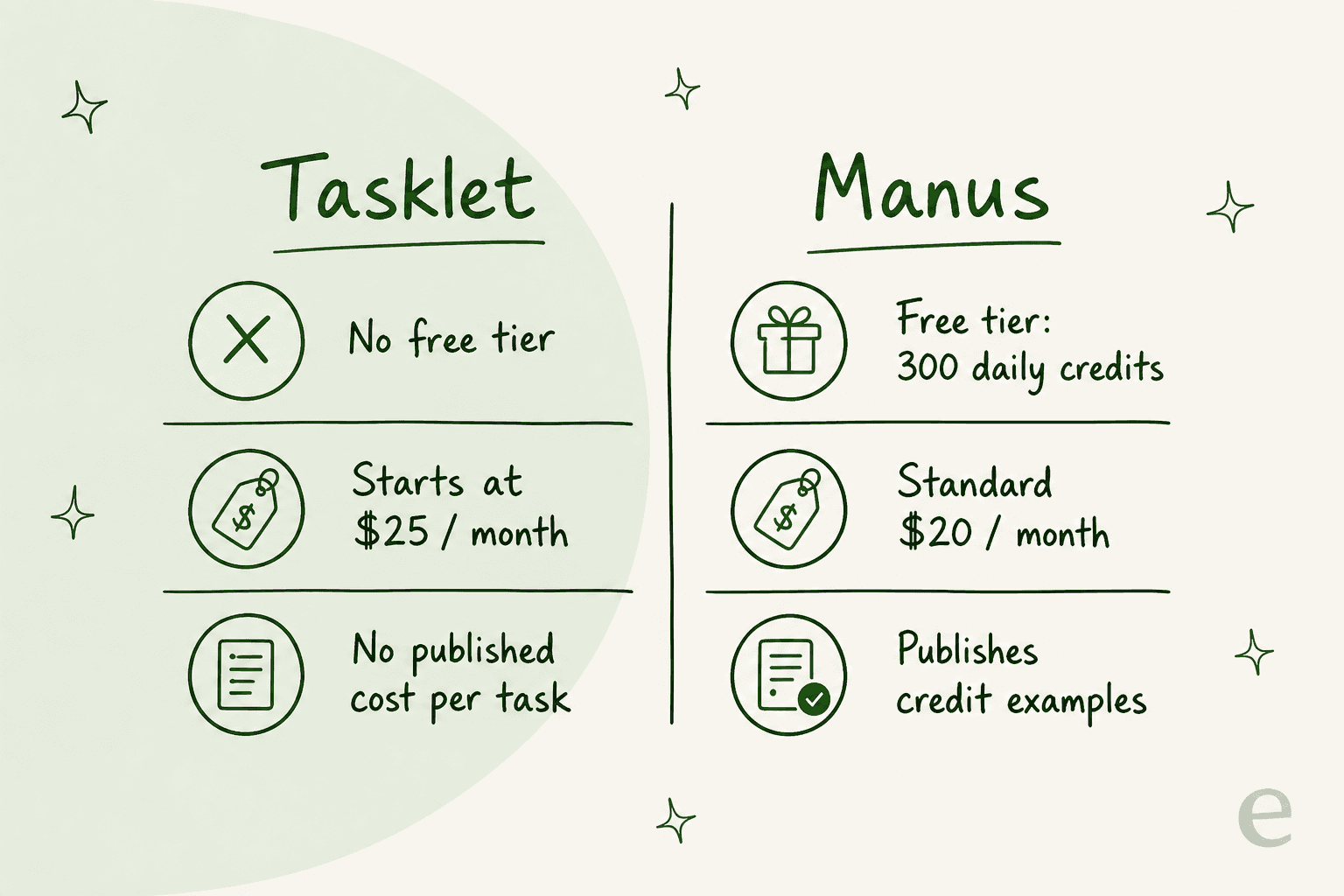
Tasklet dropped its free tier entirely this year, so you start on a paid plan. Every plan adds 600 daily bonus credits on top of the monthly allowance, bills teams at the org level with no per-user fee, and shares one credit pool.
| Tasklet plan | Monthly | Monthly credits | Notable |
|---|---|---|---|
| Starter | $25 | 10,000 | Unlimited automation runs, agent web browser, email support |
| Pro | $100 | 40,000 | Everything in Starter, for power users |
| Custom | from $250 | 100,000 (up to 4M) | Adds live video support; self-set ladder to $10,000/mo |
| Enterprise | Contact sales | custom | Custom compliance and volume |
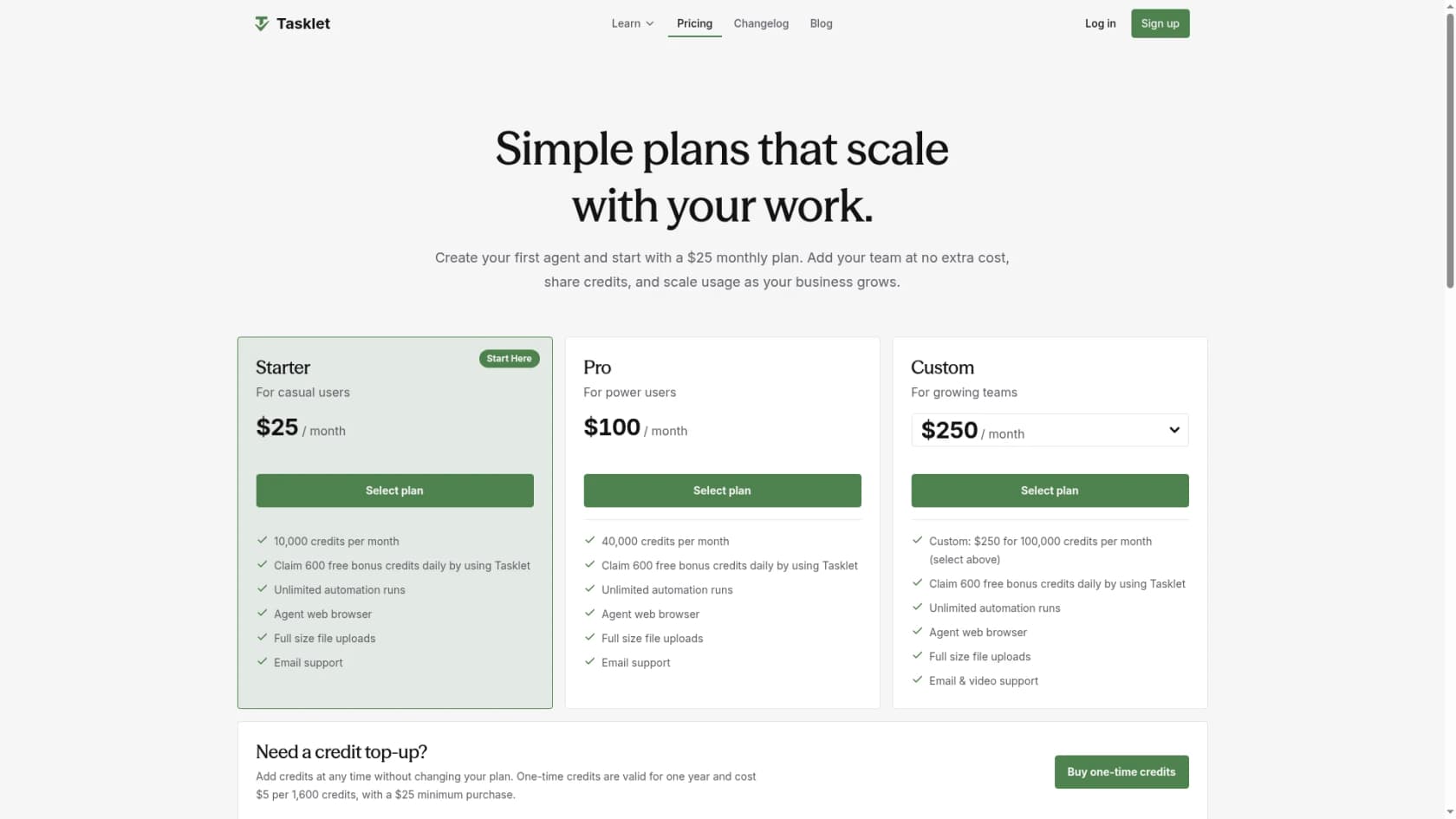
The problem is the credit itself. Tasklet does not publish how many credits any given task costs. Its own help text says the cost "depends on factors like task complexity, how much context and data are involved, which tools and connections are active, automation frequency, and the intelligence level you choose," with browser use and higher intelligence levels burning fastest. So $25 buys 10,000 credits a month, but whether that is 500 tasks or 50 is something you only learn by running them. Monthly credits do not roll over; one-time top-ups run $5 per 1,600 credits, are valid a year, and are spent last. Tasklet does refund within 14 days up to $250, which softens a bad first month.
Manus prices on credits too, but keeps a free tier and, to its credit, publishes worked examples:
| Manus plan | Monthly | Monthly credits | Notable |
|---|---|---|---|
| Free | $0 | 300 daily | 1 concurrent, 2 scheduled tasks, Lite model only |
| Standard | $20 | 4,000 | 20 concurrent, 20 scheduled, Wide Research |
| Customizable | $40 | 8,000 | Self-set credit ladder |
| Extended | $200 | 40,000 | Heaviest usage, batch production |
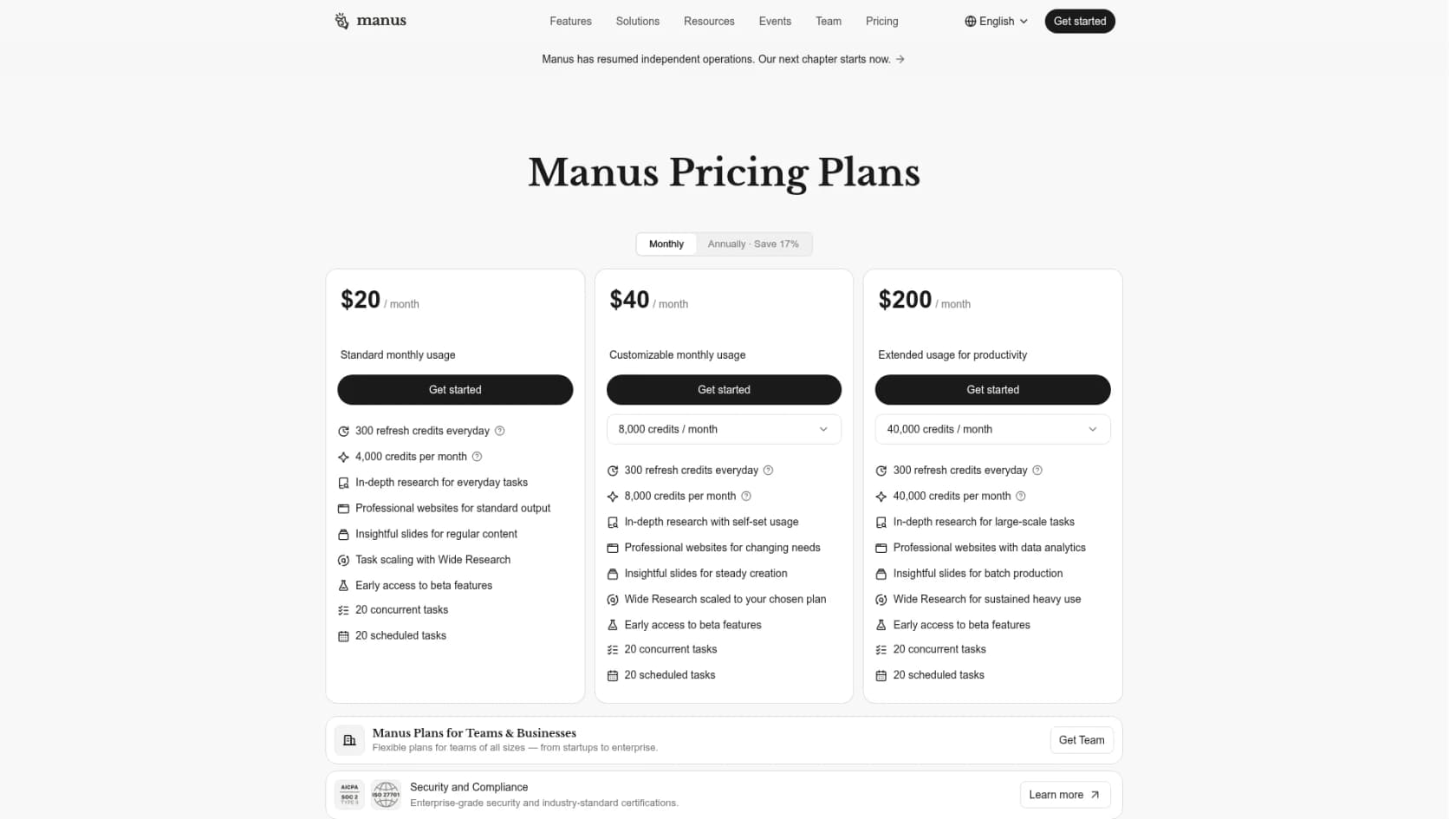
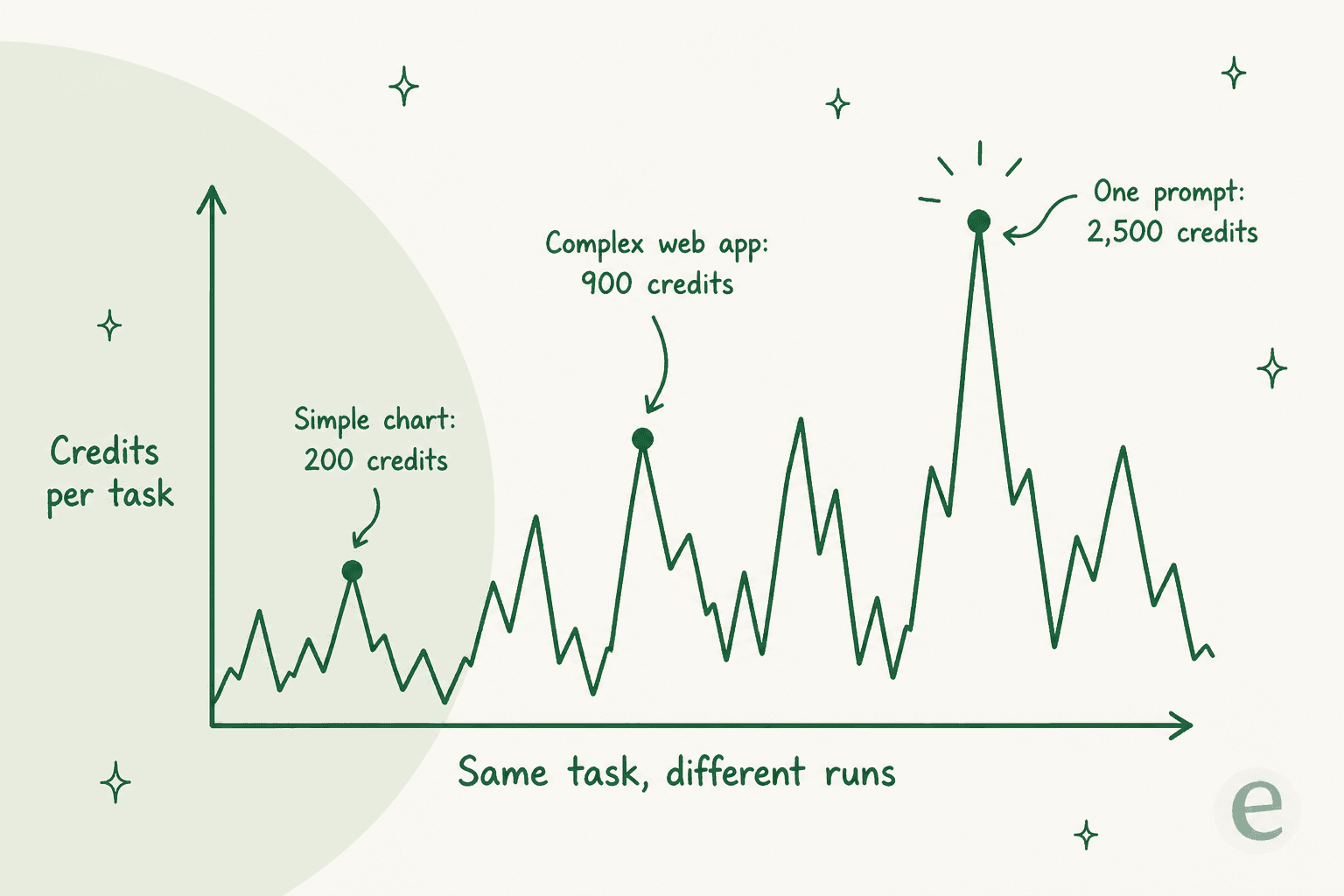
Manus at least gives you a map: its docs peg a simple chart at roughly 200 credits and a complex web app at around 900, so a $20 plan works out to something like 20 charts or a handful of complex builds a month. That is more honest than Tasklet's silence. But the credit still floats with task complexity, and as the community section shows, a single prompt can burn far more than you expect. The chart below is the shape of the risk in both tools: the same kind of task costs wildly different amounts run to run.
If you want the AI-agent-vs-human cost math for a support context, or a way to measure AI support ROI, a flat per-task model is the cleaner comparison, because it prices the work done rather than an unlabelled compute meter.
What real users say
Both communities are still forming, and neither product has a meaningful G2, Capterra, or Trustpilot footprint yet, so the honest sources are Hacker News, Reddit, and X. The recurring theme for Manus is credit burn.
"I gave it a simple excel task... consumed over 2500 credits! pathetic."

"3,000+ credits gone. It failed completely and told me to go ask my developer."
It is not all negative, and the flip side is worth quoting fairly: for the right heavy task, the same credit spend reads as a bargain.
"Spent ~5000 credits on a single prompt... totally worth it! The agents worked 4-5 hours."
Tasklet is newer and quieter, and the sharpest early question in its own launch thread is the one every buyer should ask about a generalist agent, whether it is doing something a cheaper tool already does:
"How is this different from Zapier?"

That thin footprint cuts both ways. There is not yet a pile-on about runaway costs for Tasklet the way there is for Manus, but there is also no deep body of independent, at-scale reviews to lean on. When a product does not publish a per-task cost and the community is still forming, "try it on a small budget first" is the only honest advice.
Where each one fits
Put the three side by side and the map is clear. Manus is a one-shot generalist: best when the deliverable is a self-contained artefact you want built from a prompt. Tasklet is an always-on generalist: best when you want a fleet of recurring automations wired across your stack without a flowchart. Both are generalists you supervise. A scoped teammate, like the ones in our best AI helpdesk software and AI agents for customer service roundups, sits in a different quadrant entirely.
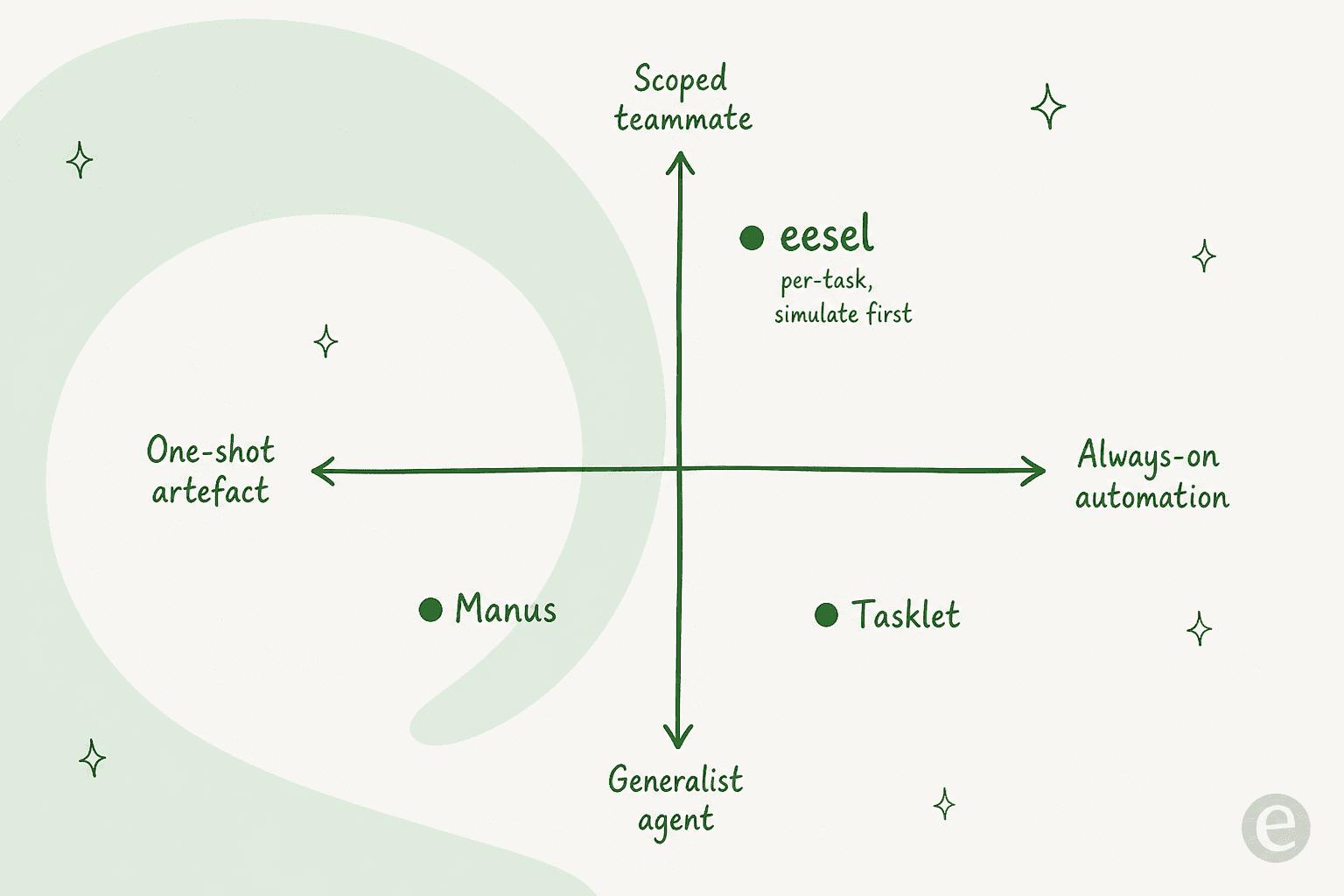
If your job is open-ended, research, prototyping, one-off builds, a generalist is the right call. You can browse the wider field in our guides to the best no-code bot builder and no-code AI agent builders, plus the classic Zapier vs IFTTT framing that Tasklet is riffing on.
You can also see how each stacks up on its own: our Manus review and Zapier AI breakdown go deeper on the builder side. But if the job is an ongoing process with a customer on the other end, the generalist's biggest weakness, no way to test it on your real data first, becomes the whole story, the same gap that separates a real AI agent from a rule-based chatbot.
Where eesel fits: hire the teammate, not the tool
If you got this far because you are weighing an autonomous agent for support or content, the short version is this: hire the teammate built for the job instead of supervising a generalist and guessing at the meter. eesel is an AI teammate platform, and instead of a blank agent you configure from scratch, you hire ready-to-work teammates for specific jobs, today an AI helpdesk agent and an AI blog writer. Each arrives with the skills, integrations, and company context for its role.

The AI helpdesk teammate joins the Zendesk, Freshdesk, or Gorgias queue you already run, trains on your past tickets and help center, and does the one thing Tasklet and Manus cannot: it simulates against your historical tickets so you see how it will perform before it answers a real customer.
It only handles the tickets it is confident about and leaves the rest, with clean human handoff on the ones it should not touch, which is exactly the confidence gate that DTC supplements lead was asking for. Under the hood it does the ticket classification and routing you would otherwise script by hand. One customer, Gridwise, saw eesel resolve 73% of tier-1 requests in the first month. And the pricing is the opposite of an unlabelled credit meter: a flat rate of about $0.40 per ticket, so you pay for work done, not a seat or a compute meter you cannot forecast.
Another customer put the build-vs-buy choice better than any pitch could. "We could try to write our own LLM application but we didn't want to invest our time into that," Karel from GENERAL BYTES told us. "We wanted something that we would not have to maintain." That is the real trade against a generalist agent: a blank canvas is powerful, but someone has to keep supervising it. Try eesel with $50 of free usage and two free blog generations, or book a demo to see the simulation run on your own tickets first.
Frequently Asked Questions
What is the difference between Tasklet and Manus?
Tasklet runs always-on agents inside its own cloud sandbox and connects to your tools through their integrations, so it is built for recurring automations across your stack. Manus takes a single prompt and builds a whole artefact end to end, like a website or a slide deck. Both are general-purpose autonomous AI agents that bill by the credit, rather than job-specific tools.
How much does Tasklet cost, and how do credits work?
Tasklet no longer has a free tier: you start on Starter ($25/10,000 credits), then Pro ($100/40,000) or Custom (from $250/100,000, scaling to 4M). Every plan adds 600 daily bonus credits and charges no per-user fee. Tasklet does not publish how many credits a task burns, so the real cost depends on task complexity, browser use, and the intelligence level you choose. That is the load-bearing caveat in any Tasklet pricing comparison.
How much does Manus cost in 2026?
Manus keeps a free tier (300 daily credits) and prices paid plans by the credit: Standard ($20/4,000), Customizable ($40/8,000), and Extended ($200/40,000). Manus does publish worked examples (a chart around 200 credits, a complex web app around 900), so its Manus pricing is more transparent than Tasklet's, though a single heavy task can still burn thousands of credits.
Is Tasklet or Manus cheaper?
On the sticker, Manus starts cheaper ($0 free, then $20) while Tasklet starts at $25 with no free tier. But the honest answer is that neither publishes a firm cost per finished task, so the cheaper option depends entirely on how many credits your real work burns. Run a small budget on each before you commit.
Can Tasklet or Manus run a customer support queue?
Both can be pointed at a helpdesk, and Tasklet even demos a support agent that drafts replies. But neither is a purpose-built support tool: there is no dry run against your historical tickets and no published resolution rate. For a scoped alternative, see our roundup of the AI agents for customer service and how an AI copilot for customer service starts safely in draft mode.
Is Manus still owned by Meta?
No. Meta acquired Manus in December 2025, but Manus formally resumed independent operations on September 1, 2026, under its founding team. Some user data was deleted during the separation, which is why the site still shows an account-restore prompt. The product itself is whole and transacting again.
Who makes Tasklet AI?
Tasklet is built by the team behind Firebase and is a Y Combinator company. Its pitch is "IFTTT for the agentic age": instead of a rigid flowchart, an LLM decides what to do at each step from plain-text instructions.
Do Tasklet and Manus have an API or CLI?
Manus ships a public API (v2), and every Tasklet agent runs in a sandboxed command-line environment that connects via custom HTTP and MCP. For support specifically, eesel exposes a real CLI and MCP server for headless control.


Article by
Kurnia Kharisma Agung Samiadjie
Kurnia is a software engineer and writer at eesel AI with two years of SEO experience, writing about AI tools, helpdesk software, and customer support. He pairs a developer's understanding of how these products are built with search-driven research into what actually ranks and resonates with the people searching for them.