Where I am coming from
I build AI agents for a living, mostly ones that work live support queues, so I read a launch like Grok Bot's through one lens: what happens the first time it is wrong in front of a real customer. I have watched a confident-sounding bot invent an answer into a live ticket because the knowledge base came back empty, and nobody caught it until a customer did. That scar is why every rollout I ship now gets simulated against historical tickets before it touches anything live. On one real-traffic trial against an e-commerce inbox, that dry run came back 93% accurate on triage and 7% factually wrong on drafts, and we knew both numbers before a single customer saw a word.
I lead with that because it is the exact thing Grok Bot and Manus do not give you. Grok Bot's own homepage animates the prompt "Sign in to Zendesk so I can work the support queue," and its docs are blunt that a test run "performs real work". Manus runs for hours and bills you for the privilege whether the output is right or not. Both are impressive. Neither was built to be careful. Let me walk through what each one actually is, then where that leaves you.
What Grok Bot is
Grok Bot is xAI's "AI teammate" app, announced on 11 August 2026 and now generally available. Each Bot is a persistent, named worker that gets its own cloud computer, signs into the apps you use, and drives them through their normal interfaces. The pitch is coverage: because a Bot works the UI the way a human does, it can reach "platforms with no clean API or MCP." It runs on grok-4.7, and it lives on macOS, Windows, Linux, iOS, and Android.
The mechanism is the whole story. A Bot never holds your password: it hands you the screen, you type the credential, passkey, or 2FA code, and then hand control back. The signed-in browser session then persists on the computer. The catch, stated twice in xAI's own docs, is that all of your Bots share one cloud computer and can reuse each other's sessions: "Do not use separate Bots as a security boundary." Cross-user isolation was hardened to dedicated Firecracker microVMs, so one person cannot reach another's machine, but within your own account every Bot sees every file and every logged-in tab.
Grok Bot ships eight named roles (Sales Outbound, Talent Scout, Paid Media, Expense Manager, and others) plus a new Bot Marketplace of installable connectors and community-built Bots. There is still no first-party support role. Support is now a use-case guide from September 2026 that shows a generalist Bot pointed at a helpdesk, with the honest footnote that its numbers are "illustrative." You can teach a Bot a task by letting it watch you work once, capped at ten minutes, and it saves that as a routine.
What Manus is
Manus is an autonomous, general-purpose agent with a different philosophy: "Less structure, more intelligence." You type a goal into a single prompt box ("build me a website," "research this market," "make a slide deck"), and it plans and executes the whole multi-step task on its own inside a cloud computer, then delivers the finished artefact. It does not just draft, it builds and ships the thing.
Manus's ownership is the plot twist most coverage still gets wrong. Meta acquired Manus in December 2025, but Manus formally resumed independent operations on 1 September 2026 under its founding team. The separation meant deleting some user data to meet regulatory requirements, which caused real disruption (backups, a restoration portal, cancelled accounts). If you evaluated Manus during that window and wrote it off as "the Meta thing that broke," it is worth another look: the product is whole and transacting again, still on the Manus 1.6 model family (there is no "Manus 1.7" model, despite the desktop app version number).
The flagship features lean into the "does the whole job" idea: Wide Research fans a task across many parallel sub-agents, and the browser operator drives a real browser when a task needs the web. Every paid plan runs 20 concurrent and 20 scheduled tasks, and there is now a public API (v2) for developers.
How they actually work: two different bets
Strip away the marketing and the split is architectural. Grok Bot reaches into your world: it logs into your accounts and operates your software, so the coverage is huge but the blast radius is your real data and your real sessions. Manus keeps the work in its world: an isolated cloud VM it controls end to end, so it is safer to point at but it only touches your tools when you connect them, and it meters every minute of compute as credits.
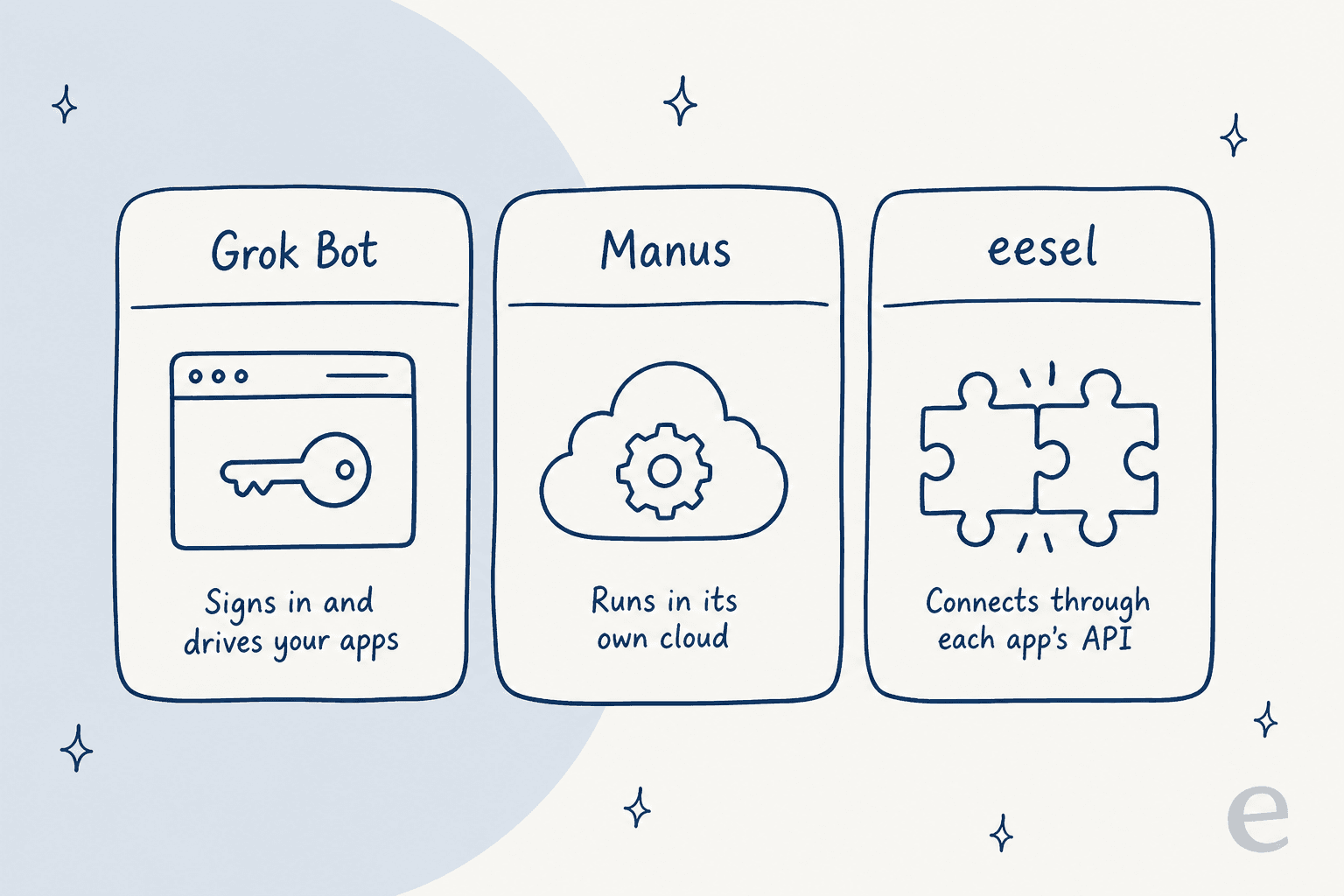
That distinction matters more than any feature checklist. A UI-driving agent is the right tool when you need to automate a legacy system with no API, the honest place where Grok Bot's design wins and where classic workflow automation and call center RPA have always lived. A cloud-native builder like Manus is the right tool when the deliverable is a self-contained artefact and you would rather not hand any agent the keys to your accounts. The trouble starts when either one is asked to run an ongoing, high-stakes process (a support queue, a published content calendar) where being usually right is not good enough.
One more thing worth naming plainly, because Grok Bot users keep raising it: the model lock-in. Grok Bot only runs on Grok models, and that annoyed enough people that someone is building an open-source clone to run the same idea against other model subscriptions. If you want the "agent teammate" pattern without the account and model commitment, the best open-source AI agents and no-code agent builders are worth a look, as is the closest commercial analogue, Claude Cowork.
Pricing: a seat, a credit, or a task
The two products price on completely different units, which makes a head-to-head number almost meaningless until you know what you are actually buying.
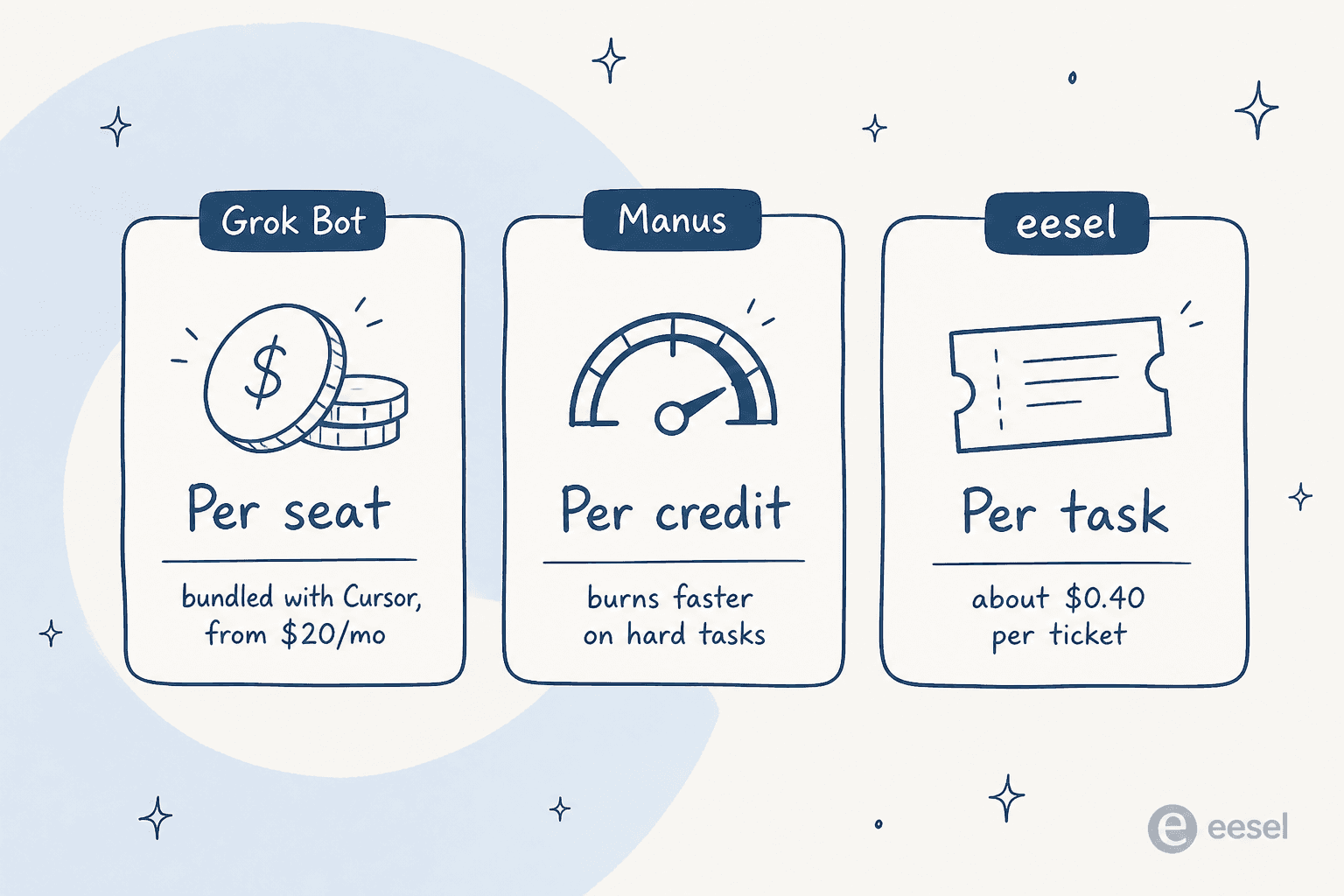
Grok Bot no longer sits behind a single $200 door. It is now bundled into your Cursor or SuperGrok subscription, so you pay for a seat and Grok Bot rides along:
| Grok Bot access path | Price | Notes |
|---|---|---|
| Cursor Pro | $20 / month | Entry path; Grok Bot included |
| Cursor Pro+ | mid-tier | Included |
| Cursor Ultra | $200 / month | The old launch gate, now one option of several |
| SuperGrok | $30 / month | Grok Bot access via an individual link |
| SuperGrok Plus / Heavy | $100 / $300 / month | Included |
| Enterprise | Contact sales | Adds audit logs, Action Recording, SCIM |
There is no standalone free tier, usage "resets weekly," and there is no published number behind "Extended limits on AI tokens." So the sticker price starts low, but the real cost is a token allowance you cannot see until you hit it, a point Grok Bot users make often (one noted the Bot "consumes more quota because it uses their infra instead of your computer").
Manus prices on the credit, and every paid plan layers a monthly allowance on top of 300 daily refresh credits:
| Manus plan | Monthly | Monthly credits | Notable |
|---|---|---|---|
| Free | $0 | daily only (300/day) | 1.6 Lite only, 1 concurrent task |
| Standard | $20 | 4,000 | Full 1.6 model family, 20 concurrent |
| Customizable | $40 | 8,000 (self-set ladder) | Adjustable credit volume |
| Extended | $200 | 40,000 | Adds a free dedicated Cloud Computer |
| Team | from $20 / seat | shared pool | SSO ($150 flat, waived at 30+ seats), SOC 2 |
| Enterprise | Contact sales | - | Enterprise security and compliance |
The credit is where the value question lives. Manus publishes real worked examples: a data-viz chart burns 200 credits in 15 minutes, a wedding webpage 360 credits, and a complex web app 900 credits over 80 minutes. Against the $20 / 4,000-credit tier, that is roughly 20 charts, 11 websites, or 4 complex apps a month, and a long or looping task can blow through the lot. Website builds carry a second usage-based meter for hosting on top of the subscription. Manus does refund credits for tasks that fail on its end, which softens the worst-case, but the predictability problem is real.
If you want the AI-agent-vs-human cost math for a support context, or a way to measure AI support ROI, the per-task model further down is the cleaner comparison, because it prices the work done rather than access or compute time.
What real users actually say
I lean hard on primary and community sources here, because both products are young enough that the marketing outruns the reality. The signal splits cleanly by product.
For Grok Bot, six weeks of real use has produced a real, divided verdict. The praise is about the teammate UX and the "infinite tokens" feeling on the Ultra plan; the criticism is about reliability on multi-step, real-tool work. The sharpest version of the reliability point:
"Grok 4.6 made more mistakes than SOL or Opus overall. Gave up a lot. And in my opinion, the rate of mistakes is kind of more important than how brilliant it is."

That "rate of mistakes" framing is exactly the gap left by having no published task-accuracy number and no dry run. The value verdict is just as split, from "$200 for 3-4 days of mediocre and frustrating work" on one side to a Cursor Ultra subscriber who gets "infinite tokens with that plan, plus grok bot, which I really like" on Hacker News. And the shared-computer design keeps getting flagged by operators, not just critics:
"Your bots do not each get their own computer. The docs are explicit: they share one persistent cloud computer, each with its own screen."

For Manus, the dominant theme is not reliability, it is credit burn. It comes up again and again, usually paired with a task that failed after spending the credits:
"Used 3,000+ credits on a task they said the AI could handle (replicating a website). It failed completely and told me to go ask my developer."

"I asked it to a simple excel task, and frankly the output was well below average and it consumed over 2500 credits! It was really pathetic!"
To be fair to Manus, when a task lands, people are thrilled, and the website builder in particular gets repeat praise. The strongest positive I found is from a research scientist, not a marketer:
"I just spent ~5000 credits on a single prompt at @ManusAI, but it was totally worth it! The agents worked for 4-5 hours & identified a bunch of drugs to activate an immune cell type I've been working on!"
Read those together and a pattern falls out: both agents are capable of remarkable single runs and both are unpredictable enough that people meter their trust carefully. That is fine for a one-off deck or a research sprint. It is a problem when the "task" is a customer waiting on a correct answer.
Where each one fits, and where neither does
Here is the map I would draw. Grok Bot and Manus are both general-purpose agents; they differ mostly on where they run. eesel sits in a different quadrant entirely, because it is not trying to be a general worker at all.
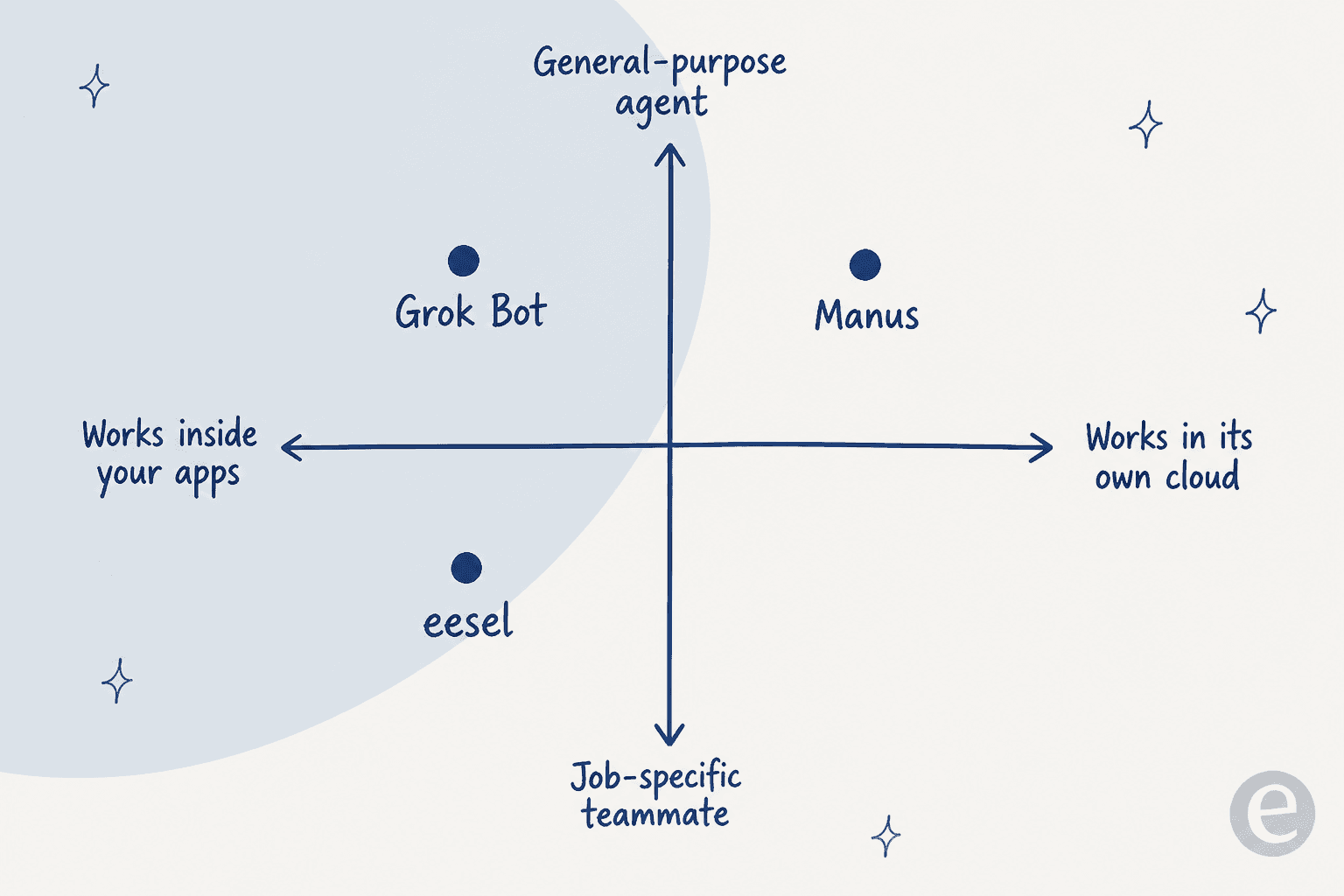
The way I think about it, borrowing the usual framing: Grok Bot and Manus are infrastructure, a smart worker you point at a task. eesel is the employee, a ready-to-work teammate hired for a defined job, arriving with the skills, integrations, and company context for it. The current roster is two teammates: an AI helpdesk agent that joins your existing support queue, and an AI blog writer that researches and drafts long-form content. You do not hand either one your credentials and a task list and hope; you plug it in and it works from day zero.
That is the whole difference for a job like agentic customer service. A general agent logged into your helpdesk has exactly one mode: it works the queue. But most support leads I talk to want the opposite, an agent that touches only the tickets it is confident about and leaves the rest alone. A CX lead at a DTC brand put the requirement to me almost word for word: "I need an AI who is only handling the tickets that it's confident to handle and all the other ones, leave them alone." A persisted, signed-in browser session has nowhere to put that constraint. A scoped teammate does: confidence thresholds, ticket classification and exclusion, and clean handoff to a human.
The guardrails are where the general-purpose agents come up short for production work, and it is worth being precise rather than sweeping:
| Guardrail | Grok Bot | Manus | eesel |
|---|---|---|---|
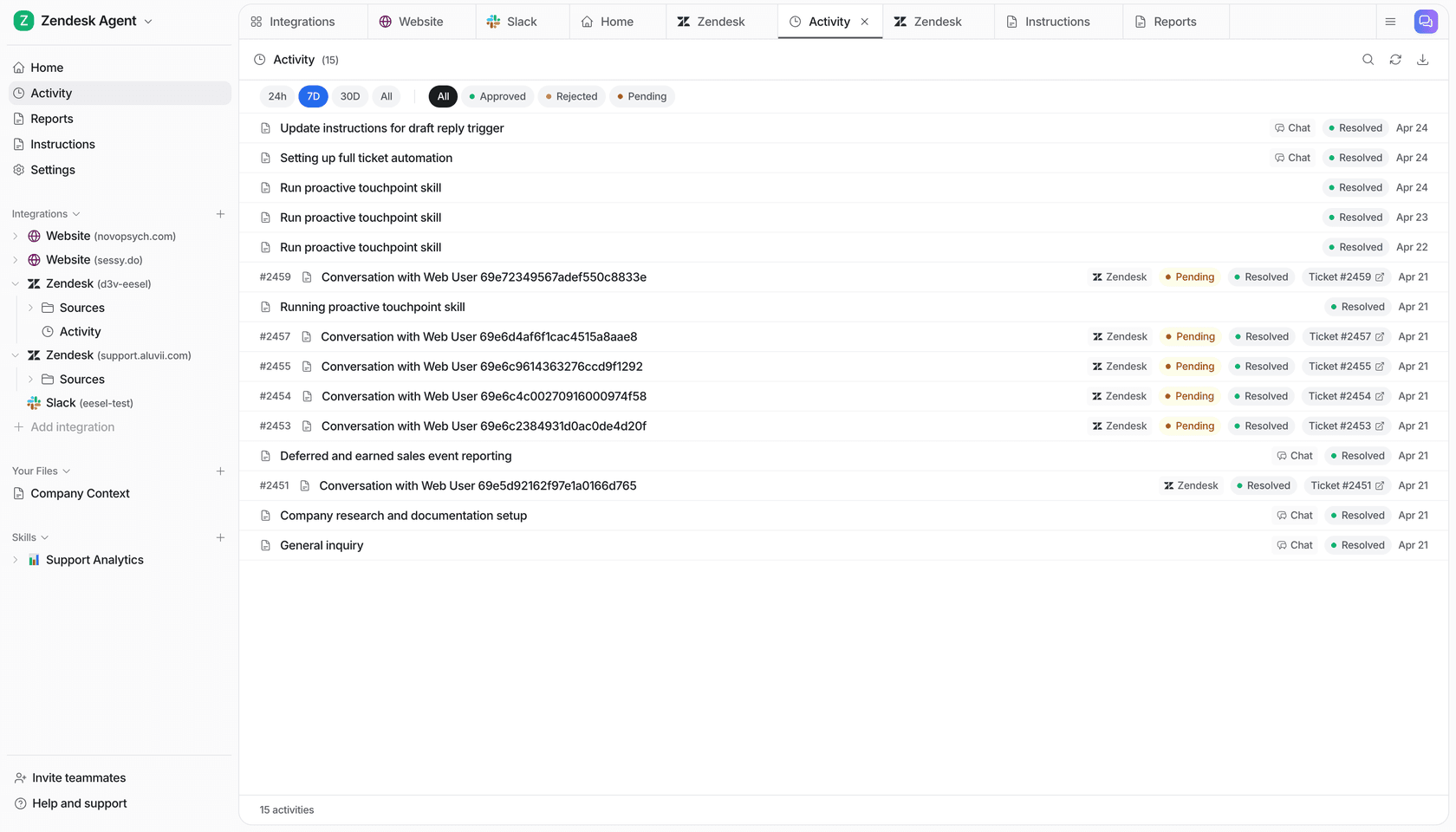
| Dry run against your real data | No ("a test run performs real work") | No | Yes, simulation on historical tickets |
| Per-response audit trail | Enterprise-only "Action Recording", off by default | Task logs only | Yes, every run logged in Activity |
| Scope to specific ticket types | No | No | Yes |
| Published accuracy / resolution rate | None | None | Resolution rate reported per workspace |
| Approvals on write actions | Auto Review + prompts | Human steering | Yes, eesel approvals |
None of this makes Grok Bot or Manus bad. It makes them the wrong shape for a queue you cannot afford to be casually wrong in. Where Grok Bot's UI-driving earns its keep, in automating a tool with no API, it is a real capability eesel does not try to match. I would just not put either one in front of a live customer on day one.
If you care about the CLI and headless control
Both Grok Bot and Manus get pitched to developers, so it is worth being exact about the programmable surface, because it is uneven. Manus ships a public API (v2), which is a real, documented way to trigger tasks from your own code. Grok Bot, despite being the more "agentic" product, has no public API or CLI to create or drive Bots; the "create API key" links point at xAI's general model API, not at Bot control. The closest programmatic seams are event-triggered routines (a Slack message can start a routine) and MCP connectors.
If the terminal is where you actually live, this is where eesel is unusually deep for a support-and-content product. It ships a real CLI (@eesel/cli), and the docs are explicit that everything you can do in the dashboard, you can do from the terminal. It is built for agents as much as people: eesel activity lists every run newest-first as JSON, eesel approvals is the human-in-the-loop gate, and crucially --dry-run prints the exact server call a write would make without sending it, the sandbox neither Grok Bot nor Manus offers. Every workspace is also an MCP server, so coding agents like Claude Code, Codex, or Cursor can drive the same teammate, and webhooks plus Network Access round out the headless workflow. It is not a marketed REST CRUD API, and I would not claim it is; it is a CLI, an MCP server, and webhooks, which is the honest shape of it.
Try eesel
If you got this far because you are weighing an autonomous agent for support or content, the short version is this: hire the teammate built for the job instead of supervising a generalist. eesel's AI helpdesk agent joins the Zendesk, Freshdesk, or Gorgias queue you already run, trains on your past tickets and help center, and (the part Grok Bot and Manus cannot do) simulates against your historical tickets so you see how it will perform before it replies to a real customer. Pricing is per task, about $0.40 per ticket, with $50 of free usage and two free blog generations to start, so you are paying for work done, not a seat or a credit meter.
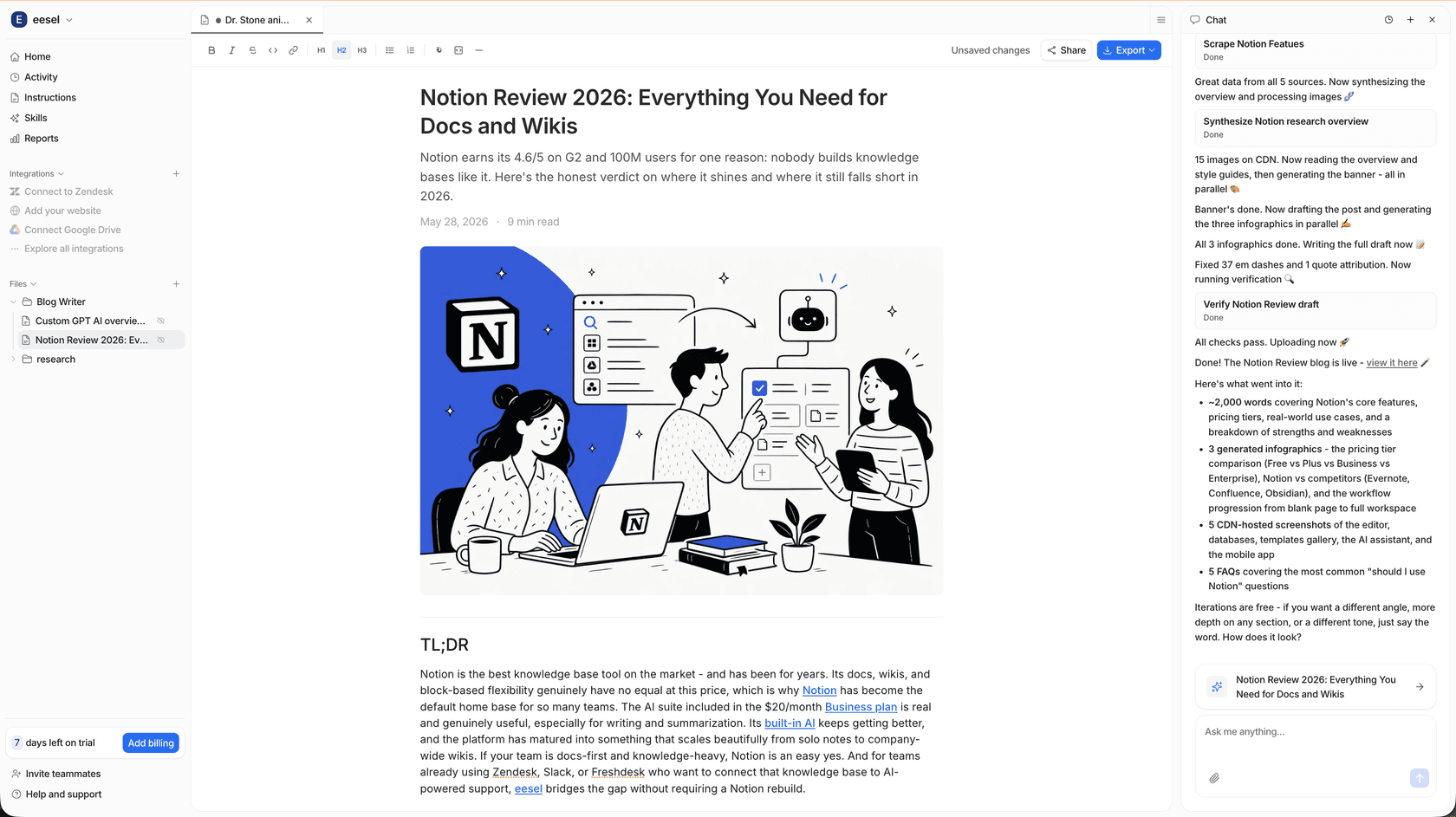
And if content is your job to be done, the other teammate on the roster is the AI blog writer: it finds topics, does real research with citations, and drafts in your voice, the scoped version of what Manus does when you ask it for a webpage. You can try eesel free and have a teammate working this week.
Frequently Asked Questions
What is the difference between Grok Bot and Manus?
Grok Bot signs into the apps you already use and drives their screens like a person would, so it can reach tools with no API. Manus instead runs a task end to end inside its own cloud computer and hands back a finished artefact like a website or deck. Both are general-purpose autonomous AI agents rather than job-specific tools.
How much does Grok Bot cost in 2026?
Grok Bot is now bundled with every paid Cursor plan (Pro from $20/month up to Ultra at $200/month) or any SuperGrok tier ($30, $100, or $300/month), rather than the old $200-only gate. There is no standalone free tier, and usage resets weekly. See our note on xAI pricing for how the plans stack up.
How much does Manus cost, and how do credits work?
Manus bills by the credit: Free ($0, daily credits only), Standard ($20/4,000 credits), Customizable ($40/8,000), and Extended ($200/40,000). A single complex task can burn 900 credits or more, so the real cost depends heavily on task complexity, which is the top theme in Manus community reviews.
Can Grok Bot or Manus run a customer support queue?
Both can be pointed at a helpdesk, but neither is a purpose-built support tool: there is no dry run against your historical tickets and no published resolution rate. For a scoped alternative, see our roundup of the AI agents for customer service and how an AI copilot for customer service starts safely in draft mode.
Is Manus still owned by Meta?
No. Meta acquired Manus in December 2025, but Manus formally resumed independent operations on September 1, 2026, and the founding team leads it again. Some user data was deleted during the separation, which caused a wave of account disruption.
Do Grok Bot and Manus have an API or CLI?
Manus ships a public API (v2), but there is no public API or CLI to create and drive Grok Bots (only event-triggered routines and MCP connectors). By contrast, eesel exposes a real CLI and MCP server for headless control.


Article by
Alicia Kirana Utomo
Kira is a writer at eesel AI with a Computer Science background and over a year of hands-on experience evaluating AI-powered customer service tools. She focuses on breaking down how helpdesk platforms and AI agents actually work so that support teams can make better buying decisions.