

What SupportLogic actually is
SupportLogic calls itself "The AI Infrastructure for Customer Experience," and the running thesis on its homepage is blunt: "Support CRMs were built for tickets. The next decade belongs to agents." The pitch is that it is a substrate that sits underneath your systems, powered by 16 ambient AI agents (sentiment, escalation, routing, coaching, knowledge, voice, account health, and more) running on three foundation agents.
The part worth internalising is where it sits in your stack. SupportLogic is not competing with your helpdesk. It is reading from it. Every ticket, chat message, and call flows into SupportLogic, which extracts signals and pushes insights back out (escalation alerts, QA scores, coaching pointers). Your agents still write every reply.
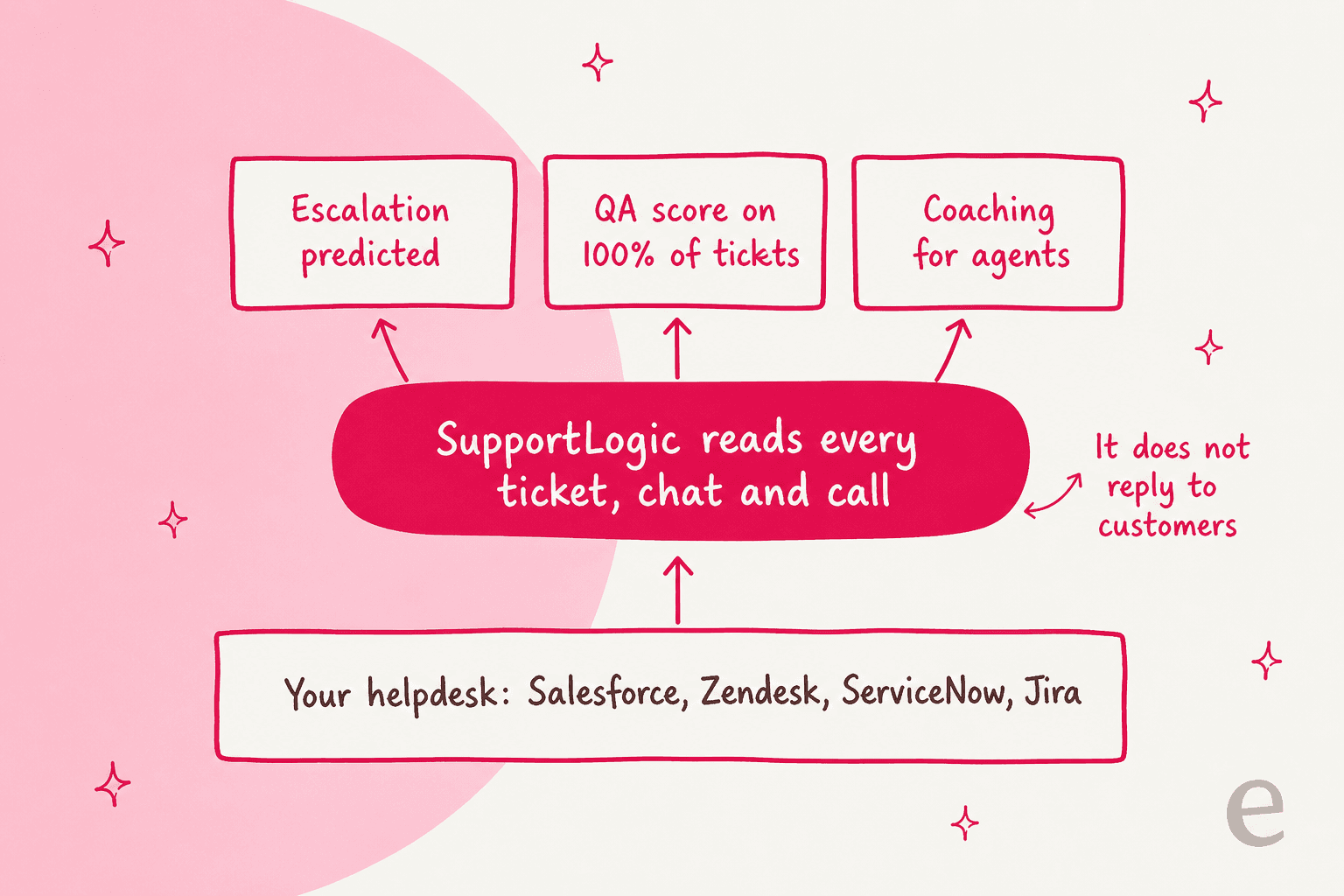
That is a real architectural choice, and it is the right one for the buyer they target. A large enterprise with Salesforce Service Cloud and 300 agents is not ripping that out. It wants an intelligence layer that makes the existing setup smarter, and SupportLogic is designed to be exactly that, with "no rip-and-replace" as an explicit promise. That instinct is common across enterprise helpdesk software buyers, who add on rather than start over. The customer list backs up the target market: Databricks, CrowdStrike, Fivetran, Qlik, Rubrik, Elastic, CyberArk, Proofpoint, and NTT Data, among others. GitLab even documents SupportLogic in its public support handbook as an internal tool, which is a nice bit of real-world proof that it is genuinely in daily use.
Reading the room: sentiment and escalation prediction
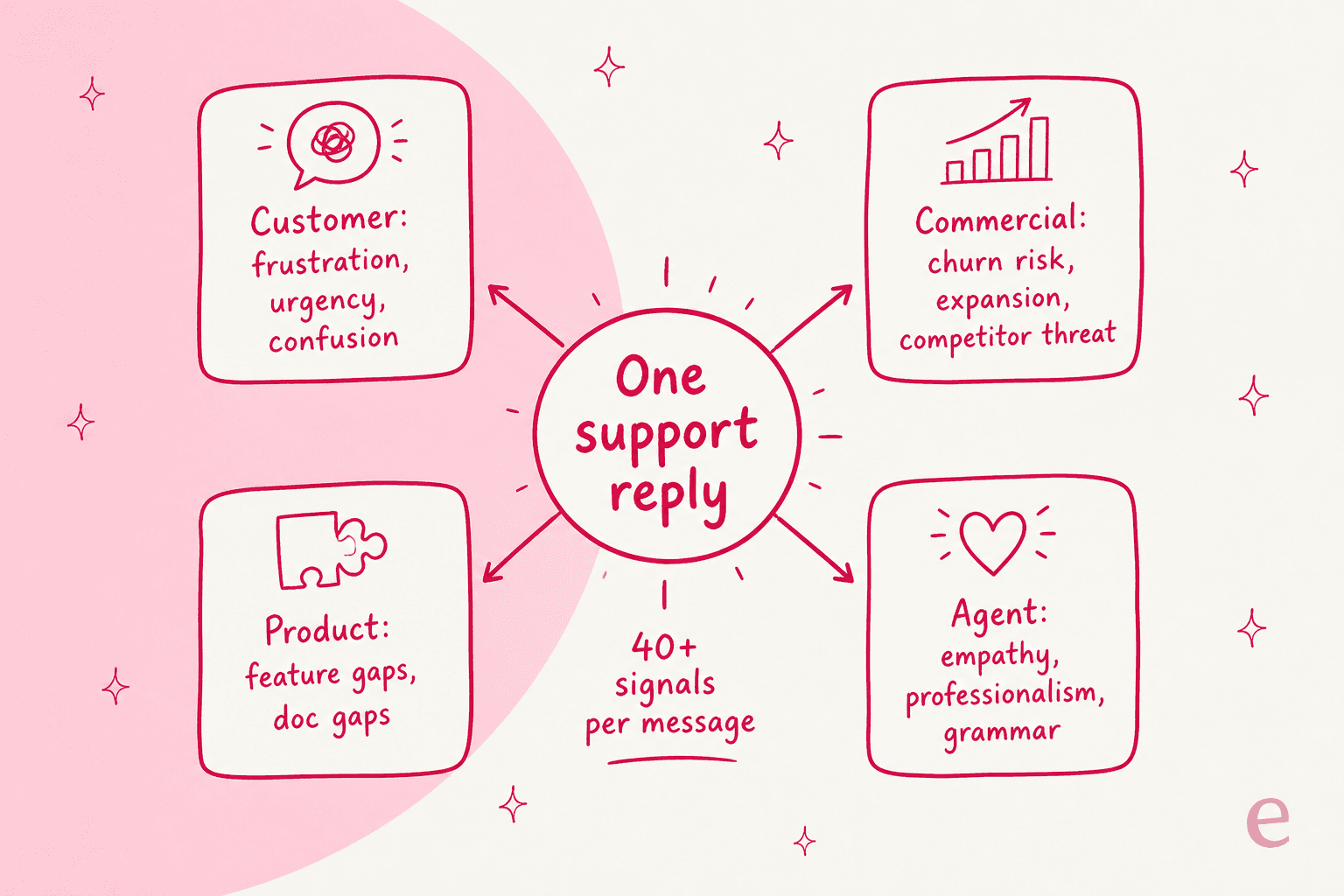
This is the original product and still the core. SupportLogic's Signal Extraction Agent pulls 40+ signals from every support interaction across four dimensions: the customer (frustration, urgency, confusion), the commercial angle (churn risk, expansion, competitor threat), the product (feature and documentation gaps), and the agent (empathy, professionalism, grammar). It scores every reply, not just the ticket as a whole.
On top of that sits the Escalation Agent, which predicts which cases are about to be escalated to an executive before anyone formally files anything, using historical patterns plus sentiment plus SLA context. This is the feature the product is known for, and predicting AI escalation well is genuinely hard. SupportLogic reports that its sentiment and escalation agents reduce escalations by around 40% on average, and it makes the case with a memorable stat: escalations cost roughly three times more to resolve than a regular case.
The customer proof here is the strongest part of the pitch, and it is refreshingly specific. On its homepage, SupportLogic reports Salesforce cut escalation rates 56% and now runs under a 2% escalation rate, Basware cut escalations 80%, NICE cut escalation rates 35%, and Certinia dropped both its escalation rate 30% and time-to-resolution 28%. These are vendor-reported numbers attributed to named support VPs, so treat them as case-study figures rather than independent benchmarks, but the breadth of named logos putting their name to real percentages is more than most tools in this space can show.
What I like about the sentiment work, from a frontline point of view, is that it does the triage a human cannot keep up with. One G2 reviewer put the day-to-day value better than the marketing does:
"Our Support Agents can't be expected to perfectly triage every case they own. SupportLogic does an amazing job of doing this via their Sentiment and Attention scores, allowing the Agent to sort and work according to the largest need. Not only does this make our customers happy and reduce Escalations, but it also reduces the cognitive load on the Support Agents, allowing them to focus on troubleshooting."

That "cognitive load" line is the honest benefit. When you are staring at a queue of 60 open tickets, having the system tell you which three are quietly on fire is real help. It is worth pairing SupportLogic's sentiment work with a good grasp of your own customer service metrics and support workflow, because the scores are only as useful as the actions you wire to them.
Auto QA and coaching, without the 2% sample
The second bundle, Elevate SX, is the QA and coaching product, and it is the one I would flag to any support manager. Its headline is the sharpest framing on the whole site: "QA that covers 100% of interactions, not the 2% manual review can reach." If you have ever run a manual QA program, that number lands, because you know the 2% is real and you know it is not enough.
Auto QA scores every written ticket and every voice call across 54+ ML models for sentiment, tone, professionalism, grammar, resolution, and policy compliance. Two details make it more than a scorecard generator. First, "Grade the Grader" calibrates your human reviewers against each other so a score reflects the agent, not whoever happened to review them. Second, every Auto QA score comes with agentic reasoning that explains which signals drove it, so a "72" is not a mystery number but a breakdown you can coach against.
The Coaching Agent then turns those scores into structured coaching, analysing 100% of an agent's queue against 19 signal types to pick a balanced mix of cases (positive, negative, and neutral) for review, rather than only surfacing the disasters. The Voice Agent extends all of this to phone support with transcription, tonal analysis, and neat touches like hold detection and dead-air detection, connecting to NICE CXone, Genesys, 8x8, Webex, Zoom, and RingCentral.
This is a strong QA suite. If you are evaluating it, my one piece of advice is to be clear-eyed that QA and coaching improve the humans; they do not reduce the volume those humans handle. That is a different lever, and it is worth knowing which one your problem needs. If ticket load is the pain, an AI helpdesk chatbot or better support ticket triage does more for it than a scorecard, and clean ticket tagging helps either way.
The three SX bundles at a glance
SupportLogic packages everything into three bundles, and you buy the package, not individual agents. Here is how they break down.
| Bundle | What it is for | Key agents and features | Standout capability |
|---|---|---|---|
| Core SX | Sentiment and escalation intelligence | Sentiment, Escalation, Prioritization, Routing, Language, Voice, Account Health agents + Data Cloud | Predict escalations before they are filed |
| Elevate SX | QA and agent coaching | Coaching + Voice agents, Auto QA, Manual QA, Custom Scorecards, Grade the Grader, 54+ ML models | Auto QA on 100% of interactions |
| Resolve SX | Knowledge and case deflection | Knowledge Agent | Draft KB articles and deflect repeat cases |
One honest wrinkle worth flagging: on the Core SX page, the intro says seven AI agents while one FAQ still says "five foundational AI agents." It is a small copy inconsistency, not a product problem, but it is the kind of thing you want to nail down in a sales conversation so you know exactly which agents are in the package you are quoted. The Account Health Agent, for instance, scores churn and expansion from 15+ contributing factors across 100% of post-sales interactions, and you would want that confirmed as in-scope before signing.
Under the hood: MCP, the Data Cloud, and the API
For a 2026 review this section matters more than it used to, because SupportLogic has leaned hard into being agent-friendly infrastructure. Everything it extracts is exposed three ways: a Snowflake-native Data Cloud you can query from your warehouse, a REST API, and a native MCP server so tools like Claude, ChatGPT, and Copilot can pull customer context directly. The platform page even lists named MCP tools like supportlogic.account.health and supportlogic.case.signals, and there is a prominent Claude-console integration on the homepage. The Data Cloud extracts data every 6 hours and refreshes the UI every 24 hours, which is worth noting if you expected real-time.
This is genuinely forward-looking, and it is the right architecture. But notice what those MCP tools do: they let another agent read SupportLogic's intelligence. They surface a health score or the signals on a case. They do not let an agent do the support work.
That distinction is exactly where our own approach at eesel differs, and it is worth explaining because it is the same agent-friendly idea pointed at a different job. eesel ships a public CLI alongside its MCP support, and the point of it is to operate the same AI teammate you configure in the dashboard, not just read reports about it. A person can drive it from a terminal, scripts can automate it, and coding agents like Claude Code, Codex, and Cursor can run it directly: inspect a teammate's instructions, send a test question and read the exact JSON response and sources it used, then propose a narrow instruction change for an owner to approve. So where SupportLogic's MCP server is a read surface onto your support signals, eesel's CLI and MCP are a control surface over an AI teammate that actually replies to tickets. If programmatic and headless support workflows are on your roadmap, that is a difference worth sitting with.
SupportLogic also ships CRM widgets (native iframe plugins for Salesforce, Zendesk, ServiceNow, Jira, and Freshdesk) with SSO and bi-directional writeback, so the insights land inside the tools your agents already live in rather than in yet another tab. That is a smart call, and one of the recurring praises in reviews.
Security and rollout
For the enterprise buyer this is table stakes, and SupportLogic covers it well. The compliance list runs SOC 2 Type 2, ISO 27001, GDPR, HIPAA, and FIPS 140-2, plus 2FA and bastion-host access. The architecture is single-tenant VPC (inference runs inside your boundary, with "no multi-tenant LLM shortcuts") and zero-copy (source data is read and normalised without being replicated to shared infrastructure). SupportLogic also claims a track record of zero breaches and zero data loss.
The one number to plan around is time. Onboarding is pitched as "live on your data in 45 days," sometimes framed as about two months. That is fast for an enterprise data integration, and far faster than the 12 to 18 months SupportLogic estimates for building this in-house, but it is not a same-week signup. If your team needs something running this week, that timeline alone rules it in or out.
SupportLogic pricing: what it actually costs
Here is the honest answer: SupportLogic does not publish pricing. The pricing page describes a "hybrid pricing" model that "scales with your business," but every bundle reads "Contact for Pricing," with Contact Sales and Live Demo as the only buttons. There are no tiers, no per-seat numbers, and no free trial.
The one concrete hint is that Elevate SX pricing is "based on agent seats and interaction volume," which tells you the model combines a per-seat component with a usage component. Beyond that, you are looking at an annual enterprise contract negotiated by volume.
| What you get | Published price |
|---|---|
| Core SX bundle | Contact for pricing |
| Elevate SX bundle | Contact for pricing (agent seats + interaction volume) |
| Resolve SX bundle | Contact for pricing |
| Free trial | None |
I will be fair here: for the enterprise accounts SupportLogic targets, quote-based pricing is normal, and nobody buying a platform for a 300-agent org is shocked to book a call. But it does mean you cannot ballpark the cost without talking to sales, and one reviewer specifically flagged "pricing complexities when bundling with integrated platforms." If budget predictability matters to you, it is a real contrast with AI customer service software that publishes transparent per-ticket rates you can model in a spreadsheet before you ever talk to anyone.
What real users say
SupportLogic holds a 4.7 out of 5 across 25 reviews on G2, with 84% at five stars and, notably, zero reviews at three stars or below. That is a strong score, though the small sample reflects the enterprise, low-deal-count footprint rather than broad adoption. It is also the only place with usable independent voice: Reddit, X, Trustpilot, and Capterra all turned up essentially nothing on the product, which is normal for an enterprise tool nobody chats about in consumer communities.
The praise is consistent and centres on the sentiment alerts. One manager framed the whole value proposition neatly:
"By leveraging predictive insights, managers can prevent fires by focusing on the embers. It also allows us to see where improvements can be made and track the performance of our support team over time."
The criticism is worth reading closely, because it is unusually mild. There are no pans; every gripe sits inside a 4.5 or 5 star review. The recurring themes: reviewers want deeper analytics and the ability to export data for cross-org correlation, they want tighter integration with Salesforce and MS Teams (Teams lags Slack), and a couple noted sync latency delaying alerts. On the analytics point, it is only fair to note that SupportLogic has since shipped its Snowflake-native Data Cloud, which is aimed squarely at exactly that "export to our warehouse" request, so that particular gap looks like it is closing. The most substantive limitation quote:
"The least helpful thing about SupportLogic is our inability to analyze the data within SupportLogic deeply. Without the ability to load our data to a data warehouse, we cannot correlate outcomes and experiences across the Customer Support organization. The built-in reporting and analytics are excellent, but much more is desired."
Who SupportLogic is for (and who should look elsewhere)
After going through the whole platform, my read is that SupportLogic is a very good tool that knows exactly who it is for, and is honest about it.
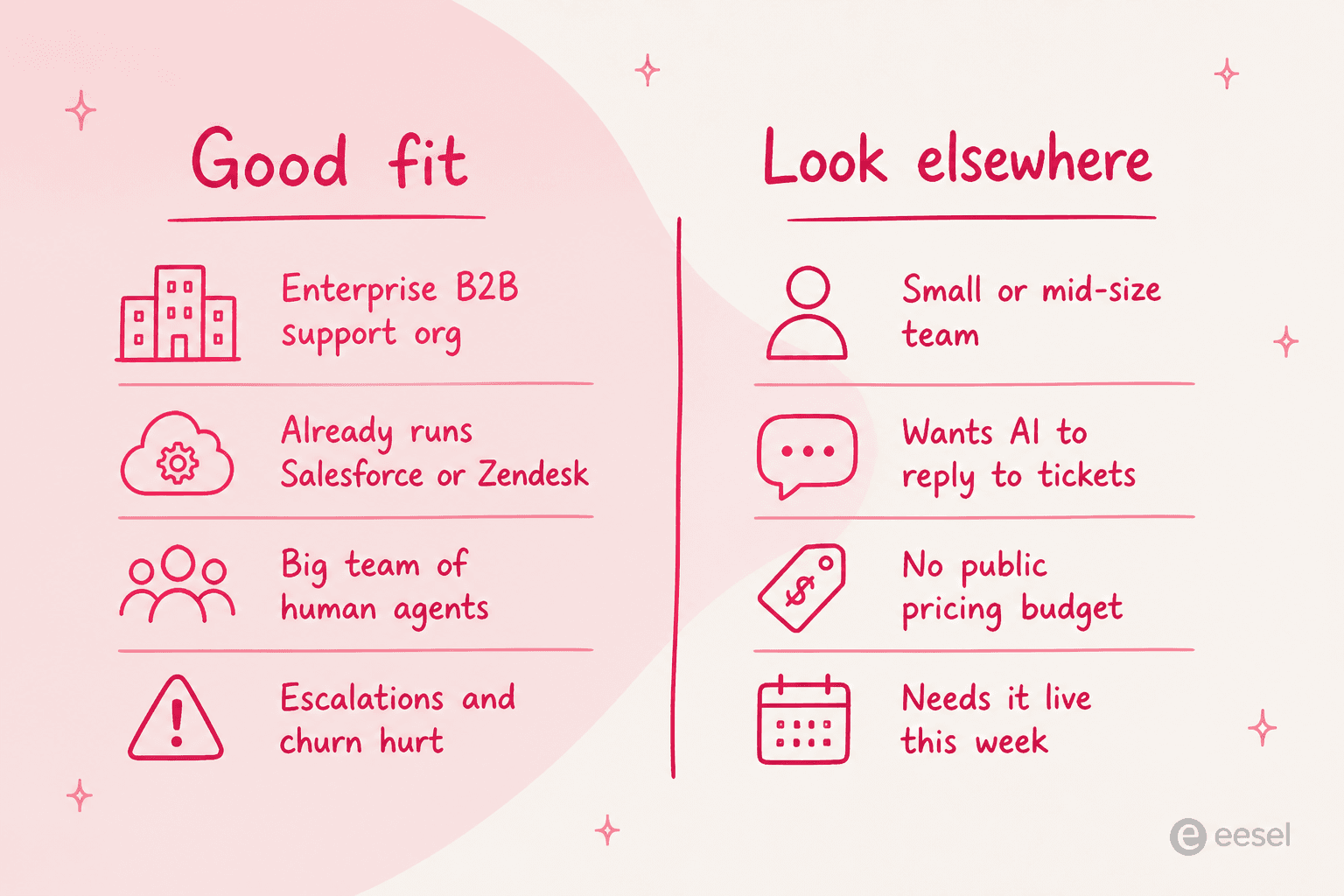
It is a strong fit if you are an enterprise B2B support org, you already run Salesforce or Zendesk, you have a big team of human agents, and escalations and churn genuinely hurt your business. In that world, escalation prediction and 100% Auto QA are levers you cannot easily pull any other way, and the security posture will clear procurement. It sits comfortably alongside the other AI customer service companies selling to that segment, but it is playing a distinct position.
It is the wrong tool if you are a small or mid-size team, if you want an AI agent for customer service that actually replies to tickets rather than scoring them, if you need public pricing to plan a budget, or if you need something live this week. None of those are knocks on SupportLogic; they are just the boundaries of what it set out to do. It is an intelligence and QA layer for teams that already have a lot of humans doing the support work, and it makes those humans better. It is not trying to be the best AI helpdesk software that handles the queue for you, and comparing it to one is a category error.
Try eesel
If your problem is that agents are drowning and you want AI to actually take tickets off the queue, that is the job eesel is built for. Where SupportLogic tells you a ticket is about to escalate, eesel's AI teammate can pick that ticket up and resolve it, replying on the front line across your helpdesk and drafting for agents on everything else, so a good chunk of escalations never happen in the first place.

The differences that matter for the reader deciding between the two: eesel plugs into Zendesk, Freshdesk, Salesforce, and more in minutes rather than 45 days, it lets you simulate on past tickets before it ever goes live so you can see the resolution rate first, it escalates to a human the moment it is unsure, and it charges a transparent per-ticket rate you can model up front instead of a quote-only contract. A large enterprise could honestly run both: SupportLogic as the intelligence and QA layer over its humans, eesel as the front-line teammate that keeps the queue from filling up. You can try eesel free and run that simulation on your real tickets to see what it would resolve.
Frequently Asked Questions
How much does SupportLogic cost?
SupportLogic does not publish pricing. Every plan on the pricing page reads "Contact for Pricing," and Elevate SX is billed on agent seats plus interaction volume. Expect an annual enterprise contract negotiated by volume, with no free trial. If you want transparent per-ticket pricing, see AI customer service software that publishes its rates.
Is SupportLogic a helpdesk?
No. SupportLogic is an intelligence and QA layer that plugs into an existing helpdesk like Salesforce Service Cloud, Zendesk, ServiceNow, or Jira. If you need the tool that actually resolves tickets, look at an AI helpdesk agent instead.
How accurate is SupportLogic's escalation prediction?
SupportLogic reports around a 40% average reduction in escalations across its base, with named customers like Salesforce citing a 56% drop. No G2 reviewer questioned the prediction accuracy itself, so the signal quality looks strong. See how AI escalation works in practice.
What are the SupportLogic SX bundles?
There are three: Core SX (sentiment, escalation, routing, and the Data Cloud), Elevate SX (Auto QA and coaching), and Resolve SX (knowledge and case deflection). You buy them as packages, not per feature.
Does SupportLogic work with Zendesk?
Yes. SupportLogic ships CRM widgets for Zendesk, Salesforce, ServiceNow, Jira, and Freshdesk with two-way writeback. If your team wants AI that also answers Zendesk tickets, compare the Zendesk AI capabilities and layered tools.
What is a good SupportLogic alternative for smaller teams?
SupportLogic is built for enterprise B2B support orgs. Smaller teams that want quick, self-serve AI that resolves tickets are usually better off with an AI helpdesk like eesel, which publishes per-ticket pricing and goes live in minutes rather than 45 days.


Article by
Riellvriany Indriawan
Riell is a designer and writer at eesel AI with about two years of experience researching CX platforms, AI chatbots, and helpdesk software. She combines her design background with a sharp eye for how these tools actually look and feel in practice — making her comparisons unusually visual and user-focused.