The 8 best Qiscus alternatives for 2026

Riellvriany Indriawan

Katelin Teen
Last edited August 27, 2026
Why teams look for a Qiscus alternative
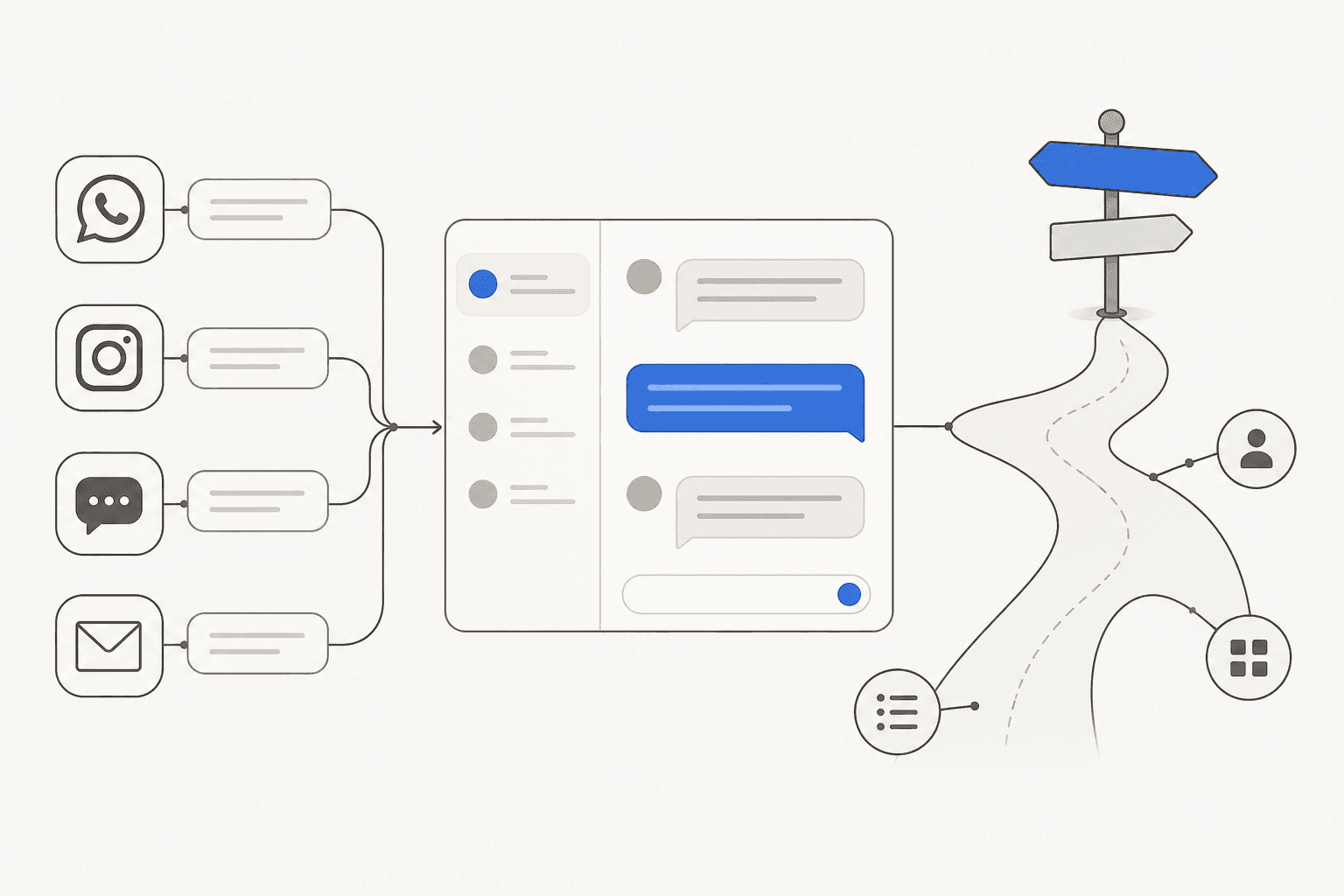
First, credit where it's due. Qiscus is a genuine omnichannel player and a Meta Business Partner, and it's earned real trust in its home market. It unifies WhatsApp, Instagram, Facebook Messenger, and email into one inbox, ships a no-code AI Agent called AgentLabs, and counts names like Kredivo, Senheng, and Pizza Hut among its customers. On review sites it sits at 4.3 out of 5 on G2 (23 reviews) and 4.4 on Capterra (7 reviews), and the recurring praise is the omnichannel breadth and an easy multi-agent inbox.
So why leave? When I read through the reviews, the same handful of frustrations keep coming up, and they're worth naming plainly because they'll tell you which alternative actually fixes your problem.
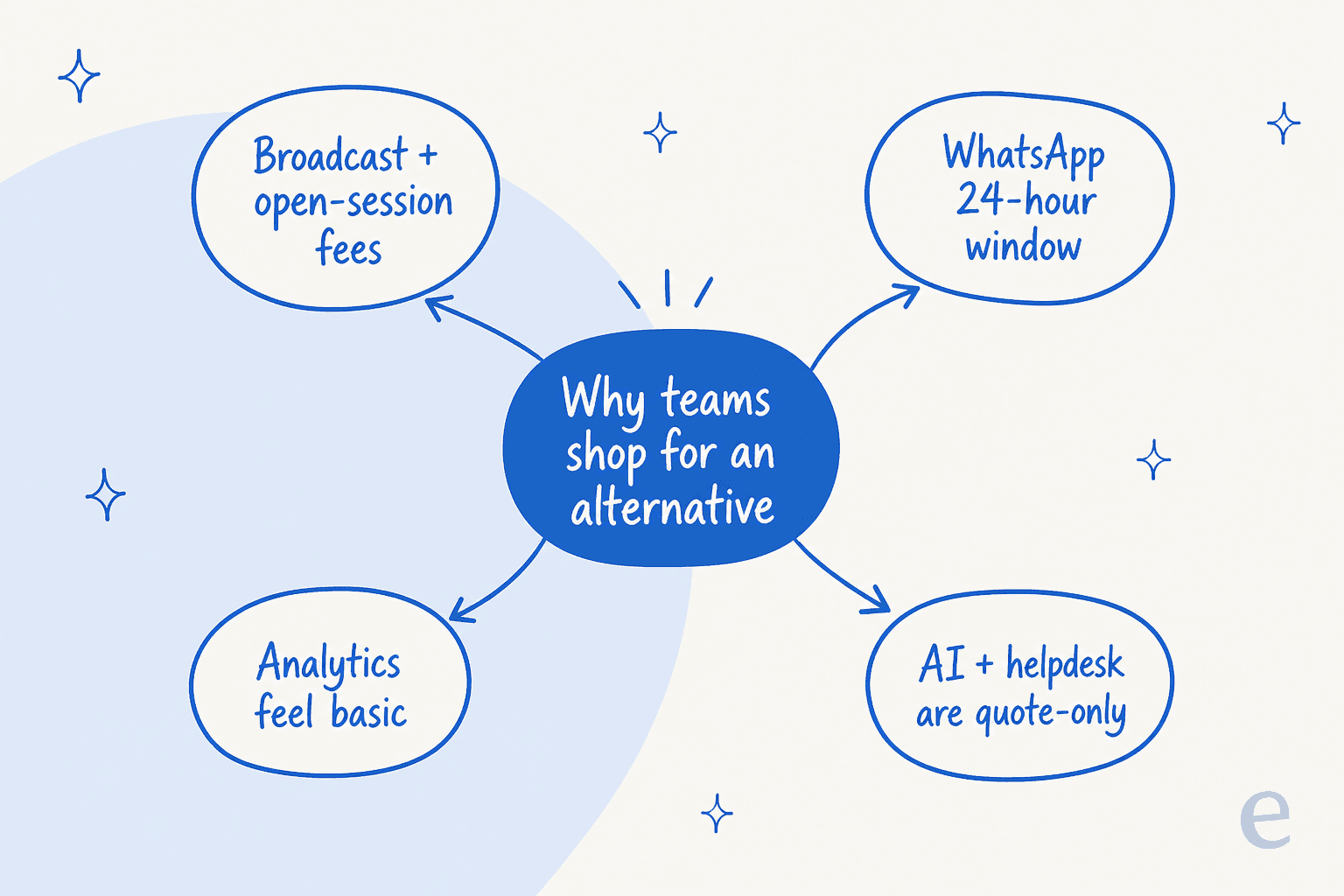
Cost, and specifically the messaging model. The sharpest complaint is money. One reviewer put it directly:
"The cost is about pricey, especially for BI open session (broadcast). The limitation active session chat for only 24 hours is about troublesome... For whatsapp channel integration, sent chats cant be undone or edited."

That 24-hour thing is the WhatsApp Business messaging window, and it bites everyone on WhatsApp, not just Qiscus. But when the follow-up fix is a paid broadcast to reopen a closed conversation, the bill grows in a way that's hard to predict.
The AI and helpdesk sit behind a sales call. Qiscus publishes prices for Omnichannel Chat, but AgentLabs (the AI Agent), the CRM, and the Helpdesk Suite are all "Contact Us." If you're evaluating on AI capability and want to know what it costs, you're booking a demo before you get a number.
Analytics get called thin. More than one reviewer flagged reporting as a weak spot, one bluntly: "The analytics is so basic, almost useless for us." Another noted data accuracy "is unstable, especially in analytics features." For a data-driven support team, that's a real gap.
None of this makes Qiscus a bad tool. It makes it a tool some teams outgrow. The good news is the alternatives split cleanly by what you're actually trying to fix.
The 8 best Qiscus alternatives, compared
Here's the quick comparison, then a full write-up of each. I've grouped pricing by the billable unit that actually drives your bill, because "starting price" hides a lot on these platforms.
| Tool | Best for | Starting price | AI billing | Free trial / plan | WhatsApp API | Deployment |
|---|---|---|---|---|---|---|
| eesel AI | An AI layer over your existing helpdesk | From $299/mo (500 credits), no per-seat fee | 1 credit per ticket or chat, however long | Yes, 100 free credits | Via your helpdesk | Cloud |
| respond.io | High-volume WhatsApp sales | $79/mo (1k active contacts) | Included on Growth+ (fair use) | 7-day trial | Yes, no markup | Cloud |
| SleekFlow | WhatsApp chat commerce | $119/mo (Pro, annual) | 500 AI credits/plan | 7-day trial (Pro) | Yes | Cloud |
| Wati | Simple WhatsApp automation for SMBs | $59/mo (Growth, annual) | Credit-based (Copilot) | 7-day trial, no card | Yes, pass-through | Cloud |
| Gallabox | Chat commerce in India / SEA | $112/mo (Basic, annual) | AI credits per 1k tokens | 7-day trial | Yes, pass-through | Cloud |
| Trengo | A shared omnichannel inbox | €299/mo (Boost, annual) | Surcharge per AI conversation | Trial available | Yes | Cloud |
| Freshchat | Messaging inside a full CX suite | Free tier, paid from ~$19/agent | Session-metered | Free plan + trial | Yes | Cloud |
| Chatwoot | Teams that want to self-host | $0 self-hosted (Community) | Captain AI credits | Free (self-host) | Yes | Cloud or self-host |
Prices are the publicly listed starting rates as of August 2026 and exclude WhatsApp's own per-message fees, which nearly all of these pass through from Meta. Now the detail.
1. eesel AI: the AI layer for the helpdesk you already have

Best for: teams whose real problem is "the AI isn't good enough," not "the whole platform is wrong."
I'll be upfront that this is my team's tool, so read the verdict with that in mind. But the reason it leads this list is a genuine difference in shape: eesel isn't another omnichannel platform you migrate to. It's an AI agent that sits on top of the helpdesk and channels you already run.
I've spent the last few years putting AI agents on live support queues, and the pattern that scares teams most is going live blind. A confident-sounding bot that quietly gives wrong answers does more damage than no bot at all. That fear is exactly what a demo can't answer and a quote-only AI product makes worse.
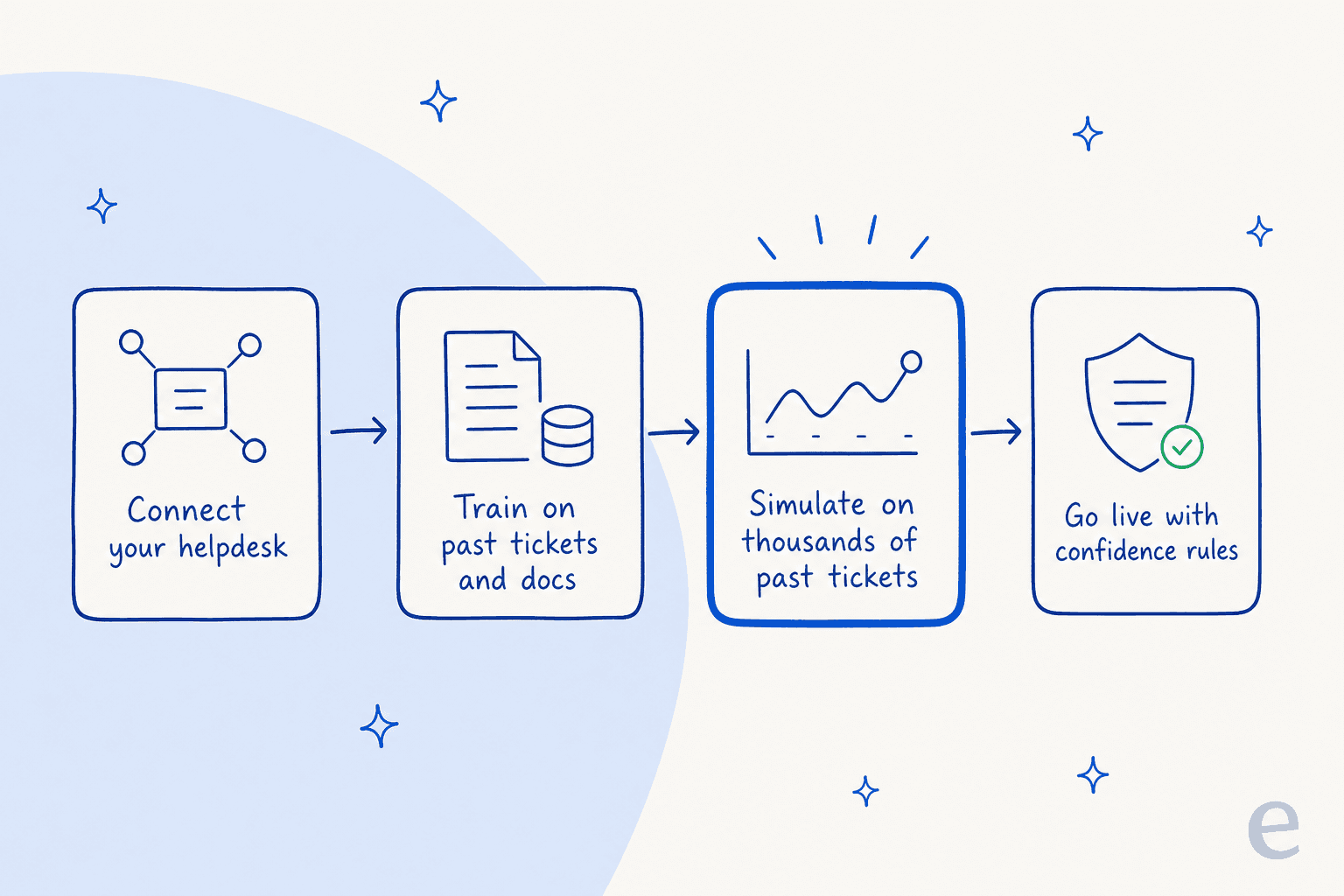
So the thing eesel does that Qiscus's AgentLabs doesn't is let you test before you trust it. You connect your helpdesk, it trains on your past tickets and docs, and then you simulate it against thousands of your real historical tickets to see exactly what it would have said and what it would have resolved, before a single customer sees it.
That control is the other half of the pitch. One CX lead I heard from framed the whole thing better than any spec sheet:
"The AI will never be able to answer 100% of the questions... I need an AI who is only handling the tickets that it's confident to handle and all the other ones, leave them alone."
a DTC supplements CX lead
eesel is built around that. You set confidence thresholds, scope it to specific ticket types, and it cleanly hands off to a human. Gridwise, using it this way, saw eesel resolve 73% of tier-1 requests with AI deflection in the first month.
Pros:
- Keeps your existing helpdesk, so no rip-and-replace migration.
- Simulation on your real past tickets before go-live, which is rare in this category.
- One fixed monthly price with no per-seat fee, and no extra charge for follow-up messages inside a ticket.
- Trains on your own history and docs, not just a website crawl.
Cons:
- It's an AI layer, not a full omnichannel inbox, so it's not the tool if you specifically need Qiscus-style multi-agent chat routing as your primary UI.
- Deepest fit is with helpdesk stacks (Zendesk, Freshdesk, Gorgias, and similar) rather than a standalone WhatsApp catalog workflow.
Pricing: from $299/month for 500 credits with no per-agent fee and a free plan of 100 credits. Because 1 credit covers a whole ticket or chat however many replies it takes, the cost-per-ticket stays predictable, which is the opposite of the broadcast-fee anxiety in the Qiscus reviews.
Verdict: if the reason you're reading this is the AI or the analytics rather than the platform, eesel is the least disruptive move on the list. If you truly need a new omnichannel platform, one of the tools below fits better.
2. respond.io: the WhatsApp sales engine
Best for: mid-market B2C teams running high-volume, revenue-critical WhatsApp conversations.
respond.io is the most direct like-for-like swap for Qiscus if your center of gravity is sales on WhatsApp. It's a WhatsApp Business Solution Provider that unifies WhatsApp, TikTok, Instagram, Messenger, email, and voice into one thread, then layers AI Agents on top to qualify leads and route chats. It lists names like Toyota and Decathlon, claims 99.999% uptime, and sits at a strong 4.8 on G2 across 400+ reviews.
The pricing model is the headline difference from Qiscus: you pay by monthly active contacts, not per open session, and respond.io adds no markup on Meta's WhatsApp fees. Incoming messages and calls are free.
Pros:
- Billing by active contacts is more predictable than per-broadcast charges.
- No fee markup on WhatsApp messages.
- Strong workflow builder and native CRM-style lead management.
Cons:
- AI Agents require the Growth plan or higher.
- Reviewers mention occasional slowness and limited message edit/delete.
Pricing: at 1,000 monthly active contacts, Starter is $79/mo, Growth (most popular) $159/mo, Advanced $279/mo, with Enterprise custom. A 7-day trial covers Growth features.
Verdict: the safe pick if you're WhatsApp-led and want the contact-based model instead of open-session fees. It's a platform migration, but a logical one.
3. SleekFlow: chat commerce with a pricing puzzle
Best for: commerce teams in Asia-Pacific that want WhatsApp catalogs, broadcasts, and flows in one place.
SleekFlow is a close Qiscus neighbor: an omnichannel commerce platform strong on WhatsApp, with regional pricing tiers and an AI layer. The consolidation story is the consistent win in reviews, with teams moving multiple client numbers onto one company number routed by a welcome flow.
The catch is that its AI needs real setup time. One G2 reviewer described "about a month of gradual training before it becomes mature enough to answer customer questions properly." That's fair rather than damning, but worth budgeting for if you expect the AI to carry load on day one. Pricing is also famously layered: three plans times AI-on/AI-off times billing interval, across regional tiers.
Pros:
- Genuinely strong commerce features (catalogs, campaigns, flow builder).
- Regional pricing means cheaper rates in some markets.
- One-inbox consolidation praised repeatedly.
Cons:
- The AI needs weeks of tuning before it's reliable.
- Pricing is hard to model, and the primary billing unit (active contacts) has no published overage rate.
Pricing: Pro starts at $119/mo (annual, no AI), Premium at $299/mo, Enterprise custom. Premium is demo-gated despite having a published price.
Verdict: a good Qiscus alternative if commerce flows matter more than out-of-the-box AI. Go in expecting to invest in training the assistant.
4. Wati: the no-fuss WhatsApp tool for SMBs
Best for: small and mid-sized teams that want WhatsApp automation without a big platform.
Wati narrows the scope to WhatsApp done well: no-code chatbots, broadcasts, a shared team inbox, and its Astra AI agents. It's the lightest-weight, most SMB-friendly option here, sitting at 4.6 on G2 across 461 reviews, where the praise is ease of setup and consolidating scattered WhatsApp chats.
Like Qiscus, the subscription is platform access only, and WhatsApp's per-message costs are billed separately as Meta pass-through, so model that into your total. The recurring complaint is that pricing feels steep for small teams once those message costs stack on top.
Pros:
- Simple, fast to set up, genuinely no-code.
- Astra AI agents can auto-resolve routine conversations with handoff.
- 7-day free trial, no card required.
Cons:
- WhatsApp-only focus, so it's not truly omnichannel like Qiscus.
- Support responsiveness and cancellation draw complaints in reviews.
Pricing: Growth $59/mo, Pro $119/mo, Business $279/mo (all annual). Astra AI agents start on Pro. AI Copilot runs on a credit model.
Verdict: the best pick if you want Qiscus-style WhatsApp automation stripped down to essentials and priced for a smaller team.
5. Gallabox: WhatsApp commerce, India and SEA
Best for: revenue teams in India and Southeast Asia running WhatsApp-first sales and support.
Gallabox is a WhatsApp-first conversational sales and support platform that prices in INR, USD, and AED side by side, which tells you exactly who it's for. It covers the WhatsApp Business API, Instagram DMs, a website widget, and AI voice, with an AI chatbot metered in credits.
Its AI billing is the detail to watch: credits are charged per 1,000 tokens processed, deducted whenever an agent "does work" like replying, rewriting, or translating. That's a usage meter that can move with volume, so heavy AI use needs top-ups (₹1,000 / $10 per 5,000 credits).
Pros:
- Purpose-built for WhatsApp commerce with catalogs and campaigns.
- Transparent, multi-currency pricing aimed at its core markets.
- Broadcast limits scale generously on higher plans.
Cons:
- No free plan, and the shortest commitment is quarterly, not monthly.
- Token-based AI credits make heavy AI usage harder to predict.
- Basic plan hard-caps at 3 seats with no add-on users.
Pricing: billed annually, Basic is about $112/mo, Essential $248/mo, Advanced $474/mo, Enterprise custom. WhatsApp conversation fees are passed through.
Verdict: a strong regional alternative if you're selling on WhatsApp in India or SEA. Just map the AI credit math against your expected volume.
6. Trengo: one inbox for every channel
Best for: European teams that want a clean, shared omnichannel inbox more than a commerce engine.
Trengo leans on the inbox itself: WhatsApp, email, live chat, Instagram, Facebook, and voice in one place, with AI agents (HelpMate) that the company says resolve up to 80% of repetitive conversations. It's the European-flavored option here, quoted in euros and built around bundled user counts and conversation allowances rather than simple per-seat pricing.
The thing to know going in is that AI is metered on top. HelpMate is included on all plans but carries a surcharge of roughly €0.25 to €0.30 per AI-handled conversation, so the "included" AI still shows up on the bill. Reviewers also flag pricing instability as the dominant negative, with one Capterra review citing a 300% increase.
Pros:
- Clean, well-liked omnichannel inbox across all major channels.
- AI included on every plan (metered).
- Meta Business Partner with solid WhatsApp support.
Cons:
- Per-AI-conversation surcharge on top of the subscription.
- Reviewers report pricing hikes and structure changes.
- No free plan or cheap 1-2 seat starter tier.
Pricing: Boost €299/mo (annual, 10 users), Pro €499/mo (annual, 20 users), Enterprise custom, plus per-conversation AI surcharges.
Verdict: a fair Qiscus alternative if the inbox experience matters most and you're comfortable with usage-metered AI. Watch the total once AI volume climbs.
7. Freshchat: messaging inside a full CX suite
Best for: teams that want messaging as part of a broader ticketing and CX platform.
Freshchat is Freshworks' live chat and messaging product, and it's the "part of a bigger suite" answer. It sits as the conversational front end of Freshdesk Omni, so you get chat plus full ticketing, knowledge base, and voice under one roof, with Freddy AI as the automation layer. Freshworks says it's trusted by 74,000+ businesses.
Freddy AI Agent is the AI story here: Freshworks claims it resolves up to 80% of queries and speaks 60+ languages. The important caveat is that Freddy runs on a session-metered model, so heavy AI volume, especially multilingual, carries a direct usage cost regardless of plan. Social and messaging channels also start on the Growth plan, not the free tier.
Pros:
- Real depth if you want the whole Freshworks CX suite, not just chat.
- Freddy AI Agent handles 60+ languages out of the box.
- A genuine free tier for website chat and email.
Cons:
- Best value only if you buy into the wider suite.
- AI is session-metered, so multilingual volume adds cost.
- Messaging channels are gated above the free plan.
Pricing: free tier for basic web chat, paid plans scale up per agent; see the full Freshchat pricing breakdown for the tiers.
Verdict: the pick if you want messaging bundled into a complete helpdesk rather than a standalone WhatsApp tool. If you like your current helpdesk and only want better AI, note you can also add an AI layer instead of switching suites.
8. Chatwoot: the open-source, self-host option
Best for: privacy-conscious or technical teams that want to own their data and self-host.
Chatwoot is the structural outlier, and a good one. It's an open-source omnichannel support platform (34k+ GitHub stars, 4.5+ on G2) that you can run as hosted cloud or self-host on your own infra. That self-host path is the reason data-residency-focused teams pick it: you own the customer data outright. It bundles an AI assistant (Captain), an omnichannel inbox, and a knowledge base, with a genuinely strong multilingual story (50+ UI/widget languages plus Google Translate).
The tradeoff is the usual one for open source: self-hosting means you own upgrades, storage, and reliability. And Captain AI is not available on the free Community Edition, so the AI features come with cloud plans or paid self-hosted tiers.
Pros:
- Free, open-source Community Edition you can self-host.
- Own your data for compliance and data residency.
- Strong multilingual support across UI, widget, and AI.
Cons:
- Self-hosting carries real maintenance and reliability overhead.
- Captain AI isn't included on the free Community Edition.
Pricing: self-hosted Community Edition is $0; Premium Support self-host is $19/agent/mo and Enterprise $99/agent/mo. Cloud plans are per agent with a 15-day trial. Captain AI is credit-metered.
Verdict: the best Qiscus alternative if control and data ownership rank above convenience. Budget for the engineering time self-hosting really takes.
How to choose the right one
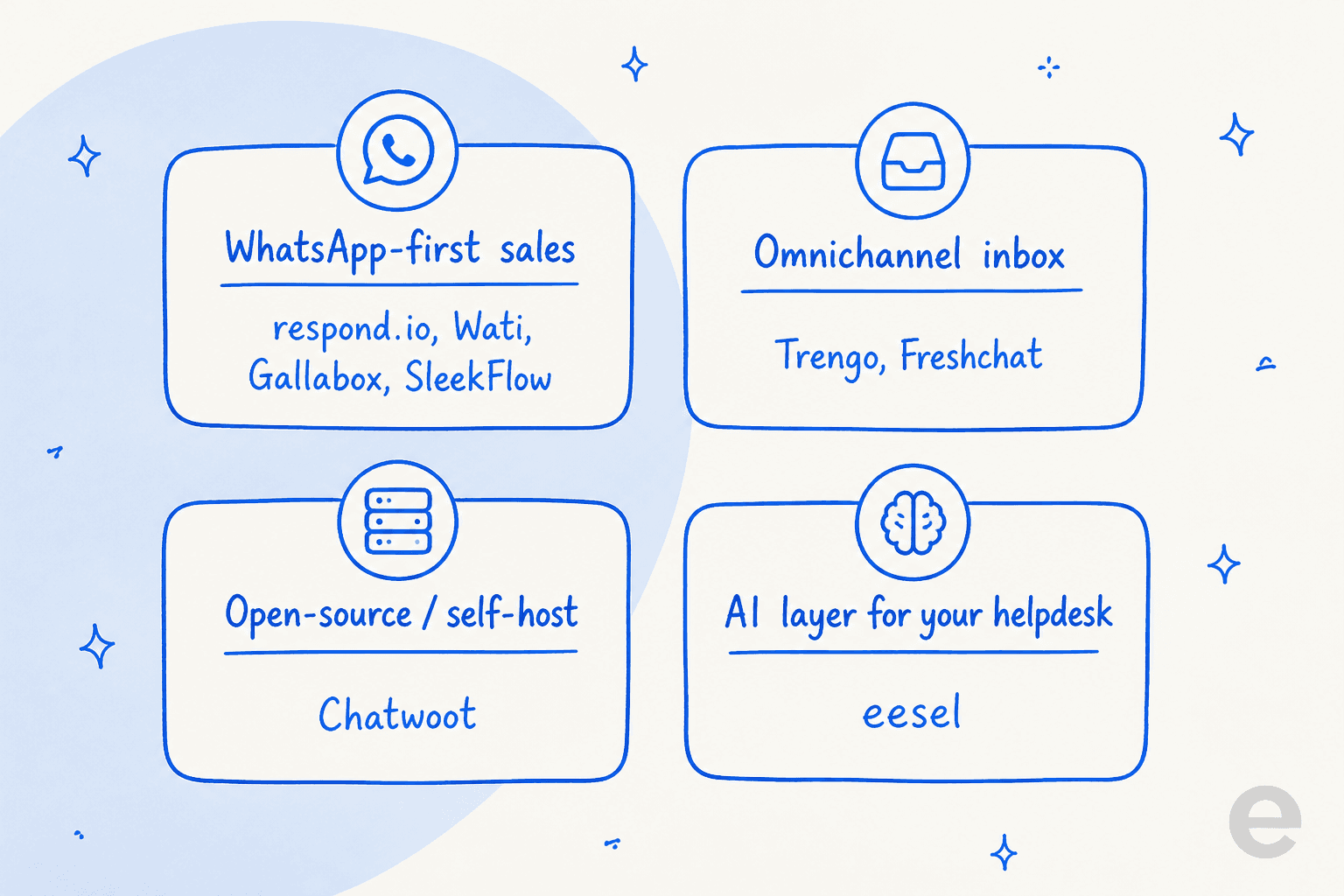
Strip away the feature lists and the decision usually comes down to one question: are you replacing the platform, or just the part of it that's failing you?
A few honest guidelines:
- If your problem is WhatsApp cost and predictability, look at the contact-based model of respond.io or the stripped-down simplicity of Wati. The per-open-session anxiety mostly goes away.
- If your problem is commerce, SleekFlow and Gallabox are built for catalogs and campaigns, with Gallabox tuned for India and SEA specifically.
- If your problem is a messy inbox, Trengo and Freshchat both do the "one place for every channel" job well, with Freshchat pulling ahead if you want a full customer service platform around it.
- If your problem is data ownership, Chatwoot's self-host path is the only real answer here.
- If your problem is the AI or the reporting, you may not need a new platform at all. Adding an AI layer that trains on your history and lets you test before launch is faster and cheaper than a migration.
That last point is the one most "alternatives" lists skip. A platform swap is weeks of migration and retraining. If the tool is fine and the AI just isn't pulling its weight, changing the AI is the smaller, saner move.
Try eesel AI
If you've read this far because the AI in your current stack keeps giving shaky answers, that's the exact gap eesel was built for. Instead of asking you to migrate off Qiscus (or Zendesk, or Freshdesk), it plugs into what you already run, trains on your past tickets and help docs, and lets you simulate on thousands of real conversations before it ever replies to a customer.

The two things Qiscus reviewers wished for, real reporting and an AI you can trust to only handle what it's sure about, are the two things eesel leads with: confidence controls on what it auto-answers, clean handover for the rest, and analytics that show what it actually resolved. Pricing is one fixed monthly price with no per-seat fee, and you can start free.
You can try eesel and run the simulation on your own tickets before you decide anything.