


Claude Ship has no sticker price. You pay for a Team or Enterprise seat ($20 to $125 per seat per month on Team, $20 per seat plus usage on Enterprise), and then every review, fix and policy check is billed on tokens through usage credits, on top of what your seats include. Anthropic publishes no per-review dollar figure, so the only honest estimate comes from a pilot.
The two settings that move the bill most: Code Review starts at "After every push", which multiplies reviews by pushes, and Claude Approvals bills even in observe mode. Enterprise teams can claim $10,000 to $50,000 in credits for 30 days. If you also run AI on your support queue, eesel's helpdesk teammate uses a fixed monthly plan instead, and coding agents can configure it through the eesel CLI.
What does Claude Ship cost, in one line?
Seat price plus metered agent usage. That's the whole model, and it's why there's no single number to quote.
I build integrations at eesel, which bills by the support ticket, so I spend a lot of time reading other vendors' usage-billing docs and asking "what's the unit?" For Claude Ship, the unit is the token, and Anthropic says it plainly in the launch announcement: usage is billed on tokens, so turning it on can add to an organization's costs. The amount depends on the number and size of pull requests, the review level, how often reviews run, and how much work PR Steward does.
Here are the pieces that make up the bill:
| Cost piece | What you pay | Source |
|---|---|---|
| Team standard seat | $20 per seat per month billed annually, $25 monthly | Claude pricing page |
| Team premium seat | $100 per seat per month billed annually, $125 monthly | Claude pricing page |
| Enterprise seat | $20 per seat per month billed annually, 20-seat minimum, plus usage at API rates | Claude pricing page |
| Code Review | Tokens via usage credits, no flat per-review price | Code Review costs |
| PR Steward | Tokens via usage credits, per-repo spend cap you set | PR Steward setup |
| Claude Approvals | No base charge; classifier runs and the reviews a policy starts are billed | Approvals docs |
/ship command | Counts as regular Claude Code usage for the developer | Launch announcement |
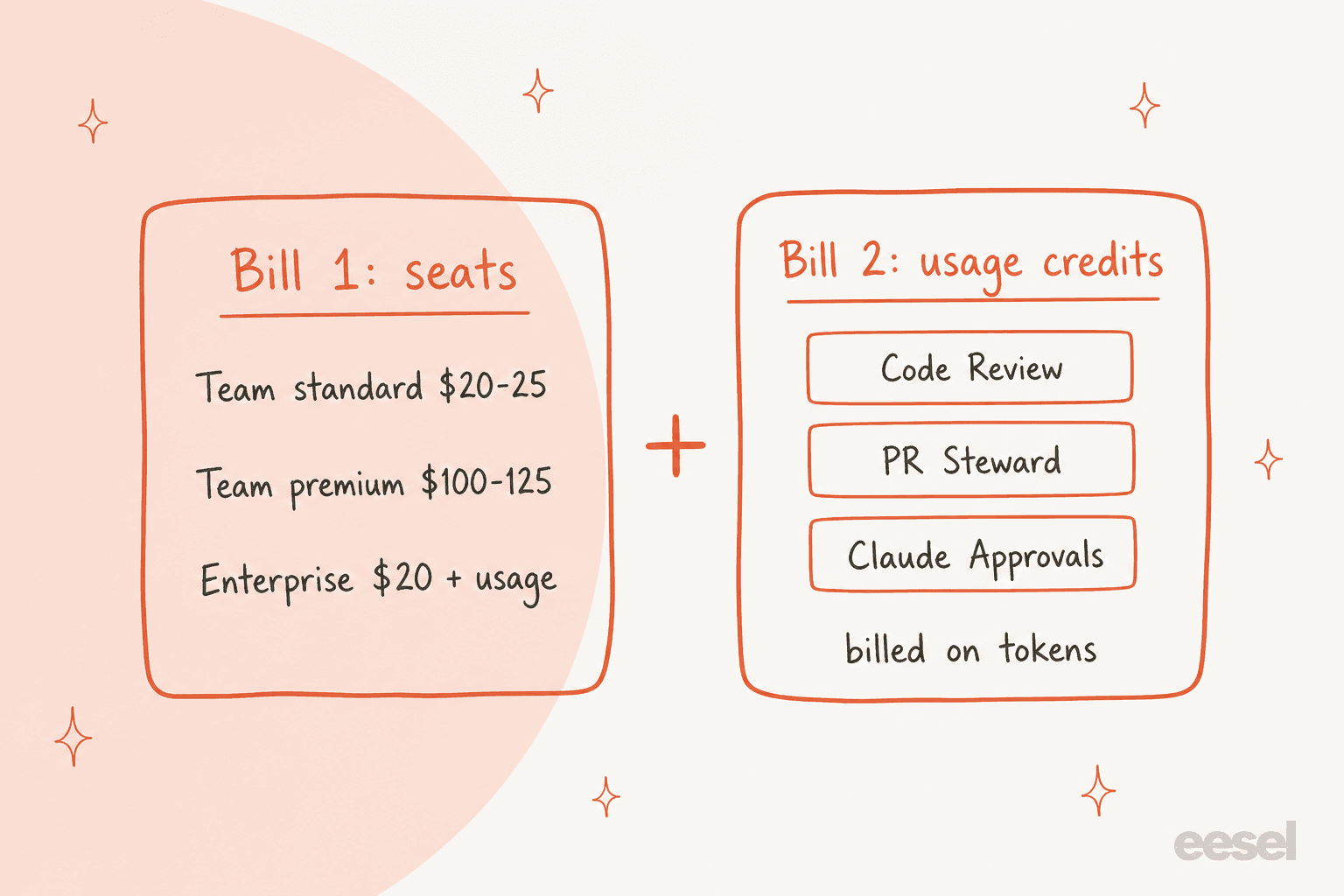
The important line from the Claude Ship docs is that each agent is billed "separately from your plan's included usage." Your seats buy access. They don't buy reviews. If you've read the Claude Code pricing breakdown, think of Claude Ship as a second meter running next to it.
Which plan do you need before you pay anything?
Team or Enterprise, with repositories on GitHub. Pro, Max and Free plans can't turn on the organization-wide agents, though a developer with Claude Code can run /ship on their own pull requests. If your repos aren't connected yet, the Claude Code GitHub integration guide covers that step.
The seat math is simple and fully published:
- Team is for 2 to 150 people (more on Claude for teams). Standard seats are $20 per month billed annually ($25 monthly), and premium seats with 5x the usage are $100 billed annually ($125 monthly). You can mix seat types.
- Enterprise is $20 per seat per month billed annually with a 20-seat minimum, so at least $400 a month before any usage. Anthropic lists it as "seat price + usage at API rates," which means Claude Code work on Enterprise also lands on the usage side.
A 30-person engineering team on Team standard seats pays $600 a month on annual billing, or $3,000 if everyone is on premium seats. None of that pays for a single Claude Ship review. For the full plan comparison, my Claude pricing guide has every tier, and the Claude Pro pricing post covers the individual plans.
There's also a hard exclusion worth checking before you budget. Anthropic says Claude Ship "is not available to organizations with Zero Data Retention, the HIPAA configuration, or customer-managed encryption keys." If your org runs any of those, the price question is moot for now.
How is Code Review billed?
Code Review is usually the biggest line, and it's the one Anthropic documents most carefully. The costs page says Code Review has no flat per-review price. Spend depends on two things: the cost of each review, and how many reviews run.
The cost of each review scales with:
- The review level. Quick is "the fastest level, at the lowest cost," Standard is the default, and Deep "takes the longest and costs the most."
- The size of the change.
- The complexity of the surrounding code.
- How many candidate issues need verification.
The number of reviews is set per repository by the Review runs setting:
- Once after PR creation: one review when the pull request opens, reopens or is marked ready.
- After every push: a review on each push, which Anthropic says multiplies cost by the number of pushes.
- Manual: reviews only when someone comments
@claude review.
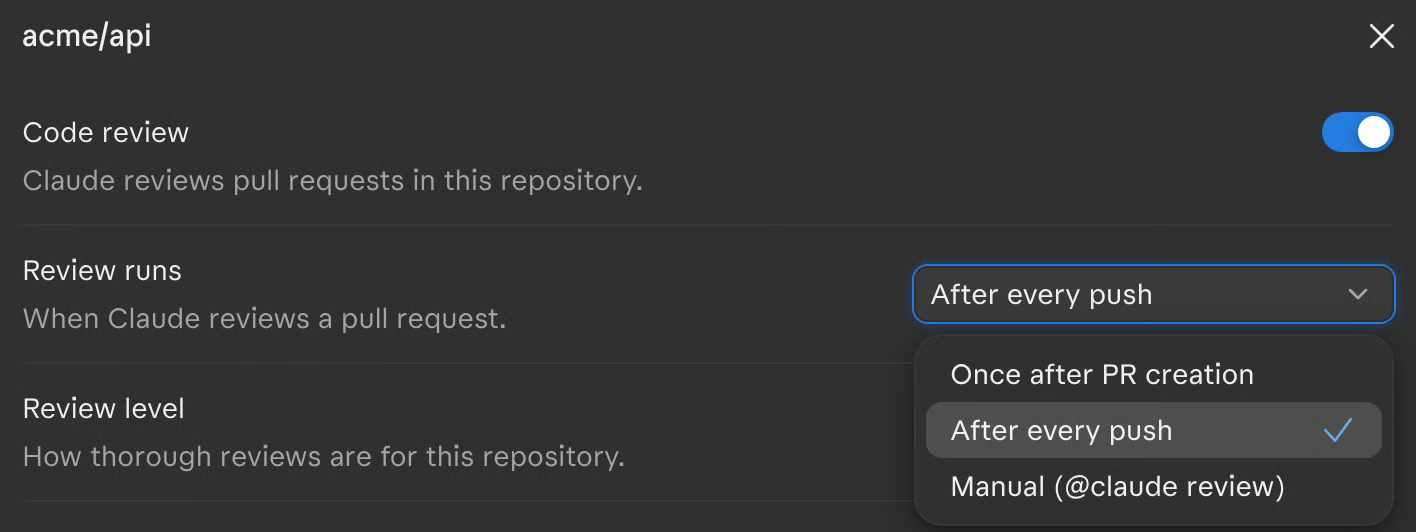
The detail most worth flagging to an engineering manager: a repository you add starts at "After every push", the setting that runs the most reviews. Drafts and pull requests from forks skip automatic reviews, which helps a bit. But @claude review always on a pull request in Once or Manual mode opts it back into a review per push.
Reviews are billed to the organization, not to the developer who opened the PR. They also show up on your Anthropic bill even if your company runs other Claude Code work through Amazon Bedrock, Google Cloud or Microsoft Foundry, so cloud-marketplace commits won't absorb them.
How much does the review-runs setting change the bill?
A lot, and you can see it without knowing any dollar figure. Take one repository that opens 200 pull requests a month, with a typical pull request getting 4 pushes before merge:
| Review runs setting | Reviews per month | Relative cost |
|---|---|---|
| Once after PR creation | 200 | 1x |
| After every push (the default) | 800 | 4x |
| Manual, requested on 1 in 4 PRs | 50 | 0.25x |
Same team, same code, same review level, and a 16x spread between Manual and the default. That's before you touch the review level, which moves the per-review cost on top.
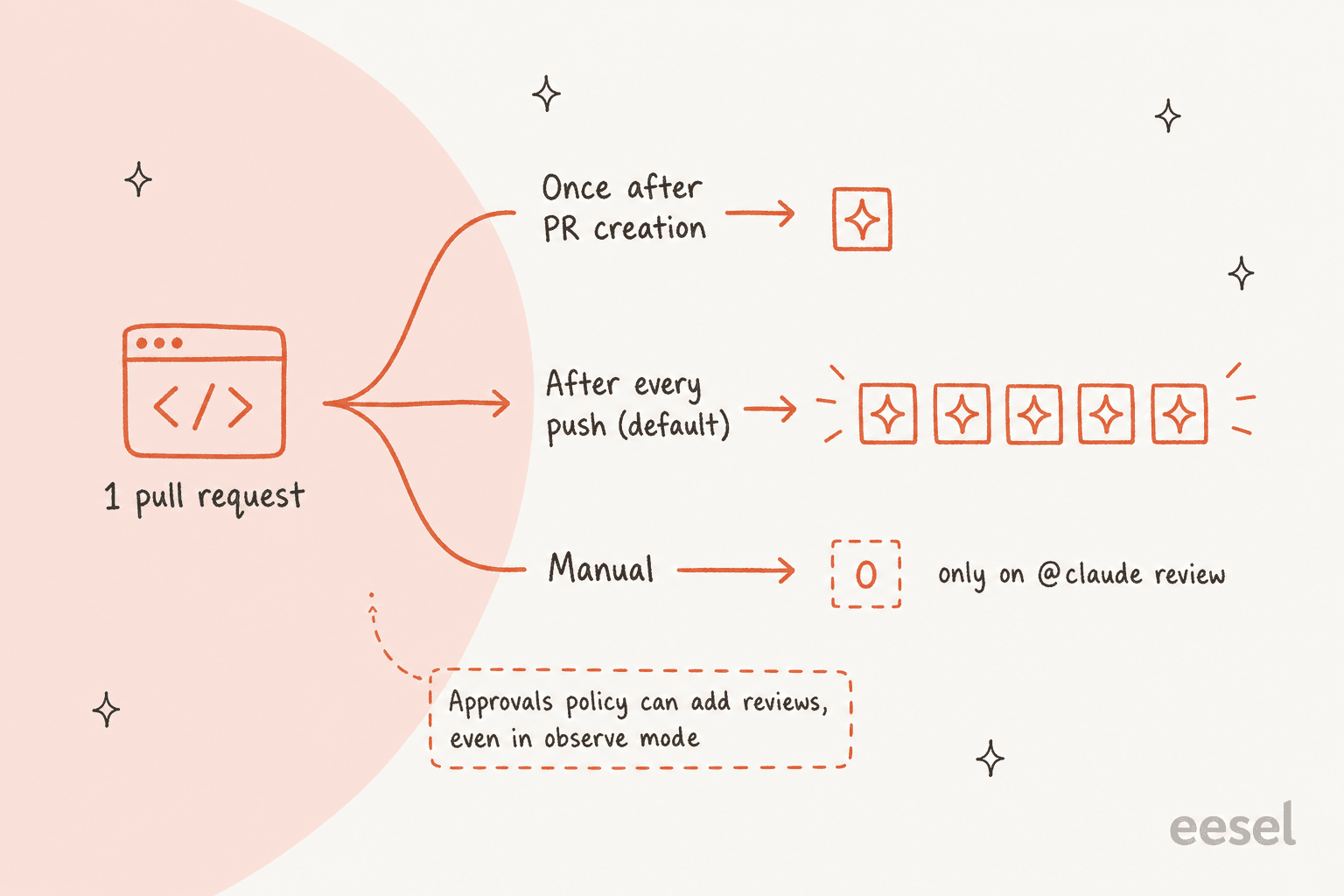
This is why my Claude Ship review recommends starting with one repository. If you're comparing against other review tools, the same push-count logic applies to anything metered per run, so read the unit before reading the price on GitHub Copilot pricing or Cursor pricing.
What do PR Steward and Claude Approvals add?
These two are in beta, and both bill on top of Code Review.
PR Steward fixes failing checks, merge conflicts and review feedback on open pull requests. It bills tokens for that work, and the setup docs carry two warnings worth reading twice:
- PR Steward has no spend limit of its own until you set one. You set a monthly limit under Organization settings > Usage, plus a per-repository Steward spend cap.
- "Spend can pass the cap before it stops." After a person restarts it, or after about a week on one pull request when it starts a new cloud session, the full cap applies again.
Adding a repository from the PR Steward flow can also start Code Review there, because Code Review is selected by default in that dialog.
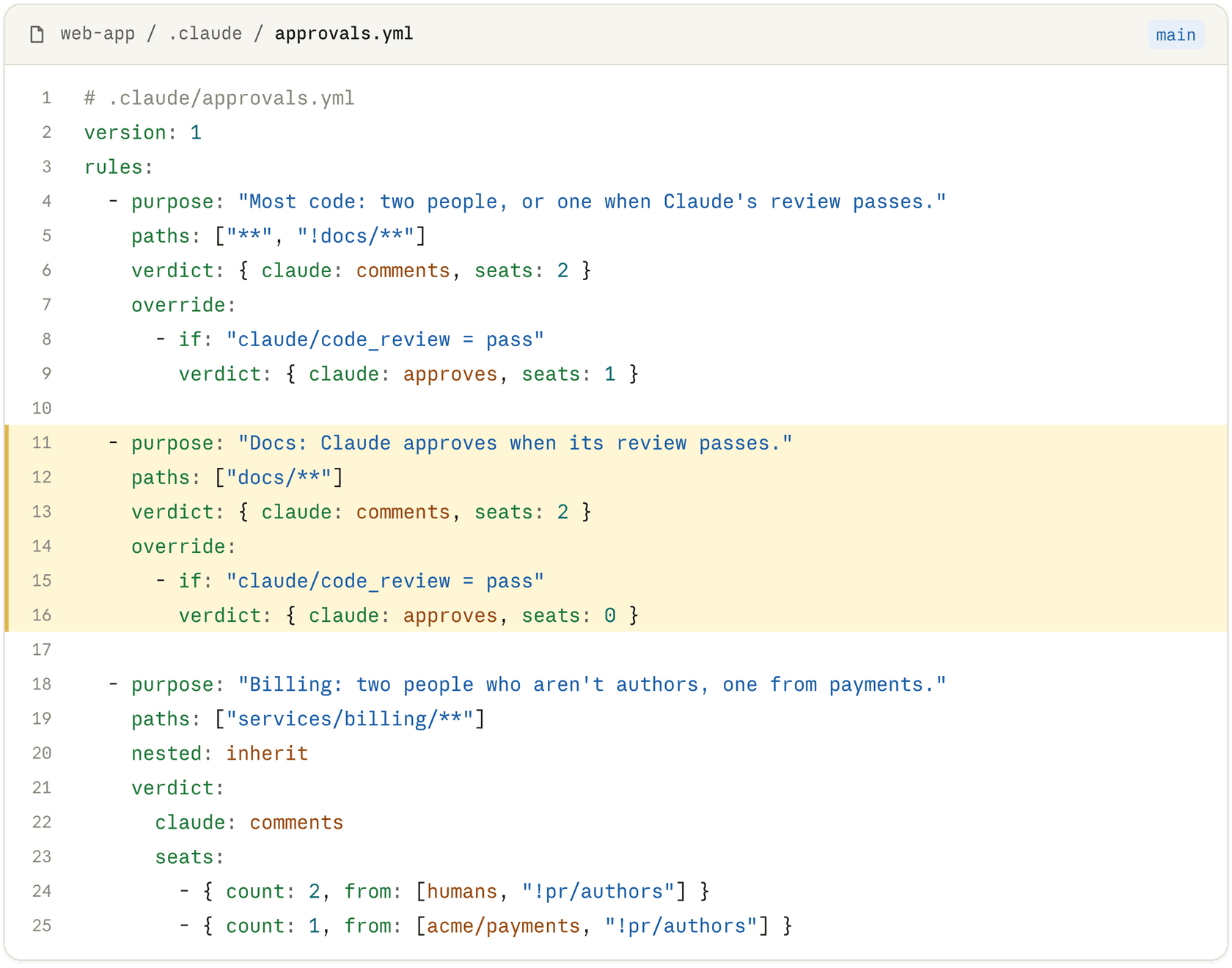
Claude Approvals reads a .claude/approvals.yml policy and decides who still needs to approve. It has no base charge. What it bills:
- Classifier runs, including
claude/diffand any custom classifiers that call a model. A custom classifier with nobudgetkey is capped at $10 per run, and Anthropic notes that "the bill can be higher" than the cap. Set the budget under $5 and a run on a large pull request can stop before it answers. - Code Reviews the policy asks for. A rule with
claude/code_reviewin anifcondition can start a billed review when a pull request opens and at each push, on top of your Review runs setting.
Why does observe mode still cost money?
This is the billing behavior I'd want every team lead to know before rollout. Anthropic recommends starting Approvals in observe mode, where the check only reports what the policy would decide. That sounds like a free dry run. It isn't.
The Approvals setup docs say it in four words: "observe mode is billed." Classifiers still run, and a policy that names Claude's review can still trigger a billed Code Review at each push. The starter policy itself "can start a billed Code Review at each push," and if your Code Review settings ask for fewer reviews, "the policy adds to them."
Two more billing behaviors that surprised me when I read the docs:
- Turning off usage credits doesn't stop the agents. The Claude Ship docs say an agent that's on "keeps running and billing your organization." You have to turn the agents off, and Anthropic says to turn off Approvals before Code Review, because a policy can start billed reviews even where Code Review is switched off.
- The analytics numbers are list price. Repository cost estimates are "estimated at list price, before any discounts or credits," and can differ from your invoice.
The fix for the observe-mode cost is in the docs too: move claude/code_review from the rule's conditions to advisory, and reviews follow your normal Code Review settings instead of firing on every push.
A Hacker News commenter guessed the billing model on launch day:
"This basically needs Claude Code on the Web enabled so that Claude can check out your PRs in Anthropic infra, and like Code Reviews, is probably billed by API, right?"

They were right. Everything that runs on Anthropic's infrastructure for your org lands on usage credits.
How do the spend limits actually work?
Anthropic gives you a limit per service, which is the right design for a metered product. All of them live at Organization settings > Usage and need an Owner:
| Limit | What it covers | What happens at the limit |
|---|---|---|
| Claude Code Review service limit | All Code Review runs, including ones an Approvals policy starts | Reviews are skipped, with a PR comment naming the cause |
| PR Steward monthly limit | Steward work across the org | Steward pauses until credits can pay again |
| Steward spend cap (per repo) | Steward work on one pull request | Steward stops on that PR, possibly after passing the cap |
| Classifier runs limit | Approvals classifier runs | Set for you when the first billed review starts |
| Organization spend limit | Everything paid from usage credits | Agents stop starting new billed work |
One subtle rule: Code Review "skips reviews once what's left is less than the expected cost of one review," so a small remaining budget can stop reviews earlier than you'd expect. And at Code Review's limit, an Approvals check that needs Claude's review can stop passing, which can block merges if that check is required. Budget limits and merge gates are now connected, so set them together.
How do you estimate your monthly Claude Ship bill?
Anthropic's own method on the costs page is the right one, and it's short:
- Set a monthly spend limit for the pilot.
- Turn on Code Review for a few representative repositories with Review runs set to Once after PR creation or Manual.
- After several reviews, open each repository's Edit dialog under Organization settings > Claude Ship and read its average cost per review under Cost.
- Multiply that average by the pull requests the repository opens in a month. For After every push, multiply again by the typical pushes per pull request.
Then add PR Steward's monthly limit and your classifier budget as ceilings, and your seats on top. I built the calculator below around that method. It doesn't guess a per-review price, because Anthropic doesn't publish one. Put in the average from your own pilot.
Try switching the Review runs setting with your own average cost filled in. On the default numbers, moving from "After every push" to "Once after PR creation" cuts the review count from 1,200 to 300 a month, a quarter of the spend for the same pull requests.
What about the Enterprise launch credit?
Enterprise orgs can offset the first month. Per the support article, updated on launch day:
- Amount: between $10,000 and $50,000, based on your organization's active Claude Code seats, set at the moment you claim.
- Window: claim from October 15, 2026 through January 15, 2027, by 23:59 UTC. One claim per organization, and it can't be undone.
- Duration: 30 days from the claim, or until used up, whichever comes first. Unused credits don't carry over.
- Coverage: Code Review, and since November 23, 2026, PR Steward and Claude Approvals too, all from the same amount.
- Not covered:
/ship,/steward,/code-review, the self-hosted GitHub Action, other Claude Code usage, Cowork, chat and the API. - Not eligible: Team, Pro, Max and Free plans, reseller-billed orgs, trial or paused orgs, and orgs that already claimed the earlier Code Review offer.
Anthropic's own advice is the one to follow: "Set up Code Review on your repositories before you claim." The 30 days start at the claim whether reviews are running or not. I'd go further and finish your pilot first, so you claim with your real repositories, levels and limits already set. While credits remain, reviews can run even past your spend limit, and once the 30 days end the agents keep running as paid features within your limits.
Is Claude Ship worth the cost?
For a team that's already merging a lot of agent-written code, probably yes on the Code Review side, as long as you treat the setup choices as budget choices. The clearest public numbers come from Anthropic's own team: on the Claude Code team, merged PRs more than doubled from June to September while the share reverted fell by more than 40%, with Claude's review as one layer of the process.
The cost risk is mostly in defaults, and there are three:
- Code Review starting at "After every push."
- PR Steward running with no spend limit until you set one.
- Approvals billing in observe mode.
Fix those three before you turn it on, and the bill becomes a function you control: pull requests, times pushes, times your pilot average. Not every reader is convinced it's worth paying for at all, and one HN reply put the build-it-yourself case bluntly:
"This is a tool which centralizes policy enforcement for teams with low-trust, I guess. I'm not sure what other value this offers, building a bot that can check for review comments and automatically push fixes is trivial for any engineering team."
That's fair for a team with spare platform engineers. For everyone else, the token bill buys the build and maintenance you'd otherwise staff. Before you commit, compare it with Codex pricing, Devin Fusion pricing and my list of the best AI coding assistants.
On Enterprise, usage runs at API rates, so the Anthropic API pricing page is the reference for what tokens cost. The model doing the work matters too: see Claude Opus 5.5 pricing and Claude Sonnet 5.5 pricing.
Where does eesel fit next to Claude Ship?
Claude Ship is infrastructure for your engineering team's pull requests. It reviews, fixes and gates code. eesel is the employee for a different queue: an AI helpdesk teammate that joins your support desk, learns from your help center and past tickets, and answers customers. Different job, different budget line, and the two don't overlap.
The billing difference matters for the same budget owner, though. Claude Ship is metered on tokens, so the bill moves with pushes and pull request size. eesel's pricing is a fixed monthly plan where a ticket or a chat is one credit however long it runs, starting at $299 a month for 500 credits, with overage off unless you turn it on with a cap. The same worry comes up in eesel's sales calls: one budget-conscious buyer said a previous vendor's price had more than doubled, and wanted the cost locked in. A per-ticket plan is built for that buyer.
SE Ranking is a good picture of what that queue looks like at volume. It runs Zendesk live chat for three products, with one eesel agent per product, and handled about 4,650 conversations in a month across chats and tickets. SamCart runs one agent on Freshdesk tickets and another on its website chat, both answering from about 280 help center articles.
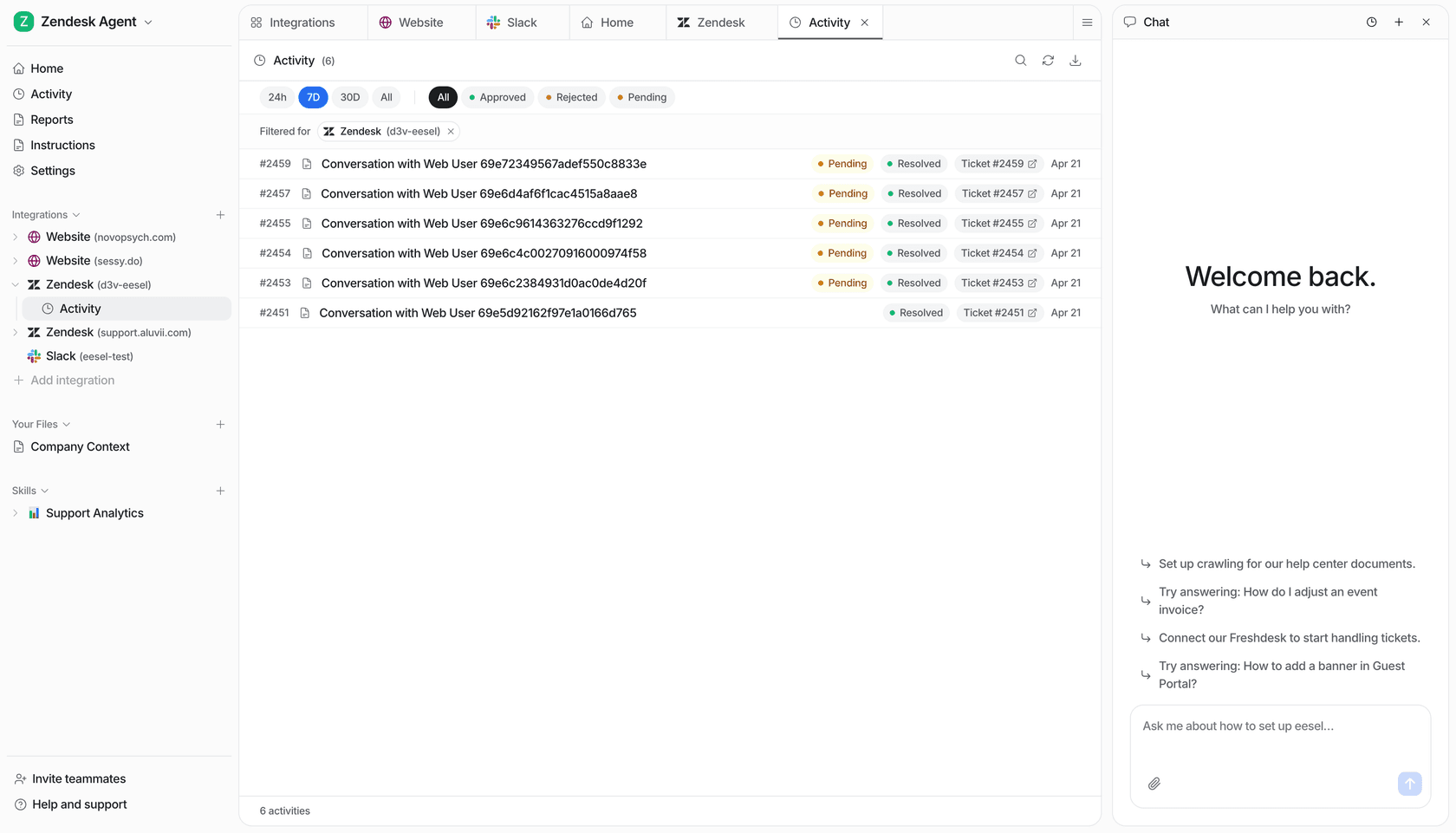
If your team already lives in Claude Code, the eesel CLI lets a coding agent upload approved support knowledge, like exported help articles and macros, adjust the teammate's instructions, and ask test questions to check answers before anything goes live. Connecting the helpdesk itself still needs someone with admin access to approve it.
Teams on Zendesk or Freshdesk can compare their options in my best AI helpdesk software roundup.
For budget planning, AI customer service costs breaks down what support automation runs across vendors, and Zendesk AI pricing shows the per-resolution model in practice.
Want a support teammate whose bill you can predict? Try eesel free with 100 credits, or read eesel vs Claude for how the two fit together.