


Turn on Code Review and PR Steward first, and keep Claude Approvals in observe mode until every rule names its classifiers. Code Review is the settled part (generally available, about 3x faster than in preview), but the headline is Claude Approvals, which can let a pull request merge with no human review under a policy file you write in .claude/approvals.yml. Anthropic's own docs warn about that, and they also say observe mode is still billed, a new policy file can silently stop automatic reviews unless a rule names claude/code_review, and organizations on Zero Data Retention, the HIPAA configuration or customer-managed keys cannot use any of it.
Claude Ship is a teammate for your codebase. eesel's ready-to-work teammates do the same kind of job for customer support and blog writing, and I roll them out the same way: watch first, then act under rules a person wrote. With the eesel CLI, Claude Code can upload approved knowledge, adjust the teammate's instructions and run test questions before anything goes live, though connecting the helpdesk itself still needs an admin to approve it.
I build integrations and APIs at eesel, so I've shipped plenty of code that a human reviewed, a bot reviewed, or both. The question I care about with Claude Ship is not whether the bot can find a bug. It is what happens to my merge button.
What is Claude Ship?
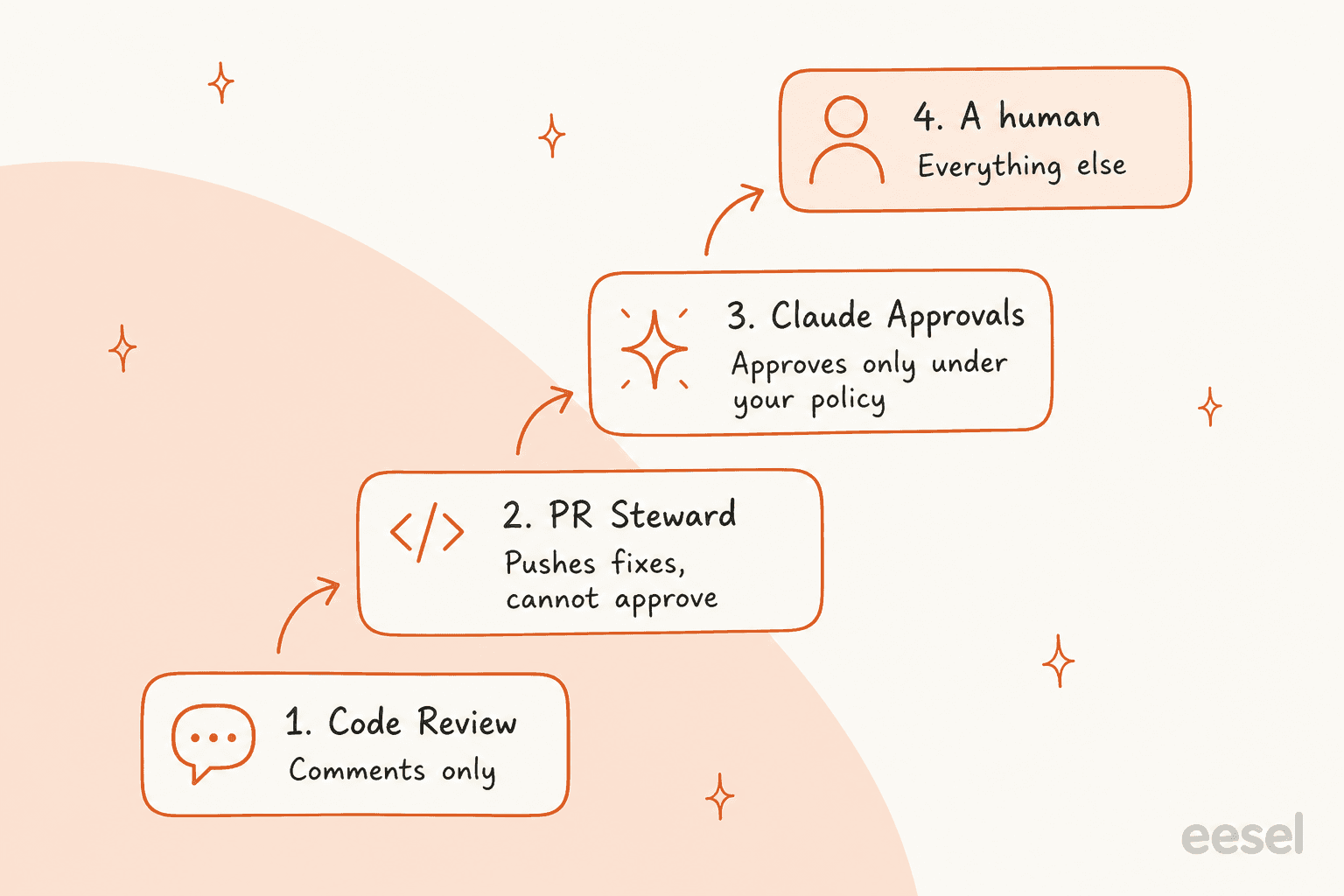
Claude Ship is Anthropic's bundle of three agents for GitHub pull requests, launched in beta on 23 November 2026. Anthropic says it can "review PRs, fix them, and decide what's ready to merge" based on policies each team sets. It sits on top of Claude Code and is available on Claude Team and Enterprise plans for repositories on GitHub.
| Agent | Status | What it does | Can it approve? |
|---|---|---|---|
| Code Review | Generally available | Several agents read the diff and surrounding code, verify findings, rank them and post them on the PR | No. By itself a review "doesn't approve or block the pull request" |
| PR Steward | Public beta | Pushes commits for failing checks, merge conflicts and review feedback, then comments what it changed and how to undo it | No. Designed not to approve or merge, and Anthropic's service refuses to |
| Claude Approvals | Public beta | Applies a policy file in your repo, reports who still has to approve, and can post an approving review | Yes, only where your policy says so |
Developers also get a /ship command in Claude Code, which rolled out on 23 November in Claude Code and the desktop app. Admins turn the agents on per repository under Organization settings, Claude Ship, and need an Owner role to do it.
How does /ship work?
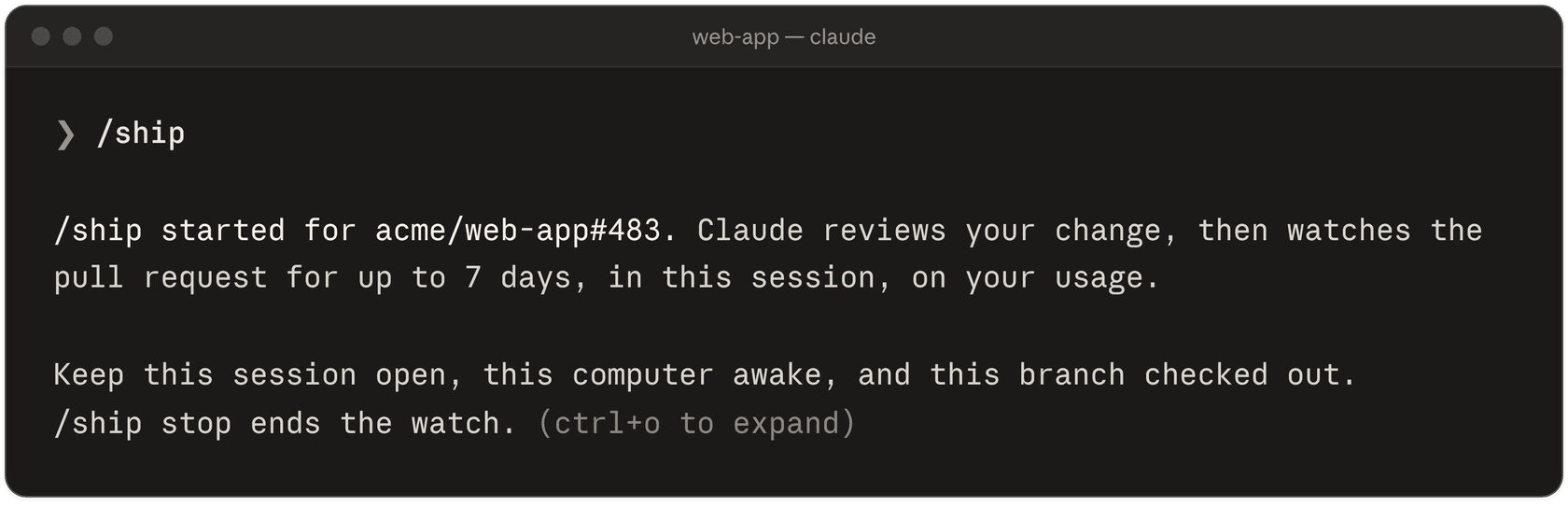
/ship is the developer-side entry point. It opens a GitHub pull request for your change if the branch has none, runs a review, then watches the PR and works on feedback and failing checks from your own session. Merging stays with you, and what can merge depends on your permissions and the repository's branch rules.
The requirements, from Anthropic's /ship docs:
- Claude Code v2.1.330 or later
- GitHub CLI 2.63 or later, signed in
- git 2.38 or later
- A local clone and the CLI (cloud sessions don't have these), and no watch on native Windows or in background sessions
The part I'd flag for your team: /ship proceeds with no confirmation prompt once you press Enter. It can commit all uncommitted changes, new files included, push, and open the PR as you. The docs add that it looks for secrets by file name, such as .env, so you still need to look inside your files yourself. The watch runs for up to 7 days in your session, on your usage, so the session, the computer and the checked-out branch all need to stay put.
One small thing from Hacker News: a developer on Hacker News reported that the bundled /ship overwrites a /ship skill their team already had, with disabling bundled skills or renaming their own as the two options they could see. If you have custom commands, check for a collision before you roll it out. If you want to automate around it, hooks and Claude Code permissions are where I'd start, and the git workflows guide covers the branch habits that make a watch session less fragile.
What does Code Review actually do?
Code Review is the mature piece, and the one I'd turn on today. It runs on Anthropic's infrastructure in four stages: find (agents examine the diff and surrounding code in parallel), verify (filter false positives), rank (dedupe and sort by severity) and post. The output is inline comments, a summary and a check run named Claude Code Review.
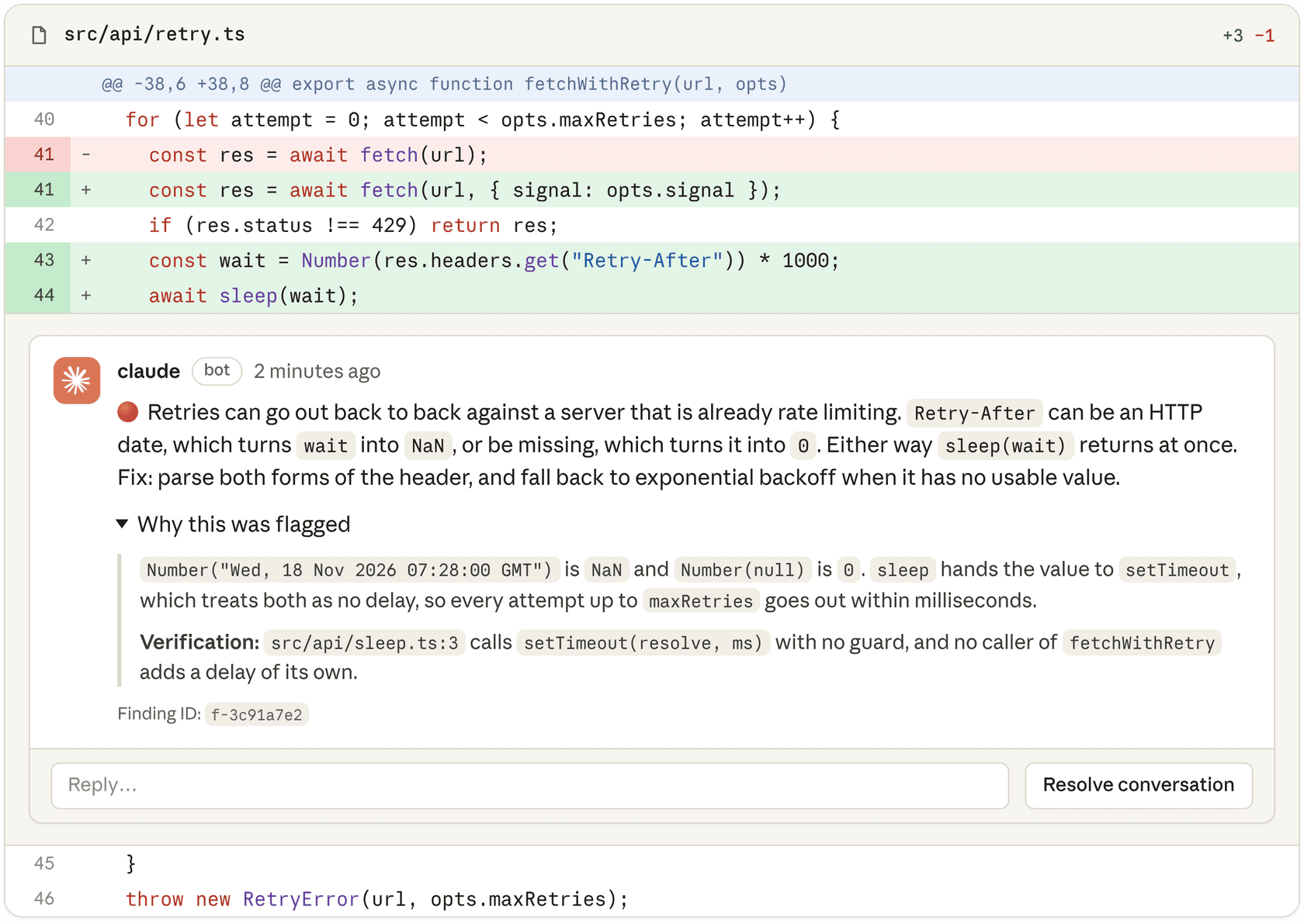
What I'd want you to know before you read the finding above:
- Speed. Anthropic says most reviews now finish about 3x faster than in preview, from roughly 20 minutes down to 6-10 minutes (GA post).
- Levels. Admins choose Quick, Standard (the default) or Deep per repository. Deep takes the longest and costs the most.
- Timing. Reviews can run once after PR creation, after every push, or manually with
@claude review. New repos start on after every push, which runs the most reviews. - Scope. The default focus is correctness, "bugs that would break production, not formatting preferences." You steer it with
REVIEW.mdandCLAUDE.md, andREVIEW.mdis read from the default branch, never from the PR's own changes. - Limits. Access is read-only, and a review reads the code without building or running it. The docs state plainly that a review with no findings doesn't mean your code is error-free or secure.
Anthropic hasn't published precision or recall numbers for the findings, so I'd treat the comments as a strong second reader. For more on how it compares with running your own setup, see my notes on Claude Code Review and the GitHub integration.
What does PR Steward refuse to do?
PR Steward is the agent that keeps a PR green. It "pushes commits to address review feedback, and attempts to fix failing checks and resolve merge conflicts," and after every push it comments with what it changed and how to undo it. Developers steer it with @claude plus an instruction, or stop it with @claude stop or by removing the claude-pr-steward-watching label.
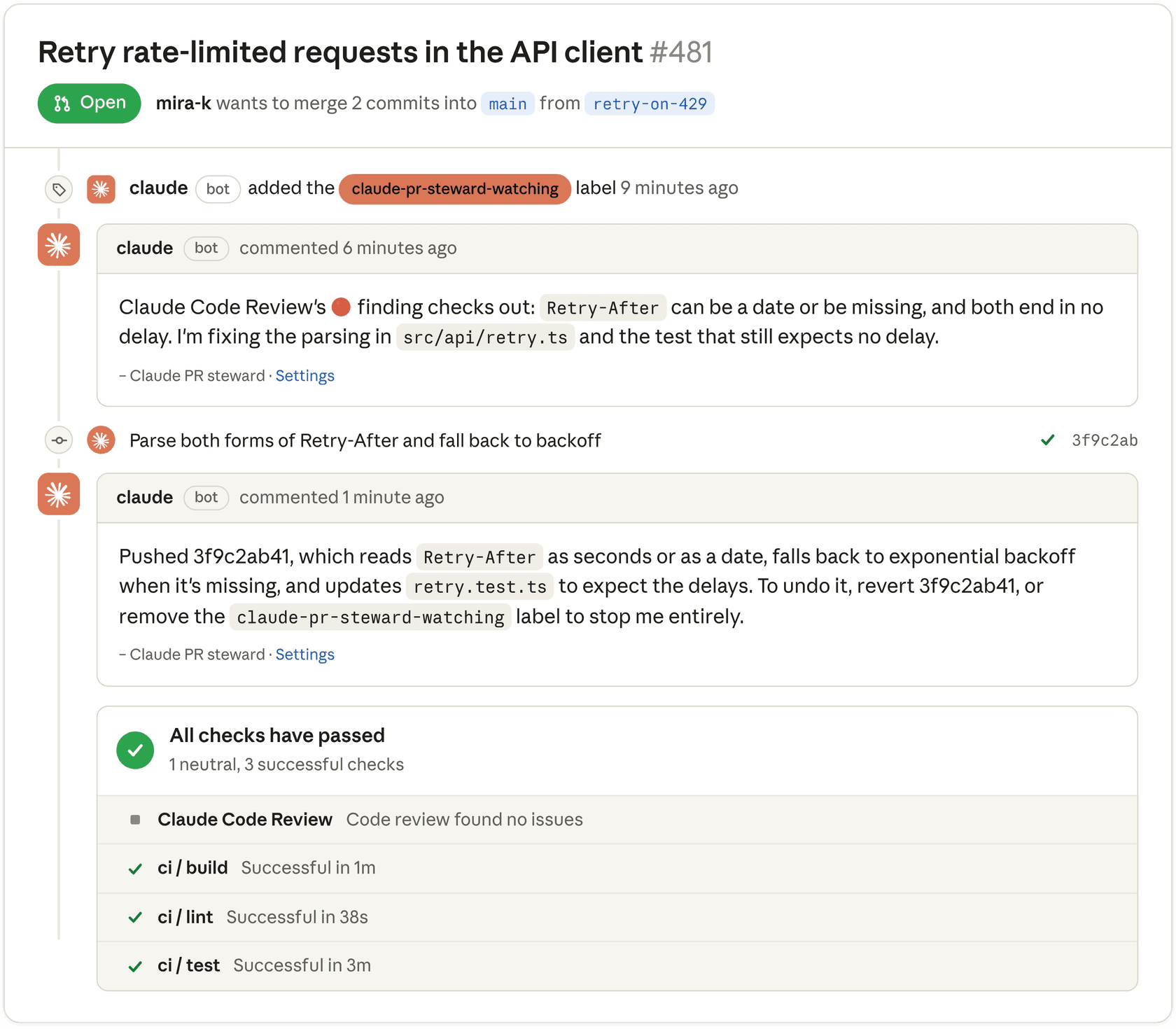
The limits are the reassuring part, and they come from Anthropic's PR Steward security page:
- Refused by the service: approving a PR, changing branch protection, rulesets or statuses, writing check runs, deleting a branch, and pushing tags.
- Left to GitHub's own branch rules: merging, enabling auto-merge, force-pushing, pushing to another branch and dismissing a review.
- Who it skips: drafts, fork PRs, bot-opened PRs and authors without write access.
Two operational notes. Anthropic advises starting repos on Manual (@claude steward) rather than On. And PR Steward has no spend limit of its own until you set one, and the per-repo cap can be passed before it stops, so set both the monthly limit and the cap on day one. While it's watching, it pushes commits and replies to comments without asking first, which is fine for a failing lint check and worth a conversation for anything in your security-sensitive code.
How does Claude Approvals work?
This is the section that made me stop scrolling. Claude Approvals is a check on GitHub pull requests that reports who still has to approve. It follows a policy, a file in your repository that sets how many people must approve a change to a path and where Claude may approve. Anthropic calls it "a smarter CODEOWNERS file", and the docs give the example that billing code can need two people while test fixtures need one once Code Review passes.
The policy lives at .claude/approvals.yml on your default branch. Here is the example from Anthropic's Approvals docs, which starts in observe mode with Claude only commenting:
# .claude/approvals.yml
version: 1
mode: observe
rules:
  - purpose: "A change takes two people, and Claude doesn't approve."
    paths: ["**"]
    verdict: { claude: comments, seats: 2 }
    advisory: [claude/code_review]
The starter policy in the setup guide goes one step further. It still takes two people, but when Claude's review passes, one is enough and Claude approves:
version: 1
mode: observe
rules:
  - purpose: "A change takes two people. When Claude's review passes, one is enough and Claude approves."
    paths: ["**"]
    verdict: { claude: comments, seats: 2 }
    override:
      - { if: "claude/code_review = pass", verdict: { claude: approves, seats: 1 } }
  - purpose: "A change to the review rules takes two people."
    paths: ["**/.claude/**"]
    nested: inherit
    verdict: { claude: comments, seats: 2 }
Rules combine by taking "the strictest of the verdicts that apply." verdict.claude is approves, comments or blocks, seats runs from 0 to 16, and conditions can read facts such as pr/files_changed, pr/diff_lines, pr/authors and pr/opened_by. A condition can't read CI results, so keep CI as its own required check in GitHub. Claude can scaffold a file for you with /claude-approvals (Claude Code v2.1.331 or later).
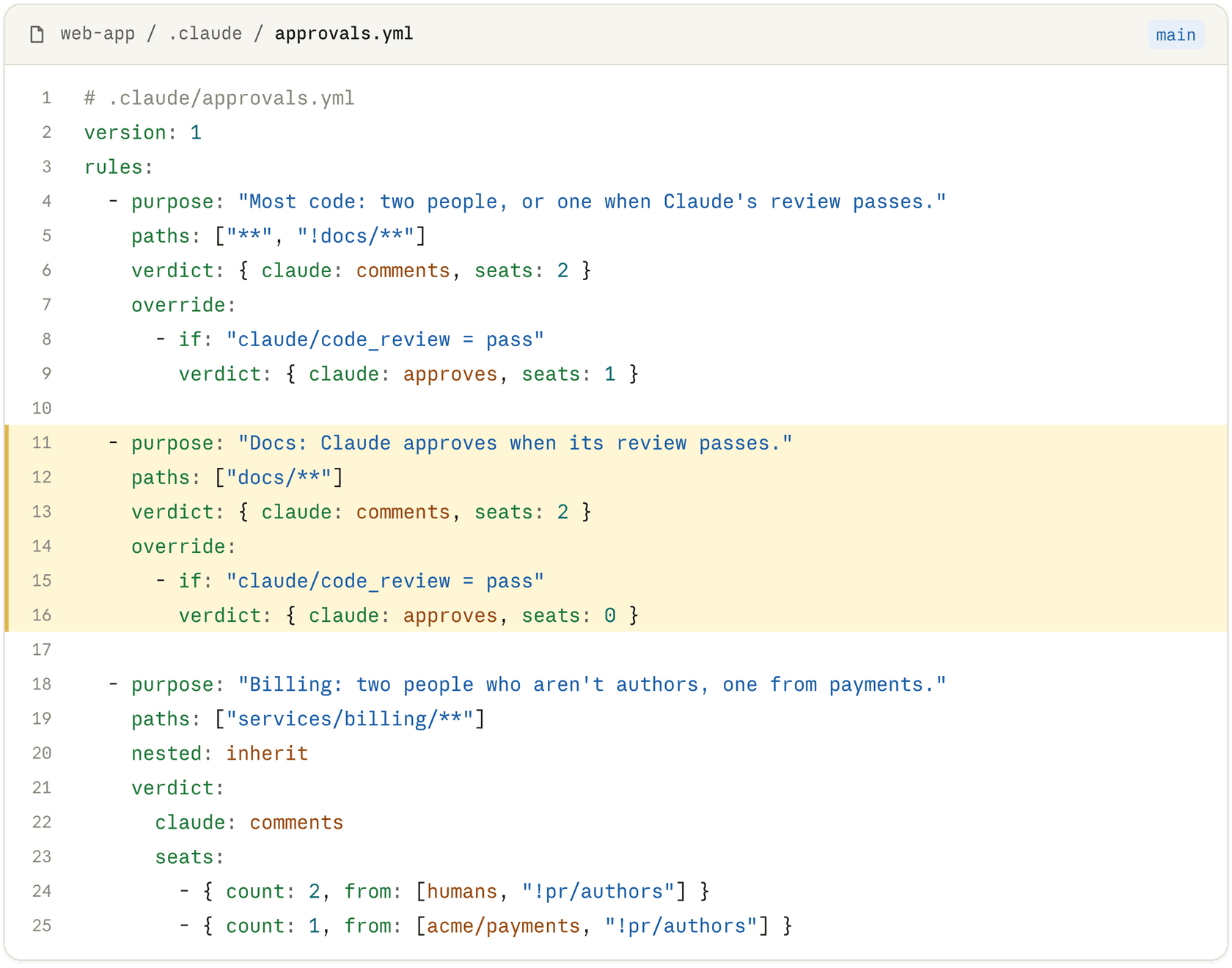
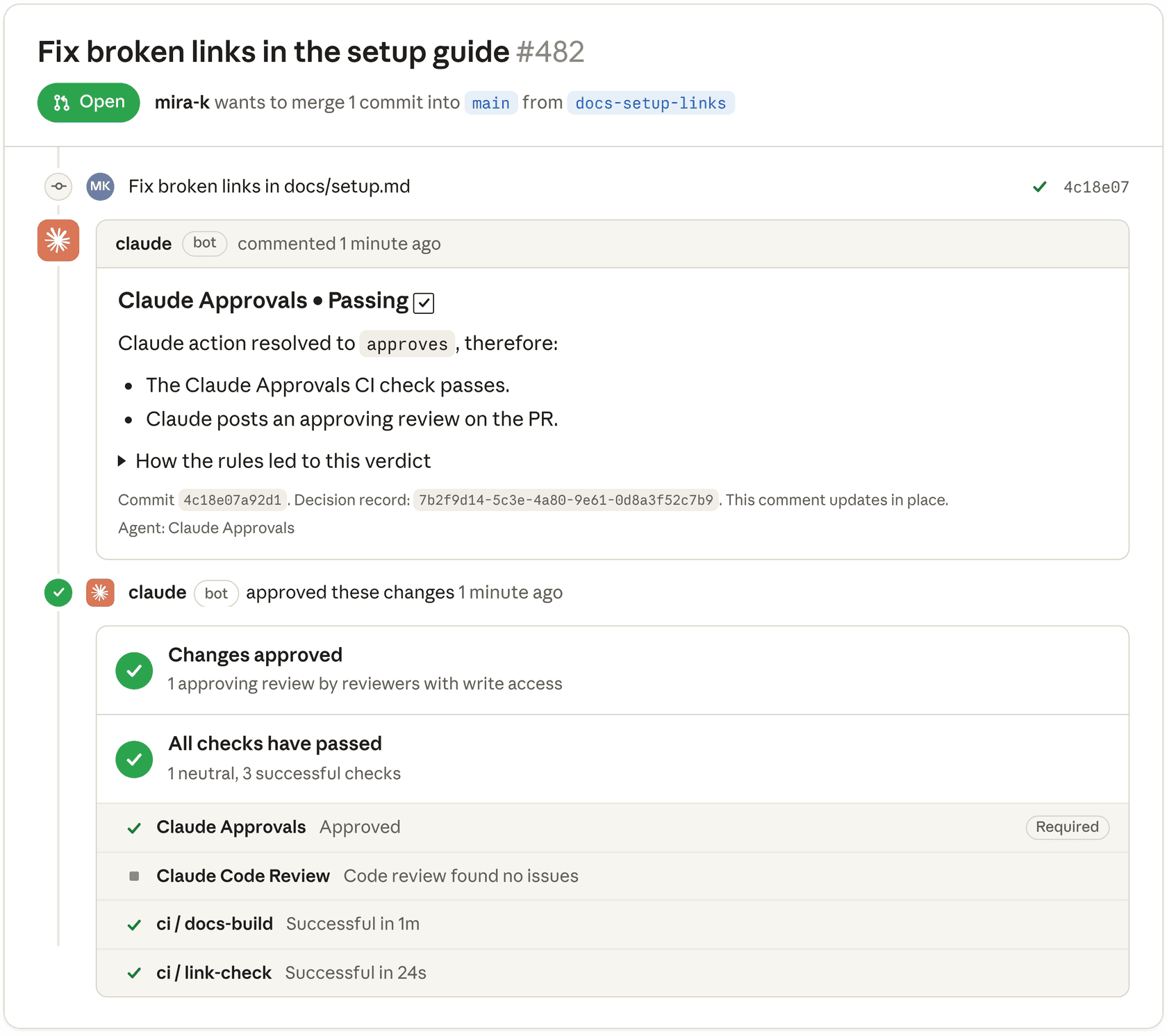
Look at the highlighted rule in Anthropic's own example: for docs/**, seats: 0 and claude: approves once Code Review passes. That is a pull request that can merge with no person looking at it, by design. The next screenshot shows the result, with a Claude Approvals check passing, an approving review from the bot and the check marked Required.
The gotchas Anthropic's docs list themselves
I give Anthropic credit here: the docs name the sharp edges. Read these before you write rule one.
- Merges without human review. The check blocks a merge only where you make it required in GitHub. The author can fill a seat, so
seats: 1means nobody else has to look, and withseats: 0a bot-written PR can merge unseen. GitHub can also count Claude's approving review toward a required approval. claude: approvesstarts no review by itself. Unless the rule readsclaude/code_review, Claude "can approve a change that nothing has reviewed."- Auto-merge. With GitHub auto-merge or a merge queue and a policy that needs no person, a change can merge without anyone acting.
- Silent loss of automatic reviews. Where every file a PR changes lies under a policy file, automatic reviews normally stop unless a rule for those files names
claude/code_review. Existing Code Review users should add it to a rule, for example underadvisory, before they merge the file. - Observe mode is billed. Reviews and classifier runs are billed in observe mode, and a policy that uses Claude's review triggers a billed Code Review even there.
Classifiers: name them explicitly
A classifier is a question about the PR that a rule's condition can read. Two are built in: claude/code_review (answers include pass, with severity none, minimal or high) and claude/diff (trivial, same_intent or different, used after a push). You can also add your own in .claude/classifiers/<name>/def.yml, referenced as repo/<name>, such as "repo/change_risk = low". Each run is a Claude Code cloud session, capped at $10 per run when you set no budget, and the docs say the bill can be higher than the cap.
Anthropic doesn't define "routine" as a category. Routine is whatever your policy says it is, which is exactly why I'd write every classifier a rule depends on by name instead of leaning on a broad path glob. When you're ready to enforce, you delete mode: observe, merge, rerun open PRs with @claude approvals rerun, and add Claude Approvals as a required status check in GitHub.
What does Claude Ship cost?
Anthropic publishes no per-review or per-PR dollar price for any of the three agents. Everything is billed on tokens through your organization's usage credits, separately from your plan's included usage, and it is billed to the organization, not the developer who opened the PR. Here is what bills how, all from Anthropic's pages:
| Item | How it's billed |
|---|---|
| Code Review | Tokens via usage credits. "No flat per-review price." Cost scales with review level, change size, code complexity and how often reviews run |
| PR Steward | Tokens via usage credits, billed to your organization. No spend limit of its own until you set one |
| Claude Approvals | No base charge. Classifiers bill on the tokens they use, and a policy that uses Claude's review triggers a billed Code Review |
| Observe mode | Still billed |
/ship and /steward | Run in your session and count as regular Claude Code usage |
| Plans | Team and Enterprise only. Plan prices sit on Anthropic's pricing page, which I haven't copied here (my Claude pricing guide covers the plans) |
Anthropic's own method for estimating spend is to run a pilot, read each repo's average cost per review under Cost in Organization settings, then multiply by monthly PRs (and by pushes per PR if reviews run after every push). One trap from the docs: if you turn off usage credits, an agent that is on keeps running and billing your organization.
The Enterprise credit offer
Eligible paid Claude Enterprise organizations can claim between $10,000 and $50,000 in Claude Ship credits, depending on active Claude Code seats, set at claim time. Per Anthropic's support article:
- Claim window: until 15 January 2027 at 23:59 UTC, one claim per organization, and it cannot be undone.
- Duration: 30 days from the claim, or until used up. Unused credits don't carry over.
- Who claims: an Owner or Primary Owner.
- Covers: Code Review, PR Steward and Claude Approvals, including runs that fail. It doesn't cover
/ship,/steward, other Claude Code usage, chat or the API. - Not eligible: Team, Pro, Max and Free plans, reseller-billed organizations, trial or canceled organizations, and any organization that can't use Code Review.
Anthropic's advice is worth repeating: set up Code Review on your repositories before you claim, because the 30 days run from the claim whether or not reviews are running. For how this fits a wider rollout, my enterprise guide and admin controls notes cover the owner-side settings.
Who can't use Claude Ship?
Plenty of regulated teams will hit a wall, and it's better to know before a pilot:
- Zero Data Retention, the HIPAA configuration, or customer-managed encryption keys: not available, per Anthropic's announcement and docs.
- BAA: Code Review "isn't covered under Anthropic's Business Associate Agreement."
- Claude Approvals also can't start with FERPA or Access Transparency settings.
- Hosts: GitHub only. Code Review and PR Steward also work with GitHub Enterprise Server, while Approvals works on github.com, including GitHub Enterprise Cloud.
- Plans: Team and Enterprise only.
One Hacker News reader put the compliance gap in a single line, quoting the exclusions and adding "Bummer." If you are on any of those settings, the options are the self-hosted routes Anthropic lists, such as running Claude in your own CI, or other tools like GitHub Copilot, Cursor or OpenAI Codex.
What are developers saying?
The Hacker News thread had 86 points and 32 comments when I read it, and it split between jokes about AI approving AI code and skepticism that the pieces are hard to replicate. I didn't find a hands-on Approvals write-up yet; it launched two days before I wrote this. A few voices worth reading, all verbatim:
"Claude writes the code, Claude reads the code, Claude reviews the code - but I merge it"

That is the line the whole product is testing: whether "but I merge it" survives.
"This is a tool which centralizes policy enforcement for teams with low-trust, I guess. I'm not sure what other value this offers, building a bot that can check for review comments and automatically push fixes is trivial for any engineering team."
That's a fair challenge, and I half agree: the bot that pushes fixes is easy to build. What's harder is the policy layer, the audit trail and the check you can mark required in GitHub, which is where Anthropic is putting its weight.
"It's weird how close this matches the review process I built from individual pieces over the last few months. I call the steward the PR shepherd though ... Right now I still review and merge everything, but for low complexity items this is not worth the time."
"There is a lot of code authoring currently happening with OpenAI's models. Using a different provider's models to do the code review part seems like a pretty good separation of responsibilities."
"Code Review, PR Steward and Approvals are all set up per repo ... The bug lives between the PRs, and nothing looks there."

The per-repo scope matters if you run many small repositories. Anthropic's own customer quotes on the launch page, from TELUS and Carvana, stress keeping a human in the loop and less time on review feedback, which is the cautious reading of the product.
How would I roll Claude Ship out?
Here is the order I'd use, and it follows Anthropic's own guidance more closely than the launch hype does.
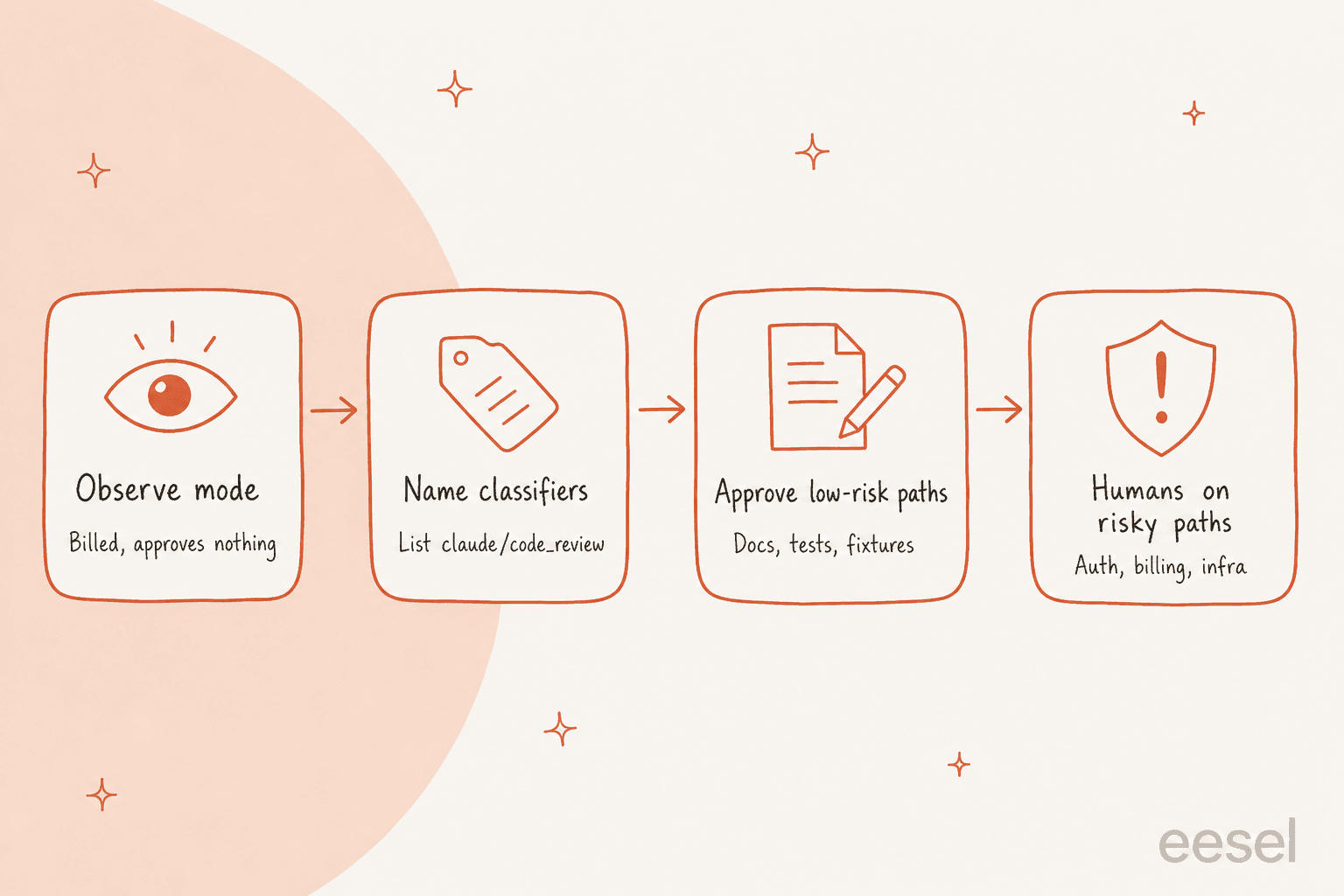
- Start with one repository and Code Review only. Set the review level to Standard, change the schedule from after every push to once after PR creation if cost worries you, and read the average cost per review after a week.
- Add PR Steward in Manual mode. Set the monthly limit and the per-repo cap first. Use
@claude stewardon a few PRs before you let it start by itself. - Merge a policy file in observe mode. Open it in its own PR, merge it, and watch the "(observe mode)" check for a couple of weeks. Remember this is billed.
- Name
claude/code_reviewexplicitly in every rule. That protects automatic reviews and means noapprovesverdict runs without a review behind it. Write any custom classifier by name too, with abudget. - Let Claude approve only low-risk paths. Docs, test fixtures and generated files are the obvious candidates. Keep
seatsat 1 or more until you've watched at least a few dozen real decisions, and avoidseats: 0anywhere a bot can open the PR. - Keep humans on risky paths. Auth, billing, infrastructure, anything under
**/.claude/**. The starter policy already makes changes to the review rules take two people, and I'd keep that. - Then enforce. Delete
mode: observe, rerun open PRs, and make Claude Approvals a required check. Turn auto-merge off for any path that has a bot-friendly rule until you trust the record.
If you want to wire this into a wider agent setup, the Claude Code best practices, subagents and agentic coding CLI guides pair well, and teams comparing hosted agents can read about Claude Managed Agents and Claude Tag, which Anthropic used in its own launch example. Model choice sits underneath all of this: Code Review chooses the models itself, so you can't pick one in the admin settings, but the Claude Opus 5.5 and Claude Sonnet 5.5 pages cover what the underlying family can do.
How do eesel teammates use the same observe-first pattern?
The reason Approvals interested me more than Code Review is that I've lived the same problem on the support side. Claude Ship is a teammate for your codebase. eesel is ready-to-work teammates for specific jobs: the AI helpdesk teammate for support, and the AI blog writer for content. When a teammate is about to act in front of customers, "observe first, then act under rules a person wrote" is the only rollout I trust. I simulate the helpdesk teammate against historical tickets before it answers anyone, and I write escalation rules for what it hands to people.
SE Ranking shows the shape. It runs one agent per product on Zendesk. Between 8 August and 8 September 2026 eesel handled about 4,650 conversations there, including 2,100 live chats, and on some products a new email ticket gets a draft reply as an internal note for a person to review and send, while billing questions only get a note. They also asked for an ai_handled tag on every ticket so containment is counted in Zendesk, not guessed. That is the support version of an observe-mode check. SamCart does a similar thing with Freshdesk tickets: the agent replies only while no person is assigned, and steps back once a teammate picks the ticket up or the customer asks for a person.
If your support team is thinking about this kind of rollout, the same discipline applies: start with drafts, count what the agent handled, then widen the rules. The eesel vs Claude comparison goes through where a general agent stops and a ready-made teammate starts, and the AI agent MCP server guide covers connecting it to the tools your coding agents already use.
Try eesel for your support queue
If your engineers are getting a reviewer for their pull requests, your support team can get a teammate for the queue. eesel's AI helpdesk teammate joins your existing helpdesk, learns from your help center and past tickets, can be simulated on historical tickets before it answers a customer, and hands conversations to a person under rules you set.
Frequently Asked Questions
What is Claude Ship?
How much does Claude Ship cost?
Can Claude approve a pull request with no human review?
claude: approves and seats: 0 lets a PR meet its policy without a person, and Anthropic's docs warn about merges without human review. PR Steward, by contrast, is designed not to approve or merge. See my notes on Claude Code permissions.What is observe mode in Claude Approvals?
mode: observe in .claude/approvals.yml) shows what the policy would decide without Claude approving anything, and the check normally counts as passing. Anthropic recommends starting there, but reviews and classifier runs are billed in observe mode.Does Claude Ship work with HIPAA or Zero Data Retention?
What do I need to run /ship in Claude Code?
/ship proceeds with no confirmation prompt, so check your files first. The git workflows guide helps.Is Claude Ship the same as Claude Code Review?
claude/code_review. More in my Claude Code Review guide.