


How I reviewed ChatGPT Pro 500
I'm a software engineer at eesel and I build the AI agents inside eesel's product, so the parts of a plan I care about are the ones deciding how an agent behaves under load, meaning how fast the tokens come back and what each call costs, and also when the meter runs out. Pro 500 is mostly a plan about exactly those things. eesel has spent years running AI teammates on live support queues, and the habit I picked up there is a simple one: before an agent touches real work, it gets simulated against historical tickets so you can see what it would have done. I reviewed Pro 500 with the same mindset, measuring before trusting.
Here is what I did, so you can weigh the verdict for yourself:
- Timed Ultrafast myself. I ran the same prompt through GPT-6 Astra six times via the OpenAI API, three of them on Standard and three on Ultrafast, and measured the time to first token and the generation speed, plus the total time. The results are further below.
- Read every primary page. OpenAI's Pro tiers article, its Speed and Codex pricing docs, the DevDay recap, and the ChatGPT pricing page. Each one of them is linked at the place where I use it.
- Read the launch threads in full. All
258comments on the Hacker News thread, plus three Reddit threads, one of which is from a Pro 500 subscriber who tested Ultrafast right on day one.
If you want the plan explained first, the ChatGPT Pro 500 explainer covers every tier, and my colleague's GPT-6 Astra review covers what Astra is good at. This post is more about the plan that is wrapped around it.
One honest caveat worth putting up front: I tested Ultrafast through the API and not through a Pro 500 subscription in Codex. The model speed is the same product, but the ChatGPT app adds some overhead of its own, and OpenAI quotes a higher peak for Codex than it does for the API. Wherever a claim comes from someone else's subscription, I say so.
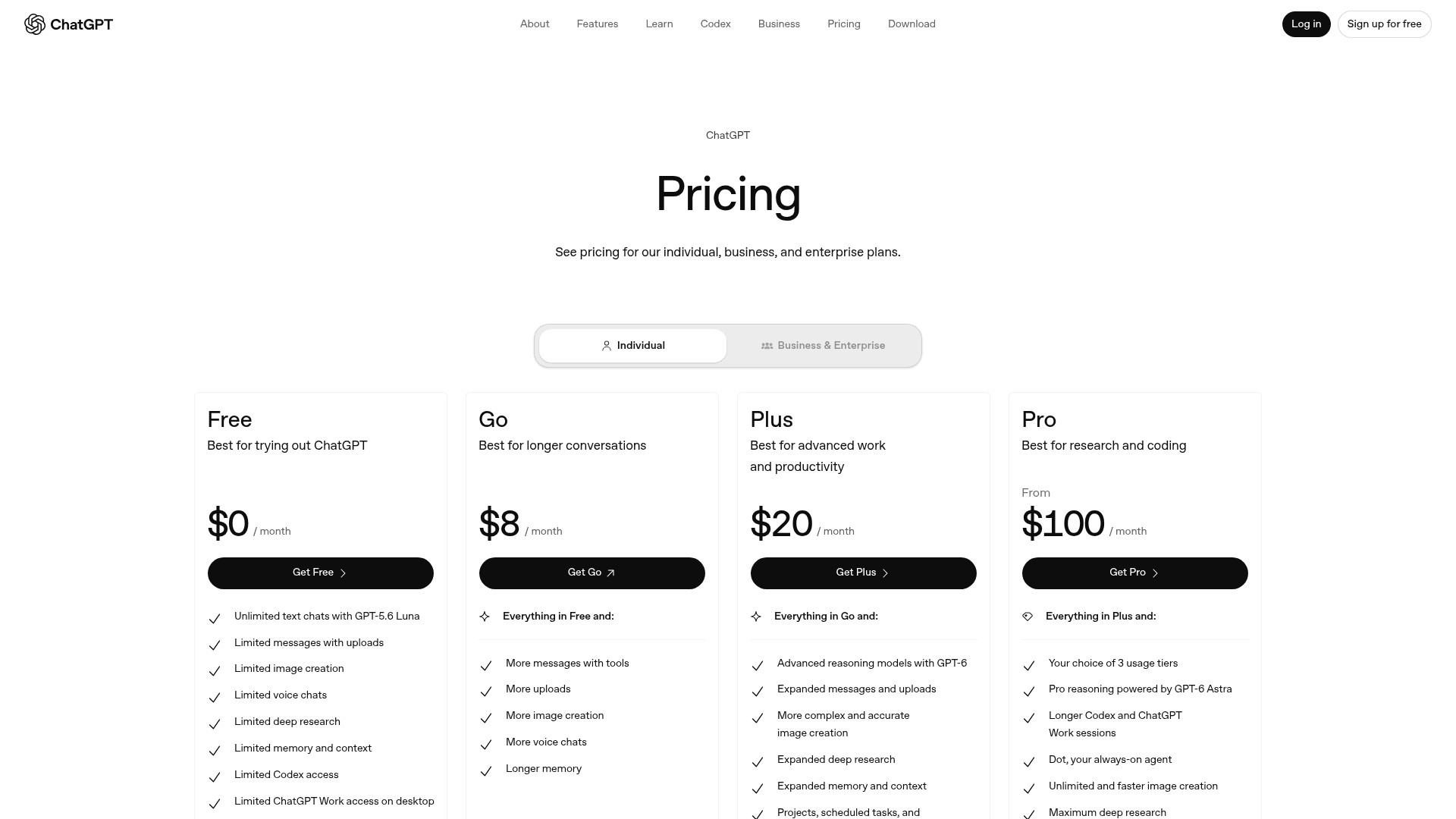
Notice what the pricing page doesn't show, which is any usage number at all. It lists "your choice of 3 usage tiers" and it stops right there. The multiples in this review come from OpenAI's DevDay post and its help docs, and also from the email it sent to Pro 200 subscribers.
ChatGPT Pro 500 review scorecard
Here's how I would score it, on the five things that decide if a $500 AI subscription earns its place or not.
| Area | Score | Why |
|---|---|---|
| Speed | 4.5/5 | Ultrafast averaged 153 tokens/sec in my test, against 29 on Standard |
| Usage headroom | 4/5 | 25x Plus, the highest personal allowance, and no five-hour limit on Pro plans for now |
| Value per dollar | 2.5/5 | Same $20 per 1x of Plus as every other tier, and Ultrafast bills at 8x |
| Transparency | 2/5 | No usage numbers on the pricing page; the multiples live in emails, a livestream, and a blog post |
| Fit for most buyers | 2/5 | Built for people who already outgrow Pro 200 |
| Overall | 3/5 | A real product for a narrow buyer, priced honestly per unit, explained poorly |
What ChatGPT Pro 500 includes
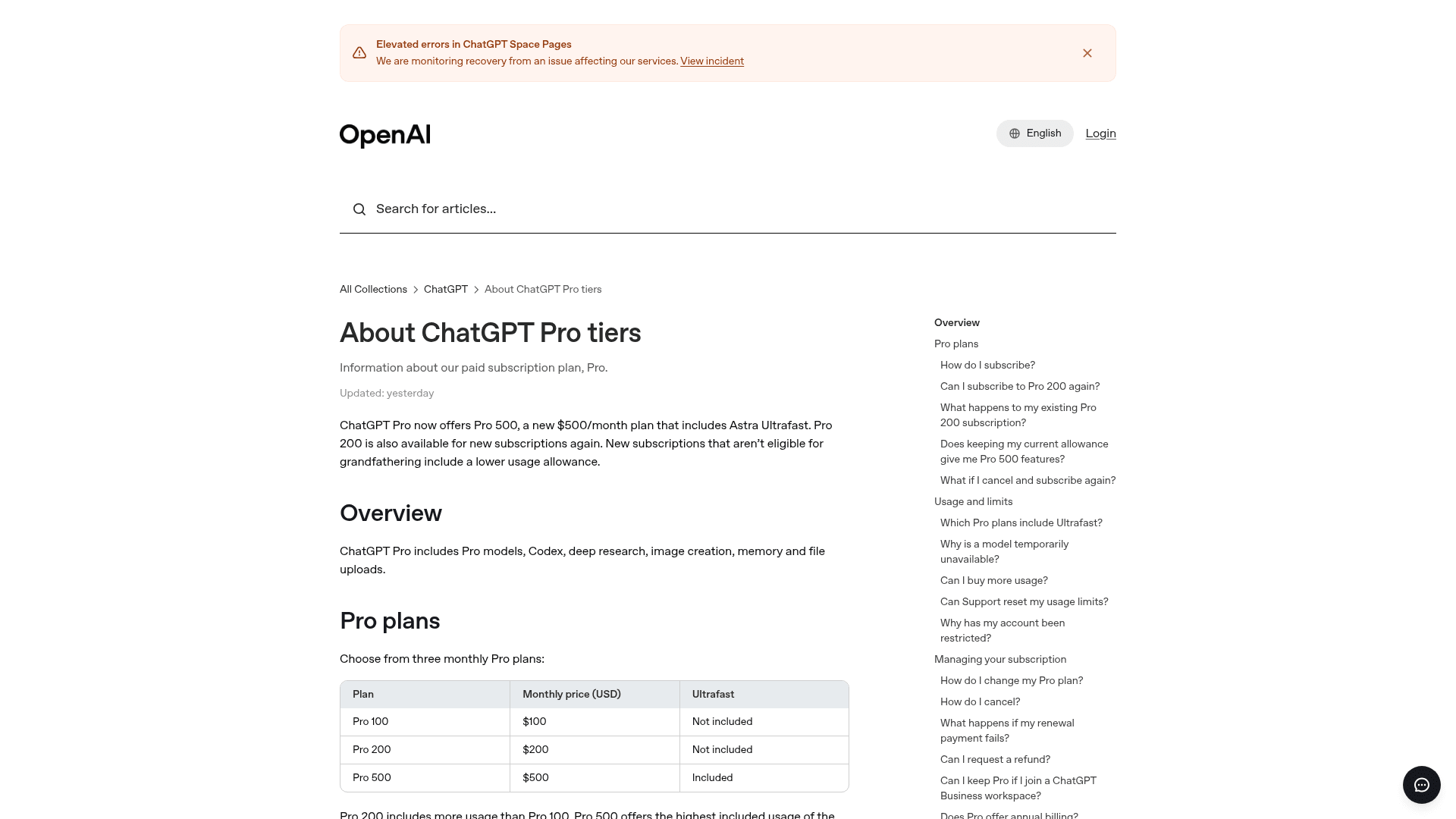
OpenAI is now selling three Pro plans. According to the Pro tiers article, all three include Pro models, Codex, deep research and image creation, plus memory and file uploads. Where they differ is the usage, and one speed tier.
| Plus | Pro 100 | Pro 200 | Pro 500 | |
|---|---|---|---|---|
| Monthly price | $20 | $100 | $200 | $500 |
| Work and Codex usage vs Plus | 1x | 5x | 10x (was 20x) | 25x |
| Price per 1x of Plus | $20 | $20 | $20 | $20 |
| Astra Ultrafast | No | No | No | Yes |
| Five-hour limit | Yes | None for now | None for now | None for now |
| GPT-6 Pro in Chat | No | Shared weekly allowance | 100/week (was 200) | Highest Pro-model limits |
| Billing | Monthly | Monthly only | Monthly only | Monthly only |
| Your first OpenAI dot | No | Yes, outside EEA/UK/CH | Yes, outside EEA/UK/CH | Yes, outside EEA/UK/CH |
A few notes on where those numbers come from, since OpenAI spreads them out across several pages:
- 25x for Pro 500 is in OpenAI's DevDay recap: "our highest usage allowance at 25 times the ChatGPT Plus allowance."
- 5x for Pro 100 comes from the usage table in OpenAI's Astra usage article, which still has its columns labelled "Pro 5x" and "Pro 20x".
- 10x for Pro 200 comes from the email OpenAI sent Pro 200 subscribers, quoted below. The help center itself only says that new Pro 200 subscriptions "include a lower usage allowance."
- No five-hour limit is stated on the Codex pricing page: "Pro plans currently have no five-hour limit." Weekly limits still apply.
- Monthly only. "Pro is billed monthly. Annual billing and payment for multiple months in advance are not available," per the Pro tiers article.
There is one small documentation gap that is worth knowing about: OpenAI's GPT-6 Pro article lists GPT-6 Pro in Chat for "Pro $100, Pro $200, Business and Enterprise plans," and doesn't name Pro $500 in that sentence. The same article says higher-allowance Pro plans get higher Pro-model limits, so I read it more as a missed update than as a missing feature. If GPT-6 Pro in Chat is the main reason you buy, do check the model picker before you commit.
The Pro 200 change is the real story
Most of the anger in the launch threads isn't really about Pro 500 at all, it's about what happened to Pro 200 on that same day. One Hacker News commenter posted the relevant lines of OpenAI's email:
"Starting October 30, 2026, your included usage in ChatGPT Work and Codex will decrease from 20 times to 10 times the ChatGPT Plus allowance. Your GPT-6 Pro limit in Chat will decrease from 200 to 100 messages per week. Your price remains unchanged and you'll keep your current limits through October 29, 2026."

OpenAI's own wording in the Pro tiers article is that the lower allowance reflects "our increasingly efficient models." Existing subscribers get to keep the old allowance through October 29, 2026, for as long as their Pro 200 stays active. The allowance in question is shared between ChatGPT Work and Codex, which means a cut to one of them is a cut to both.
That context changes the way Pro 500 reads. Before this week, 20x cost $200, and now 25x costs $500. Pro 500 is 25% more usage than the old Pro 200 for 2.5x the price. If you measure it against the new Pro 200, though, the pricing is perfectly linear:
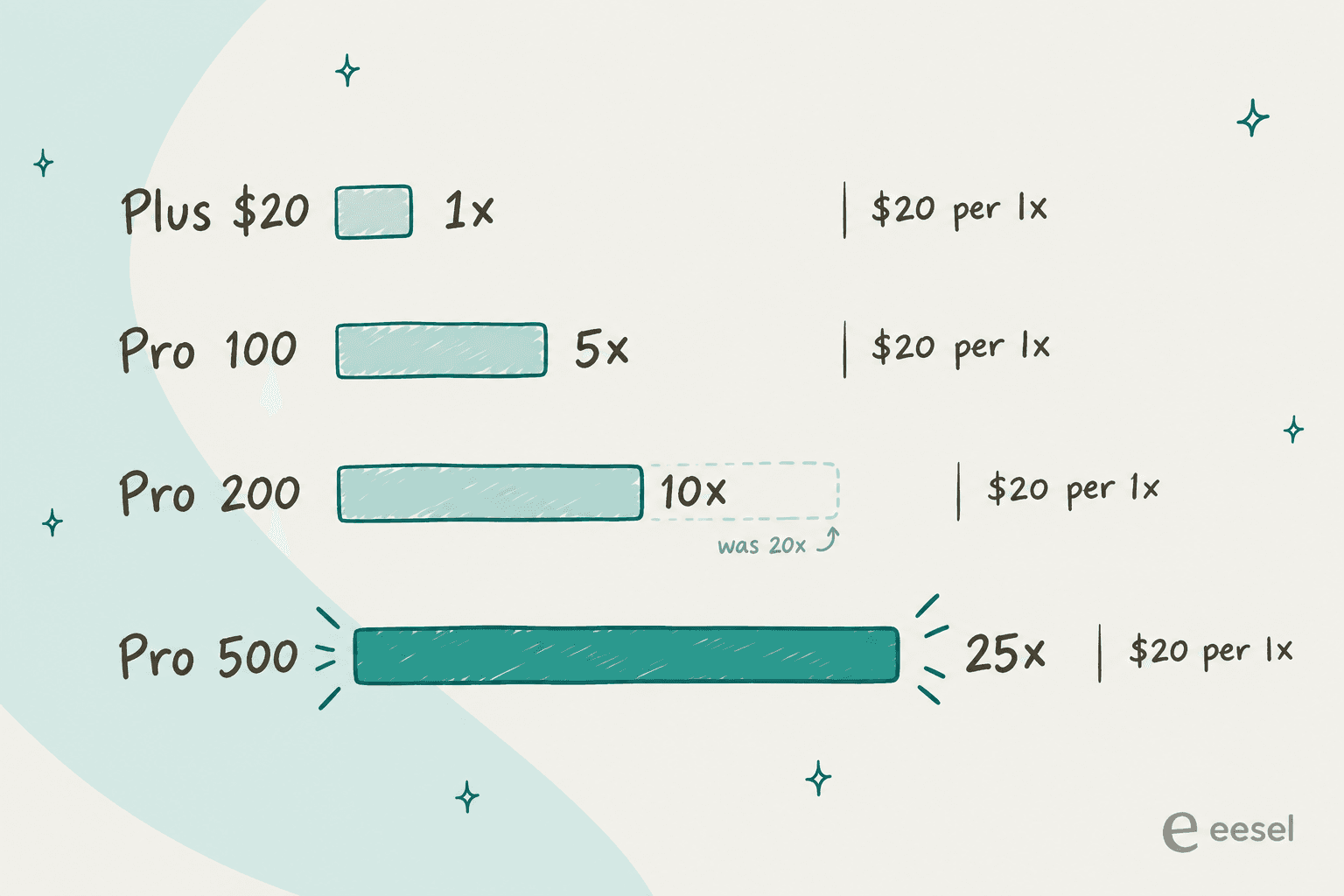
"ChatGPT Plus: 1x usage, $20. Pro 100: 5x usage, $100. Pro 200: 10x usage, $200 (previously was 20x usage, $200). Pro 500: 25x usage, $500. So, essentially scaling is equal."
That's the fairest one-line summary I read anywhere. There is no bulk discount waiting at the top. With Pro 500 you're not buying cheaper usage, you're buying more of it in one account, and Ultrafast on top.
Existing subscribers did also get something to soften the change. Another commenter quoted a one-time grant of "62,500 usage credits (a $2,500 USD value)" that expire on December 31, 2026, per the same email thread on Hacker News. That grant is useful for a second reason too, because it tells you a credit is worth 4 cents. At OpenAI's published credit rates, GPT-6 Astra costs 250 credits per million input tokens and 1,250 per million output tokens, which works out to $10 in and $50 out, the same as Astra's API pricing.
I tested Ultrafast: how fast is it really?
Ultrafast is the headline feature, so I went and measured it. On October 1, 2026, I sent the same prompt (a roughly 600-word explanation of triaging a 500-ticket backlog, plain prose) to gpt-6-astra through the OpenAI Responses API, streamed, at low reasoning effort. Three runs on Standard, three with service_tier: "ultrafast", alternating them so that neither one got a quieter minute on the servers.
| Run | Mode | Time to first token | Generation speed | Total time | Output tokens |
|---|---|---|---|---|---|
| 1 | Standard | 5.6s | 29.3 tok/s | 30.7s | 820 |
| 1 | Ultrafast | 1.7s | 139.0 tok/s | 6.9s | 799 |
| 2 | Standard | 3.7s | 30.1 tok/s | 28.0s | 771 |
| 2 | Ultrafast | 1.6s | 162.8 tok/s | 6.1s | 727 |
| 3 | Standard | 2.8s | 28.6 tok/s | 28.7s | 769 |
| 3 | Ultrafast | 1.8s | 156.0 tok/s | 6.4s | 745 |
| Average | Standard | 4.0s | 29.3 tok/s | 29.1s | 787 |
| Average | Ultrafast | 1.7s | 152.6 tok/s | 6.5s | 757 |
Generation speed went up by about 5.2x, and the whole request finished 4.5x sooner. The first token arrived more than twice as fast as well, and that is the part you feel the most when you're sitting and watching a terminal.
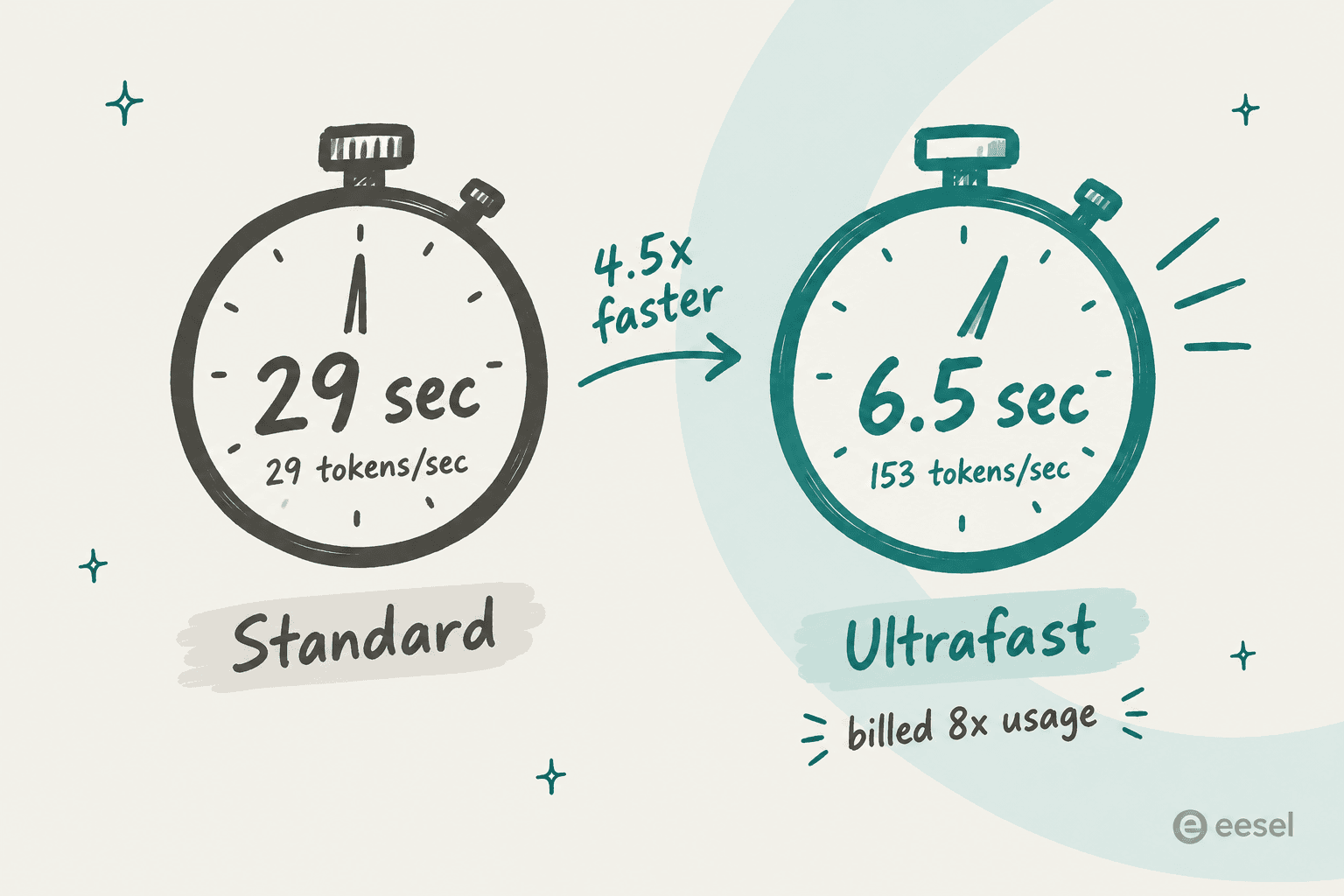
So how does that compare to the marketing? OpenAI's DevDay recap says Ultrafast offers "up to 8× faster token generation (300 tokens per second) in Codex and up to 6x in the API." My API runs landed at about 5.2x on generation speed and they never touched 300 tokens per second, which still sits inside the "up to" and is a fair result for a short prompt. OpenAI's Speed docs are careful on this point too: the 8x figure "measures token generation speed, not billing rates or overall task completion time."
That caveat matters a lot for agent work. A long Codex task spends its time on tool calls and file reads, and on test runs too, none of which Ultrafast speeds up. Pure writing, like in my test, is close to the best case.
Where your usage goes: the 8x meter
Here's the part of Pro 500 that the launch coverage mostly skipped over, and it's also the part I would want explained before paying $500.
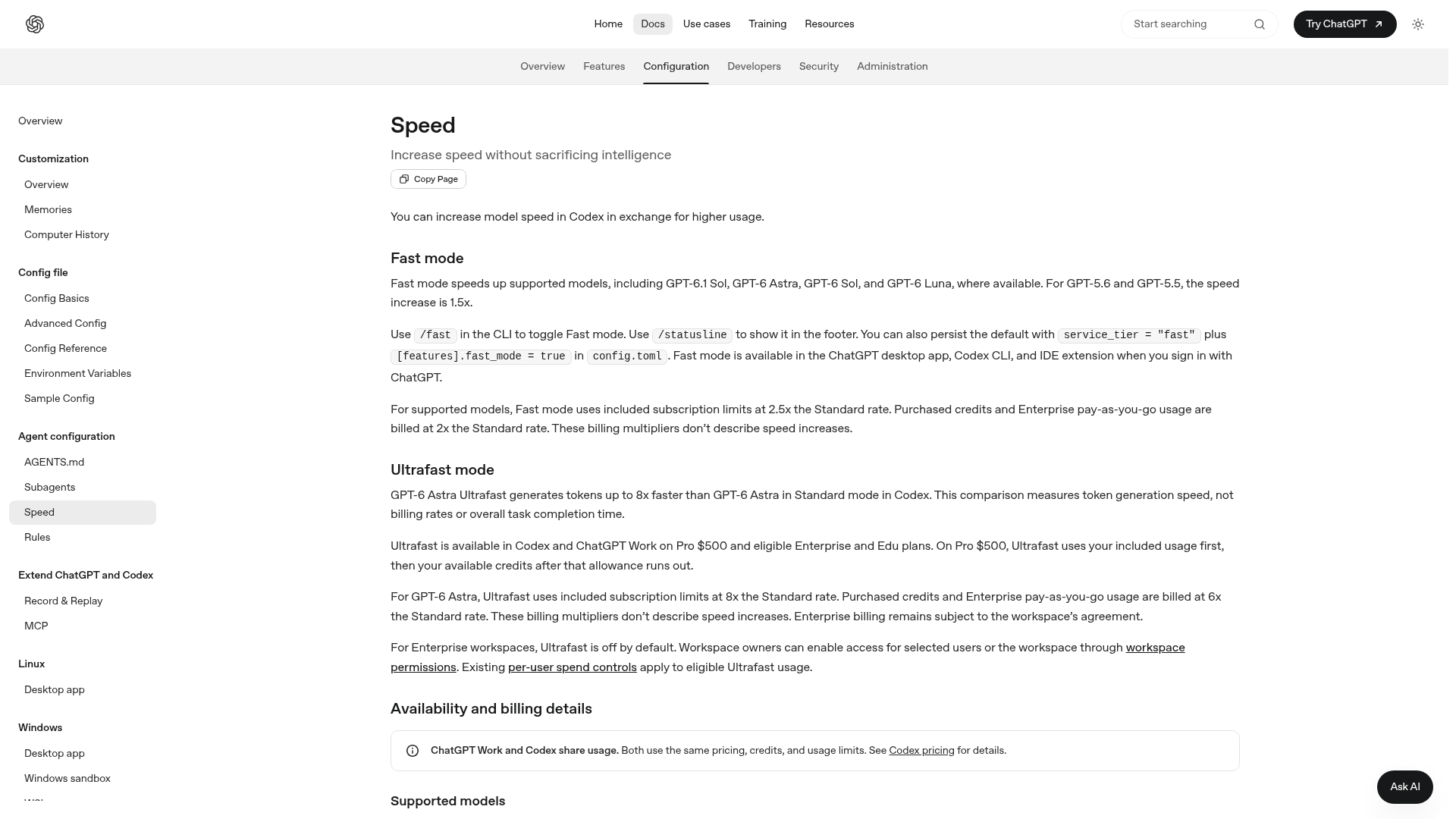
Per the Speed docs, Ultrafast "uses included subscription limits at 8x the Standard rate." Purchased credits get billed at 6x. Fast mode, which is the milder option, uses included limits at 2.5x. On Pro 500, Ultrafast spends your included usage first and only after that moves on to your credit balance.
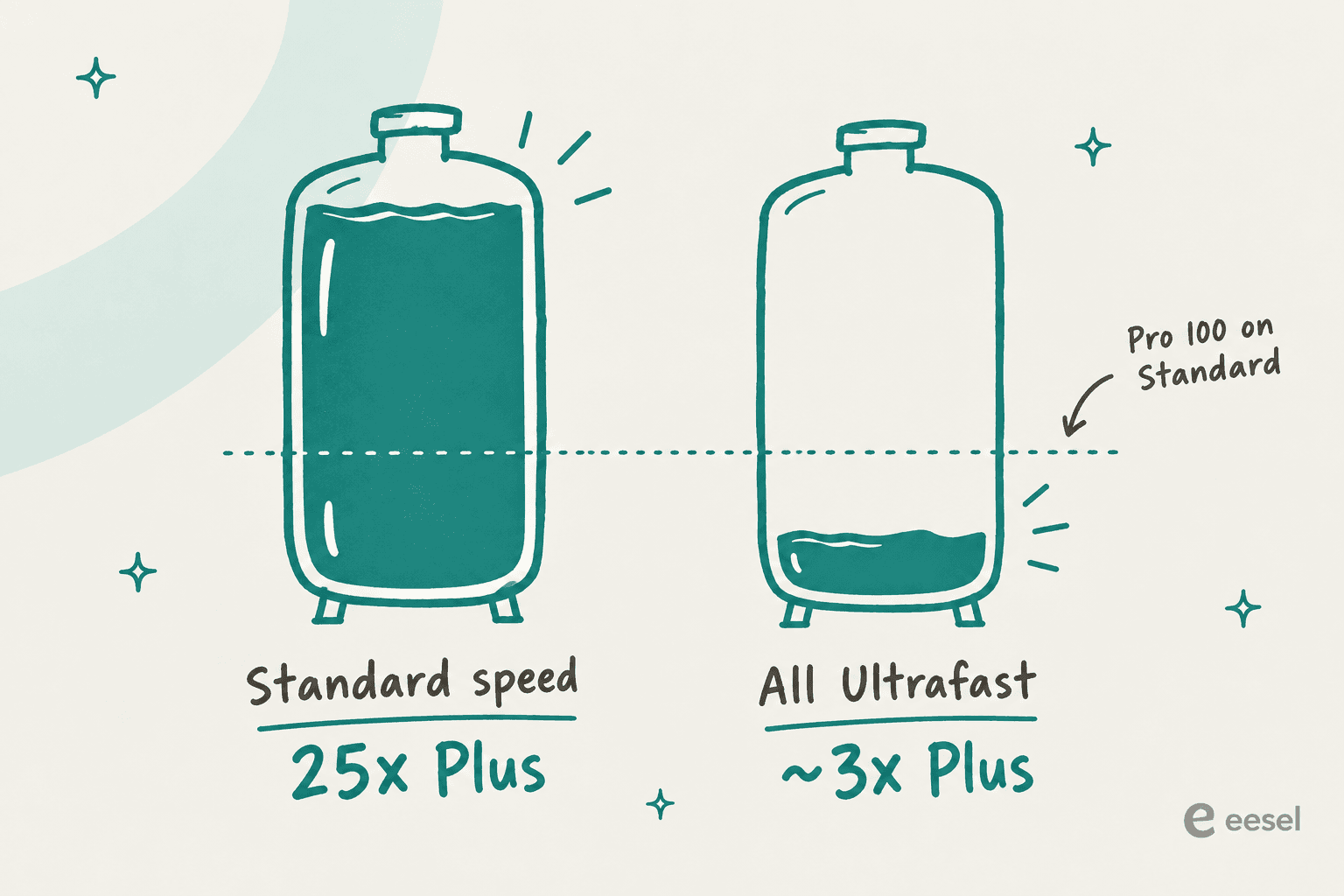
So do the division yourself. Pro 500 gives you 25x Plus, and at 8x per task, a week run entirely on Ultrafast is about 3x Plus worth of Astra work. That is less than what Pro 100 gives you at Standard speed, for five times the price.
The day-one reports line up with the math. One r/codex post from a new Pro 500 subscriber, upvoted 472 times, shows the weekly meter falling 17% in five minutes:
"I was running on ultra fast and Astra 6 ultra (just wanted to see). Not sure what I expected but more for $500. I was using it to create a 3d figure with comfyui and blender."

To be fair to OpenAI, that run stacked every expensive setting at the same time, the most capable model at its "Ultra" setting and on Ultrafast. A reply in the same thread worked out how much Standard-speed work that burst stands for. It uses the 6x credit rate, while on included usage the docs say 8x, which makes it slightly worse:
"If you're going by time it worked, its 8x as fast so 5 minutes = the amount of tokens you would have burned in 45 minutes at normal speed, and you're paying 6x the cost on top of that...so the amount of work done would have lasted you 4.5 hours at normal speeds."
A second Pro 500 subscriber in a separate thread reported the same pattern, and this one was without the extreme settings:
"Pro 500 here, usage went down as fast as pro 20x, 3-4 hours and I'm down to 28% for the week"
My read on it: treat Ultrafast like a taxi and not like a car you own. It's worth it for the stretch where waiting costs you money, and it's wasteful as the default.
The cheaper lever most people miss
If you're buying Pro 500 for the headroom, the model you choose moves the meter more than the plan you choose. OpenAI's credit table prices GPT-6.1 Sol at 50 credits per million input tokens and 250 per million output, against Astra's 250 and 1,250. That comes to a fifth of the cost per token. The Codex pricing page estimates 15-160 local messages per five hours on Plus for GPT-6.1 Sol against 5-45 for Astra.
OpenAI's email makes the same pitch as well, calling 6.1 Sol "near-Astra capabilities" for everyday use. My colleague's GPT-6.1 Sol review tested that claim. The full OpenAI models list shows where each one sits. The practical version goes like this: default to Sol and switch to Astra for the hard problems, then save Ultrafast for the moments you're actually waiting on it. Done in that way, Pro 200's 10x stretches a lot further than the headline suggests.
Is ChatGPT Pro 500 worth $500?
Because every tier costs the same per unit, the question isn't "is Pro 500 good value." It's "do you need that much in one account, and does speed pay for itself?" Pick your situation below:
Which ChatGPT Pro tier fits you?
Based on OpenAI's published tiers and multipliers as of October 1, 2026.
There are three kinds of buyer who come out ahead on Pro 500.
The multi-account user. Plenty of heavy Codex users are paying for two or more Pro plans just to get enough capacity. One account at 25x is simpler than two at 10x, and the unit price is the same.
"Among my circle, it's not uncommon for people to have multiple $200 accounts. This seems like it would make things easier for them by letting them use one account instead of juggling two or more."
The person whose time is billed. If a 30-second wait happens hundreds of times in a day, then Ultrafast's 4.5x can be worth the 8x meter. A commenter in the r/ChatGPT thread put the view of the employer plainly: "6k is potentially a few weeks of salary for an employee," adding that their company "paid 3k this weekend on resets" (matRmet, Reddit).
The Agents API tester. The DevDay recap says computer use in the Agents API is available in Codex and ChatGPT Work "on Pro 500 and Enterprise." If you're building on the Agents API and want to try computer use inside Codex first, Pro 500 is the personal route.
For everyone else the plan doesn't earn the extra money, and that includes most of the people who arrived here wondering whether they "should" be on the top tier.
What users are saying about Pro 500
The launch reaction was loud and mostly negative, although most of the heat was aimed at the Pro 200 cut more than at Pro 500 itself. Three themes kept on coming up.
The numbers are hard to find. Several people went looking for the multiples on OpenAI's own pages and couldn't find them:
"Does anyone see the usage limits? I don't see anything indicating how much usage is in each tier."
That's a fair complaint, and it's the reason the scorecard marks transparency down. Somebody spending $6,000 a year should be able to read the allowance right on the pricing page, not have to reconstruct it from an email.
Pro 500 read as a price rise, not a new tier. A small business owner who runs two Pro 200 plans framed it by putting the old deal next to the new one:
"before: 400$ == 40x now: 500$ == 25x"
Some people are switching or splitting. Across both platforms, a plan that kept recurring was to drop down to Pro 100 and add a second provider. If you're weighing that up, my colleagues' Claude pricing and Claude Code pricing breakdowns cover Anthropic's side, and the ChatGPT vs Claude comparison covers the models.
The one theme I'd push back on is "it's a scam." It isn't one. The per-unit price is the same as on every other tier and OpenAI did publish the Ultrafast multipliers in its docs, plus the extra usage is real. What is missing is a clear explanation on the page where people actually buy.
Pro 500 vs the alternatives
If you've read this far and still aren't sure Pro 500 is for you, these are the realistic alternatives, either for the same money or for the same job.
| Option | Price | Ultrafast | Usage | Best for |
|---|---|---|---|---|
| Pro 500 | $500/month | Yes | 25x Plus, no five-hour limit | Heavy solo Codex users |
| Pro 200 | $200/month | No | 10x Plus (20x until Oct 29 if grandfathered) | Daily Codex use without hitting walls |
| Pro 100 | $100/month | No | 5x Plus | Regular use plus your first dot |
| OpenAI API key | Per token | Yes, as a service tier | Pay as you go | Scripts, CI, predictable per-call cost |
| ChatGPT Business Premium | $100/seat/month annual | No at launch | Premium seat allowance | Teams that need admin and no training on data |
| ChatGPT Enterprise | Contract | Off by default, admin can enable | Credits or rate limits | Companies that need Ultrafast per user |
Two things in that table are worth a closer look.
First, the API. With an API key, Codex uses API token pricing and the ChatGPT credit multipliers don't apply, per the Speed docs. For bursty or automated work, paying per token for Ultrafast can come out ahead of a $500 subscription that you only half use. My OpenAI API pricing guide has the per-model rates.
Second, teams. Pro is a personal plan. OpenAI's Pro tiers article says credential sharing and reselling access are prohibited under its terms. If a team is sharing one Pro 500 login, that is a policy problem before it ever becomes a cost problem. Ultrafast also isn't available to workspaces that require inference residency outside the United States.
For a wider view of coding tools at this price, see the best AI coding assistants roundup and the Cursor pricing breakdown.
My verdict on ChatGPT Pro 500
Buy Pro 500 if you hit Pro 200's weekly wall most weeks, or you're already paying for two Pro accounts. Run it at Standard speed by default, use GPT-6.1 Sol for everyday work, and switch on Ultrafast only when waiting has a price. Used in that way, it's a decent plan.
Skip it if you're upgrading for Ultrafast alone. Ultrafast is fast, about 4.5x in my test, but at 8x usage it turns 25x Plus into about 3x. That makes it a luxury for deadlines, not a way to work every day.
Wait if you're a grandfathered Pro 200 subscriber. You keep 20x until October 29, 2026. Use that month to measure your real weekly usage on the dashboard, and then pick the tier that matches it.
The broader lesson of this launch isn't really about OpenAI specifically. When a plan's value is expressed as "Nx of another plan," with the multiplier set by the vendor and changeable by email, you're buying a moving target. That's fine for a personal coding tool, but it's harder to live with for work other people depend on, and that is where I'd want a unit I can count.
eesel, for work you can count
If this review left you thinking "I just want to know what a week of work will cost," that's exactly the problem eesel is built around. eesel is an AI teammate platform: you hire a ready-made teammate for one job, like the AI helpdesk teammate that joins Zendesk, Freshdesk, or Gorgias, or the AI blog writer. Each one arrives already trained on your context, and before it answers a real customer you can simulate it against your own past tickets.
The billing unit is something a manager can actually plan around. A ticket or a chat is one credit, whether the conversation takes one reply or ten. There's a free plan with 100 credits, then teammate plans from $299/month for 500 credits, all on the public pricing page. I've sat in on sales calls where that mattered more than any feature did: one hardware company handling around 250 tickets a month had watched a previous vendor's price more than double, and wanted the price locked in writing before anything else.
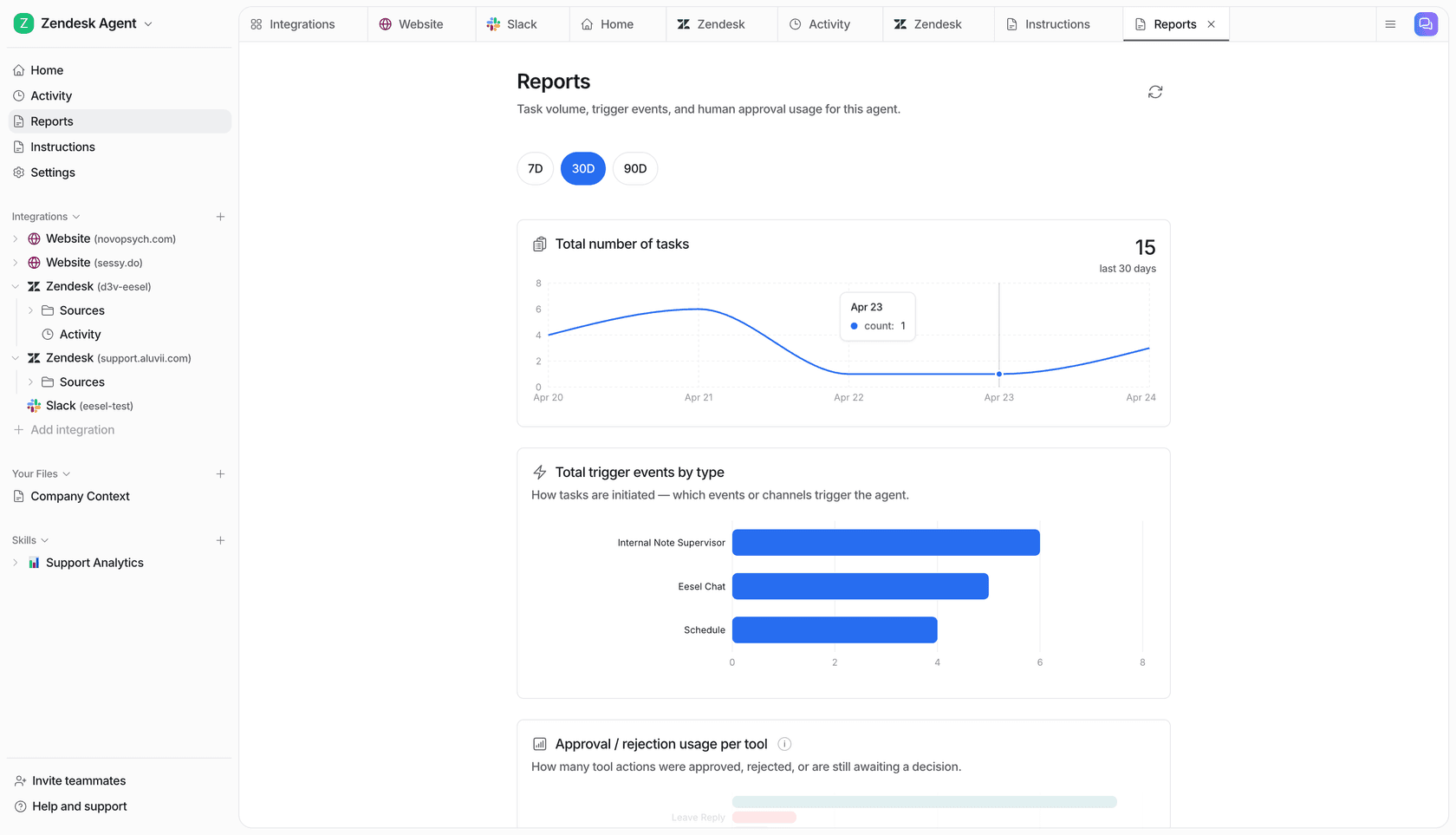
And if you're a Pro 500 buyer, chances are you live in Codex already. The eesel CLI lets you run the same teammate from a terminal: eesel activity lists every run, eesel approvals list shows what's waiting on a human, and every command prints JSON with a --dry-run option, so a coding agent like Codex or Claude Code can script it safely. On top of that, each workspace works as an MCP server.
The AI agent CLI post walks through that setup, and the AI teammates guide explains the model. When you're ready, try eesel and watch a teammate answer your real past tickets before it touches a live one.
Frequently Asked Questions
Is ChatGPT Pro 500 worth it?
How much usage does ChatGPT Pro 500 include?
How fast is Ultrafast on ChatGPT Pro 500?
Why does Ultrafast use up my ChatGPT Pro 500 limit so quickly?
What changed with ChatGPT Pro 200 when Pro 500 launched?
Does ChatGPT Pro 500 have annual billing or a team version?
Is ChatGPT Pro 500 cheaper than the OpenAI API?


Article by
Kira
Kira is a writer at eesel AI with a Computer Science background and over a year of hands-on experience evaluating AI-powered customer service tools. She focuses on breaking down how helpdesk platforms and AI agents actually work so that support teams can make better buying decisions.