

What this review is actually based on
Nano Banana 2 Lite (model ID gemini-3.1-flash-lite-image) launched on June 30, 2026, which means there's no meaningful body of independent, hands-on user reviews to draw on yet. Rather than pretend otherwise, this review works from what's actually verifiable: Google's own published benchmark charts, its own side-by-side comparison images (the same prompt run against Lite, full Nano Banana 2, and Nano Banana Pro), the exact numbers on its pricing page, and the earliest reactions from developers who've had API access. That's a different kind of review than "I ran 50 prompts myself," and it's worth saying so up front rather than implying otherwise.
If you want the full spec breakdown and model-family map, that's covered in what Nano Banana 2 Lite is; if you're pricing it out, the full cost breakdown has the token math. If you're weighing the wider field before committing to any single vendor, a rundown of Nano Banana 2 alternatives is worth a look too. This piece is about whether the thing is actually good.
Speed: the headline claim holds up
Speed is Nano Banana 2 Lite's entire pitch, and it's the one claim Google backs with a real, visible demo rather than just a number on a spec sheet. Google Cloud's own launch post ran the same prompt through all three tiers of the Gemini image family and published the actual generation times:
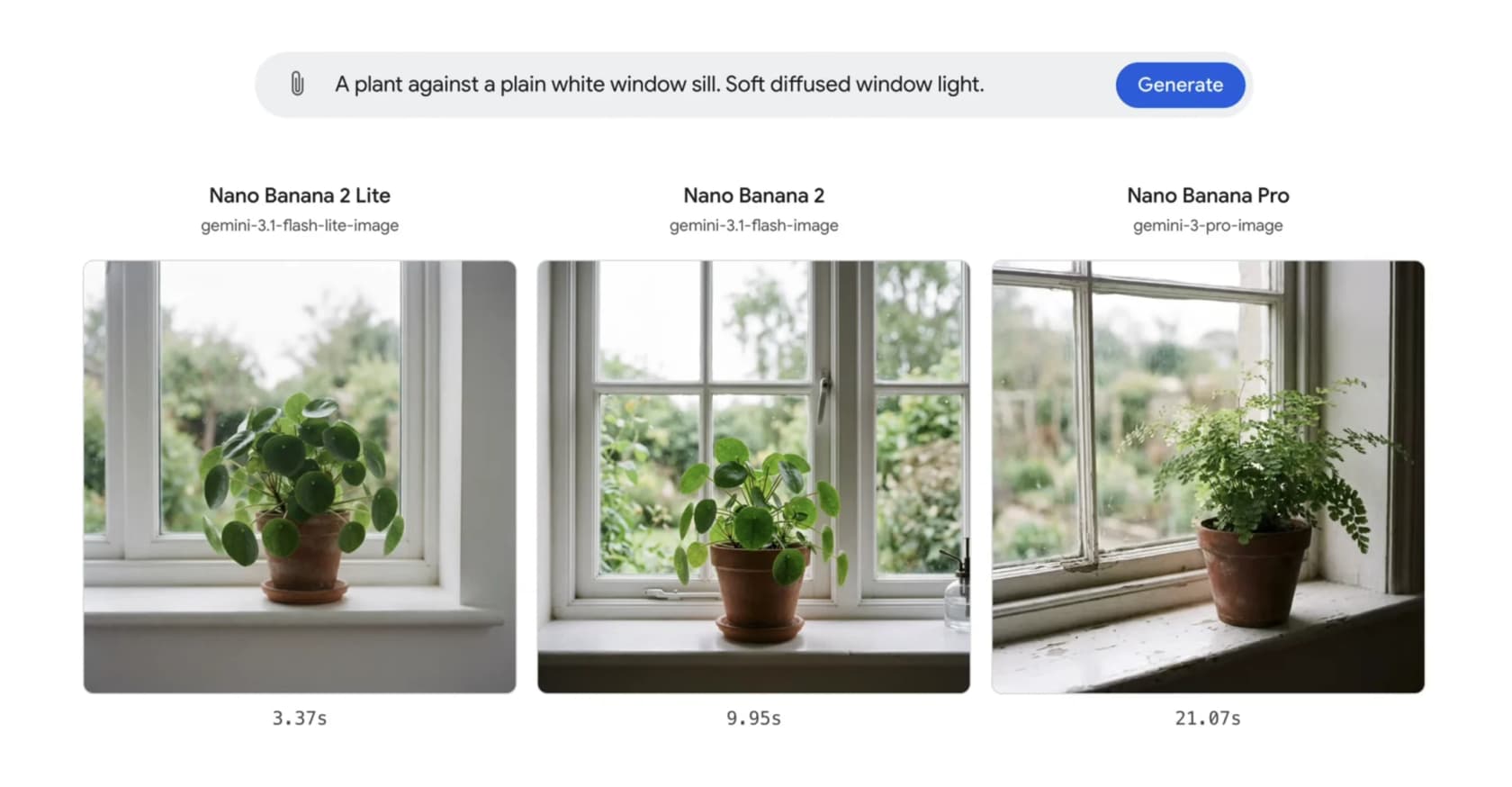
That's a 6.3x speed gap between Lite and Pro on identical output, and it's the exact scenario the model is built for: a user watching a spinner, an AI agent iterating on a design in a loop, a chatbot generating an image inline mid-conversation. Max Child, CEO of Weekend, put it plainly in Google's own materials: the model "delivers consistent, high-quality 1k images ~2.7x faster than Gemini 3.1 Flash Image" while giving him "Flash-Lite speed and cost with Nano-Banana quality" through one drop-in API for generation, edits, and multi-image composition.
Image quality: five real comparisons, not a marketing claim
The more interesting question than "is it fast" is "does the speed cost you anything visible." Google published a set of direct comparison shots, same prompt, same seed conditions, run against both Lite and full Nano Banana 2. Here's what that actually looks like across five different subjects:
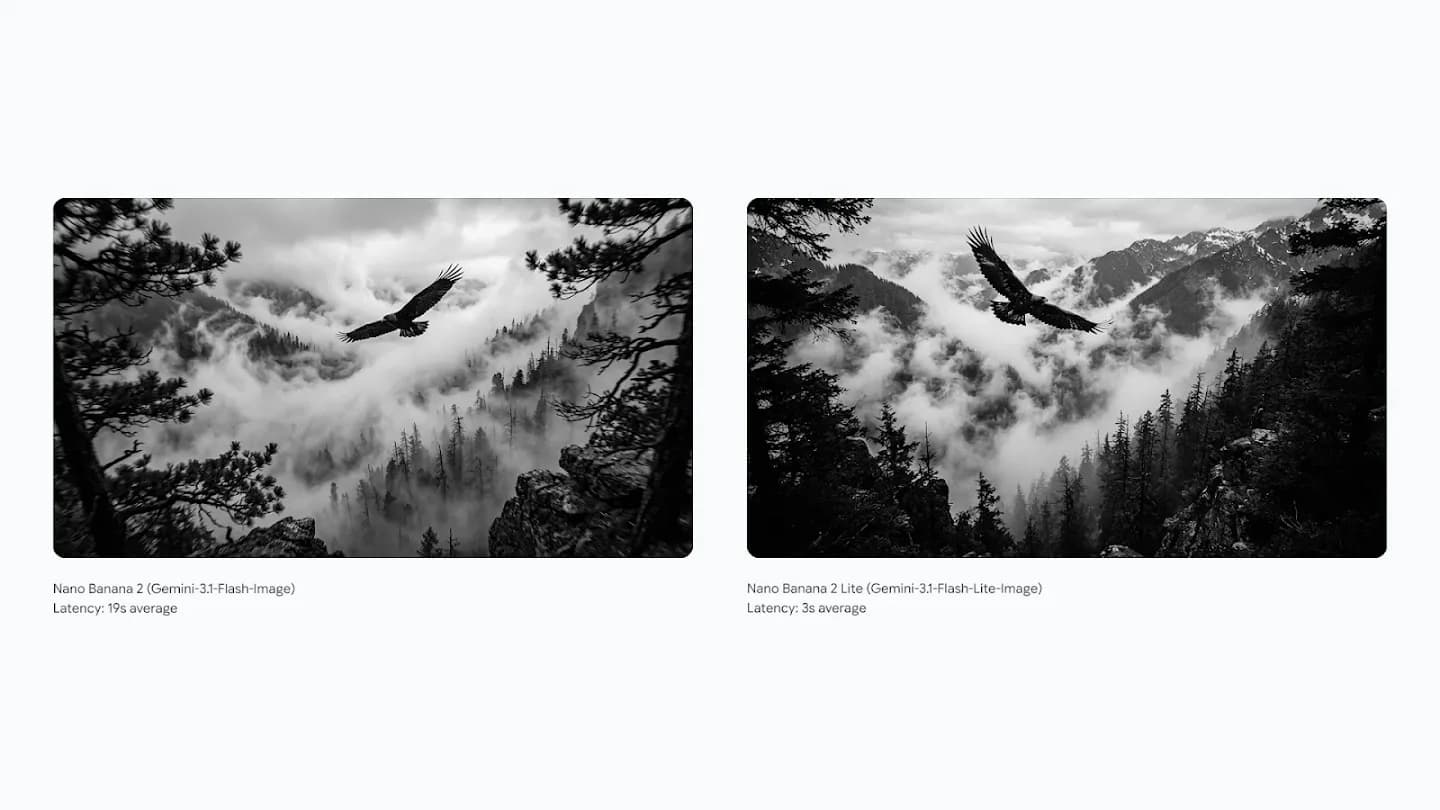
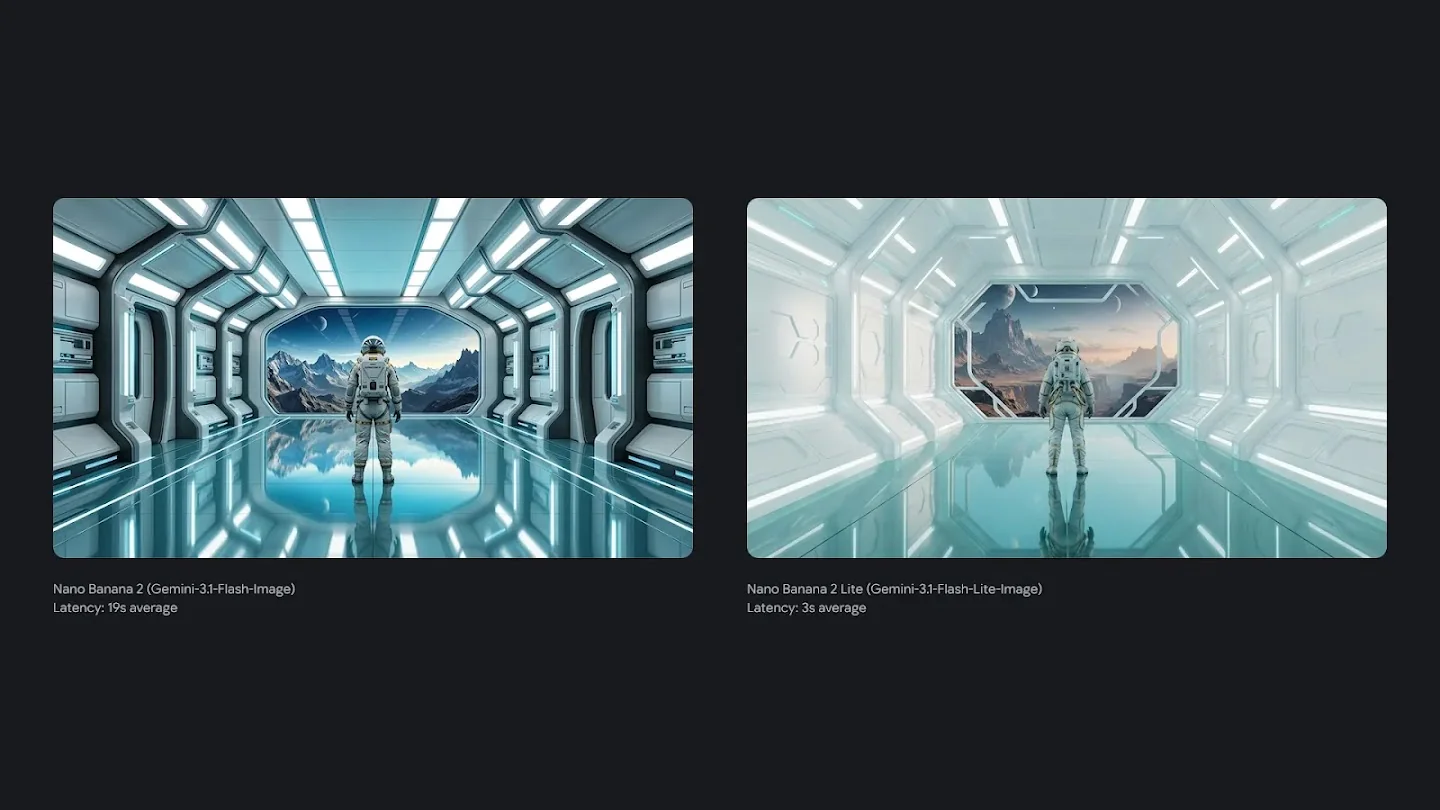
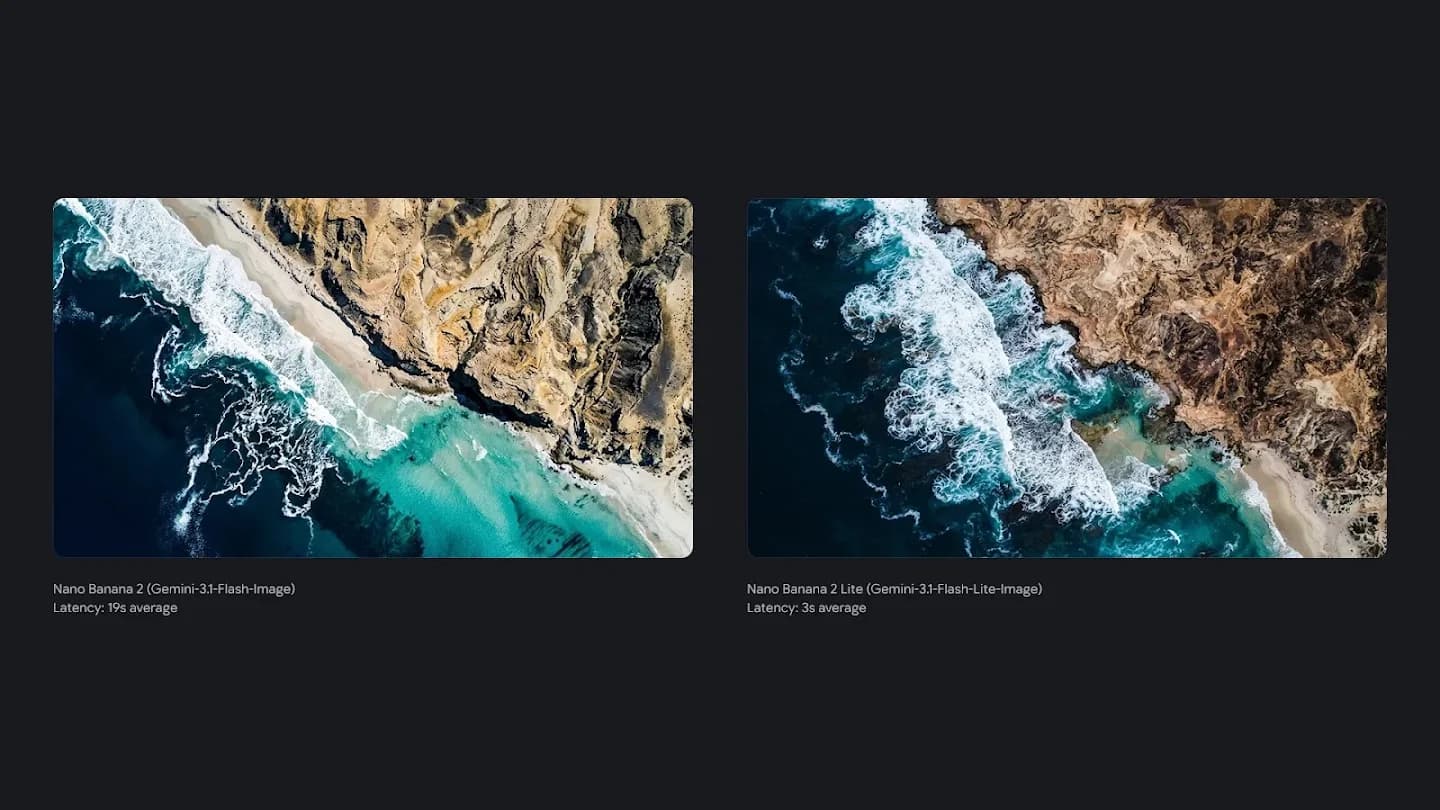
The pattern across all of these, and the two more Google published (a glass sphere with a light vortex, and a woman's hair dissolving into birds), is consistent: Lite's output holds composition, lighting, and subject fidelity close to the full model, with the visible losses concentrated in fine texture and small detail rather than the overall scene. That tracks with the Elo benchmark numbers: 1308 versus 1387 on editing, 1251 versus 1270 on generation, both close enough that a casual viewer scrolling past wouldn't reliably pick the "worse" one.
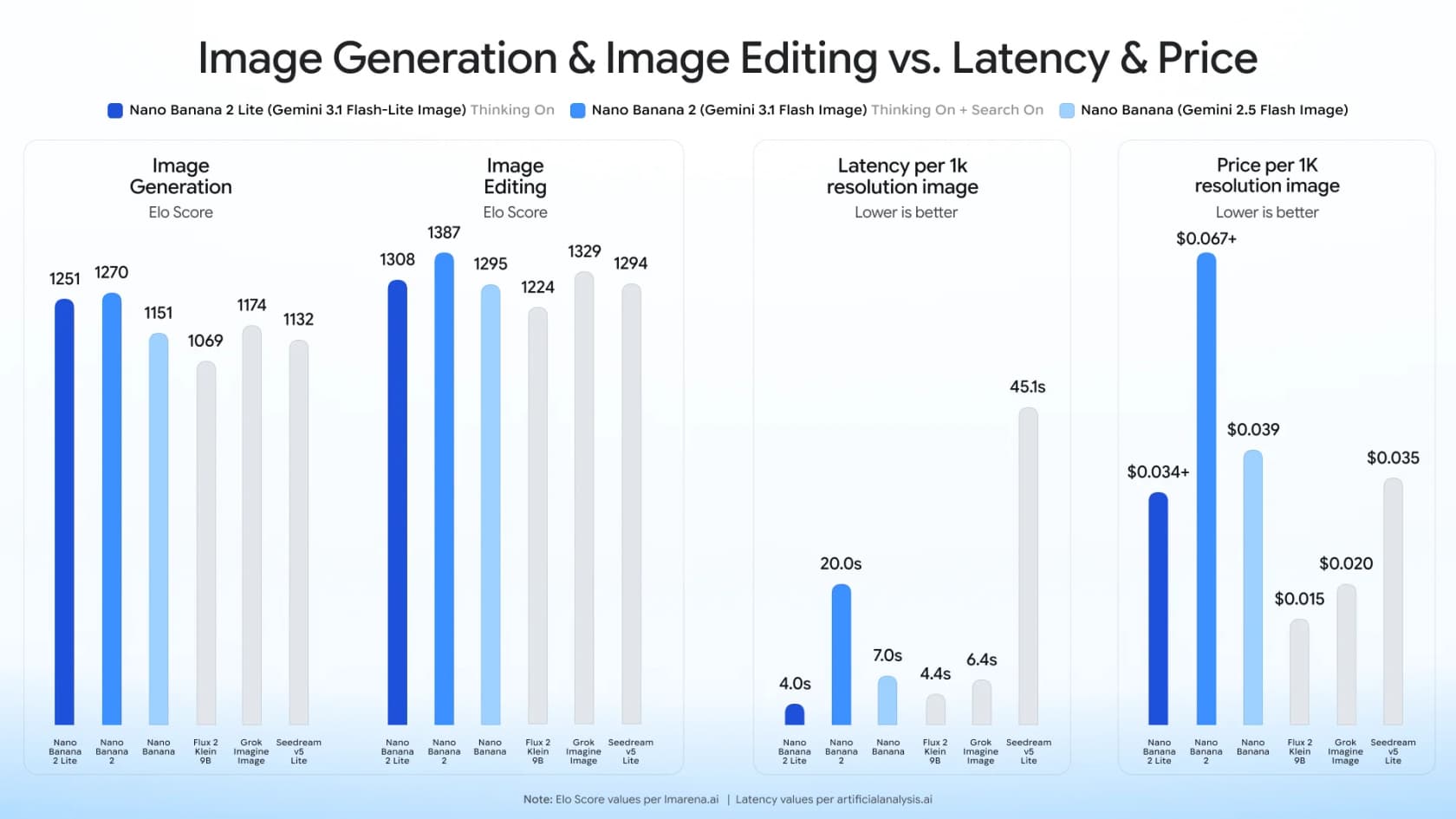
Worth flagging: Nano Banana 2 Lite beats the older original Nano Banana outright on generation Elo (1251 versus 1151), which means anyone still running the legacy model has no real reason not to switch, cost aside.
Where it actually sits against the competition
Elo scores in isolation don't tell you much without the price attached. Plotting quality against cost is where Nano Banana 2 Lite's actual position in the field gets clearer:
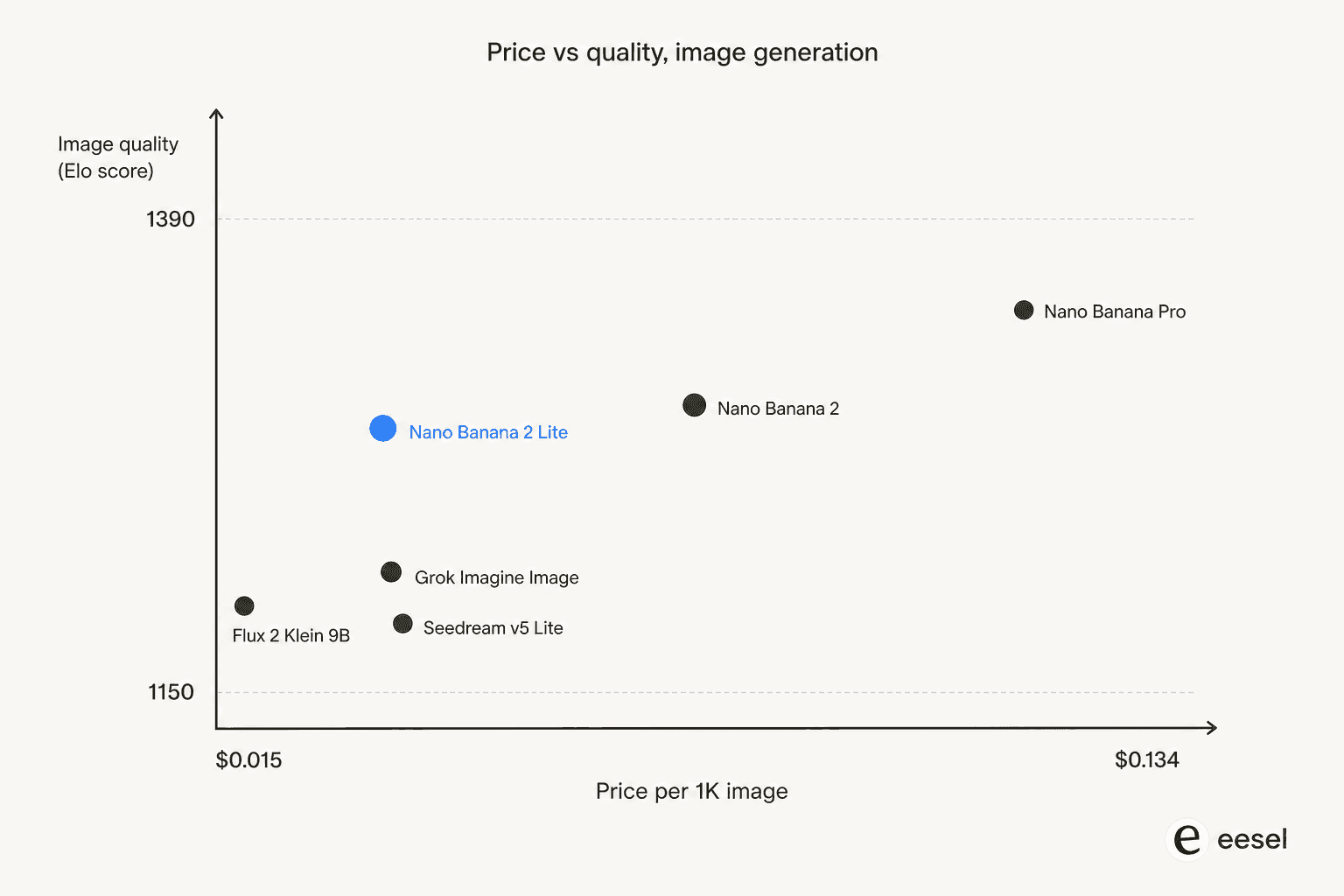
Against Flux 2 Klein 9B, which is genuinely cheaper at $0.015 per image, Nano Banana 2 Lite wins decisively on quality (1251 versus 1069 Elo on generation). Against Seedream v5 Lite, priced almost identically at $0.035, Lite wins on both quality and latency (4.0 seconds versus Seedream's 45.1 seconds, according to Google's own artificialanalysis.ai-sourced chart). The one model that beats it on raw speed is Flux 2 Klein 9B at 4.4 seconds, and that's a near-tie, not a real gap. On this chart, Nano Banana 2 Lite isn't just "the cheap Google option," it's arguably the best price-to-quality ratio in the set Google chose to compare itself against, and a stronger pick than most tools you'd find on a general AI content generation tool roundup that only tests one or two prompts.
Zoom out from image models specifically and the same logic applies to the Gemini family it belongs to: Google tends to ship a fast, cheap tier alongside a flagship one, and the Gemini 3 pricing structure follows the same pattern as the image lineup here.
The resolution ceiling: the one real limitation
Here's the trade that doesn't show up in any Elo score. Full Nano Banana 2 and Nano Banana Pro both publish per-image pricing across 0.5K, 1K, 2K, and 4K resolution tiers. Nano Banana 2 Lite publishes exactly one: 1K.
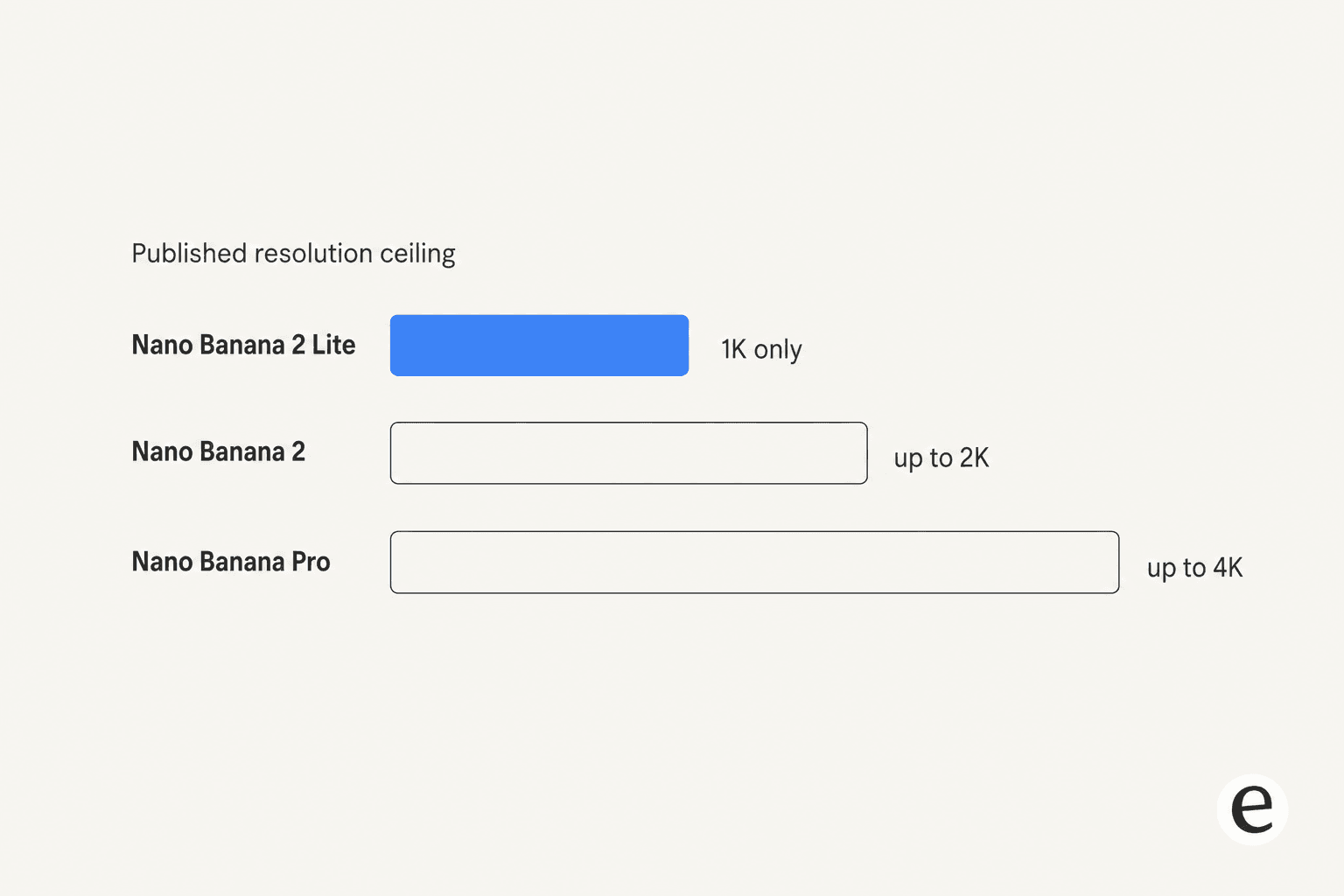
That's not necessarily a flaw, since 1K is fine for most in-app, in-chat, and thumbnail use cases, but it's the concrete reason to skip Lite for anything destined for print, a large hero banner, or any surface where a viewer will zoom in. If you need a guaranteed 2K or 4K output, Nano Banana 2 or Nano Banana Pro are the only options that state one, and Nano Banana Pro's pricing is the place to check what that resolution actually costs.
Character consistency and text rendering, honestly assessed
Google's own model card doesn't oversell this, which is a point in its favor. Stated limitations for the whole Gemini image family, which apply to Lite:
- It "can still struggle with small faces, accurate spelling, and fine details in images."
- Character consistency is "excel[lent]... but it may not always get it right," with Google explicitly saying it's "working to make this consistency even more reliable" rather than claiming it's solved.
- Complex edits like masked editing or major lighting changes "may sometimes produce unnatural results, visual artifacts, or disjointed scenes."
- Real-world knowledge is "extensive but not infallible," so anything data-driven (an infographic, a chart, an annotated diagram) needs a human check before it ships.
None of that is unusual for the category, and it's the same reason a Midjourney or Gemini output still gets a once-over before publishing. What's notable is that Google states these limits plainly rather than burying them, which is the kind of honesty this review is trying to match rather than paper over. It's also the same disclaimer worth remembering any time an AI content generator or AI content writer claims to be fully hands-off; the human check-pass doesn't disappear just because the first draft got faster.
Who's actually shipping with it
The strongest signal for a four-day-old model isn't a benchmark, it's who already trusts it in production. Itay Schiff, co-founder of Figma, is running it inside Figma Weave's node-based canvas, calling it "fast and reliable, helping designers explore more ideas... while staying in the creative flow." Tao Zhang, co-founder of Manus AI, is using it for real-time image generation inside autonomous agent workflows, from slide decks to web pages, noting the image quality "comes close to the full Nano Banana 2." Idan Yonas of Artlist frames the speed itself as the product: "when generation is faster than imagination, creators can stay inside the idea instead of waiting on the tool."
Inside Google, Logan Kilpatrick of Google DeepMind called the latency gain "honestly feels like magic," predicting it "will enable so many new use cases where there is a high degree of latency sensitivity." Independent AI-news account TestingCatalog confirmed the model went live and selectable inside the Gemini app within hours of the announcement, a faster real-world rollout than most model launches get. Worth being honest here too: the loudest early reactions skew Google-affiliated rather than independent, which is normal for a launch this fresh but means the community verdict is still forming.
Who should reach for it, and who should skip it
"We have been testing Nano Banana 2 Lite to power real-time image generation within Manus's autonomous workflows... The image quality is also impressive, coming close to the full Nano Banana 2." - Tao Zhang, Co-founder and Chief Product Officer, Manus AI
Pulling the whole review into one call:
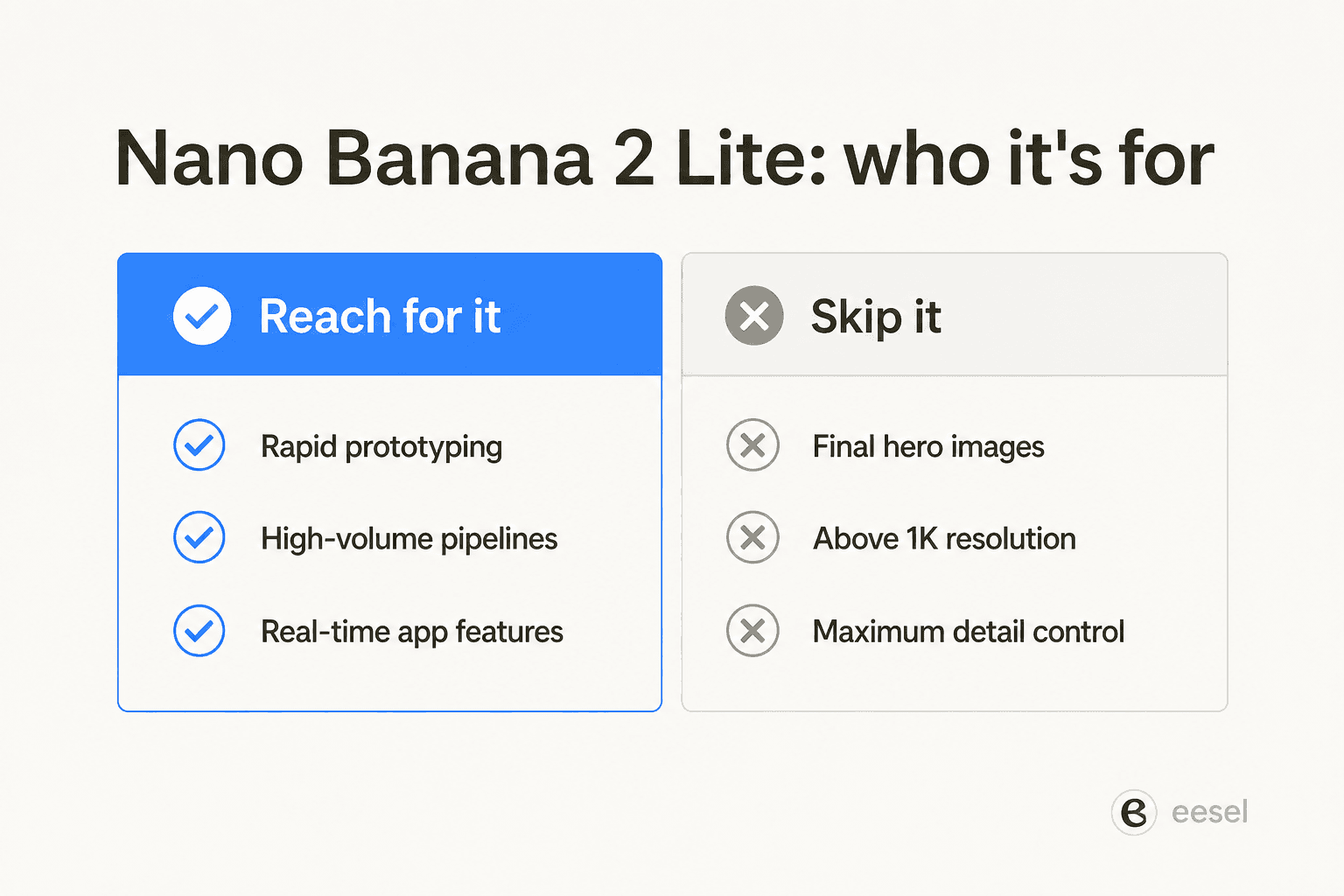
Reach for it if you're building an agentic workflow, a real-time design tool, or anything that needs to generate dozens or thousands of variants without the cost or wait time piling up. The Elo gap to full Nano Banana 2 is small enough that most end users won't notice it in a live product.
Skip it if you need a guaranteed 2K or 4K deliverable, a single hero image that has to hold up at full size, or maximum control over a complex, multi-step edit. That's what Nano Banana 2 and Nano Banana Pro are for, and the extra cost is worth paying for that specific job. If you're building out a full AI content pipeline tool rather than a single feature, the honest answer is usually "both": Lite for the drafts and iterations, a heavier tier for the piece that actually ships.
The part a fast image model doesn't solve
Here's where this review is going to sound like it's changing the subject, but it isn't. Nano Banana 2 Lite makes the image itself close to free and nearly instant. It doesn't write the headline, the brief, the alt text, the internal links, or decide where in the article the image actually belongs. Those are the parts of a published post that still take a person (or a different AI) real time, and eesel's own AI blog writer is where that gap gets closed, generating the article and its visuals as one pipeline rather than stitching a model API into a separate AI content writer tool.
That distinction matters more than most AI blog writing tools roundups let on: plenty of them will happily create AI blog images but hand you a generic stock-photo-style illustration disconnected from what the paragraph next to it actually says, the same failure mode a fast image model falls into without someone (or something) directing it. A best AI blog writer pick should be judged on whether the visuals it drops in actually match the text, not just on whether it can call an image API at all.
That's not a hypothetical: the illustrations and hero banner on this page were generated through exactly that kind of pipeline, on eesel's own pay-per-task pricing rather than a seat fee, which is the same logic Google uses for image tokens, pay for what you generate.
Try eesel for AI content workflows
eesel builds AI teammates that plug into your existing tools, and the AI blog writer is one of its two current products alongside AI for helpdesks. If the reason you're evaluating Nano Banana 2 Lite is to power a content pipeline, thumbnails, in-article illustrations, or social assets to go with a post, eesel's blog writer researches the topic from primary sources, writes in your brand voice, and drops in generated visuals in the same run, rather than leaving you to wire a model API into a standalone writing tool.
It's free to try, and worth pairing with a fast image model like Nano Banana 2 Lite if the images were never actually your bottleneck.
よくある質問
Nano Banana 2 Liteは本当に良いのか、それとも単に安いだけなのか?
Nano Banana 2 LiteはNano Banana 2やNano Banana Proと比べてどうか?
Nano Banana 2 LiteはMidjourneyより優れているのか?
Nano Banana 2 Liteに解像度の上限はあるのか?
Nano Banana 2 Liteは実際に何に使われているのか?
Nano Banana 2 Liteの1画像あたりのコストはいくらか?
Nano Banana 2 Liteでブログやマーケティング用の画像を生成できるか?


Article by
Rama Adi
Rama is a software engineer at eesel AI with two years of experience writing about B2B SaaS, AI tools, and customer support technology. Based in Bali, Indonesia, he brings a developer's perspective to product comparisons — cutting through marketing copy to what the integrations and APIs actually do.