Thank-you messages for customers: examples and templates

Riellvriany Indriawan

Katelin Teen
Last edited July 6, 2026

Why a thank-you message is worth the 20 seconds
I work the support queue, and here's the honest truth about thank-you messages: most of them never get sent. Not because anyone decided they don't matter, but because the agent who just resolved a tricky ticket is already three tickets behind, and "send a nice note" loses to "clear the backlog" every single time. The ones that do go out are often a canned "Thank you for contacting us" that the customer has seen forty times this month.
That's a shame, because the moment right after you've helped someone is when a two-line thank-you does the most work. It turns a transaction into a relationship, the difference between feeling like a vendor and feeling like a partner. And that feeling doesn't come from a discount code. It comes from small, human touches landing at the right time.
There's a business case underneath the warm fuzzy one, too. Thanking customers is one of the cheapest customer retention levers you have, it feeds directly into how people rate you when you measure customer satisfaction, and it's a natural fit for the proactive support motion where you reach out before the customer has to. The trick is making it specific enough to feel real.
What makes a thank-you message land
Before the examples, here's the anatomy. A thank-you that works is almost never clever, it's just specific and human. Five things do the heavy lifting.
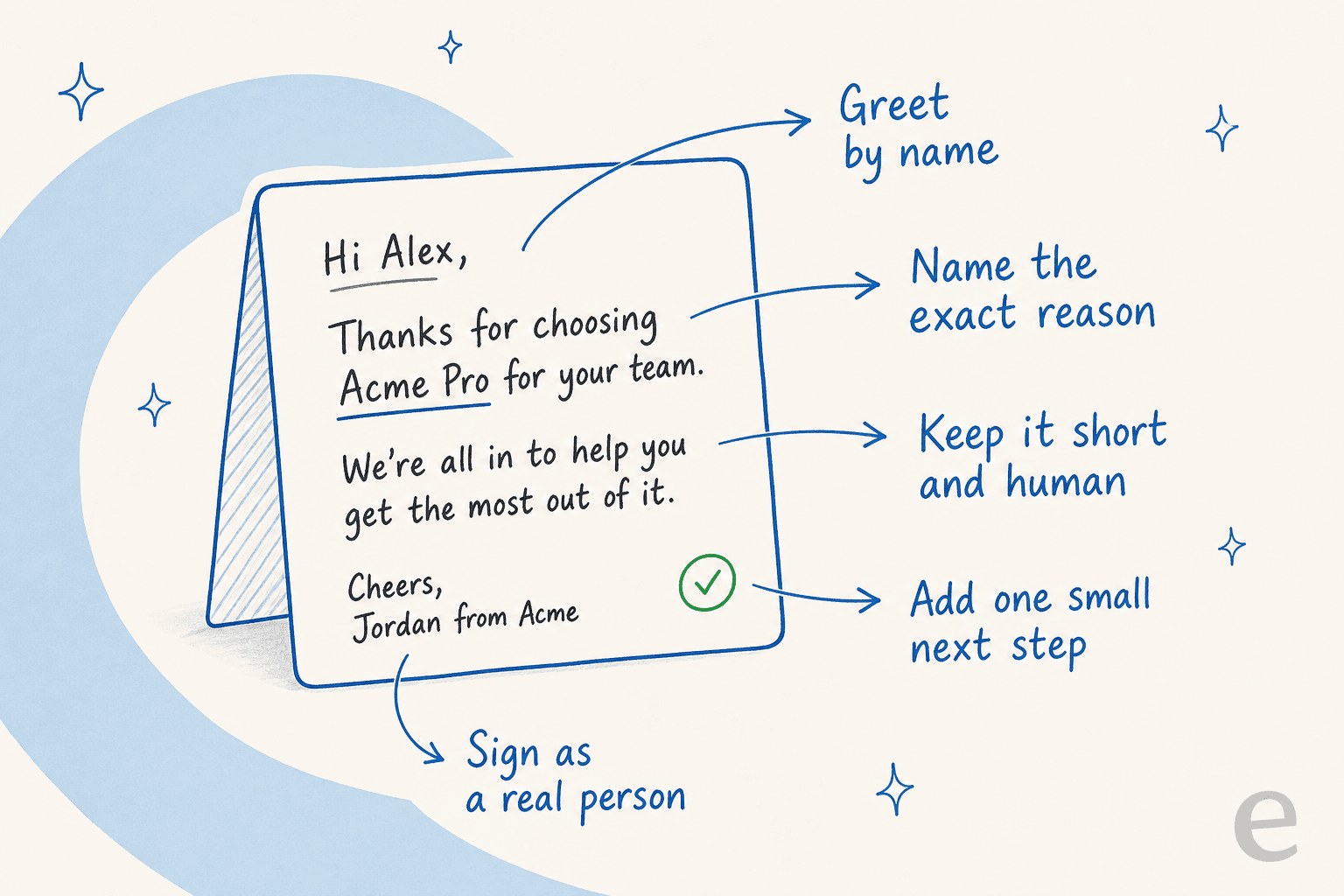
- Greet by name. "Hi Sam" beats "Dear valued customer" every time. If you can't personalize the greeting, you've already lost the thread.
- Name the exact reason. "Thanks for your order" is fine. "Thanks for grabbing the walnut desk, Sam" is better, because it proves a person (or a system that knows what a person would say) is actually paying attention.
- Keep it short and human. Two or three sentences. The second a thank-you note starts explaining your company mission, it's an ad. Write it the way you'd talk to a customer over chat.
- Add one small next step (optional). A link to track the order, a way to reply, a person to contact. Not a hard upsell, just an open door.
- Sign as a real person. "Riell from the support team" lands warmer than "The Team." Named humans build trust, and building trust with customers is the entire point.
That's it. Everything below is just this formula applied to different moments.
Thank-you message examples for every moment
The right message depends on when you're sending it. A first-purchase note and a renewal note are doing different jobs. Here are the moments worth a thank-you, in the order a typical customer hits them.
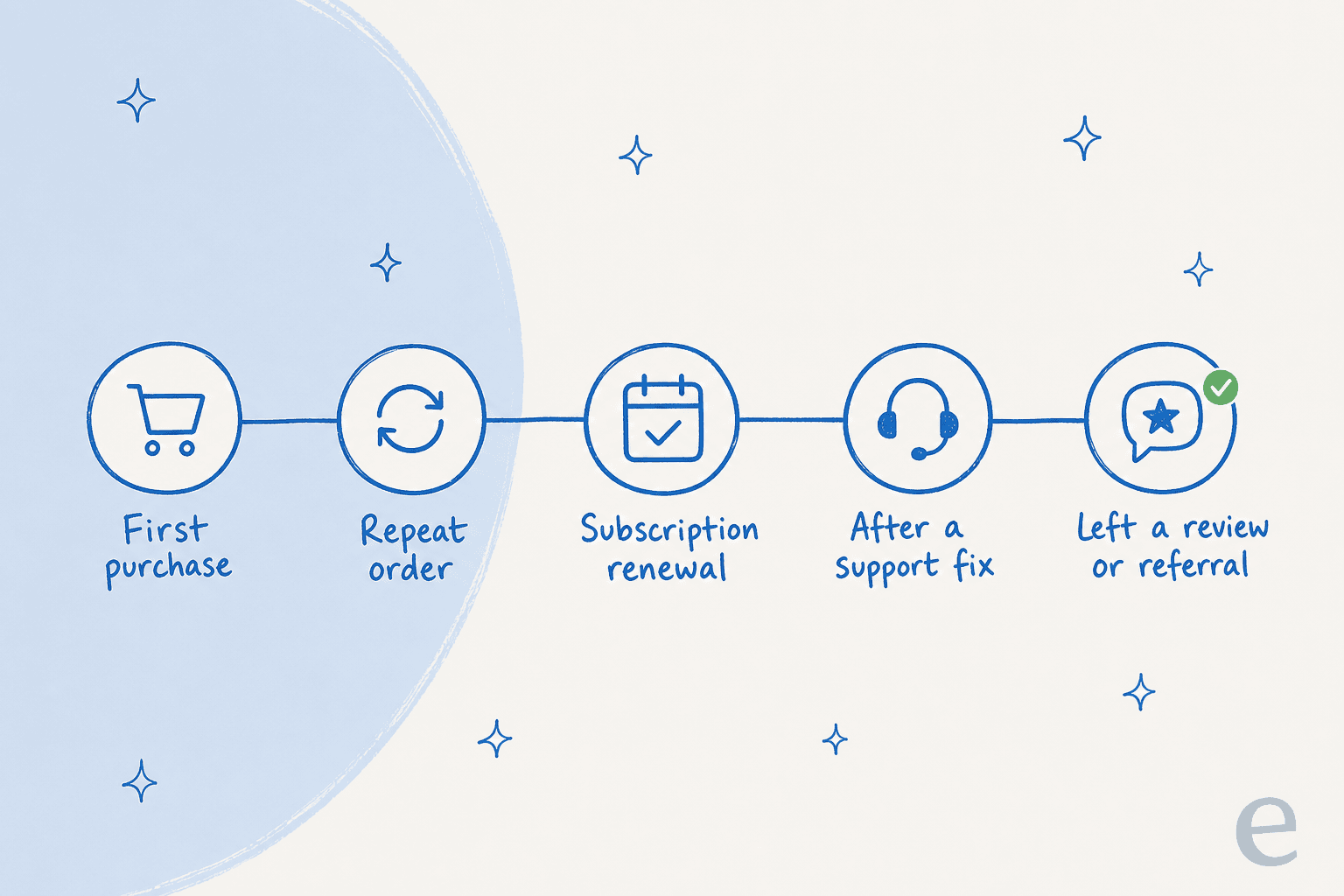
After a first purchase
The order-confirmation thank-you is the one almost everyone sends, which is exactly why a human one stands out. It doubles as your first welcome message, so it sets the tone for everything after.
Hi Sam, thanks so much for your first order with us! Your walnut desk is packed and heading out today, you'll get tracking as soon as it ships. If anything looks off when it arrives, just reply to this email and it'll come straight to me. Riell
Order confirmed, and honestly, thank you for choosing us over the fifty other tabs you probably had open. We don't take that lightly. Everything you need to track your delivery is below.
Welcome aboard, Sam. You're customer #4,201 and we're so glad you're here. Here's a quick guide to getting the most out of your order, and my inbox is open if you get stuck.
For ecommerce specifically, the confirmation email is prime real estate, it's the customer communication with the highest open rate you'll ever send, so don't waste it on boilerplate.
For repeat and loyal customers
Loyalty deserves acknowledgment of the history. Reference the relationship.
Sam, that's your tenth order with us this year, which frankly makes you more committed to this brand than some of our staff. Thank you. I've added a little something to this shipment as a small thanks.
We noticed you've been with us for two years now. That kind of loyalty is rare, and we don't want to take it for granted, here's early access to our next drop before anyone else sees it.
Thank you for being one of our regulars, Sam. Regulars are the reason we still exist. If there's ever anything you'd change about how we do things, you're exactly the person I want to hear it from.
That last one doubles as a feedback prompt, which is a nice two-for-one.
After you've resolved a support issue
This is my favorite one to send, because the customer arrived frustrated and is leaving happy. The thank-you cements that.
All sorted, Sam! Thanks for bearing with me while we tracked that down, and thanks for flagging it in the first place, it actually helped us catch a bug that would've hit other people too. Shout if anything else comes up.
Glad we got that fixed for you. Thank you for being patient and clear about what was happening, it made my job a lot easier. I'll keep an eye on your account for a few days just in case.
Thanks for sticking with us on this one. I know a broken checkout is the last thing you needed on a Monday. It's working now, and if it so much as hiccups again, reply here and I'll jump straight on it.
Notice these thank the customer for their effort, not just their business, and lean on a bit of empathy without over-apologizing. When your team is already delivering fast resolutions, a note like this is what turns a good CSAT score into a loyal customer. It pairs naturally with a CSAT survey sent a beat later.
After feedback, a review, or a survey response
Someone gave you their time and opinion. Close the loop.
Sam, thank you for the review, it honestly made our week. You mentioned the packaging felt a bit much, and you're right, we're switching to recyclable mailers next month. You helped make that call.
Thanks for filling out the survey. Most people don't, so it means a lot that you did. The bit about our docs being hard to search? Fair. It's now on the roadmap.
The strongest version of this names what you'll do with the feedback. That's the difference between a thank-you and a thank-you that builds a voice-of-customer loop people actually trust.
After a subscription renewal
A renewal is a customer voting with their wallet a second time. Don't let it pass silently.
Sam, your plan just renewed for another year, thank you for staying with us. A lot has shipped since you signed up; here are the three things I think you'll get the most out of. And your rate is locked, no surprises.
Renewal confirmed. Twelve more months of us, and we're going to earn it. If there's one thing you wish worked differently, tell me, renewals are exactly when I want to hear it.
Silent renewals are a quiet churn risk, a thank-you here is a cheap way to remind people why they're paying.
For referrals and milestones
When someone brings you a new customer, that's the highest-trust thing they can do.
Sam, your friend just signed up and mentioned you sent them. Referrals are the best compliment we can get, so thank you, sincerely. I've popped a credit on your account as a small thanks.
Happy one-year anniversary with us, Sam! Thank you for a whole year of trusting us with this. Here's to the next one.
For B2B customers, after a call or a deal
B2B thanks are a little more buttoned-up, but the same rules apply, be specific, be human. This is customer focus in miniature.
Thanks for the time today, Sam. The point you raised about rollout timing is a good one, I've noted it and I'll come back to you Thursday with a concrete plan. Genuinely glad we're working together on this.
Thank you for trusting us with this project. I know switching vendors is never zero-effort, so I don't take the decision lightly. My direct line is below if you ever need it.
Try the builder
Not sure which shape fits your moment? Pick an occasion and a tone below and grab a starting point.
Where to send it: picking the right channel
The same words land differently depending on where they show up. A handwritten card carries more weight than an email, but you can't scale it to 10,000 orders. Here's the honest trade-off.
| Channel | Best for | Effort to scale | Feels personal? |
|---|---|---|---|
| Order-confirmation email | First purchases, renewals | Low (automated) | Medium, unless personalized |
| Post-resolution email or chat | After a support fix | Low | High, it's timely |
| SMS | Time-sensitive thanks, ecommerce | Low | Medium |
| In-app / live chat message | SaaS, digital products | Low | High |
| Packaging insert / note | Physical products, first orders | Medium | High |
| Handwritten card | VIPs, big B2B deals | High (manual) | Very high |
If live chat is your main channel, a few well-placed live chat scripts make the thank-you feel effortless. For most teams, the workhorses are the confirmation email and the post-resolution message, because they ride on events that are already happening. A multichannel setup lets you match the thank-you to wherever the customer already is, rather than forcing everyone into email.
How to personalize thank-yous at scale (without sounding like a robot)
Here's the wall every growing team hits. Writing one lovely thank-you is easy. Writing a specific one for every customer, when you're closing hundreds of tickets and shipping thousands of orders a day, is not. So teams reach for the mail-merge "Hi {{first_name}}, thank you for your business" template, and customers can smell it instantly.
The way out isn't to write faster. It's to trigger the message off a real event and let a system pull in the context that makes it specific. That's exactly the kind of work an AI teammate is good at.
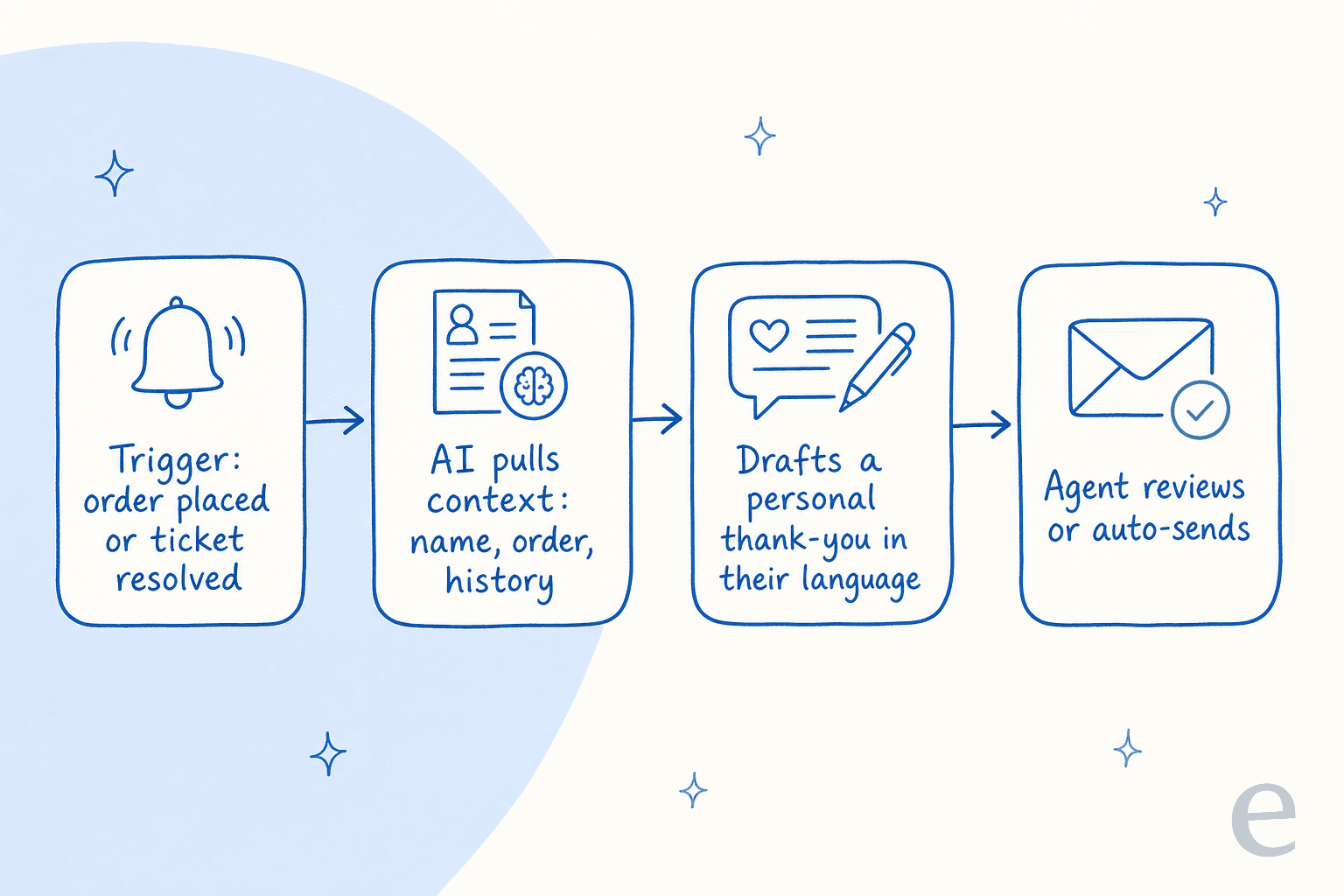
This is where eesel AI fits. Its AI helpdesk agent lives inside the helpdesk you already use (Zendesk, Freshdesk, Gorgias, HubSpot, Front), learns from your past tickets and help docs, and can draft a thank-you that references the actual order or the actual issue that was just solved, in the customer's own language across 80+ of them. You decide whether it sends automatically or leaves a draft for a human to approve, so automated customer communication stays personal instead of turning into the robotic version everyone hates.
The reason I trust it for something as tone-sensitive as a thank-you is that you don't have to flip it live and hope. You can run it against your past tickets in simulation first to see exactly how it would have replied, and roll it out gradually. It's the same discipline we apply to reducing support tickets with AI, start supervised, earn the autonomy.
Try eesel for personal thank-yous at scale
If your team is skipping thank-you messages because there's never time, that's the exact gap eesel AI closes. It plugs into your existing helpdesk in minutes, learns from your history, and can send a specific, personal thank-you every time a ticket is resolved or an order ships, drafting first and sending only when you're comfortable.

One eesel customer, Gridwise, saw the AI resolve 73% of tier-1 requests in the first month, with results showing during a 7-day trial, that's the same automation muscle handling the follow-up thanks, not just the resolution. Pricing is one fixed monthly price from $299/month for 500 credits (1 credit per ticket or chat) with no per-seat fees, and there's a free plan with 100 credits and no credit card. Try eesel and see how it reads against your own tickets.
Mistakes that make a thank-you backfire
A bad thank-you is worse than none, because it advertises that you're going through the motions. The ones I see most:
- The generic wall. "We value your business and are committed to your satisfaction." This says nothing. Cut it.
- The upsell in disguise. A thank-you that's 20% gratitude and 80% "and here's 15% off your next order" isn't a thank-you, it's a promo. Send the promo separately.
- The wrong name (or no name). A merge-field misfire (
Hi {{first_name}}) is more memorable than the thanks itself. If you can't guarantee the personalization, don't fake it. - The delayed thanks. A thank-you for a support issue that arrives four days later has lost the moment. Timeliness is most of the value, which is why triggering off the event matters.
- The one-size template for everyone. A first-time buyer and a five-year customer should not get the identical note. Match the message to the type of customer and the moment.
Get those right and you're ahead of most companies, who either send nothing or send the wall. A specific, timely, human thank-you is one of the last cheap ways left to stand out, so it's worth the 20 seconds. And when 20 seconds times a thousand customers stops being feasible, that's when you let the AI do the drafting and keep the human judgment for approving it.
Frequently Asked Questions
What is a good thank-you message for customers?
How do you write a thank-you message to a loyal customer?
When should you send a thank-you message to a customer?
How can I automate thank-you messages without sounding robotic?
Does a thank-you message really improve customer retention?


Article by
Riellvriany Indriawan
Riell is a designer and writer at eesel AI with about two years of experience researching CX platforms, AI chatbots, and helpdesk software. She combines her design background with a sharp eye for how these tools actually look and feel in practice — making her comparisons unusually visual and user-focused.