Customer focus performance review examples (copy-paste phrases)

Riellvriany Indriawan

Katelin Teen
Last edited July 6, 2026
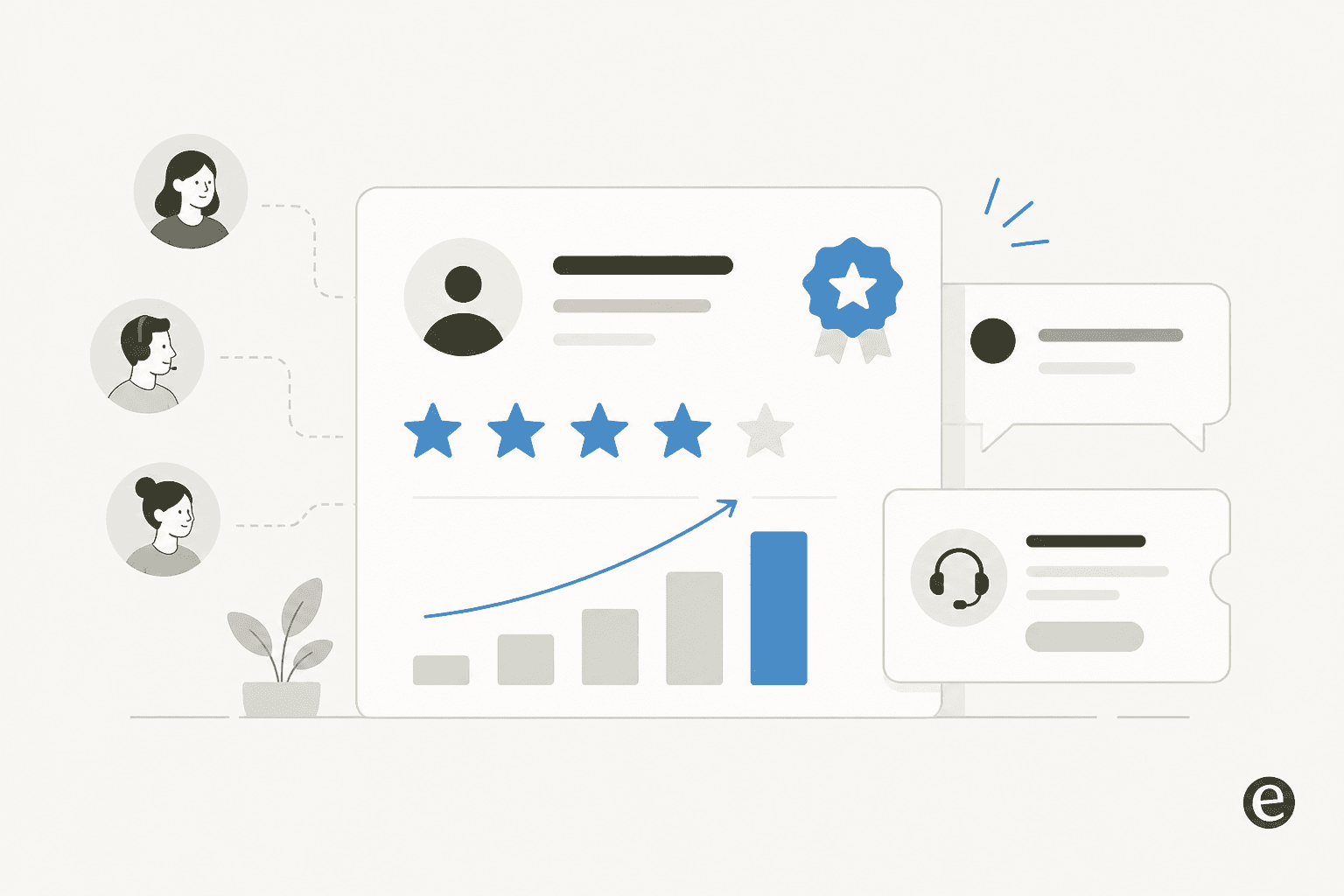
What "customer focus" actually measures
Before you can rate it, you have to define it, and "cares about customers" is not a definition anyone can act on. On the support queue, customer focus breaks down into a handful of observable behaviors you can actually point to in real tickets.
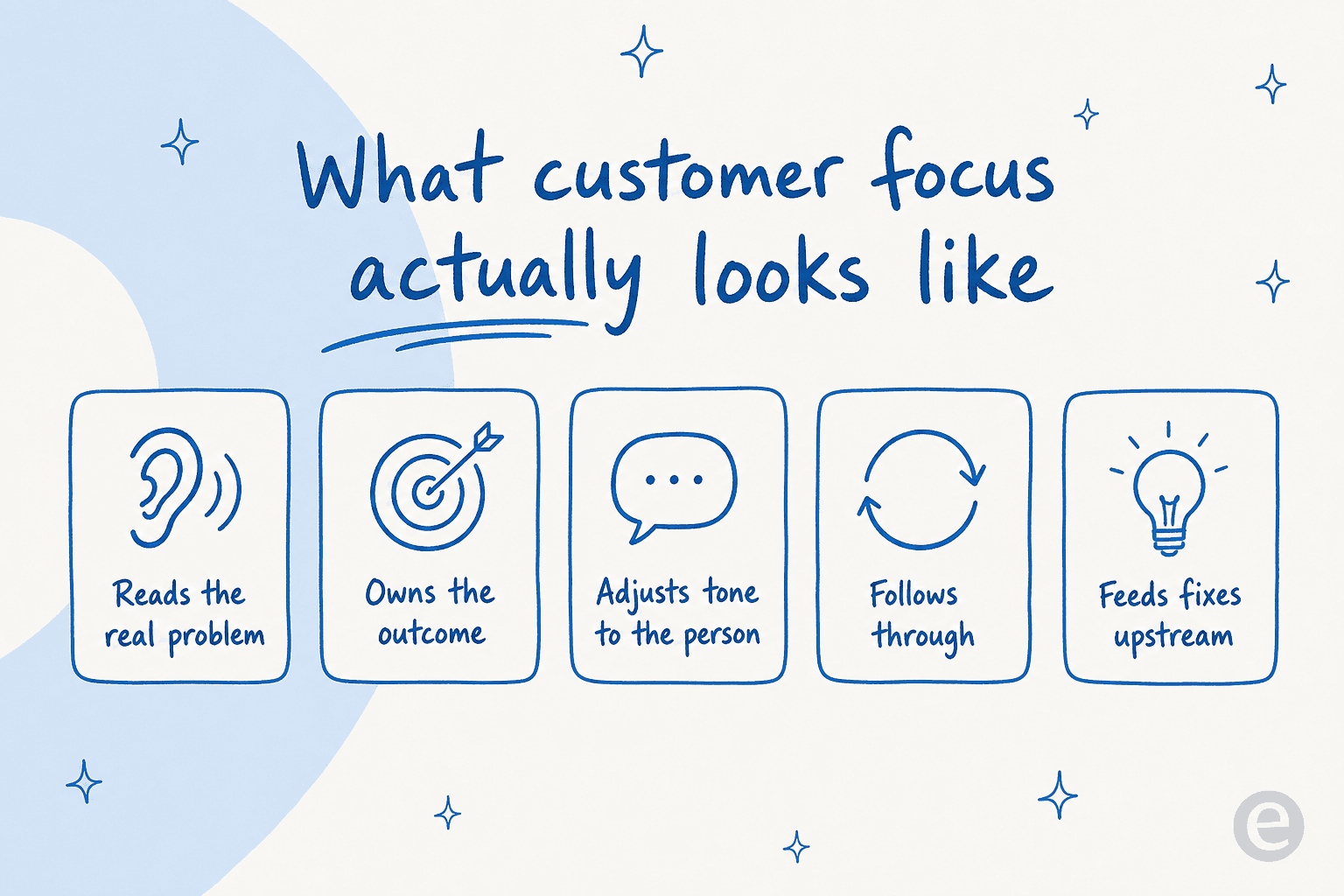
- Reads the real problem. The customer says "your app is broken"; the agent works out they are actually locked out of a specific setting. Diagnosis over transcription.
- Owns the outcome. They do not bounce the ticket to another queue and forget it. They see the customer through to a resolved state.
- Adjusts tone to the person. A frustrated enterprise admin and a confused first-time buyer do not get the same script.
- Follows through. They confirm the fix actually worked before closing, which is the single biggest driver of reopened tickets.
- Feeds fixes upstream. They notice the same question ten times and do something about it, a macro, a docs edit, a flag to product.
These map cleanly onto the wider customer service standards most teams already track, and they give you five things to rate instead of one vague vibe. When you write the review, cite the behavior, not the feeling.
Why most customer focus reviews are useless
The failure mode is always the same: the comment is too vague to argue with, agree with, or improve on. "Sarah is great with customers" tells Sarah nothing. Was it her tone? Her follow-through? Her instinct for when to escalate? She cannot repeat what she cannot name.
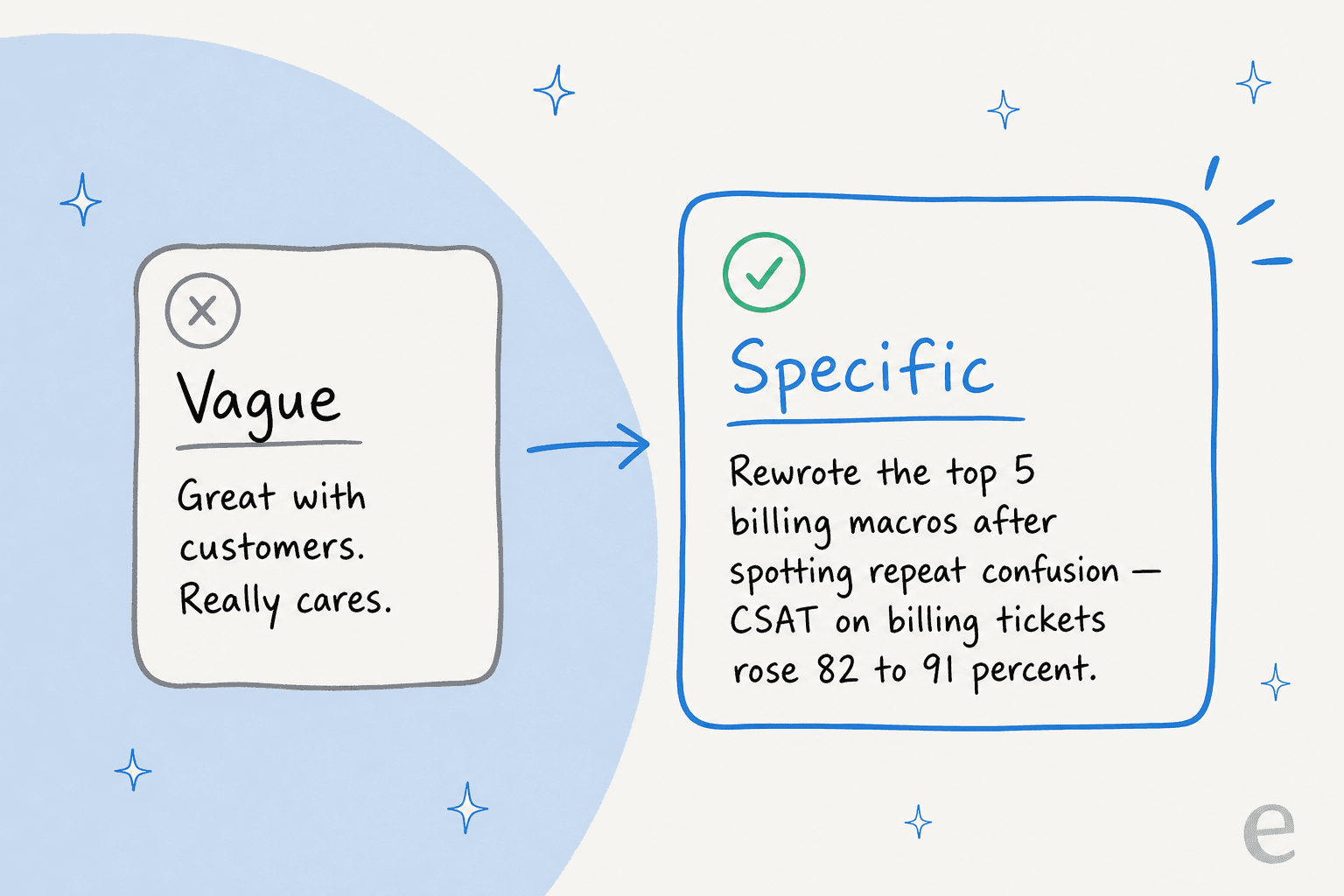
The fix is a formula: behavior + outcome + number. Watch the same praise get useful:
- Vague: "Really cares about customers."
- Better: "Consistently rewrites canned responses so they sound human."
- Useful: "Rewrote the top five billing macros after spotting repeat confusion, lifting billing CSAT from 82% to 91%."
The third version is something you can put in a promotion case, and something Sarah can do again on purpose. Numbers do a lot of the work here, so pull them from the customer service KPIs you already track, CSAT, resolution rate, reopen rate, first response time, rather than reaching for adjectives.
A rating rubric you can copy
If your form uses a 1-4 or 1-5 scale, give each level a behavioral anchor so two managers rating the same agent land in roughly the same place. Here is the rubric I use for customer focus.
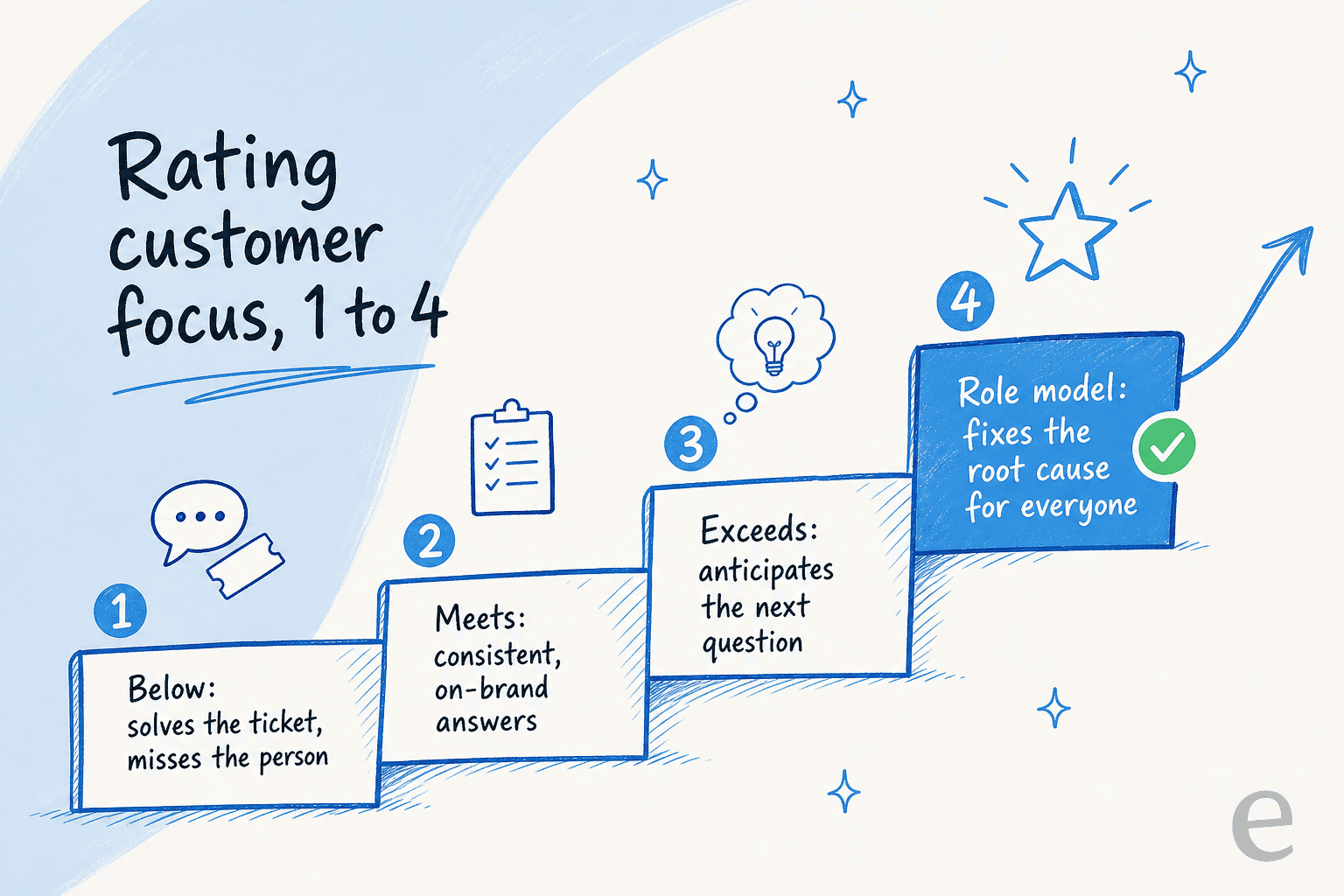
| Rating | What it looks like on the queue |
|---|---|
| 1 - Below expectations | Solves the ticket but misses the person. Correct answers, cold delivery, tickets reopen because the fix was not confirmed. |
| 2 - Meets expectations | Consistent, on-brand, accurate answers. Handles the standard cases well. Does not go looking for problems beyond the ticket in front of them. |
| 3 - Exceeds expectations | Anticipates the next question, adjusts tone to the customer, and owns the outcome end to end. CSAT visibly above team average. |
| 4 - Role model | Fixes the root cause for everyone, not just the current customer. Improves macros, docs, and product feedback loops. Other agents copy their replies. |
The jump from 2 to 3 is where most of your development conversations live, and it is almost always about the same thing: moving from answering the ticket to owning the customer's outcome.
Customer focus performance review examples by rating
Here are the phrases. Adapt the specifics to your agent, but keep the shape: behavior, then outcome, then a number when you have one. Swap in the real metric names from your customer service management stack.
Exceeds expectations
- "Consistently reads past the literal question to the underlying problem. When a customer reported a 'broken checkout,' [name] diagnosed an expired payment method and walked them through the fix, turning a 1-star interaction into a 5-star one."
- "Owns tickets end to end. Reopen rate on [name]'s queue is 4%, well under the team's 11%, because they confirm the fix landed before closing."
- "Sets the tone for the team on hard conversations. Their de-escalation replies are now saved as team templates."
- "Turned repeat confusion into a permanent fix by rewriting our top billing macros, lifting billing CSAT from 82% to 91%."
- "Treats every ticket as a signal. Flagged a recurring shipping question that led to a docs update and a measurable drop in that ticket type."
Meets expectations
- "Delivers accurate, on-brand answers consistently and holds a solid CSAT of [x], in line with the team standard."
- "Handles the standard queue reliably and rarely needs a reply corrected."
- "Adjusts tone appropriately for most customer types and keeps interactions professional under pressure."
- "Responds within our first-response-time target on the large majority of tickets."
- "Reliable on the fundamentals; the next step is looking beyond the individual ticket to spot patterns worth fixing."
Needs improvement
- "Answers are technically correct but often miss the customer's emotional state, which shows up in below-average CSAT on escalated tickets."
- "Tends to close tickets before confirming the fix worked, contributing to a reopen rate above the team average. Goal: confirm resolution before closing."
- "Relies heavily on canned responses without tailoring them, so replies can read as generic. Goal: personalize the opening line of each reply."
- "Escalates cases that are within scope to handle, which slows resolution for the customer. Goal: build confidence on [specific ticket type]."
- "Focuses on clearing volume over quality of outcome; several tickets were resolved on paper but the customer came back unhappy."
Self-evaluation phrases for agents
If your review process includes a self-assessment, agents often freeze on customer focus because it feels like bragging. Give them this frame: describe a decision you made for the customer and what changed. These read well without sounding inflated.
- "I noticed we got the same onboarding question repeatedly, so I drafted a help article that cut those tickets on my queue by roughly a third."
- "I started confirming the fix with customers before closing, and my reopen rate dropped over the quarter."
- "On escalations, I now lead with an acknowledgment before the solution, which has smoothed out my hardest conversations."
- "I flagged a confusing error message to the product team, and it has since been reworded."
A strong self-review is really just evidence of a good customer service mindset, put into concrete terms.
Turning ratings into goals
A review that ends at a rating is half a review. Every score below "role model" should come with one or two goals the agent actually controls. Keep them behavioral with a measurable edge:
- "Reduce reopened tickets on my queue by 20% by confirming the fix before closing."
- "Lift personal CSAT to the team's 90th percentile by tailoring the opening of each reply."
- "Own [ticket type] end to end without escalating, on at least 80% of cases, by end of quarter."
- "Turn my three most common repeat questions into macros or docs the whole team can use."
For agents ready to level up their diagnosis, our roundup of problem-solving techniques pairs well with goals like these.
How AI changes the customer focus review
Here is the part most performance-review templates have not caught up to. On the teams I talk to, an AI for customer service is now quietly resolving a large chunk of the repetitive tier-1 volume. I have spent the last few years putting AI agents on live support queues, and the pattern is consistent: the AI takes the FAQs, the password resets, the "where is my order" tickets, and the humans keep everything hard.
That inverts the old review math. When the routine tickets leave the human queue, the tickets that remain are the emotional, ambiguous, high-stakes ones, exactly the tickets where customer focus is the whole job. So customer focus should weigh more in the human review, not less, and your rubric should lean on judgment: how they handled the angry escalation, the edge case with no macro, the customer who needed a human precisely because the bot could not help. It is worth revisiting your customer service metrics at the same time, since the balance of AI and human work changes what a fair target even looks like.
There is a real trap here worth naming. One CX lead I spoke with put the guardrail perfectly:
"The AI will never be able to answer 100% of the questions. I need an AI who is only handling the tickets that it's confident to handle, and all the other ones, leave them alone."
a DTC supplements CX lead, on why confidence-based routing matters
If your AI over-reaches and answers tickets it should have left alone, it quietly damages the customer relationships your agents are being reviewed on. So a fair customer-focus review in 2026 also means checking the handoff: were the right tickets escalated to a human, or did an over-eager bot mangle a conversation before a person ever saw it? Review the human's judgment on what the AI passed them, not just the raw CSAT.
Try eesel for the tier-1 tickets
If customer focus is where you want your agents spending their energy, the fastest way to get them there is to take the repetitive tickets off their plate, without letting a bot loose on the conversations that need a human.
That is the whole idea behind eesel. It plugs into your existing helpdesk, trains on your past tickets and help docs, and drafts or auto-handles the tier-1 volume, so your team's queue fills up with the judgment-heavy cases where customer focus actually shows. And because you can set it to only handle the tickets it is confident about, it hands the rest to a human instead of guessing, the exact guardrail that CX lead was asking for. eesel already resolves a large share of tier-1 requests for teams in their first month, and you can simulate it against your own historical tickets before it ever replies to a live customer.
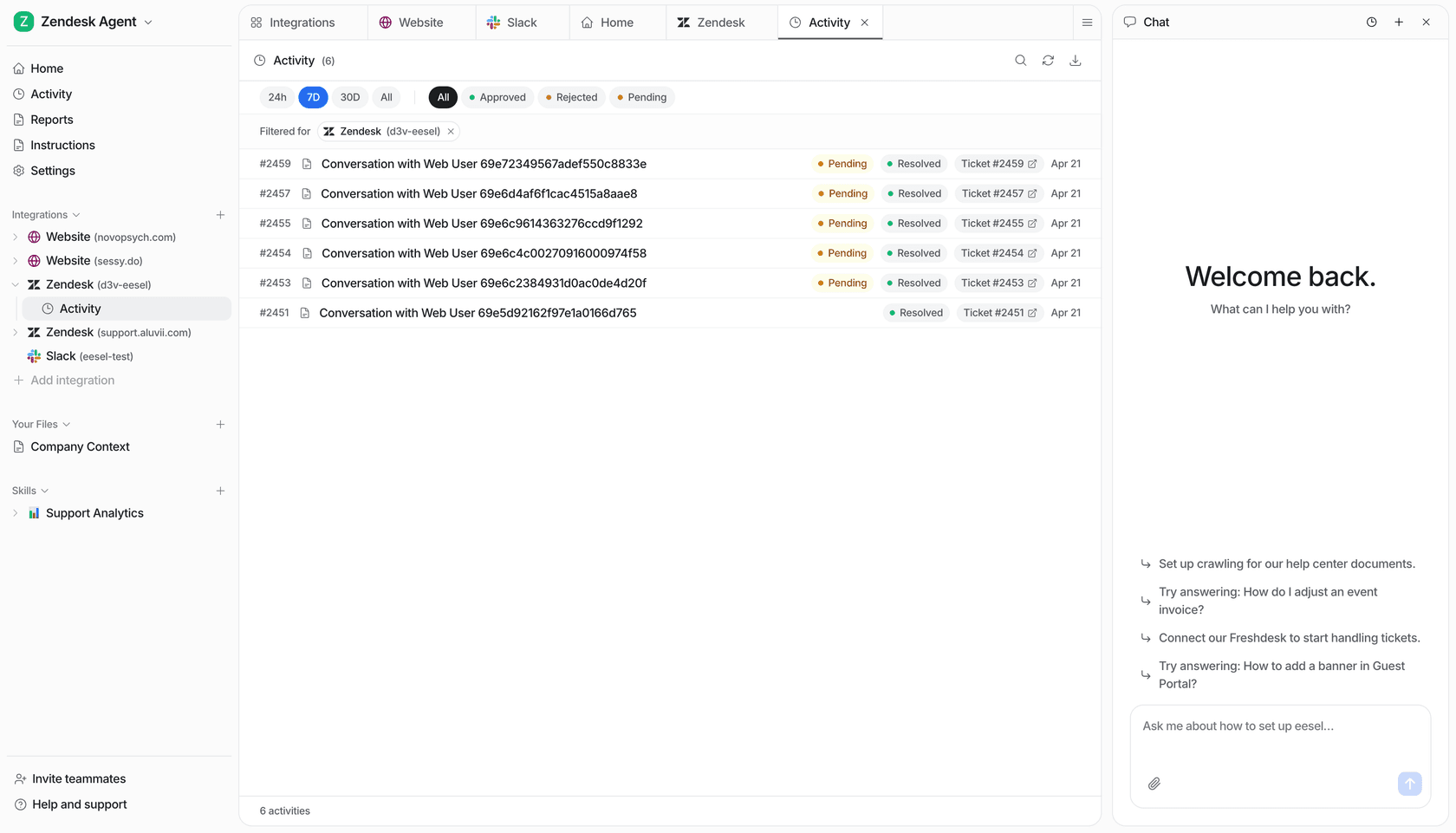
Give your agents the hard, human tickets and review them on how they handle those. Try eesel free.
Frequently Asked Questions
What are good customer focus performance review examples?
How do you rate customer focus on a performance review?
What phrases show customer focus in a self-evaluation?
How do you write customer focus goals for a support agent?
Should AI change how I review customer focus in 2026?


Article by
Riellvriany Indriawan
Riell is a designer and writer at eesel AI with about two years of experience researching CX platforms, AI chatbots, and helpdesk software. She combines her design background with a sharp eye for how these tools actually look and feel in practice — making her comparisons unusually visual and user-focused.