

What Shieldstral actually is, in sixty seconds
It is a classifier, not a chat model, and that distinction matters. You hand it a policy written as a plain question, plus a piece of content, and it answers back yes or no.
The specifics from Mistral's docs and the model card:
- Size. Marketed as 3B. The docs weights table says 3.8B parameters and Hugging Face's sidebar rounds it to 4B. Built on Ministral-3-3B-Base-2512 with a native Pixtral vision encoder.
- Licence. Apache 2.0, commercial use included.
- Context. Trained on sequences up to 32k. Mistral notes it theoretically supports 256k and tells you to stay inside the training range anyway.
- Modalities. Text, image, and text plus image, through one interface.
- Languages. Twelve named on the card: English, French, Spanish, German, Italian, Portuguese, Dutch, Chinese, Japanese, Korean, Arabic and Russian. The text-safety chart, worth noting, averages across 45.
- Hardware. Fits 16GB of VRAM at BF16. One
vllm serveline gets it running. - Status. Public Preview, per the docs page.
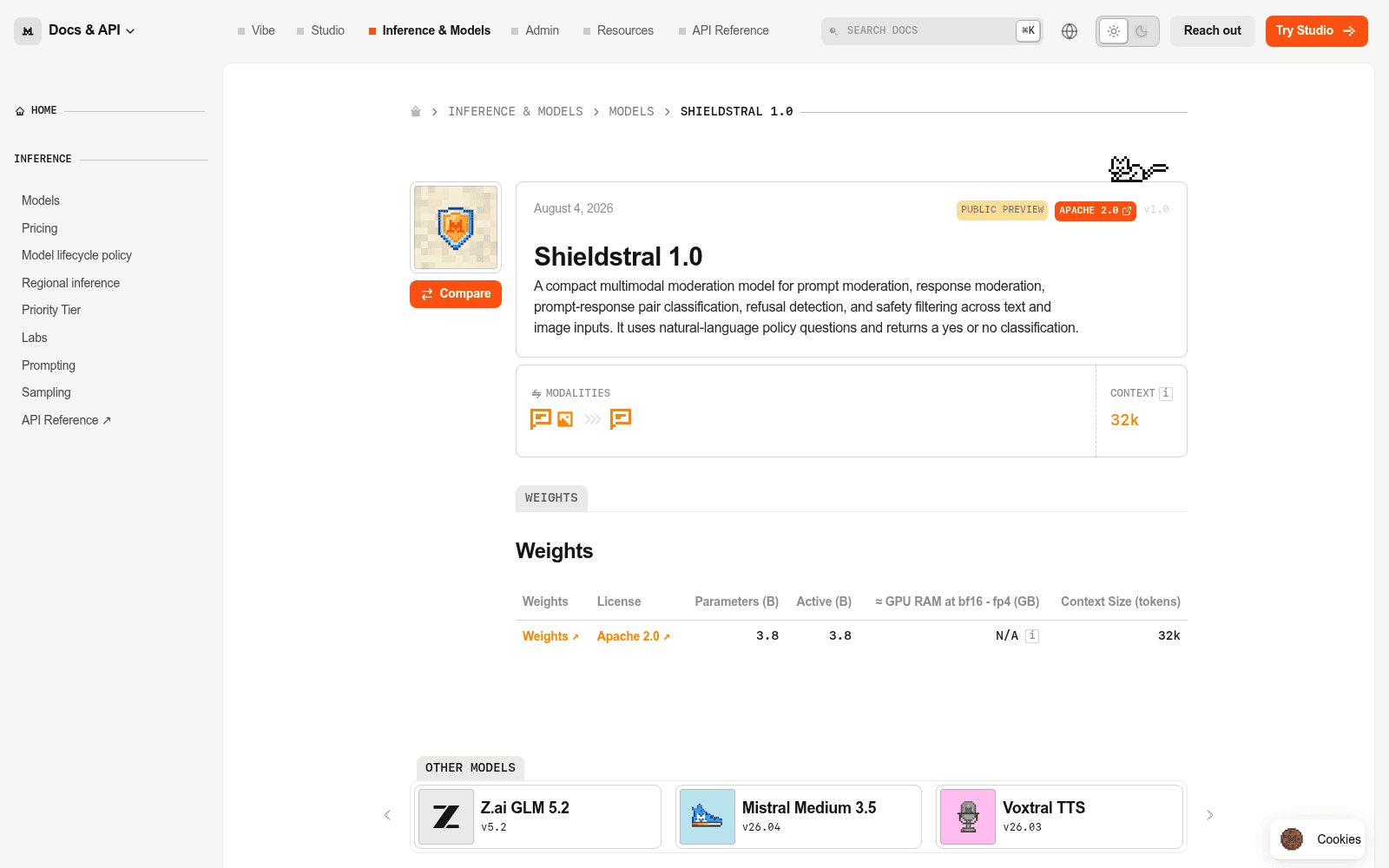
It is trained for four tasks: prompt moderation, response moderation, prompt-response pair classification, and detecting a refusal. The last of those is less obvious than it sounds, and more useful too: it tells you when your own assistant declined to help, which is how you measure over-refusal instead of just guessing at it.
The interface is the actual product
Most guard models bake a taxonomy into the weights. You get their categories, and retargeting to your own product means retraining. Shieldstral, instead, moves the policy into the prompt.
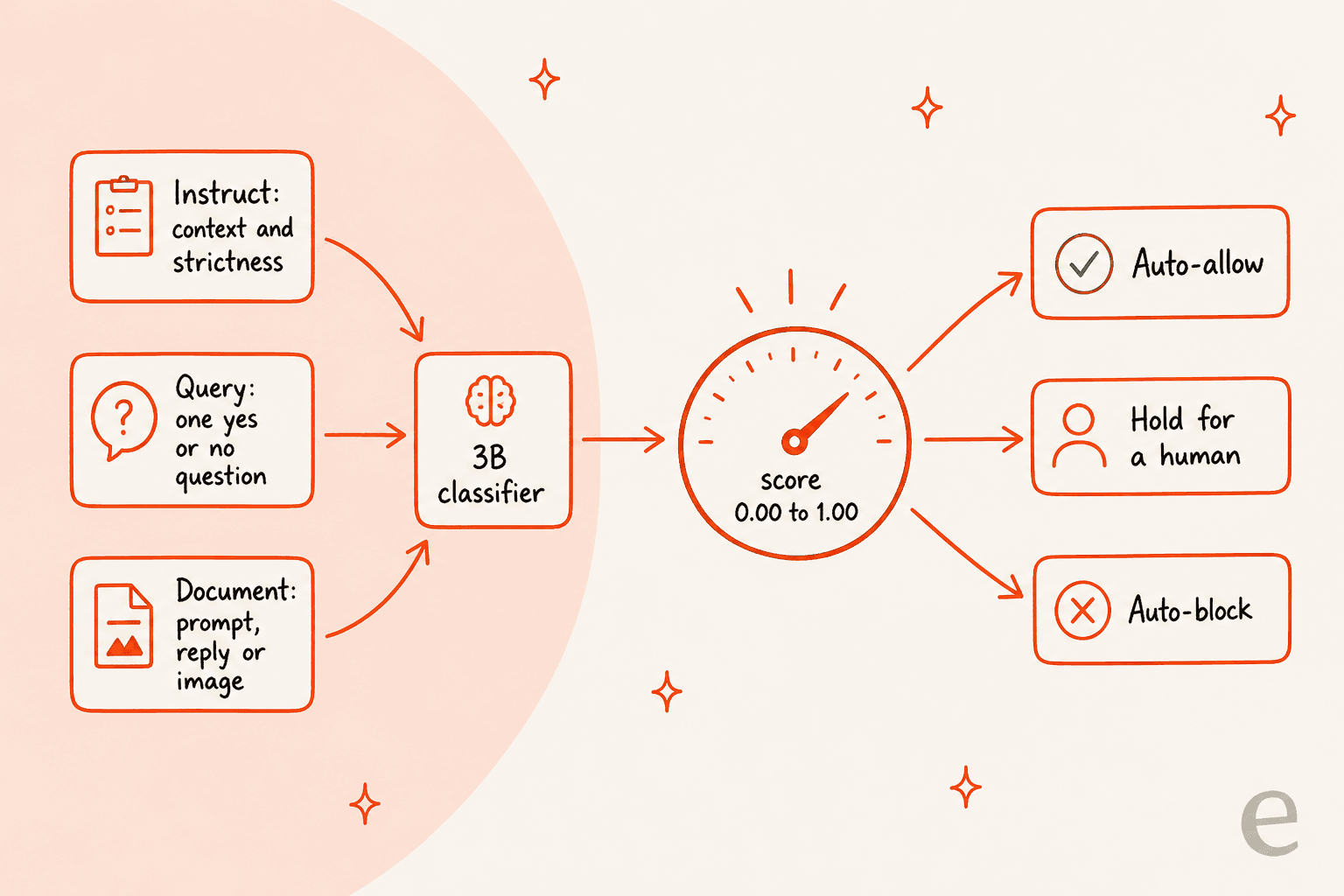
A request has three fields, under one fixed system message:
<Instruct>sets the evaluation context and strictness, and optionally the candidate categories. Mistral's guidance is to keep this constant across a product surface.<Query>is one yes/no question, phrased as a question. "Does this content promote physical violence?" Not a label, not a keyword.<Document>is the thing being judged: a prompt, a response, a formatted pair, or an image.
Then the model emits just a single token. You read the yes and no logits, softmax-normalise them, and out comes a score between 0 and 1, with a default threshold sitting at 0.5.
Someone in r/LocalLLaMA quantised it the same day and posted what using it feels like, which is more instructive than any architecture diagram:
"It's a classifier model, not a chat model with image support. So you ask it and it just answers quickly:
Should we throw a child a birthday party?> yes"

That is the whole of the experience, really. A question goes in, a word comes out, fast.
The one policy per query tax
Here is the constraint that shapes every deployment, and it comes straight from Mistral's own prompt-engineering tips: one policy per query. If you have six categories to check, that means six calls, not one single call that returns six labels.
An HN commenter worked it out in one line:
"You have a set of moderation policies and then you evaluate the model 1 time per policy if it is violating it. Then you combine the results into a score you use for taking actions off of."

Mistral does offer up a shortcut here. List your categories inside <Instruct> and ask one broad <Query>, something like "Is this content unsafe?", for an overall verdict. That collapses six calls down into one, but it also collapses six answers into one, so you no longer know which policy actually tripped. Fine for a blunt gate, and not much use for a report.
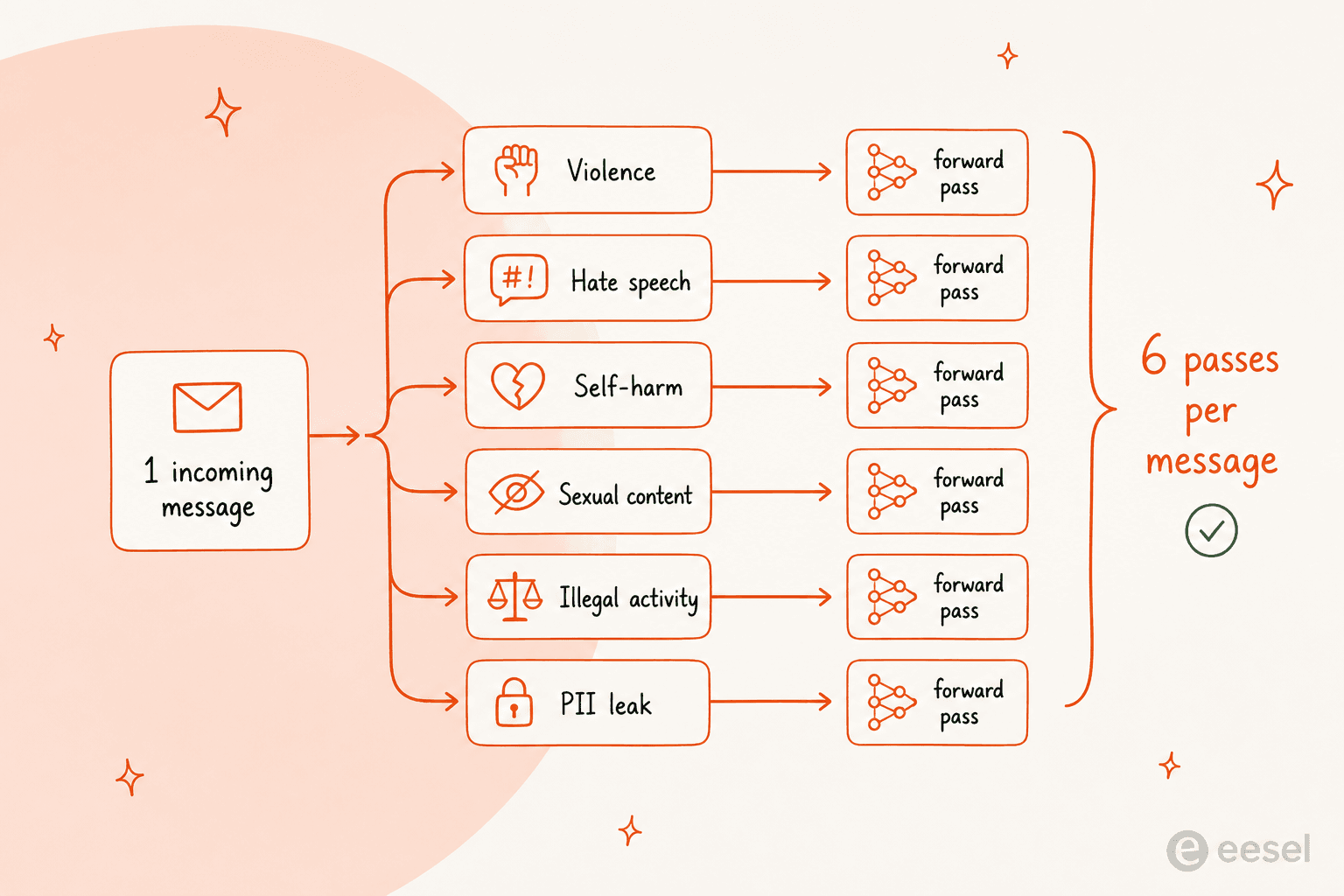
The multiplier is the thing most people underestimate, so here is the arithmetic, with your own numbers dropped in.
None of this is meant as a knock on the design, to be clear. A single-token forward pass on a 3B model is cheap, and cheap times thirteen still comes out cheap next to a frontier model doing one careful pass. It just means the sizing conversation is about throughput, and not really about tokens.
What the benchmarks actually say
Mistral published four charts in total, and the interesting part is just how narrow the top of the field turns out to be.
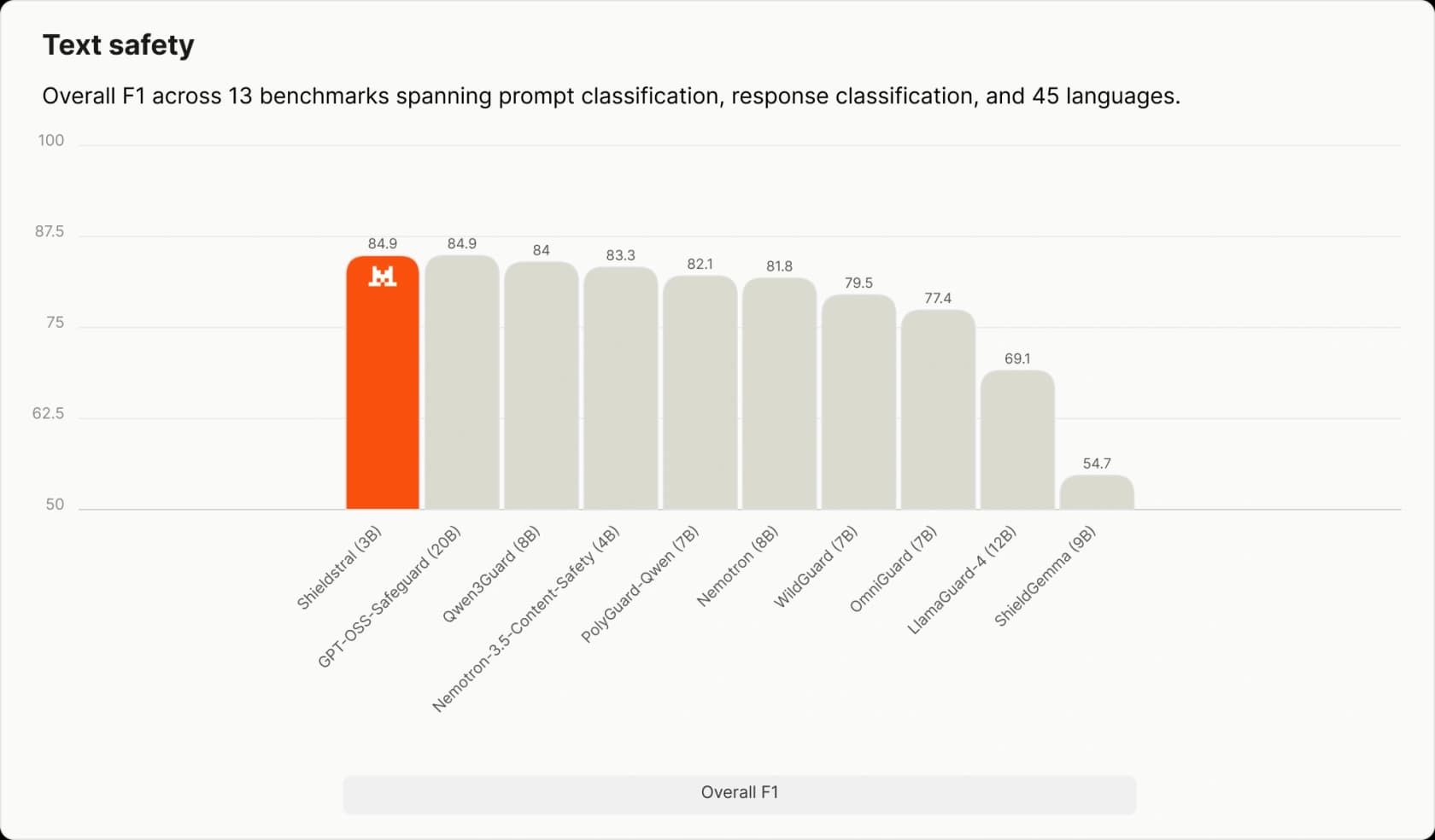
On the aggregate text-safety axis, it goes: Shieldstral 84.9, GPT-OSS-Safeguard-20B 84.9, Qwen3Guard-8B 84.0, Nemotron-3.5-Content-Safety-4B 83.3. Four models within 0.9 points of each other, sizes running from 3B up to 20B. Further down the list it opens up more: PolyGuard-Qwen-7B 82.1, WildGuard-7B 79.5, OmniGuard-7B 77.4, LlamaGuard-4-12B 69.1, ShieldGemma-9B 54.7.
Read it honestly, and the real headline is not "3B beats 20B." It is more that the accuracy race at the top of the guard-model field is basically over now, and what is left differing is packaging: parameter count, licence, modality coverage, how you express a policy. Mistral's own paper uses the more careful phrase, "matches or outperforms," even though the blog summary rounds it up to just "outperforms."
Refusal detection, this is where the chart gets more candid than most vendor marketing ever does.
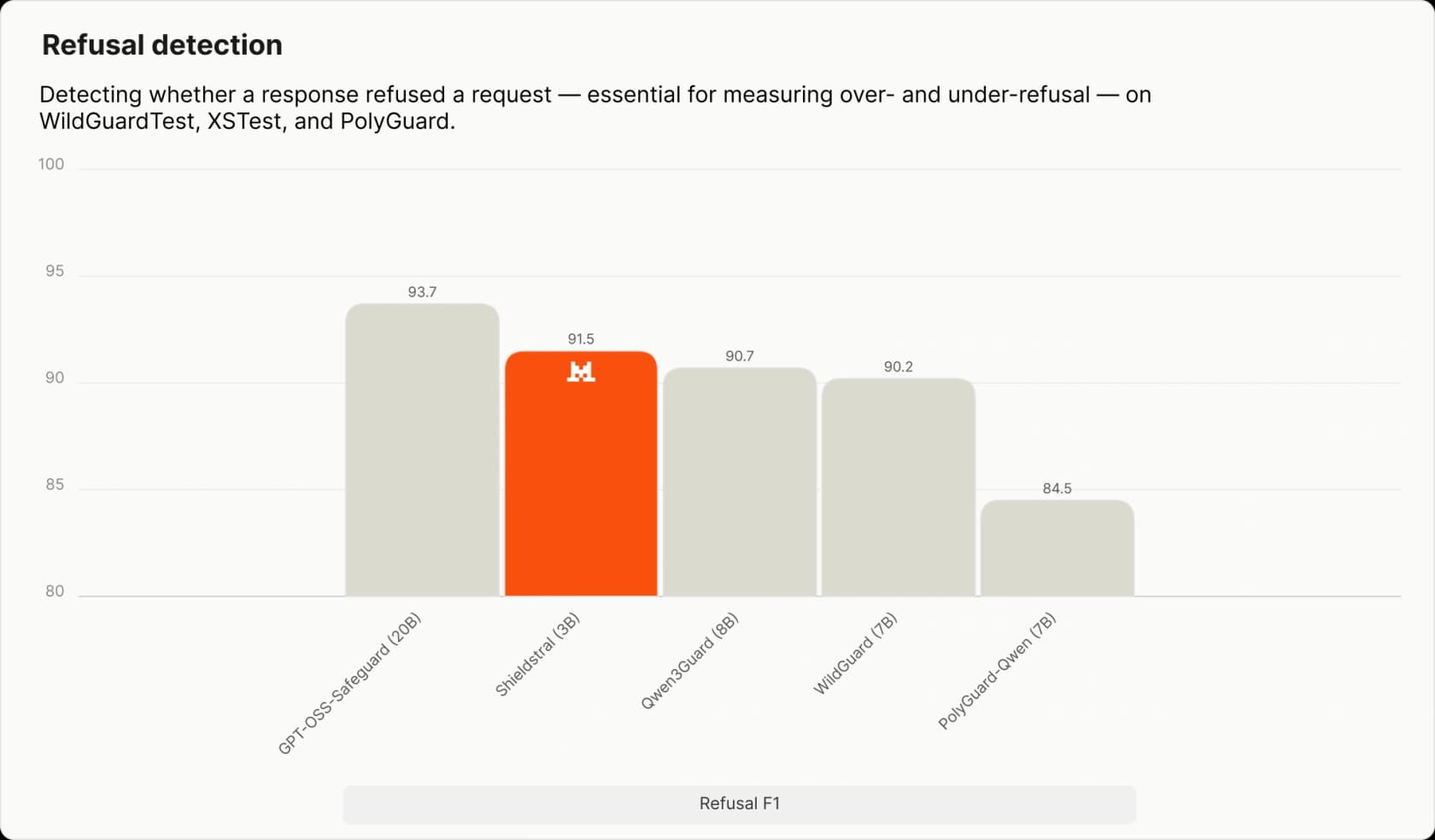
Mistral put its own model in second place here. GPT-OSS-Safeguard-20B takes it at 93.7 against Shieldstral's 91.5, and the per-benchmark table on the model card is a clean sweep for the 20B, across WildGuardTest, XSTest and PolyGuard. Publishing a chart where you come out losing is, honestly, a good sign about the rest of the numbers.
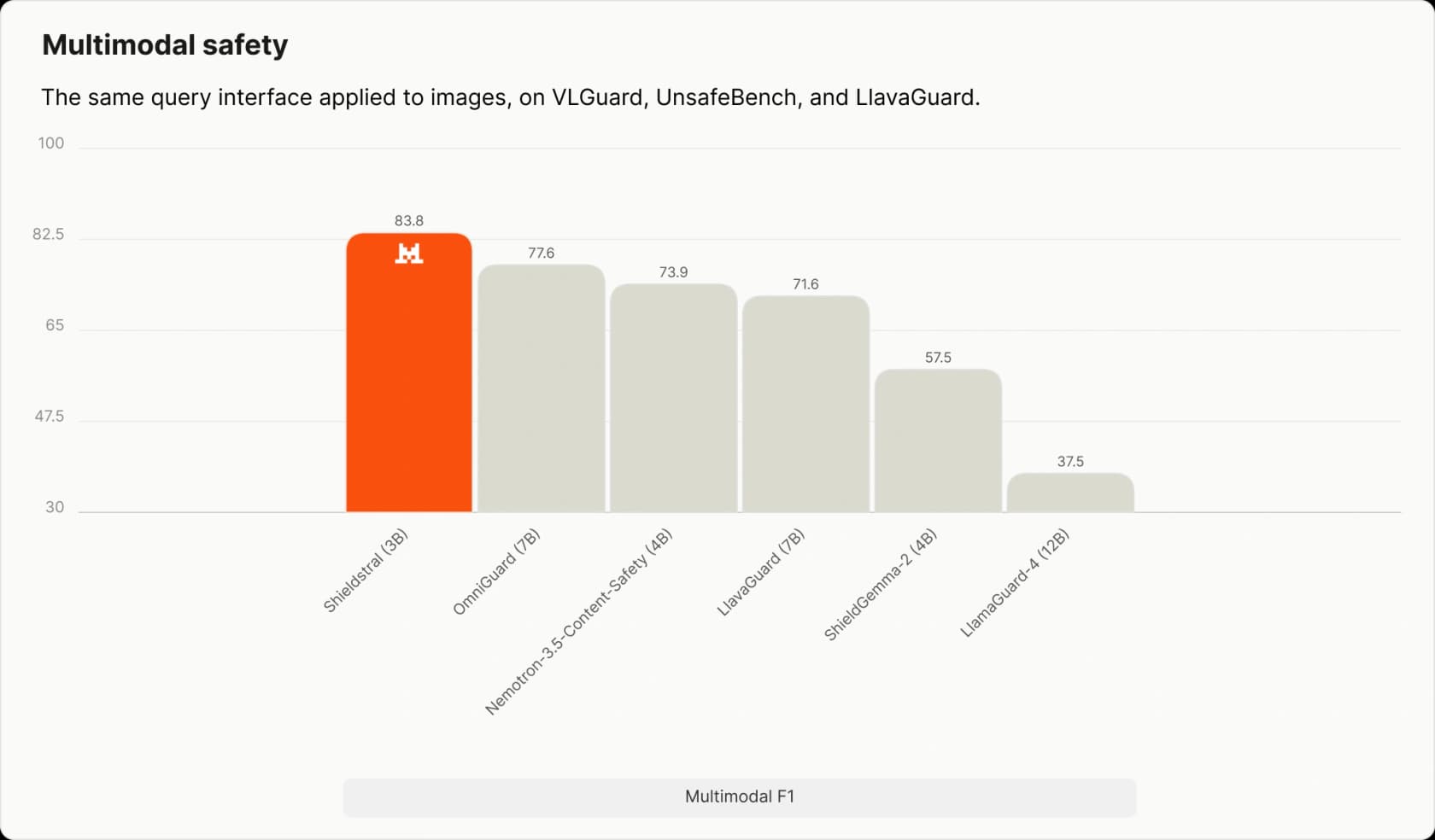
Multimodal is where the win is real, and least contested too, mostly because far fewer models compete in that space. Shieldstral takes VLGuard at 97.7 against OmniGuard-7B's 88.5, and it takes UnsafeBench at 81.8 against 72.6. On the third benchmark though, LlavaGuard, it comes second at 72.0 behind LlavaGuard-7B's 81.4, with a footnote noting some test images were unavailable, so the score only covers a subset.
One more row is worth pulling out here, because it is the widest gap on the whole card, and not in Shieldstral's favour either. On RTP-LX Prompt, a multilingual set, Shieldstral scores 70.3, while Nemotron-3.5-Content-Safety-4B scores 86.1, a 15.8-point spread against a model that is barely bigger. If your queue runs heavily non-English, that single row deserves a proper test before you commit to anything, and it does line up with the model card's own warning that reliability varies by language.
| Axis | Shieldstral (3.8B) | Best rival on the same chart | Verdict |
|---|---|---|---|
| Text safety, overall F1 | 84.9 | GPT-OSS-Safeguard-20B, 84.9 | Tie, at a fifth of the size |
| Refusal detection, overall F1 | 91.5 | GPT-OSS-Safeguard-20B, 93.7 | Second |
| Multimodal, VLGuard | 97.7 | OmniGuard-7B, 88.5 | Clear win |
| Multimodal, UnsafeBench | 81.8 | OmniGuard-7B, 72.6 | Clear win |
| Multimodal, LlavaGuard | 72.0 | LlavaGuard-7B, 81.4 | Second, partial test set |
| Multilingual, RTP-LX Prompt | 70.3 | Nemotron-3.5-4B, 86.1 | Well behind |
How a 3B gets there, since the recipe is the story
The reason a 3.8B checkpoint lands level with one at 20B is not architecture, it is data work, and Mistral described it in enough detail that you can actually check it. Four moves in total, pulled from the launch post and the technical report.
They converted every public safety dataset into that same instruction-query-document shape, using a per-dataset processor, and then deliberately varied the wording of instructions, queries and delimiters, so the model generalises across phrasing rather than just memorising one house style. They also calibrated strictness per source, strict for the adversarial jailbreak sets, lenient for the response-quality ones, and that is how you end up with a score that actually means something, instead of a model that just flags everything.
The second move is the clever one, really. Training on a fixed label set teaches a model to recognise those particular labels, not to reason about where a policy boundary actually sits. So they built sets of deliberately similar, easily confused policies, and had an LLM rewrite safe text into contrastive pairs, with each rewrite engineered to violate one policy but not its sibling. That is what makes a novel policy, one you write yourself at inference time, work at all, and honestly it is the part I would have expected a vendor to skip.
For images, they ran into the opposite problem, since you cannot synthesise unsafe images the same way you can synthesise unsafe text. Their answer was to pad out limited moderation sets with general-purpose image data as high-quality negatives, mutate the queries for augmentation, and then filter every image-query pair through a vision-language reranker, to cut down on mislabelled data.
Then they merged everything. LoRA fine-tunes combined by SLERP: one checkpoint calibrated on public data, one carrying the fine-grained policy discrimination from the generated pairs, plus the base instruct model, with the merge recovering both calibration and adaptability at once. Total corpus, per the paper, is roughly 54.1M samples, and the whole thing was trained on Forge, Mistral's own training platform. The paper lists 276 authors, and that alone tells you something about how much of this was infrastructure work rather than research.
Worth noting the company it keeps here: Mistral shipped this as an inaugural member of the Open Secure AI Alliance, alongside NVIDIA, which is likely the strategic reason a lab with limited compute spends it on a guard model instead of chasing a frontier release.
The thing everyone hit on day one: there is no why
The Hacker News thread ran to 482 points and 133 comments, and the criticism that kept resurfacing was not about safetyism, nor the EU. It was, plainly, operational.
"But when I imagine actually using a guardrail for a product, this model only outputs yes/no probabilities. There is no reasoning trace why it was rejected. Users or even developers would have no idea why a prompt was classified yes or no."
Another commenter put the customer-facing version of it:
"Let's say you deploy it in production and a user comes back and says 'Why is this prompt considered harmful?' You have no way to provide a concrete reason to the user at that point."
This is a real gap, and also a deliberate trade-off. Single-token output is exactly what makes it fast enough to run thirteen times per message. GPT-OSS-Safeguard, the model that beats it on refusal detection, is a reasoning model, run at reasoning_effort=high in these comparisons, and that puts it in a different cost bracket entirely. You can have the explanation, or you can have the throughput. Mistral picked throughput, and said so.
The workaround the thread landed on is the right one, and it is worth stating plainly because it is how you would actually ship this:
"One could set different operating thresholds: auto-approve low-risk posts, hold ambiguous posts for review, and automatically reject very high-confidence violations. So HITL for sure, but MUCH less H in the L."
That is what the continuous score is really for. Not a binary gate, three bands, with a human owning the middle one. Which means the model itself is only one component of a moderation system, and the bands, the queue and the appeal path are still yours to build. If you have ever wired up chatbot escalation, or argued about where AI chat escalation thresholds should sit, you already know the middle band is most of the work.
The other gap: you cannot rent it
This one is easy to miss, mostly because the launch post never mentions it at all. Shieldstral is not on Mistral's API.
I went through the pricing page myself, row by row. Flagship models, specialised models, third-party hosted, code models, Labs. Shieldstral is not in any of them. The moderation model that is there is Mistral Moderation 2, listed at free for input, cached input, and output. Hugging Face puts it even more bluntly: "This model isn't deployed by any Inference Provider."
Someone asked about exactly this within an hour of launch, and the whole buying decision plays out in three replies:
"Is it not offered by the API? I can't find info on its pricing"
The answer that came back was that it is a 3B model, one you could run on an old phone even. The reply to that one is the part I would actually put in a slide:
"I imagine, but I prefer having it managed and hosted by someone else. I'll wait for Mistral or other providers to add it."
Apache 2.0 weights come free. A GPU with an on-call rota attached is not. The community has done its part fast, with GGUF conversions, 17 quantisations, two finetunes, and an Axolotl fine-tuning example already up, plus 14,130 downloads in the model's first month. But the person who has to keep the box alive, that is you.
That trade shows up in every build-versus-buy conversation I sit in. One of eesel's customers, Karel at GENERAL BYTES, said it about AI support generally, and it applies exactly here:
"We could try to write our own LLM application but we didn't want to invest our time into that. We wanted something that we would not have to maintain."
If self-hosting is the whole point for you, this is a gift. If it is an accident of the release schedule, then wait, or use the free hosted Moderation 2 for now and revisit.
What it means if you run a support queue
Here is where I have to be careful about what Shieldstral is actually for, because there is an obvious-looking mapping onto support that does not hold up.
The obvious version: put a guard model in front of your AI agent, block whatever it flags, and you have made AI customer service safe. Shieldstral does part of this well. Abuse detection on inbound messages, self-harm signals that need a human right away, a policy check on outbound replies before they go out, screening image attachments in an ecommerce queue where customers will photograph anything. Those are real jobs, and a 3B classifier at 84.9 F1 does them at a price that makes running it on every single message unremarkable. Someone on r/LocalLLaMA made the production case better than the launch post did:
"If you've to build something that has user-facing llm input and output that isn't processed, moderation is one of your biggest concerns. So havving a 3B model that does this very well at minimal cost is very valuable for production environments."
The part that just does not transfer is the decision everyone actually wants automated. "Is this content unsafe" and "should the AI answer this ticket" are two quite different questions, and only the first one is really a safety question. A refund request that hinges on some undocumented policy exception is perfectly safe content, and completely wrong for an autonomous reply. A password reset question is safe content too, and ideal for one. No safety classifier can tell those two apart, because the signal is not sitting in the message, it is in whether your knowledge actually covers it.
That is the gap the CX lead I quoted at the top was describing. They had roughly 7,000 tickets a month and no appetite for auditing an AI's guesses:
"The AI will never be able to answer 100% of the questions, but if it tries and just answers 'sorry I don't know this,' I cannot go and check all my 7,000 tickets to see if the AI actually made a good answer, then the point is a little bit gone. I need an AI who is only handling the tickets that it's confident to handle and all the other ones, leave them alone."
What that requires is confidence measured against your own history, not against some policy question. It is the same three-band structure the HN thread arrived at, just with a different source of truth: instead of "how unsafe does this look," you need "how often has this kind of ticket been answered correctly before." At eesel, I get that by replaying an agent over a customer's past tickets before it ever goes near a live conversation, which is how a team gets to see a resolution rate before their first customer even meets the AI. Kim Simpson at Gridwise put the outcome of that approach on record on G2:
"In the first month, eesel is resolving 73% of our tier 1 requests... results quickly during our 7-day trial."
Different tool, different question, really. Shieldstral is a good answer to "is this content against our policy." It is not much of an answer to AI hallucination prevention though, and if you are trying to work out whether an agent should be allowed to reply at all, you want AI ticket classification and support ticket triage doing that job instead, with the safety classifier sitting beside them rather than in place of them.
Reading a guard-model launch and wondering what it actually takes to trust an AI on your own queue? eesel plugs into the helpdesk you already run, replays your past tickets so you can see the resolution rate before anything goes live, and lets you keep the tickets it is not confident about well away from customers entirely. Free to try, and the simulation runs on your own history, not some benchmark set. Try eesel.
What I would test in week one
If you are evaluating it for a queue, rather than just reading about it, five tests will get you to a real decision faster than any benchmark table.
Run it over a month of your own historical messages first, using your policy questions, and look at the score distribution rather than just the pass rate. What you are trying to find is where the ambiguous middle actually sits, so you can set two thresholds instead of one. This is the same discipline behind any AI quality assurance programme: you want the distribution, not an average.
Test that same policy, phrased three ways. If the scores move materially, you have found out that your policy strings are configuration, and need reviewing like configuration too.
Feed it your non-English tickets specifically. The RTP-LX Prompt row is a 15.8-point warning, and the model card says coverage is uneven, so measure it against your own languages rather than trusting the aggregate.
Time it under load, with your actual policy count, not just one policy. The call-budget arithmetic above is the sizing input here, and peak throughput ends up deciding how many GPUs you buy.
Finally, decide who owns the middle band before you turn anything on. A held message needs a human, a queue, and an SLA, which is the same design work as AI escalation management and agent handoff. Skip this step and a moderation rollout turns into a backlog nobody owns, which is the failure I see most often when teams bolt a classifier onto a live customer service automation setup.
Where it is rough right now
Mistral's own limitations section is short, and unusually direct too, which I do appreciate. A few items worth flagging:
- Uneven coverage. Reliability varies across languages and domains that are unevenly represented in training. The RTP-LX Prompt row is what that looks like in a number.
- Residual label noise. Even after multi-model verification and consistency filtering, synthetic and public safety data carry bias and noise. Worth remembering that the recipe involves roughly 54.1M samples, much of it generated.
- Adversarial and obfuscated input. Encoded or transliterated text, and very long documents, reduce reliability.
To that, I would add a few more practical ones, from reading through the docs closely.
The query wording turns out to be load-bearing. A <Query> has to be a yes/no question, not a label or a keyword, and the same policy, phrased two different ways, can move the score around. Mistral trained on varied phrasings specifically to reduce this, and that alone tells you it was a real problem for them. Plan on a prompt-tuning pass per policy, and version those strings like you would code.
Prompt injection is not its job, though people assumed that it was. Someone asked on r/MistralAI whether it handles the basic "ignore previous instructions" attack, and got back the correct one-line answer: it is not an LLM, it is a classifier. If you want injection defence, you need a policy question that actually asks about injection, and you should test that rather than just assume it.
The threshold, really, is a product decision disguised as a default. 0.5 is just what the benchmarks use, not necessarily what your product wants. Whether false positives or false negatives hurt more is a business call, and it does change per surface. The one thing that makes this manageable is that you get a continuous score rather than a label, so tuning is at least possible.
Should you actually run it?
A few honest profiles, then.
Run it if you host your own model and moderate user content. This is the intended case, and it is a strong fit. Apache 2.0, 16GB, multimodal, no per-call bill, no data leaving your network. If you are building anything with open user input, this is now pretty much the default first thing to reach for. One HN commenter had been putting off a social product for exactly this reason, and said the launch changed the maths:
"I've had dreams of building something in the image sharing or social platform realm, but stopped short of planning because of obvious content moderation responsibilities. This seems to be a realistic, cost effective solution to that one piece of the puzzle."
Skip it if you want a hosted moderation call. There is no endpoint here, and the free Mistral Moderation 2, or the OpenAI moderation API, will get you moving today with nothing to actually operate. Revisit it once a provider picks it up.
Do not buy it as support automation. It is a filter, not an agent, and that distinction matters more than it sounds. If what you are shopping for is something that resolves tickets, you want an AI agent for customer service, and agents versus chatbots is a much better frame for that particular search than any guard-model benchmark. A classifier can tell you a message is abusive. It cannot tell an angry customer what actually happened to their order.
Shieldstral against the models people will compare it to
The comparison set is small, and pretty clear.
GPT-OSS-Safeguard-20B is the closest rival, and the one that beats it on refusal detection, 93.7 to 91.5, plus most of the per-benchmark response-classification rows. It is also 20B and reasoning-based, so it costs more per verdict, but can tell you why. If explainability matters to you more than throughput does, that is your trade.
Qwen3Guard-8B sits at 84.0 on text safety, less than a point behind, at a bit over twice the parameters. Close enough that deployment convenience really decides it.
LlamaGuard-4-12B is the one this release most clearly moves past. 69.1 on text safety, and 59.9 on VLGuard, against Shieldstral's 97.7. If LlamaGuard is what you are running in your stack today, this counts as a real upgrade, not just a lateral move.
Mistral Moderation 2 is the odd one out, and probably the most practical: same vendor, fixed taxonomy, hosted, free, zero ops. For a lot of teams that is the honest answer, and Shieldstral only really wins when you need custom policies, image moderation, or data that stays on your own hardware. If you are weighing Mistral's lineup more generally, Mistral AI pricing and Mistral AI reviews cover the rest of the range, and Mistral alternatives is the wider view.
The verdict
Shieldstral is a good model, with a narrow, well-chosen job, and it released with an unusually honest set of charts. The 3B-matches-20B claim holds on the aggregate text-safety axis, as a tie rather than a win, and the multimodal results are the new thing here. The policy-in-the-prompt design is the right idea, and treating moderation as one single yes/no question is a cleaner abstraction than a frozen taxonomy.
What keeps it from being a drop-in is that it hands you the score, but keeps the reasoning. That is fine, once you accept that a guardrail model is a component and the three-band routing around it is the product. The teams who get the most out of it are the ones who already run their own inference, and already have a review queue for the ambiguous middle.
And if you came here looking for a way to make an AI safe on a support queue, a score is only the easy half. The hard half is knowing which tickets your AI should not touch at all, and no safety classifier can see that, because the answer sits in your ticket history, not in the message itself.
Related reading
- Best model for support tickets, on why retrieval usually beats the model choice
- AI ticket classification and AI ticket routing for SaaS
- AI escalation management, the human path behind every automated verdict
- AI hallucinations in support
- AI support quality assurance and AI agent coaching
- Mistral AI, Mistral AI new models and Claude vs Mistral
- Domain-specific LLMs and custom AI models
- SOC 2 and GDPR for support chatbots, plus Zendesk AI agent data privacy and HIPAA compliant AI
- Best open source AI agents, if self-hosting is the theme
- AI sentiment analysis for support and AI agent handoff best practices
Sources
- Introducing Shieldstral, Mistral AI, 4 August 2026
- Shieldstral 1.0 model page, Mistral docs
- mistralai/Shieldstral-1.0-3B model card, Hugging Face
- Shieldstral technical report, arXiv 2607.25857 v2
- Mistral inference pricing, Mistral docs
- Hacker News discussion, 482 points, 133 comments
- r/LocalLLaMA launch thread and r/MistralAI launch thread
- eesel Customer Voice Dossier: customer calls and permissioned testimonials (Gridwise via G2, GENERAL BYTES case study)
Frequently Asked Questions
Is Shieldstral any good?
What is Shieldstral used for?
Is Shieldstral available on the Mistral API?
How does Shieldstral compare to Llama Guard and GPT-OSS-Safeguard?
What hardware do you need to run Shieldstral?
vllm serve line with a 32k context. There are also llama.cpp, SGLang and Transformers paths, plus community GGUF quants at Q8_0, Q5_K_M and Q4_K_M if you want it smaller. If nobody on your team wants to own that box, the build-versus-buy maths looks a lot like the AI versus human cost comparison.Can Shieldstral explain why it flagged something?
Is Shieldstral free to use commercially?
Can Shieldstral moderate a customer support queue?


Article by
Kira
Kira is a writer at eesel AI with a Computer Science background and over a year of hands-on experience evaluating AI-powered customer service tools. She focuses on breaking down how helpdesk platforms and AI agents actually work so that support teams can make better buying decisions.