Shelf alternatives in 2026: 8 tools and what they replace

Kira

Katelin Teen
Last edited October 14, 2026

Shelf, in one sentence, for anyone who landed here without knowing what it is
Shelf is a content-quality engine that sits on top of a knowledge base. It connects to Confluence, SharePoint, Google Drive, Notion, Zendesk, Salesforce Knowledge and a handful of others in pull-only mode, then scores what it finds against real thresholds: anything at 99% similarity or above gets flagged a near-duplicate, a document over 2,000 words needs a table of contents, more than 49 files in one folder is a structural problem. It is a useful audit layer, a 2026 Gartner Magic Quadrant Leader for customer service knowledge management, and it holds 4.7 out of 5 across 141 G2 reviews.
None of that closes a ticket. Answer Assist puts a snippet in front of an agent, who then copies or sends it themselves. If the thing costing you money is ticket volume rather than a messy wiki, Shelf was never the tool, and neither are several of the alternatives people default to next. My wider comparison of AI knowledge management platforms covers where a governance tool like this actually helps, and where it runs out of road.
How I look at this, building the resolution side of it every day
I write the retrieval and simulation code that decides what an AI agent is confident enough to say to a customer, so I read this comparison differently than a pure researcher would. The question I care about is not "does it have a knowledge base connector," almost everything does, but "what happens the moment the retrieved context comes back empty."
That gap is not theoretical. One of eesel's customers, a Danish solar-energy provider, had a bot fabricate an answer and send it to a live customer because its knowledge base had no match for the question asked. Nobody configured that to happen. The retrieval returned nothing, and the model filled the silence rather than saying it did not know. The fix for that is a confidence threshold and a dry run against real history, not a two-quarter content-cleanup project, and it is exactly the layer most of the tools on this page skip entirely, Shelf included.
The dry run matters because a knowledge base audit tells you what is wrong with your documents. It tells you nothing about how an agent will actually perform against your real questions, worded the way your customers actually word them. In eesel's own simulation runs, one refund-policy theme moved from 28% coverage to 91% after a single documentation fix, a change a scored replay found and a manual audit would have had to get lucky to catch. On a separate cross-validated trial over live Zendesk traffic, 284 chats plus 100 tickets returned 93% triage accuracy and a 7% factual error rate, a number that only shows up when you measure it, and one you want to know before anything auto-sends. My piece on AI knowledge base benefits goes further into fixing documentation only where the data says to, rather than everywhere at once.
The one question that actually sorts this list
Every tool below does one of four jobs, and mixing them up is the single most expensive mistake in this category.
- Govern: clean, deduplicate and version a knowledge library so humans and models both read something trustworthy.
- Surface: put the right snippet in front of an agent who is already inside a ticket, chat or call.
- Deflect: answer the customer before a ticket exists at all, usually through a widget or embedded help centre. See my deflection rate guide for how this is actually measured.
- Close: read the actual ticket, take the action, and finish it without a human touching it. This is the job my AI ticket automation roundup is built around.
Use the picker below to see which of the eight tools reach the job you're actually buying for.
Filter by job
Which job do you need done?
Pick the outcome. The grid below narrows to the tools that actually reach it, not just the ones that mention it.
Korra is excluded here; it is an air-gapped documentation platform with no ticket, queue or reply concept at all. See item 8 below.
Why the price question is harder than it should be
Shelf is not unusual in refusing to publish a number, it is the norm in this category. Guru's pricing page has no dollar figures, no tier grid and no billing unit, its FAQ describes itself as a "platform and expertise solution" scoped on a call. Bloomfire's FAQ answers "is pricing based on user count?" with a flat no, then requires every tier to commit to a multi-year term regardless. Document360 runs a quote configurator instead of a price list, and Stonly publishes a free tier and goes silent above it.
That leaves three vendors with an actual number attached: eesel from $299 a month for 500 credits (1 credit per ticket or chat) with no seat cost, Zendesk at $55 to $149 per agent per month before a $50 Copilot add-on and $1.50 to $2.00 per extra resolution, and Capacity at a Capterra-reported $25,000-a-year floor. Everyone else wants a call first, and G2's own buyer-reported data on the quote-only vendors is not flattering: Shelf shows a four-month implementation and 13-month payback, Guru two months and 10 months, Document360 two months and 10 months, Capacity three months and 14 months. Thirteen months is longer than a lot of support teams keep the same helpdesk, which is worth weighing before the discovery call even happens. My wider roundup of AI knowledge base tools has the full price comparison across the category.
The 8 best Shelf alternatives in 2026, compared
| Tool | Entry price (published) | Closes a ticket? | Helpdesk depth | Free option | Security | G2 / Capterra rating | Implement time |
|---|---|---|---|---|---|---|---|
| eesel | From $299/mo (500 credits) | Yes | Zendesk, Freshdesk, Gorgias, Front, Help Scout, HubSpot, Salesforce, Jira SM | 100 free credits, no card | SOC 2 Type II certified, GDPR, HIPAA on Enterprise (signed BAA) | 4.6/5, 18 on G2 | Not published |
| Zendesk AI agents | $55/agent/mo + $1.50/resolution | Yes | Zendesk only | Trial only | SOC 2, ISO 27001, HIPAA | 4.3/5, 7,044 on G2 | Not published |
| Shelf | Not published since 2024 | No | Zendesk, Salesforce, ServiceNow, Confluence, SharePoint, Drive, Notion | No | SOC 2, GDPR | 4.7/5, 141 on G2 | 4 months, 13-mo ROI |
| Guru | Not published | No | None, extension only | No | SOC 2 Type II, HIPAA named | 4.7/5, 2,322 on G2 | 2 months, 10-mo ROI |
| Bloomfire | Not published, multi-year term | No | None | No | SOC 2, GDPR | 4.6/5, 515 on G2 | Not published |
| Document360 | Not published | No, opens tickets only | Zendesk, Freshdesk (ticket creation only) | 14-day trial | SOC 2, GDPR | 4.7/5, 541 on G2 | 2 months, 10-mo ROI |
| Stonly | Free, paid tiers not published | Yes, Enterprise only | Zendesk, Salesforce, Freshworks, ServiceNow | Yes, 400 views/mo | SOC 2 Type II, GDPR, HIPAA | 4.8/5, 132 on G2 | Not published |
| Capacity | $25,000/yr per Capterra | Yes, own channels only | Zendesk, Freshdesk (API only) | No | SOC 2 Type II, HIPAA, GDPR | 4.7/5, 106 on G2 | 3 months, 14-mo ROI |
| Korra | $199/user/mo per Capterra | No | None | Trial | On-prem, air-gapped | 4.8/5, 17 on Capterra | Not published |
A caution on that rightmost column: several of these ratings carry heavy vendor-referred or incentivized review counts, Korra is 15 of its 17 reviews. Read the written cons, not the star average.
1. eesel
Best for teams whose actual problem is ticket volume, not a messy wiki.
What it is
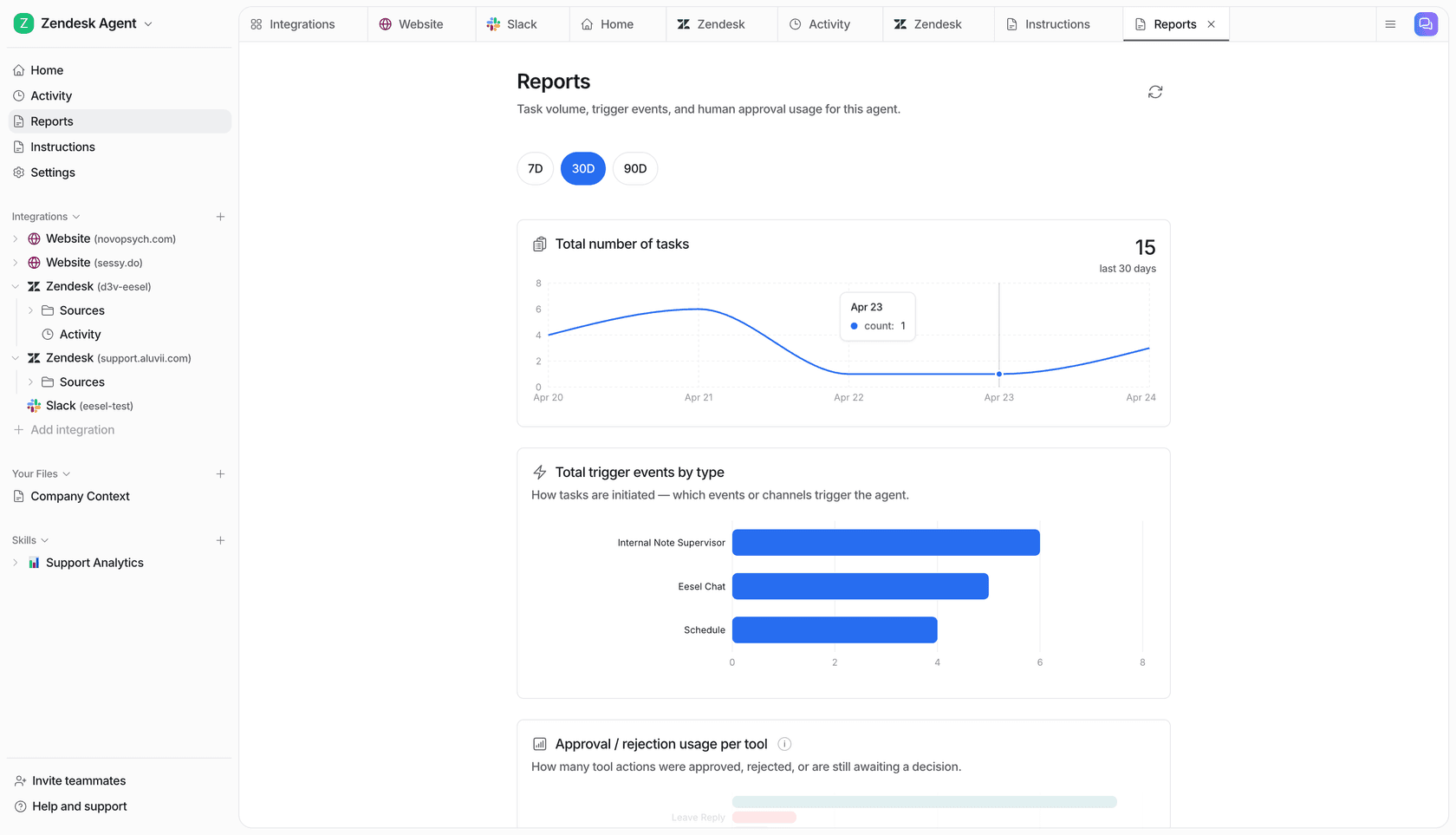
I build on this product, so weigh the framing accordingly, though every fact here is on eesel's own public pages. The AI helpdesk agent connects to a helpdesk, reads past tickets and macros alongside your knowledge sources, then drafts or sends replies from inside the queue. It runs in Zendesk, Freshdesk, Gorgias, Front, Help Scout, HubSpot, Salesforce and Jira Service Management, with the deepest coverage in the Zendesk integration: reading, replying publicly or as an internal note, tagging, routing and status changes, each independently set to full automation, approval-only or off.
Strengths
Knowledge sits pooled rather than siloed. Connect Confluence, Notion, SharePoint, a website crawl and file uploads, and one search reaches all of them, plus the ticket history itself as a source, which is the practical version of the AI knowledge base benefits case. The mechanism that separates it from everything else here is simulation: a replay of your own past tickets, scored against what your team actually sent, with per-theme coverage gaps reported back before anything touches a live customer.
Limits
No Genesys, Five9, NICE, Zoho Desk, Crisp or LiveAgent connector, so a CCaaS-heavy stack is out of scope. SOC 2 Type II is certified. HIPAA is available on Enterprise with a signed BAA. Each credit covers a ticket or chat handled, so a ticket that fails to resolve still uses a credit.
Pricing
| Monthly credits | Price | Unit |
|---|---|---|
| 100 | Free | No card needed |
| 500 | $299/mo | 1 credit = one ticket or chat, any number of replies |
| 1,000 | $499/mo | Same |
| 2,500 | $999/mo | Same |
| 5,000 | $1,899/mo | Above 5,000, talk to us |
| Blog post | $4 each | One blog draft |
Every integration, channel and seat is included. Pay a year upfront and get two months free. If credits run out, agents pause until they reset, or you can turn on overage with a monthly cap you set at $0.80 per extra credit.
Verdict
Choose eesel if the metric you're accountable for is queue size, and if you want the answer quality proven before launch rather than discovered after. Smava runs 100,000+ tickets a month in German on Zendesk, and Gridwise reported 73% of tier-1 requests resolved in month one. Skip it if you're buying a governance layer or your channel is voice.
2. Zendesk AI agents
Best for teams staying on Zendesk who would rather buy the native option than bolt on a second vendor.
What it is
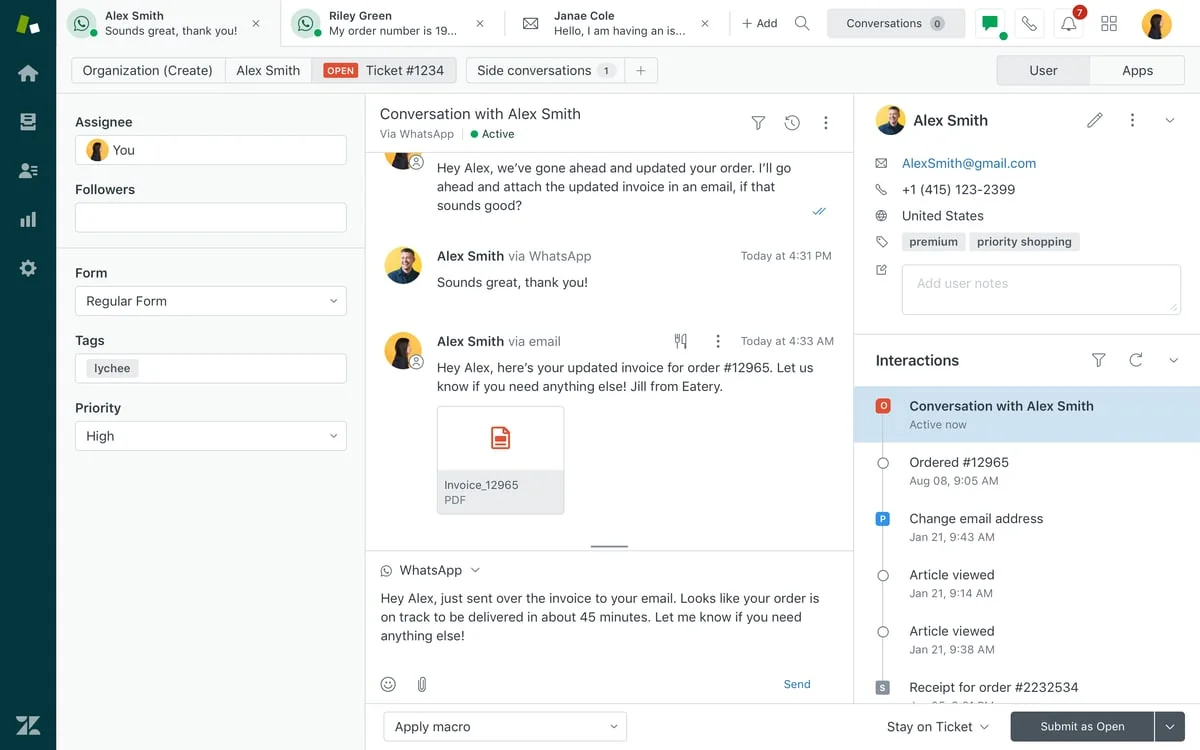
Zendesk is the only tool on this list that owns both the knowledge base and the resolution layer natively, having absorbed Forethought into its AI agent line. Generative search runs by default from Suite Team up, with 100,000 eligible searches a month included, and AI agents resolve end to end inside the ticket without leaving Zendesk.
Strengths
No integration work: the knowledge base you already have becomes the retrieval source. Resolutions since May 2026 split into verified, assisted and unverified tiers, and only verified resolutions, where the customer stays quiet for 72 hours and an LLM confirms it, are billed, a stricter bar than the deflection rate most vendors report.
Limits
Copilot, the layer that unlocks knowledge approval workflows and content blocks, costs $50 per agent per month on top of Professional or above, and Suite Enterprise carries no public price at all. There is no replay mode, only a manual test widget you type scenarios into one at a time, with no predicted resolution rate before launch.
Pricing
Support Team starts at $19 per agent annually, Suite Team at $55, Suite Professional at $115, each with a rising resolution allowance. Copilot adds $50 per agent, and resolutions beyond the plan allowance run $1.50 committed or $2.00 pay as you go, capped at 10,000 a year.
Verdict
Sensible if Zendesk itself is non-negotiable and Copilot fits the budget. Twenty agents on Suite Professional plus Copilot runs $3,300 a month before a single extra resolution. My eesel vs Zendesk AI piece runs that arithmetic against a per-ticket model at real volume, and my full Zendesk AI agents guide covers the native setup in more depth.
3. Guru
Best for knowledge that has to stay verified, with a named owner accountable for every card.
What it is
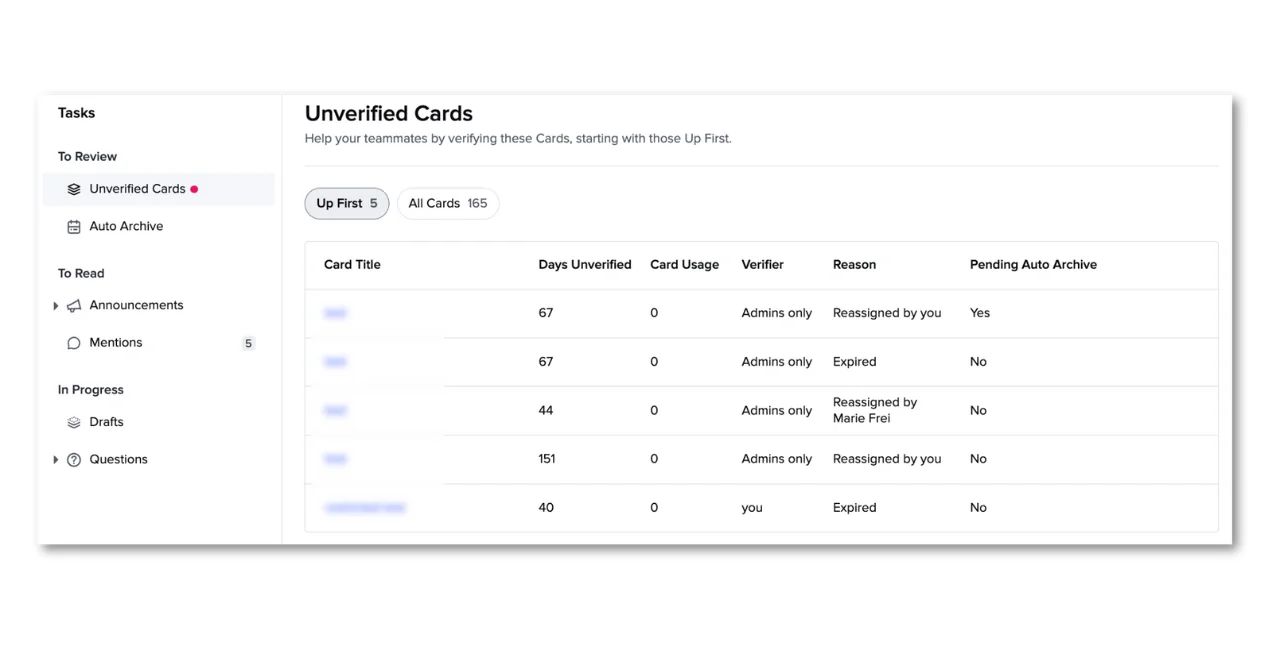
Guru is the closest like-for-like Shelf swap for a governance-first buyer. Cards carry named owners who get prompted on a schedule, and stale ones land in an unverified queue with a day count attached. Guru claims 80 to 90% of that verification loop runs without a human touching it, across 132 listed integrations and an MCP server that exposes the same knowledge to Claude or ChatGPT.
Strengths
The ownership model is the best-designed piece of this whole category. One reviewer put it plainly: the platform enforces ownership by prompting subject-matter experts on a schedule, keeping the repository trustworthy for support specialists inside the tools they already use.
Limits
Every helpdesk in Guru's directory, Zendesk, Freshdesk, Front, Gorgias, Salesforce Service Cloud and more, is tagged a "source you search," never "a place you answer from." Answers land in Slack, Teams, a browser or an MCP client, none of which is a customer channel. Guru can open a ticket when a human explicitly asks in chat, and that is the extent of its write access.
Pricing
Fully unpublished. No dollar figures, seat counts or billing unit anywhere on the pricing page. Both AI Assist and Knowledge Agents require the All-in-One or Enterprise tier, scoped on a first call, with no free plan or trial.
Verdict
Take Guru if the actual complaint is "our knowledge is wrong and nobody owns it" and your team lives in Slack. Do not expect it to touch deflection numbers. More detail in Guru alternatives and Guru review. If Bloomfire is also on your shortlist, I compare them directly in Guru vs Bloomfire.
4. Bloomfire
Best for one company-wide library where search needs to reach into video and audio, not just text.
What it is
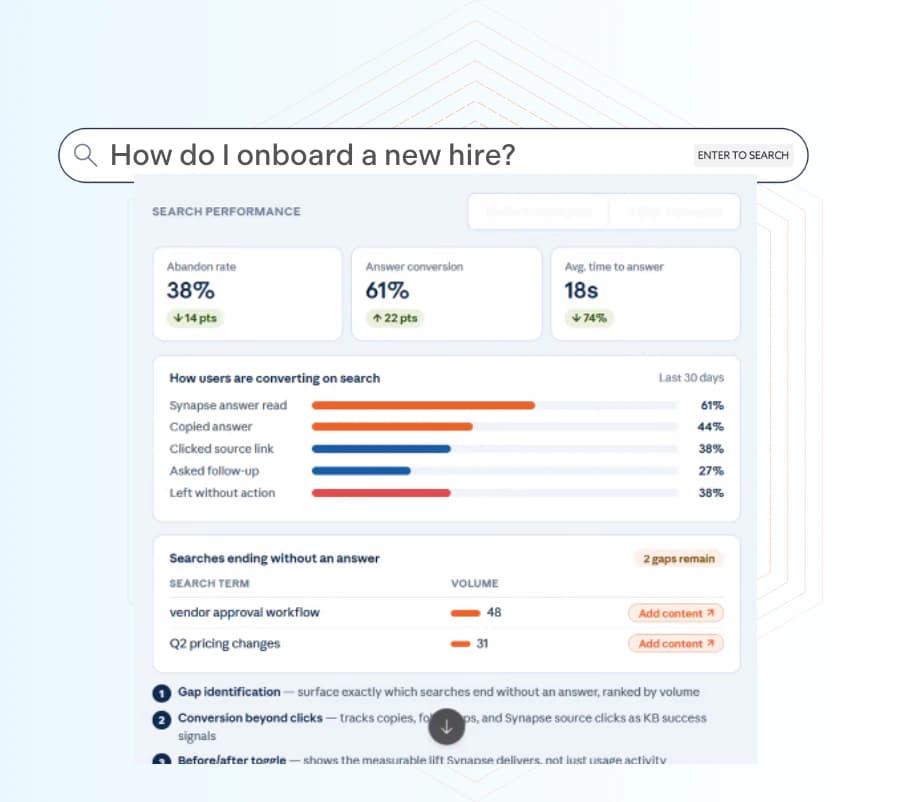
Bloomfire's edge is indexing depth plus the analytics layered on top. That dashboard, abandon rate, answer conversion, a ranked list of searches that came back empty, is close to a content roadmap generator, telling you exactly which article to write next. Synapse, its conversational layer, connects to Zendesk, Salesforce, Genesys, Microsoft Dynamics and Gong, with Workato covering everything else.
Strengths
The "91% resolved without escalation" figure that Bloomfire cites is agents self-serving inside Bloomfire, a meaningfully different claim than customers getting bot replies, and worth reading closely rather than skimming past.
Limits
There is no ticket object, no reply action, and no deflection claim anywhere on the site. The verb Bloomfire uses for itself is "surfaces." Freshdesk, Freshservice, Gorgias, HubSpot Service Hub, Help Scout, Front, Jira Service Management and ServiceNow are all absent from the integration list.
Pricing
Three tiers, Team, Department and Enterprise, none priced. The FAQ explicitly rules out per-seat pricing, then requires every tier to commit to a multi-year term regardless, which is an odd pairing for a vendor that also lists seat bands of 25, 100 and 500 on its G2 profile. No free trial exists.
Verdict
Strong where a large mixed-media library and a content-gap analytics view matter more than deflection. Negotiate the multi-year term hard. More in Bloomfire pricing.
5. Document360
Best for teams whose real gap is that they don't have a proper documentation set yet.
What it is
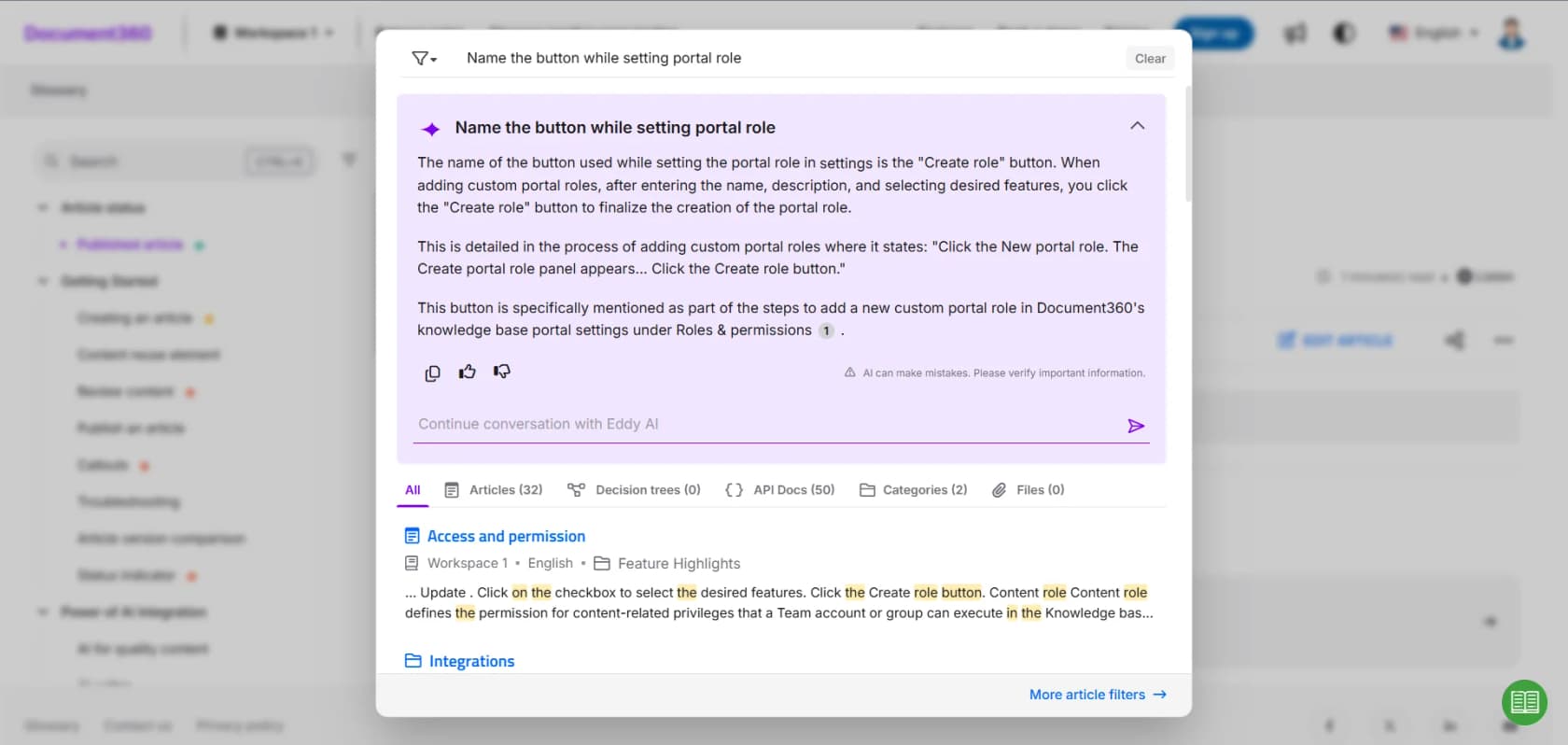
Document360 is the strongest pure authoring tool in this comparison: versioning, review workflows, localization, API docs and a solid editor. Eddy AI sits on top for search and answers, with an embedded help centre and a Support Ticket Deflector aimed at stopping tickets before they start.
Strengths
The deflection story is real for what it covers: a customer who never opens a ticket because the embedded widget answered them first. Eddy AI credits are metered one-per-question, which is at least a transparent unit.
Limits
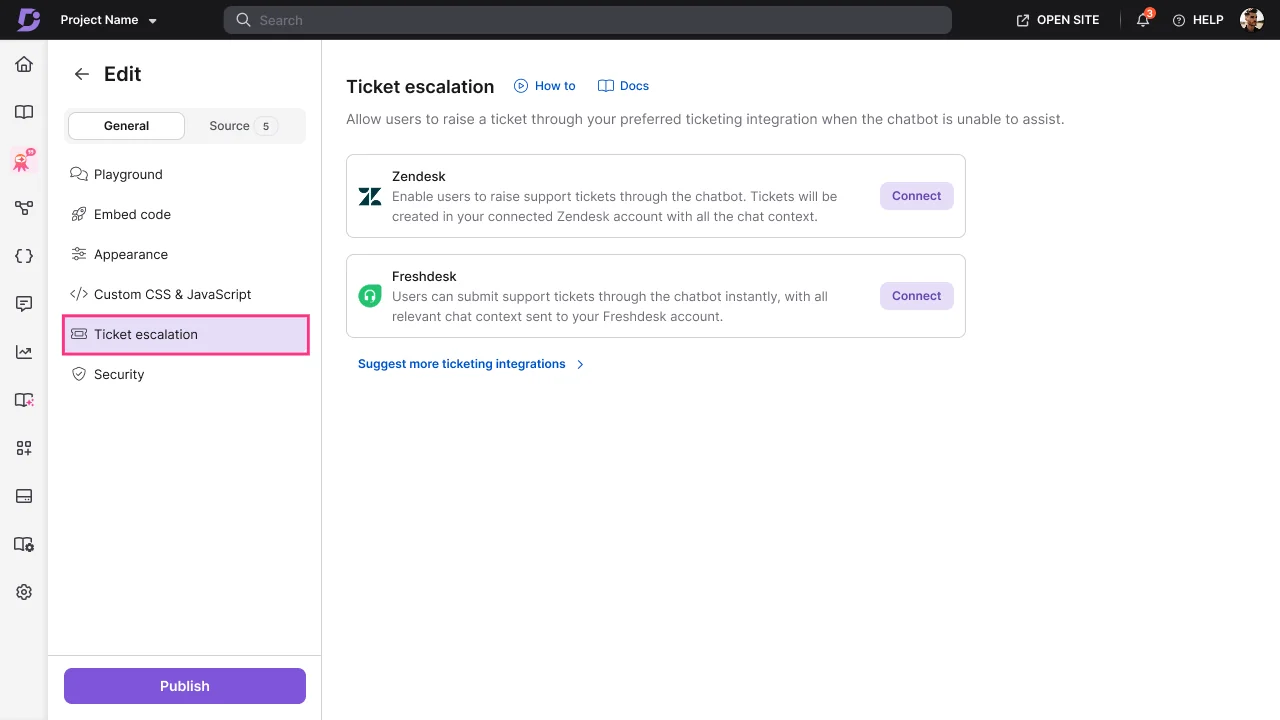
The whole AI layer, search, the deflector, the embedded help centre, sits at Business tier or above, so none of it exists on Professional. Only two helpdesk integrations exist, Zendesk and Freshdesk, and both run one direction: the chatbot opens a ticket when it can't help, description capped at 250 characters, but nothing reads a queue, replies, tags or closes anything. Once a ticket exists, Document360 is out of the loop.
Pricing
No plan names or prices published; a three-step quote configurator stands in their place. G2's vendor-supplied profile shows Professional at five team accounts and Business at ten, both annual and quote-only.
Verdict
Buy this to build documentation and treat the AI as a bonus on Business rather than the reason you signed. If ticket volume is the actual pain, this is the wrong shelf. See Document360 pricing and Document360 AI.
6. Stonly
Best for resolutions that must follow a fixed, auditable sequence, like troubleshooting or a regulated process.
What it is
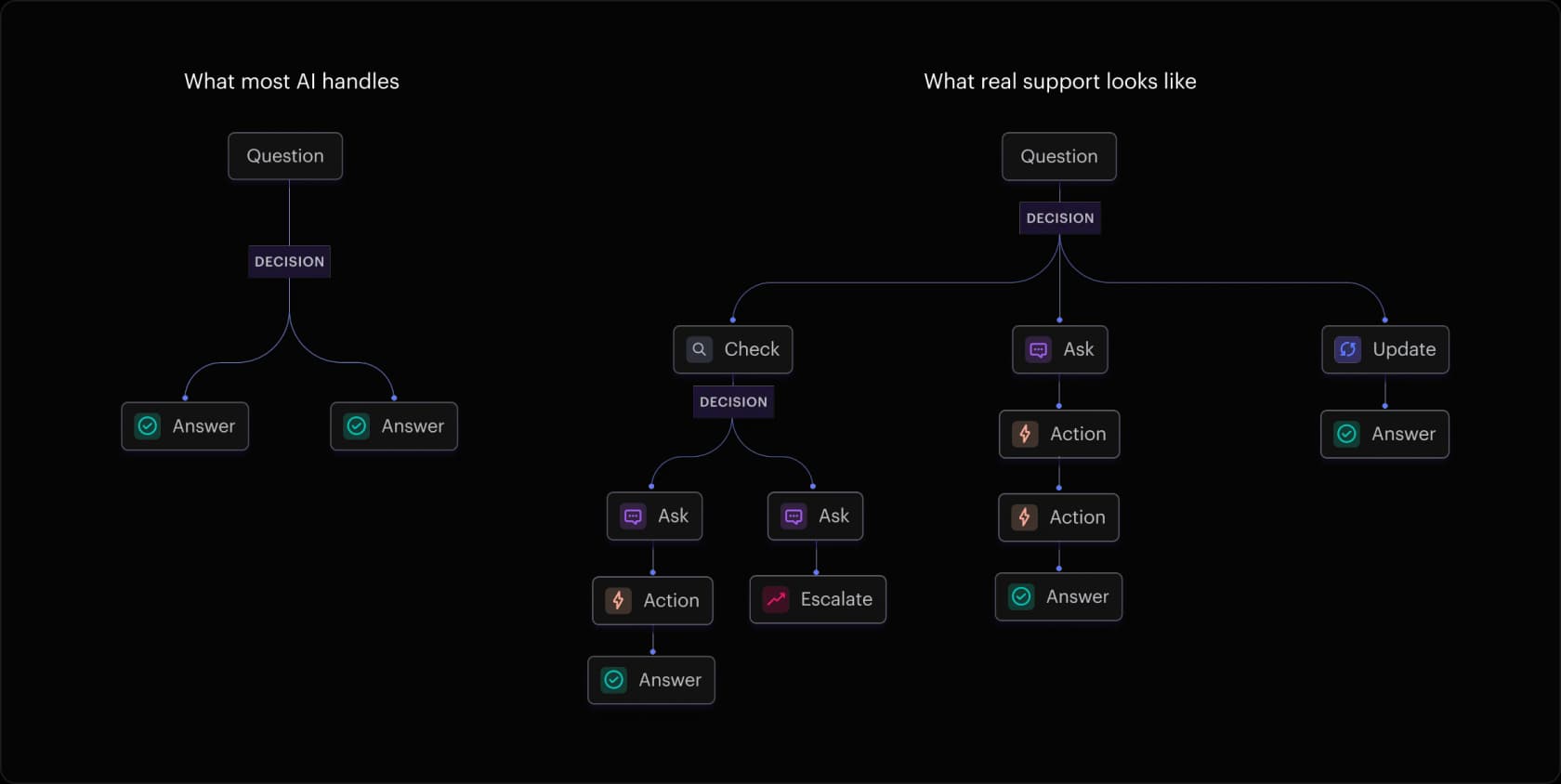
Stonly is the deliberate outlier here: instead of retrieving text and trusting a model to reason well, it walks a decision tree an author built. Business Process Agents extend that into full conversations across email, chat and WhatsApp, gathering information and driving to a resolution while staying on the rails the author defined. Integrations run deep into Zendesk, Salesforce, Freshworks and ServiceNow, where trees run inside the ticket itself, fill fields and fire macros.
Strengths
Determinism is the actual selling point, not a limitation, when the process is truly fixed. Anderson America reports 80% fewer tickets and a 71% self-serve success rate running Stonly guides.
Limits
Coverage never exceeds what someone authored, and nothing in Stonly's documentation treats past ticket history as an input to a resolution. AI agents and every helpdesk integration sit in the Enterprise column only, and Small Business is gated to companies under 100 employees regardless of what it needs. Evaluation is vendor-run: Stonly shows you what a Business Process Agent would do with a scenario you bring, rather than replaying your own history.
Pricing
Basic is free at 400 guide views a month, one seat and five published guides. Small Business and Enterprise carry no published price; exceeding the free cap two months running auto-upgrades the account to an unpriced plan.
Verdict
If your resolutions are procedural rather than open-ended, this determinism pays off. Price the authoring effort honestly, and know the AI layer you're evaluating lives on the Enterprise line you cannot self-serve into. My ticket deflection guide covers how to measure whether guides like these are actually working after launch.
7. Capacity
Best for replacing the support stack outright instead of layering something on top of it.
What it is
Capacity is the most substantial company here by the numbers: $92M raised in a single 2025 round, $155M+ total, profitable at $60M ARR, roughly 250 staff. It is a full helpdesk in its own right, with an IVR, shared inbox, live chat and agent-assist, and its agents create CRM records, open tickets and trigger workflows beyond simple retrieval, closer to the AI ticket automation category than a knowledge tool.
Strengths
Autopilot reads and can auto-send replies to incoming email before an agent ever sees it, inside Capacity's own channels.
Limits
Zendesk and Freshdesk are API-only, with no indexing and no interface tag, unlike Salesforce and Slack which get first-class treatment. Front, Gorgias, Zoho Desk and Help Scout are absent entirely. Billing is per response rather than per resolution, so a six-turn conversation that ends in a human escalation still bills six times.
Pricing
The meter structure is public and every rate on it is blank: platform fee, per-response chat, per-minute voice, per-message SMS, per-hour agent assist. Capterra reports $25,000 a year as the entry price for a plan called Basic, with no free trial.
Verdict
Worth evaluating if you're consolidating channels onto Capacity itself. Skip it if Zendesk or Freshdesk stays your system of record, because API-only is a real ceiling there. More in Capacity AI alternatives.
8. Korra
Best for air-gapped industrial or defence documentation, and not much else.
What it is
Korra now positions itself as a "Standalone Industrial AI Platform," air-gapped and on-premise on an Nvidia appliance, with a MiG-29 flight manual as its lead demo example. It still shows active on Crunchbase, 1 to 10 employees, based in Jerusalem.
Strengths
If a sealed network with zero cloud egress is a hard requirement, Korra is the only tool on this page built for it.
Limits
There is no ticket, queue, assignment, status or escalation concept anywhere in Korra's documentation. Its own connectors are three: SharePoint, Google Drive and Dropbox. A reviewer described it precisely: an AI tool trying to become a knowledge-management tool, rather than an existing KM tool that added AI, missing the common workflows that keep information fresh.
Pricing
No prices on Korra's own pricing page, just a Calendly link. Capterra lists Business Plus at $199 per user per month, seat-metered rather than usage-based, with Enterprise as a custom quote.
Verdict
Take it only if air-gapped is non-negotiable and the content is manuals. It was never a support-queue tool, and the workflow gap a reviewer flagged is exactly the layer Shelf is built for. For the wider field, my AI knowledge base tools roundup covers the governance side of this category too.
Five steps before you sign anything
- Name the outcome, not the feature. "Cut first response time" and "stop the same refund question landing twice a day" are different purchases. Use the picker above if you're not sure which.
- Ask for a replay against your own tickets, scored against what your team sent. Shelf, Guru, Bloomfire, Document360, Stonly, Capacity and Korra all document no such mode.
- Get the billing unit in writing. Per response, per guide view, per verified resolution and per ticket handled produce very different bills at identical volume, and a failed task still bills on some of these.
- Check the tier gate on the exact feature you're buying for. Stonly's agents and Document360's deflector both sit above the entry plan, and Zendesk's Copilot is $50 per agent on top.
- Scope the content cleanup last, against what a scored replay actually flagged, not against the whole library up front. My ticket deflection guide covers what to measure once something is live.
If the real problem is the queue, not the library
Shelf and its closest peers will leave you with a better-organized knowledge base, and if your content really is unmanageable with enterprise budget to match, that is a defensible reason to buy one. But it is a different purchase than shrinking a queue, and most people who land on "Shelf alternatives" actually came here for the second one.
If that's you, eesel plugs into Zendesk, Freshdesk, Gorgias, Front, Help Scout, HubSpot, Salesforce or Jira Service Management, learns from tickets your team already answered instead of waiting on a content project, and runs the one check none of the knowledge platforms above will run: a sandboxed replay of your own history, scored against your team's own past replies, so the coverage gaps show up by theme before a customer ever sees a miss. Most teams have a first agent live inside 30 minutes, it covers 80+ languages, and it starts at $299 a month for 500 credits (1 credit per ticket or chat) with no seats and an optional overage cap you set yourself. The free plan gives 100 credits with no card, which covers 100 real tickets or chats, which is the one number on this page you can go verify this afternoon.
Start with eesel's pricing for the arithmetic, or eesel's security page if procurement is the gate you're stuck behind.