Choosing the right knowledge management platform can feel like comparing apples to oranges. Both Guru and Bloomfire promise to help teams find information faster, but they approach the problem from different angles. One focuses on embedding knowledge into daily workflows. The other builds comprehensive enterprise intelligence hubs.
If you're evaluating these two platforms, you're probably wondering: which one actually fits your team's needs? Let's break down what each platform does best, where they differ, and how to choose between them.
What is Guru?
Guru positions itself as an "AI Source of Truth" for modern teams. The platform connects information from your existing tools (Slack, Salesforce, Google Workspace, and 100+ others) into one governed knowledge layer that delivers answers right where people work.
The core concept is simple: instead of making employees search for information, Guru brings verified answers to them. Through browser extensions, Slack integrations, and embedded AI agents, knowledge appears contextually when and where people need it.
Guru organizes information using a card-based system. These bite-sized knowledge units are easier to digest than lengthy documents and can be verified by subject matter experts on a schedule. When content becomes outdated, automated workflows prompt experts to review and update it.
The platform particularly resonates with mid-market teams (roughly 51-1,000 employees) who want quick implementation without enterprise complexity. Sales and support teams especially appreciate having instant access to product information, competitive intelligence, and process documentation without leaving their workflow.
What is Bloomfire?
Bloomfire takes a different approach, positioning itself as an "Enterprise Intelligence" platform. Rather than focusing on workflow embedding, Bloomfire creates a comprehensive knowledge hub designed for large-scale organizational deployment.
The platform's standout feature is its deep indexing capabilities. Bloomfire doesn't just store documents; it indexes content across formats including PDFs, videos, audio files, and presentations. This means you can search inside a video transcript or find specific information within a PDF attachment, something most knowledge bases can't do.
Bloomfire's AI, called Synapse, provides conversational answers drawn from your knowledge base with citations. The platform also includes a self-healing knowledge base that automatically flags outdated or redundant content before it pollutes search results.
The target market here is clearly enterprise: Global 2000 companies, organizations with 500+ employees, and teams with complex, diverse content libraries. Customers like Dominion Energy, MGM Resorts, and Regeneron use Bloomfire for organization-wide knowledge engagement.
Feature comparison: Guru vs Bloomfire
Search and AI capabilities
Both platforms offer AI-powered search, but with different emphases.
Guru focuses on contextual delivery. Its Knowledge Agents provide AI answers within existing workflows (Slack, browser, Teams). The platform uses "triggers" to surface relevant information when users view specific websites or applications. Research mode turns complex questions into guided research plans with citations.
Bloomfire emphasizes comprehensive discovery. Its Synapse conversational AI lets users ask questions in plain language and receive cited answers. The deep indexing means search works across all content formats, including video and audio. The platform also includes topic-based alerts and auto-populated feeds based on user interests.
Content organization
Guru uses a card-based system. Knowledge is broken into digestible units organized in collections and boards. The verification workflow ensures content stays current through automated reminders to subject matter experts. Duplicate detection uses AI to identify redundant content.
Bloomfire takes a more traditional knowledge base approach with enhanced capabilities. Content is organized in communities with role-based access. The self-healing knowledge base automatically flags outdated content. AI authoring tools auto-generate summaries, suggest tags, and extract insights when uploading content.
Integrations
Both platforms connect to major enterprise tools, but with different strengths.
Guru's integration strategy focuses on workflow embedding. The browser extension (Chrome, Edge, Opera) puts knowledge at users' fingertips regardless of which app they're using. The platform recently launched an MCP Server, allowing Knowledge Agents to connect to external AI systems like Claude and Cursor. Native integrations include Slack, Teams, Salesforce, Zendesk, Notion, Confluence, and 100+ others.
Bloomfire emphasizes enterprise system connectivity. Native integrations include Slack, Microsoft Teams, Salesforce, Microsoft Dynamics 365, SharePoint, Google Drive, Dropbox, Box, and Zendesk. The platform offers enterprise search connectors that unify search across multiple repositories.
Analytics and reporting
Guru provides content analytics showing how teams use knowledge, what they search for, and content performance trends. The platform identifies trending topics and knowledge gaps.
Bloomfire offers a comprehensive analytics suite measuring engagement, search behavior, content performance, and knowledge gaps. Reports tie usage to business impact with downloadable data for company reporting.
Pricing comparison
Here's where the two platforms diverge significantly. Neither offers transparent, self-serve pricing anymore; both have moved to custom quote models.
Guru pricing
Guru has shifted from per-seat pricing to a platform + expertise model. Your investment is tailored to organization scale, knowledge complexity, and AI maturity.
| Component | What's Included |
|---|---|
| The Platform | AI Knowledge Layer, automated quality maintenance, Knowledge Agents, AI search, 100+ integrations, verification workflows, deep research |
| The Expertise | Knowledge architecture design, AI agent configuration, integration setup, change management playbook, ongoing optimization reviews |
| The Infrastructure | SOC 2 Type II, HIPAA, GxP compliance, SSO/SCIM, DLP masking, encryption, zero data retention |
Source: https://www.getguru.com/pricing
Guru offers demos and working sessions (not traditional free trials) where their team walks through how the platform fits your specific stack and requirements.
Bloomfire pricing
Bloomfire also uses scope-based pricing rather than per-user fees. Plans are based on whether you're deploying team-wide, department-wide, or company-wide.
| Plan Type | Target |
|---|---|
| Team | Teams starting with knowledge management |
| Department | Departments building robust knowledge programs |
| Enterprise | Every employee at the company |
Source: https://bloomfire.com/pricing
All plans include unlimited data storage, AI-powered search, generative AI authoring, enterprise search integrations, customizable layouts, moderation workflows, advanced analytics, SAML SSO, and implementation support. Billing is on a multi-year basis.
Bloomfire offers a self-guided test drive for exploration.
Key pricing differences
- Guru bundles expertise and strategy services with the platform
- Bloomfire focuses on platform access with implementation support
- Both require speaking with sales for actual quotes
- Neither publishes starting prices publicly
User experience and adoption
User ratings are remarkably similar between the two platforms, suggesting both deliver solid experiences.
| Platform | G2 Rating | TrustRadius Score |
|---|---|---|
| Guru | 4.7/5 (2,381+ reviews) | 9.1/10 |
| Bloomfire | 4.6/5 (514+ reviews) | 8.5/10 |
Source: Platform homepages and review sites
Guru users consistently praise the workflow integration and ease of finding information without context switching. The verification process gets positive mentions for keeping content accurate. Some users note that the platform works best when teams commit to maintaining their knowledge base.
Bloomfire users highlight the search capabilities, particularly finding information within videos and documents. The platform's ability to handle diverse content formats appeals to teams with extensive media libraries. Enterprise customers appreciate the scalability and governance features.
Implementation timelines differ: Guru typically deploys faster for smaller teams, while Bloomfire's implementation includes more comprehensive planning and configuration phases.
AI capabilities deep dive
Both platforms have invested heavily in AI, but with different philosophies.
Guru AI features
Guru's AI strategy centers on "Knowledge Agents" that deliver contextual answers:
- AI-powered answers with citations Every response includes sources
- Contextual suggestions Information surfaces based on what users are working on
- Research mode Complex queries become guided research plans
- Trending topics AI identifies popular subjects from team conversations
- Content assist Generative AI helps create and refine knowledge cards
- MCP Server Connects Knowledge Agents to external AI tools
Source: https://www.getguru.com/features
Bloomfire AI features
Bloomfire's AI, called Synapse, focuses on comprehensive knowledge discovery:
- Conversational AI Plain language questions with cited answers
- Deep content indexing Search across videos, audio, PDFs, and documents
- Self-healing knowledge base Automatic flagging of outdated content
- AI authoring tools Auto-summarization, tagging, and insight extraction
- Hallucination detection Constraints keeping AI responses to verified content
- Topic-based alerts Automated feeds based on interests
Source: https://bloomfire.com/platform
Real-world AI performance
Both platforms emphasize citations and source verification, addressing the "hallucination" problem that plagues generic AI tools. Guru focuses on delivering answers within workflow tools, while Bloomfire emphasizes comprehensive search across all content types.
Which platform should you choose?
The right choice depends on your organization's size, content complexity, and how your teams work.
Choose Guru if:
- You want knowledge embedded in daily workflows rather than a separate destination
- You're a mid-market organization (roughly 50-1,000 employees)
- Your teams live in Slack, Salesforce, or browser-based tools
- You need quick implementation without extensive configuration
- Your focus is sales enablement, support, or operational knowledge
- You prefer bite-sized, verified knowledge cards over lengthy documents
- You want AI assistance within existing tools (via MCP and integrations)
Choose Bloomfire if:
- You need an enterprise-wide knowledge hub for 500+ employees
- You have diverse content including videos, audio, and complex documents
- Deep content indexing and multimedia search are priorities
- You want a self-healing knowledge base that flags outdated content
- Comprehensive analytics and governance are must-haves
- You're replacing or consolidating multiple knowledge repositories
- You have the resources for a more extensive implementation process
An alternative worth considering: eesel AI
While Guru and Bloomfire focus on knowledge management, some teams need something different: an AI teammate that doesn't just store knowledge but actively uses it to get work done.
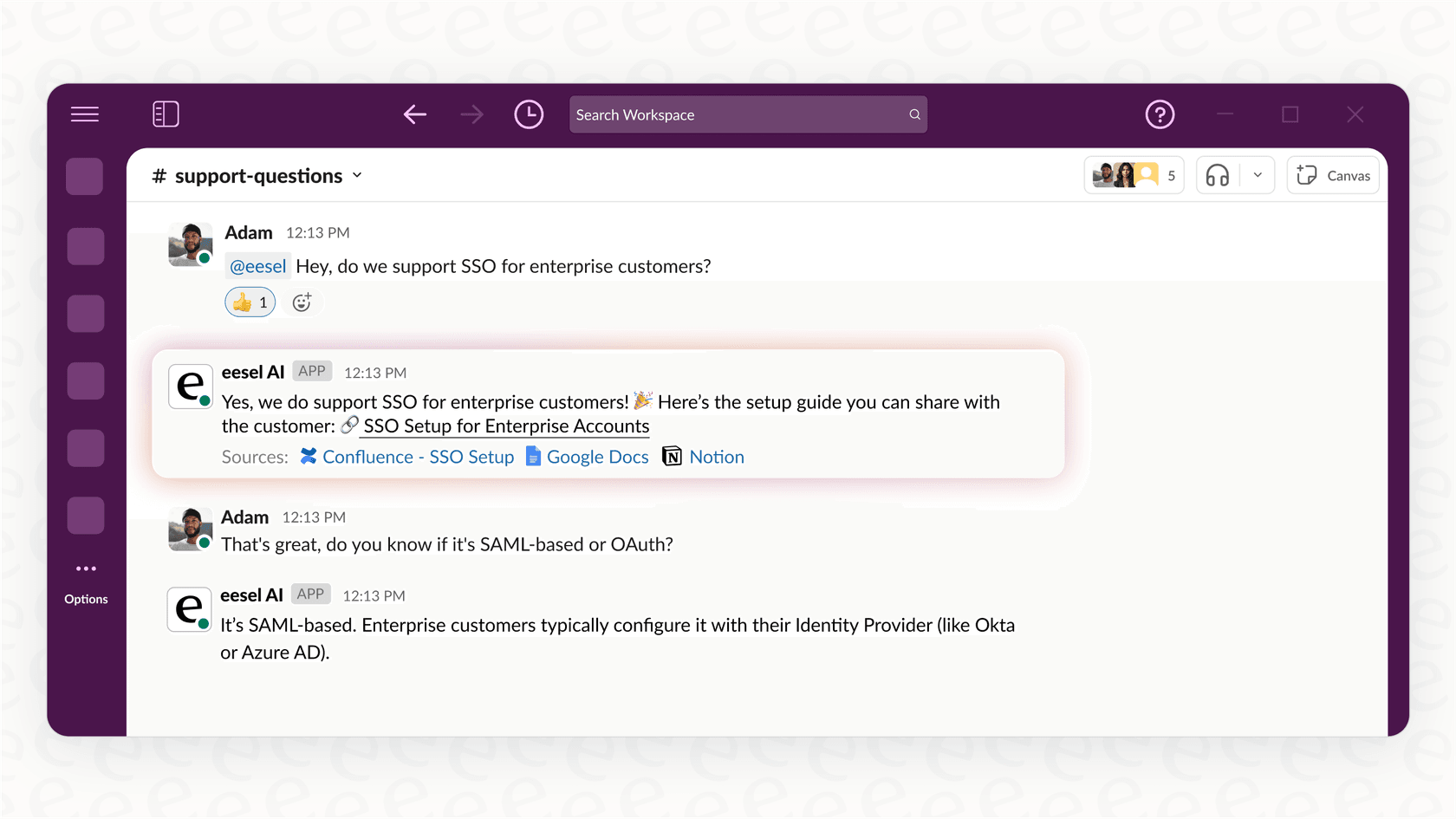
eesel AI takes a different approach. Instead of building a knowledge base you manually maintain, eesel learns from your existing tools (Confluence, Google Docs, Notion, past tickets, help centers) and becomes an AI teammate that can answer employee questions, draft responses, and take actions.
Here's how it compares for internal knowledge use cases:
| Capability | Traditional KM (Guru/Bloomfire) | eesel AI |
|---|---|---|
| Setup | Import and organize content | Connects to existing sources, learns automatically |
| Maintenance | Manual verification workflows | Continuous learning from corrections |
| Delivery | Search and browse | Conversational answers in Slack/Teams |
| Actions | Information retrieval | Can draft replies, create tickets, look up data |
| Pricing | Custom quotes based on scope | Transparent per-interaction pricing |
Source: https://www.eesel.ai/product/ai-internal-chat
If your primary need is helping employees find answers from company knowledge, eesel AI's approach of "hiring an AI teammate" rather than "implementing a knowledge base" might fit better. The platform integrates with the same tools (Slack, Teams, Confluence, Google Docs) but focuses on instant answers with citations rather than building a structured repository.
Making your knowledge management decision
Both Guru and Bloomfire are solid platforms that solve real problems. The choice comes down to your specific situation.
If you want knowledge that follows your team through their daily workflows, Guru's browser extension and contextual delivery make more sense. If you need a comprehensive enterprise knowledge hub with deep multimedia indexing, Bloomfire's approach fits better.
Before committing to either, take advantage of their evaluation options. Guru offers working sessions where their team demonstrates the platform with your use cases. Bloomfire provides a self-guided test drive to explore the interface.
And if you're realizing that what you really need is an AI teammate that learns your business and answers employee questions (rather than a traditional knowledge base), eesel AI offers a different path worth exploring.
The best knowledge management platform is the one your team will actually use. Focus on how your teams work today, where information friction exists, and which approach fits your culture. Whether that's workflow-embedded cards, a comprehensive enterprise hub, or an AI teammate that learns as it goes, the right choice is the one that gets your team the answers they need, when they need them.