Choosing the right knowledge management platform can feel like trying to organize a library while blindfolded. You know the information exists somewhere, but finding it when you need it is another story entirely. Two platforms that consistently come up in these conversations are Bloomfire and Guru. Both promise to solve your knowledge chaos, but they take fundamentally different approaches.
Let's break down what actually matters when comparing these two platforms. We'll look at real pricing, features users care about, and honest assessments of where each tool shines (and where it doesn't). And if neither feels quite right, we'll also introduce how eesel AI offers a different approach to knowledge management that might fit teams looking for something more AI-native.
What is Bloomfire?
Bloomfire positions itself as an enterprise intelligence platform designed to activate trusted knowledge across large organizations. Founded in 2010, the company has built its reputation on deep search capabilities and comprehensive content management for enterprises with complex knowledge needs.
The platform's core strength is its AI-powered semantic search that indexes content across 29 file types, including video and audio files. This means you can search inside a recorded meeting or training video and find the exact moment someone mentioned a specific topic. For organizations sitting on years of recorded content, this is genuinely useful.
Bloomfire targets larger enterprises, typically those with 1,000+ employees, particularly in regulated industries like financial services, healthcare, and energy. Their customer list includes names like Dominion Energy, MGM Resorts, and Raymond James. The platform offers unlimited storage and highly configurable homepages with drag-and-drop editors, giving knowledge managers significant control over how information is organized and presented.
Users on G2 give Bloomfire a 4.6/5 rating across 514 reviews, while TrustRadius scores it 8.5/10. The platform earns praise for its search depth and enterprise-grade security, though some users note the learning curve's steep for smaller teams.
What is Guru?
Guru calls itself an "AI Source of Truth" and takes a different approach to knowledge management. Founded in 2013, Guru focuses on delivering knowledge directly in the workflow rather than requiring users to visit a separate platform. The browser extension is central to this strategy, surfacing relevant information as users work in other tools.
The platform organizes knowledge into cards, bite-sized pieces of information that are easier to digest than lengthy documents. Guru's verification workflows assign subject matter experts to review and validate content, creating a trust score system that helps users know whether information is current and accurate.
Guru primarily serves mid-market companies, typically 51-1,000 employees, with strong penetration in sales and customer support teams. The platform integrates deeply with Slack, Salesforce, and other workflow tools where these teams spend their time.
User ratings are consistently strong: 4.7/5 on G2 across 2,378 reviews, 9.6/10 on TrustRadius, and 4.8/5 on Capterra. Guru also claims faster implementation times, with 65% of customers going live in under a month compared to Bloomfire's 47%.
Feature comparison: Bloomfire vs Guru
| Feature | Bloomfire | Guru |
|---|---|---|
| Search capability | AI semantic search, deep video/audio indexing | AI suggestions, semantic search |
| Content format | Long-form documents, multimedia | Cards, bite-sized knowledge |
| Customization | Highly configurable homepage, drag-and-drop | Limited UI customization |
| Integrations | 18+ enterprise integrations | 100+ including Slack, Salesforce |
| Q&A | Public crowdsourced questions | Private expert-assigned questions |
| Analytics | Comprehensive reporting suite | Engagement tracking |
| Mobile apps | iOS, Android | iOS, Android |
| AI capabilities | Synapse Conversational AI, self-healing KB | Knowledge Agents, MCP support |
Bloomfire excels at enterprise-scale content management. Its ability to search inside video and audio files sets it apart for organizations with extensive recorded content libraries. The platform's self-healing knowledge base uses AI to flag outdated content before it pollutes search results, prompting authors to update or archive stale information.
Guru excels at in-workflow knowledge delivery. The browser extension brings answers to users rather than forcing them to search a separate platform. This approach works particularly well for sales and support teams who need quick answers while on calls or responding to tickets.
The fundamental difference: Bloomfire is designed as a destination, a comprehensive knowledge hub users visit intentionally. Guru is designed as a companion, appearing when needed within existing workflows. Neither approach is inherently better. It depends entirely on how your teams work and what type of knowledge they need to access.
Pricing comparison
Understanding what these platforms actually cost requires some digging, as their pricing models differ significantly.
Bloomfire pricing
Bloomfire uses custom quote-based pricing and does not publish standard rates. Based on research, their basic plan starts around $25 per user per month, but enterprise deployments typically require contacting sales for custom quotes.
Key characteristics of Bloomfire's pricing:
- Enterprise-focused with custom quotes for most deployments
- No free trial available, though they offer demos and test drives
- Unlimited storage included
- Implementation services with dedicated "Ignition Engineer" for enterprise plans
The opaque pricing model makes it tough to estimate costs without engaging their sales team, which can frustrate teams trying to budget or compare options quickly.
Guru pricing
Guru offers more transparent pricing with clear tiers:
| Plan | Price | Details |
|---|---|---|
| Standard | $25/seat/month (annual) / $30 (monthly) | Predictable pricing for teams getting started. AI credits included. Usage limits apply. |
| Enterprise | Custom | True usage-based pricing built for scale and governance. AI credits included. Usage limits apply. |
All plans include custom AI Knowledge Agents, knowledge quality automation, enterprise AI search, AI chat and research, verified knowledge base, advanced governance controls, MCP server access, and 100+ integrations.
Value analysis: Guru's transparent pricing makes it easier for smaller teams to get started without sales conversations. The $25 per seat starting point is accessible for mid-market teams, though costs scale as you add users. Bloomfire's custom pricing likely makes more sense for large enterprises where the unlimited storage and deep enterprise features justify the sales process.
When calculating total cost, factor in implementation time, training, and ongoing administration. Both platforms need dedicated resources to maintain content quality and organization.
User reviews and ratings
Aggregate ratings tell part of the story, but understanding what actual users praise and criticize gives better insight.
What users love about Bloomfire
It's super easy to use...everything populates so quickly
- Deep search across all content types including video and audio
- Enterprise-grade security and compliance (SOC 2 Type II, GDPR)
- Strong onboarding and implementation support
- Highly configurable knowledge hubs
- Unlimited storage without worrying about usage limits
What users love about Guru
Guru is a top-notch knowledge management platform...seamless integration, efficient search functionality, robust security measures, and exceptional support make it a must-have

- Browser extension delivers knowledge directly in workflow
- Verification workflows keep content accurate
- Fast implementation and time to value
- Strong Slack and Salesforce integrations
- Permission-aware governance for AI answers
Common complaints
Bloomfire users mention:
- Opaque pricing requiring sales conversations
- Can be overwhelming for smaller teams
- Steeper learning curve for full feature utilization
- Advanced editing may require HTML knowledge
Guru users mention:
- Search requires precise keywords, less forgiving with broad terms
- Limited customization options for UI and branding
- Card-based structure can become messy at very large scale
- AI credit usage limits on lower tiers
Which platform should you choose?
The right choice depends on your organization's specific context. Here's how to think about it:
Choose Bloomfire if:
- You have 1,000+ employees
- You manage large volumes of video and audio content
- You need enterprise-grade security and compliance certifications
- You want highly customizable knowledge hubs
- You have dedicated knowledge management resources
- You prefer unlimited storage without usage limits
Choose Guru if:
- You're a mid-market company or fast-growing startup
- Your teams live in Slack and browser-based workflows
- You need quick implementation and adoption
- You want verification workflows for content accuracy
- You prefer transparent, per-seat pricing
- You need extensive HRIS integrations for user management
Consider the workflow question carefully. If your teams primarily work in Slack, Salesforce, and web browsers, Guru's in-workflow approach will likely feel more natural. If your teams are used to visiting dedicated knowledge portals and you have extensive video libraries, Bloomfire's destination approach may work better.
A modern alternative: eesel AI
While both Bloomfire and Guru offer solid knowledge management solutions, some teams are looking for a more AI-native approach. eesel AI takes a different path.
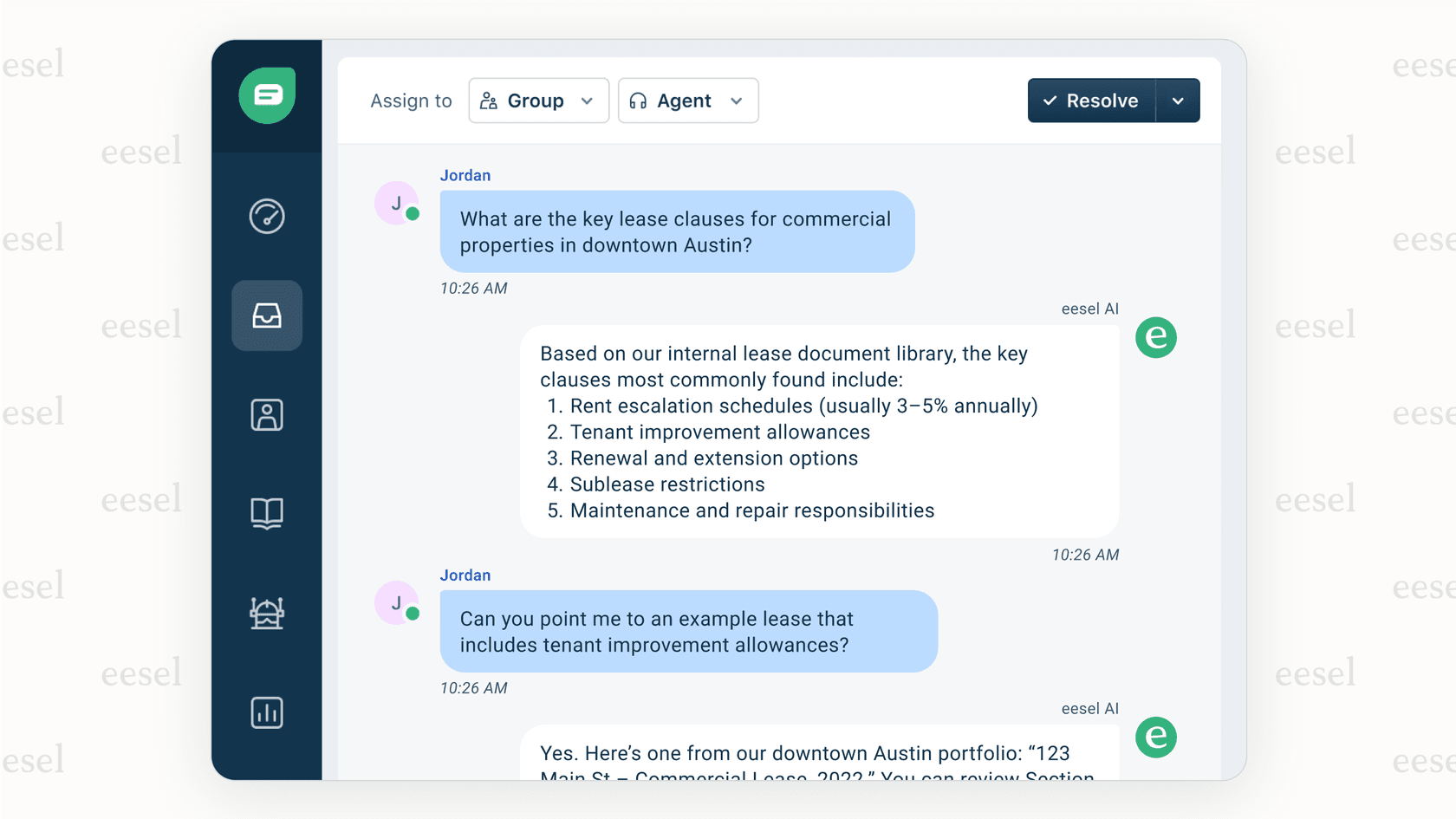
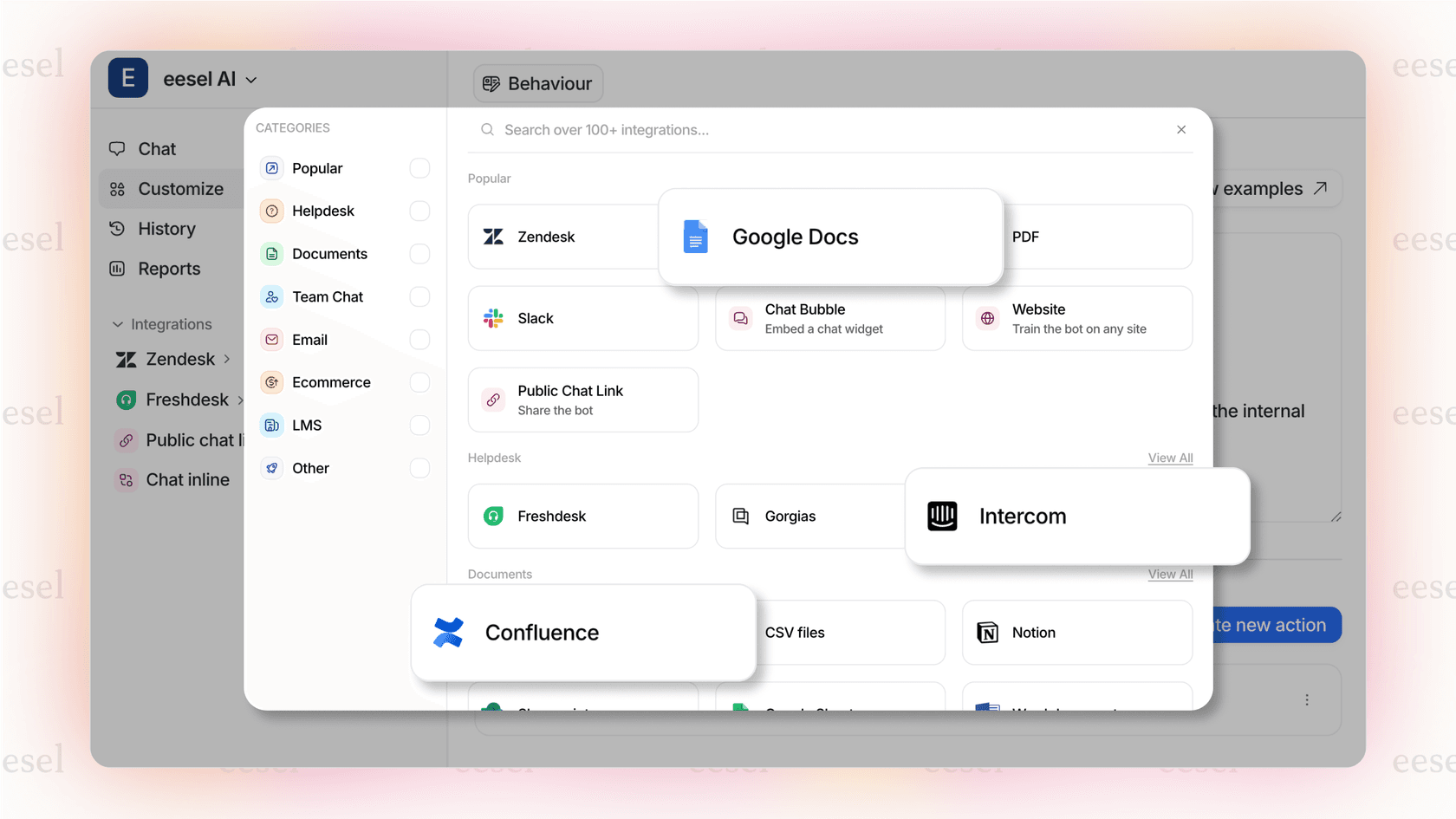
Rather than treating knowledge management as a separate platform to visit, we designed eesel AI as an AI teammate that learns your business and delivers answers where your teams already work. Instead of migrating content to yet another system, eesel connects to your existing tools, help desks, documents, and Slack to provide instant answers with citations.
Key differences from traditional knowledge management:
- No content migration required: Connect to Zendesk, Confluence, Google Docs, Notion, and 100+ other sources without moving anything
- Progressive rollout: Start with AI drafting replies for review, then level up to autonomous responses as it proves itself
- Plain-English control: Define what the AI handles and when it escalates using natural language, not complex configuration
- Pre-go-live testing: Run simulations on past tickets to verify quality before going live
For teams comparing Bloomfire vs Guru who find themselves wanting something more integrated with their existing support stack, eesel AI's approach might be worth evaluating.
Making your decision
Both Bloomfire and Guru are established, well-regarded platforms that serve their target markets well. The choice between them comes down to a few key factors:
- Team size and growth trajectory: Bloomfire scales better for very large enterprises, while Guru fits mid-market teams more naturally
- Content types: If video and audio search is critical, Bloomfire has a clear advantage
- Workflow integration: If your teams live in Slack and browsers, Guru's approach wins
- Budget transparency: Guru's published pricing makes budgeting easier; Bloomfire requires sales conversations
- Implementation timeline: Guru typically deploys faster; Bloomfire offers deeper customization
The best approach is to try before committing. Guru offers free trials that let you test the platform with your actual content. Bloomfire offers demos and test drives. Take advantage of both to see which interface and workflow feels more natural for your team.
And if neither quite fits how your team works, consider whether an AI-native approach like eesel AI might better serve your knowledge management needs by meeting your teams where they already work.