Pangram 4 alternatives: 5 AI detectors compared

Alicia Kirana Utomo

Katelin Teen
Last edited August 4, 2026

Why anyone is shopping for a Pangram 4 alternative in the first place
Two things happened on July 29, 2026, and only one of them made the launch post.
The first was the model. Pangram 4 reports an AUROC of 0.9916 with a false positive rate of 0.0041% and a false negative rate of 0.3396%, per its technical report. Those are strong numbers and they are, importantly, scoped: they are English, long-form, complete-sentence numbers. Pangram's own model card puts multilingual false negatives at 1.24%, rising to 5.3169% for Urdu, and rules out anything under 50 words, source code, tables of contents, reference sections, templated writing and technical manuals.
The second was the bill. The API unit shrank from 1,000 words to 100 words while the price stayed at $0.05, which means Pangram 4 costs exactly ten times Pangram 3 per word. Pangram is straightforward about the effect, describing it as "a price change of 1-2x for short documents and up to 10x for long-form documents". The monthly word ceilings on both paid tiers were also halved, from 600,000 to 300,000 on Individual and from 3,000,000 to 1,500,000 on Professional.
There is a third reason, and it is louder than either. Substack rolled Pangram out platform-wide in July 2026, which put a research tool in front of tens of thousands of working writers at once, and the reaction was not kind.
"Pangram says my private diary entries from an old LiveJournal from 2001 are AI so make of that what you will."

The version of that complaint worth taking seriously is not the anecdote but the arithmetic. Princeton's Arvind Narayanan takes Pangram's claim at face value and shows it still breaks at scale:
"Suppose every instructor started using an AI detector on all student work. I'd estimate that students submit 500 – 1,000 written works in the course of a 4 year education […] If each of these were run through an AI detector with a FPR of 1 / 10,000, you'd have 5–10% of your student body falsely accused of cheating at least once."

None of that makes Pangram a bad product. I said in my Pangram 4 review that it is the best detector I have used, and the independent record backs it: a University of Chicago working paper across 1,992 verified-human passages found Pangram "achieves essentially zero false positive rates and false negative rates on medium-length to long passages", and a peer-reviewed VUB study put it at 97.5% on fully-AI academic papers where Turnitin and Copyleaks both scored 0%. It does mean the price and the blast radius are now worth a second look.
The summary table
Every figure below is from the vendor's own pages. Accuracy and false-positive numbers are self-reported unless the row says otherwise.
| Tool | Cheapest paid plan | Billable unit | Word allowance at entry price | Free tier | Self-reported accuracy | Self-reported FPR | API | Image detection | Humanizer figure | LMS |
|---|---|---|---|---|---|---|---|---|---|---|
| Pangram 4 | $20/mo ($15 annual) | 100 words | 300,000/mo | 2,000 words/day | 0.3396% FNR (English) | 0.0041% | Prepaid credits, $0.05/100 words | 100 scans/mo on Individual | 98.83% across 13 tools | Institutional licence |
| GPTZero | $12.99/mo annual | Words | 300,000/mo | 10,000 words/mo | 99% | Not published (1% for ESL) | Contact sales | No | Listed, no figure | Canvas |
| Originality.ai | $14.95/mo ($12.95 annual) | 100-word credit | 200,000/mo | 3 scans/day, no account | 99%+ (Turbo 3.0.2) | 0.5% (Lite), 1.5% (Turbo) | Enterprise only | No | 97% (Turbo) | No |
| Copyleaks | $16.99/mo ($13.99 annual) | 250 words or 1 image | 25,000/mo | 25,000 chars/scan | Over 99% | 0.03% | Contact sales | Yes, both tiers | Claimed, no figure | Yes, enterprise |
| Turnitin | Not published | Not published | Not published | None | Not published | Under 1% above 20% AI | None standalone | No | Reported separately | Native |
| Winston AI | $18/mo ($10 annual) | 1 credit per word | 100,000/mo | 2,000 credits, 14 days | 99.98% | Not published | Self-serve dashboard | Yes, all plans | Claimed, no figure | No |
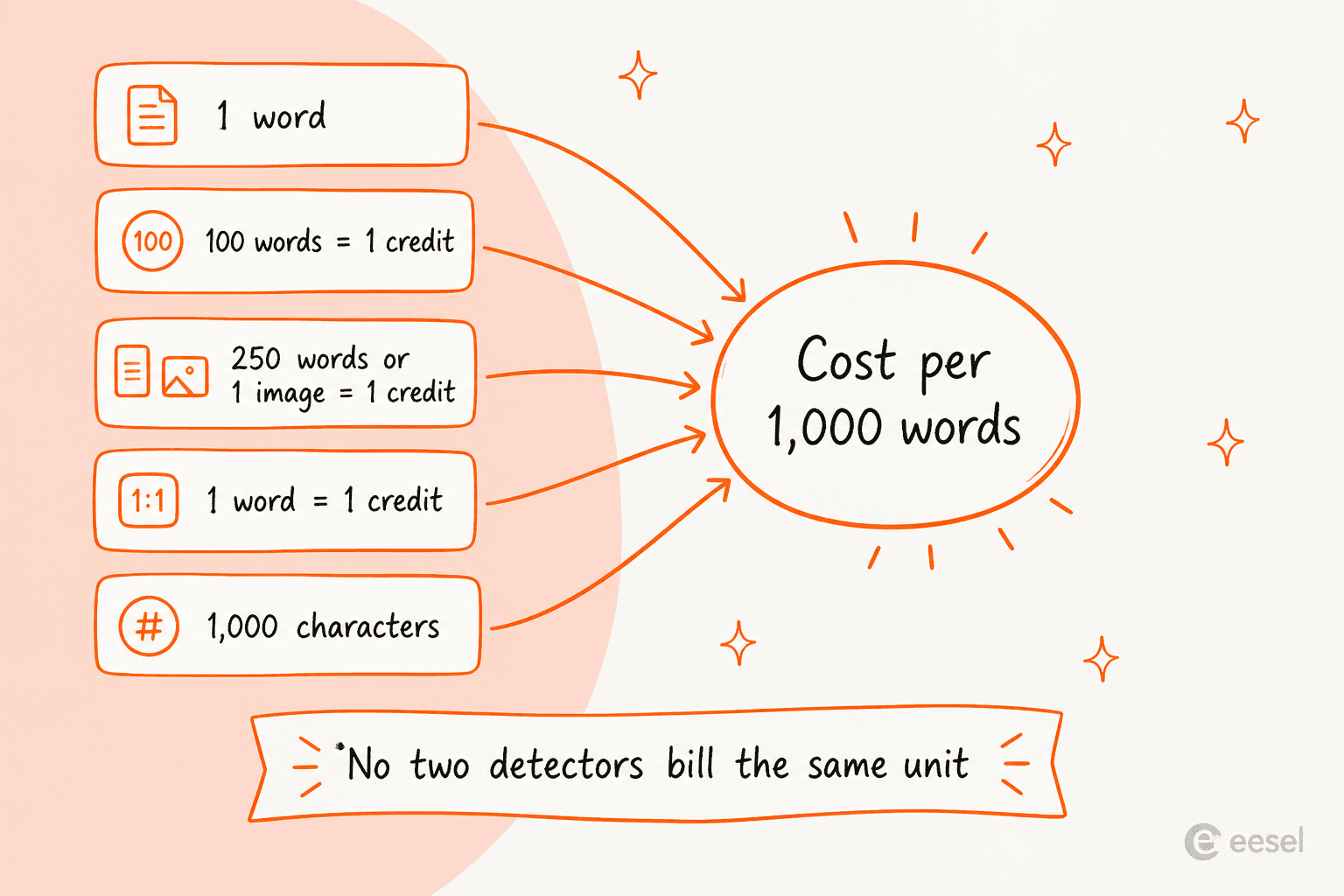
The one structural read: four of the six bill by volume and no two use the same unit, so headline prices are not comparable to each other at all. Which is what the calculator is for.
Cost calculator: what your monthly volume actually costs
Put your real monthly word volume in. The widget picks the cheapest plan at each vendor that covers it, and shows the monthly bill plus the effective rate per 1,000 words.
Two things fall out of that almost immediately. At small volumes GPTZero and Pangram both cover you for nothing, which makes the whole comparison academic. At publishing volumes Copyleaks becomes the most expensive option on the board by a wide margin, because its 250-word credit and 100-credit Personal allowance work out to just 25,000 words a month. And the Pangram 4 API sits at $0.50 per 1,000 words, 7.5x the per-word cost of Pangram's own $20 subscription, which tells you the API is priced for embedding detection in a product rather than for bulk scanning.
1. GPTZero
Features
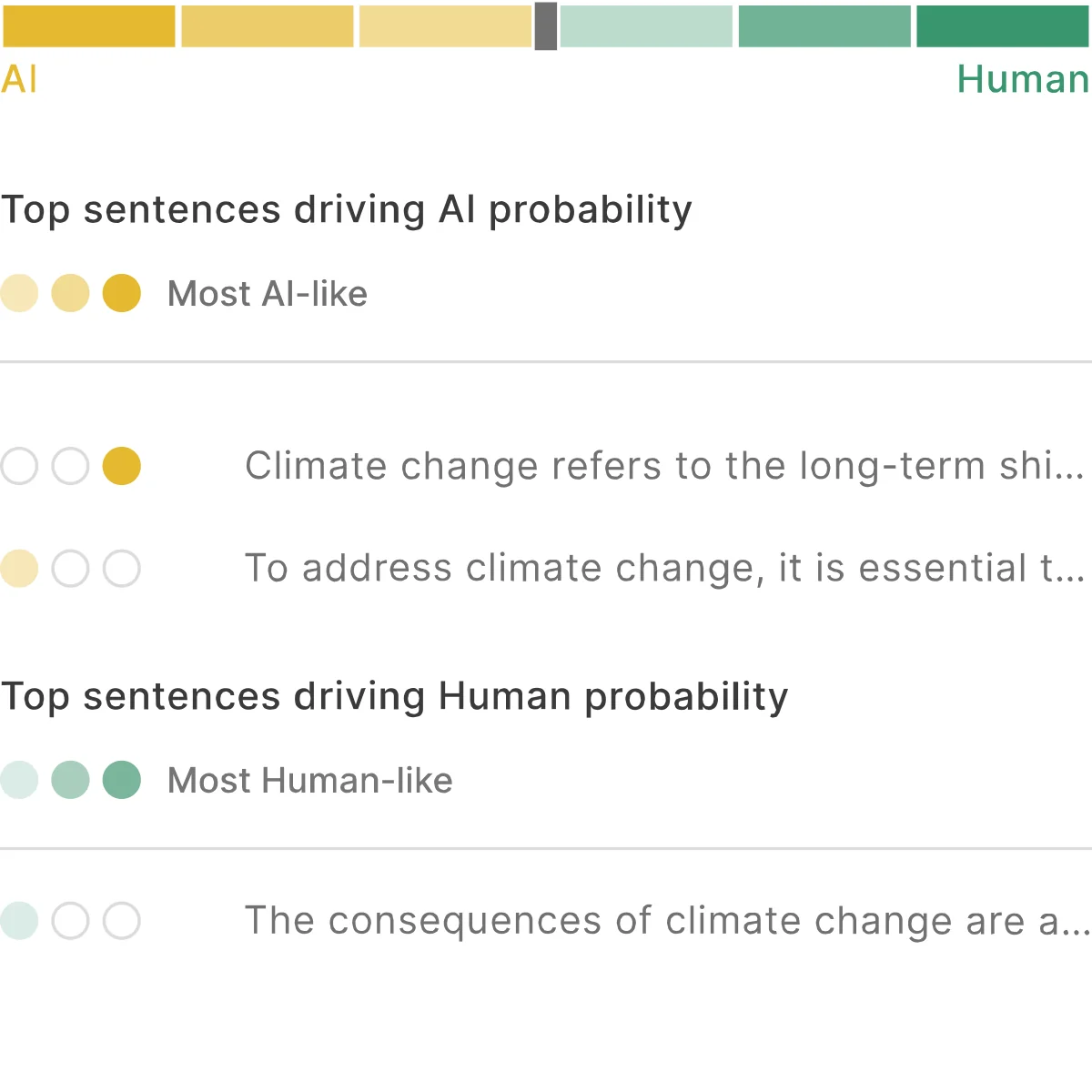
GPTZero is the most consumer-shaped product in this group. It scans by document and by sentence, ships a browser extension, and has the widest integration surface of the five: Google Docs, Google Classroom, Canvas, Zapier and an API, plus a Writing Replay feature that reconstructs how a document was typed rather than only how it reads. Batch upload runs 3, 50 and 250 files by tier. Paraphraser and AI bypasser detection is a line item on every plan including Free.
Pros
The free plan is the most generous standing allowance in the category at 10,000 words a month, no trial clock attached. It is also the most honest vendor on the page about its own limits, publishing both its 99% headline and the third-party RAID benchmark result of 95.7% AI-text detection at 1% human misclassification, side by side, along with a plain note that no detector is 100% accurate and results "should not be used to punish or as the final verdict". It claims to be the only detector de-biased for ESL writing, with a stated 1% false-positive rate for that group.
Cons
There is no global false-positive rate anywhere on the site, which makes the 99% hard to place. The 99% is also the figure filtered to modern LLMs, not the unfiltered one. The pricing page carries a Monthly/Annual toggle advertising "Save 45%" but rendered the same annual figures in both states when I checked, so the monthly-billed prices are effectively unpublished. gptzero.me/api 404s, and API pricing routes to contact sales. No image detection on any tier.
Pricing
Free at 10,000 words a month. Premium at $12.99/month billed annually for 300,000 words. Professional at $24.99/month annual for 500,000 words plus up to 2 million words of overage. Per-scan character ceilings are 10,000, 50,000 and 150,000 respectively. Teams buy Professional seats; the page's own worked example is $49.98/month for two.
Verdict
The best free option and the best fit for individual writers who want a detector living inside the tools they already use. If you need a defensible number to hand to someone else, the missing global false-positive rate is a real gap. Pairs naturally with an AI writing detection tool workflow rather than replacing one.
2. Originality.ai
Features
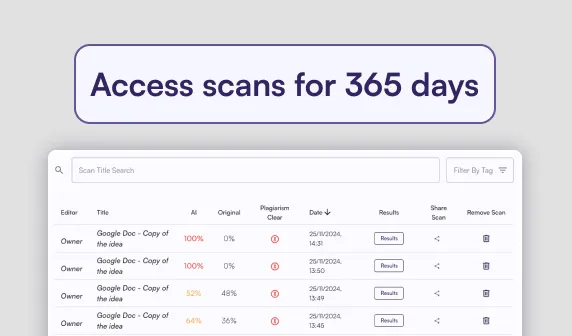
Originality.ai is built for content teams rather than classrooms, and it shows in the product shape: a scan history you keep for 365 days, tags, team seats, an AI Allowance slider from 0 to 40% so you can set your own tolerance, plus plagiarism, readability, grammar and fact checking in the same suite. It runs multiple named detector models you choose between, currently Lite 1.0.2, Turbo 3.0.2, Academic 0.0.5 and a graded AI Allowance model.
Pros
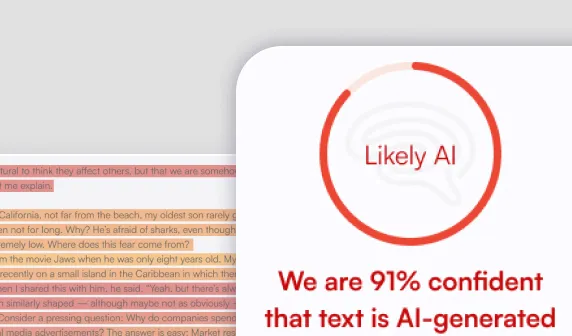
This is the most granular public disclosure of any vendor here, and the numbers move in a believable direction: Lite 1.0.2 at 0.5% false positives against Turbo 3.0.2 at 1.5% on its own accuracy page, so the higher-recall model carries the worse false-positive rate rather than magically beating it on both. It is also the only vendor to quantify humanizer resistance, at up to 97% for Turbo and up to 92% for Academic, and it says outright that it trains on adversarial datasets. Its own homepage supplies the line I would hold every vendor on this page to:
"Any AI detector accuracy claim that is not transparently supported by methodology, benchmark data, and independent or reproducible analysis should be viewed skeptically"
Cons
There is no free plan at all, only 3 scans a day in the homepage widget. Subscription credits expire at the end of each month if unused, per the pricing page, and extra seats are billed separately at $9.95/month on Pro monthly. API access is Enterprise-only, so the real API entry price is $136.58/month annual-billed, not $12.95. No image detection.
Pricing
Pro at $14.95/month billed monthly, or $12.95 billed annually, for 2,000 credits, which is 200,000 words. Enterprise at $179/month monthly or $136.58 annual for 15,000 credits. Pay As You Go credits exist and expire two years after purchase, but the page does not state their price.
Verdict
The right pick if you need to show your working to a client or a legal team, because it is the only one publishing per-model accuracy and false-positive rates together. The Enterprise-gated API is the thing to check before you commit, and if you are wiring detection into a pipeline, read AI content pipeline tool first.
3. Copyleaks
Features
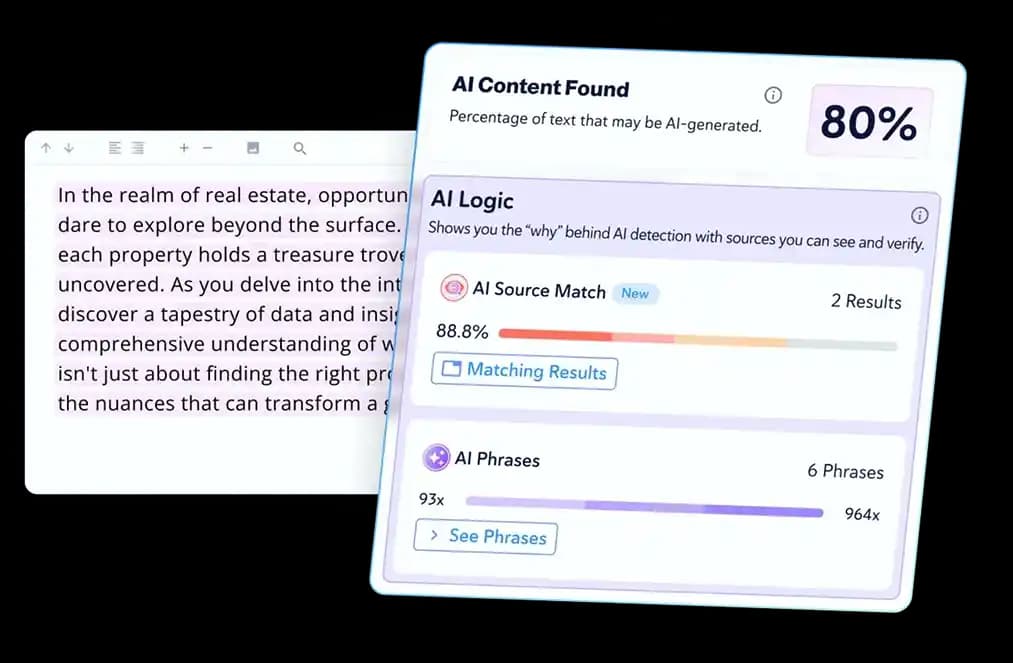
Copyleaks is the only vendor here whose credit pool spans text and images, and the one leaning hardest into explainability. Its AI Logic panel shows source matches and flagged phrase frequencies rather than just a score, which is the closest anything in this group gets to answering the "why" question that makes detector verdicts so hard to act on. It markets multi-modal detection across video, audio, image and text at the enterprise level, and it detects obfuscation techniques including paraphrasing and character manipulation.
Pros
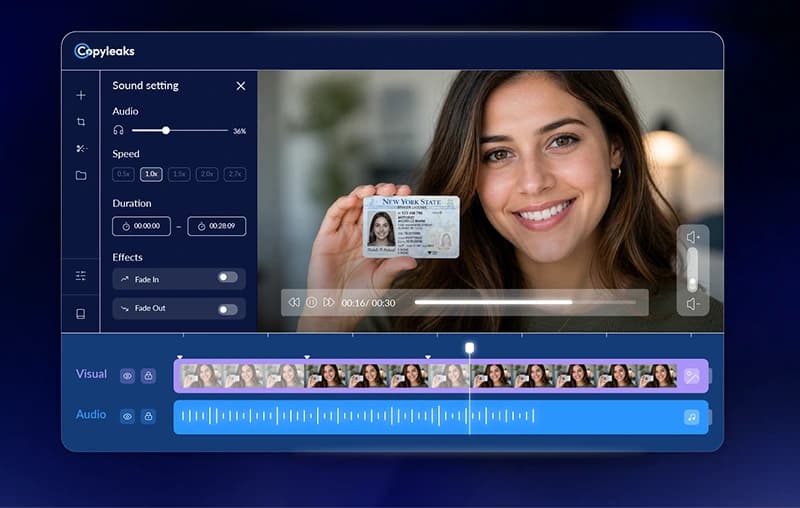
The lowest claimed false-positive rate in the category by roughly an order of magnitude, at 0.03%. The highest logged-out scan limit at 25,000 characters, which Copyleaks markets as a category record and which is the most useful free check on this list for a single long document. Per-language accuracy is published separately rather than hidden behind the English headline. AI image detection ships on both self-serve tiers at 1 credit per image. And it takes an explicit editorial position against the bypass use case: "We're not here to help you bypass AI detection—we're here to help you understand it".
Cons
The entry allowance is the smallest here by a long way. 100 credits at 250 words each is 25,000 words a month, so the $13.99 annual price buys about a tenth of what GPTZero's $12.99 does. Moving up is a 5.4x price jump from Personal to Pro for a 10x credit increase, plans do not stack, and switching plans forfeits remaining credits. The 99% headline carries an asterisk reading "based on internal testing of the English language datasets", and per-language AI-side accuracy runs as low as 93.08%. API access and LMS integration are both quote-gated to Enterprise or Education.
Pricing
Personal at $16.99/month monthly or $13.99 annual for 100 unified credits. Pro at $99.99/month monthly or $74.99 annual for 1,000 credits. One credit covers up to 250 words or one image. Enterprise and Education are quote-gated.
Verdict
Buy this for the explainability and the image detection, not for the price per word. If your job is fielding "why was I flagged?" conversations, the AI Logic panel is worth more than a tighter score, and it is the closest thing here to the transparency I argue for in how AI content detectors work.
4. Turnitin
Features
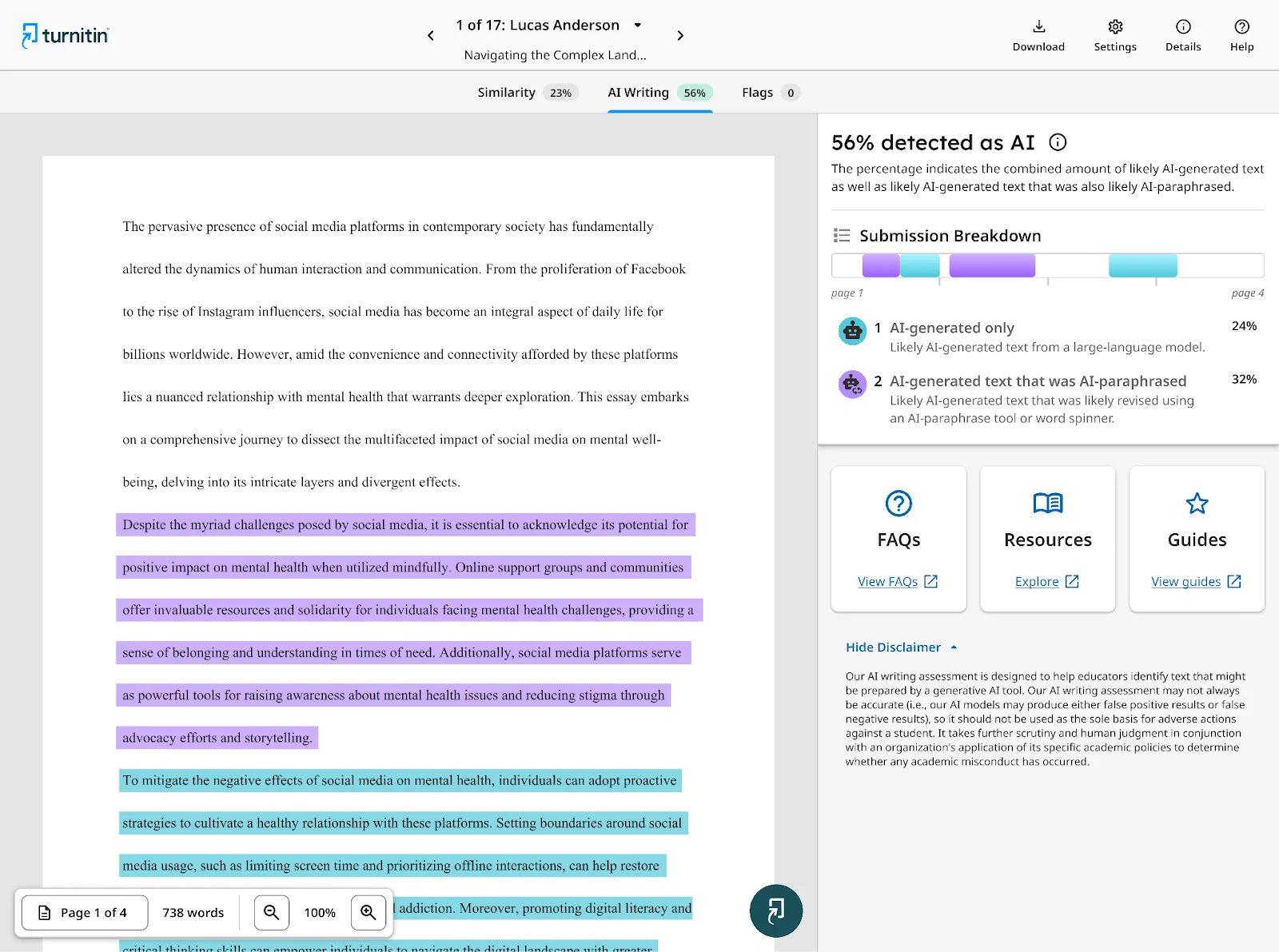
Turnitin is the only tool here that is not a standalone detector. AI writing detection is bundled into the products institutions already license, surfaced inside the existing similarity-checking workflow, and reported as two separate signals: text that is likely AI-generated, and text that is likely AI-generated and then AI-paraphrased. The report in the screenshot above splits a 56% verdict into 24% AI-generated only and 32% AI-paraphrased, which is a more useful shape than a single number. Model provenance is disclosed unusually openly: an open-source foundation model from Hugging Face, retrained on 25+ years of student writing.
Pros
The most rigorously described false-positive claim of any vendor on this page, and the only one validated against a named corpus: under 1% for documents with over 20% AI writing, checked against 700,000 pre-ChatGPT academic papers before every model update, per the detection capabilities FAQ. On ESL bias it publishes the sharpest numbers in the category, reporting a 0.014 false-positive rate for English Language Learners against 0.013 for native writers across nearly 2,000 samples. It also argues, rather than asserts, why its paraphrase layer cannot inflate that rate: the paraphrase model only runs on content the AI detector already flagged.
Cons
No price, no plan names, no allowance, no self-serve path, no free scan, and no way to try it unless your institution already has a licence. It publishes no headline accuracy percentage at all, deferring instead to an outside study. There are hard input requirements the others do not have: at least 300 words of prose in a long-form format. No standalone API, no image detection, and its own report carries a disclaimer that the assessment "should not be used as the sole basis for adverse actions against a student".
Pricing
Not published. Quote-gated institutional licence, bundled with Turnitin's existing products. Any Turnitin price figure you see quoted anywhere did not come from Turnitin.
Verdict
If you are an educator, this is not really a choice you make, it is the tool your institution bought. The good news is that it is the most methodologically careful vendor in the group. The bad news, and this is the VUB result worth knowing before you rely on it, is that the same peer-reviewed study putting Pangram at 97.5% on fully-AI papers scored Turnitin at 0%.
5. Winston AI
Features
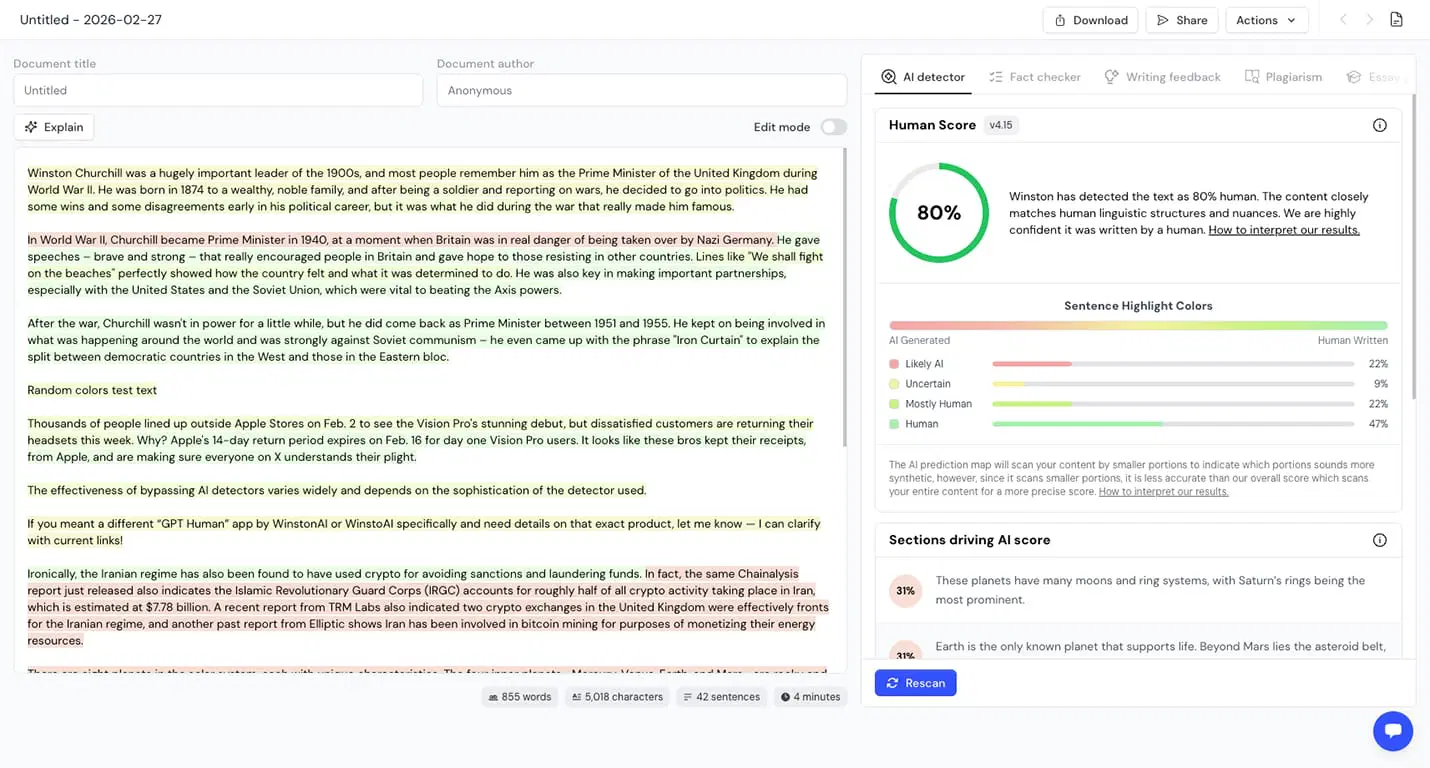
Winston AI has the broadest endpoint list of anyone here: AI text detection, plagiarism, fact checking, AI image and deepfake detection, OCR on pictures and handwriting, image forensics reading C2PA, Exif and IPTC, plus a website-level HUMN-1 certification. Its detector panel breaks a score into Likely AI, Uncertain, Mostly Human and Human bands rather than one number, and it flags the specific sections driving the AI score.
Pros
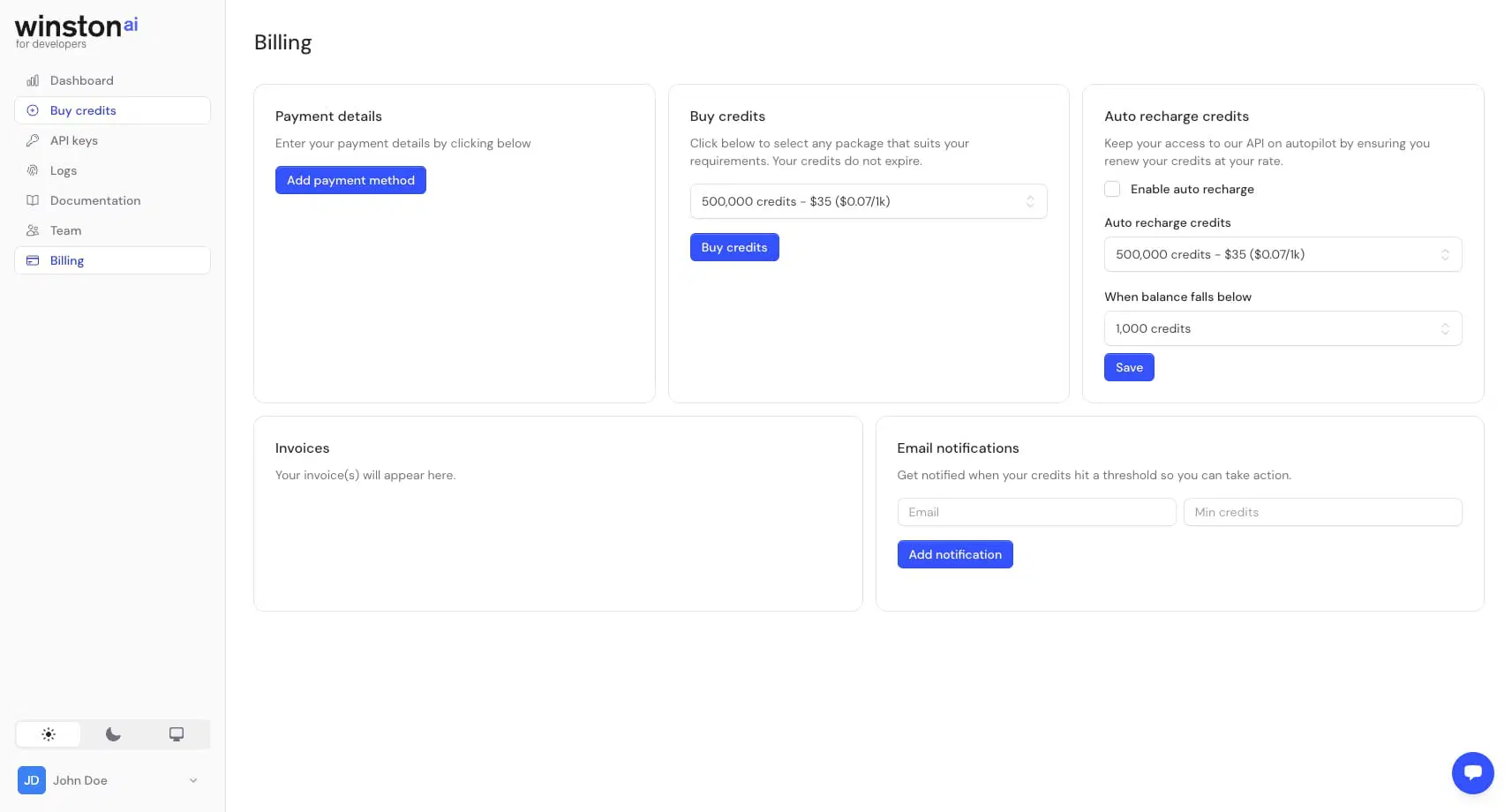
It is the only vendor in this group selling real API access off a low-cost self-serve base, through a separate developer dashboard with no credit card required, and it is the only one publishing a full per-endpoint credit schedule: 1 credit per word for AI detection, 2 for plagiarism, 2 for fact checking, 300 per image. Both monthly and annual prices are printed cleanly, which is not true of most of this list. Image and deepfake detection ships on every plan including Free. Per-scan ceiling is 200,000 characters on all paid tiers, with unlimited scans per hour.
Cons
The disclosure gap runs the wrong way: Winston claims the highest accuracy of anyone here at 99.98% and publishes no false-positive rate at all, only qualitative language about being "tuned to eliminate false positives". A two-decimal accuracy figure with no methodology page behind it reads as marketing, not measurement, especially next to Turnitin's 700,000-paper protocol. The free plan is a 14-day trial rather than a standing allowance. The logged-out web tool is capped at 2,000 characters and the lite version is English-only. And the free API allowance conflicts across Winston's own pages: 2,500 credits on the marketing page, 2,000 in the docs.
Pricing
Free at 2,000 credits over 14 days. Essential at $18/month monthly or $10 annual for 100,000 credits. Advanced at $29 monthly or $16 annual for 200,000. Elite at $49 monthly or $26 annual for 500,000. At 1 credit per word, Essential's 100,000 credits is 100,000 words a month, but only if you run no plagiarism or image scans, since those draw from the same pool.
Verdict
The best value per word on this list and the only sane self-serve API path, which makes it the natural swap for anyone who was using the Pangram API for bulk scanning. Just do not treat the 99.98% as comparable to anyone else's number. If you are building detection into a publishing flow, my notes on an AI blog writer API cover the same integration shape.
What every vendor on this page is quietly not telling you
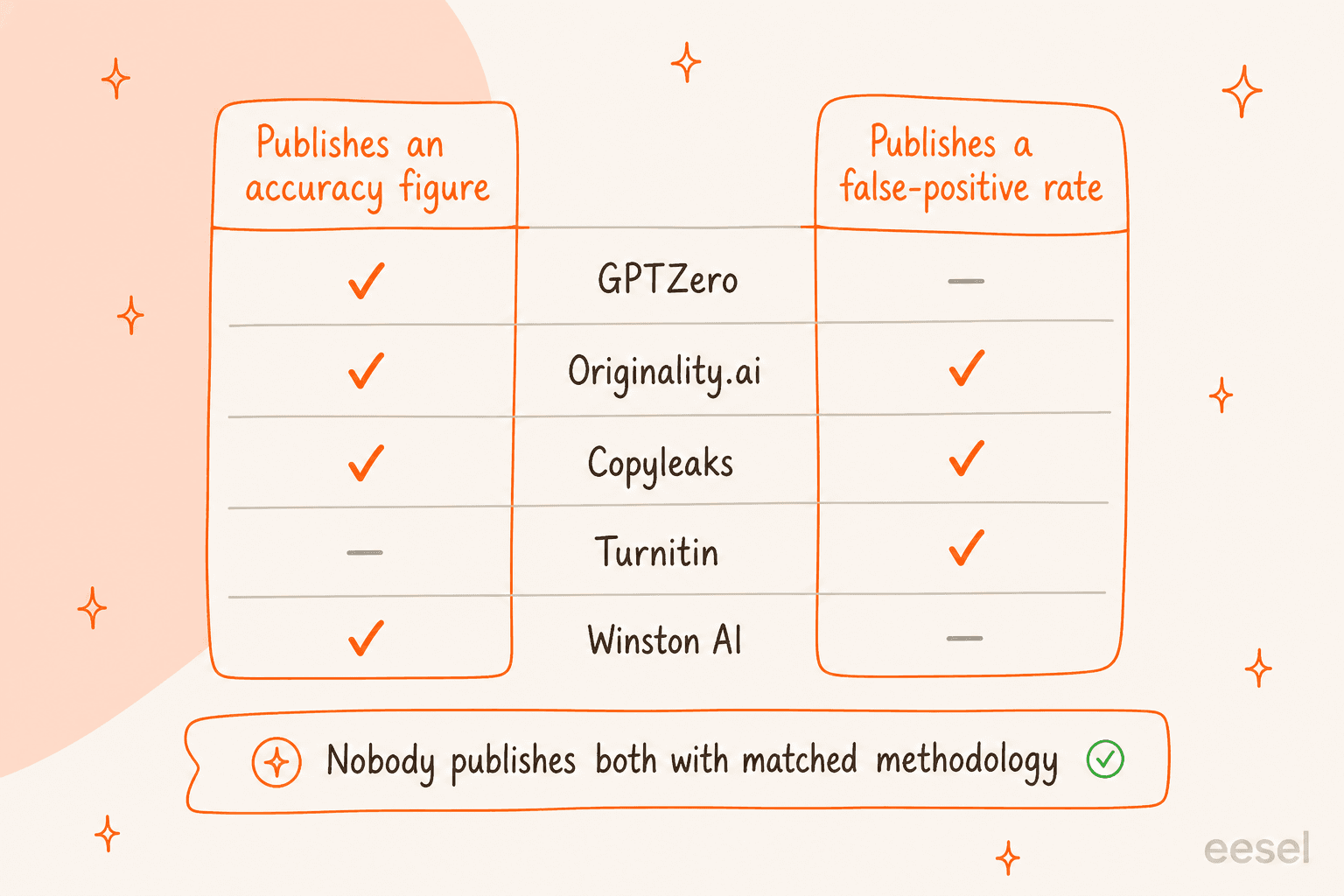
Line the disclosures up and the pattern is hard to miss. Not one vendor publishes both a credible accuracy figure and a credible false-positive rate under matched methodology. Copyleaks claims the best false-positive rate and scopes its accuracy to English internal testing. Winston AI claims the best accuracy and publishes no false-positive rate. Turnitin describes its false-positive protocol in detail and refuses to print an accuracy percentage. Originality.ai comes closest to publishing both, per model, and is the only one whose numbers trade off against each other the way real numbers do.
Two vendors also undercut their own headline on the same page, which is worth more than any competitor's criticism. GPTZero's 99% sits next to the RAID figure of 95.7% at 1% human misclassification. Copyleaks' "over 99%" sits next to per-language AI-side accuracy as low as 93.08%.
And the base-rate problem applies to all of them, not just to Pangram. A 1% false-positive rate across a team publishing 500 articles a month is five wrongly flagged pieces every month, forever. That arithmetic is why the practitioners I trust most treat the score as evidence rather than as a verdict:
"Ultimately they're black boxes. You don't really know what causes false positives/negatives. You get a number and hopefully its correct, but it's not like something that scans for plagiarism because with that you have the original source that you can refer to and make more insightful decisions on."
If you only need the API: Sapling is the cheapest published rate
Sapling is not a full listicle entry here because it has no public product screenshot to show you, but it belongs in the price conversation and it is the only vendor in this whole research set with a published volume ladder.
Sapling bills per character, tiered by monthly usage on its API pricing page: $0.025 per 1,000 characters up to 10 million, $0.020 from 10 to 50 million, $0.015 from 50 to 100 million, contact-sales above that. Its own conversion is 5 characters per English word, which puts the entry rate at $0.125 per 1,000 words, a quarter of what the Pangram 4 API charges. The subscription side is $0 Free, $25/month Pro or $12/month annual, with Enterprise starting at 10 seats at $15/seat/month. The web tool caps free queries at 2,000 characters and paid at 100,000; the API accepts 200,000 characters per call.
What you give up is any accuracy claim at all. Sapling's own docs say plainly that "all AI detection systems have false positives and false negatives" and that no detector, including Sapling's, should be used as a standalone check. It also notes the detector "becomes much more accurate after 50 or so words". That is honest, and it is also the entire disclosure. If the number has to hold up in front of someone else, that is not enough. If you are running a moderation queue where the score is one input among several, it is a quarter of the price.
How to actually deploy one of these
The best thing I have read on this came from a professor, not a vendor, and it is a workflow rather than a score:
"I always input my homework or essay prompt or short answer prompt from the class project into a suite of AI models. […] Also when doing this, I state that the AI detector is a "last chance at exoneration" and only comes after all the due diligance from before. If the detector says its real (even if it's a false negative) I drop it and don't report it. […] But when I point out that the detector is the last step and not the first step, this past year I have gone 24-for-24 in academic integrity submissions"
Detector last, never first. Translated to a content team, that is: know why the piece exists, check the sources yourself, read it for whether it says anything, and only then scan. Which order you run those in changes the outcome more than which of these six tools you buy.
There is one more thing worth saying about false positives, because it is the failure mode nobody prices in. The people getting flagged are frequently the most careful writers, and the mechanism is not mysterious:
"Writing professor here. I've been teaching composition for 25 years. To be honest, I'm alarmed by Pangram. It said my writing is AI-generated, with a 100% degree level of certainty. I write comedy. Comedic writing has very specific rules, such as the "rule of three" (or comic triple), a classic comedic technique. As a comic writer, I have to tighten and re-tighten my writing over and over and over and over again, line by line."
Heavily polished prose converges on the same surface statistics as generated prose. That is true of every detector here, not one of them, and it is why a low published false-positive rate is necessary but nowhere near sufficient. The practical answer is to write about things where you have something to say, since specificity is the one property no humanizer produces and no detector penalizes. I go into the mechanics in making AI content sound human and in the human-sounding prompts I rely on.
Which one should you actually pick?
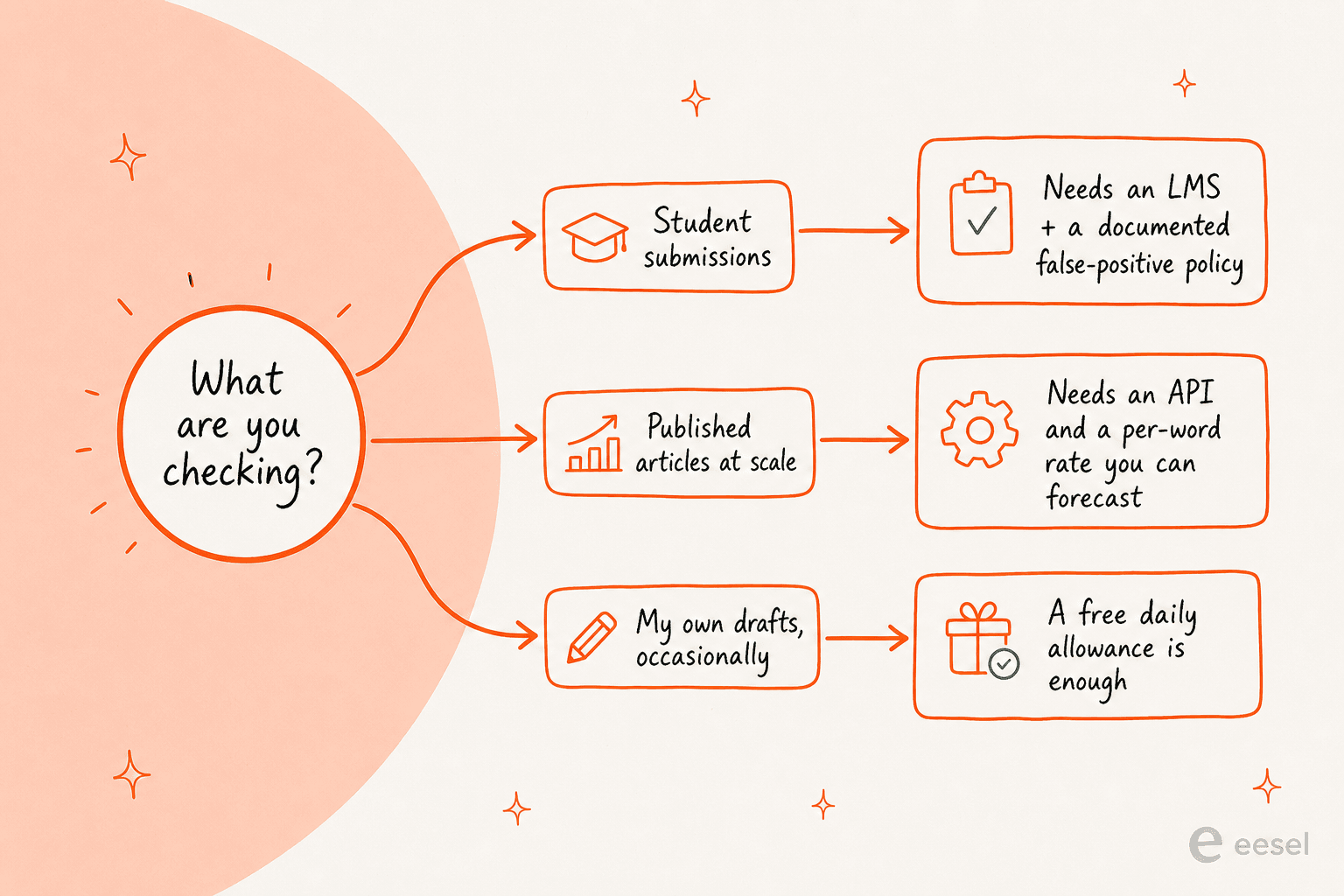
- Checking your own drafts, occasionally. GPTZero Free. 10,000 words a month, no clock, lives in Google Docs. Nothing else here gives you that for nothing.
- Publishing at volume and forecasting a bill. Winston AI Essential at $10/month annual for 100,000 words, or its self-serve API. Best value per word on this list.
- Needing to defend a verdict to a client. Originality.ai Pro. Per-model accuracy and false-positive rates published together, and a 365-day scan history you can point at.
- Fielding "why was I flagged?" conversations. Copyleaks Personal, for the AI Logic panel and the source matches. Expensive per word, worth it for the explainability.
- Working in education. Turnitin, because it is what your institution licensed, plus a second opinion from something the VUB study scored above 0%.
- Wiring detection into a product at scale. Sapling at $0.125 per 1,000 words, if the score is one input among several rather than the decision.
- Wanting the most accurate available and willing to pay. Stay on Pangram 4, but move short documents to it and long documents off the API onto a subscription.
If your monthly volume is under about 10,000 words, the honest answer is that all of this is free and you should pick on interface rather than price. If it is over 500,000, only Pangram, GPTZero and Winston have a published plan that reaches you at all.
The part a detector cannot do
Every tool on this page answers the same question: how was this text probably produced? Not one of them answers the question that decides whether the post works, which is whether it was worth producing.
That gap is where I spend my week. I build the eesel blog writer, and the thing that surprised me after a few hundred drafts through a detector gate is how weakly the two correlate. The posts that rank are the ones with a real primary source, a number nobody else has, and an internal link graph that tells search engines what the site is about. The posts that fail the detector are frequently just the well-edited ones.
So eesel does the front of that process, not the back. It researches a topic from primary sources rather than from other people's summaries, writes with brand voice training so the output sounds like your team rather than like a model, builds the internal link graph as it drafts, and hands you something an editor can finish instead of rescue. Then you scan it, with whichever tool on this page you picked. This post came out of that pipeline, detector gate included, which is about as honest a demo as I can offer.
Start with automating blog writing, then try eesel free. It costs nothing to see whether the drafts hold up next to whatever you write by hand today.
If ranking is the only thing you care about, the SEO blog writer angle is the faster read.
A last note on the review base
One thing to know before you weigh anyone's star rating here. Pangram's G2 listing exists with zero reviews, Capterra has no listing at all, and search results put Trustpilot around 2.4 out of 5 from 13 reviews. Its Chrome extension sits at 5.0 from 19 ratings. So there is no broad review corpus for the incumbent in either direction, and anyone citing "the reviews" is citing roughly thirty people.
The competitors are better covered on G2 and Capterra, but the same caution applies to the accuracy percentages on their own sites: the only figures in this whole comparison that were produced by someone with nothing to sell are the UChicago working paper, the VUB peer-reviewed study, and the ESPERANTO benchmark. Every one of them tested Pangram 3.x. None has tested Pangram 4, and none has tested the 2026 versions of the five alternatives above.
Which means the real answer to "which detector is most accurate in August 2026" is that nobody independent knows yet. Pick on the things you can verify: the price, the billing unit, the free tier, the API access, and whether the vendor will tell you its false-positive rate when you ask. That is what the table above is for.
Further reading
- How AI content detectors work explains the mechanism under every score on this page.
- How accurate are AI detectors covers why these numbers resist comparison.
- Software to detect AI writing is the wider category, including tools that did not make this list.
- Writer AI content detector looks at detection bundled inside a writing suite.
- Grammarly is the other suite worth checking for the same reason.
- Surfer SEO AI humanizer is the other side of the same arms race.
- Avoiding AI detection is what the bypass tools actually do.
- AI content editing process is the human pass that matters more than the scan.
- Error-free blog writing is the pass before that one.
- AI blog writer explained is the production side in one page.
- E-E-A-T compliant content is what search actually rewards.
- Best AI content generators is what sits upstream of every scan.
- AI blog writer not ranking is the problem a clean detector score does not solve.
Frequently Asked Questions
What are the best Pangram 4 alternatives?
Is there a free Pangram 4 alternative?
Which AI detector has the lowest false positive rate?
How much do Pangram 4 alternatives cost?
Which Pangram alternative has an API?
Can any AI detector catch humanized text?
Should I switch off Pangram 4 because of the price change?
Do AI detectors affect Google rankings?


Article by
Alicia Kirana Utomo
Kira is a writer at eesel AI with a Computer Science background and over a year of hands-on experience evaluating AI-powered customer service tools. She focuses on breaking down how helpdesk platforms and AI agents actually work so that support teams can make better buying decisions.