

Why procurement is the story here
I write about search intent for a living, and "OpenAI Marketplace" is one of those keywords where the name kind of misleads. Most people who type it are expecting a storefront of ChatGPT apps. What OpenAI shipped instead is more a way to move the money that's already been approved.
That matters more than how it sounds. At eesel, I've watched AI support trials run 300+ real chats in production, prove the agent works, and then they stall on procurement or on a competing vendor bake-off, not on anything the product did. I also have seen a European SaaS support team that never signed up at all, because an internal ISO security review got there first. The hard part in buying AI for a support team is rarely the demo, it's the second budget line.
OpenAI Marketplace goes right at that problem. HubSpot's Jon Dick put it quite plainly:
"The budget you've already set aside for OpenAI now works here too, without a separate procurement conversation."

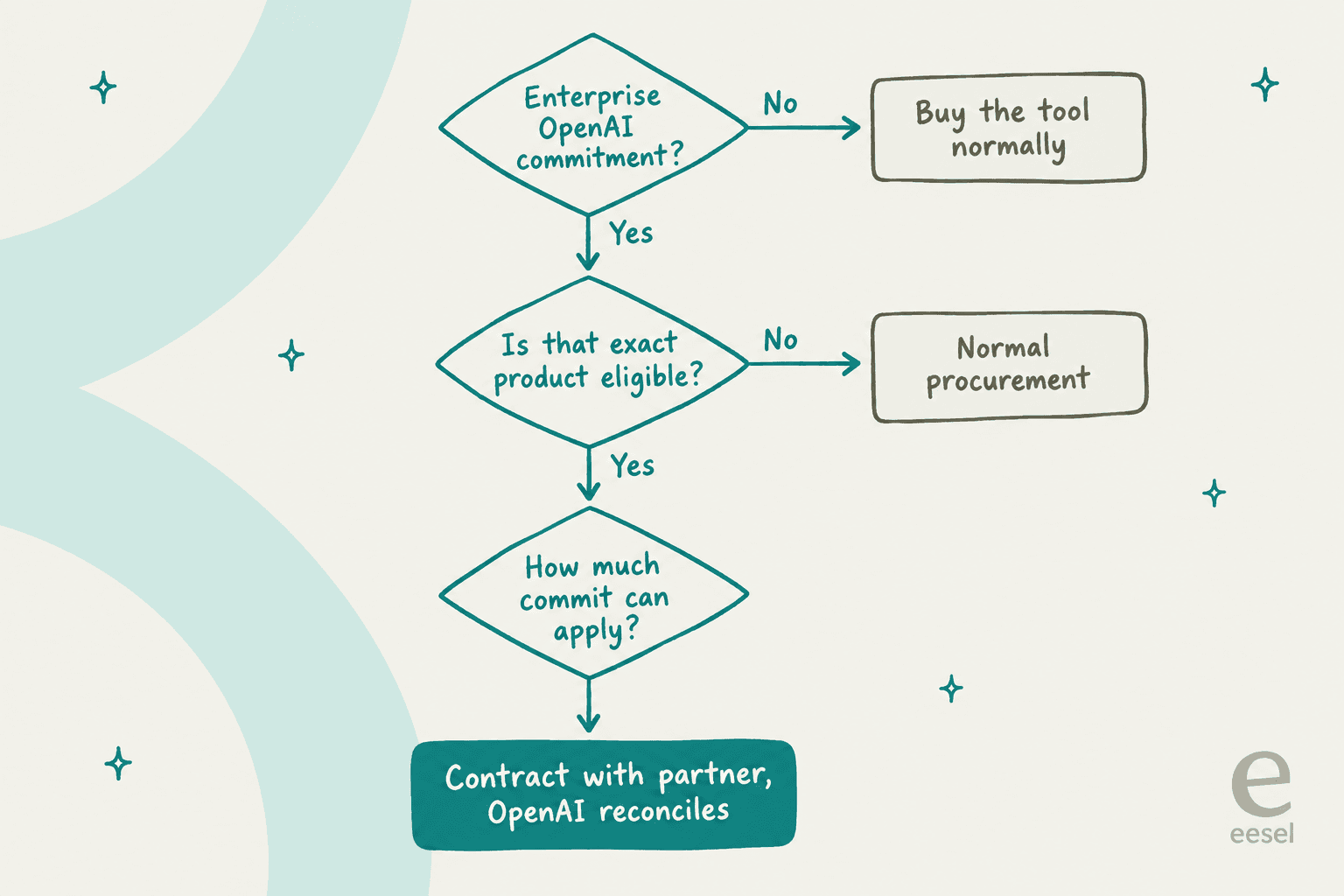
So the more useful question is not "what's in the store?" It's "does my company have an OpenAI commitment, and is the tool I want on the list?"
What is OpenAI Marketplace?
OpenAI Marketplace is a directory of partner products plus a billing arrangement. In OpenAI's own definition from its help center, it is a program "that lets eligible enterprise customers apply part of their OpenAI commitment toward qualifying partner products built on OpenAI models."
A few facts worth to pin down:
- It's in beta, per the ChatGPT Enterprise release notes for September 29, 2026.
- It was one from several enterprise announcements in the DevDay 2026 recap, alongside OpenAI Dots, the ChatGPT Pro 500 tier and GPT-6.1 Sol.
- The page has exactly two buttons, "Request to buy" and "Join our partner waitlist." There is no cart at all.
- A "commitment" here means a contracted amount of OpenAI spend that an enterprise has agreed to over a term, usually in exchange of better rates. If you're on ChatGPT Enterprise or a large OpenAI API contract, your account team will know whether you have one.
That last point is what confused people on the launch day. One reply under Notion's announcement on X asked, "I keep hearing this word commit and commitment, and I have no idea what that means in this context." (X). If you never signed a committed-spend contract with OpenAI, then this program is not built for you, yet.
How does buying through it actually work?
OpenAI's help article spells out four steps for the initial rollout, which are:
- OpenAI and the partner confirm whether the customer and the proposed purchase qualify.
- The customer contracts directly with the partner.
- The partner invoices the customer.
- OpenAI records the eligible amount against the customer's OpenAI commitment.
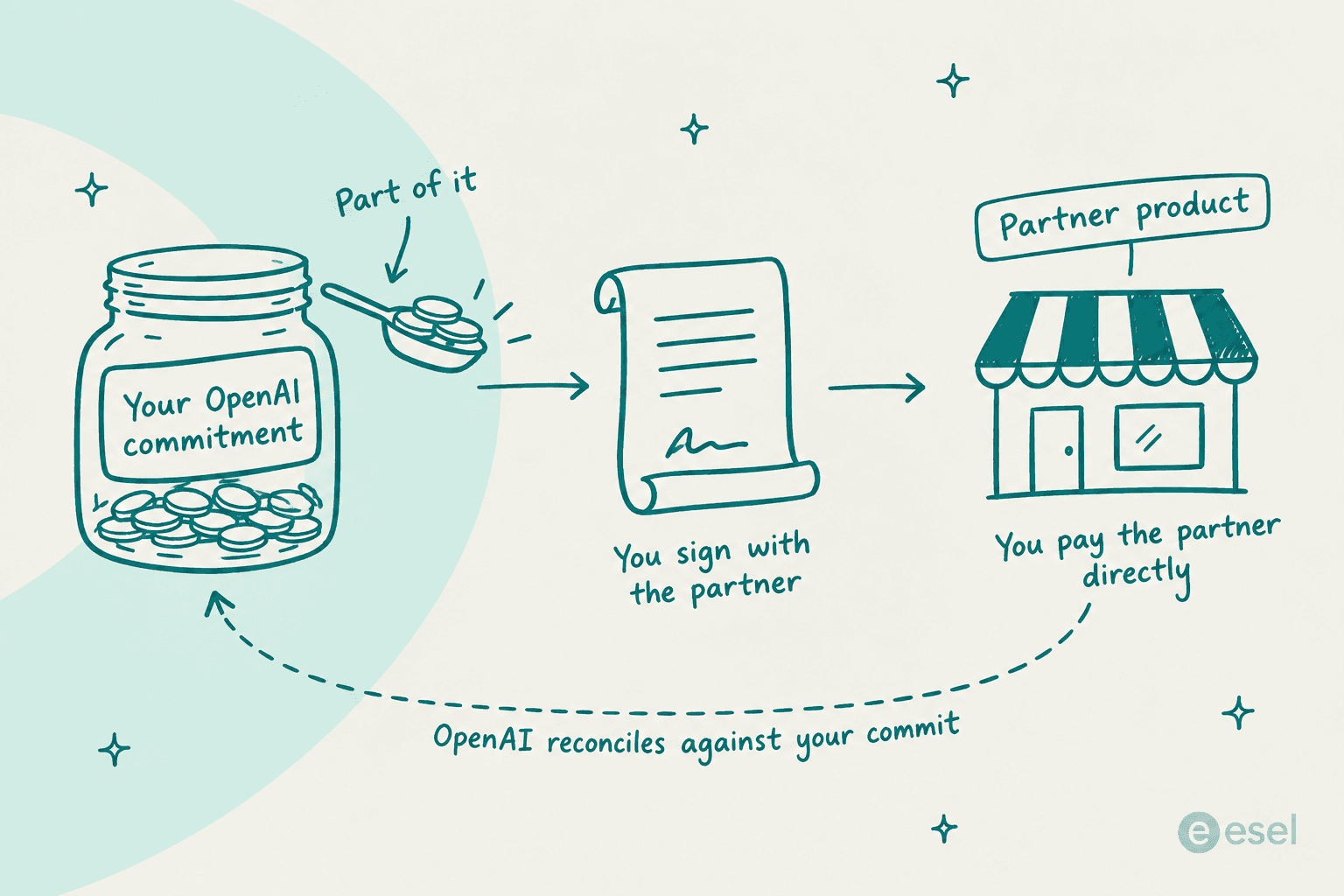
The part that people tend to miss is the step 2. You still sign a contract with the vendor. Their legal review and security questionnaire still happens, and their order form too. What goes away is the internal fight for a new budget, since the money was committed to OpenAI already.
The "Request to buy" form is a short one. It asks for your company name, your OpenAI Organization ID, a contact, which partner you want and some detail on the use case (customer interest form). There's no field for budget or commitment size, which tells you that eligibility gets worked out in a conversation after.
What OpenAI hasn't published
This is the section I'd read twice before getting excited about anything:
| Question | What OpenAI says |
|---|---|
| How much of my commitment can I apply? | "Part of" it. The amount "depends on the applicable program terms and purchase." (help center) |
| Is there a minimum commitment? | Not stated anywhere |
| Is every product from a listed partner eligible? | No. "Not every product from a listed partner qualifies." (landing page FAQ) |
| Can I check out myself? | No. "There is no self-service checkout" in the beta (release notes) |
| What happens at renewal? | Not stated |
| Is it live for everyone? | Rolling out gradually, "some features may not be available to your account yet" (help center) |
Some of the partners are hedging as well. ElevenLabs says its listing is live but "purchasing will be available soon" (ElevenLabs), and Figma's Praveer Melwani says Figma purchases start "later this year" (LinkedIn). DevRev's wording is the most careful of all: eligible customers "may also be able to apply part of an existing OpenAI commitment" (DevRev).
Who's on the OpenAI Marketplace partner list?
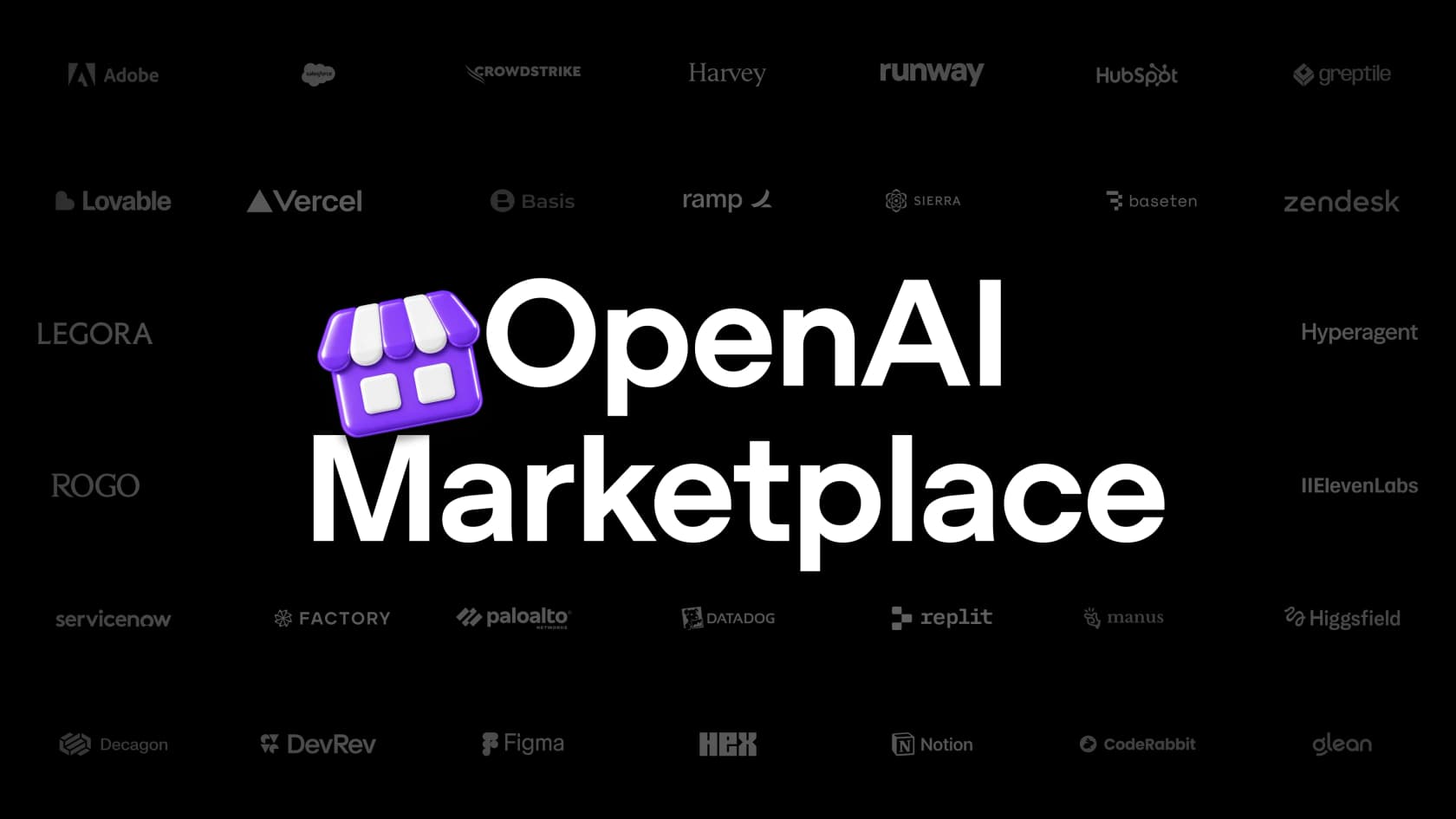
The landing page lists 32 partners. OpenAI's recap groups a handful of them, then I grouped the rest by what each one is selling.
| Category | Partners |
|---|---|
| Customer experience (9) | Sierra, Decagon, Zendesk, HubSpot, Salesforce, ServiceNow, DevRev, ElevenLabs, Adobe |
| Building software (6) | CodeRabbit, Greptile, Factory, Lovable, Replit, Vercel |
| Data and knowledge (5) | Baseten, Datadog, Hex, Glean, Notion |
| Finance (3) | Basis, Ramp, Rogo |
| Creative (3) | Figma, Runway, Higgsfield |
| Security (2) | CrowdStrike, Palo Alto Networks |
| Legal (2) | Harvey, Legora |
| General agents (2) | Manus, Hyperagent |
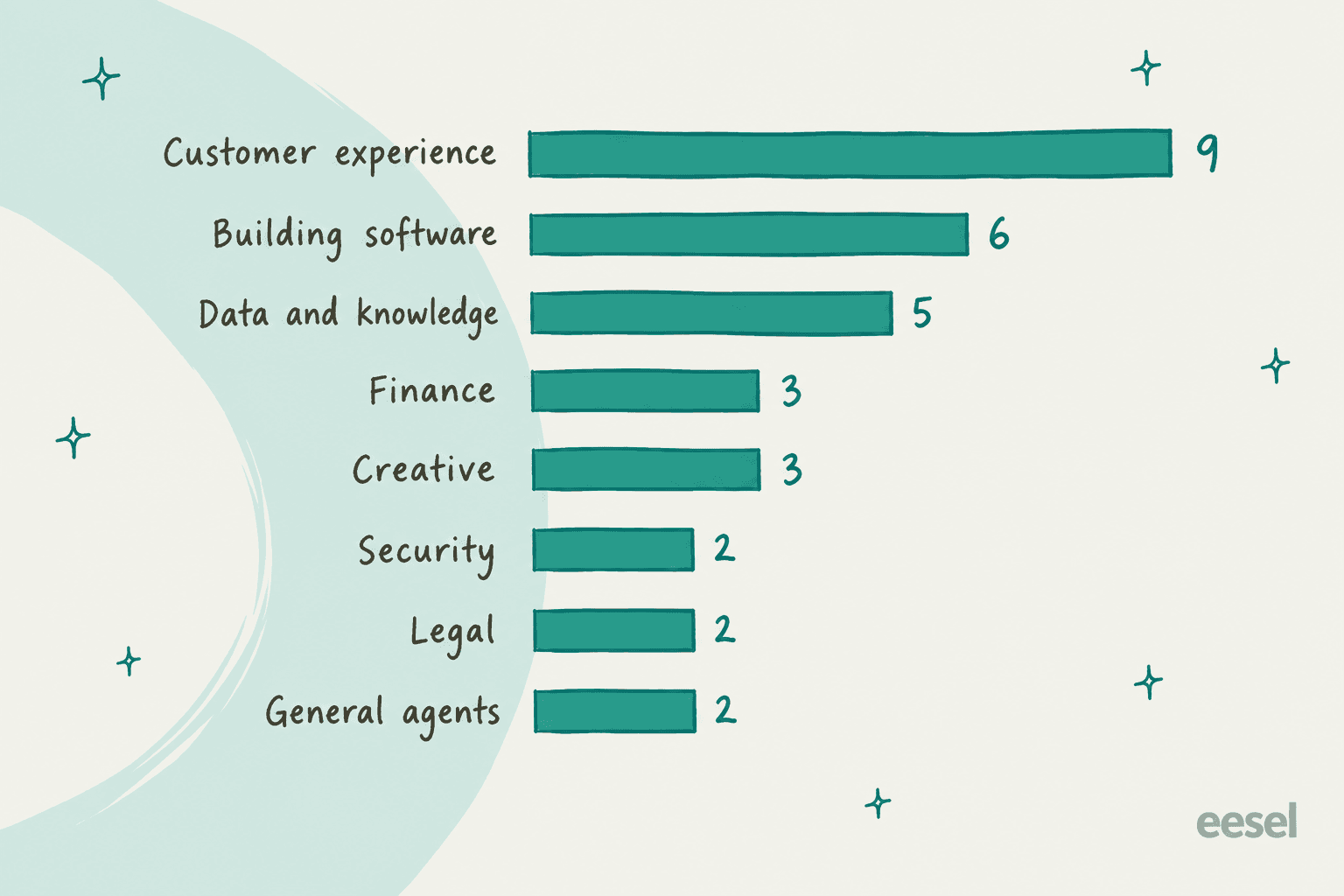
Customer experience is the biggest single group, and that is not by accident. Support automation is one of the clearest places where enterprises already spend heavily on model tokens, so it's a natural place for OpenAI to recycle commitment dollars.
One more detail stood out in Baseten's announcement: OpenAI enterprise customers "can now use existing OpenAI commitments for open models served by Baseten within Codex or via the Responses API" (Baseten). So, in one case at minimum, OpenAI commit dollars can pay for inference on models OpenAI didn't build.
Why does OpenAI want this?
If you read the partner waitlist form, the motive gets clear quite fast. It asks each applicant for "Model usage served by OpenAI (%)," in buckets from 0-25% to 75-100% (partner interest form). Combined with the help center's line that qualifying products are "built on OpenAI models," this is a program for the vendors whose bills flow back to OpenAI.
That's a reasonable business for OpenAI, and it does give buyers something real. But the sharpest read on incentives came from an X thread in the day after launch:
"8) enterprises are more willing to commit, because committing to openai has a lower opportunity cost when unused spend can go to apps"
"9) and once they've committed, they're hard to move: taking one app off openai means reallocating that spend or renegotiating, which touches multiple vendors at once"
Both things are true at the same time. The program makes a big OpenAI commitment easier to sign off on, and it also makes that commitment more sticky once it's signed. CrowdStrike's own press release frames the listing as "unlocking more spend for Falcon platform adoption" (CrowdStrike), which at least is honest about whose spend is getting unlocked.
There is also a hint on where it's heading. OpenAI is hiring a Head of Marketplace at $400K to $445K plus equity, whose remit includes "discovery, listing, evaluation, procurement, billing, deployment" and "private offers." Private offers are basically the AWS and Azure marketplace playbook, so I'd expect a fuller self-serve flow coming later. To be clear that's my inference from a job post, not an announcement.
How does it compare to AWS, Azure, Google and Claude Marketplace?
Committed-spend marketplaces are not a new thing. Roman Kirsanov, who writes about cloud go-to-market, summed up the lineage of it:
"For years, cloud marketplaces have helped vendors reach budgets customers already committed to AWS, Microsoft, and Google.
Anthropic brought that approach to Claude Marketplace earlier this year. Now OpenAI is applying the same mechanic."
Here is how the published rules line up against each other:
| Program | Share of an eligible purchase that counts | Cap | Who invoices you | Self-service checkout |
|---|---|---|---|---|
| OpenAI Marketplace | "Part of" your commitment | Not published | The partner | No |
| Claude Marketplace | Existing Anthropic commitment "can apply" | Not published | Not published | No, "Request to buy" |
| Azure (MACC) | 100% of the pretax amount | None stated | Microsoft | Yes, in the Azure portal |
| Google Cloud | 100% minus exclusions | 25% of the minimum commitment | Google or a reseller | Yes |
| AWS | "Eligible AWS Marketplace transactions can count" (AWS) | Not published by AWS | AWS | Yes |
Two things jump out. First, OpenAI is the only one where the partner sends the invoice, so your finance team ends up with two relationships instead of one. Second, the cloud programs publish their rules and OpenAI doesn't, at least not yet.
The overlap with Anthropic is a real one. Claude Marketplace lists 15 products, and 8 of them also appear on OpenAI's list: CodeRabbit, CrowdStrike, Factory, Harvey, Legora, Lovable, Rogo and Vercel. None of Claude's 15 is a customer support vendor, which makes OpenAI's 9 CX partners the bigger story for support teams. Vendors are already working on both sides: Decagon told customers in July that businesses "with existing committed spend" on AWS "can apply that investment directly toward Decagon" (Decagon).
What it means for customer support teams
In case your company already has a large OpenAI commitment, this is a real shortcut for you. You can shortlist Sierra, Decagon, Zendesk's AI agents, Agentforce or ServiceNow and fund the winner without a new budget request.
Zendesk's announcement pitches it as expanding "access to agentic service for more businesses" (Zendesk), and Sierra says "eligible customers can build agents with Sierra using their OpenAI commitments" (Sierra).
The questions I'd ask before leaning on it:
- Is the specific product eligible? A listing doesn't mean every SKU qualifies.
- What happens at renewal? One commenter under a post of a HubSpot exec put it well:
"The question is whether the HubSpot spend renews as its own contract or stops when the OpenAI commitment runs out"
- Does the tool fit your helpdesk? The funding source shouldn't be what picks your support stack. A Sierra vs Zendesk or Decagon vs Sierra comparison still matters more than the budget which pays for it.
- Can you test it on your own tickets first? Commit dollars make it easy to buy before you've proved anything.
That last one is where I'd push the hardest. The vendors on this list mostly get sold through enterprise contracts, and Sierra's pricing and Decagon's pricing are quote-based. "Free money" from an existing commit can make a six-figure decision feel smaller than it really is.
Should you use OpenAI Marketplace?
Here's my honest take, by situation:
- You have an OpenAI commitment you're not going to burn through. Use it. Recycling committed dollars into a tool you were going to buy anyway is basically free value, as long as the product passes your own evaluation first.
- You have a commitment but you're model-agnostic. Be careful here. Every partner you fund through OpenAI makes moving off OpenAI more expensive later, which is exactly the lock-in that the X thread above describes.
- You don't have a commitment. The program doesn't apply for you. Buy the tool you'd pick anyway, and judge it on what it actually costs per ticket.
- You're a vendor. Join the waitlist if most of the inference you do runs on OpenAI. As one LinkedIn commenter warned, "Unless there's active selling motion, getting a listing is as good as having one in the yellow pages." (LinkedIn)
Most support teams I talk with sit in the third bucket. They don't have an enterprise OpenAI contract, and they shouldn't need one just to put an AI agent on their queue. For a more broad view of the options, my roundup of the best customer service AI agents covers tools you can start without a commit.
eesel for teams without an OpenAI commit
eesel isn't on OpenAI's partner list, and for most support teams that is kind of the point. eesel's AI helpdesk teammate joins your existing Zendesk, Freshdesk or Jira Service Management queue, learns from your help center and past tickets, then drafts or sends replies the way a new hire would do.
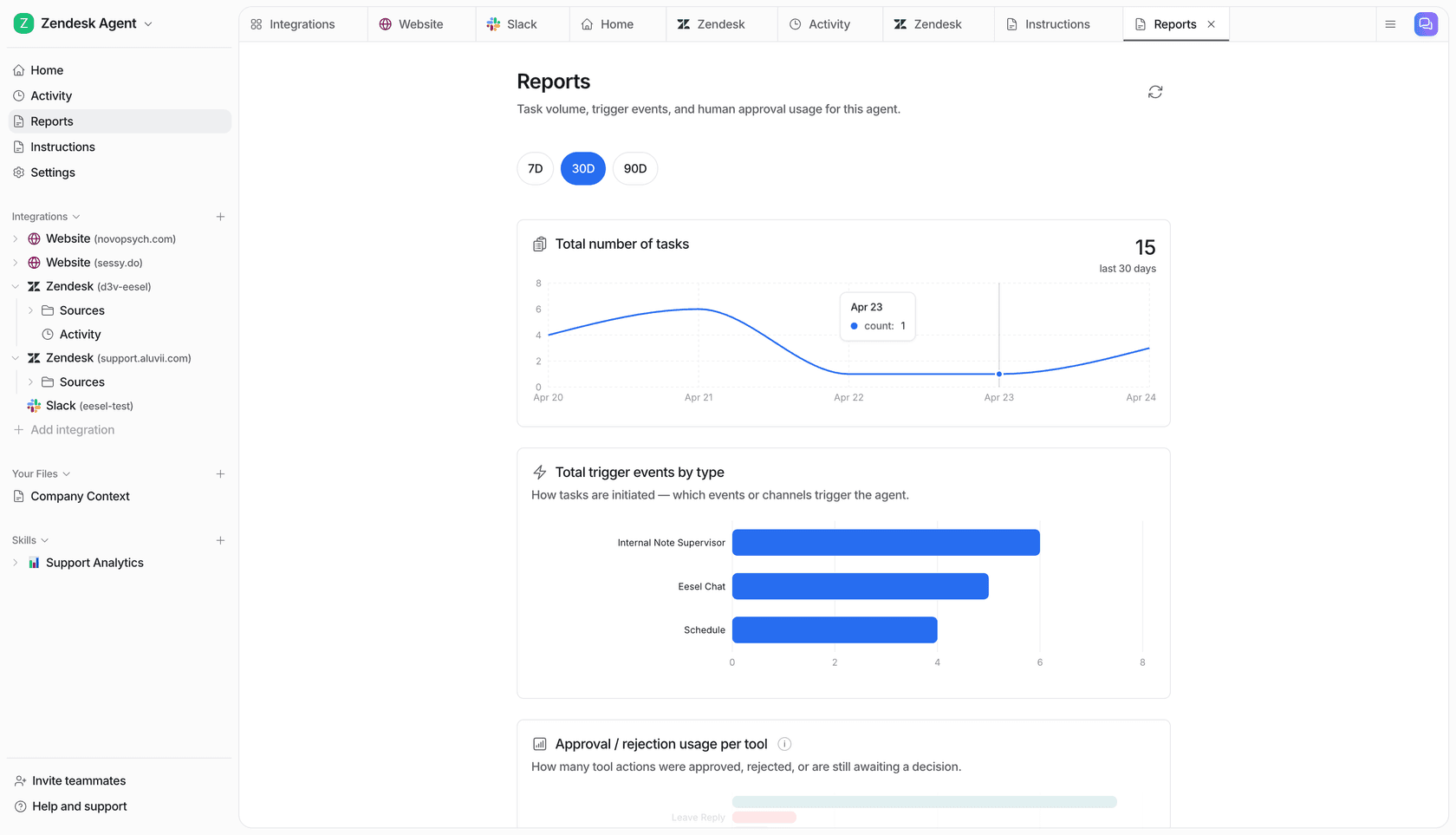
Where the Marketplace removes a budget cycle, eesel skips it. Plans start at $299/month for 500 credits, where a ticket or chat is one credit, and there is a free plan of 100 credits with no card. Before it ever answers a live customer, the agent's simulation skill tests replies against hundreds of your past tickets, so you get to see the quality first.
Gridwise reported 73% of tier 1 tickets resolved in the first month (eesel). And since OpenAI is one of eesel's listed subprocessors, you still get frontier models, just without a commitment contract. Try eesel on your own queue and compare it against whatever your OpenAI commit could buy you.
Frequently Asked Questions
What is OpenAI Marketplace?
How much of my OpenAI commitment can I spend in OpenAI Marketplace?
Is OpenAI Marketplace the same as the ChatGPT apps directory?
Which customer support tools are in OpenAI Marketplace?
Can small businesses use OpenAI Marketplace?
Do I pay OpenAI or the partner when I buy through OpenAI Marketplace?
What happens to an OpenAI Marketplace purchase when my commitment ends?


Article by
Kurnia Kharisma
Kurnia is a software engineer and writer at eesel AI with two years of SEO experience, writing about AI tools, helpdesk software, and customer support. He pairs a developer's understanding of how these products are built with search-driven research into what actually ranks and resonates with the people searching for them.