


Gradient Labs vs Lorikeet at a glance
Here is the quick version before we get into each one. The rightmost column is eesel, included as the "plug into your existing helpdesk" reference point rather than a like-for-like enterprise build.
| Dimension | Gradient Labs | Lorikeet | eesel |
|---|---|---|---|
| Best for | Regulated financial services only | Complex fintech and healthtech | Teams layering AI onto an existing helpdesk |
| Founded | 2023 (London) | 2023 (Sydney) | - |
| Funding | $26M Series A | ~$75M+ raised | - |
| Pricing model | Pay per successful resolution | Credits per resolved ticket | Per ticket handled |
| Published price | None | Start $1,500/mo, Scale $4,000/mo | $0.40/ticket |
| Free trial / self-serve | No (demo only) | No (demo only) | Yes ($50 free) |
| Channels | Voice, chat, email, SMS, social | Email, chat, voice, SMS, WhatsApp | Chat, email, Slack, WhatsApp, social |
| Test on your real tickets | Simulate scenarios pre-launch | Scenarios + failed-ticket replay | Replays your real past tickets |
| Named helpdesk integrations | Sits on Zendesk, Freshdesk | Zendesk, Front, Help Scout, Salesforce, HubSpot | Zendesk, Freshdesk, Gorgias, Front |
| Compliance | SOC 2, FCA, PSD2, GDPR | SOC 2, ISO 27001, HIPAA | SOC 2 Type II underway, HIPAA (Enterprise) |
What Gradient Labs is
Gradient Labs builds an AI agent named Otto that is aimed at exactly one market: regulated financial services. Not "support in general with a finance case study," but banks, neobanks, lenders and insurers as the entire product. The founders are ex-Monzo: Dimitri Masin led the 100-plus data team, and Neal Lathia built Monzo's ML infrastructure. That heritage shows up everywhere in the product.
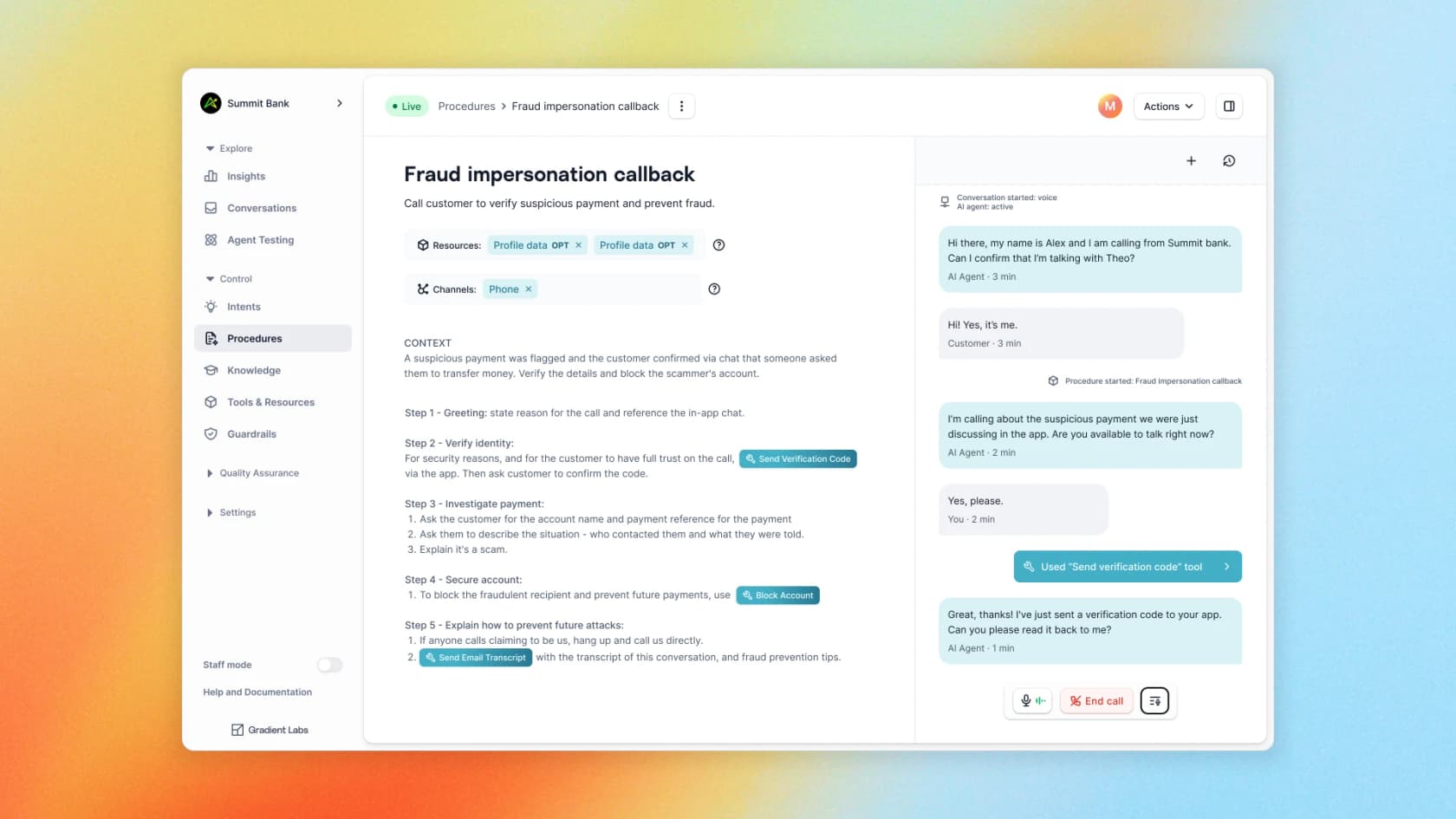
The pitch is "we handle what others hand off": full resolution, not deflection. When a customer gets in touch, Otto remembers past conversations and takes real actions to close the issue, freezing a lost card or tracking a missing payment, rather than surfacing a help article. You author procedures in plain language, and the agent trains on your SOPs and your best human agents' real conversations, not just the knowledge base.
What makes Gradient Labs distinct is the depth of the vertical. Instead of one horizontal chatbot, it ships specialist agents for customer service, disputes, KYB, collections, insurance claims and lending. A disputes agent gathers and verifies evidence, decides the outcome, escalates to a human for sign-off, then files the chargeback with the card scheme. That is hard, regulated work, and it is the sort of thing a general-purpose helpdesk bot never touches.
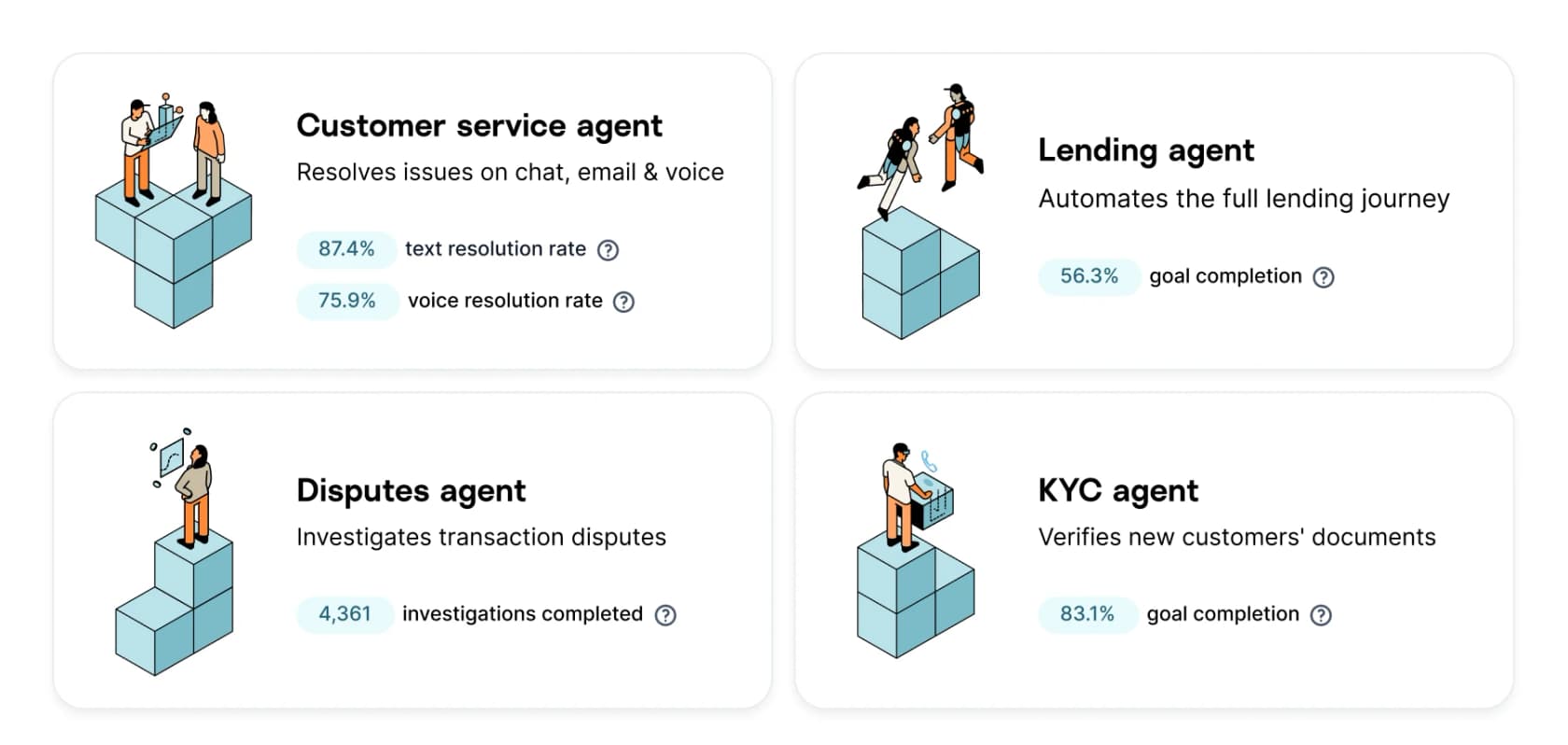
The numbers Gradient publishes are strong, with the usual caveat that they are vendor-stated. It cites a 80 to 90% peak resolution rate, 98% CSAT in some deployments, and 32M end users reached across its customers. In the OpenAI case study, most deployments are said to start "with over 50% resolution rates on day one, even for complex workflows like disputes." Named customers include Pockit (70% resolution) and SteadyPay (33,000 AI voice calls a month).
The company raised a $26M Series A (led by Octopus Ventures and CommerzVentures, with Redpoint following on) and reports roughly 10x revenue growth year over year. It is a young, focused company betting entirely on one vertical.
What Lorikeet is
Lorikeet calls itself an "AI Customer Concierge for complex companies," and its target is a bit wider: ambitious fintechs and healthtechs. It was founded in Sydney by Steve Hind (ex-Stripe and Watershed product) and Jamie Hall, a former Google Brain research lead who was a named author on the LaMDA paper. It has raised about $75M across three rounds in roughly ten months, with backers including QED, Blackbird and Square Peg.
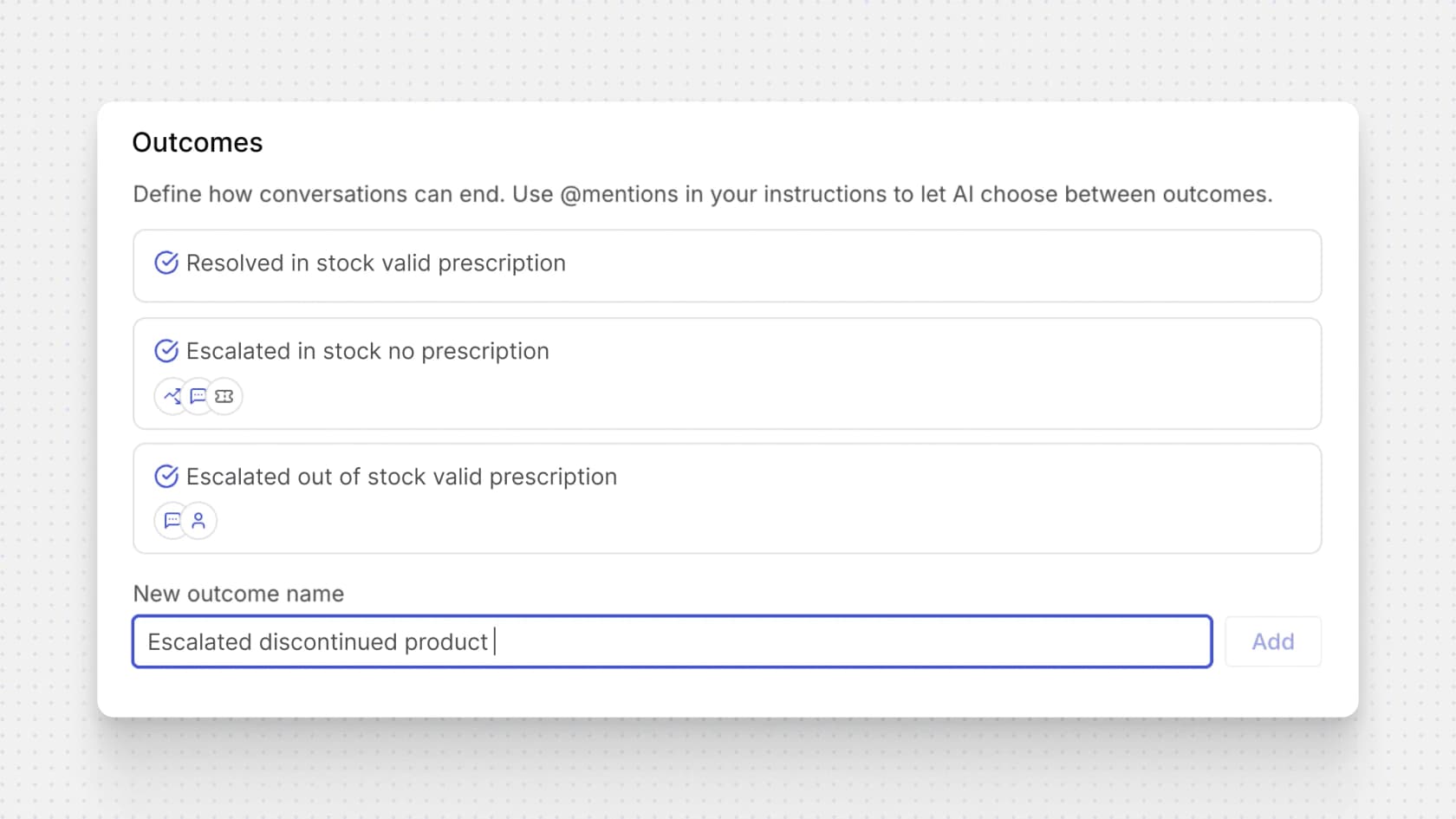
Like Gradient, Lorikeet's whole point is that it takes actions. It explicitly targets "the hardest 20% of tickets driving 80% of your support effort", the ones that involve looking up data, doing something in your systems, and making a real decision. Where it goes further is a concept it calls Outcomes: instead of a generic "close" or "escalate," you define named, meaningful ways a conversation can end, and each Outcome fires its own bundle of actions in a fixed, deterministic order every time.
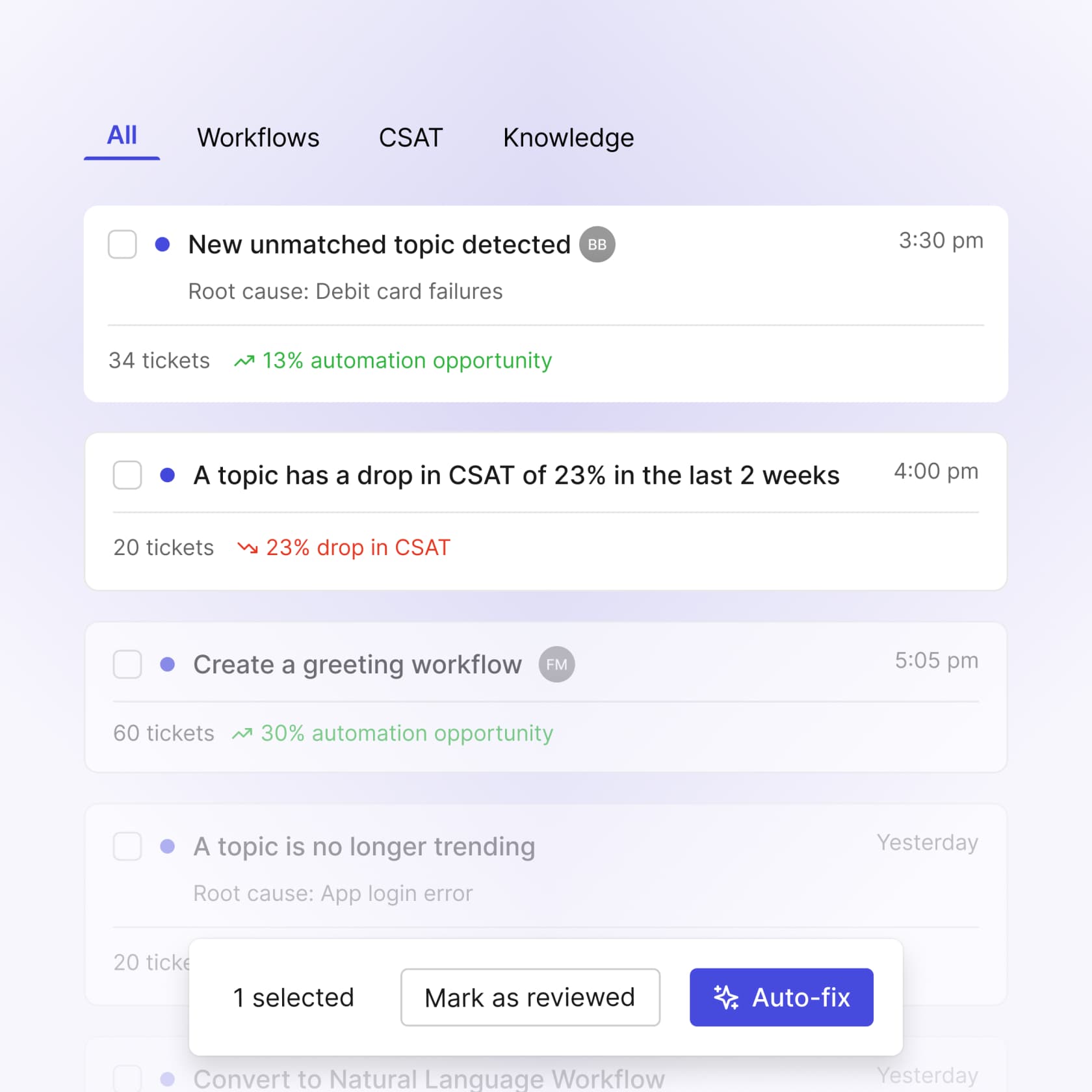
The second thing Lorikeet leans on is a separate ops agent called Coach. Coach is the internal counterpart to the customer-facing Concierge: it watches conversations, clusters contact drivers, spots a CSAT drop tied to a specific workflow, then proposes and (with your approval) implements the fix. It is reachable in Slack, Claude, ChatGPT, or over MCP.
Lorikeet's customer proof is broad. Carmoola took resolution from 30% to 60% of conversations end-to-end, Linktree cut first response time to about a minute, and Eucalyptus, a healthtech, handled 3x ticket load with CSAT up ten points. The healthtech logos are the tell that Lorikeet is not a finance-only play the way Gradient is.
One honest note on sentiment: independent reviews of either product are thin. The one verifiable public complaint I found is a 1-star Trustpilot review from an end user who hit Lorikeet inside Airwallex's onboarding and could not get escalated to a human. It is a single data point, but it is the exact failure mode both of these tools are built to avoid, which is worth remembering when you read the resolution numbers.
How each one is actually built
This is the part I care about most, because it is where the real difference between "great demo" and "safe in production" lives. Both companies are unusually thoughtful here, and they solve the same problem in different shapes.
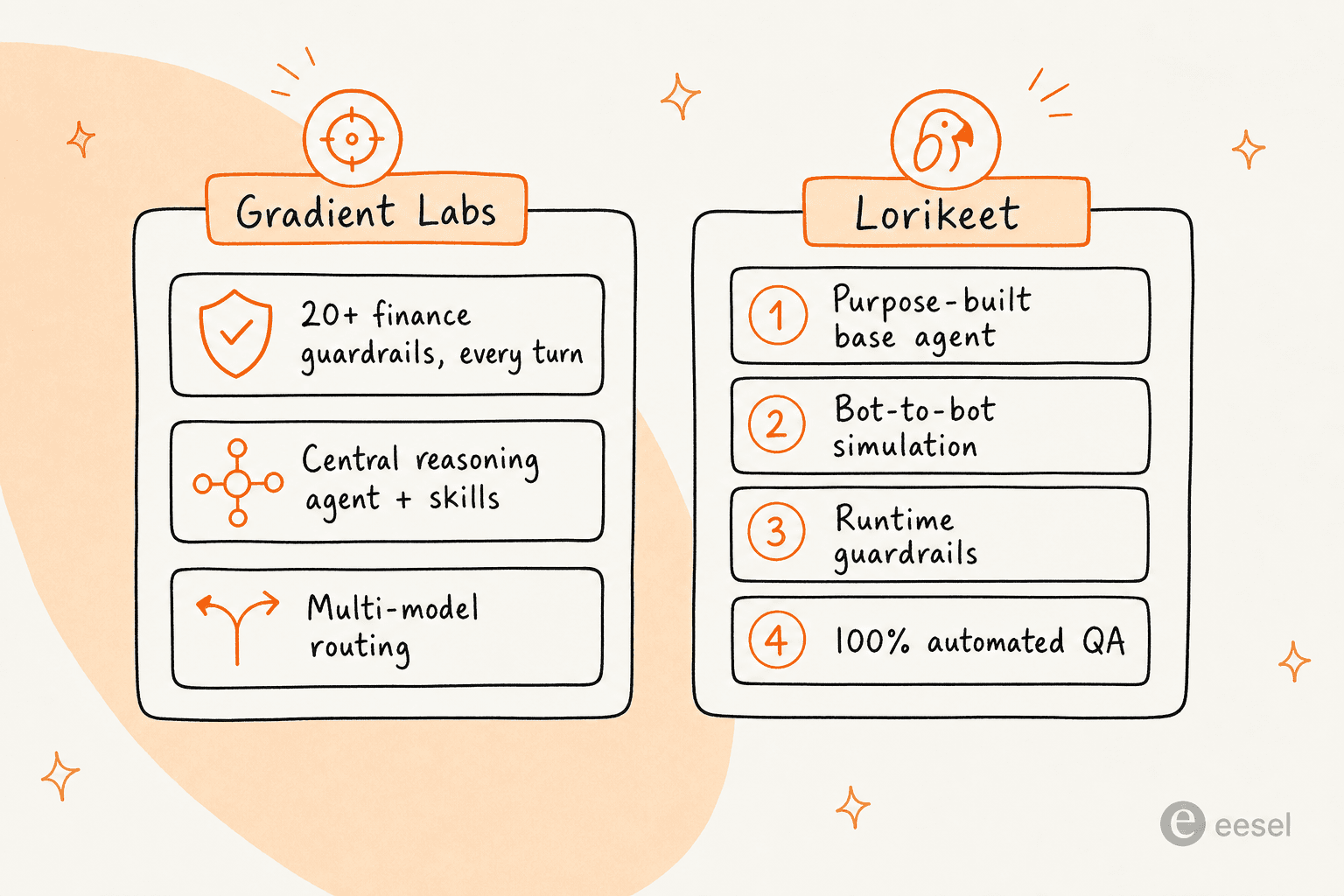
Gradient Labs runs the agent as a state machine: a central reasoning agent orchestrates specialized skills, and cases move across workflows without losing context. It is multi-model under the hood, routing to OpenAI, Anthropic and Google depending on whether a step needs heavy reasoning or fast deterministic execution. The safety layer is 20-plus finance-specific guardrails running on every single turn, checking for things like financial-advice detection, vulnerability signals, complaints, and attempts to bypass verification. Chief Scientist Danai Antoniou's line in the OpenAI case study sums up the philosophy: "You have to architect from the ground up for no hallucinations."
Lorikeet's answer is what it calls "defence in depth", four layers that each assume the others will occasionally fail:
- A purpose-built support base agent whose default is "do not make things up."
- Bot-to-bot simulation, where an LLM plays a customer against the real agent and real workflow, and scenarios can be generated from real production tickets that failed.
- Runtime guardrails that run on a separate thread, watching every outgoing response before it reaches the customer, without bloating the main prompt.
- Post-ticket QA that scores 100% of tickets (human, AI, or hybrid) on a traffic-light scorecard.
CTO Jamie Hall describes the runtime layer as "basically watching every statement as it goes out". The practical difference: Gradient bakes its compliance checks into a dense per-turn guardrail set tuned for banking, while Lorikeet spreads its checks across a testing-and-QA flywheel you can inspect. Both are serious. Neither removes your own regulatory accountability, and Lorikeet is refreshingly explicit about that.
Pricing: one publishes, one does not
Here is the cleanest practical split between these two, and it decides a lot.
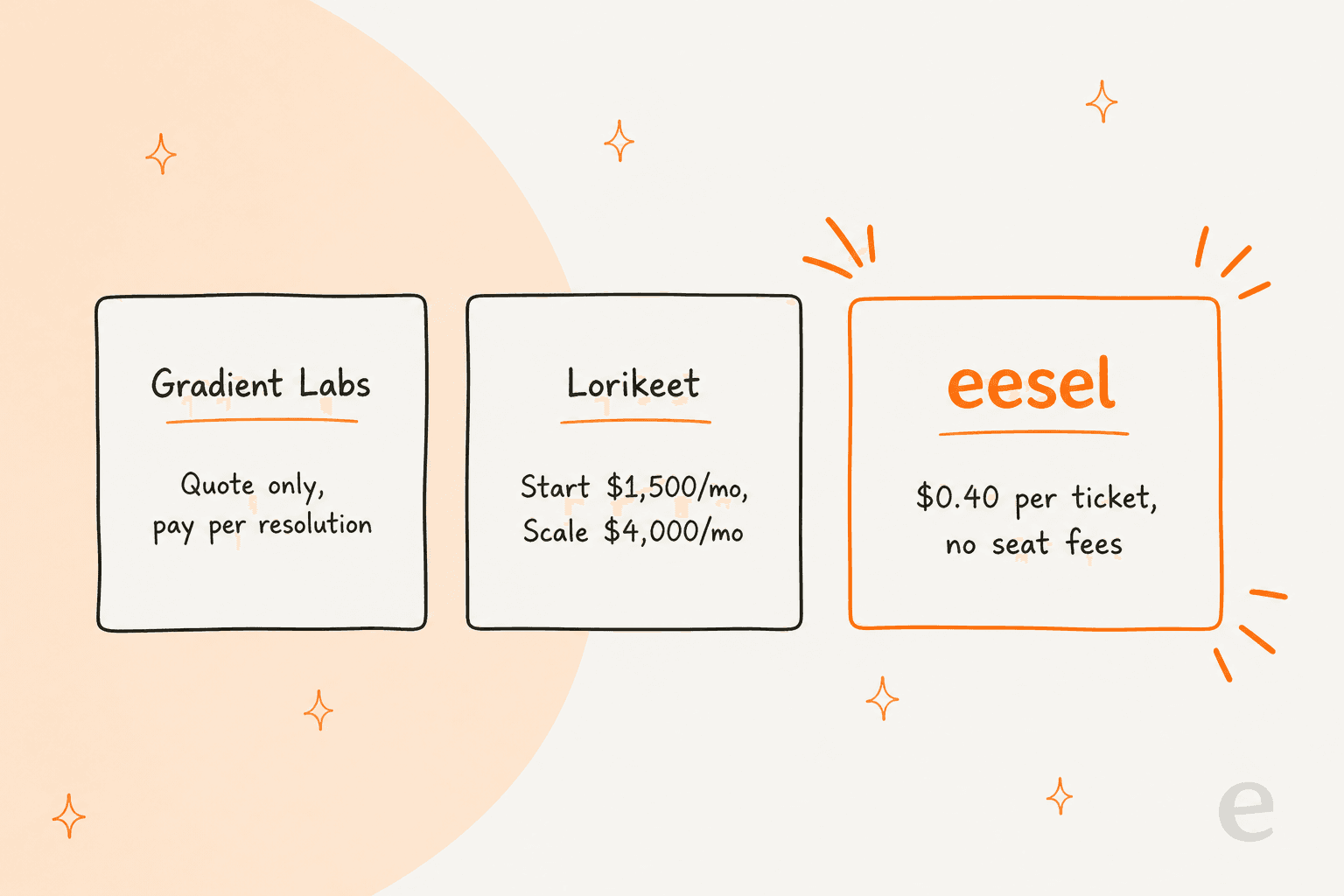
Gradient Labs publishes no number at all. Its pricing page is a lead-capture form. The model is described in words, "outcomes based pricing without platform fees, pay only for successful query resolutions", and CEO Dimitri Masin is on record making the case for it: "If we don't resolve the issue and you still need to get your human team involved, then you don't need to pay us." It is a fair model. It just means you cannot know what you will pay without a sales conversation, and the rate is tiered by the resolution level you hit.
Lorikeet actually publishes its plans, which is rare in this category and worth crediting.
| Plan | Price | Credits / year | Best for |
|---|---|---|---|
| Start | $1,500/mo (billed annually) | 18,000 | Startups, under 5,000 monthly tickets |
| Scale | $4,000/mo (billed annually) | 48,000 | 5,000 to 20,000 monthly tickets |
| Enterprise | Custom | Custom | 20,000+ tickets or complex builds |
Credits are drawn down per resolved ticket, and the rate drops as you scale:
| Action | Start | Scale |
|---|---|---|
| Chat / email / SMS resolution | 0.95 | 0.80 |
| Voice resolution | 1.50 | 1.20 |
| Routing or analytics tag | 0.30 | 0.25 |
| Automated QA per ticket | 0.30 | 0.25 |
That works out to roughly $1.00 per chat resolution on Start and about $0.80 on Scale, with no per-seat or implementation fees on any tier. Like Gradient, Lorikeet only charges for tickets it actually resolves, and it refunds the AI portion of any ticket its own QA scores as bad.
Neither offers a free trial or self-serve signup. Every entry path is a demo. That is the practical cost most teams underestimate: you are committing to a sales cycle and a multi-week build before you see the agent touch a single real ticket. For comparison, eesel is a flat $0.40 per ticket with no seat fees and no platform fee, and you can start on $50 of free usage without talking to anyone.
So which one, and for whom?
Once you line them up, the choice is actually clean.
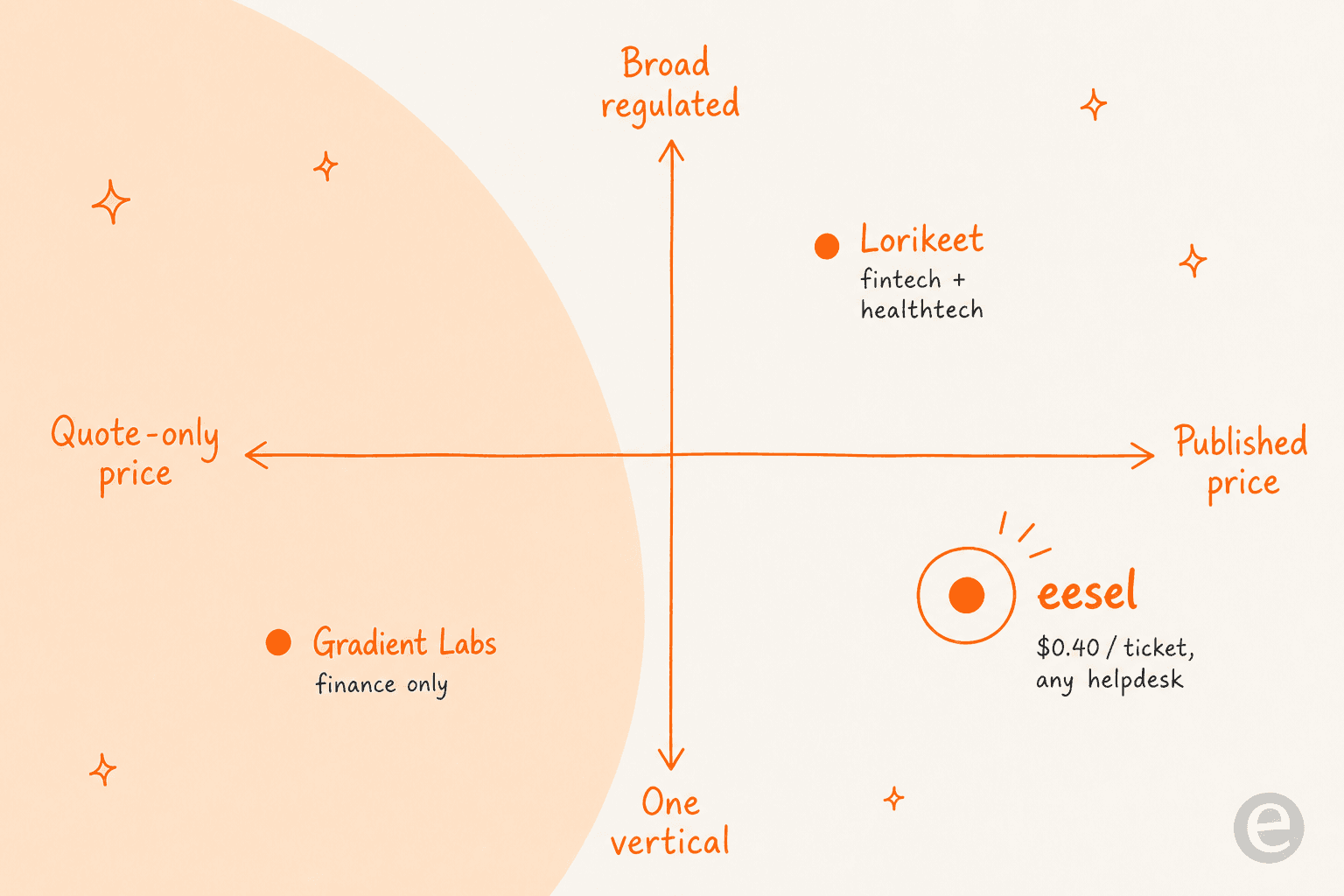
Pick Gradient Labs if you are a bank, lender or insurer and the work you want automated is disputes, KYB, collections or claims. Nobody else on this shortlist goes as deep into regulated finance operations, and the 20-plus per-turn guardrails are built for exactly that risk profile. You will trade price transparency for that depth.
Pick Lorikeet if you span fintech and healthtech, you want a heavy testing-and-QA stack you can inspect, and you would like to see a real number before you book a call. Its Outcomes model and Coach ops agent are real differentiators, and publishing its pricing earns real trust.
Look past both if the honest description of your situation is "we run a normal helpdesk and want an AI agent handling the repetitive 40 to 60% of tickets, soon." Both Gradient and Lorikeet are enterprise, sales-led, multi-week builds. That is the right call when a mistake is a regulatory incident. It is overkill when it is a WISMO question. This is where a lighter teammate fits, and it is worth being honest that the two tools above are simply not aimed at you.
Try eesel for a faster path
If you read the section above and thought "that is me," here is the pitch, and I will keep it concrete. eesel AI is a support teammate you layer onto the helpdesk you already run, Zendesk, Freshdesk, Gorgias or Front, in minutes rather than a quarter. It learns from your past tickets and help center on its own, so it starts knowing your product instead of waiting on a build team.
The differentiator I would flag, given everything above about demos lying, is the simulation: before eesel answers a single live customer, it replays your real past tickets and scores each draft against what your team actually sent. You deploy from evidence, not a promise. It is a flat $0.40 per ticket, self-serve, with $50 of free usage to test on your own data first. For a regulated finance operation Gradient or Lorikeet may still be the deeper fit, and that is fine. For most support teams, eesel gets you the same "resolve, do not deflect" value live this week.
Frequently Asked Questions
What is the main difference between Gradient Labs and Lorikeet?
How much does Gradient Labs cost compared to Lorikeet?
Do Gradient Labs or Lorikeet offer a free trial?
Which is better for a fintech support team?
Which AI customer support agent is best for a small support team?


Article by
Alicia Kirana Utomo
Kira is a writer at eesel AI with a Computer Science background and over a year of hands-on experience evaluating AI-powered customer service tools. She focuses on breaking down how helpdesk platforms and AI agents actually work so that support teams can make better buying decisions.