8 best Meta Muse Spark Open alternatives in 2026, compared on license, price and hardware

Rama Adi

Katelin Teen
Last edited October 18, 2026
Why people look past Muse Spark Open
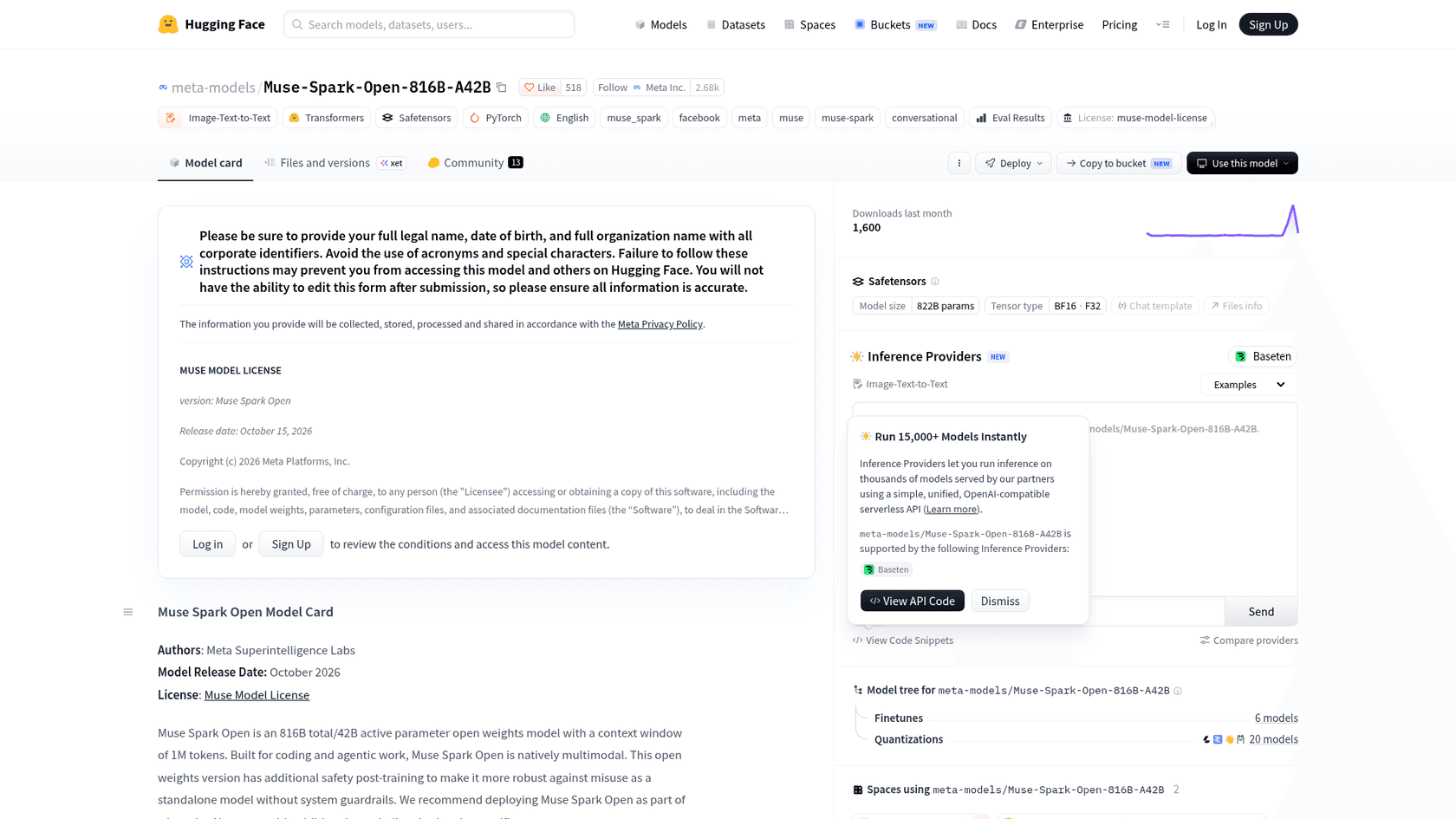
Meta released Muse Spark Open on October 15, 2026, and it's a serious model. It's an 816B-parameter mixture-of-experts with 42B active per token, a 1M-token context window, and native text, image, audio and video input, per Meta's research blog. It's also the first model in its class that runs on a desk: two M5 Ultra Mac Studios, using Apple's MLX at 24.99 tokens per second.
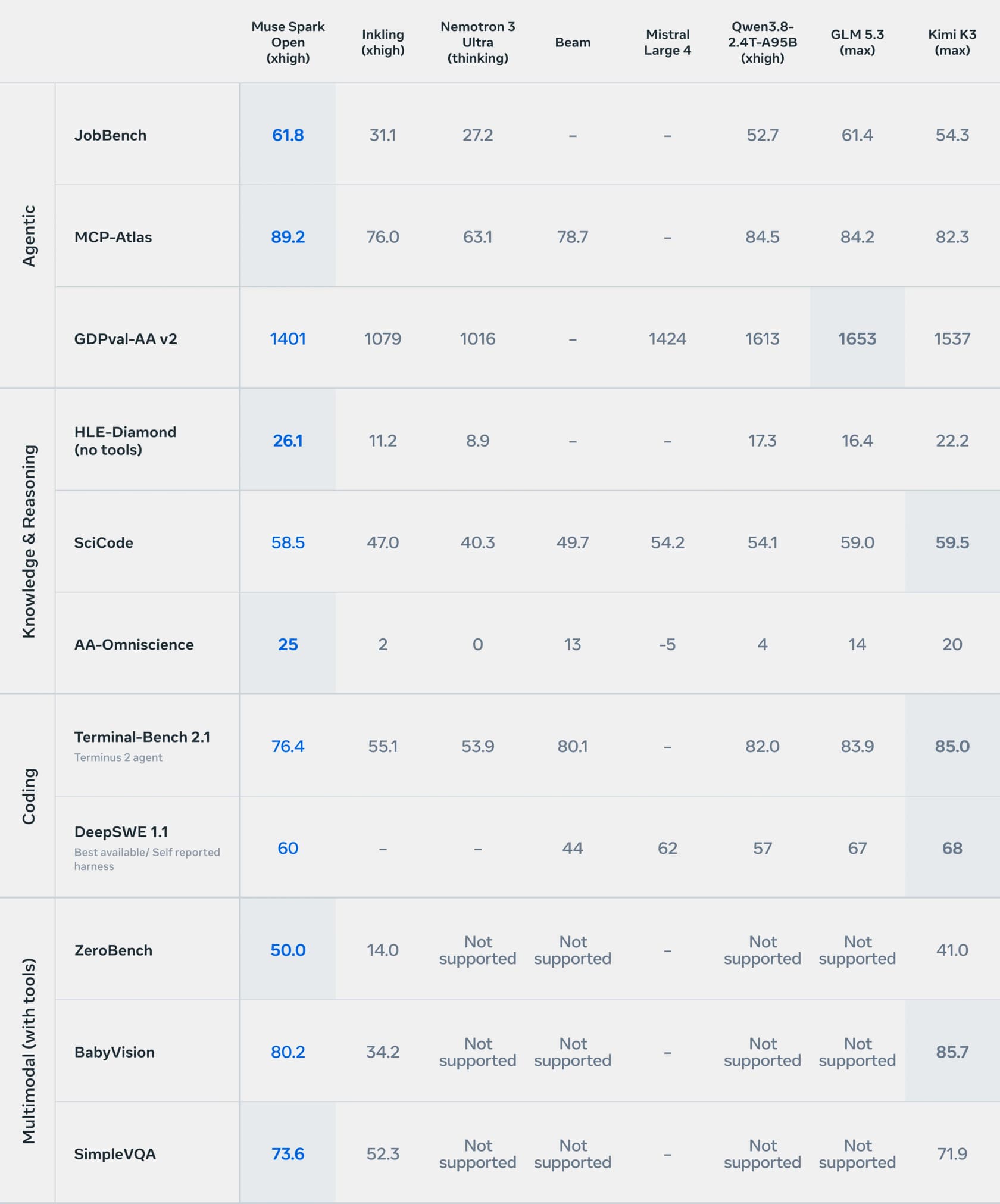
I build integrations and APIs at eesel, so the first thing I do with any new model is read the license and the rate card before the benchmark chart. Muse Spark Open has real strengths there. It leads its peers on Meta's model card for MCP-Atlas (89.2), JobBench (61.8) and HLE-Diamond (26.1), and it posts a 0.5 on StrongREJECT, where every other model in the table sits between 62.9 and 86.4. For an agent that calls tools all day and has to refuse bad requests, that is a meaningful lead.
But four things keep showing up when people decide to look elsewhere:
- The score. Meta's own table puts Muse Spark Open at 39 on the Artificial Analysis Intelligence Index, behind GLM 5.3 (45), Kimi K3 (44) and Qwen3.8 (40). It also trails on coding: 60 on DeepSWE against 68 for Kimi K3.
- The license. The Muse Model License requires you to "prominently display 'Built with Muse Spark Open'" in every product that uses it, at any size. Model-hosting businesses above $20 million in revenue also need a separate deal with Meta.
- The price. Every host on OpenRouter charges $1.25 in and $4.25 out per million tokens, the same card as the closed Muse Spark 1.3. Open weights usually bring hosted prices down. These didn't.
- Over-refusals. On FORTRESS, Muse Spark Open's over-refusal score is 17.4, against 2.7 for Kimi K3 and 3.2 for GLM 5.3. The safety training that makes it hard to jailbreak also makes it say no to more harmless requests.
The Hacker News launch thread landed on the same two points:
"The model license requires large inference providers to contact Meta separately to obtain a license to serve the model. I know we've seen this before with other large models, but it's still a bit irritating. The usual effect of separate licensing is decreased price competition from public providers (like we saw with Kimi K3)."

"Well, this is much better than nothing -- we should be grateful that whatever the market conditions and corporate incentives, a major lab is releasing a capable open-weight model. But still very far behind DeepSeek and GLM. Even on consumer hardware, Qwen 3.8 27B is going to compare favorably to this."
How I picked these alternatives
Before writing this, I asked ChatGPT what a builder should compare Muse Spark Open against, and recorded the searches it ran. It went straight to "best open-weight language models 2026 Qwen DeepSeek Kimi GLM" and came back with six names: GLM 5.3, Kimi K3, Qwen3.8, DeepSeek V4, Mistral Large 4 and gpt-oss-120b. I kept all six and added the two other open models from Meta's own comparison table, Nemotron 3 Ultra and Inkling.
Every alternative here had to meet three rules:
- The weights are downloadable today, or the vendor has a dated public promise (only Mistral Large 4 falls in that bucket, and I flag it).
- Prices come from the vendor's own page, or from a named host's own pricing page when the lab doesn't sell the model directly.
- Scores come from one place where possible. I use Meta's comparison table, because it ran every model through the same harness, and I say so when a number comes from somewhere else.
I compared each one on the same four questions: what it beats Muse Spark Open on, where it falls short, what it costs, and what the license asks of you.
Muse Spark Open alternatives at a glance
| Model | Maker | Total / active params | Context | Input types | License | Strings attached | Score on Meta's table | Hosted price, in / out per 1M | Self-host minimum | Reasoning can be turned off |
|---|---|---|---|---|---|---|---|---|---|---|
| Muse Spark Open (baseline) | Meta | 816B / 42B | 1M | Text, image, audio, video | Muse Model License | "Built with" label on every product; deal for model hosts over $20M revenue | 39 | $1.25 / $4.25 | 2 Mac Studios (M5 Ultra) | No |
| GLM 5.3 | Z.ai | 744B / 40B | 1M | Text only | GLM-5.3 License (MIT-style) | Security review only for model hosts over $10B revenue | 45 | $1.40 / $4.40 | Not stated | No |
| Kimi K3 | Moonshot AI | 2.8T / 104B | 1M | Text, image, video | Kimi K3 License (MIT-style) | Show "Kimi K3" past 100M users or $20M/month; deal for model hosts over $20M | 44 | $3.00 / $15.00 | Not stated (2.8T params) | No |
| Qwen3.8 2.4T | Alibaba | 2.4T / 95B | 262K native, up to 1M | Text only (open base) | Qwen3.8 License | Show name past 100M users or $20M/month; license for model hosts over $50M | 40 | $2.00 / $6.00 (Qwen3.8 Max) | Not stated | No (open base) |
| DeepSeek V4.1 Flash | DeepSeek | 552B (8B / 16B active) | 1M | Text, image | MIT | Keep the copyright notice | Not in table | $0.15 / $0.60 off-peak | Not stated | Yes |
| gpt-oss-120b | OpenAI | 117B / 5.1B | 128K | Text only | Apache 2.0 | Notices on redistribution | Not in table | $0.15 / $0.60 (Together) | 1 x 80GB GPU | No (low / medium / high) |
| Mistral Large 4 | Mistral AI | 1.05T / 52B | 1M | Text, image | Not named yet | Weights due end of October | 38 | $0.68 / $2.09 (sale) | Not stated | Hybrid model |
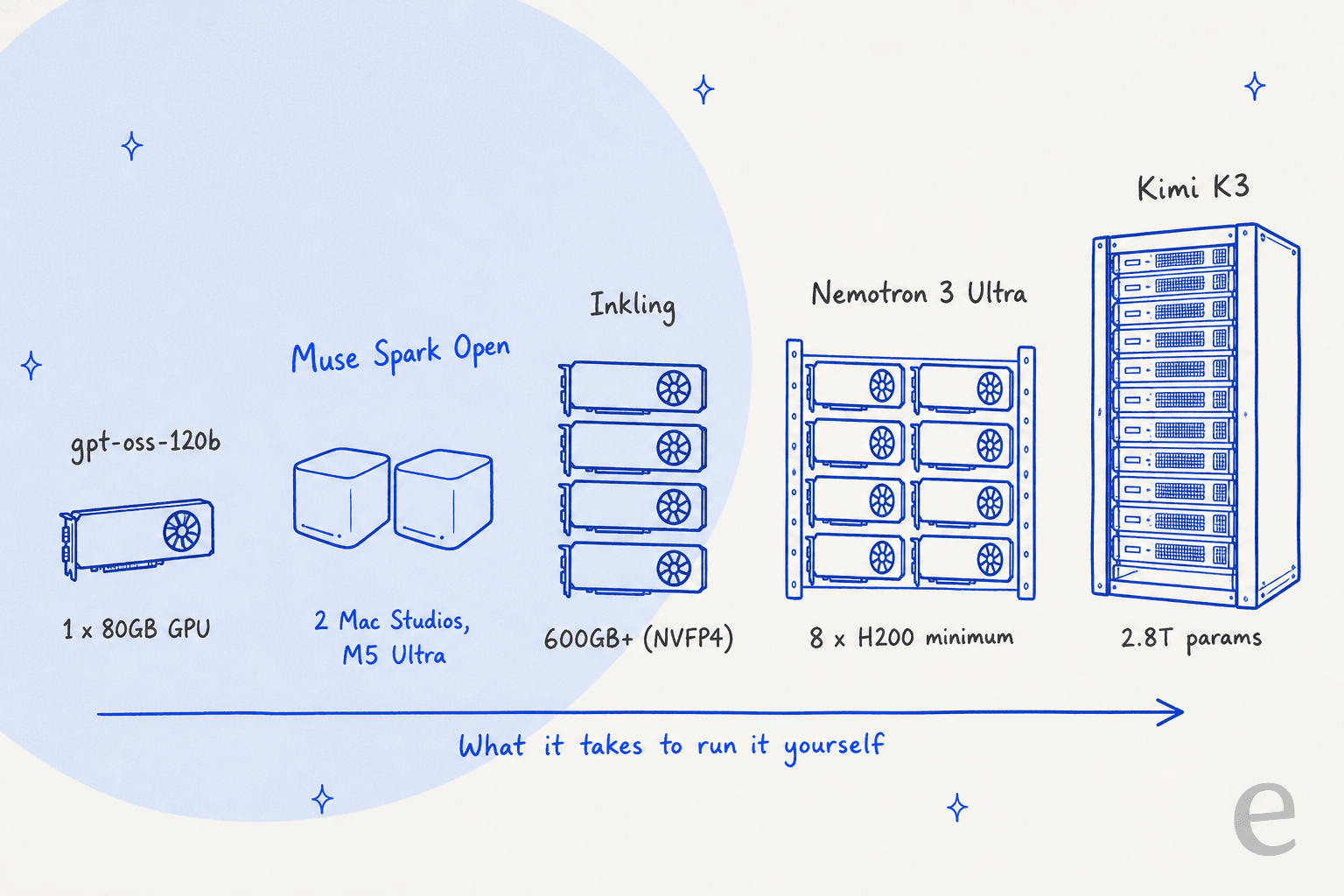
| Nemotron 3 Ultra | NVIDIA | 550B / 55B | Up to 1M (262K in config) | Text only | OpenMDW-1.1 | Notices on redistribution | 23 | $0.50 / $2.20 (DeepInfra) | 8 x H200 | Yes |
| Inkling | Thinking Machines Lab | 975B / 41B | 1M | Text, image, audio | Apache 2.0 + usage policy | Usage policy (AI disclosure) | 26 | $1.00 / $4.05 | 600GB+ (NVFP4) | Effort control |
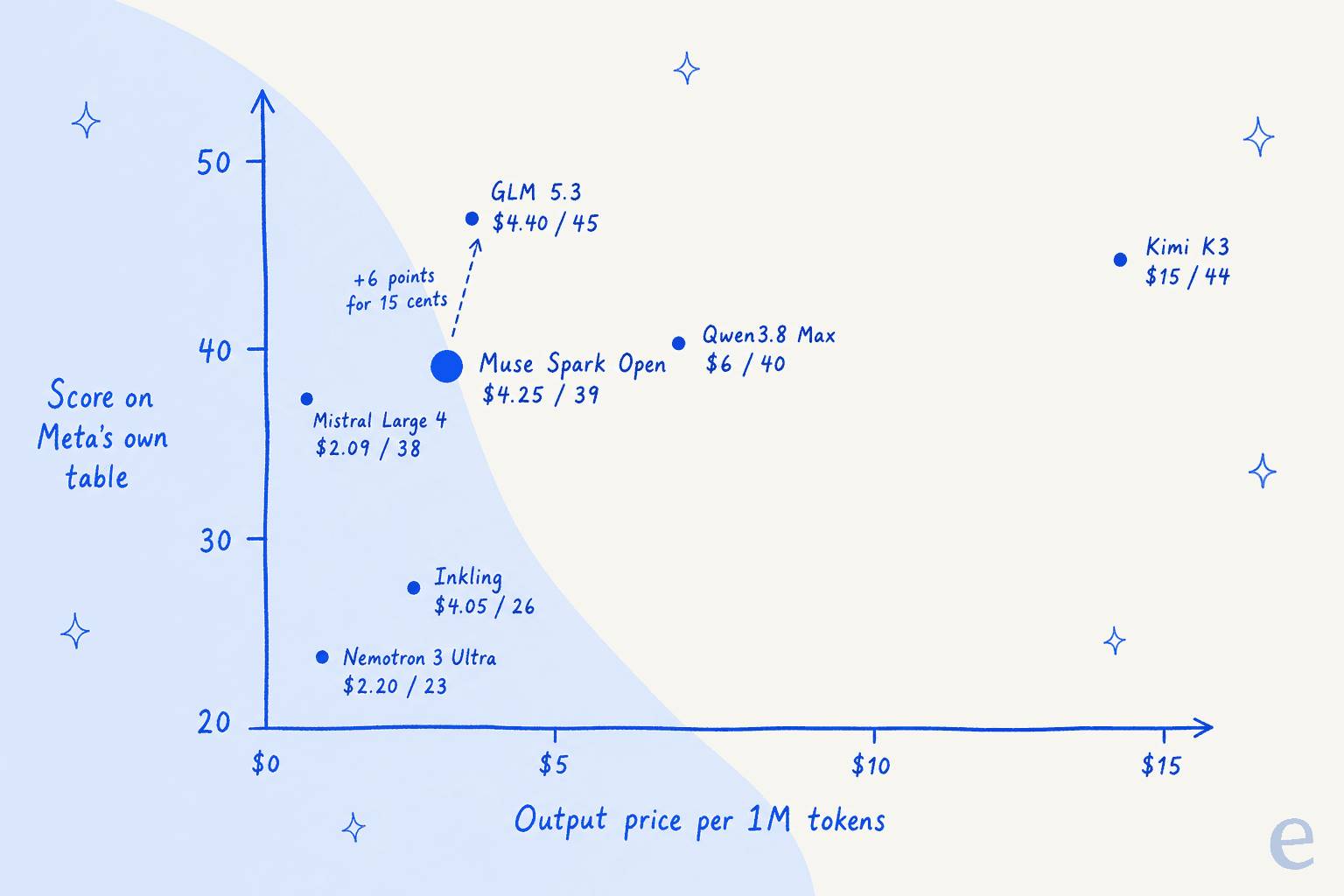
The chart is the whole argument in one picture. Muse Spark Open sits in the middle of the pack on price and score. GLM 5.3 is almost directly above it. Kimi K3 buys a few points with a much bigger bill, and Mistral Large 4 is cheaper for about the same score, but only on a preview API for now.
Which alternative fits your reason for leaving?
Most people aren't leaving Muse Spark Open for "a better model" in general. They're leaving for one specific reason. Pick yours and the matching pick shows below.
Pick the reason that's pushing you off Muse Spark Open to see the alternative I'd test first. All numbers come from the vendor pages and Meta's table cited below.
1. GLM 5.3
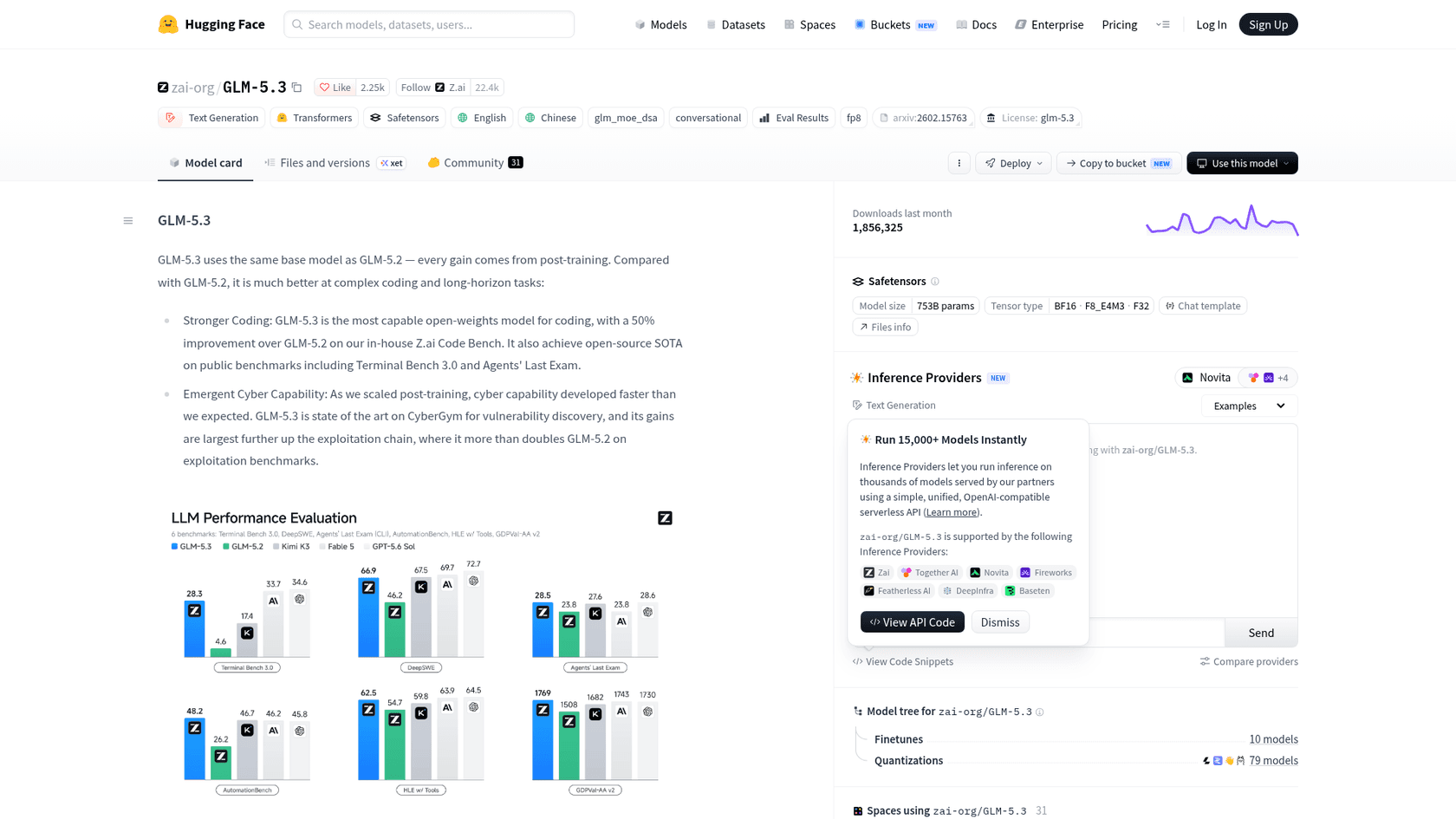
Best for: teams that want a straight upgrade on Muse Spark Open at nearly the same price, with a lighter license.
GLM 5.3 is Z.ai's flagship, launched August 14, 2026. It's a 744B-parameter mixture-of-experts with 40B active, per Z.ai's GLM-5 download table, with a 1M-token context and up to 128K tokens of output. It's the same base model as GLM-5.2, and the model card says "every gain comes from post-training." Don't confuse it with the smaller GLM 5.3 Flash, which is a different 320B base.
What it beats Muse Spark Open on. On Meta's own table, GLM 5.3 has the highest Intelligence Index score of any open model (45 vs 39), the best GDPVal-AA v2 score (1653 vs 1401), and leads on HLE with tools (62.5 vs 61.0), DeepSWE (67 vs 60) and Terminal-Bench 2.1 (83.9 vs 76.4). It also refuses far fewer harmless requests (FORTRESS over-refusal 3.2 vs 17.4).
Where it falls short. It's text only, so there's no image, audio or video input. Reasoning can't be switched off; the Z.ai docs say "disabling reasoning is no longer supported," and the effort levels are low, high and max. It loses to Muse Spark Open on MCP-Atlas (84.2 vs 89.2) and is much easier to jailbreak (StrongREJECT 62.9 vs 0.5).
"Feels dumber than GLM 5.3 (only open model I use extensively). But is really fast (fireworks.ai)."
Pricing and license. Z.ai's pricing page lists GLM 5.3 at $1.40 per million input tokens, $0.26 cached and $4.40 output, unchanged since launch. That's 15 cents more than Muse Spark Open on both input and output. The GLM-5.3 License is MIT-style with one condition: a model-hosting business whose group revenue exceeds $10 billion must pass Z.ai's security review. Products that embed the model in a feature are excluded from that definition, and there's no display rule.
| Plan | Input per 1M | Cached input per 1M | Output per 1M |
|---|---|---|---|
| GLM 5.3 | $1.40 | $0.26 | $4.40 |
| GLM 5.3 FlashX | $0.37 | $0.075 | $1.25 |
| GLM 5.3 Flash | $0.15 | $0.03 | $0.50 |
Verdict: This is the alternative I'd test first. If you don't need multimodal input, GLM 5.3 gives you a higher score, fewer refusals and a looser license for 15 cents more per million tokens. Skip it only if images, audio or tool-calling accuracy are the core of your workload.
2. Kimi K3
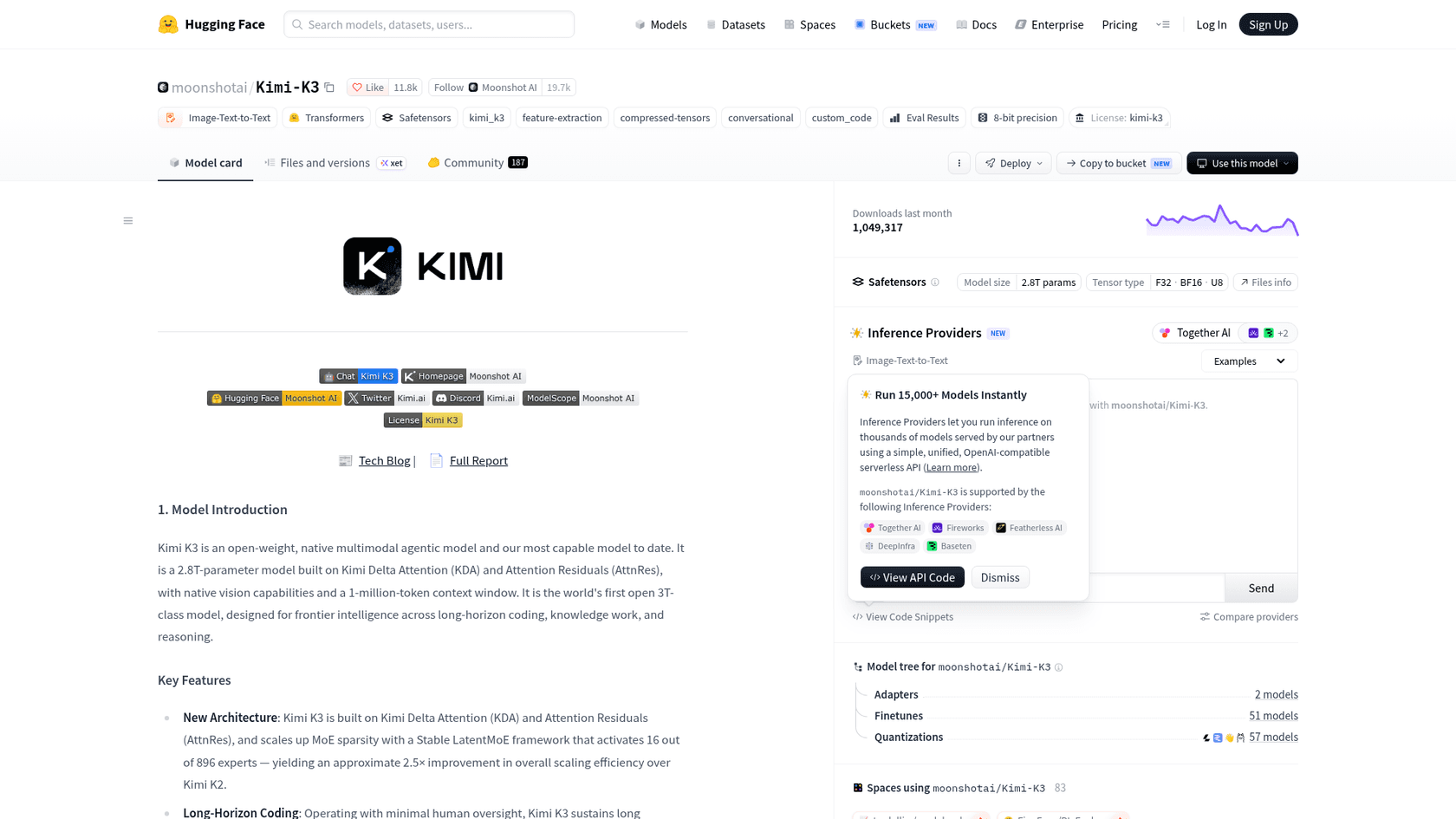
Best for: coding agents and multimodal work where quality matters more than the token bill.
Kimi K3 is Moonshot AI's flagship, released in July 2026 with weights on Hugging Face. It's the biggest model here: 2.8T total parameters, 104B active, 896 experts with 16 picked per token. It reads text, images and video natively and holds 1M tokens of context, with output configurable up to 1,048,576 tokens per the K3 quickstart.
What it beats Muse Spark Open on. Kimi K3 is the coding leader in Meta's table: DeepSWE 68 vs 60, SWE-Atlas-QnA 66 vs 58, Terminal-Bench 2.1 85.0 vs 76.4. It also wins on OSWorld Verified (84.8 vs 80.4), Toolathlon (76.5 vs 72.8) and the video benchmark VideoMMEv2 (65.4 vs 61.5). It has the lowest over-refusal score in the set at 2.7.
Where it falls short. Muse Spark Open beats it on MCP-Atlas (89.2 vs 82.3), JobBench (61.8 vs 54.3) and safety. Meta's card reports Kimi K3 refused only 75.5% of jailbreaks on Meta's internal cyber benchmark, against 99.2% for Muse Spark Open. Reasoning can't be turned off, and the API won't take public image URLs, only base64 or uploaded file IDs.
Pricing and license. Moonshot's pricing page lists $3.00 per million input tokens, $0.30 cached and $15.00 output, flat across the full 1M context. A newer detail: cache writes now bill separately, at $3.00 per million for a 5-minute cache and $6.00 for a 1-hour cache. The Kimi K3 License is close to Muse Spark Open's on the hosting side (a separate deal for model-hosting businesses over $20 million a year), but its display rule only kicks in above 100 million monthly users or $20 million in monthly revenue.
"I believe it's because they are below $20 Million revenue limit (which Kimi K3's license has) So we won't see any price decrease unless Kimi changes the license of K3"
Verdict: Kimi K3 is the pick when coding scores decide the project. It costs 3.5x Muse Spark Open's output price, so I'd only reach for it for the jobs that need it, and route everything else to something cheaper. My Kimi K3 pricing breakdown has the cost math.
3. Qwen3.8
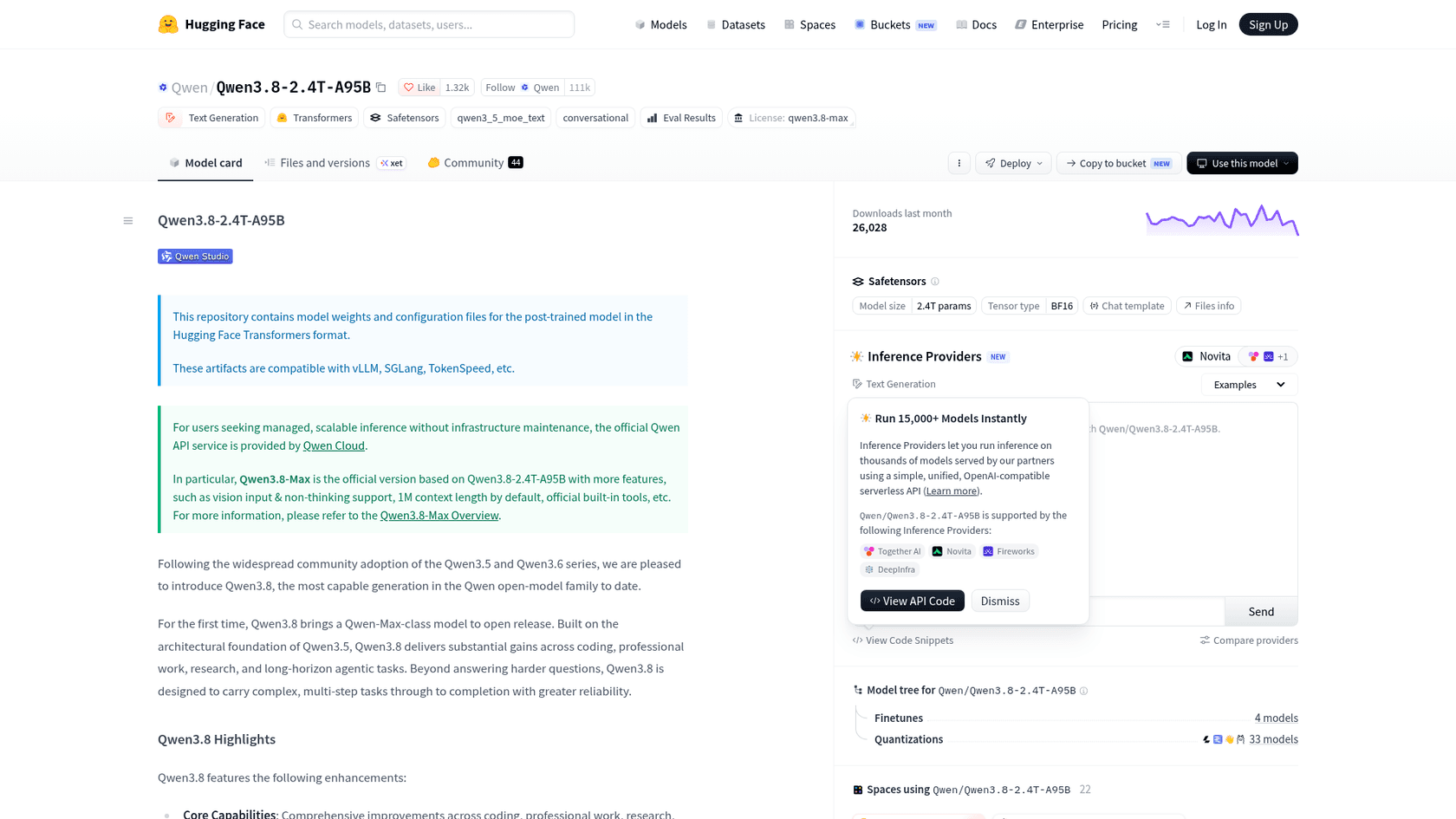
Best for: teams that want one model family that scales from a single Mac to a hosted flagship.
Qwen3.8 is really two open releases. The big one, Qwen3.8-2.4T-A95B, is a 2.4T-parameter mixture-of-experts with 95B active. Its context is 262,144 tokens natively, extensible to about 1M. The small one, Qwen3.8-27B, is a dense 27B model that reads images and video and lets you switch thinking off per request. The hosted Qwen3.8 Max is built on the big base with vision, a non-thinking mode and built-in tools added.
What it beats Muse Spark Open on. On Meta's table, the 2.4T open base scores 40 on the Intelligence Index (one point ahead), ties Kimi K3 for the best GPQA Diamond score (93.5 vs 89.0), and beats Muse Spark Open on Terminal-Bench 2.1 (82.0 vs 76.4), SWE-Atlas-QnA (62 vs 58) and GDPVal-AA v2 (1613 vs 1401). The 27B is the real surprise: Apple's MLX benchmarks show it fits on one Mac Studio using up to 68GB of memory at a 65,536-token context.
Where it falls short. The open 2.4T base is narrower than people expect. The model card says it "is a text-only model that requires thinking mode for all interactions," so the vision and non-thinking features belong to the hosted Max only. It trails Muse Spark Open on MCP-Atlas (84.5 vs 89.2), JobBench (52.7 vs 61.8) and HLE-Diamond (17.3 vs 26.1).
"From running small models like Qwen3.8-27B to large models like Qwen3.8-2.4T. I can tell you that small models will never be enough or match up. Everyone will want the smartest model, not just a good enough model."
Pricing and license. Alibaba doesn't sell the open base directly. The hosted route is Qwen3.8 Max on QwenCloud at $2 in and $6 out per million tokens, with implicit cache hits at $0.25. The 27B now has its own hosted page at $0.50 in and $3 out. The 2.4T base ships under the Qwen3.8 License, with a display rule above 100 million monthly users or $20 million monthly revenue, and a separate license for model-hosting or AI work assistant businesses above $50 million. The 27B is plain Apache 2.0.
| Model | Input per 1M | Cached input per 1M | Output per 1M | License |
|---|---|---|---|---|
| Qwen3.8 Max (hosted) | $2.00 | $0.25 (implicit) | $6.00 | Hosted only |
| Qwen3.8-27B (hosted) | $0.50 | $0.10 (implicit) | $3.00 | Apache 2.0 |
| Qwen3.8-2.4T-A95B | Self-host or third-party | n/a | n/a | Qwen3.8 License |
Verdict: Qwen3.8 is the family pick. Use the 27B where you'd have used a small Muse model on a laptop or one Mac, and the hosted Max when you need the big one. If you want the 2.4T for its open weights, remember it's text-only. For head-to-heads, see Qwen3.8 Max vs Kimi K3.
4. DeepSeek V4.1 Flash
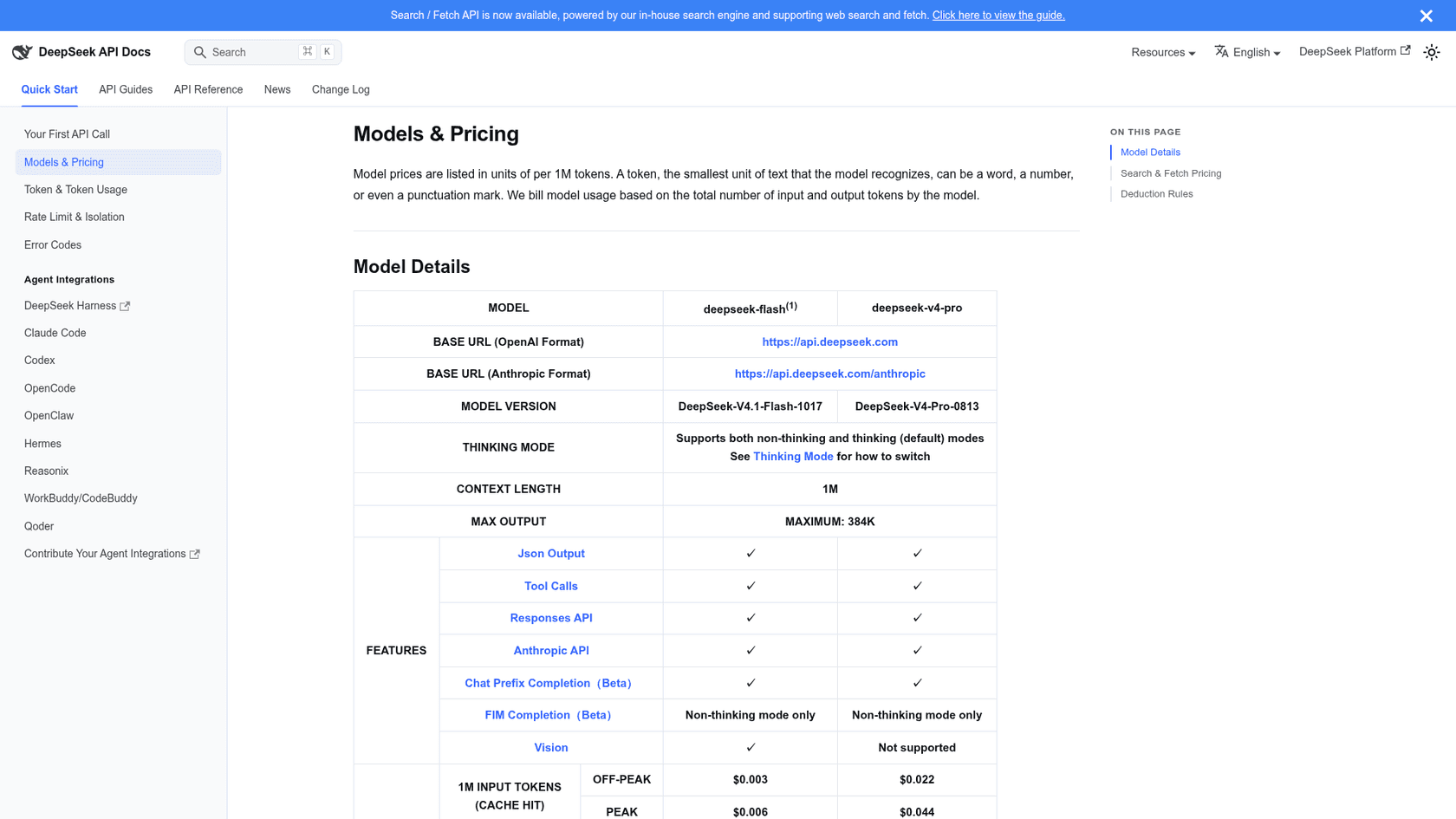
Best for: high-volume workloads where token cost decides everything.
DeepSeek V4.1 Flash launched September 10, 2026, and got an update on October 17: DeepSeek-V4.1-Flash-1017, which DeepSeek describes as having "stronger benchmark performance, faster task completion, and shorter outputs than the previous version." It's a 552B-parameter mixture-of-experts with an unusual split: 8B active parameters for reading input and 16B for writing output, per the launch notes. It has a 1M context, up to 384K output tokens, and vision input.
What it beats Muse Spark Open on. Price, by a mile. And on DeepSeek's own card for the 1017 release, DeepSWE v1.1 rises to 77.0, which would beat every model in Meta's table, though that's a vendor number from a different harness. DeepSeek isn't in Meta's comparison. A commenter on the Muse Spark Open launch thread pointed to Artificial Analysis putting the previous V4.1 Flash on the same score as Muse Spark Open:
"Crucially, it's about the same as DeepSeek v4.1 Flash, and about 10x more expensive to run...
No thanks..."
Where it falls short. Reasoning tokens bill as output, and thinking is on by default, so a cheap rate can still turn into a large bill on long answers. The paid API terms are silent on whether DeepSeek trains on your inputs, with no published zero-retention option, which matters if you plan to send customer data to the first-party API. Hosting the MIT weights yourself or through a third-party host avoids that question.
Pricing and license. The DeepSeek pricing page has two rates. Peak hours are 01:00-04:00 and 06:00-10:00 UTC on weekdays; everything else is off-peak at half price.
| Rate | Cache-hit input per 1M | Cache-miss input per 1M | Output per 1M |
|---|---|---|---|
| Off-peak | $0.003 | $0.15 | $0.60 |
| Peak | $0.006 | $0.30 | $1.20 |
The weights are MIT: keep the copyright notice, and that's it. No revenue thresholds, no display rule.
"I've been using DS v4.1 Flash daily for nearly a month now on Agent Swarm experiments. I've tested it against GLM-5.3-flash and Opus 5.5. DS 4.1 comes out tops for me. Opus 5.5 is still the smartest, but DS 4.1's speed and price more than make up for the "intelligence" gap."
Verdict: If you were going to call Muse Spark Open millions of times a day, run the same test set on DeepSeek V4.1 Flash first. At $0.60 per million output tokens off-peak, it's about 7x cheaper under the most permissive license in this list. See DeepSeek V4.1 Flash pricing for the peak-hour math.
5. gpt-oss-120b
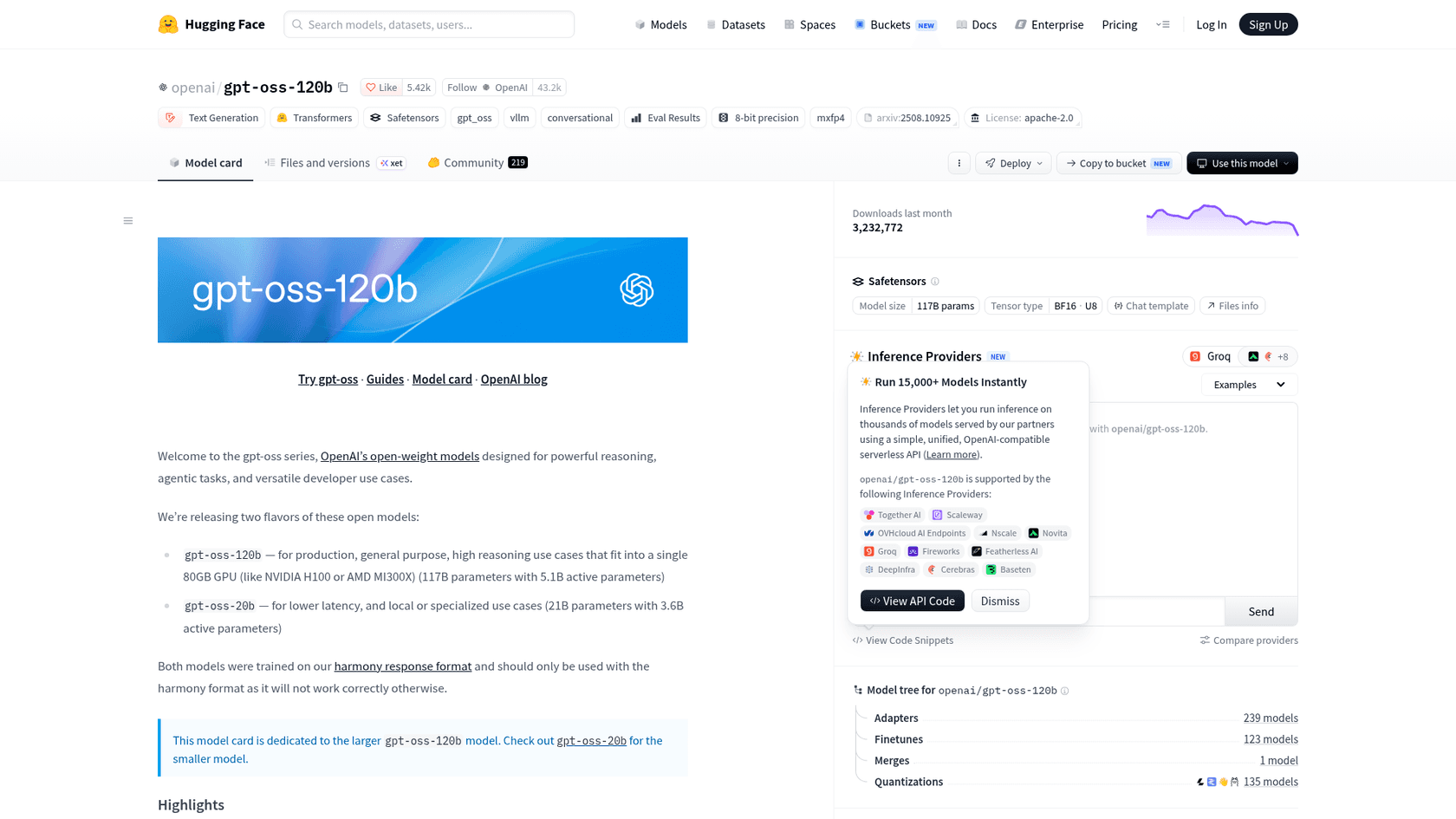
Best for: teams that need to self-host on one GPU, and anyone who wants a cheap baseline to test bigger models against.
gpt-oss-120b is OpenAI's open-weight model from August 2025. It's 117B total parameters with only 5.1B active per token, quantized so it runs "on a single 80GB GPU (like NVIDIA H100 or AMD MI300X)," per the model card. It's text only, with a 128K context and three reasoning levels (low, medium, high) set in the system prompt.
What it beats Muse Spark Open on. Hardware and cost. Muse Spark Open needs two Mac Studios with up to 512GB of memory each, per Apple; gpt-oss-120b needs one card. That makes it the one alternative here that a small team can realistically run on its own server or in a private cloud account.
Where it falls short. It's 14 months old, and OpenAI hasn't shipped a newer gpt-oss model since; the later releases are safety classifiers. It isn't in Meta's comparison table, and the 128K context is an eighth of Muse Spark Open's. It also only works properly with OpenAI's harmony response format; the card says it "will not work correctly otherwise."
"The finding that flips the usual story is the sparse-MoE reversal: on gpt-oss-120b the A100 comes in cheaper per output token than the H100, because the workload is latency-tolerant and the MXFP4 experts fit in 80GB."
Pricing and license. OpenAI doesn't sell it, so hosted prices come from providers. Together AI's pricing page lists $0.15 in and $0.60 out per million tokens, the same as DeepSeek's off-peak rate. The license is Apache 2.0, and the usage policy is one line about following the law.
Verdict: gpt-oss-120b won't match Muse Spark Open on hard agent tasks, and I wouldn't pretend otherwise. But it's the right control model: run your eval on it first, and you'll know how much of Muse Spark Open's extra size you're actually using. Hosts like Together AI and Groq both serve it.
6. Mistral Large 4
Best for: European teams that want an EU-trained, EU-hosted model and can wait a couple of weeks for weights.
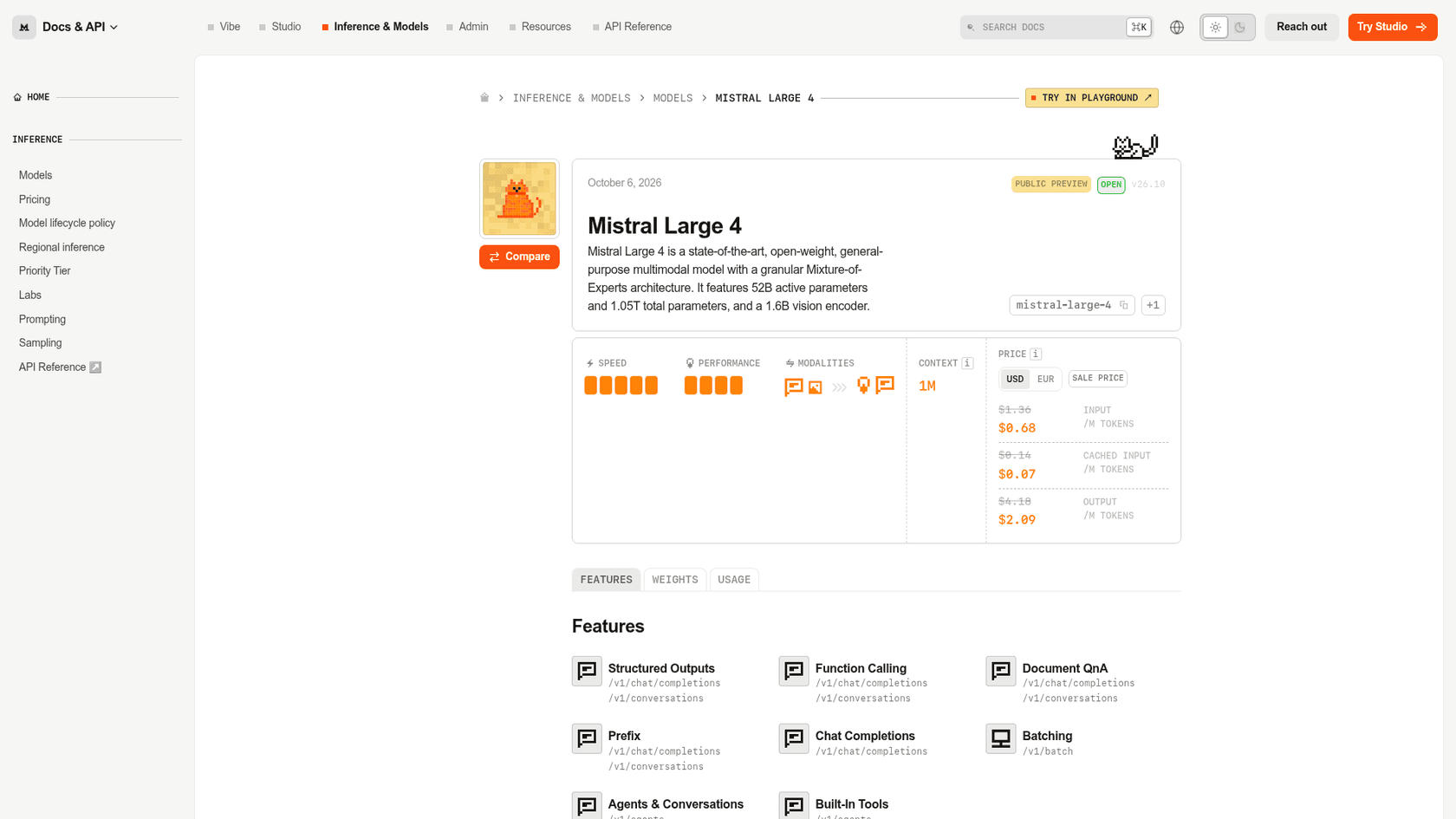
Mistral Large 4 went into public preview on October 6, 2026. The model card lists 1.05T total parameters, 52B active and a 1.6B vision encoder, with a 1M context. Mistral trained it on 3,800 NVIDIA Grace Blackwell GPUs in its own European datacenters, per the launch post.
What it beats Muse Spark Open on. Price, and the European angle. It scores 38 on Meta's table, one point behind Muse Spark Open, at half the output price during the sale. It also edges it on DeepSWE (62 vs 60), SWE-Atlas-QnA (59 vs 58) and GDPVal-AA v2 (1424 vs 1401).
Where it falls short. As of October 18, the weights are not out. There's no Mistral Large 4 repo on Hugging Face, and the launch post still says "we will release the weights by the end of the month." No license has been named, so I wouldn't assume Apache 2.0. Its AA-Omniscience score on Meta's table is -5, the only negative score in the set, against 25 for Muse Spark Open.
"I created a brand new programming language to test LLM models on. It looks like Mistral Large 4 fares about as well as Kimi K3 and Claude Sonnet 5.5. Though it is much slower than Sonnet 5.5 and more expensive than both of those."
Pricing and license. Mistral's pricing page shows a 50% sale with no end date: $0.68 in, $0.07 cached and $2.09 out per million tokens, against a list price of $1.36, $0.14 and $4.18. The license is unannounced.
Verdict: A fair pick if EU training and hosting is the requirement, and the sale price beats Muse Spark Open today. But it isn't an open-weight alternative yet. Check back after October 31 before you build a self-hosting plan around it. My Mistral Large 4 pricing post tracks the sale.
7. Nemotron 3 Ultra
Best for: teams that need the training data and recipe, not just the weights, under a permissive US license.
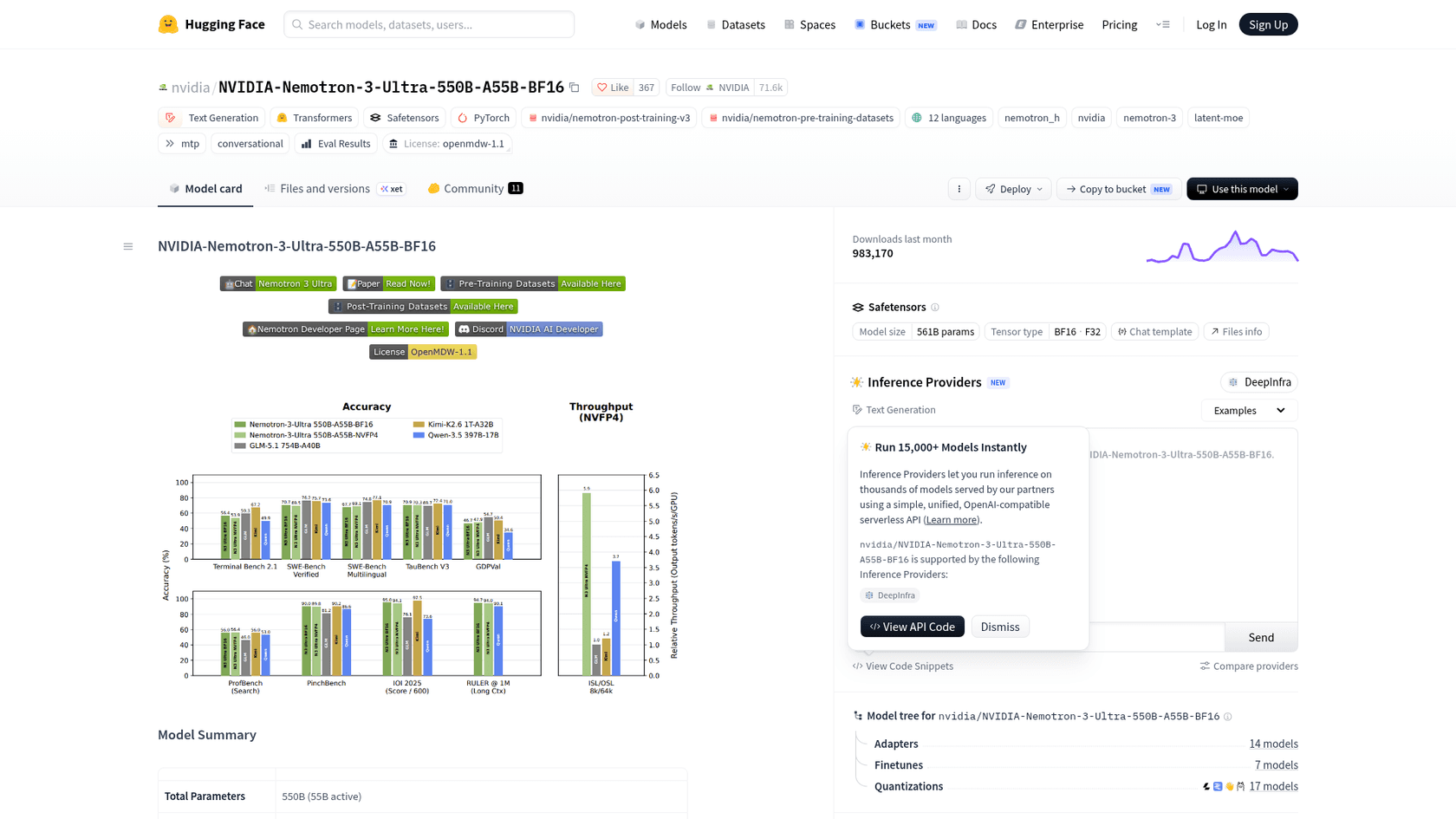
Nemotron 3 Ultra is NVIDIA's largest open model, released June 4, 2026. It's 550B total with 55B active, a hybrid of Mamba-2 layers, attention and mixture-of-experts. It's text only, and reasoning switches on or off in the chat template.
What it beats Muse Spark Open on. Openness. NVIDIA publishes the pre-training and post-training datasets, the RL environments, and a technical report. If you need to explain to an auditor what went into a model, this is the only one in the list where you can. The license is lighter too.
Where it falls short. Capability. It scores 23 on Meta's table, the lowest here, and trails Muse Spark Open on every benchmark where both appear, including MCP-Atlas (63.1 vs 89.2) and Terminal-Bench 2.1 (53.9 vs 76.4). The card says "up to 1M tokens," but the shipped config is set to 262,144. Minimum hardware is 8x H200 or 16x H100.
"Each of the Nemotron 3 models were briefly competitive when they launched, but never exceptional, and less competitive with each scale up. The fact that it took so long for Nemotron 3 Ultra to launch really hampered its competitiveness. The Nemotron 3 series is extremely open about training recipes and training data, far more open than most open weight models, and that is valuable."
Pricing and license. NVIDIA's build page offers a trial endpoint without a per-token price. DeepInfra lists $0.50 in, $0.10 cached and $2.20 out per million tokens. The license is OpenMDW-1.1: keep the license and notices when you redistribute, and it "does not impose any restrictions or obligations" on outputs.
Verdict: Pick Nemotron 3 Ultra for transparency, not for a smarter model. If your legal or research team needs to know the training data, it's the clear choice. If you just need the best answers, it isn't.
8. Inkling
Best for: audio-plus-text products that want an Apache 2.0 model from a US lab.
Inkling is Thinking Machines Lab's first model, released July 15, 2026. It's a 975B-parameter mixture-of-experts with 41B active, a 1M context per the model card, and input in text, images and 16kHz audio. A smaller Inkling Small (276B, 12B active) followed on July 30.
What it beats Muse Spark Open on. License clarity: the weights are Apache 2.0, with no product label and no revenue clause. Thinking Machines also runs Tinker, a hosted fine-tuning platform, so tuning it on your own data is a supported path rather than a weekend project.
Where it falls short. It scores 26 on Meta's table, and Muse Spark Open beats it on every shared benchmark, often by a wide margin (JobBench 61.8 vs 31.1, MCP-Atlas 89.2 vs 76.0). And while the weights are Apache 2.0, the Hugging Face card links a separate acceptable use policy that says it binds anyone who downloads. It requires telling users they're talking to an AI where that's material, which most support teams already do.
"Very nice, multi modal, largest open weight model that supports audio. Would be interesting to see how good the audio capability is."
Pricing and license. The price dropped. Thinking Machines' serverless inference beta now lists Inkling at $1.00 in, $0.17 cached and $4.05 out per million tokens, as of October 14, with a note that it's "not yet recommended for intensive production use." Together AI charges the same. Inkling Small is $0.30 in and $1.20 out.
Verdict: Inkling is the pick if you need audio input under Apache 2.0. Muse Spark Open also takes audio and scores much higher, so the deciding factor is whether the "Built with Muse Spark Open" label works for your product. For a closer look, see my Inkling review.
The license fine print, side by side
Most comparison posts stop at benchmarks. For open weights, the license decides whether you can ship at all, so here's every obligation in one view.
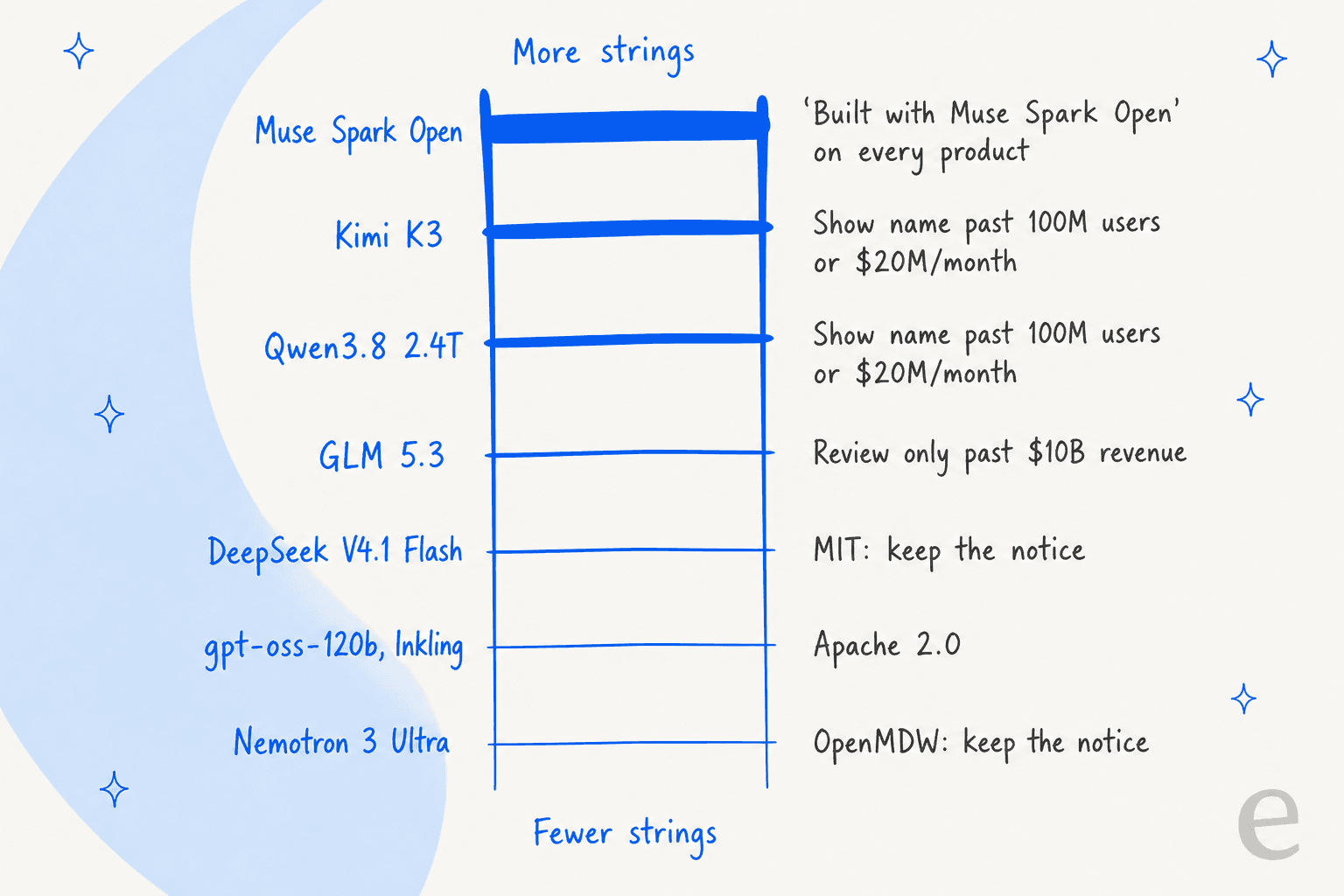
The surprise for me was how unusual Meta's display rule is. Kimi K3 and Qwen3.8 also ask you to show the model's name, but only once you pass 100 million monthly users or $20 million in monthly revenue. Muse Spark Open is the only model here that asks for a label in every product, from day one. Its hosting clause is close to Kimi K3's ($20 million a year), while GLM 5.3 sets its bar at $10 billion and only asks for a security review.
None of this is a dealbreaker for a typical product. A "Built with Muse Spark Open" line in your docs or settings menu satisfies Meta's clause. But if you white-label for clients, or resell inference, read the clause with your lawyer before you pick.
How to choose between them
After working through all eight, here's the order I'd test in, for most teams:
- Start with GLM 5.3 as the direct replacement. Same price band, higher score, lighter license.
- Add DeepSeek V4.1 Flash as the cost check. If it passes your eval, you just cut your bill by about 7x.
- Add gpt-oss-120b as the floor. If it passes too, you probably don't need a 700B+ model for that job.
- Bring in Kimi K3 only for the coding or vision tasks the others fail.
- Keep Muse Spark Open for tool-heavy agents where its MCP-Atlas lead and jailbreak resistance matter, especially anything customer-facing that must refuse cleanly.
The step most teams skip is the eval itself. Benchmarks are averages; your workload isn't. Run 100 of your own real tasks through each candidate on a host like Fireworks AI or Baseten before you commit, and score them the same way.
If the model is for customer support, the model is the smaller decision
A lot of people evaluating open weights in 2026 are doing it for a support bot. I'd say the same thing to all of them: the model is infrastructure. The employee is everything built on top of it.
eesel has spent years running AI on live support queues, and the failure that stung most had nothing to do with model choice. A few paying customers had a bot that, when it couldn't find anything relevant in their knowledge base, filled the gap from the model's general training data and sent confident, wrong answers to real customers. Swapping in a higher-scoring model doesn't fix that. A hard fallback, grounding on your own sources, and testing on real tickets before launch do. That's why every eesel rollout is now simulated against historical tickets before it answers anyone.
So if you're picking between GLM 5.3 and Muse Spark Open for a helpdesk, there's a shorter path. eesel's AI helpdesk teammate plugs into Zendesk, Freshdesk or Gorgias, learns from your past tickets and help center, and shows you how it would have answered last month's tickets before it goes live. One honest limit: eesel runs on hosted frontier models from OpenAI, Anthropic and Google (listed on the security page), not on these open weights, so if self-hosting the model is a hard requirement, eesel isn't the fit.
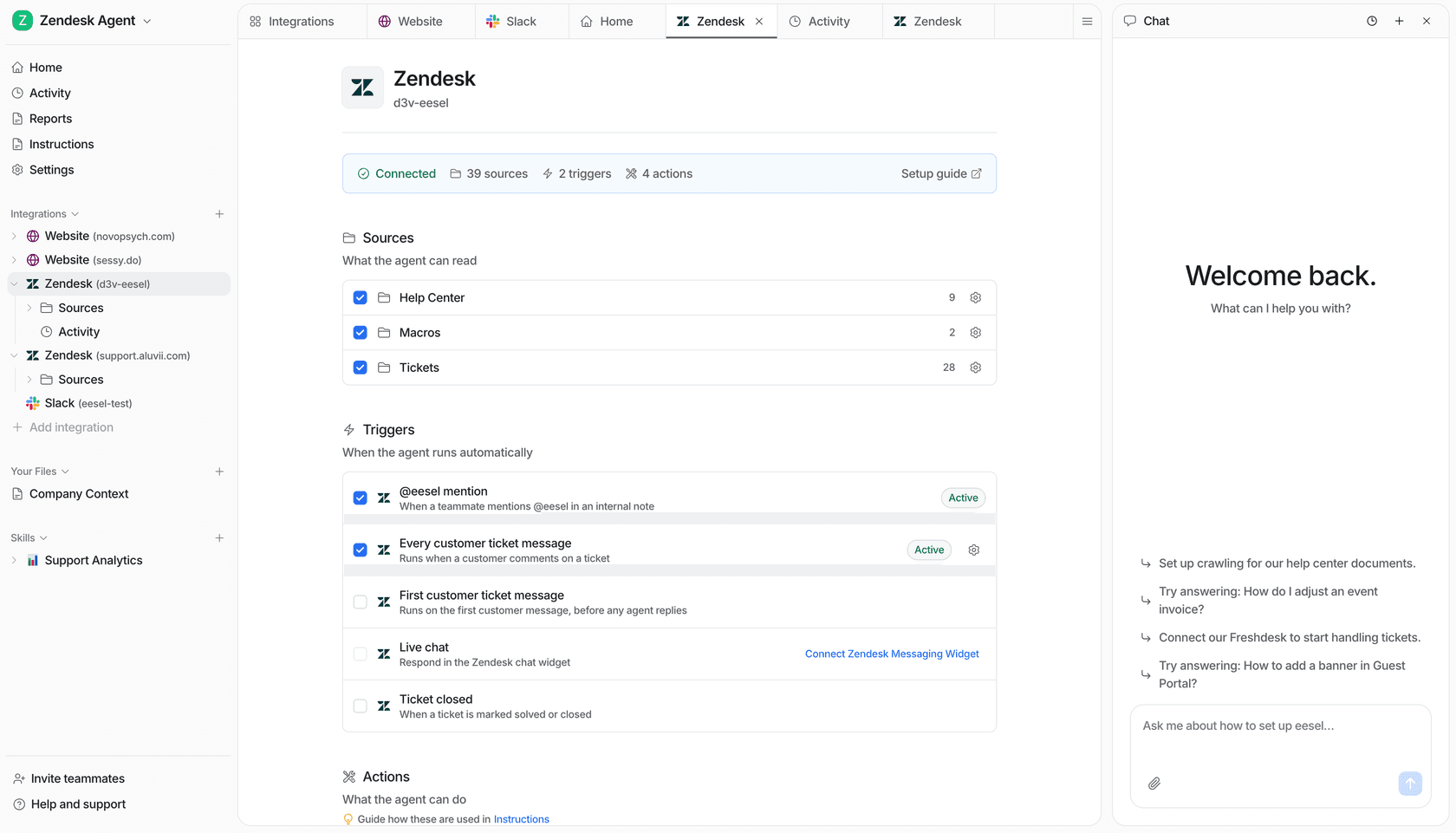
If you're the kind of team that's comparing model licenses, you'll probably want to drive it from code too. The eesel CLI (@eesel/cli on npm) runs the same teammate and workspace from a terminal: connect a helpdesk with eesel integrations connect, read and edit its standing instructions with eesel instructions, approve or deny pending actions with eesel approvals, and review what it did with eesel activity. Every command prints JSON, write commands support --dry-run, and headless tokens work in CI, so a script or a coding agent like Claude Code can operate it as easily as you can. Every workspace is also an MCP server, which I cover in MCP for customer support.
And if your open-weight project is about content rather than tickets, eesel's other teammate is an AI blog writer that researches, drafts and illustrates posts like this one.
Try eesel
Muse Spark Open, GLM 5.3 and the rest are engines. If what you actually need is an AI that answers your customers, eesel is a support teammate that already knows your help center and past tickets, joins your existing helpdesk in minutes, and proves itself on last month's tickets before it touches a live one. Try eesel free, or see how teams compare it in my roundup of the best AI customer support agents.