CWILL pricing 2026: what the free AI chat really costs a Shopify store

Rama Adi

Katelin Teen
Last edited October 22, 2026
How much does CWILL cost?
Short answer: nothing, for now. I build integrations at eesel, including the Shopify order lookups our AI runs before it answers, so I read pricing pages like this one with two questions in mind. What's the unit you'll eventually pay for, and what does the tool connect to without extra work? Here's every price CWILL publishes for AI Chat, checked on its own pages on October 22, 2026.
| Where | What it says | Source |
|---|---|---|
| AI Chat pricing card | Free, $0/month, "100% free, no paid tiers or usage limits" | AI Chat pricing |
| Same page, FAQ | "AI Chat is free today, but a paid tier is coming as usage grows" | AI Chat pricing |
| Same page, trust notes | No credit card on free plans, paid plans "priced for the $3M-$50M revenue range", no annual lock-in on most plans | AI Chat pricing |
| Shopify App Store | Pricing: Free | Shopify listing |
| Bundle page | AI Chat at $0 inside Starter, Professional and Enterprise | Bundle pricing |
| Returns integration doc | "no plan limits or extra charges for this integration" | Help center |
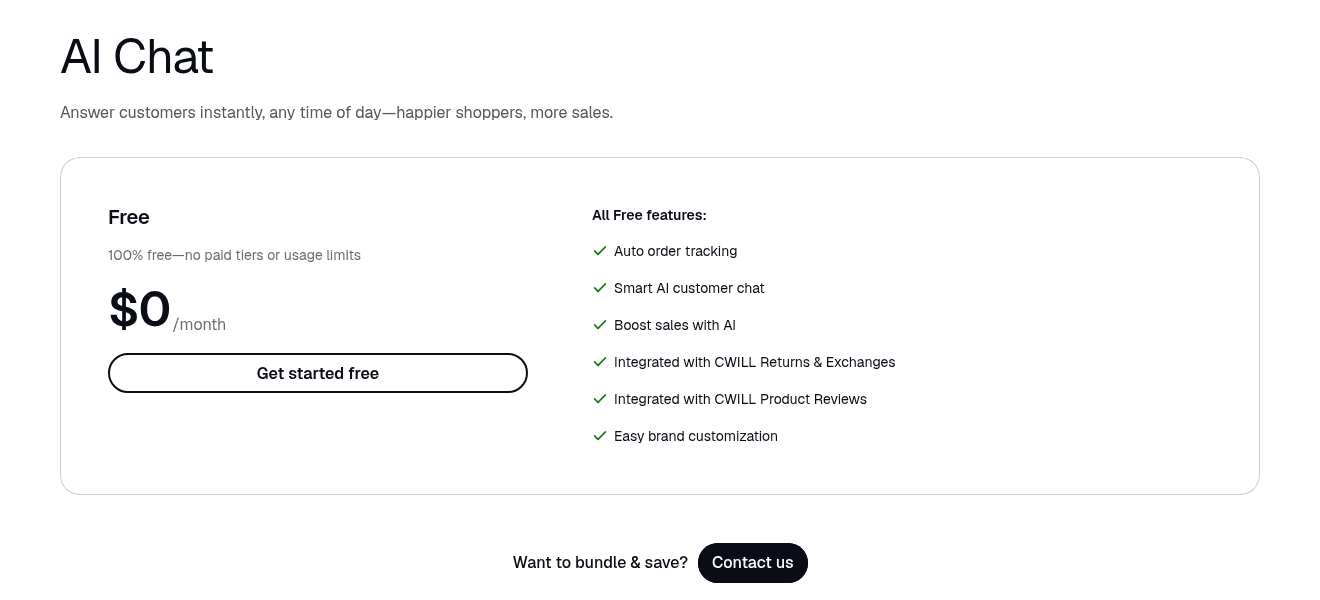
One wrinkle is worth knowing before you read too much into "no paid tiers". The header on the same page says every CWILL capability "has free and paid tiers", AI Chat included, while the AI Chat card underneath says there are none. Then the FAQ says a paid tier is coming. I read that as: free today, priced later, and the page hasn't caught up with itself. That's normal for a young app (it launched on the App Store on April 11, 2025). It just means "free" is a current state, not a promise.
If you want the full feature tour before the money talk, my CWILL review covers how the AI decides what to say and where it hands off.
What does the free plan include?
The pricing card lists six things, and the Shopify listing repeats five of them:
- Auto order tracking. Shoppers type an order number plus email or phone, and the chat shows status and tracking, the core of AI order tracking.
- Smart AI customer chat. Answers from a knowledge base you set up: your Q&A pairs, site pages, files, synced products and Shopify policies.
- Boost sales with AI. Product cards dropped into the chat when a shopper asks for something.
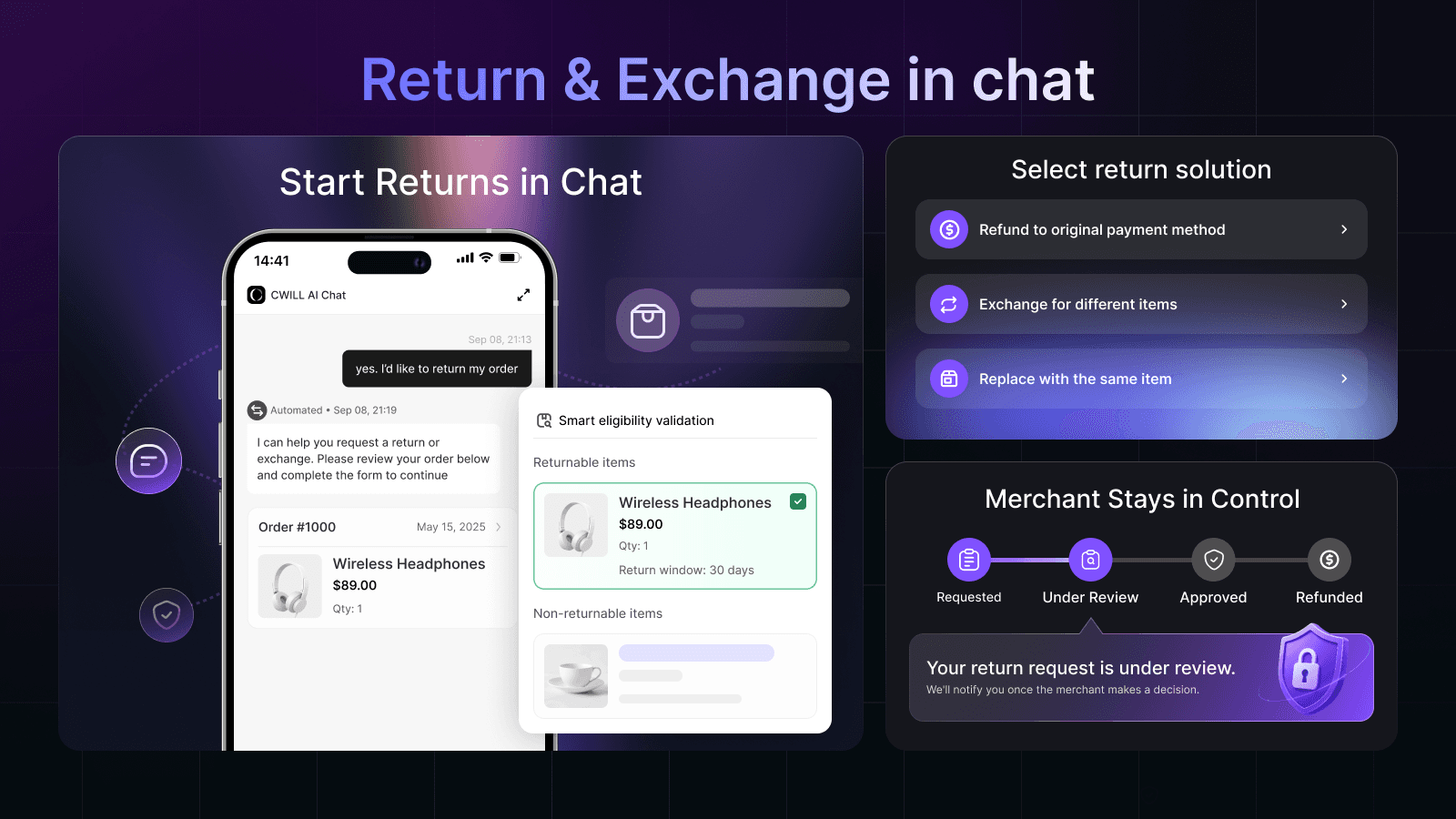
- CWILL Returns & Exchanges integration. Shoppers start a return in chat, if you own the Returns app.
- CWILL Product Reviews integration. Ratings shown and reviews collected in chat, if you own the Reviews app.
- Easy brand customization. Logo, colors and welcome message.
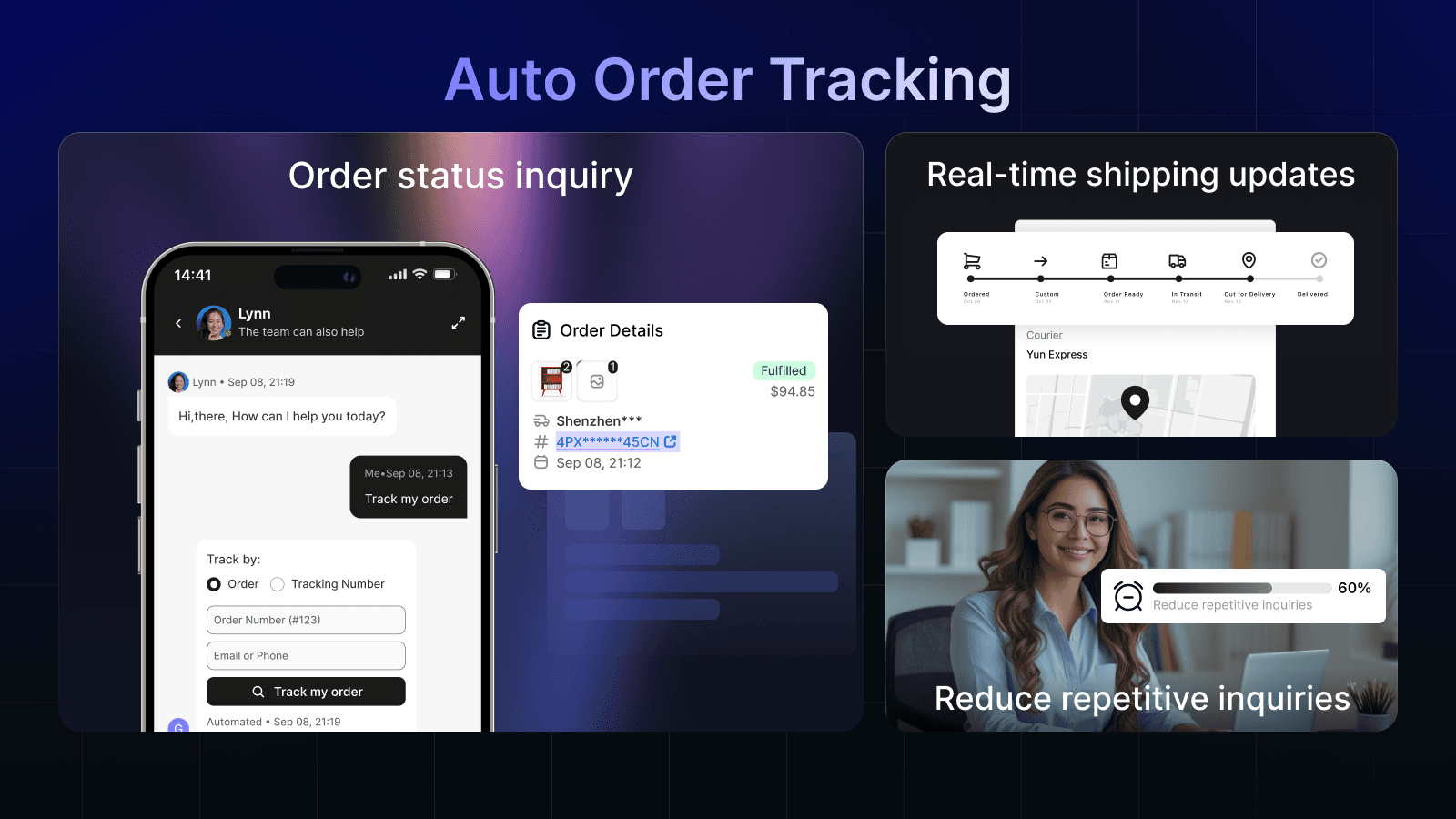
Order tracking is the line I'd value most. "Where is my order?" tends to be the biggest single slice of ecommerce chat, and getting it answered at no cost is real money saved; my piece on WISMO automation covers the rest of that job. The listing also names 21 languages and real-time translation, which matters if you offer multilingual support across Europe.
Notice what two of the six lines depend on. Returns and reviews in chat are free as long as you pay for CWILL's other apps. The chat side costs nothing extra, which the returns doc confirms, but the Returns & Exchanges app is a separate product. That's a sensible business model: give the chat away, and let it make the paid apps more useful.
"No usage limits" is the official line, and for most stores it holds. One merchant with a very large catalog did hit a limit of some kind, and says support lifted it fast:
"Amazing app, Works instantly out the box, instant engagement from consumers. Can't fault this at all. Support also fast when i ran into limits because size of my store is so huge, They solved in seconds."

The integrations list is where I'd slow down. CWILL's pricing FAQ says AI Chat connects to Instagram and Facebook, Gmail and Outlook, Klaviyo and Mailchimp, helpdesks such as Zendesk, Freshdesk and Help Scout, and tracking tools like AfterShip. The Shopify listing's "Works with" section names only Checkout, Shopify Admin, Parcel Panel and ParcelWILL, and the help center has no setup guide for the others. As someone who ships integrations, I'd treat any connection without a setup doc as "ask support to show you" rather than "included".
What are CWILL's bundle prices?
CWILL's main business is the rest of the post-purchase stack, and its bundle page prices those apps by monthly order volume. AI Chat appears in every bundle at $0, next to Pop-up & Email Marketing, also at $0.
| Bundle | Starting price | Orders included | Apps listed with prices | Support |
|---|---|---|---|---|
| Starter | $89/month | 1,000 | Order Tracking $35, Returns & Exchanges $99, Loyalty & Referrals $99, Product Reviews $49, SEO & Speed $59 | Email, 24/7 chat, self-serve onboarding |
| Professional | $145/month | 2,000 | Order Tracking $59, Returns & Exchanges $199, Loyalty & Referrals $169, Product Reviews $69, SEO & Speed $59 | 24/7 support, dedicated onboarding, 1:1 Slack support |
| Enterprise | $567/month | 10,000 | Order Tracking $215, Returns & Exchanges $699, Loyalty & Referrals $999, Product Reviews $199, SEO & Speed $59 | Adds a dedicated CS manager and priority technical support |
The bundle FAQ says CWILL "usually" offers around 20% off annual plans, sometimes with seasonal savings at year end, and that the best bundle pricing comes from booking a demo. If you get close to your order limit, the FAQ says to reach out for an adjusted or custom plan.
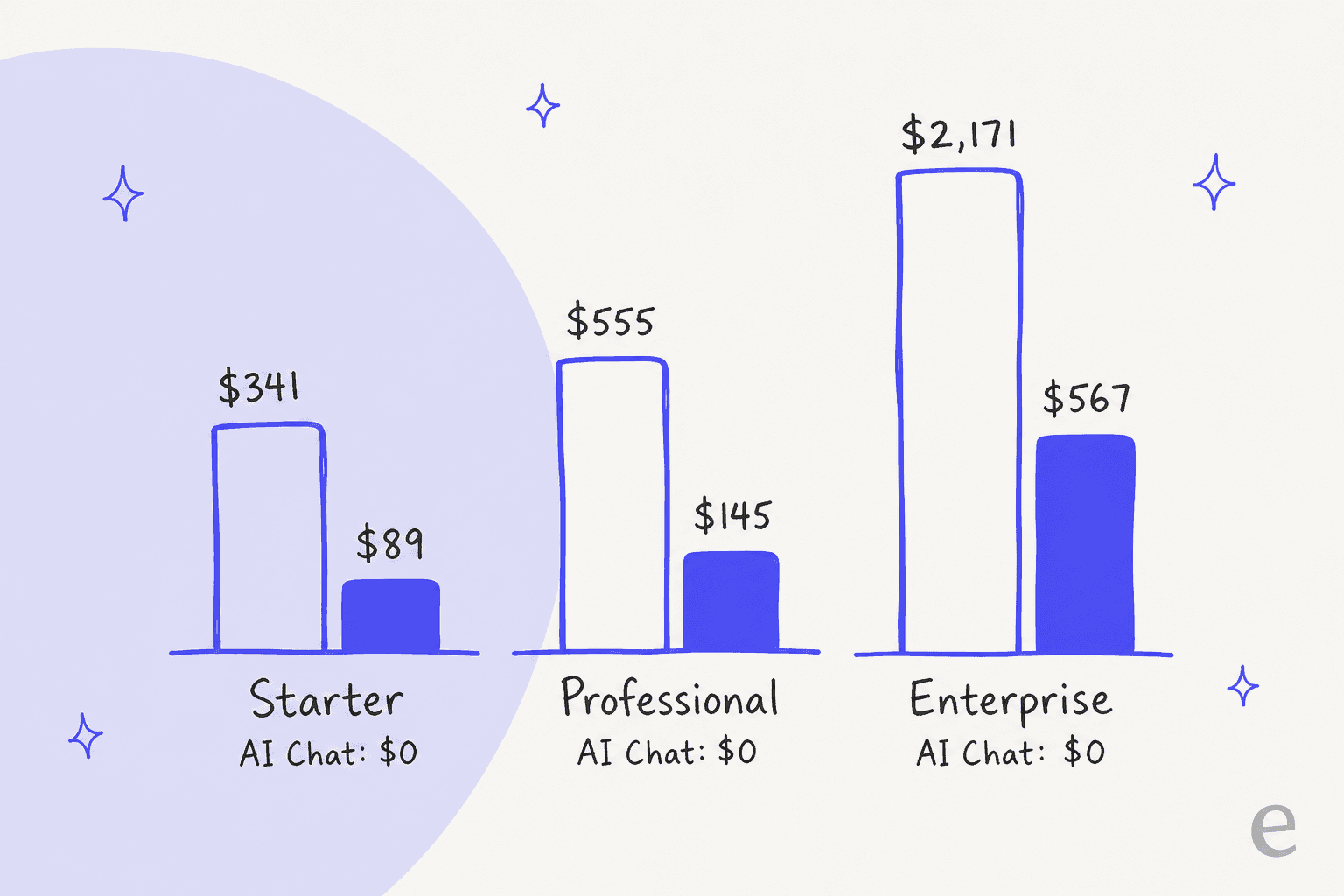
Add up the per-app prices CWILL prints inside each bundle card and you get $341 for Starter, $555 for Professional and $2,171 for Enterprise, against bundle prices of $89, $145 and $567. The outline bars in the chart are those added-up app prices; the solid bars are the bundle. That's the pitch in one picture: the bundle is the cheap way in, and the free chat is what ties the apps together.
My take on who should care: if you already pay for CWILL order tracking or returns, the bundle is worth a demo call, because the chat gets more useful with each app you add. If you only want a chat widget, ignore the bundles entirely. AI Chat is free on its own.
What does "free" really cost a Shopify store?
The app bill is $0, but nobody runs a chat widget for $0. Here's the stack I'd actually budget for.
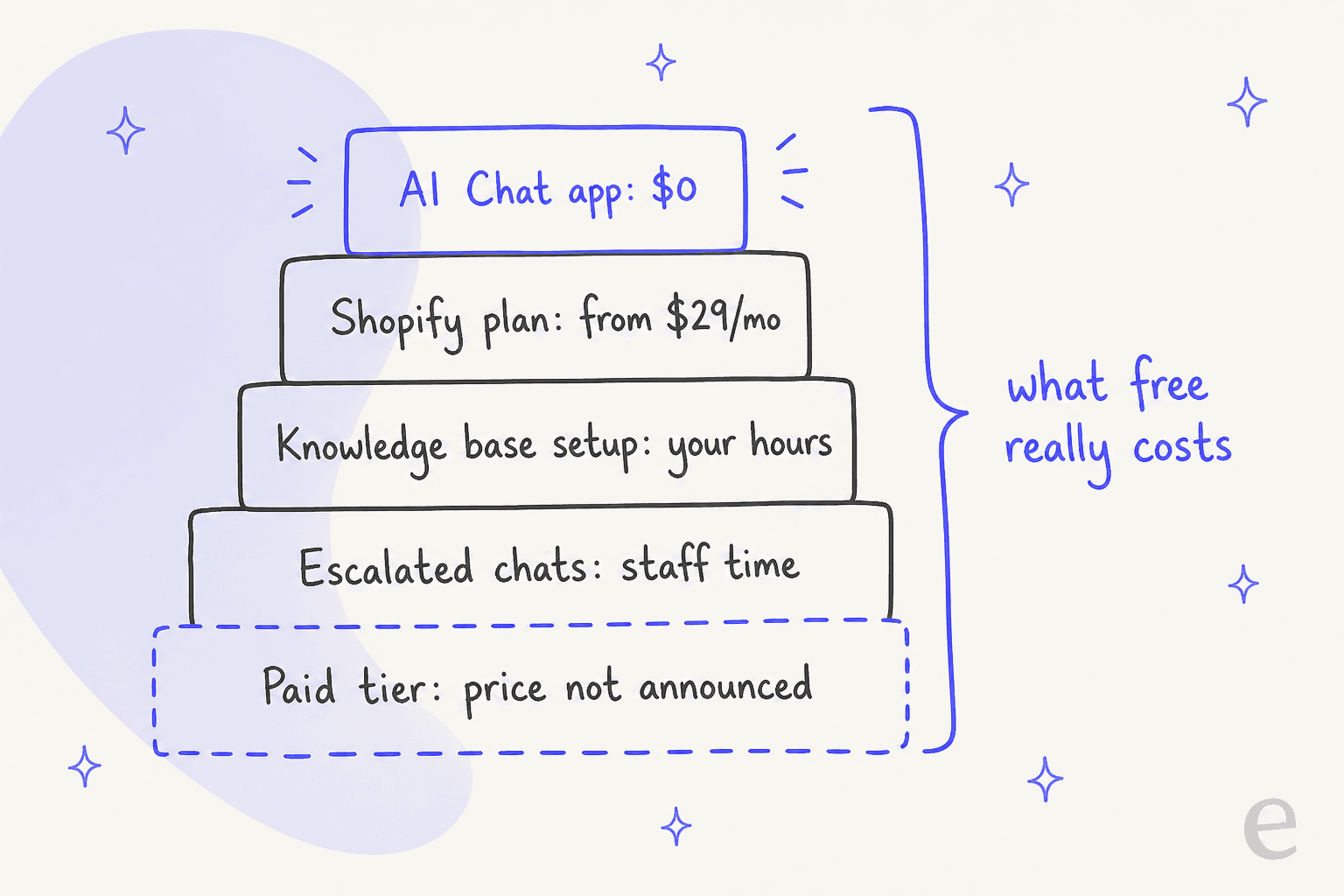
Your Shopify plan
CWILL AI Chat is a Shopify app, so you need a Shopify store. Shopify's own pricing page lists Basic at $39 a month paid monthly or $29 paid yearly, Grow at $105 or $89, and Advanced at $399 or $359. You were paying that anyway, but it's the floor under "free".
The hours you spend on the knowledge base
CWILL's knowledge base doc lists five sources: Questions you write, public pages via URL, uploaded files up to 2MB, synced products and synced Shopify policies. The AI only answers from those. Past chats and the replies your team has already sent aren't one of the sources, so any answer that lives in your team's heads has to be typed into Questions.
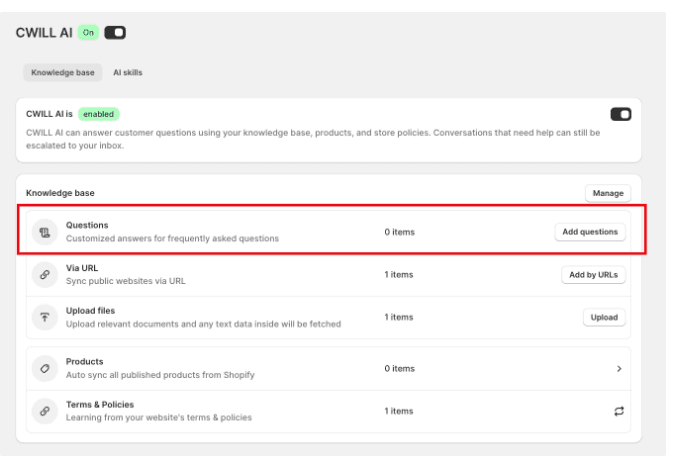
For a store with 30 common questions, that's an afternoon. For a store whose answers sit in two years of replies, it's the main cost of going live, and it keeps going as policies change. Before launch, I'd run your 20 hardest questions through it, the way my AI agent testing checklist describes.
Staff time on chats the AI hands over
When a question falls outside the knowledge base, the help center says the AI tells the shopper it's escalating, moves the chat to an Escalated list, tags it "Human Request" and writes a summary note. That note is a nice touch. But every escalated chat is now a person's job, and that time is the biggest line in your real bill, as my guide to AI escalation explains.
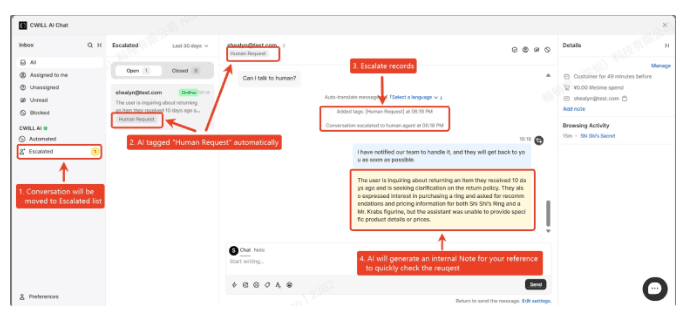
Two details add to it. Email alerts go out when a chat is assigned to you and when a message sits unread for 15 minutes, per the notifications doc. And there's no standalone mobile app; you reply on the go through the Shopify app. Neither is unusual for free chat, but both stretch the time from "escalated" to "answered", which is the tradeoff my guide to chatbot escalation digs into.
Here's a quick way to put a number on it. Plug in your own volume and handoff rate:
Plug in your monthly chats, how often the AI hands over and how long a person spends per chat to see the staff cost behind CWILL's $0 plan. The defaults are an example store, not CWILL data.
With the example numbers (600 chats, 2.5 AI replies each, 30% handed over at 6 minutes), the dashboard would show 1,500 "AI Resolved" and 12.5 hours saved, while your team still picks up 180 chats and spends 18 hours on them. Neither number is wrong. They just measure different things, which brings me to the metric most likely to mislead you.
What does "AI Resolved" actually count?
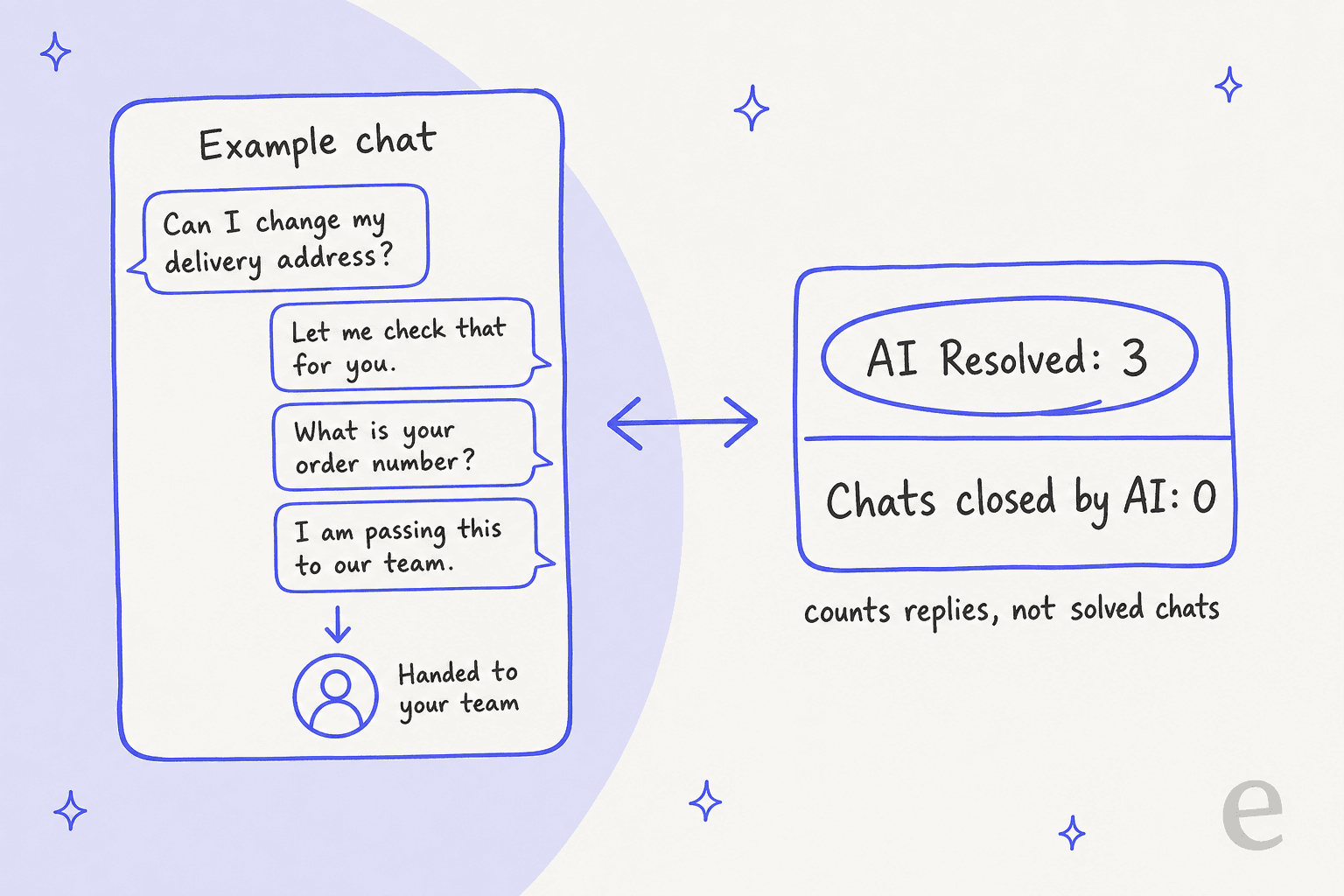
CWILL's analytics doc defines AI Resolved as the "number of messages successfully replied to by AI". That's replies, not conversations, and not problems solved. A chat where the AI sends three polite messages and then hands over to your team adds three to AI Resolved.
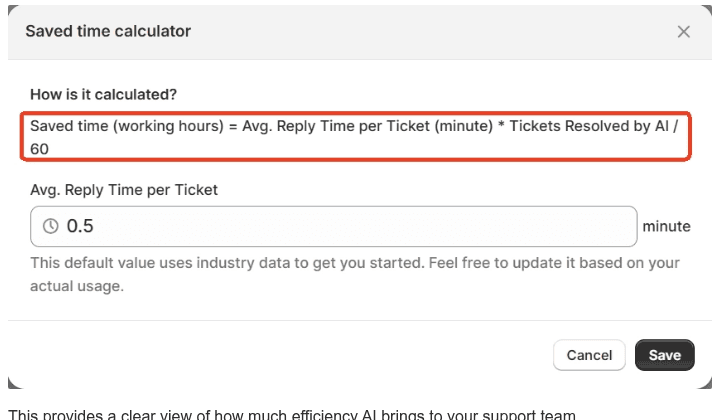
The "Time saved" figure builds on top of that count. Its formula is average reply time per ticket times tickets resolved by AI, divided by 60, with the reply time set to 0.5 minutes by default. You can edit that default, and you should, because 30 seconds is a short time for a person to answer most shopper questions.
How many replies make a conversation? One Shopify vendor that bills per reply gives a useful hint. Zipchat's pricing page sells 750 AI replies a month on Starter and says that's "around 300 conversations", about 2.5 replies per chat. That's where my calculator's default comes from.
Why this matters for pricing: CWILL says the coming paid tier will likely be priced by conversation volume or revenue. If the meter turns out to be close to the AI Resolved count, your bill would scale with replies sent, not with problems solved. I'd start tracking two numbers now, conversations and chats closed without a person, so you can check any future price against what the AI actually did. My explainer on deflection vs resolution covers why those two numbers drift apart.
At eesel we hear this from support leads all the time. A CX lead at a direct-to-consumer brand with about 7,000 tickets a month told us on a sales call that checking every AI answer by hand would defeat the point, and then put the real requirement plainly:
"I need an AI who is only handling the tickets that it's confident to handle and all the other ones, leave them alone."
That's the standard I'd hold any AI chat to, free or paid: count what it closed, not what it said.
What happens when CWILL's paid tier arrives?
Here's the full FAQ answer from CWILL's pricing page:
"Yes. AI Chat is free today, but a paid tier is coming as usage grows. It will likely be priced by conversation volume, revenue driven, or some mix of the two."
There's no date and no price. Read closely, it tells you three things anyway:
- It's tied to usage. "As usage grows" suggests a free allowance that ends at some volume, not a flat paywall for everyone.
- The meters grow with you. Conversation volume and revenue both go up as your store succeeds, so the stores getting the most value are the ones most likely to pay first.
- CWILL already has a pricing style. Its bundles meter by monthly orders, and the AI Chat page promises "no surprise fees when order volume grows past a threshold" and no annual lock-in on most plans. I'd expect the paid tier to follow that pattern, though that's my guess, not CWILL's statement.
I've watched what happens on our own side when a free allowance runs out. One eesel customer's bot quietly handled more than 1,500 messages in a single month, and when he hit the usage limit he subscribed straight away, with "no hesitation". That's not a trap, it's the moment a tool proves it's worth paying for. But it's easier to make that call with numbers in hand than under pressure.
So my advice, if you install CWILL today: write your knowledge base in documents you control (your FAQ page, your policies), since CWILL can sync those by URL. Keep your own monthly count of conversations and handoffs. And when the paid tier lands, compare it with what your support costs would be on the alternatives, using the same unit.
How does CWILL pricing compare with other Shopify chat apps?
On sticker price CWILL is hard to beat. The useful comparison is the billing unit, because each app meters something different. All prices below come from each vendor's own page.
| App | Entry price | What you pay for | AI allowance | Source |
|---|---|---|---|---|
| CWILL AI Chat | $0 | Nothing today; paid tier announced, unpriced | "No usage limits" | CWILL pricing |
| Willdesk | Basic $16.90/month | Helpdesk plan plus AI conversations | $20 per 100 AI conversations on Basic | Shopify listing |
| Chatty | Free, then Basic $19.99/month | AI conversations | 50 on Free, 100 on Basic, 500 on Pro ($68.99), 1,000 on Plus ($199); $0.40 per extra | Shopify listing |
| Zipchat | Starter $64/month, billed annually | AI replies | 750 replies, about 300 conversations; extra replies $49 per 250 | Zipchat pricing |
| eesel | Free trial with 100 credits, then $299/month | Credits: a chat or ticket is 1 credit | 500 credits on the first paid plan, up to 5,000 for $1,749 | eesel pricing |
Three units, three different bills. Willdesk and Chatty count conversations, Zipchat counts replies, and eesel counts a ticket or a chat as one credit however long it runs. CWILL hasn't picked yet. My breakdowns of Willdesk pricing, Chatty pricing and Zipchat pricing run each one at real volumes.
The other difference is scope. CWILL, Chatty and Zipchat are mainly storefront chat. Willdesk is a helpdesk with a shared inbox. eesel works inside the helpdesk you already run, so chat and email sit in one queue. If you're shopping by scope rather than price, my list of Shopify live chat apps and the guide to the ecommerce helpdesk are the better starting points. For the wider market, my chatbot cost guide sets out typical ranges.
Is CWILL worth it at $0?
For most small Shopify stores, yes. Free order tracking, a knowledge base built from your products and policies, and a handoff with a summary note cover what a small store needs from chat. The reviews back that up: 4.8 stars from 101 on the App Store reviews, mostly praising support. If all you want is a plain free inbox, Shopify's own Shopify Inbox is the other obvious option.
Install it if chat is a channel you want to offer without a budget line, order-status questions eat your day, and you already use CWILL's tracking, returns or reviews apps.
Think twice if most of your tickets arrive by email, your support already runs in a helpdesk like Gorgias or Zendesk, or you need a cost you can predict a year out. A free chat widget is the smaller half of that problem, and a paid tier is coming with a meter nobody has seen yet. My roundup of AI helpdesks for Shopify covers tools built for that.
eesel for Shopify stores that want one predictable price
I spend my days building the parts of eesel that talk to other tools, and the Shopify connection is the one that earns its keep the fastest. eesel's ecommerce AI agent looks up the order before it writes a word, learns from your past tickets and help center rather than a Q&A list you type from scratch, and works in the helpdesk you already have. We've spent years putting AI on live support queues, and the lesson that stuck is to test on past tickets before a single customer sees a reply.
Rúngne is the clearest example of what that looks like on Shopify. Its Gorgias queue mixes email, live chat and social comments, and eesel runs three agents on it: one acknowledges and tags every ticket, one leaves a draft after checking order, tracking and stock in Shopify, and one answers plain questions like shipping policy and stock directly. In a month that came to about 580 drafts for the team and about 440 public replies. Question Beauty, a cosmetics brand, lets eesel reply directly in Gorgias and saw it check about 290 Shopify orders in a month before answering.
The pricing is the part that answers CWILL's open question. A chat or a ticket is 1 credit however many messages it takes, there's no per-seat fee, and plans start at $299 a month for 500 credits after 100 free credits on the pricing page. If you want a storefront widget too, the chat bubble goes on your Shopify store and draws from the same credits. Try eesel on your own Shopify orders and see what it would have said.
Frequently Asked Questions
How much does CWILL AI Chat cost?
CWILL AI Chat costs $0 a month today. The AI Chat pricing page lists one Free plan with "no paid tiers or usage limits", and the Shopify listing shows Free. You still pay for your Shopify plan and for the staff time on chats the AI hands over. My CWILL review covers what the app does.
Will CWILL pricing change when the paid tier launches?
Yes, CWILL says so itself. The pricing page FAQ says a paid tier is coming as usage grows and will likely be priced by conversation volume, revenue, or a mix. No date or price is published, so I'd plan a support budget that doesn't rely on $0 forever. My free AI chatbot guide explains what free plans usually trade away.
What are the CWILL bundle prices?
CWILL's bundle page lists Starter from $89 a month with 1,000 orders, Professional from $145 with 2,000 orders and Enterprise from $567 with 10,000 orders. Each bundle includes AI Chat at $0, and CWILL says annual plans usually get around 20% off. Exact bundle pricing comes from a demo call.
Is CWILL pricing the same as Willdesk pricing?
No. Willdesk is a separate helpdesk app from the same company, with paid plans from $16.90 a month and AI conversations billed on top. CWILL AI Chat is a free chat widget. My Willdesk pricing breakdown covers that app's plans in full.
Does CWILL charge extra for returns or reviews in chat?
Not for the chat side. CWILL's help center says there are no plan limits or extra charges for the Returns & Exchanges integration. The Returns app itself is priced separately, and the bundle page lists it from $99 a month on its own. See how AI should handle refunds and returns.
What does AI Resolved mean in CWILL analytics?
CWILL's analytics doc defines AI Resolved as the number of messages successfully replied to by AI, so it counts replies, not solved conversations. Its time saved figure multiplies that count by 0.5 minutes by default. Track real resolution rate separately before you report savings.
Is there a cheaper alternative to CWILL for a busy Shopify store?
Nothing beats $0 on sticker price. For a store whose tickets arrive by email as well as chat, eesel's Shopify integration works the whole queue at one fixed price: 100 free credits, then $299 a month for 500 credits, with a chat or ticket at 1 credit. My list of Shopify AI chatbots has more options.