


The best Claude Duet alternative for most people is OpenAI dots, if you can stomach ChatGPT Pro at $100 a month: it's the same always-on idea with its own cloud computer, and your chats with it don't eat your ChatGPT limits. If you're in the US and want free, Meta Muse is the pick. If you're in Europe, on Outlook, or just want a flat $19 a month, look at Argus, Individu and Fyxer.
Most people searching for Claude Duet alternatives can't get Duet yet. It's a US-only waitlist for Claude Pro and Max, it shares your chat limits, Microsoft 365 isn't connected and there's no team plan. Every pick below is live and open to sign up today, with prices taken from each vendor's own page on October 23, 2026.
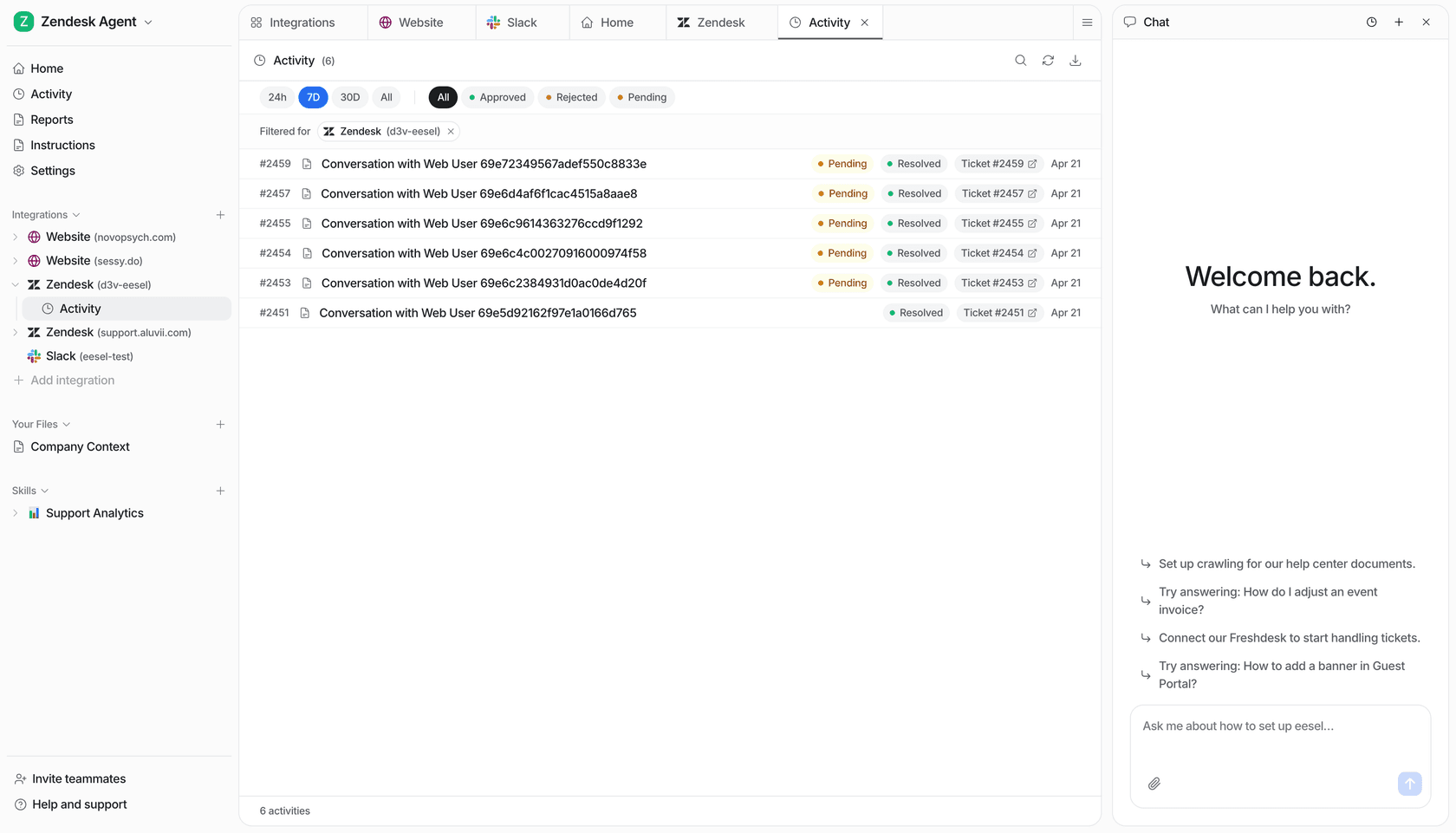
If the inbox you want an agent for is a support queue, skip all eight. A personal agent checks in for one owner; a helpdesk needs a teammate on every ticket as it lands. eesel's helpdesk teammate handled about 4,650 conversations in a month for SE Ranking across three products, and refunds still go to a person.
Why are people looking for Claude Duet alternatives?
Because most of the people who want Claude Duet can't use it yet. Anthropic launched it on October 21, 2026 as a research preview, and access is a waitlist for US Pro and Max subscribers only.
To be fair to Duet, the design is strong. It runs on Claude Opus 5.5, sends a morning brief, checks your connected apps every few hours, works on its own cloud computer and asks before it sends, pays, signs or deletes anything. My colleague's Claude Duet review gives it 3.5 out of 5, mostly for judgment and safety.
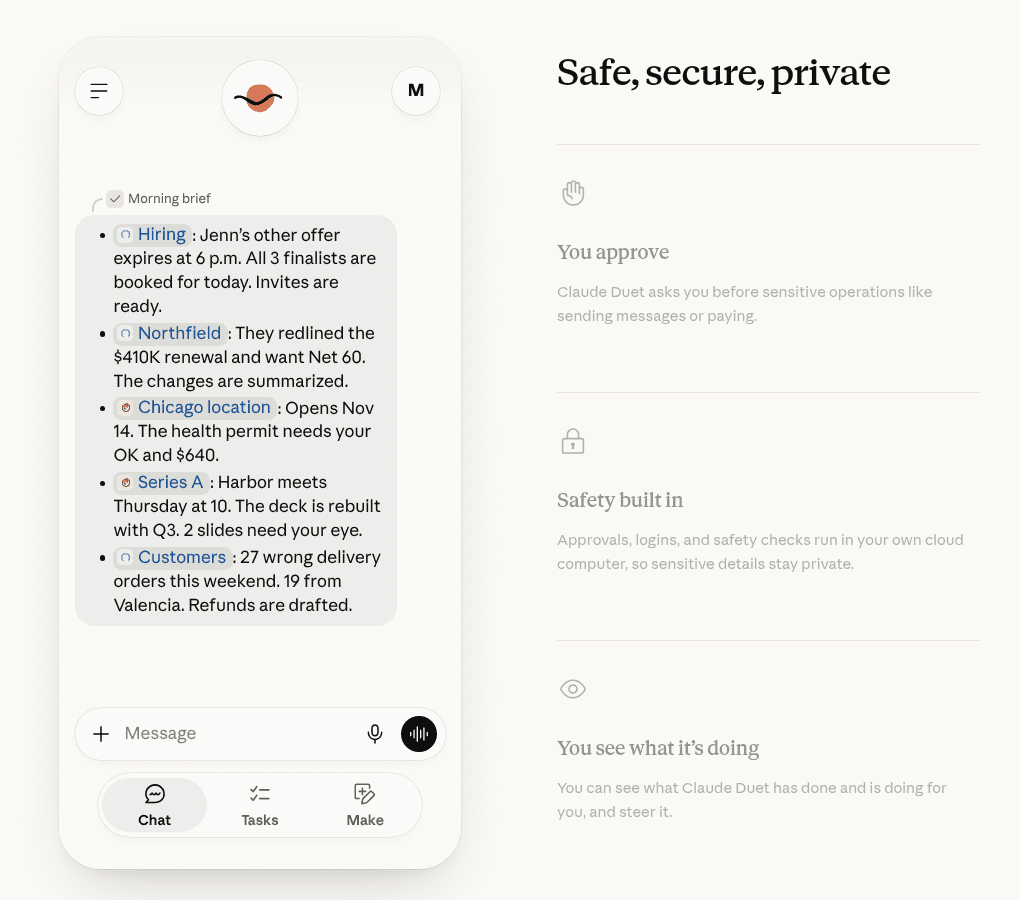
The reasons people go looking elsewhere are concrete, and they come straight from Anthropic's own help center:
- US only, waitlist only. Pro and Max subscribers in the US get invites in waves. No Team or Enterprise plan yet.
- It shares your usage limits. Duet costs nothing extra on Pro ($20/month) or Max ($100 or $200/month), but background checks eat the same allowance as your chats. The full math is in the Claude Duet pricing breakdown.
- Connector gaps. Slack "works with limits" and Microsoft 365 "isn't available yet," even though the product page shows a Microsoft logo in its connector strip. I'd trust the help center for now.
- Less control. You can't pick the model, watch its browser or have it call or text anyone.
That shared-limits point is the one I see most in the launch thread. One Hacker News commenter put it bluntly:
"I really have no interest in this if it's going to use my plan's regular limits."

How I picked these Claude Duet alternatives
I'm a software engineer at eesel and I've spent two years on SEO, so the first thing I do with a keyword like this is ask what the person typing it needs. "Claude Duet alternatives," two days after a waitlist launch, mostly means "I want an always-on assistant for my email and calendar, and I want it this week." Some readers are also outside the US or on Outlook, which rules Duet out entirely.
So I asked ChatGPT that exact question in a fresh chat, the way a buyer would, and wrote down what it recommended: Argus, Individu, Lindy, Sezio, Zapier Agents and Reclaim. Then I checked each one against its own site, added the two big-lab agents it skipped (OpenAI dots and Meta Muse) plus Fyxer, and dropped what I couldn't verify or sign up for today.
My bar for making the list:
- It runs without you. It watches your inbox, calendar or apps on a schedule or a trigger and brings you things. A chatbot you have to open doesn't count.
- It asks before it acts. Sending, buying or deleting needs your approval, or the agent only drafts.
- You can sign up today, and the price is on the vendor's own page.
For context on where I'm coming from: eesel has spent years putting AI agents on live support queues, and the lesson that stuck is that a confident agent which is quietly wrong is the expensive failure. Every eesel rollout gets simulated against past tickets before it touches a real one. I read personal agents the same way: what does it do on its own, and where does it stop and ask?
Claude Duet alternatives at a glance
Here's every pick against Duet itself, on the things that decide whether you can use it and trust it. Prices are the cheapest plan that includes the agent, from each vendor's pricing page on October 23, 2026.
| Tool | Starting price | Free tier | Where it's open | Email + calendar | Asks before acting | Integrations | Where you use it | Security (stated) |
|---|---|---|---|---|---|---|---|---|
| Claude Duet | Included in Claude Pro, $20/mo | No | US only, waitlist | Gmail, Google Calendar; no Microsoft 365 yet | Before send, pay, sign, delete | 6,000+ connectors and plugins | iOS, Android, claude.ai | Not stated on pages checked |
| OpenAI dots | Included in ChatGPT Pro, from $100/mo | No | Pro outside the EEA, Switzerland, UK | Personal email and calendar via plugins | Built-in rules plus your Custom Rules | 4,000+ apps | ChatGPT desktop, web, iOS, Android; Slack, Teams | Not stated on pages checked |
| Meta Muse | Free for most use | Yes | US | Email, calendar | Before emails and purchases | Email, calendar, Instagram, tools it builds | iOS, Android, Mac, WhatsApp, web | Isolated cloud VM, Sentinel checks |
| Lindy | $29.99/user/mo | $50 credits for 7 days | No limit listed | Gmail, Calendar, 2 to 5 inboxes | Anything with outside impact | 1,500+ plus MCP | Slack, iMessage, browser | SOC 2 Type II, GDPR, HIPAA, PIPEDA |
| Argus | $19/mo | No | No limit listed | Gmail, Outlook, Google Calendar | Drafts wait for you | 12 listed, more added | Browser, iMessage, SMS, email | Not stated on pages checked |
| Individu | €19.99/mo | Yes, 3 apps | No limit listed (Dutch company) | Gmail, calendar, WhatsApp | Messages wait for sign-off | 116+ | Desktop and phone | Not stated on pages checked |
| Fyxer | $37/mo yearly, $49 monthly | Yes, 400 credits | No limit listed | Gmail, Outlook, meetings | Drafts replies, you send | Slack, Teams; MCP on Team | Gmail, Outlook, browser, Slack, Teams | HIPAA on Enterprise |
| Zapier Agents | $33.33/mo billed yearly | Yes, 400 activities | No limit listed | Any you connect | Only actions you set up | 9,000+ apps | Web, Chrome extension | Not stated on pages checked |
| Reclaim.ai | $10/seat/mo yearly, $12 monthly | Yes, Lite | No limit listed | Google and Outlook calendars, no email | You approve schedule changes | Calendars, task apps, MCP | Web, Google Calendar add-on | SOC 2 Type 2, GDPR |
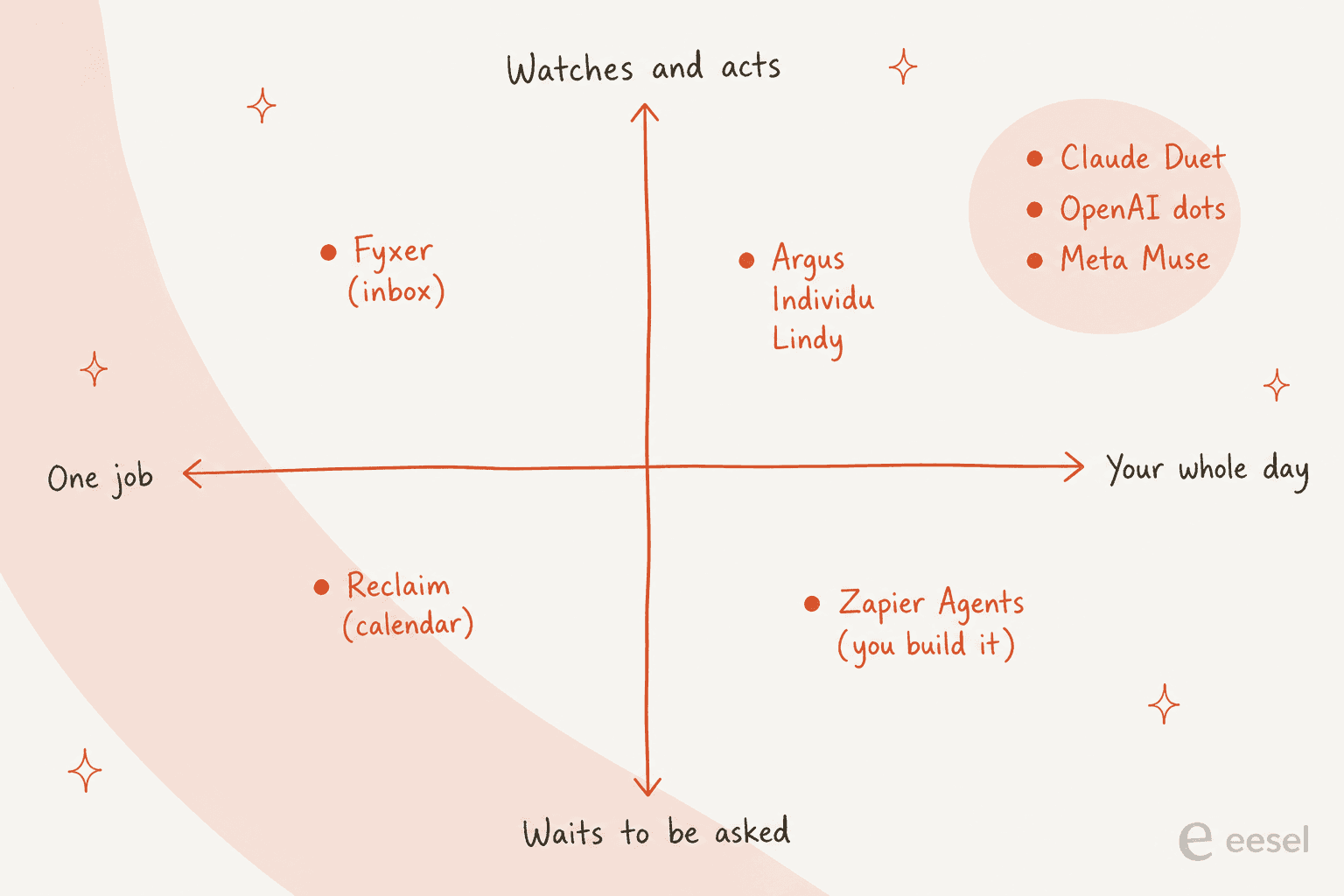
The map above is the short version of this post. Only three of these are a like-for-like swap for Duet: dots, Muse and, on a smaller budget, Argus. The rest are narrower on purpose, and that can be exactly what you want.
Which Claude Duet alternative fits your reason for leaving?
Most people leave over one specific thing. Pick yours and I'll point you at the agent that fixes it.
Pick the reason Duet doesn't fit you to see the alternative I'd try first. Recommendations use each vendor's own pricing and help pages, checked October 23, 2026.
1. OpenAI dots
Best for: people who want the closest thing to Duet today and already pay for ChatGPT Pro.
What it does
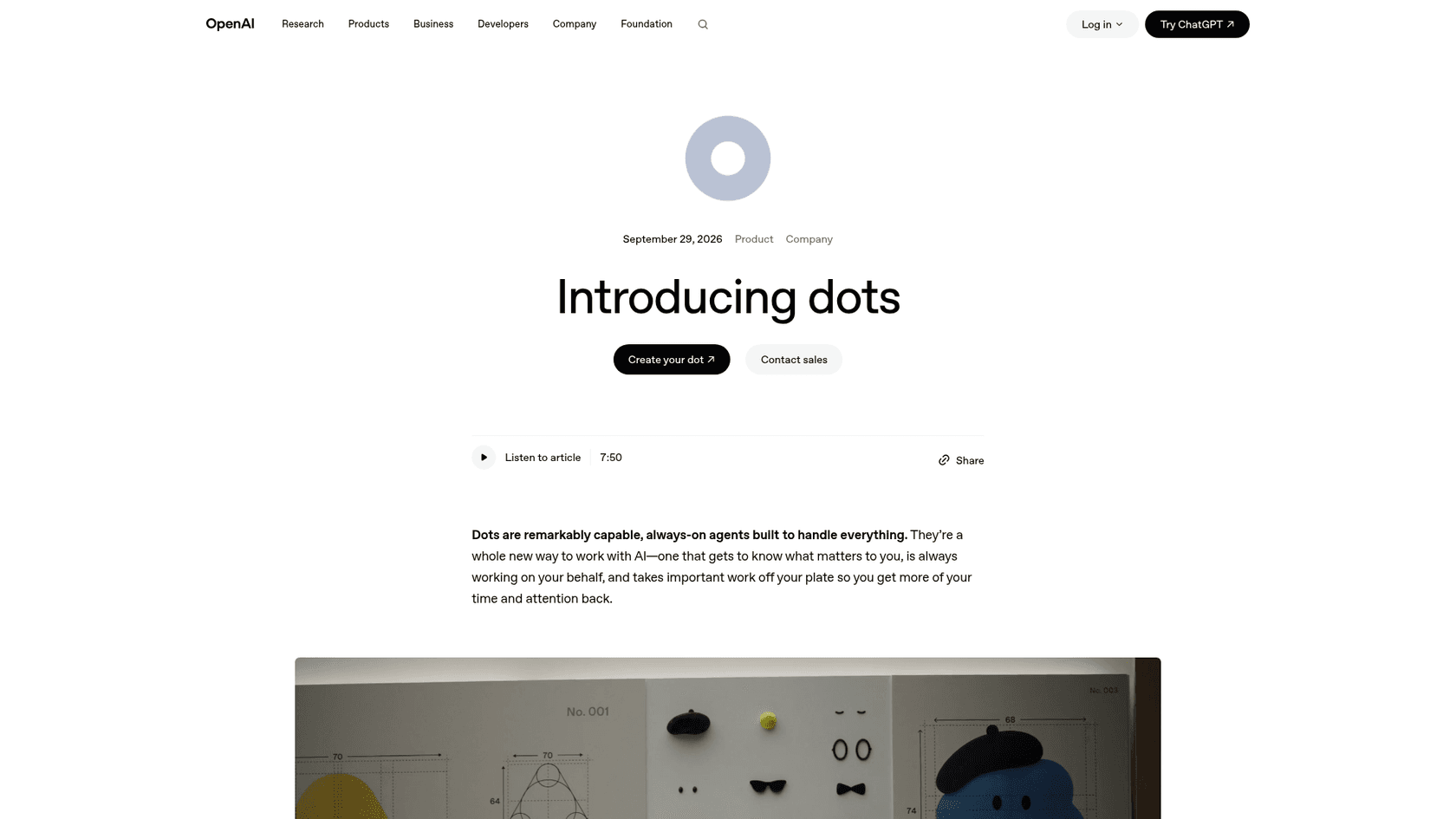
OpenAI calls dots "remarkably capable, always-on agents built to handle everything." Your dot runs on GPT-6 Astra, has its own cloud computer and browser, connects to over 4,000 apps through plugins and keeps working between conversations. You can message it in ChatGPT, Slack or Teams, and texting is a limited US beta for Pro users. My colleague's OpenAI dots explainer has the full tour.
When you're not talking to it, your dot does what OpenAI calls "proactive research" using read-only tools, so it can't send messages or change app content in the background. When it does act, an auto-review step checks the action against your Custom Rules and decides what needs your approval.
Where it beats Duet
- Your chats don't eat your limits. OpenAI's launch post says conversations with your dot don't count toward ChatGPT usage limits. That's the exact complaint people have about Duet.
- It's where your team talks. Slack and Teams messaging are built in, where Duet's Slack support "works with limits."
- Wider availability. Pro users 18 and older outside the EEA, Switzerland and the UK, plus Business Premium workspaces.
Where Duet is still ahead
- Price. Duet comes with a $20 Claude Pro plan; dots need ChatGPT Pro, from $100 a month.
- Europe and the UK are out for personal Pro accounts.
- It can't call you at launch, and it can't have its own email address.
One early user's verdict lines up with the read-only design:
"very nice as a 'Monitor my communication channels for me' tool. It's surfaced a few buried/filtered email messages that actually were important"
Pricing
| ChatGPT plan | Price | Dots |
|---|---|---|
| Free | $0 | No |
| Go | $8/mo | No |
| Plus | $20/mo | No |
| Pro | From $100/mo (3 usage tiers) | Yes, first dot included |
| Business Premium | Not on the page I checked | Yes, in supported regions |
Plan availability is from the ChatGPT pricing page. My OpenAI dots pricing post covers the tiers in depth.
My take: the best Claude Duet alternative if $100 a month is fine. Pick it for Slack and Teams reach and for limits that don't fight your chats. Skip it if you're in Europe or only need email triage.
2. Meta Muse
Best for: US users who want a free, always-on agent for life admin as much as work.
What it does
Meta launched Muse in September 2026 as a personal agent that "doesn't just answer questions, it actually does the work." It runs on Muse Spark, Meta's model, inside a dedicated cloud computer Meta calls the Muse Secure VM. You chat with it in the Muse app, on Mac or inside WhatsApp, and connect apps like email, calendar and Instagram. If a task needs a tool that doesn't exist, it builds one. More detail is in our Meta Muse agent guide.
The safety design is careful. A separate Sentinel agent sits on the same machine, and per Meta's announcement "Nothing Muse does reaches the internet unless the Sentinel approves it." It checks with you before sending an email or making a purchase, and shows a full audit trail.
Where it beats Duet
- It's free for most of what people need, with paid plans for heavier use.
- It shops for you. Checkout runs through Link by Stripe with a one-time card number, so your real card stays hidden.
- You get a real computer. People use the VM to host small sites and run scripts.
"I use Muse. So far the biggest value to me is 1) being a more "squishy" reminder service than a typical task tracker, because it can at its own discretion raise stuff to my attention"
Where Duet is still ahead
- Model quality, if you value Opus 5.5. Several Hacker News regulars say they'd switch for the model alone.
- Noise. Not everyone loves its proactive nudges:
"I've largely found Muse to be annoying, it's pestering me about emails that don't matter and messages I've already read."
- US only, same as Duet.
Pricing
| Plan | Price | What you get |
|---|---|---|
| Free | $0 | Most of what people need, per Meta |
| Paid plans | Not listed on the pages I checked | More usage for people who want to do more |
Meta's announcement doesn't list the paid tiers, so I'm not quoting a number. My colleague's Meta Muse pricing post tracks them.
My take: the free pick, and the most fun of the big-lab agents. Pick it if you're in the US and want help with life admin too. Skip it if a chatty agent will drive you up the wall.
3. Lindy
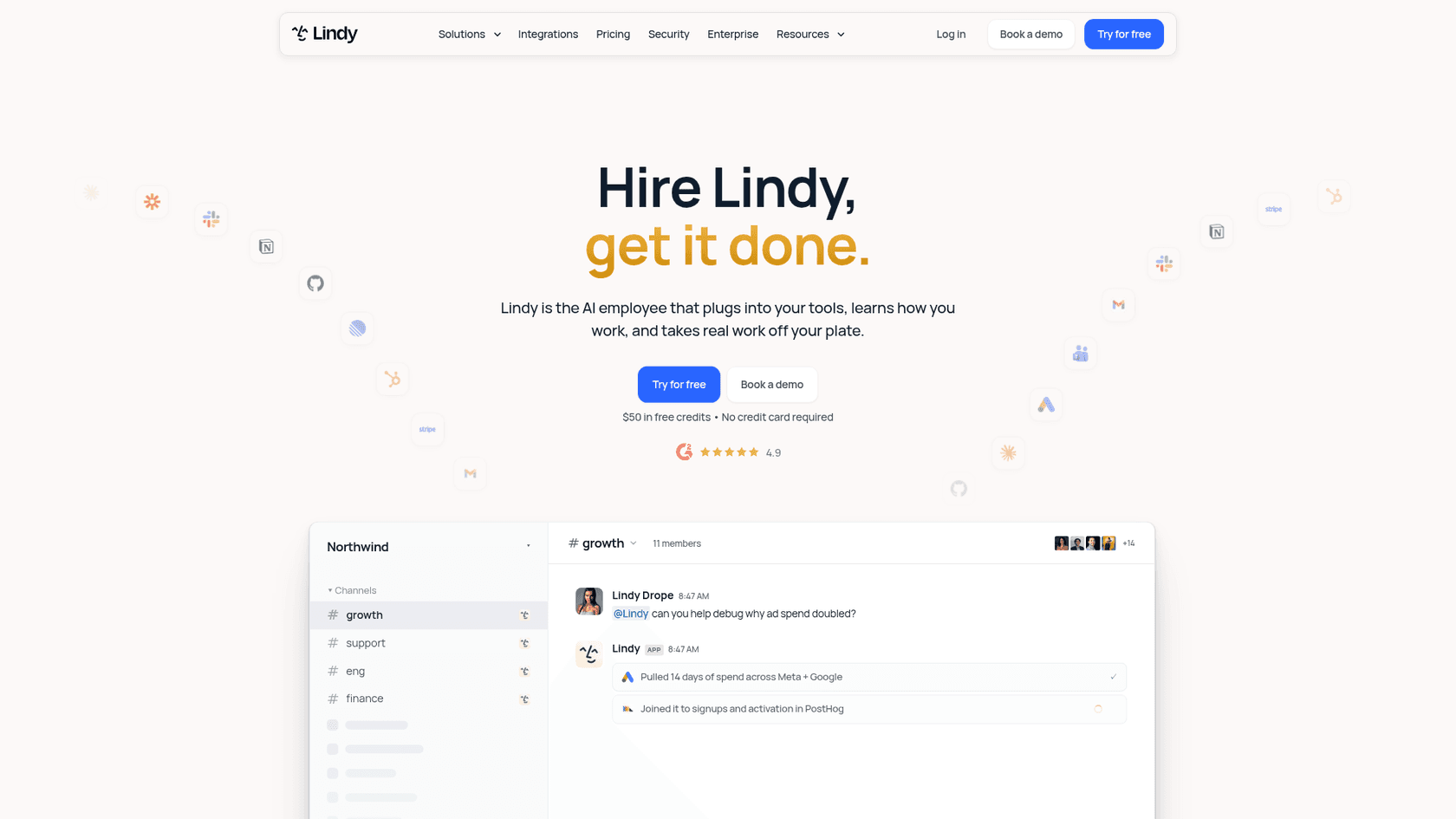
Best for: small teams that want an AI employee in Slack and email, with security paperwork in order.
What it does
Lindy calls itself "the AI employee that plugs into your tools." It manages your inbox, drafts replies in your voice, preps and schedules meetings, sends daily briefs and nudges, and runs scheduled routines. You reach it in Slack threads, over iMessage or in the browser. It connects to Gmail, Google Calendar, Slack, Notion and 1,500+ more, supports MCP and lets you pick the model per task. Our Lindy AI breakdown covers the builder side.
Where it beats Duet
- Built for teams. Credits pool across the workspace, and Enterprise adds SSO, SCIM and audit logs.
- Security you can show a buyer. Lindy states SOC 2 Type II, GDPR, HIPAA and PIPEDA compliance.
- You choose the model, which Duet doesn't allow.
Where Duet is still ahead
- Price for one person. Every active user is billed, from $29.99 a month.
- Credits run out. When the pool runs low, Lindy pauses credit-using actions until reset or a top-up.
- More setup. It's a teammate you shape, not an agent that just starts watching.
Pricing
| Plan | Price | Credits |
|---|---|---|
| Free | $0 | $50 in credits for 7 days, no card |
| Team | From $29.99/user/mo | 3,000/mo, tiers up to 1,750,000 for $9,999.50 |
| Top-up | $10 per 1,000 credits | Never expire |
| Enterprise | Custom | Custom credits, HIPAA with BAA |
Everyday asks cost 2 to 250 credits and deep work 250 to 1,000, per the Lindy pricing page. One conflict worth knowing: the homepage mentions "Pro and Max" plans adding credits and computer use, while the pricing page shows only Free, Team and Enterprise. I'd go by the pricing page. If Lindy isn't quite it, see these Lindy alternatives.
My take: the strongest pick for a team. Pick it if you want one agent the whole company can @mention. Skip it if you're one person who wants a set-and-forget assistant.
4. Argus
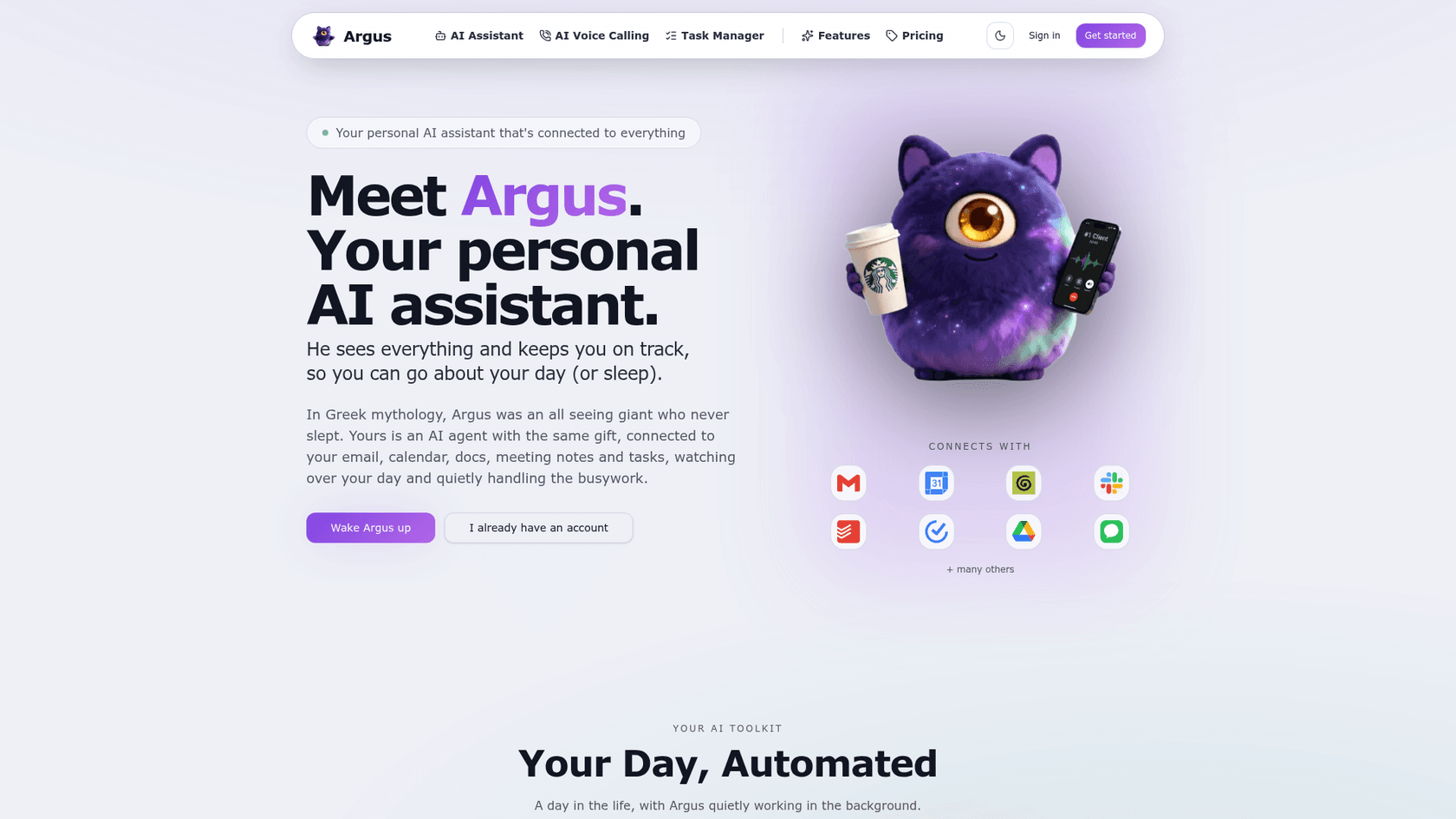
Best for: solo founders and busy professionals who want Duet's daily rhythm at a flat $19 a month.
What it does
Argus is the closest small-company match to Duet's shape. It's "connected to your email, calendar, docs, meeting notes and tasks," and runs routines in the background: a Daily Brief, an Evening Recap that turns commitments into tasks, Inbox Autopilot that drafts replies in your voice, Pre-Meeting Briefs and a Follow-Up Radar for emails nobody answered after three days. It connects Gmail, Outlook, Google Calendar, Granola, Todoist, Slack, Notion and more.
You can text it over iMessage or SMS, email your own Argus address, or chat in the browser. On the Executive plan it places real phone calls to book appointments or sit on hold.
Where it beats Duet
- Outlook works. Duet doesn't have Microsoft 365 yet.
- It makes calls. Duet doesn't call or text other people.
- A flat price with unlimited routines and connections, so no limits to ration.
Where Duet is still ahead
- Judgment and model. Argus doesn't name its model on the pages I checked.
- No free tier and no trial on the pricing page.
- Smaller vendor, with no security certifications listed.
Pricing
| Plan | Price | Includes |
|---|---|---|
| Assistant | $19/mo | Unlimited connections and routines, Inbox Autopilot, iMessage/SMS |
| Executive Assistant | $39/mo | Everything, plus 60 calling minutes; overage from $0.20/min |
| Lifetime | $499 once | Executive features forever |
Prices are from the Argus pricing page. Inbox Autopilot only drafts: "Nothing gets sent without you."
My take: the best budget Claude Duet alternative. Pick it if you want the morning brief, inbox drafts and follow-ups without a $100 plan. Skip it if your company needs a SOC 2 report.
5. Individu
Best for: people in Europe whose day runs across Gmail, WhatsApp and a calendar.
What it does
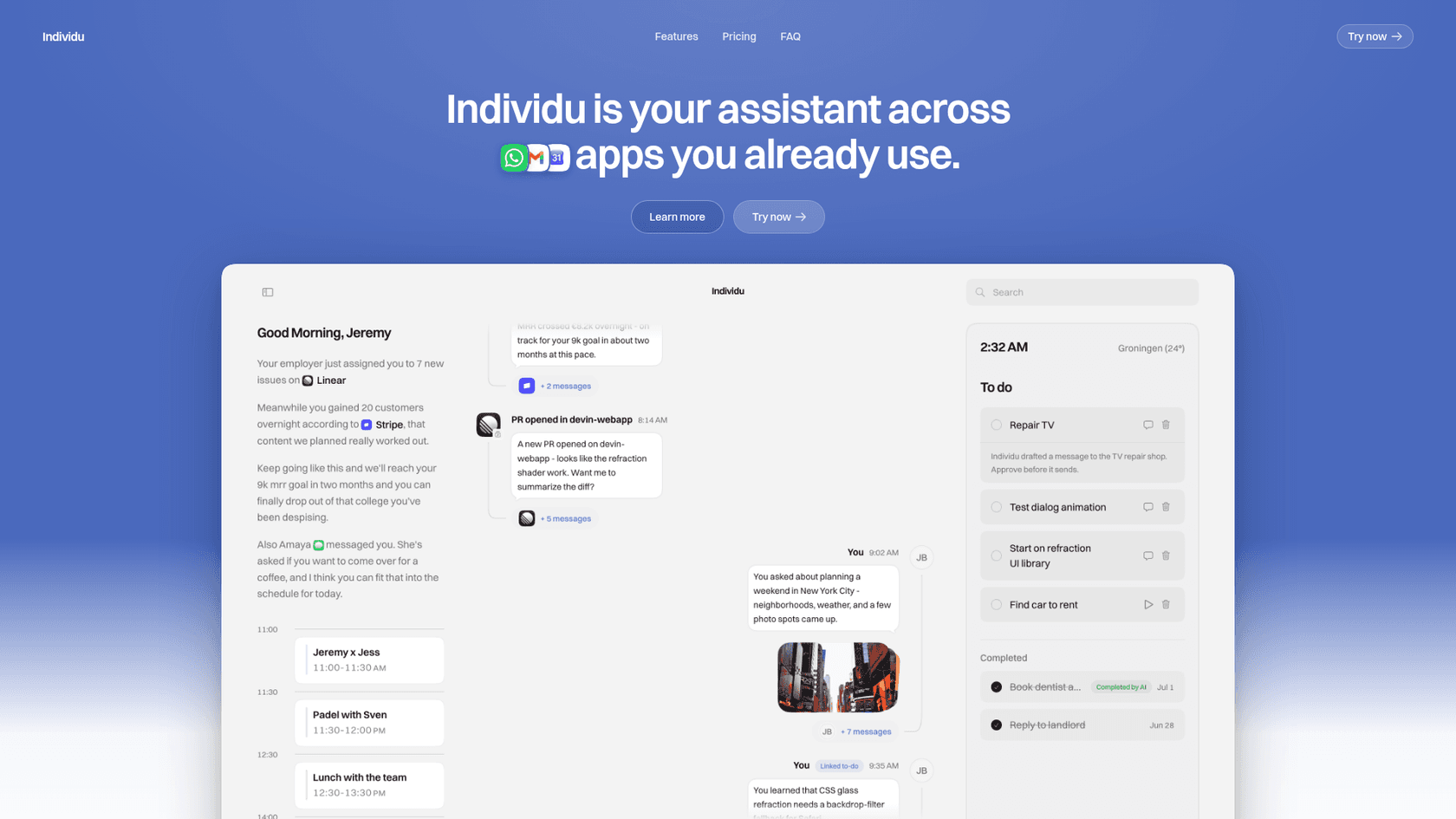
Individu reads Gmail, WhatsApp and your calendar overnight and gives you "a short narrative briefing. Not a wall of notifications." Everything that moved lands in one activity feed, to-dos link back to the thread that created them, and plain-language automations like a weekly briefing or a 4 PM inbox catch-up run in the background. When a site has no integration, it opens a browser with a live view and hands control back to you for sign-ins.
The about page is refreshingly direct about fit: it's the wrong tool if you need "an unattended sender that never asks before it messages people."
Where it beats Duet
- WhatsApp, which none of the big-lab agents list as a connected source.
- Europe-friendly. It's a Dutch company, and no region limit is listed.
- A real free tier to try it on your own inbox.
Where Duet is still ahead
- Browser tasks run in automations, but background agents don't support them, per Individu's integrations note.
- The free tier is tiny: 5 messages a month.
- No published security certifications on the pages I checked.
Pricing
| Plan | Price | Includes |
|---|---|---|
| Free | €0 | 3 apps, 5 messages/mo, 3 open to-dos, 1 briefing a day |
| Pro | €19.99/mo | Chat, browsing, 3 automations, 116+ integrations, background agents |
| Ultimate | €49.99/mo | 3x Pro usage, unlimited automations, priority runs |
| Enterprise | Contact sales | Bulk licensing, security review |
Prices are from the pricing section on the Individu homepage; the standalone pricing URL returned a 404 when I checked.
My take: the pick for Europe. Pick it if WhatsApp is half your inbox. Skip it if you need Outlook.
6. Fyxer
Best for: Outlook or Gmail users whose real problem is the inbox and meeting follow-ups.
What it does
Fyxer sits in Gmail and Outlook, sorts and labels your inbox, drafts replies in your tone, records meetings and keeps a running list of what you promised. You get a daily dashboard briefing, and the Pro plan adds a daily email briefing and automated Flows. It's narrower than Duet: no cloud computer, no buying things, no browsing on your behalf. It's an AI email assistant with a strong memory for meetings.
Where it beats Duet
- Microsoft is first-class. You can sign up with Microsoft, and it works in Outlook, Slack and Teams.
- Meetings. It records every meeting on Pro and tracks the follow-ups.
- Data residency in the EU, UK or US on Enterprise.
Where Duet is still ahead
- Scope. Fyxer won't book a table or chase an invoice on a website.
- Credits. Sorting costs 1 credit per 5 emails, and chat messages cost 20 credits each.
Pricing
| Plan | Yearly | Monthly | Credits |
|---|---|---|---|
| Free | $0 | $0 | 400/mo |
| Pro | $37/person/mo | $49/person/mo | Unlimited for 3 months, then 3,000/mo |
| Team | $64/person/mo | $99/person/mo | Unlimited for 3 months, then 6,000/mo pooled |
| Enterprise | Talk to sales | Talk to sales | Contracted |
Prices are from the Fyxer pricing page, with a 14-day trial on paid plans. Our Fyxer AI pricing post and Fyxer AI reviews go further.
My take: the Outlook pick. Pick it if your pain is email and meetings, not errands. Skip it if you want an agent that goes off and does things on the web.
7. Zapier Agents
Best for: people who already automate with Zapier and want an agent that runs on triggers they define.
What it does
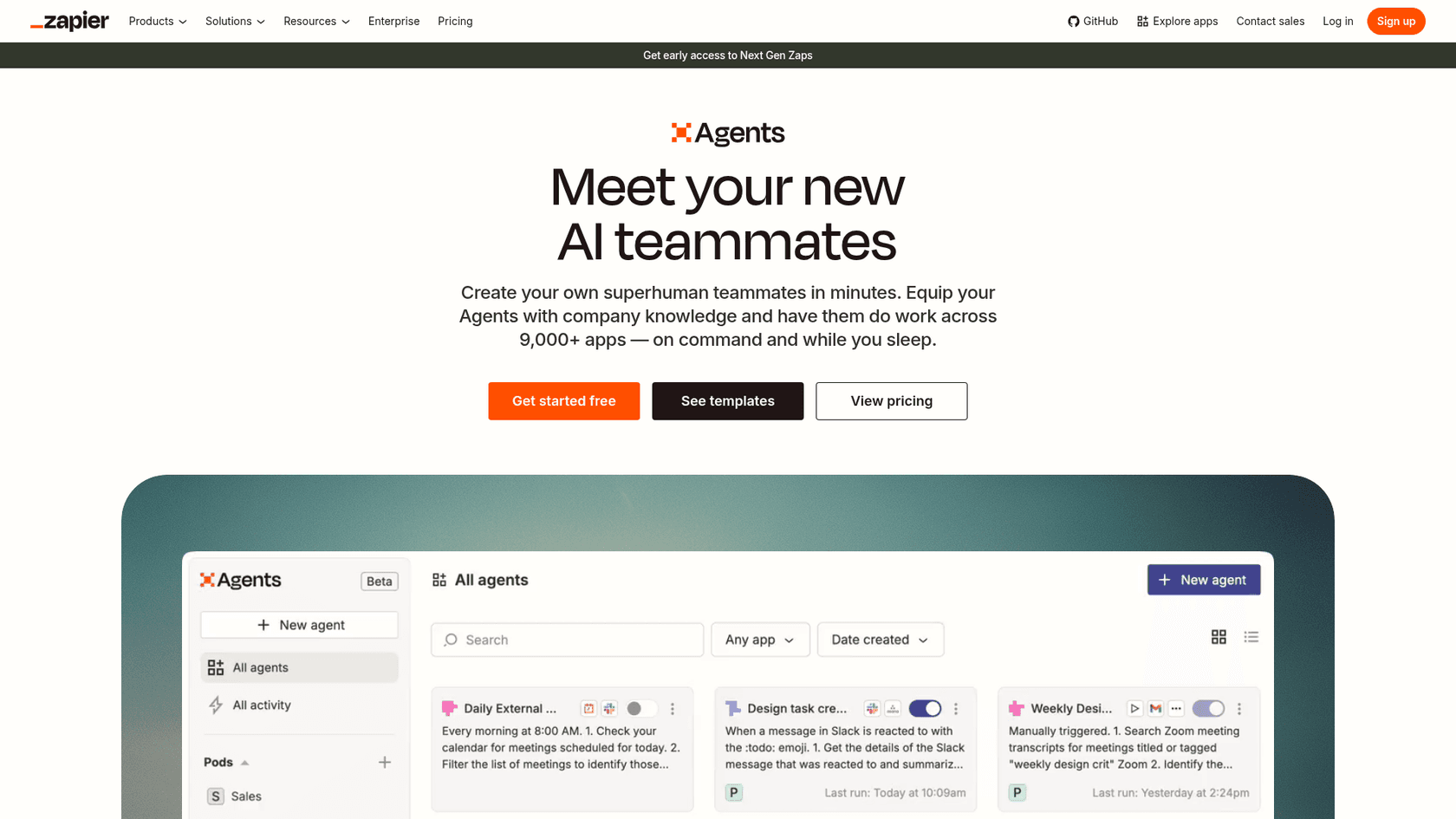
Zapier Agents lets you build agents that work across 9,000+ apps, on command or in the background while you sleep. You describe the job, attach knowledge and pick the triggers and actions, and the agent runs in the background or from a Chrome extension. Templates cover meeting prep, lead enrichment and Slack summaries. The trade is clear: Zapier "can only take actions in the apps you've connected and use the triggers and actions you've set up." Our Zapier AI guide covers the wider platform.
Where it beats Duet
- Reach. 9,000+ apps, including Microsoft tools.
- Predictability. It only does what you wired up.
- A free plan with 400 activities a month.
Where Duet is still ahead
- No judgment out of the box. Duet decides what needs you; Zapier waits for the trigger you built.
- Setup time. You're building, not hiring.
Pricing
| Plan | Price | Activities |
|---|---|---|
| Agents Free | $0 | 400/mo |
| Agents Pro | $33.33/mo, billed $400 yearly | 1,500/mo |
| Agents Enterprise | Contact sales | Custom, plus audit logs and org-wide sharing |
An activity is any action, web browse or knowledge lookup the agent makes, per the Zapier pricing page. If you're weighing it against xAI's agent, see Grok Bot vs Zapier Agents.
My take: the builder's pick. Pick it if you know which events should wake your agent. Skip it if you want something that notices what you didn't think to ask.
8. Reclaim.ai
Best for: people whose real problem is the calendar, not the inbox.
What it does
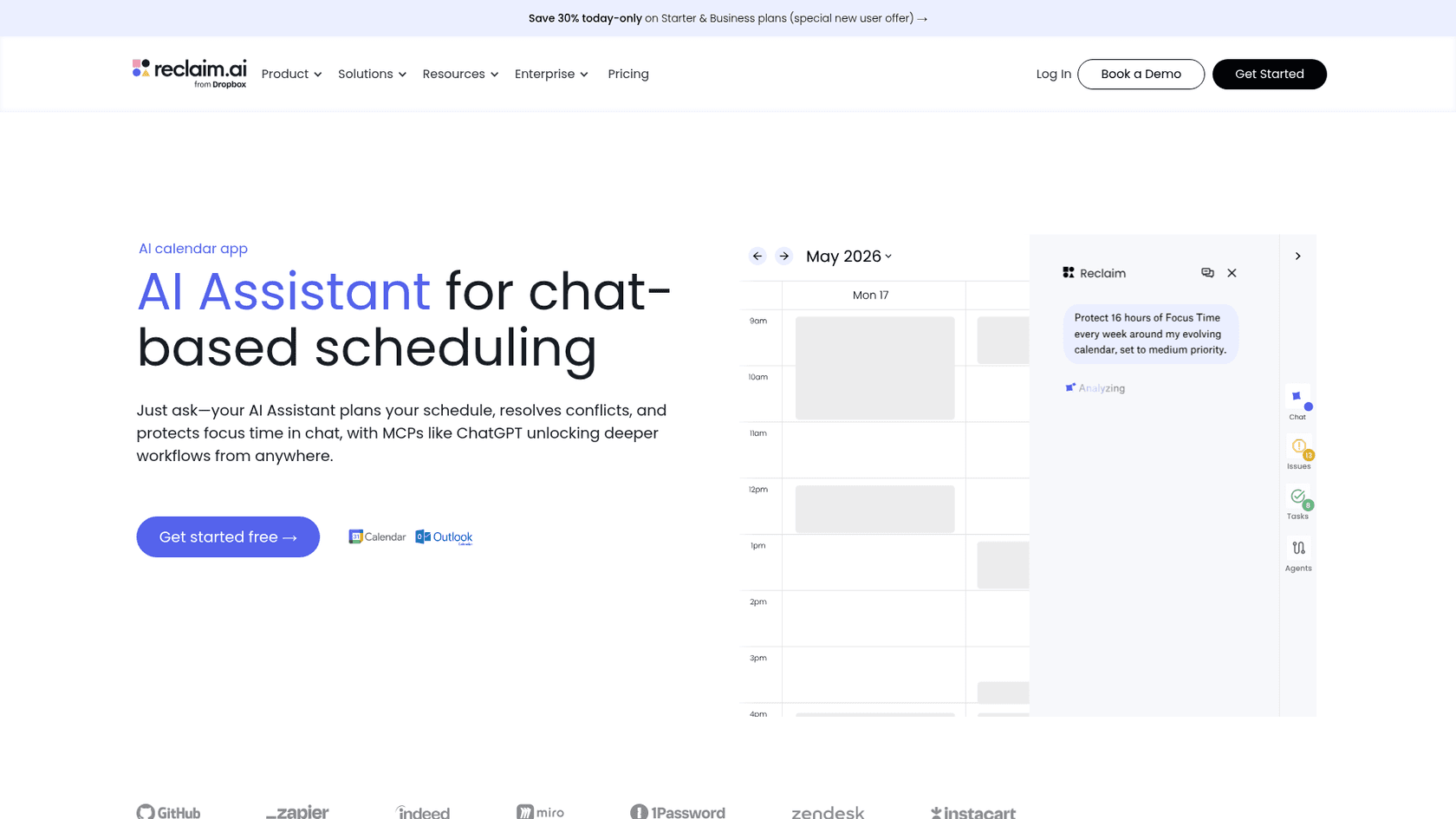
Reclaim is an AI calendar app, and its chat-based AI Assistant "plans your schedule, resolves conflicts, and protects focus time." It runs AI agents that keep optimizing focus time, habits, buffer time and meetings across Google and Outlook calendars, and you "review and approve changes before they're applied." It also plugs into ChatGPT and other tools over MCP. It doesn't read or answer your email. For more calendar-first tools, see my AI scheduling assistants list.
Where it beats Duet
- Calendar depth Duet doesn't try for: focus time, habits, buffers and team scheduling policies.
- Outlook calendar support.
- Security badges: SOC 2 Type 2 and GDPR on the pricing page.
Where Duet is still ahead
- Email. Reclaim doesn't triage or draft it.
- Errands. No browser, no buying, no forms.
Pricing
| Plan | Yearly | Monthly | AI Assistant |
|---|---|---|---|
| Lite | Free | Free | Limited |
| Starter | $10/seat/mo | $12/seat/mo | Standard |
| Business | $15/seat/mo | $18/seat/mo | Expanded |
| Enterprise | $22/seat/mo | Yearly only | Unlimited |
From the Reclaim pricing page. Small conflict: the billing toggle says yearly saves 20%, while the FAQ on the same page says 29%.
My take: the calendar pick. Pick it if meetings are eating your week. Skip it if email is the mess.
What about Sezio and the others?
ChatGPT also recommended Sezio, and on paper it's a close Duet match: it reads Gmail, Outlook, Google and Outlook calendars, Drive, OneDrive and Jira, picks a model per task and says "nothing goes out without your yes." It's waitlist-only with no published prices, though, so it fails my "sign up today" bar. I'd join the waitlist if you're on Microsoft 365 and Jira.
I also looked at Martin and Motion. Martin's homepage shows no pricing, and Motion's pricing page marked its plans as "not available" when I checked, so I left both out. For a wider net, my AI personal assistant guide and the Claude Cowork alternatives list cover desktop-side agents.
How much do Claude Duet alternatives cost?
From free to $100 a month, and the cheapest isn't always the one with the fewest strings. Here's the monthly price of the cheapest plan that includes each agent.
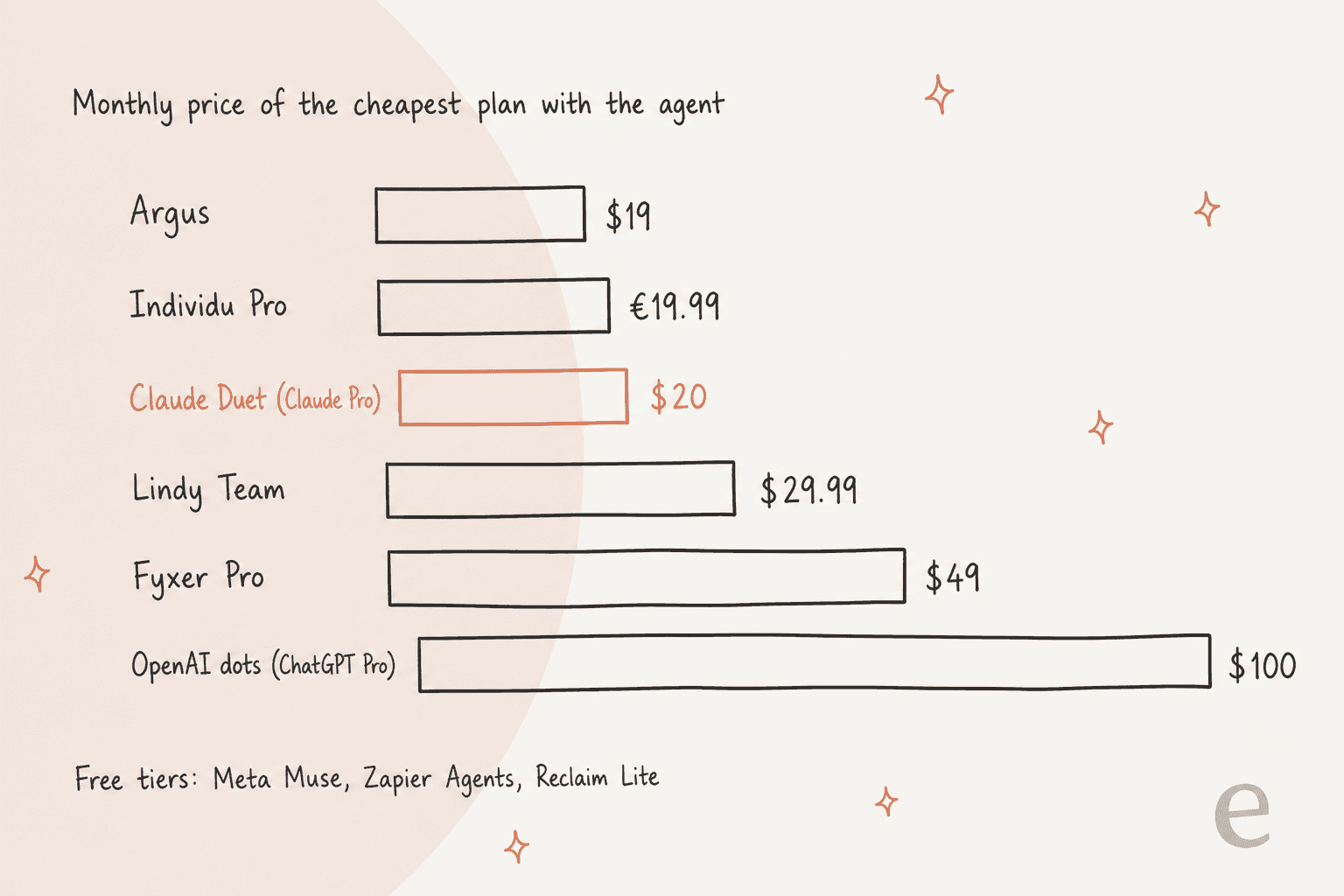
Three things that chart doesn't show:
- Duet's $20 is shared. Its checks draw on the same limits as your Claude chats, so heavy users drift toward Max at $100 or $200.
- Dots' $100 buys separate room. Your chats with a dot don't count toward ChatGPT limits.
- Credit meters bite at the edges. Lindy pauses when credits run out, Fyxer pauses sorting at the cap, and Zapier counts every action as an activity.
If you mostly want inbox help, an AI email assistant or one of the best AI apps for Gmail can cost less than any agent here.
What if the inbox is a support queue?
Then none of these is the right tool, Duet included. Personal agents are built for one owner: they check in every few hours, draft for you to approve, and live in your own inbox and calendar. A support queue is a different job.
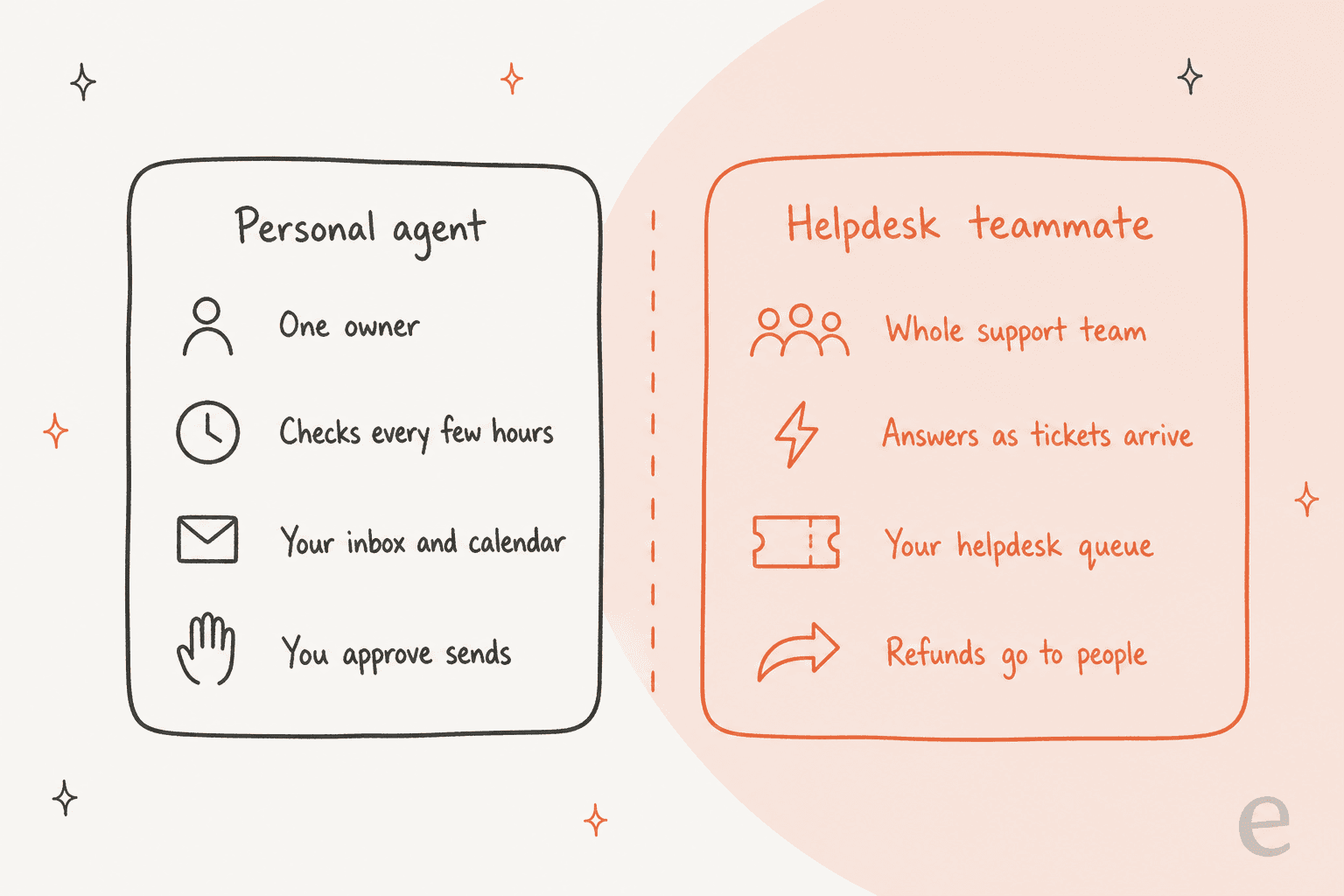
That's the gap eesel fills. eesel gives you ready-to-work AI teammates for specific jobs, and right now that's two: an AI helpdesk teammate and an AI blog writer. The helpdesk teammate joins your existing queue in Zendesk, Freshdesk or Gorgias, answers from your help center and past tickets, and hands anything sensitive to a person.
Two live examples:
- Adverscale runs a passport application help desk. The teammate handled about 2,400 Zendesk tickets in a month, sent about 1,600 replies to customers and left about 2,700 internal notes for the team.
- SE Ranking runs one agent per product across three products on Zendesk. About 4,650 conversations in a month, including about 2,100 live chats answered first by eesel. Refunds and requests for a person go to the team.
Neither of those would work as a personal agent that checks in every few hours. If you're comparing agents for work more broadly, my colleague's best AI teammates roundup is the next read.
Try eesel for your support queue
If you came here looking for an agent to watch an inbox, and that inbox belongs to your customers, eesel's helpdesk teammate is the one I'd try. It plugs into the helpdesk you already use, learns from your help center and past tickets, and you can run it against old tickets before it answers a real customer. Plans and credits are on the eesel pricing page.
Frequently Asked Questions
What is the best Claude Duet alternative?
For most people it's OpenAI dots: same always-on design, its own cloud computer, and chats with your dot don't count toward ChatGPT limits. The catch is price, since it needs ChatGPT Pro from $100 a month. On a budget, Argus at $19 a month is the closest small-company match among these Claude Duet alternatives.
Is there a free Claude Duet alternative?
Yes. Meta Muse is free for most of what people need, but it's US-only for now. Individu, Zapier Agents and Reclaim all have free tiers with tight caps, and Lindy gives $50 in credits for 7 days. My AI personal assistants roundup covers more free options.
Can I use a Claude Duet alternative outside the US?
Yes. Claude Duet and Meta Muse are US-only, and OpenAI dots excludes the EEA, Switzerland and the UK. Lindy, Argus, Fyxer, Zapier Agents and Reclaim don't list a region limit on their pricing pages, and Individu is a Dutch company. If you're in Europe, those are the Claude Duet alternatives to start with.
Which Claude Duet alternative works with Outlook and Microsoft 365?
Anthropic's help center says Microsoft 365 isn't available in Duet yet. Fyxer works in Gmail and Outlook and reaches Slack and Teams, Argus connects Outlook alongside Gmail, and OpenAI dots can be messaged in Teams. My AI for Outlook email guide goes deeper.
Is OpenAI dots better than Claude Duet?
It's broader today: dots reach Slack and Teams, and conversations with your dot sit outside your ChatGPT usage limits. Duet is far cheaper to get into at $20 a month on Claude Pro versus $100 for ChatGPT Pro. My Claude Duet review and the OpenAI dots review score them side by side.
Do Claude Duet alternatives use my chat limits?
It depends on the vendor's meter. Duet's background checks draw on your Claude plan's limits, as my Claude Duet pricing post explains. Dots conversations don't count toward ChatGPT limits, while Lindy, Fyxer, Individu and Zapier Agents run on their own credit or activity allowances.
Can a Claude Duet alternative run my support inbox?
Not well. These are personal agents built for one owner's email and calendar. A shared queue needs an AI helpdesk agent that works every ticket as it arrives, like eesel's helpdesk teammate in Zendesk, which handled about 2,400 tickets a month for Adverscale.