

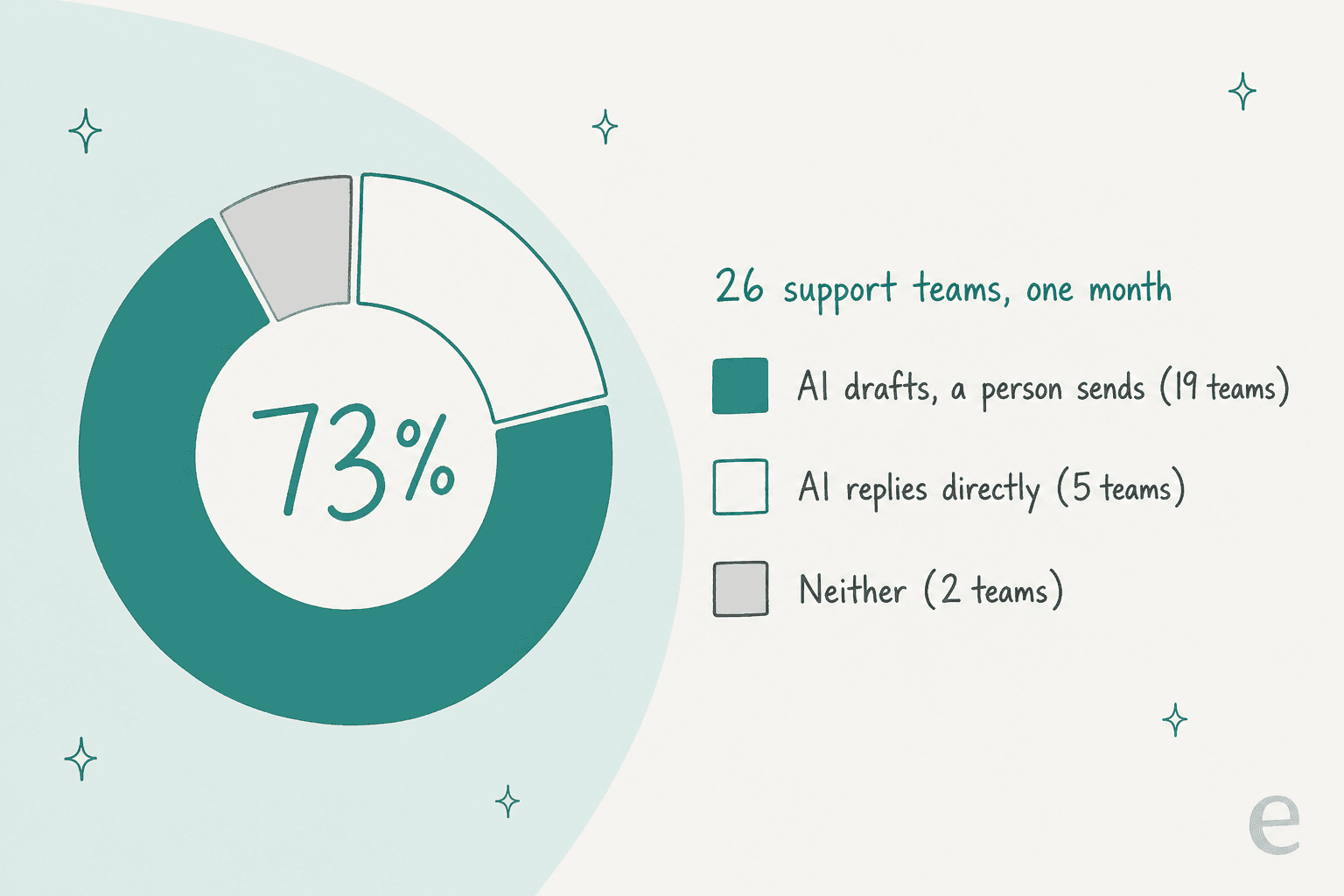
73% of the 26 support teams in eesel's sample used AI to draft more replies than it sent directly, while 19% sent more direct replies than drafts. That's from about 47,000 conversations between 8 August and 8 September 2026. These are selected case-study teams, not a representative sample of all eesel customers. Gartner found only 24% of service leaders have shown positive financial returns from AI, while 87% of customers want a way to reach a human. My recommendation for a support lead: test AI drafting inside your helpdesk, measure it, and then consider direct replies for ticket types it handles reliably.
Key takeaways
The one-line stats most worth quoting, eesel's own data first:
- 73% of teams in eesel's sample used AI to draft more replies than it sent directly (19 of 26 teams, eesel data, 2026).
- 19% of teams in eesel's sample used AI to send more direct replies than drafts (5 of 26 teams, eesel data, 2026).
- 81% of teams in eesel's sample used AI to leave internal notes (21 of 26 teams, eesel data, 2026).
- The median workspace in eesel's sample has about 1,500 knowledge items connected for AI support (26 teams, eesel data, 2026).
- Only 24% of service and support leaders have shown positive financial returns from AI (Gartner, 2026).
- 87% of customers say companies using GenAI for service must offer a way to reach a human (Gartner, 2026).
- Support agents with an AI assistant resolve 15% more issues per hour (Quarterly Journal of Economics, 2025).
- Only 20% of customer service leaders have cut agent staff because of AI (Gartner, 2025).
What eesel's own data shows
I've spent two years watching what people search for around AI support, and most stats pages answer it with the same borrowed numbers: a Gartner release here, a vendor survey there. Those are useful, and they're further down this page. But I started with the one dataset nobody else can publish: what eesel's AI actually did inside real helpdesks.
The sample is 26 eesel workspaces with a published case study and a usage file behind it. Together they ran about 47,000 conversations through eesel's AI helpdesk agent between 8 August and 8 September 2026. They use several helpdesks, plus website chat. The full method is in the methodology section below; the short version is that every number covers at least 5 workspaces and 1,000 conversations, and no customer is named.
How do support teams actually run AI on their helpdesk?
Most keep a person on the send button. In 19 of 26 teams (73%), the AI wrote more draft replies for the team than replies to customers. In 5 of 26 (19%), it sent more replies straight to customers than drafts. The rest used it for other jobs, like tagging and lookups.
This is a one-month snapshot of activity, not evidence of how teams began their rollout or why they chose their settings. eesel can reply directly, but drafting was more common in this sample. If you want the mechanics, the guides on AI copilots for customer service and agent assist cover the drafting setup.
Does it differ by helpdesk?
Yes, a little. Two helpdesks clear the sample threshold (5+ workspaces and 1,000+ conversations):
| Helpdesk | Workspaces | Conversations (one month) | AI mostly drafts for a person | AI mostly replies directly |
|---|---|---|---|---|
| Gorgias | 8 | 1,000+ | 75% (6 of 8) | 25% (2 of 8) |
| Zendesk | 9 | 1,000+ | 56% (5 of 9) | 33% (3 of 9) |
Drafting was more common among the Gorgias teams in this sample. These small groups do not establish that the helpdesk itself explains the difference.
Freshdesk and HubSpot fell under the threshold in this window, so I left them out rather than stretch the data. If you're comparing helpdesk-native options, my Zendesk AI, Gorgias AI and Freshdesk AI breakdowns go through each one.
What does the AI do besides replying?
A lot of the work never reaches the customer. Across the 26 teams:
- 96% (25 of 26) have the AI search the team's own knowledge before it answers.
- 81% (21 of 26) have it leave internal notes for the team: a summary, a draft, or what's missing.
- 38% (10 of 26) have it tag or categorise tickets.
- 23% (6 of 26) have it look up live order or product data before answering.
- 38% (10 of 26) run two or more AI agents with different jobs.
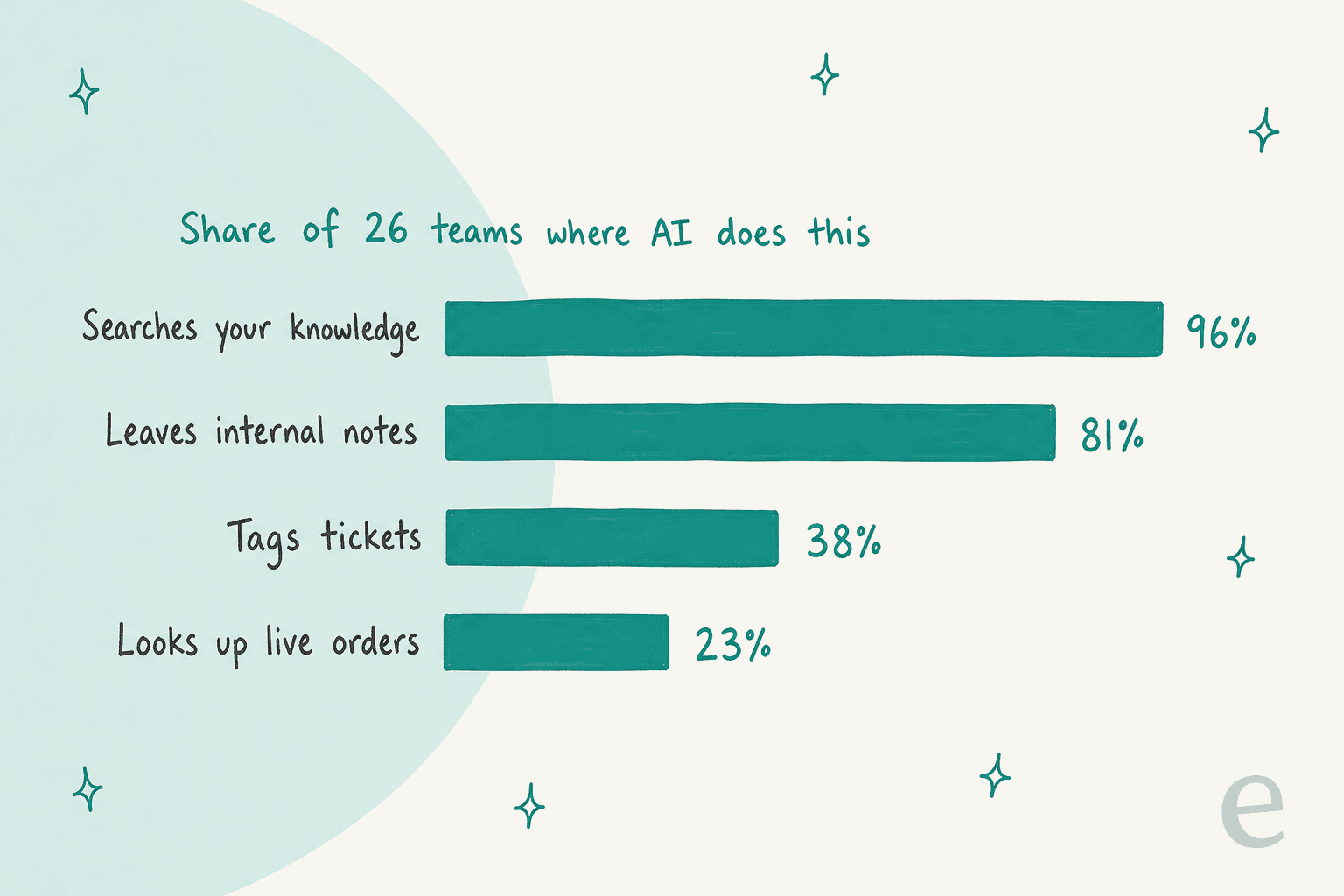
The internal-note number is the one I didn't expect. Four in five teams use the AI as a teammate who writes things down for the humans, not only as a reply machine. If that's the job you have in mind, AI ticket summarization and AI ticket classification are worth reading next.
How much knowledge does an AI support agent need?
The median workspace in the sample has about 1,500 knowledge items connected: help center articles, past tickets, web pages and uploaded files. 77% of teams (20 of 26) connect three or more types of source, not just a help center. This measures connected knowledge, not how many items the AI reads for each reply.
That fits Gartner's finding that 61% of service leaders have a backlog of knowledge articles to edit. Past tickets fill the gaps a help center leaves. eesel's guide to building an AI knowledge base covers what to connect first.
How many conversations does the AI handle?
The median team ran about 300 conversations a month through eesel. 27% of teams (7 of 26) ran 1,000 or more. Volume is very uneven, with a few large teams carrying most conversations, which is why every stat above counts teams, not tickets.
I left out language-specific statistics because the available data does not establish the required ticket volume for each language. More on the setup in multilingual customer support.
What this data can't tell you (yet)
This sample logs what the AI did, not whether the customer's problem was solved. So there's no eesel resolution rate on this page, and no AI vs human first reply time, handoff rate, or time-to-go-live figure. The available closure data does not meet the reporting thresholds. I'd rather leave those out than publish a number I can't back.
AI customer service adoption statistics
Adoption is close to universal at the leadership level, and much of it is driven by pressure from the top.
- 85% of customer service leaders planned to explore or pilot customer-facing conversational GenAI in 2025 (187 leaders, Gartner, Dec 2024).
- 77% of service and support leaders feel pressure from other executives to deploy AI, and 75% have bigger AI budgets than last year (265 leaders, Gartner, Oct 2025).
- 91% of customer service leaders are under pressure from executive leadership to implement AI in 2026 (321 leaders, Gartner, Feb 2026).
- 66% of customer service organizations use agentic AI, up from 39% in 2025 (3,075 service professionals, Salesforce, 2026).
- 30% of cases are handled by AI today, by service teams' own estimate (6,500 service professionals, Salesforce, 2025).
- 65% of CX leaders say their teams already use AI across CX operations (1,000+ CX leaders, HubSpot, 2024).
- 92% of organizations have implemented or piloted AI in customer service (600 decision-makers, Five9, 2026).
- Nearly 44% of support teams use AI across their operations, up from 32% a year earlier (Freshworks platform data, Freshworks, 2026).
- 86% of large organizations have implemented, piloted or are exploring gen AI in service, but only 49% feel prepared to offer AI-powered service (1,002 executives, Capgemini, 2025).
The gap worth noticing: 86% are trying it, 49% feel ready. This list of AI customer service implementation mistakes covers what usually sits in that gap.
Do customers trust AI customer service?
Not by default. Customers will use AI, but most want a person within reach, and one bad experience is hard to recover from.
- 64% of customers would prefer companies didn't use AI for customer service (5,728 customers, survey run Dec 2023, Gartner, Jul 2024).
- 53% of customers would consider switching to a competitor if they learned a company was going to use AI for service (same Gartner survey, 2024).
- 87% of customers say companies using GenAI for service must offer a way to reach a human, while 50% say GenAI makes interactions easier (3,566 customers, Gartner, Aug 2026).
- 49% of customers would have used a chatbot if offered, but only 7% used one in their most recent service interaction (3,566 customers, Gartner, Sep 2026).
- 3x: customers are about three times more likely to use outside GenAI tools than a company's own chatbot to fix a service issue, and company chatbot use hasn't changed since 2022 (Gartner, Jul 2026).
- 54% of customers trust human agents more than AI for product or service recommendations; 32% trust AI more (5,801 US customers, Gartner, Apr 2026).
- 19% of US adults think AI would provide customer service better than people; 47% think worse. Among AI experts, 42% say better (5,410 adults, Pew Research Center, 2025).
- 26% to 55%: trust in AI customer service more than doubles when a human option is visible (3,000 consumers, Five9, Oct 2026).
- 58% of consumers don't care whether a human or AI solves their issue, as long as it's quick and complete (4,000 consumers, Genesys, 2025).
- 30% of consumers, and 37% of Gen Z and millennials, would work with an AI agent instead of a person for faster service (15,015 consumers, Salesforce, 2024).
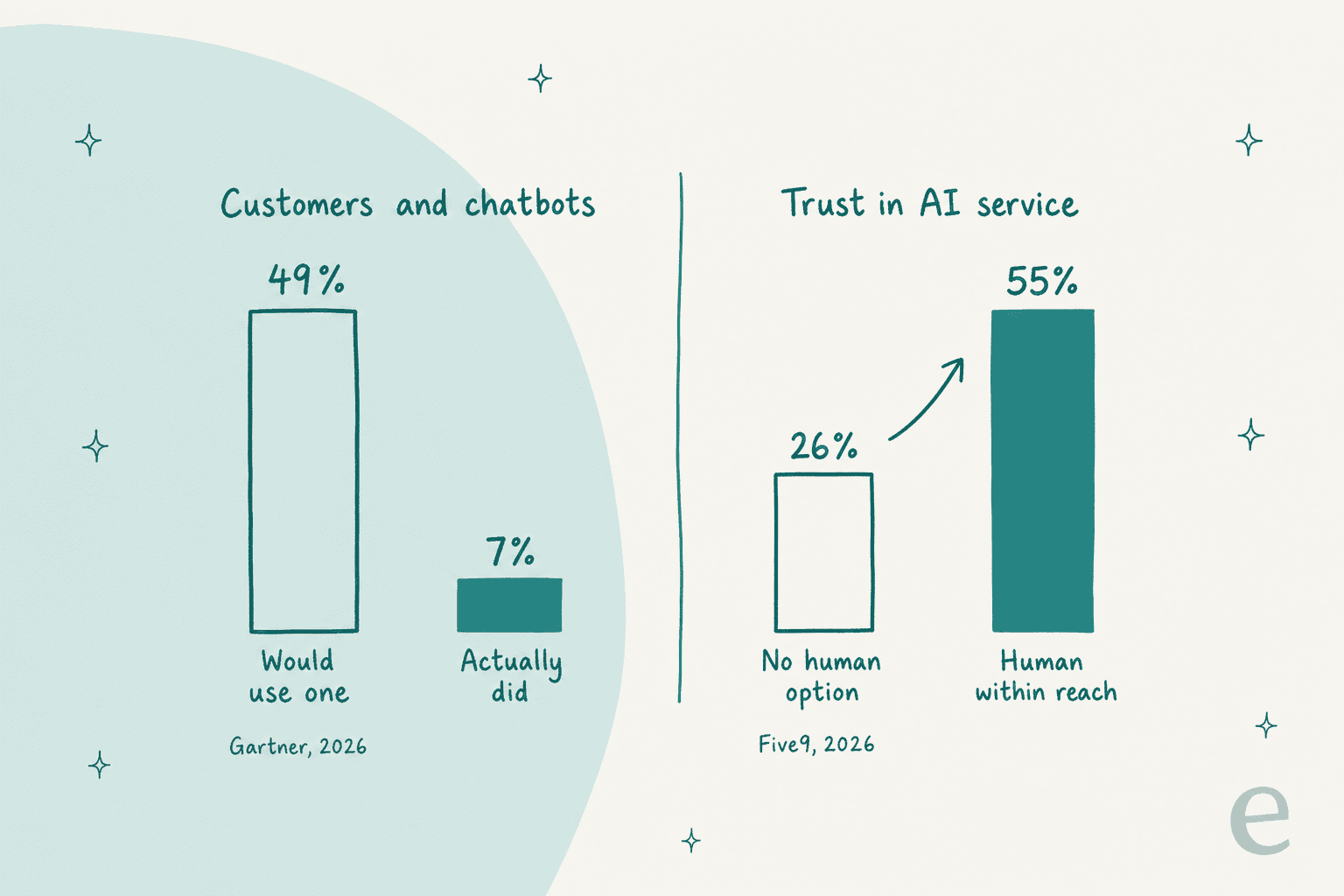
Put the Five9 and Genesys numbers side by side and the message for support leads is simple: customers care about getting the problem solved, and they relax when they can see the exit. A visible AI to human handoff does more for trust than any amount of tone tuning. For the old "chatbot or live chat" question, see AI chatbot vs live chat.
Does AI make support teams faster?
Yes, and the strongest evidence is independent, not vendor-made. The gains go mostly to newer agents and routine work.
- 15% more issues resolved per hour for support agents with a generative AI assistant, across 5,172 agents. Less experienced agents gained the most; the most experienced saw small speed gains and small quality drops (Quarterly Journal of Economics, 2025).
- 14% of customer service issues are fully resolved in self-service, and only 36% of issues customers call "very simple" get resolved there (5,728 customers, survey run Dec 2023, Gartner, Aug 2024).
- 20% less time on routine cases for service reps using AI, freeing about four hours a week (6,500 service professionals, Salesforce, 2025).
- 70% of service organizations with AI agents see measurable value within 60 days (3,075 professionals, Salesforce, 2026).
- 83% average deflection rate for AI agents on Freshworks' platform, with resolution times falling from over 9 minutes to under 5 (Freshworks' own platform data, 33,000+ accounts, Freshworks, 2026).
- 56% less time spent summarizing tickets by agents using AI copilots (Freshworks platform data, Freshworks, 2025).
- 55% of service leaders keep staffing flat while handling more customer volume with AI (321 leaders, Gartner, Dec 2025).
- 42% of AI-leading care organizations have reversed rising inbound volume through self-service and deflection, and 40% report much better CX scores, against 12% of laggards (McKinsey, 2026).
The QJE study is the one I'd cite in a business case. It's peer reviewed and measured real support agents. Its finding that newer agents gained most supports testing an assistant alongside your team, but does not explain the choices of teams in eesel's sample. For the metrics to track during a pilot, see AI customer service metrics.
What does AI in customer service cost, and does it pay off?
Spend is rising fast; proven returns are not keeping up.
- 24% of service and support leaders have shown positive financial returns across their AI use cases (1,303 leaders across functions, Gartner, Jul 2026).
- 12%: service and support leaders put a median 12% of their 2025 budget into AI, the highest of 10 business functions (same Gartner survey, 2026).
- 38% growth in AI spending by customer service leaders, while overall service budgets grew 2% (199 leaders, Gartner, Aug 2026).
- $3+: by 2030, GenAI cost per resolution will exceed $3, more than many B2C offshore human agents (Gartner prediction, Jan 2026).
- 20% average drop in service costs and case resolution times expected by companies with AI agents (6,500 professionals, Salesforce, 2025).
- 90% of "CX Trendsetter" companies report positive returns on AI tools for agents (about 10,500 respondents, Zendesk, 2024).
- 33% of CX-related spend planned for AI in the coming year by CX leaders (1,181 decision-makers, Genesys, 2025).
- 4 in 5 businesses spend less than 10% of their customer care budget on AI, and half are stuck in pilot mode (McKinsey, 2025).
Notice the spread: Zendesk's top performers say 90% see returns, Gartner's broad sample says 24%. Both can be true, because the gap is between teams that measure and teams that don't. Pricing models matter too. Per-resolution pricing, as on Zendesk AI and Gorgias, behaves differently from per-ticket pricing; my AI customer service cost guide works through both.
Is AI replacing customer service agents?
Slowly, and less than predicted. Most leaders are reshaping roles rather than cutting them.
- 20% of customer service leaders have reduced agent staffing because of AI (321 leaders, Gartner, Dec 2025).
- 42% of service organizations are hiring new AI roles such as conversational AI designers and automation analysts (same Gartner survey, 2025).
- 85% of service leaders are expanding human agent responsibilities; 31% have done or planned AI-driven layoffs through early 2027 (321 leaders, Gartner, Apr 2026).
- 63% of service leaders are shrinking frontline headcount through attrition rather than layoffs (same Gartner survey, 2026).
- 80%+ of organizations expect to reduce agent headcount in the next 18 months, mainly through attrition, hiring pauses or layoffs, and 84% are adding new skills to agent profiles (Gartner, Dec 2025).
- 58% of service leaders plan to upskill agents into knowledge management specialists who review AI content (Gartner, Feb 2026).
- 71% of service reps with AI say it creates growth opportunities, and 86% have built new skills (6,500 professionals, Salesforce, 2025).
The "knowledge management specialist" stat connects back to eesel's data: the median agent answers from about 1,500 items, and someone has to keep them current. The piece on AI agent coaching for support covers that job. For the per-ticket maths of AI versus people, see AI vs human agent cost.
AI customer service predictions for 2027 to 2030
Analyst predictions, so treat them as direction, not fact.
- 80% of common customer service issues will be resolved by agentic AI without human help by 2029, cutting operational costs 30% (Gartner, Mar 2025).
- 50% of organizations that planned big AI-driven service workforce cuts will abandon those plans by 2027 (Gartner, Jun 2025).
- 0% of the Fortune 500 will have fully eliminated human customer service by 2028 (Gartner, Sep 2025).
- 50% of companies that cut service staff because of AI will rehire for similar work under new job titles by 2027 (Gartner, Feb 2026).
- 40% of all customer service issues will be fully resolved by unofficial third-party GenAI tools by 2027 (Gartner, Dec 2024).
- 50% of service requests will be started by "machine customers", AI agents acting for buyers, by 2030 (Gartner, Mar 2025).
- 50% of cases will be handled by AI by 2027, up from 30% today, according to service teams (6,500 professionals, Salesforce, 2025).
- 75% of CX leaders expect 80% of customer interactions to be resolved without a human in the next few years (Zendesk, 2024).
- 49% of current customer service jobs will disappear because of AI by 2030 (Forrester, 2026).
The predictions disagree with each other, which is itself useful. Gartner's 80% autonomy forecast sits next to its own forecast that half of workforce-cut plans get abandoned. My reading: AI will take most routine tickets, and the human team gets smaller and more skilled, not gone.
Where does AI customer service go wrong?
The failure stats are the ones to bring to your rollout plan.
- 27% of customers would try a chatbot again after a bad experience (3,566 customers, Gartner, Sep 2026).
- Nearly 1 in 5 consumers who used AI for customer service got no benefit, a failure rate almost 4x higher than AI use in general (20,000+ consumers, Qualtrics XM Institute, 2025).
- 53% of consumers say misuse of personal data is their top worry when companies automate with AI, and half fear losing access to a human (same Qualtrics study, 2025).
- 37% of consumers believe AI makes things up, and 59% of CX leaders call hallucinations a serious risk (4,000 consumers, 1,600 leaders, Genesys, 2025).
- 92% of consumers give AI less than 10 minutes before asking for a human, and 46% quit AI because it kept misunderstanding them (3,000 consumers, Five9, Oct 2026).
- 83% of consumers still have to repeat themselves at least sometimes after an AI-to-human handoff (Five9, Jun 2026).
- 1 in 3 companies will harm customer experience with frustrating AI self-service in 2026 (Forrester, 2025).
- 30% rise in human-assisted service volume by 2028, driven by "right to talk to a human" rules (Gartner, Jan 2026).
- 61% of service leaders have a backlog of knowledge articles to edit, and over a third have no process for revising outdated ones (187 leaders, Gartner, Dec 2024).
The 83% "repeat yourself" stat is a reason to preserve context during handoffs. In eesel's sample, 81% of teams used AI to leave internal notes; that is a share of teams, not a share of tickets or a measured handoff success rate. For the rest, read AI chatbot problems and how to prevent AI hallucinations in support.
What do these AI customer service statistics mean for a support lead?
Three things I'd take into a planning meeting:
- Test drafts before expanding to direct replies. 73% of teams in eesel's sample mostly drafted, but the data does not show their rollout sequence. The QJE study shows gains for newer agents, and Gartner says only 24% of leaders can show returns yet. My recommendation is to measure your own pilot before expanding it.
- Make the human exit obvious. Trust goes from 26% to 55% when a person is within reach (Five9), and 87% of customers expect it (Gartner). A handoff that carries context is worth more than a smarter bot.
- Budget for knowledge, not just software. The median workspace in eesel's sample has about 1,500 knowledge items connected, and 61% of leaders have an article backlog. Whoever keeps that knowledge current is now part of your AI team.
If you're still choosing a tool, my roundups of AI customer service software and AI customer service solutions compare the main options by helpdesk.
Methodology
eesel data. The eesel statistics come from the usage files behind eesel's published customer stories, on 2026-10-29. Of 31 published stories, 26 have a usage file; the other 5 are excluded. All 26 files cover the same window, 8 August to 8 September 2026, for a total of about 47,000 conversations.
- What counts as a conversation: one ticket, chat or browser-extension draft the AI agent ran on. It is not a resolution, and this page reports no resolution rate.
- "Mostly drafts" vs "mostly replies directly": for each workspace, I compared the number of draft replies left for the team with the number of replies sent to customers. This counts replies, not tickets, and it reflects each team's own settings.
- Thresholds: every reported number covers at least 5 workspaces and at least 1,000 conversations. Helpdesk slices below that, including Freshdesk and HubSpot, were dropped.
- Counting teams, not tickets: a few large workspaces carry most of the volume, so shares are shares of workspaces, not of ticket volume.
- Excluded: draft (unpublished) stories, eesel's own workspace, and test, seed and demo workspaces. No customer, workspace, domain or person is named; numbers are rounded to whole percents.
- Known bias: these are teams that agreed to a public story, so they are likely more engaged than the average eesel customer.
Third-party data. Every third-party stat was checked word for word on the publisher's own page (press release, report, PDF or journal abstract) on 2026-10-29. Only stats published from 2024 to 2026 are included. Three Gartner stats (64%, 53% and 14%) were published in July and August 2024 from a survey run in December 2023, and are marked. Vendor surveys are labelled with the vendor's name; Freshworks figures come from its own platform data.
Can I cite these statistics?
Feel free to cite these stats with a link to this page. For a third-party number, please also credit the original publisher; each one links to its source above. If you're a journalist or researcher and want a cut of eesel's data that isn't here, the methodology above shows exactly what the dataset can and can't support.
Try eesel on your own helpdesk
If these numbers match where your team is, eesel's AI helpdesk teammate is built for exactly this path. It joins your existing Zendesk, Freshdesk, Gorgias or Help Scout queue, learns from your past tickets and help center, and starts by drafting replies and internal notes for your team. You can test it against your own past tickets before it talks to a single customer, then let it reply directly on the ticket types it gets right.
It connects to 1,000+ apps, and pricing is per ticket handled, so you're not paying more each time it hands a ticket to a person. Try eesel free, no card needed.