Why edtech support breaks differently
Every support team thinks their queue is special. Edtech teams have a real case. Three things make the job different from a retail inbox or a generic SaaS support desk.
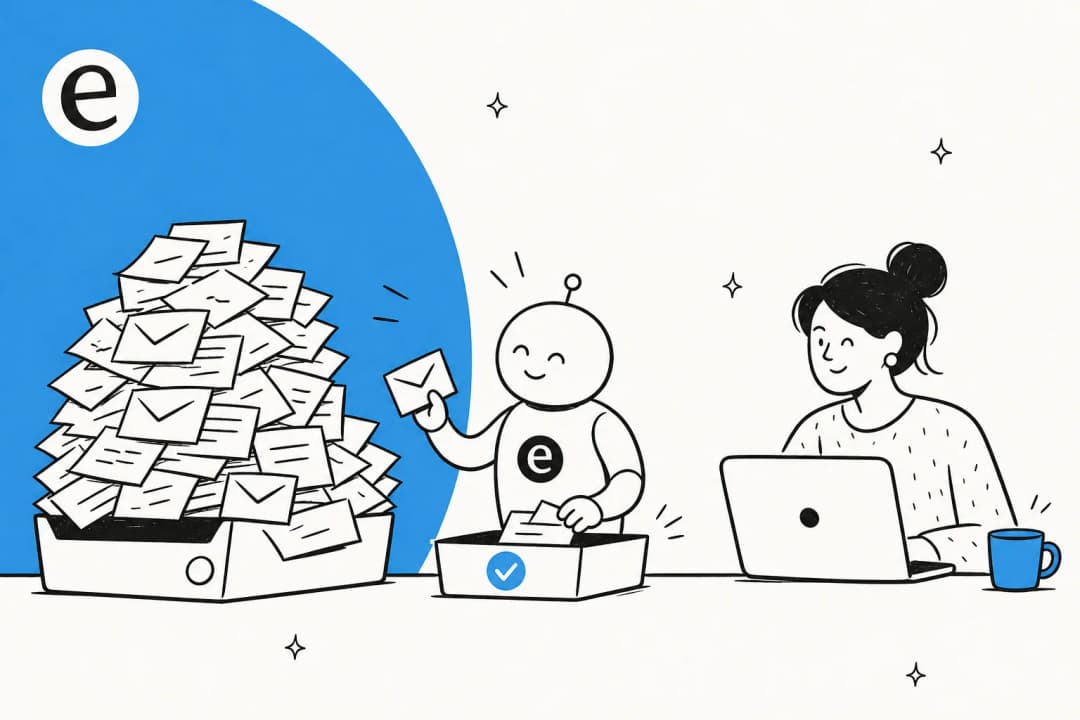
First, the volume isn't linear, it follows the academic calendar with brutal precision. September brings the back-to-school flood, January brings spring enrollment, and April through May brings finals and certificate season. Khan Academy saw a 1,200% increase in parent contacts in a single month when COVID closed schools. Unlike a retail holiday peak, this spike is non-negotiable: if a student can't get into their course on day one, they miss actual content and fall behind.
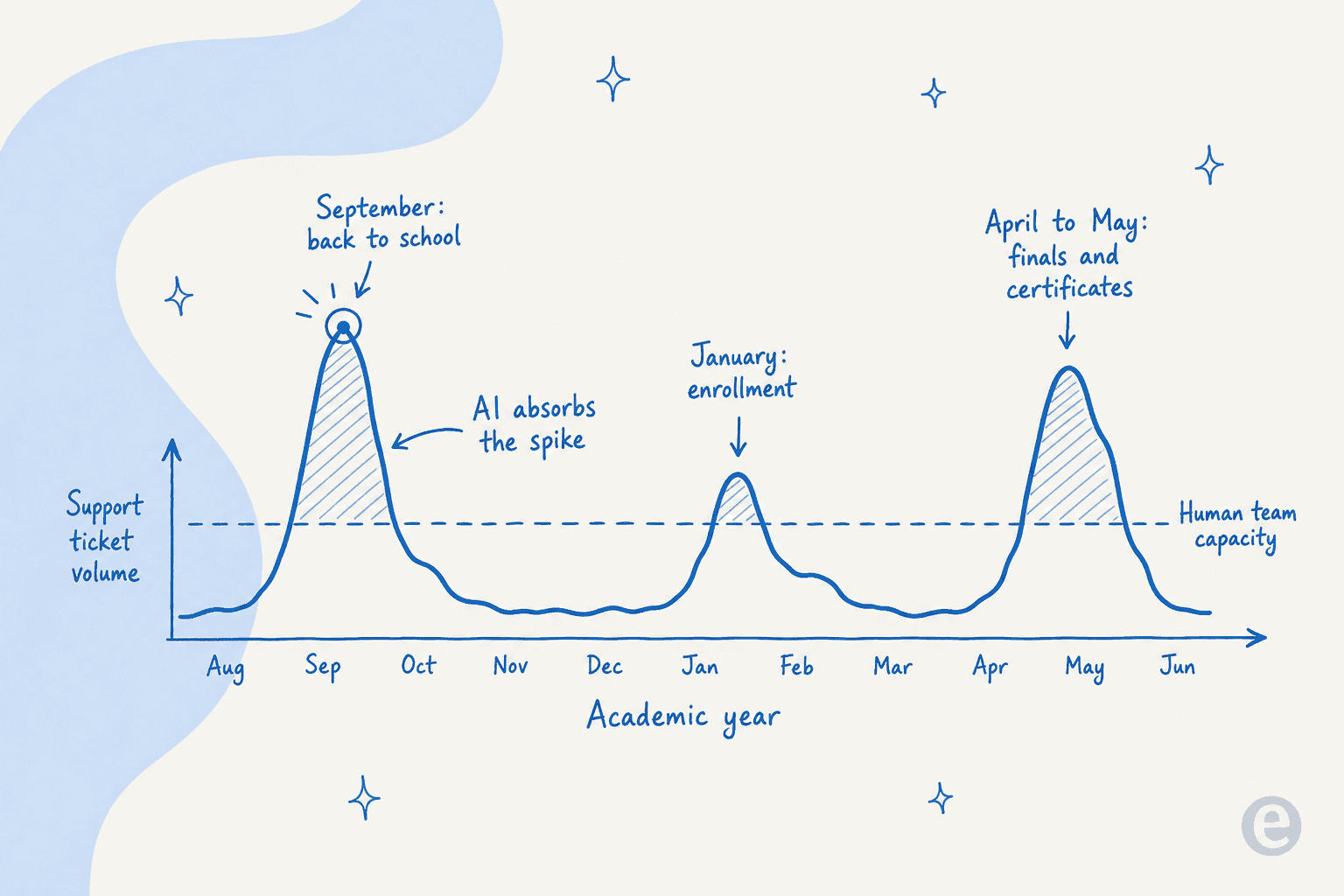
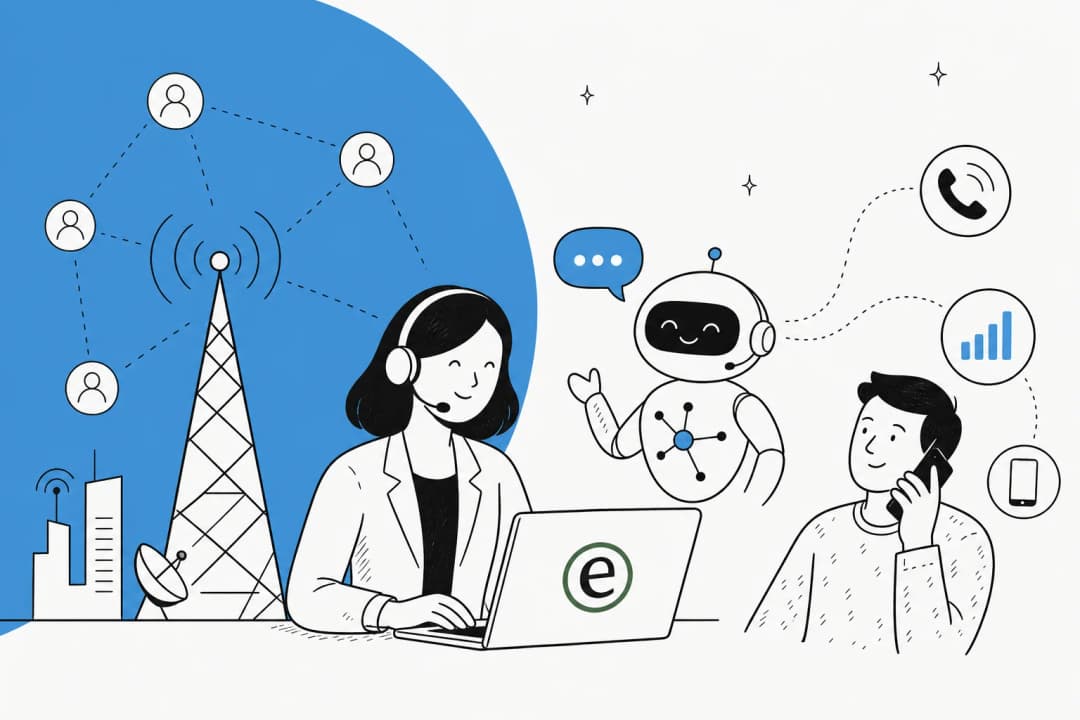
Second, the demand is 24/7 but the teams usually aren't. Students study at 11 PM, submit assignments at midnight, and discover a login problem at 6 AM before an exam. Most edtech orgs, especially smaller platforms and institutions, staff support during business hours. For a learner in a different timezone, an always-on AI agent isn't a luxury, it's the entire support experience.
Third, it's emotionally loaded in a way retail rarely is. A frustrated shopper abandons a cart. A frustrated student panics about a grade, a scholarship, or a graduation date, and a frustrated teacher feels professionally exposed. The cost of a wrong answer is higher here, which is why I'm allergic to any tool that's tuned to resolve everything at all costs. That instinct is the whole reason edtech teams reach for AI customer service in the first place: the volume curve and the headcount curve diverge the moment a platform grows, and you can't hire your way through a one-week spike.
The many people one edtech team has to answer
Here's the wrinkle that trips up generic chatbots. A single edtech platform doesn't serve one kind of customer, it serves five or six, and they barely speak the same language. A student wants to know why their login is broken. An instructor wants to set a different deadline for one student without breaking it for everyone. An administrator wants a compliance report. An IT admin is debugging SSO. A parent can't see their kid's progress dashboard.
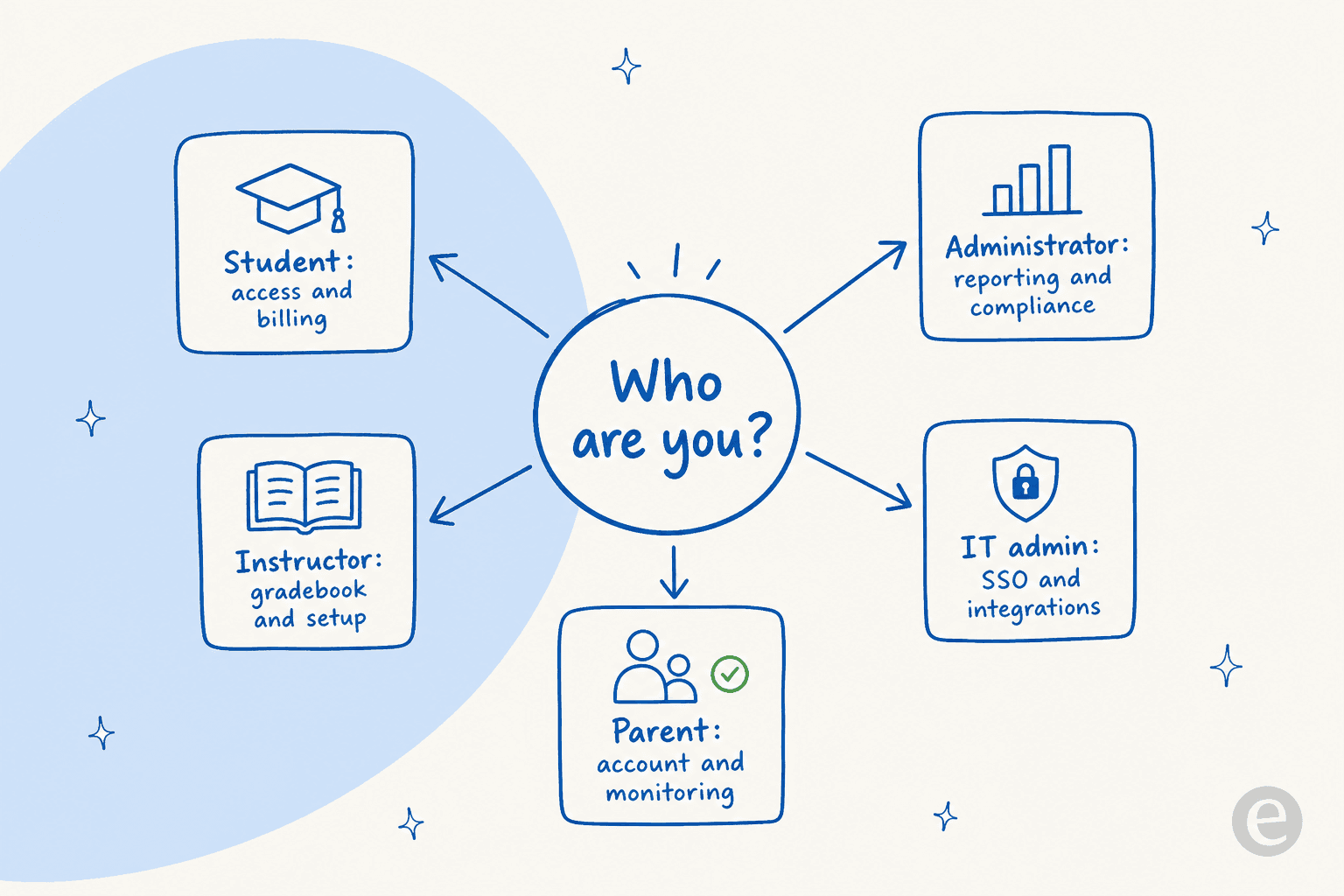
A chatbot trained only on student FAQs will fall over the first time an instructor asks about SCORM packaging. The fix is role-based routing at intake: ask who you're talking to, then answer from the slice of knowledge that fits them. This is also where the knowledge source matters more than any feature checkbox. The best agents learn from your solved tickets, not just your help-center articles, because a help center tells the AI what you wrote down, while past tickets tell it how your team actually answers an anxious first-year student versus a department admin.
Yellowdig, a social-learning platform used across higher ed, runs this setup on Zendesk with eesel handling the agent, a support copilot, and a customer-facing chatbot. Jon Miron, their Director of Support and Operations, framed the core pressure better than I could:
"As a fast-growing startup with a small team, our customers far outnumber our employees. It's crucial that we have robust self-service solutions as well as tools to supercharge the efficiency of our client-facing teams."
Jon Miron, Director of Support & Operations, Yellowdig
What good AI support actually does here
The phrase "AI customer service" covers everything from a canned-response macro to a fully autonomous agent, so let me be specific about the three jobs that matter for edtech.
- Deflection and resolution. The agent answers the student directly for questions it's confident about, end to end, so the ticket never reaches a human. Password resets, enrollment status, and "where's my certificate" are the textbook cases. This is where the ticket deflection numbers come from.
- Copilot drafts. For everything else, the AI writes a suggested reply your human agent reviews and sends. It's the safest place to start, and where most teams I work with begin. Our support copilot walkthrough covers the pattern.
- Triage and routing. Before anyone opens a ticket, the AI tags it, sets priority, and routes it to the right queue. Quiet, unglamorous, and a huge time saver. If you've never looked at support ticket triage, it's the easiest first win.
The reason I keep hammering "done right" is that edtech is full of cautionary tales of it done wrong. The canonical one is Udemy's "Alex" chatbot, which students describe as a loop with no exit:
"It took over 30 minutes using Alex the very unhelpful chat to submit a ticket... It did not provide an actionable step once I stated the gift recipient didn't receive or couldn't find the gift notification email. It tells you to contact support, which is how I got to the chatbot."

And the cost of automation built around friction instead of resolution isn't just bad reviews. The FTC settled with Chegg for $7.5 million in September 2025 over cancellation practices tied to automated systems that students said made it impossible to cancel or even verify their own account. AI designed around resolution, not deflection-at-any-cost, is the entire difference between those two outcomes.
How the AI decides what to answer
This is the part the marketing pages skip, and the part I care about most as the person who'd be cleaning up the mess.
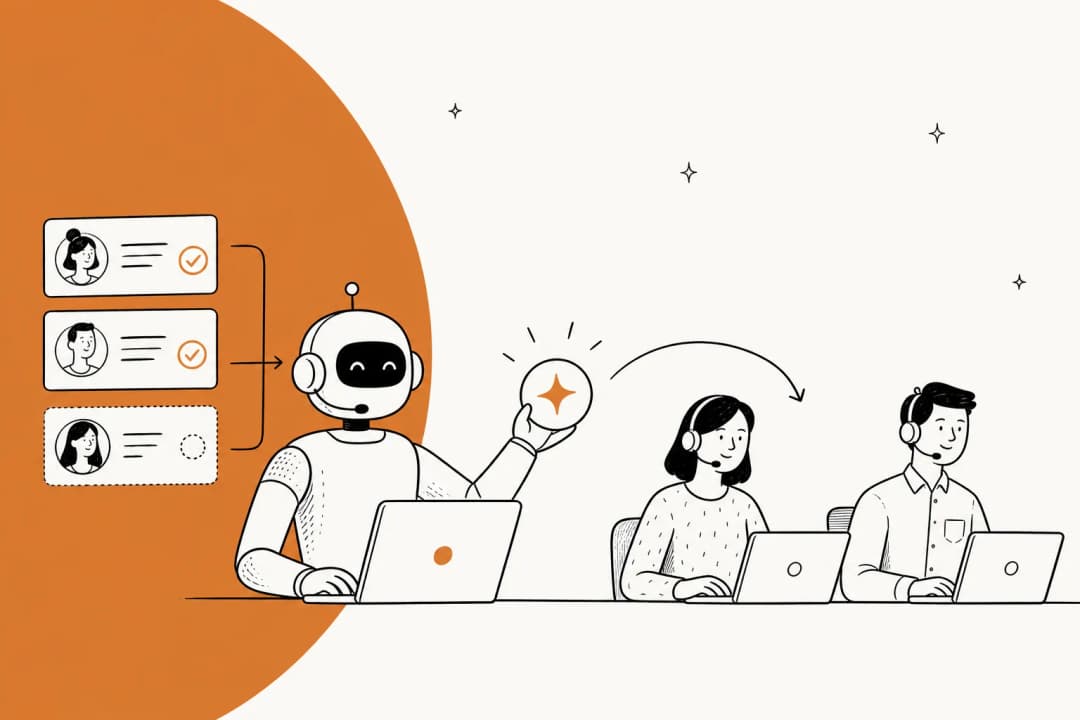
A decent support agent doesn't just generate text. It runs a loop: read the incoming ticket, search everything it knows (past tickets, help docs, connected tools), then make a routing decision based on how confident it is. High confidence and the topic is in scope, it answers. Low confidence, it backs off, drafts a reply for a human, or escalates cleanly. This is confidence-based routing, and it's the one feature I'd refuse to buy without.
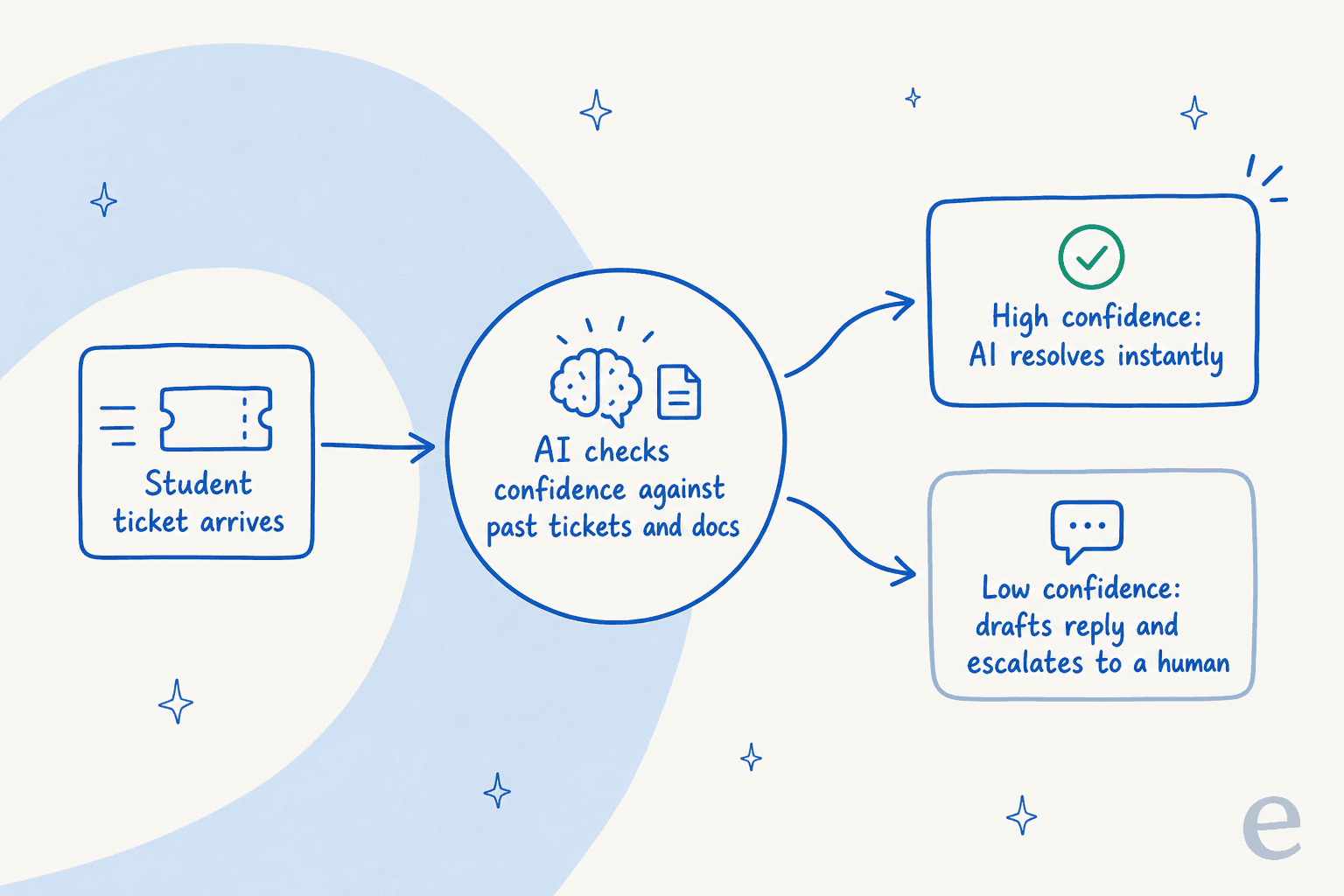
A CX lead I spoke to who ran a few thousand tickets a month put the logic perfectly. Edtech or not, every overloaded team I've met says some version of this:
"The AI will never be able to answer 100% of the questions, but if it tries and just answers 'sorry I don't know this,' I cannot go and check all my 7,000 tickets to see if the AI actually made a good answer... I need an AI who is only handling the tickets that it's confident to handle and all the other ones, leave them alone."
a CX lead at a high-volume support team, from an eesel sales call
That's the whole game. An agent that answers everything is worse than useless when one wrong answer can cost a student a deadline. The way you de-risk it before launch is simulation: run the agent against your last few thousand real tickets and read what it would have said, by topic, before a single student sees it. You find the gaps, fill them, and re-run. eesel built that in because "trust us, it's accurate" was the only assurance most tools offered, and that's not good enough when the stakes are a grade.
The proof: what good edtech support looks like
I'm wary of resolution-rate claims because they're easy to inflate, so here are real ones with their context attached.
The best edtech support story I know is Khan Academy. During COVID school closures their traffic grew 2.5x overnight and they held 92% CSAT, per Zendesk's case study, partly through automation and partly through a community where users answer each other at a 38-to-1 ratio of views to tickets. Their Head of Community Support, Laurie LeDuc, described the approach:
"We use ticket forms as the sole gateway to support, which really enables us to power through triage and automate a lot of flows."
Laurie LeDuc, Khan Academy, via Zendesk
On the eesel side, Gridwise is the number I quote most: 73% of tier-1 requests resolved in the first month, with results landing during a 7-day trial. The pattern repeats across eesel customers, InDebted runs eesel as the first responder on Jira tickets, and Smava processes 100,000+ German-language tickets a month on a fully automated Zendesk setup. Different products, same shape: automate the documented majority, keep humans on the rest, and let the reporting tell you where the gaps are.
It's worth saying what AI is not good at here too, because educators are right to push back on overreach. When Instructure demoed Canvas AI features at InstructureCon, professors praised the admin-automation parts and sharply criticized the AI-grading parts. One r/Professors attendee called the engagement-grading demo "pure fluff and hype." That line is the right one: AI for the administrative drudgery, humans for the judgment calls. Support automation lives firmly on the first side of it.
What to check before you buy
If you only verify five things, verify these. They separate a tool that survives a real edtech queue from one that gets switched off in week three.
| What to check | Why it matters for edtech | Red flag |
|---|---|---|
| Confidence-based routing | One wrong answer can cost a student a deadline; the AI must skip what it isn't sure of | "It answers everything" |
| Trains on past tickets | Docs alone miss how your team handles an anxious student vs. an admin | Help-center-only ingestion |
| Simulation before launch | See what it'd say on real tickets before students do | "Just turn it on" |
| FERPA-safe data handling | Authenticate before record access, scope by role, no training on student PII | Vague answers on data use |
| Multilingual out of the box | Learners are global; English-only support causes abandonment | One-language widget |
| Pricing that tracks usage | Volume spikes every term; per-seat punishes a small team | Per-resolution surprise bills |
Two of those rows are edtech-specific and worth dwelling on. FERPA is non-negotiable in US higher ed: any AI touching grades, enrollment, or aid records has to authenticate the student first, keep access role-scoped, and run on a vendor agreement that prohibits training on student data. Ask about it early, because it's a common deal-killer late. And multilingual support isn't a nice-to-have when your learners span dozens of countries, a single team can serve all of them only if the AI answers in the student's language automatically.
The other thing I'd insist on: the AI should layer onto the helpdesk you already run, not force a migration. eesel connects to 100+ integrations including Zendesk, Freshdesk, Jira Service Management, and Salesforce Service Cloud, so you keep your stack and bolt the agent on. eesel does integrate with those helpdesks, so weigh my take on them with that in mind.
What it costs
Pricing is where edtech teams get burned, because the billing unit does a lot of quiet work. Per-seat pricing punishes you for the team you need in September but not in October. Per-resolution pricing can produce a scary bill in a high-volume exam month. eesel runs on flat, usage-based pricing, which maps cleanly to how academic-calendar volume actually behaves.
| Plan | Price | What you get |
|---|---|---|
| Free trial | $50 in free usage + 2 blog generations, no card | Try it on real tickets |
| Usage-based (PAYG) | From $0.40 per ticket/conversation | No per-seat fee, no platform fee, no minimum |
| Annual commit | 25% off (commit ≥$300/mo for the year) | Same features, lower rate |
| Enterprise | $1,000/mo platform fee + usage | SSO, HIPAA/BAA, data residency, higher KB limits |
The thing I'd flag: a light task like a dashboard lookup is free, a regular ticket or chat is $0.40, and you're never charged for tickets your human agents handle. So your support bill scales with support work, not with how many seasonal staff you onboard. The full breakdown is on the pricing page, and the cost savings guide shows worked examples. If you're just testing the water, the free options are a fair place to start, and the build-versus-buy maths tends to favor buy once you price in an engineer's time and the FERPA work.
Try eesel for edtech support
eesel is an AI helpdesk agent built for exactly this shape of problem: it learns from your past tickets and docs, runs in simulation against your real history before going live, and uses confidence-based routing so it only answers what it's sure about and cleanly hands the rest to a human. It speaks 80+ languages for your global learners, sits on top of the helpdesk you already use, and bills by usage rather than per seat, so a one-week enrollment spike doesn't blow up your plan. It's the same setup running behind Yellowdig's student support today. If you want to see what it'd say on your own tickets, the 7-day trial runs against your real history.
Frequently Asked Questions
What is AI customer service for edtech?
How much does AI customer service for an edtech platform cost?
Can AI handle the back-to-school support spike?
Is AI student support FERPA compliant?
Can AI support students in multiple languages?
Will an AI chatbot just loop students without resolving anything?
Should we build our own edtech support AI or buy one?


Article by
Riellvriany Indriawan
Riell is a designer and writer at eesel AI with about two years of experience researching CX platforms, AI chatbots, and helpdesk software. She combines her design background with a sharp eye for how these tools actually look and feel in practice — making her comparisons unusually visual and user-focused.