
Sendbird AI review scorecard
Here's the whole review in one card. I scored Sendbird AI on the five things I actually care about when judging whether an AI agent will survive a live queue. Tap any row to see the reasoning.
▶Omnichannel & integrations4.6
▶Testing & safety before launch4.0
▶Enterprise & compliance4.5
▶Pricing transparency1.7
▶Speed to value for smaller teams2.8
What is Sendbird AI, briefly
Sendbird started as the communications infrastructure company: the chat, calls, and messaging APIs that power conversations inside other companies' apps. In 2026 it repositioned the whole company as "the AI customer experience platform," putting an AI concierge story out front and the messaging stack underneath. I won't re-tread the full overview here, our what is Sendbird AI piece does that, but the one thing to internalize for a review is that this isn't a helpdesk that bolted on a bot. It's a messaging platform that scaled to billions of conversations and then built an AI agent on top of that pipe.
That heritage shapes the whole product. The AI Agent is pitched beyond conversational AI: rather than the rule-based chatbot approach of rigid scripts, Sendbird says its agents "understand intent, hold context, take action, and adapt over time." That's the standard agentic framing now, and it puts Sendbird in the same conversation as the other top customer service AI platforms.

One thing that trips people up: the AI Agent has been rebranded to delight.ai. Visit sendbird.com/ai-agent and you get a 301 redirect straight there. It's the same company and product lineage, joined by a few newer pieces, Omnipresence, Trust OS, and the Agent Memory Platform. When you read "Sendbird AI agent" and "delight.ai" in the wild, treat them as the same thing.
How it actually performs
This is the part I weigh most heavily in any review, because it's where marketing meets the day-to-day of running the thing. Sendbird structures the work into a loop: build the agent, test it in simulation, deploy across channels, then evaluate and refine. I'll go through each, with my honest read.
Build: it works like onboarding a teammate
You "onboard your AI agent like a new team member," transferring knowledge and defining workflows through a supervisor dashboard. In the builder you add knowledge sources (a website, a file, a snippet) and write the agent's reasoning as manuals it can reference, pulling external content from connectors like Salesforce, Confluence, and Zendesk.
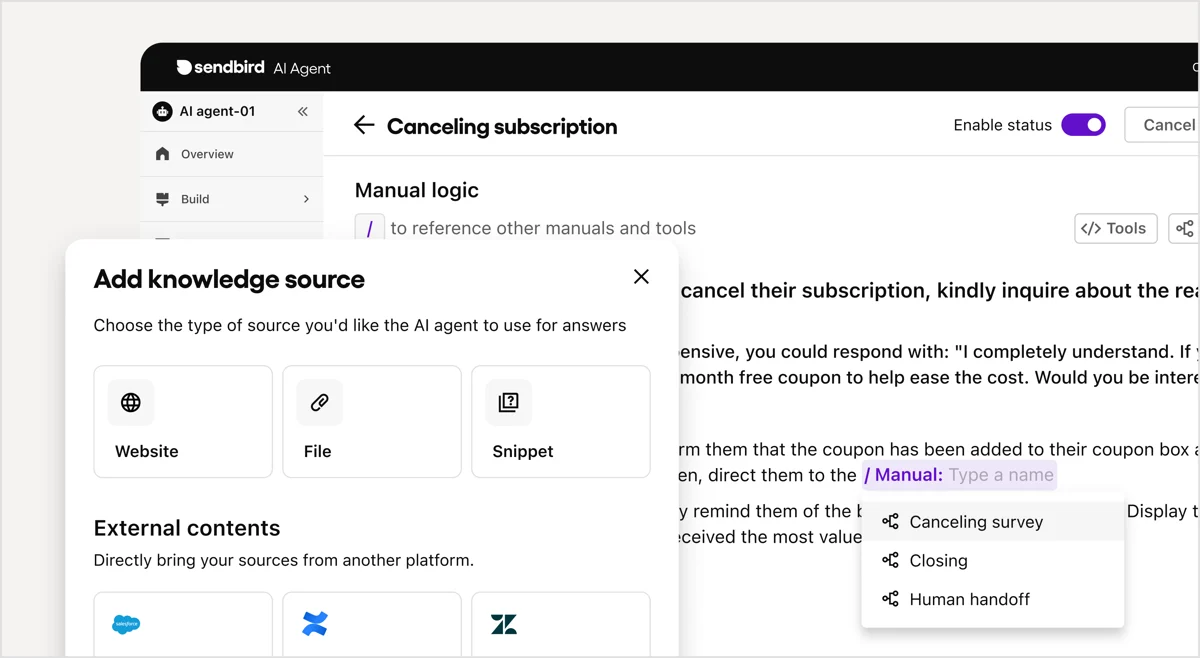
The model of writing manuals the agent references is sound, and it's the same idea behind training AI on your knowledge base. Most of the best AI knowledge base tools work this way. How fast it feels depends on how much of your knowledge already lives in connected tools versus how much you author by hand.
Test: the feature I most want every vendor to have
Sendbird's simulation step is the part I'd happily give it credit for. You run the agent against a set of questions and it scores each answer, marking the response accurate or inaccurate and the run success or fail, so you can see where the agent is confidently wrong before a real customer does.
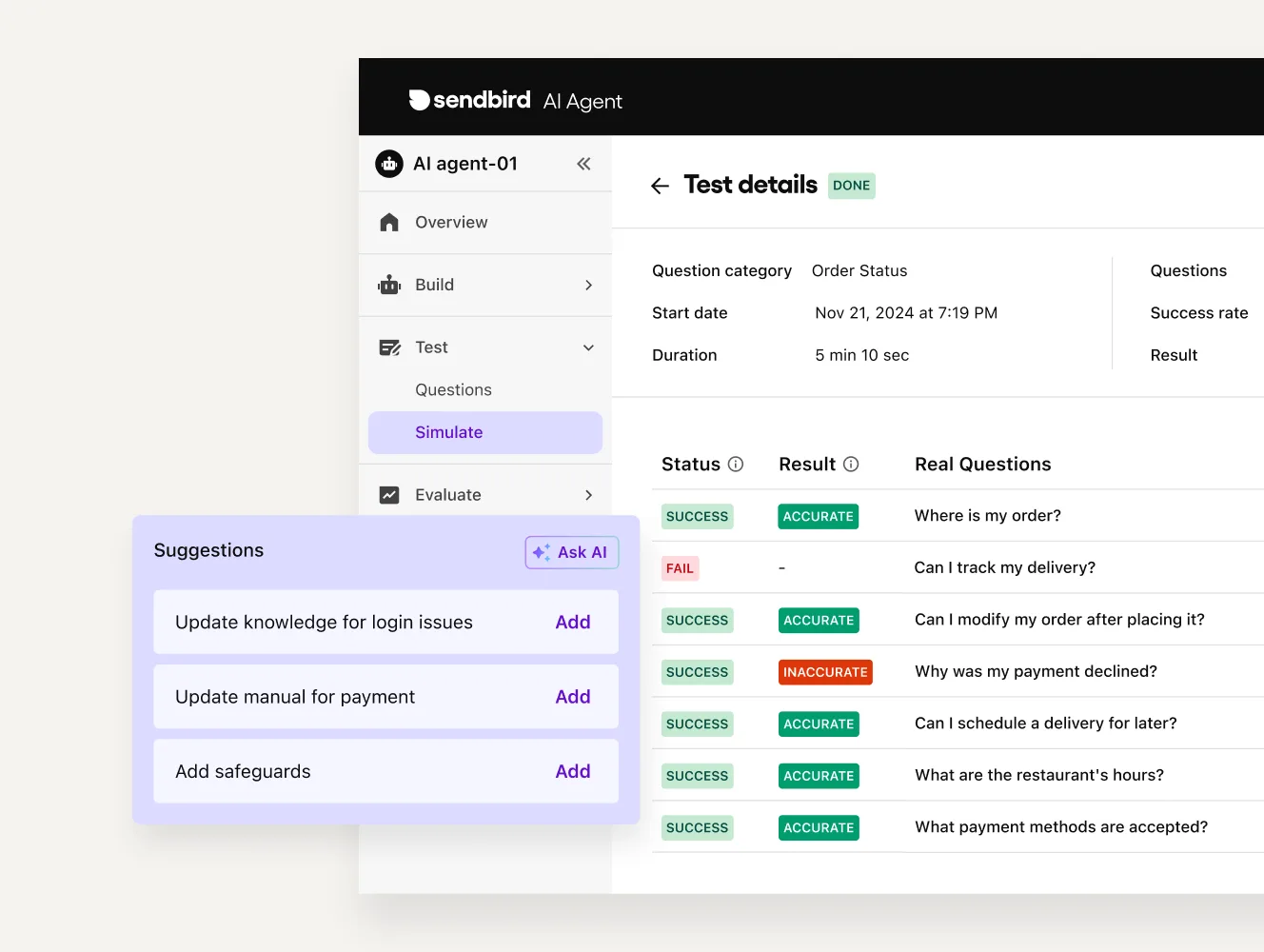
Here's where my frontline experience makes me push on it. Simulating against a list of sample questions is good; simulating against your real, historical tickets is far better. We learned this the hard way at eesel: a confident-sounding bot can sail through a tidy test set and then fall apart on the messy, half-finished, multi-language tickets a live queue actually contains. That gap between "passes the demo" and "survives the queue" is exactly why we test rollouts against thousands of past conversations first. It's also the number I'd make Sendbird's sales team show you with your data, not theirs. The deeper version of this argument is in our piece on AI resolution rates and the idea of a confidence threshold.
Evaluate: the right metrics, no published numbers
Once live, the agent reports into a conversations dashboard with resolution rate, resolution time, CSAT, and human-handoff metrics, plus a breakdown of AI-resolved versus AI-unresolved volume.
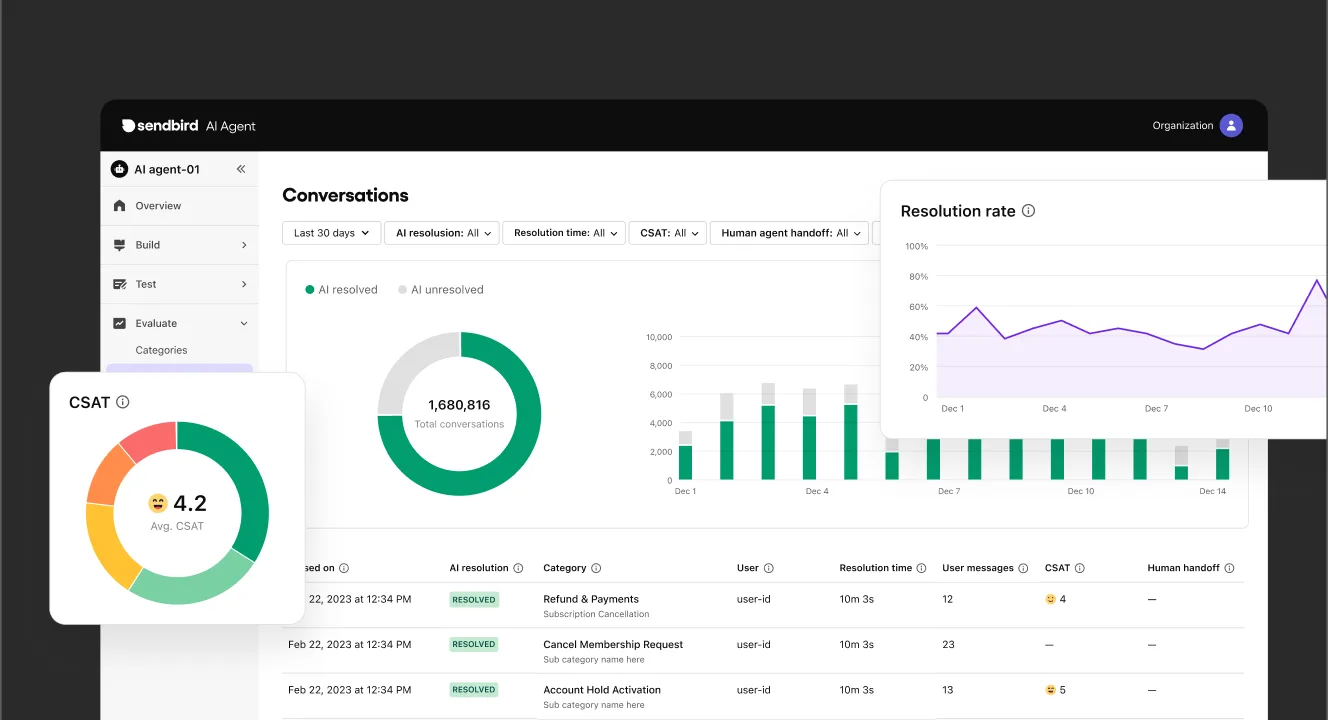
This is a clean analytics surface and the metrics are the right ones. One honest note: Sendbird talks about "record resolution rates" qualitatively and publishes no specific deflection or resolution percentage, so read those numbers off your own dashboard, not the marketing page. For how those metrics translate into money, our AI agent cost breakdown is the one I'd hand a finance team.
The strengths: where Sendbird AI earns its reputation
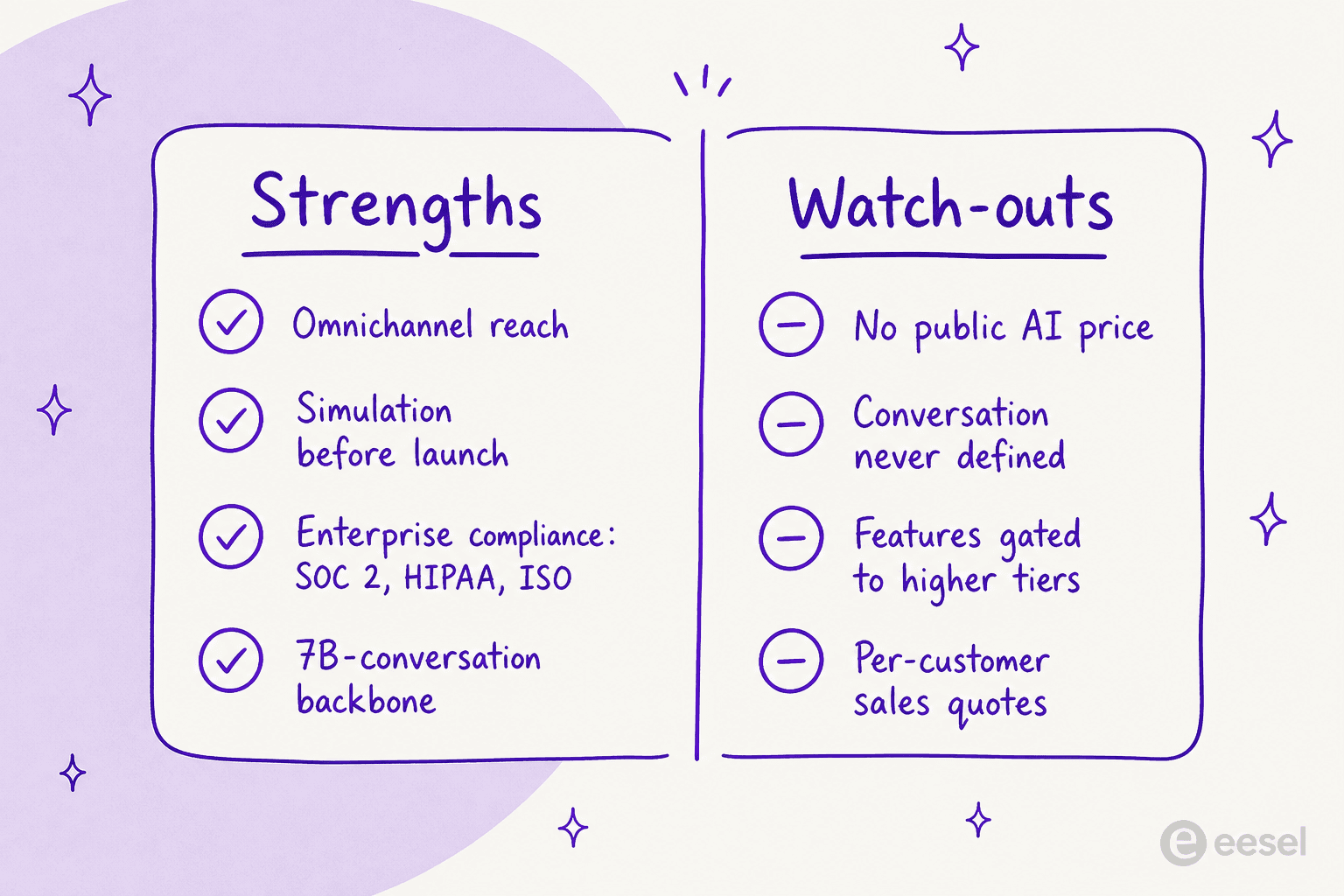
Omnichannel is the real win, and it's where the communications heritage pays off. The agent meets customers across in-app chat, web, email, SMS, WhatsApp, and social messaging, and because every interaction shares the same memory layer, customers don't repeat themselves when they switch channels. For escalations, the agent hands off to a human inside Zendesk, Salesforce, and Freshworks, and a clean transfer to human is worth testing in your own stack before you trust it in production.
On compliance, Sendbird claims SOC 2 Type II, HIPAA/HITECH, ISO 27001, and GDPR, with PII protection and region-specific storage, the table-stakes set for selling into enterprise. If data handling is top of mind, our AI agent data privacy guide is a useful checklist. Add the genuine scale underneath (Sendbird's own diagram lists 6 billion+ end users and 145,000+ developers) and you have a product that holds up at volumes most tools never see.
The weaknesses: the price you can't see
Now the part that drags the score down. The single biggest issue with Sendbird AI is that you cannot find out what it costs without a sales call. The AI Agent has no public rate, no tier card, and no volume schedule. Both sendbird.com/pricing and delight.ai/pricing return a 404. The only button is "contact sales."
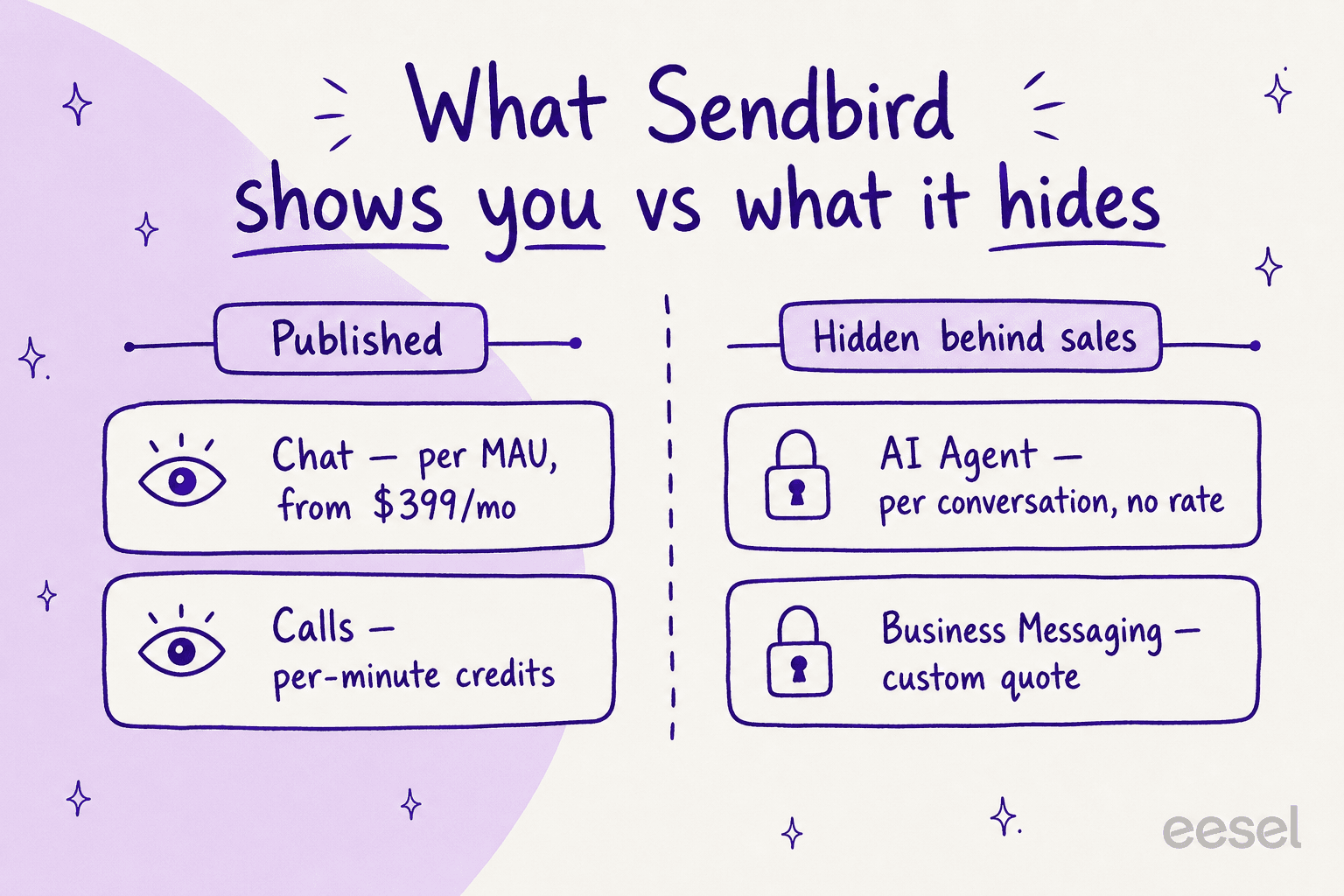
It gets thornier. Sendbird says it charges per conversation and makes a thoughtful argument against per-resolution pricing, but it never defines a "conversation" operationally: no session window, no message threshold, no rule for how a re-opened thread counts. When you can't see the rate and can't define the unit, you simply cannot model your own bill. The one Sendbird product with public list prices is the legacy Chat SDK (per Monthly Active User, from $399/month at 5,000 MAU), but that's a different product, so don't read the Chat price as the AI price.
The full breakdown lives in our Sendbird AI pricing post. And it's worth saying sales-quoted AI pricing isn't unique to Sendbird, our HubSpot AI agent pricing and Gorgias AI agent pricing breakdowns show the same pattern.
What real users say
A review is only as good as the voices behind it, so I pulled the verifiable ones. Sendbird scores a strong 4.6/5 across 124 reviews on G2, with praise for ease of integration and reliable performance. The negative themes cluster almost entirely around one thing: cost. The tags "Expensive," "Cost," and "Cost Limitations" appear 34 times combined, more than any other complaint, and G2's own summary notes pricing "can be high, especially for startups."
The most useful gripe is specific and verifiable, it's about feature gating:
"Sendbird is an enterprise solution and the pricing reflects this. Features are bundled into different packages, so you may need to upgrade your subscription to get a particular feature. Advanced analytics, for example, is only available in the Pro package and above. This means that cost depends not only on usage but also on desired feature set."

The sharpest reviews are about billing rather than the product. On Capterra (4.2/5), where Value for Money is the lowest sub-score, one startup describes a refund fight:
"Absolutely terrible. We ended up cancelling our subscription, and asked for a partial refund for the unused portion of the costs. They refused... We are a B2C startup and every dollar counts."

To be fair, there's a strong counter-theme. Long-tenure enterprise customers defend the value, with one G2 reviewer noting their "pricing stays the same for 8 years" and crediting the CS team with finding savings during a budget crunch. The pattern is consistent: Sendbird earns its keep at enterprise scale, and the friction concentrates at the small-team end. That tracks with the wider companies that use AI chatbots picture, where big deployments and scrappy ones want very different things.
Who Sendbird AI is actually for
Pulling it together, the fit is clearer than the score alone suggests.
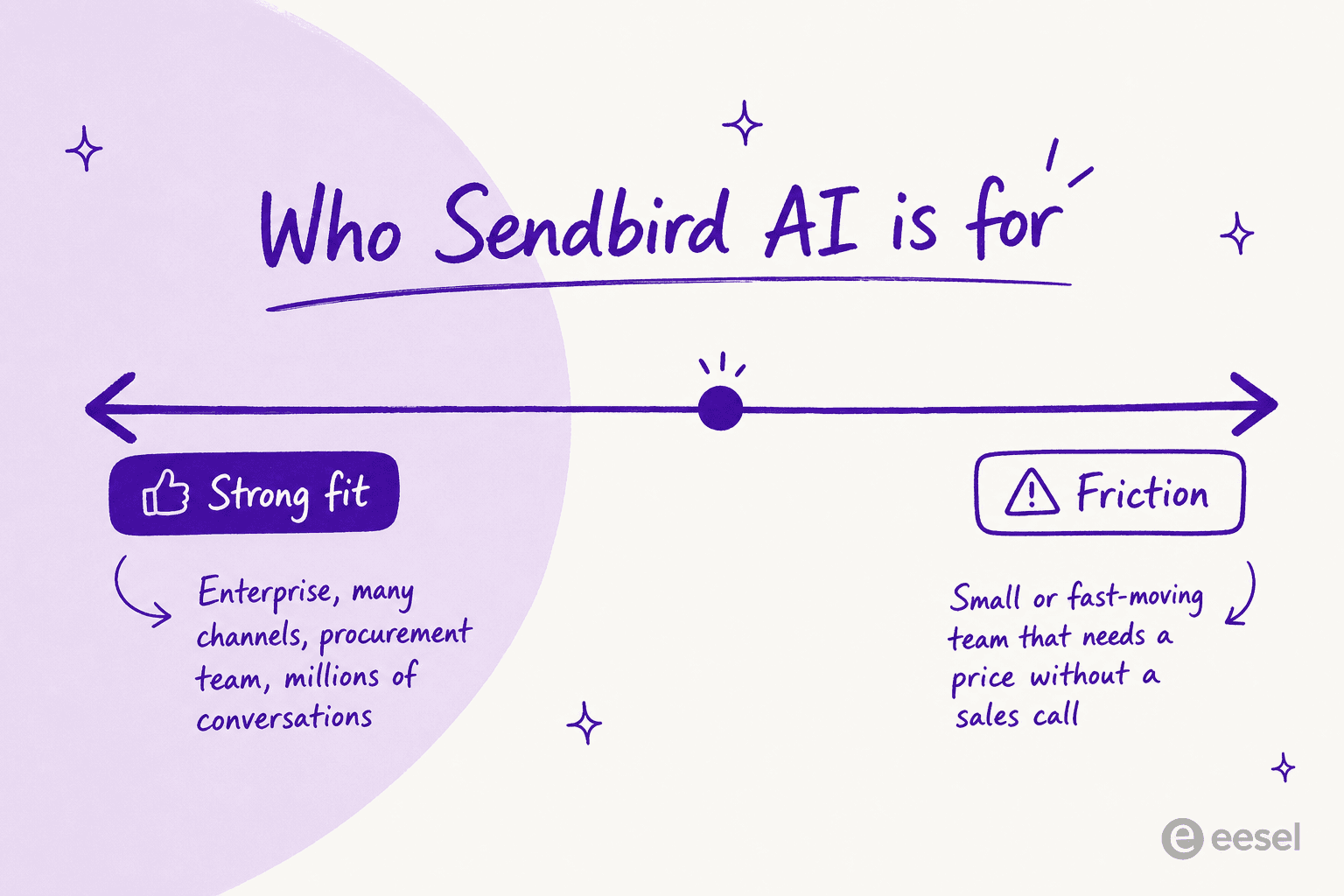
- Strong fit: an enterprise running millions of conversations across many channels, with a procurement team and time for a sales cycle. The omnichannel reach, compliance, and stability are real advantages at your scale, and the long-tenure reviews are mostly from teams like you.
- Friction: a small or fast-moving team that wants to read a price, plug into an existing helpdesk, and test against its own tickets before paying. Cost and a sales-led motion are the top complaints from exactly this end of the market.
If you're in the second group, you're not short on choices, our roundups of the best customer service AI, the best AI agent for customer service, and the best Sendbird AI alternatives are all built to help you choose.
Sendbird AI vs a self-serve alternative
Here's my honest take after all of this. Sendbird's per-conversation model is defensible and its omnichannel product is strong. The issue is everything that's missing for a smaller buyer: no public rate, no conversation definition, feature-gated tiers, and per-customer negotiation. For an enterprise that's annoying but survivable. For a small or mid-sized team, it's a wall, and that's the gap eesel was built for.
| What you care about | Sendbird AI | eesel |
|---|---|---|
| Public price for the AI agent | No (contact sales) | Yes, on the pricing page |
| Billable unit | Per conversation (undefined) | Per ticket, clearly defined |
| Charged for follow-ups in one unit | Unclear | No |
| Test before you commit | Simulation (sales-led, sample questions) | Self-serve simulation on your past tickets |
| Setup | Sales-led onboarding | Self-serve, Zendesk / Freshdesk / Gorgias / Help Scout in minutes |
| Best fit | Large enterprise, procurement-led | Teams that want to start today |
The reason transparent, per-ticket pricing matters isn't ideology, it's adoption. The teams I see stall on AI support almost always stall on the budget question, not the technology. When you can read the rate, model your spend, and try it against your own historical tickets before paying, the decision gets a lot easier.
Try eesel
If the friction points above sound familiar, here's where I'd point you. eesel is an AI support agent you can plug into Zendesk, Freshdesk, Salesforce, and your help center in a few minutes, train on your past tickets and docs, and actually try for free, with per-ticket pricing published on the page, no sales call to get a number.
The differentiator that matters most against Sendbird's simulation step: eesel runs your agent against thousands of your real historical tickets before it ever touches a live customer, so the resolution rate you see in the simulation is the one you can trust on day one. It's the same instinct behind that confident-but-wrong problem one ops lead at a DTC supplements brand (running ~7,000 tickets a month) put perfectly to us: "I need an AI who is only handling the tickets that it's confident to handle, and all the other ones, leave them alone." That confidence-based control is the whole point.

If you're weighing the field by helpdesk, our write-ups on the Zendesk AI agent and the Gorgias AI agent go integration by integration. You can try eesel and have an agent answering test tickets before lunch.
Frequently Asked Questions
Is Sendbird AI worth it in 2026?
What is Sendbird AI's rating on G2 and Capterra?
Is Sendbird AI the same as delight.ai?
sendbird.com/ai-agent redirects there. It's the same vendor and product line, now joined by Omnipresence, Trust OS, and an Agent Memory Platform. For the category background, see our explainer on AI agents versus rule-based chatbots.How much does Sendbird AI cost?
What do users complain about most in Sendbird AI reviews?
Does the Sendbird AI agent support WhatsApp and SMS?
How do you test a Sendbird AI agent before going live?
What's the best Sendbird AI alternative?


Article by
Riellvriany Indriawan
Riell is a designer and writer at eesel AI with about two years of experience researching CX platforms, AI chatbots, and helpdesk software. She combines her design background with a sharp eye for how these tools actually look and feel in practice — making her comparisons unusually visual and user-focused.