


I would start a HubSpot AI budget with two questions: what does the account already pay for, and what event creates an additional charge? A price per conversation is not enough if the product bills only certain outcomes or shares an allowance with other tools.
This guide separates those costs and shows how to inspect an alternative eesel support pilot through the CLI. Prices and product rules were checked on September 8, 2026. Your order form and billing account still determine your actual charges.
What HubSpot charges for
The official product catalog lists different units for different agents:
| Feature | Chargeable action | Credits |
|---|---|---|
| Customer Agent | Resolve a conversation on text-based channels | 50 |
| Data Agent | Answer one prompt for one record | 10 |
| Prospecting Agent | Recommend outreach for one lead | 100 |
| Content Agent, beta | Generate one piece of content | 1,000 |
These are not interchangeable workloads. Do not estimate Customer Agent usage by charging 50 credits for every incoming message.
Additional credits are listed at $0.01 each, with 1,000-credit capacity packs priced at $10.
The catalog lists Customer Agent access with Professional or Enterprise editions of Marketing, Sales, Service, Content, Data, Revenue Hub, or Smart CRM. Confirm the required seats and features for your deployment. A credit balance does not grant every agent or every channel.
For a purchase decision, request a written quote that separates subscription seats, additional usage, onboarding, and any partner implementation. An onboarding charge on one package is not evidence that every AI feature carries that same fee.
Check the allowance and its limits
HubSpot's credit management guide explains that included credits follow the highest applicable subscription allowance rather than adding across products. Unused credits expire monthly.
With only included credits, usage-based features pause when those credits run out. After buying extra capacity, the default is an automatic upgrade that lasts through the remaining commitment. Pay-as-you-go overages require purchased capacity and an explicit setting change.
Account and feature limits help control usage, but a feature limit does not reserve credits for that feature. Review both before a pilot. Check when a billing-setting change takes effect rather than assuming it applies immediately.
In Account & Billing, inspect the HubSpot Credits usage and feature breakdown. Keep a dated record of the settings alongside the quote.

Build a budget from your own workload
Treat the following as a planning worksheet, not a vendor quote:
| Budget line | What to enter |
|---|---|
| Existing subscription | Current committed spend, separately from any proposed upgrade |
| Added access | Seats or products needed specifically for the pilot |
| Usage | Chargeable units at the account's current rate |
| Services | Quoted onboarding, migration, or implementation |
| Human work | Review, corrections, escalations, and maintenance |
For example, 200 billable text resolutions at 50 credits use 10,000 credits. That is a usage calculation, not a $100 invoice. The additional purchase depends on the available allowance, other tools' consumption, capacity packs, and the rate in your account.
Use low, expected, and busy-month volumes. If a busy month changes the committed capacity for future months, include that effect rather than reporting only the first month's charge.
Keep the quality denominator separate too. Count the cases that actually met your support standard. A vendor billing unit and your team's accepted outcome may differ.
Compare eesel without mixing billing units
The eesel pricing documentation lists regular support tasks at $0.40 and heavy blog-writing tasks at $4. The default pay-as-you-go arrangement has no platform fee or monthly minimum. Annual commitments and Enterprise have different terms.
A support ticket is one task regardless of reply count; a chat session is one task regardless of message count. Tasks are billed regardless of outcome. This matters: comparing $0.40 per task with a price per resolved conversation does not prove a percentage saving.
As a hypothetical example, 100 regular tasks would cost $40 at that rate before other work or special terms. If your reviewers accept only 80 results, the usage cost per accepted result is $0.50. Human review and the existing HubSpot subscription remain additional costs.
eesel's spending cap pauses new work at the limit; work already in progress finishes. Its documentation gives a $250 default cap, with editing available after adding a card. Confirm your workspace's actual setting.
Inspect a HubSpot support budget through eesel CLI
The eesel CLI operates the same teammate and workspace as the dashboard. A person can use it in a terminal, a script can collect its JSON output, and Claude Code, Cursor, or Codex can help compare what the teammate did with the resulting usage.
For this pricing question, that means inspecting existing automations, recording a billing baseline, and reviewing the work behind a change in spend. The CLI does not read or change HubSpot's native credit settings in this workflow. Keep that account's billing evidence separately.
Establish a read-only baseline
With Node.js 18.17 or newer:
npx @eesel/cli login
npx @eesel/cli whoami
npx @eesel/cli agents
npx @eesel/cli integrations --agent PILOT_AGENT_ID
npx @eesel/cli status --agent PILOT_AGENT_ID
npx @eesel/cli automations --agent PILOT_AGENT_ID
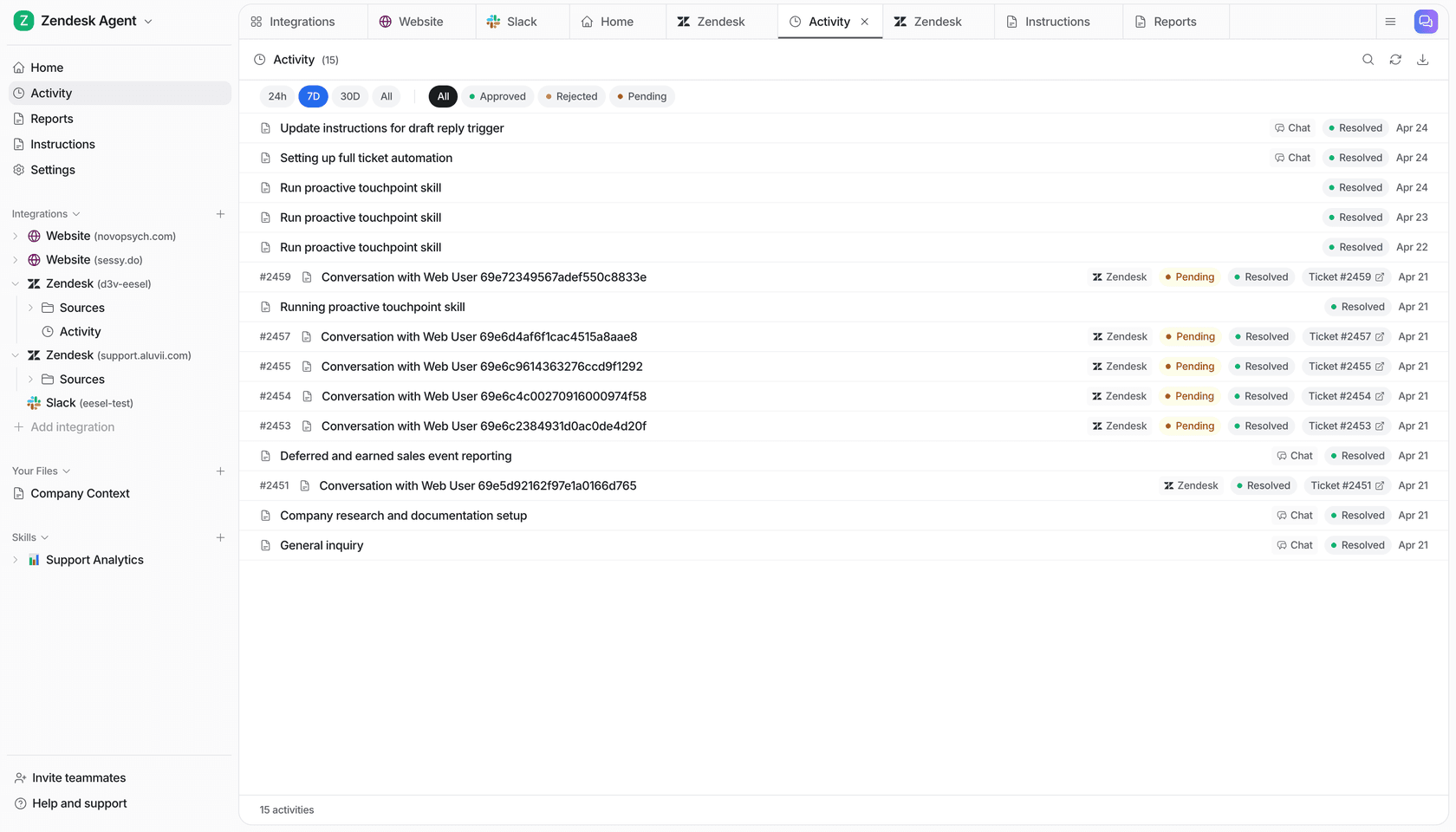
npx @eesel/cli activity --agent PILOT_AGENT_ID
npx @eesel/cli billing
Replace PILOT_AGENT_ID with the intended teammate. Selecting it does not isolate its permissions or reserve a separate budget. The billing command reads workspace billing state; do not assume its total belongs only to the selected teammate.
The inspection commands are free. CLI chats are billed work. That distinction lets you gather the baseline without starting a chat merely to ask what the bill says.
Record the time window, workspace, selected agent, enabled automations, and current billing state. Store exports securely because activity may contain customer information. Never put credentials into a report.
Give a coding agent a bounded review task
You can ask your coding agent:
Inspect this eesel teammate's status, automations, activity, and workspace billing using read-only CLI commands. Report which automations could explain the work in the selected period, and identify any gaps in attribution. Do not start chats, connect sources, change billing settings, create automations, or approve actions. Do not claim that a workspace total is the cost of this one agent.
The JSON output makes this practical for scripts and coding agents. It does not guarantee that every response contains per-ticket cost attribution. If the available fields cannot reconcile a charge, flag the gap and check Billing & Usage rather than inventing a split.
Test useful work, not just the smallest bill
Before running a fictional answer test, confirm that the intended policy is available and disable customer sending and other writes. These example commands do not change permissions.
npx @eesel/cli new --name "hubspot-billing-policy-pilot" --agent PILOT_AGENT_ID
npx @eesel/cli chat "Fictional support request: a customer says they were charged twice for the same subscription. Draft a response using the approved billing-support policy. Explain what evidence is needed and when a human must investigate. Do not inspect real records, issue a refund, change a subscription, create a ticket, post a comment, or send a message." --agent PILOT_AGENT_ID
npx @eesel/cli chat "The customer now says one charge may still be pending. Revise the draft without claiming that either charge has been verified or reversed." --agent PILOT_AGENT_ID
The follow-up continues the same conversation. Check whether the reply distinguishes a reported charge from verified payment evidence. A fluent answer that promises an unverified refund should not count as an accepted result.
This is a billed writing rehearsal, not a payment-system test or a live HubSpot delivery test. The CLI's --dry-run previews a server call; it does not measure answer quality or forecast production spend.
Review a narrow live pilot separately
For a connected HubSpot teammate, follow the integration setup guide and inspect existing permissions and automations before enabling any work. Connection itself imports permitted data, so authorization needs a privacy review even when writes are disabled.
Start with an approved test conversation and an on-demand inbox @eesel comment, narrowly filtered to the pilot. Keep customer sending off and require approval for the internal comment. Review the automation before creation because chat-created automations start enabled.
After a fresh triggering event, inspect activity and approvals, review the proposed comment, and approve only that action. Verify the private comment in HubSpot before counting it as delivered. A ticket-record note is not the same trigger as an inbox @eesel comment.
Then inspect workspace billing again over the same period. Other agents or jobs may also have run, so explain that overlap instead of assigning the whole difference to your pilot.
Decide what earns a wider rollout
| Pilot result | Budget implication |
|---|---|
| Useful draft with little editing | Include the measured review time |
| Wrong policy or unsupported promise | Count the correction work, not just the task charge |
| Held action never approved | Do not count it as delivered |
| Unexpected automation activity | Inspect scope before increasing the budget |
| Missing cost attribution | Keep the estimate provisional |
A small bill is not the goal if the team must redo the work. Compare total incremental spend and review effort for the same kind of accepted support outcome.
Try eesel to evaluate a HubSpot support teammate, then use eesel CLI to inspect its work and billing before widening the pilot.
Frequently asked questions
How many credits does HubSpot Customer Agent use?
Do included HubSpot Credits roll over?
Is onboarding a universal AI fee?
Is eesel still a flat $239 monthly plan?
Can eesel CLI show HubSpot's credit bill?



Article by
Rama Adi Nugraha
Rama is a software engineer at eesel AI with two years of experience writing about B2B SaaS, AI tools, and customer support technology. Based in Bali, Indonesia, he brings a developer's perspective to product comparisons — cutting through marketing copy to what the integrations and APIs actually do.